Landscape Photographer of the Year

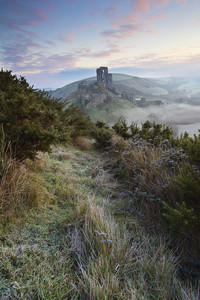
Corfe Castle - Anthony Spencer

It's that time of year again where hundreds of photographers around the UK end up dazed and confused and a small handful end up quite happy and one quite rich. Yes it's the Take a View competition - the UK's only dedicated landscape photography competition. I have been quite critical of the competition previously and have drawn the occasional ire of a few people but this year I'm going to try to be as positive as possible (however difficult it may or may not be).
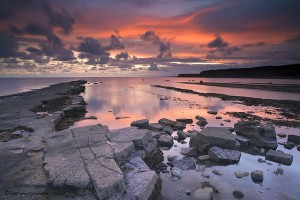
Kimmeridge - Anthony Spencer

Well firstly a big 'Well Done!' goes to Anthony Spencer , a very hard working landscape photographer from Dorset who has won the main prize (and a cool £10k) for his picture of Corfe Castle (the image featured at the top of this post). I'm sure Anthony will make very good use of the money and esteem that comes with the prize.
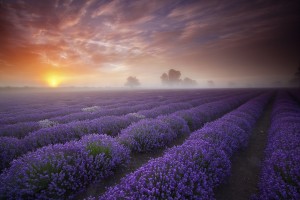
Lavendar - Anthony Spencer

Anthony creates a large range of different pictures and despite the winner being very good, I do much prefer his recent lavendar pictures, his wonderful shot of Kimmeridge and a great shot in Sgwd Ddwli.
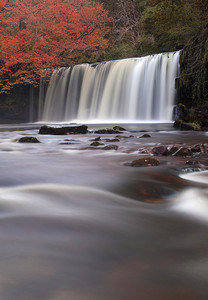
Sgwd Ddwli - Anthony Spencer

I've only seen the other images from the Sunday Times website (unfortunately protected by Murdoch's wallet) but from the 16 that are on their, I really like four of them, which is about on par with the amount I liked from last years. The other good news so far is no sign of any Crabgate (google it if you want to know) and the preponderance of HDR is reduced somewhat.
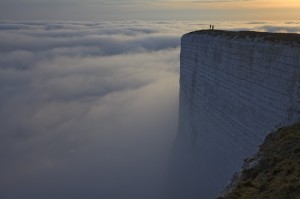
Beachy Head Haar - Rhys Davies

So what about the four shots that I like then? Well let's start with Rhys Davies who entered a stunning shot of Beachy Head under a Haar - for those like me who wondered where the word Haar came from, it's a Scottish word for a fog or sea mist, very onomatopoeic. Rhys is an Australian photographer who is settling in London and what better welcome than a place in a UK photographer book. If take a view is about being in the right place at the right time then this photograph is bang on the money. At first I couldn't work out whether it was in the UK, the slender tongue of cliff looks like something from Iceland or Norway. Well done Rhys! I spoke with Rhys on the phone today and he told me that he's a born and bred brit from Coventry and is back in the UK living in Kent. He went out to revisit this location and the day was bright blue skies which weren't looking great and he nearly left but as the afternoon rolled in the Haar appeared,
an their followed quite a few shots at different stages. The winner was one that really showed the colour and amazing height of the cliffs. Rhys is an old 'albmuen' plate photographer and is looking to take up large format again sometime.
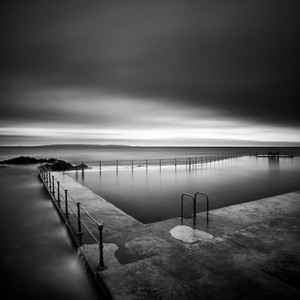
La Vollette, Guernsey - Mark Voce

The next two photographers are both black and white, one of whom is a fellow Yorkshireman. We'll start with Mark Voce, that Yorkshireman from the city of Brighouse. He's a platinum printer and winner of the Prix de la Photographie prize, who uses a combination of Hassleblad medium format cameras with black and white film and a Canon 5dmk2 (plus a Lubitel, Diana and a Zero Image pinhole). His winning photograph in the competition was a photograph of La Vallette bathing pool in Guernsey and although firmly in the Michael Kenna school, it is a beautiful image.
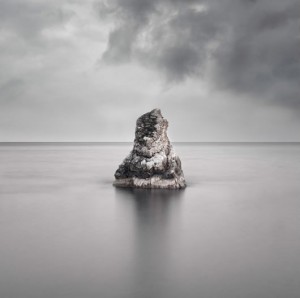
Mupe Rocks - Marcin Bera

The last picture I really like is from Marcin Bera (http://marcinbera.com/) who for me is the 'great find' of this years landscape photographer of the year competition. A photographer working in a unique style, obviously influenced by Kenna but drawing from all sorts of influences with concious or subconcious references to Gustav Le Gray (conjoining skies and sea) and Bernd and Hilda Becher (typologies) . The island photographs, of which the winner is one, are a wonderful typology of - not sure about the Samurai's though ;-)

There are another couple of shots I quite like - Jon Brook's shot of the heather burning in Bentham makes a great documentary landscape photo, Paul Sansome takes a good competent shot of La Corbiere lighthouse, Adam Burton (a Take a View regular) includes a shot of the Newlands valley (http://www.adamburtonphotography.com/gallery/view/valley-of-light/) that is well taken but not spectacular, sorry Adam you've taken, and entered better, Jim Parren's shot is an interesting find and great idea, but again I've seen a lot better from Jim too (after chatting, Jim admits it wasn't his strongest and he overgradded because he only had one available at the time).

So, some great photography on show and I've managed not to be too critical (although I had to ignore the Parkour shots, the full breakfast in front of an inner city with steamtrain, hobgoblin slumming in london, pipeline installation lot, inner city photographs - which I personally don't find to be landscape  - but that's another article).

Read our other articles on Landscape Photographer of the Year:

Mark Littlejohn – Landscape Photographer of the Year 2014

The Landscape Photographer of the Year - So What's the Controversy
Brimham Rocks, North Yorkshire

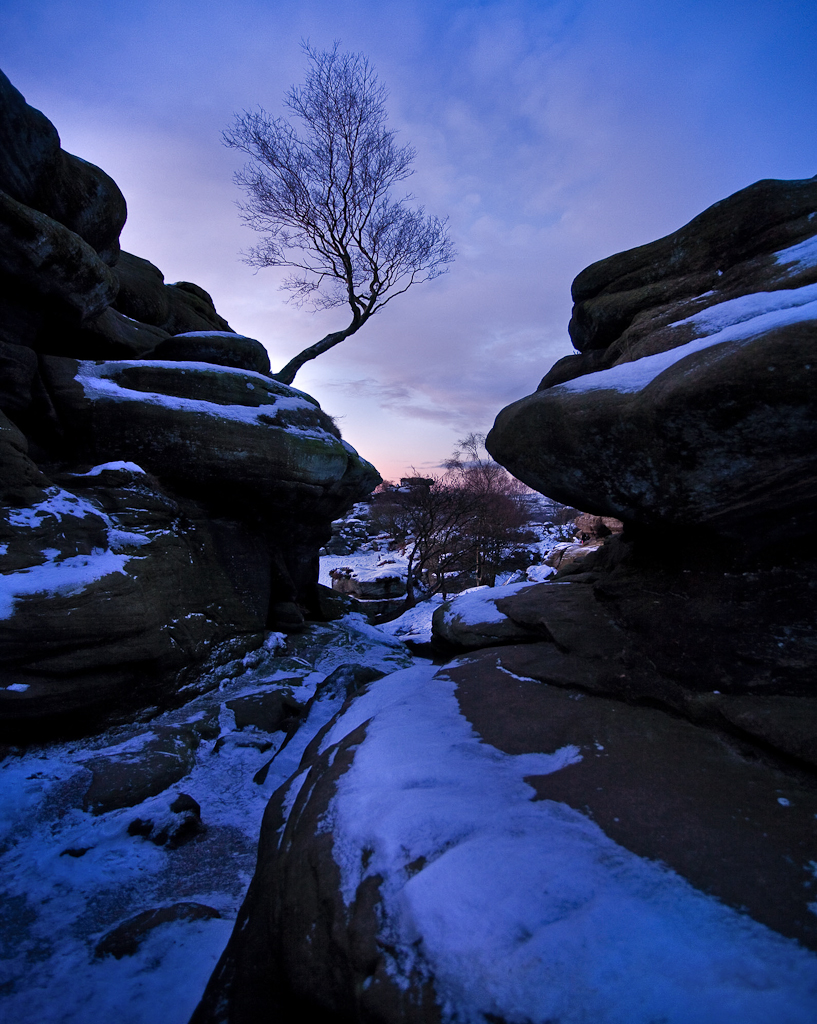
Brimham Rocks is one of the UK’s strangest environments. The victorians thought it was some form of Druidic place of religious significance, such is the astonishing variety of rock outcrops and features, and it was only in the 20th Century that we realised it was just a remarkable array of environmental erosion. "For Brimham, could it be transported to Salisbury Plain, would reduce Stonehenge itself to a poor and pygmy miniature". And it is spectacular, but it is also a surprisingly difficult place to photograph for somewhere with so much ‘material’.

As it’s one of the closest dramatic locations to me, I have visited it quite a few times and have been lucky to find one or two unique viewpoints. The following is my rough guide to the possibilities and potentials of the location.

Brimham Rocks OS Map on Multimap

The Location

Firstly, you should be aware that the location is *very* popular and is not particularly large for the numbers of people that visit it. I have seen over a hundred cars in the car park in a midweek. The best times to go are, unsurprisingly, first thing in the morning and last thing at night with the morning being the best for vantage and for having the place to yourself apart from the odd dog walker.

The car park at Brimham is quite often closed from dusk to dawn but if you arrive very early, you can typically park up just outside without blocking the entrance to the Park and the side road just next to it (if you do park here, please make sure you don’t block either road! It’s quite easy to accidentally obstruct the track on the left of the entrance). Also, if you can’t park here without causing an obstruction, you can always drive a little bit further north-east (about 200 yards) where there is a substantial parking area on the right hand side of the road.

Satellite view of Brimham, Google Maps


View Larger Map

Located just north west of Harrogate, the site is a National Trust property and as such, prepare yourself for hefty car parking fees or, a lot better suggestion, buy a membership (you’ll recoup the cost once you’ve parked at three locations in a year). It is also a Site of Special Scientific Interest which covers the area of Brimham Rocks, Brimham Moor and Hare Heads (the north end of the site surrounded by the main road).

For the sake of these location guides, I’ve split the Brimham Rocks site into three areas. There is the main area that the general public visit which has quite substantial paths and includes the track to the visitor centre.

Photographing at Brimham Rocks

The typical photographic visitor to Brimham will take the main road path through the site all the way to the visitor centre, probably stopping to take a photograph of the wonderful formations to the right of the path show in the picture below and definitely stopping at the main enclosure of rocks where ‘that’ famous tree grows out of the side of a mass of gritstone.

They will probably walk to Idol rock and see the Druids Tablet and then walk over the western edge of the site, looking over toward Low Wood and Glasshouses and then return to the car park via the western path marked on the ordnance survey maps.

If they do this, they will definitely see some of Brimham’s interesting features but will miss out on many of it’s photogenic areas. There are many more paths through the site than appear on the ordnance survey map or on the site’s own maps. The main area people miss is just on and below the eastern crags. There is a path that follows the far edge of the site through some wonderful woodland and allows access to the bottom of the rocky ledges, an area that is probably more familiar to rock climbers than photographers and the general public.

Paths and Land Types

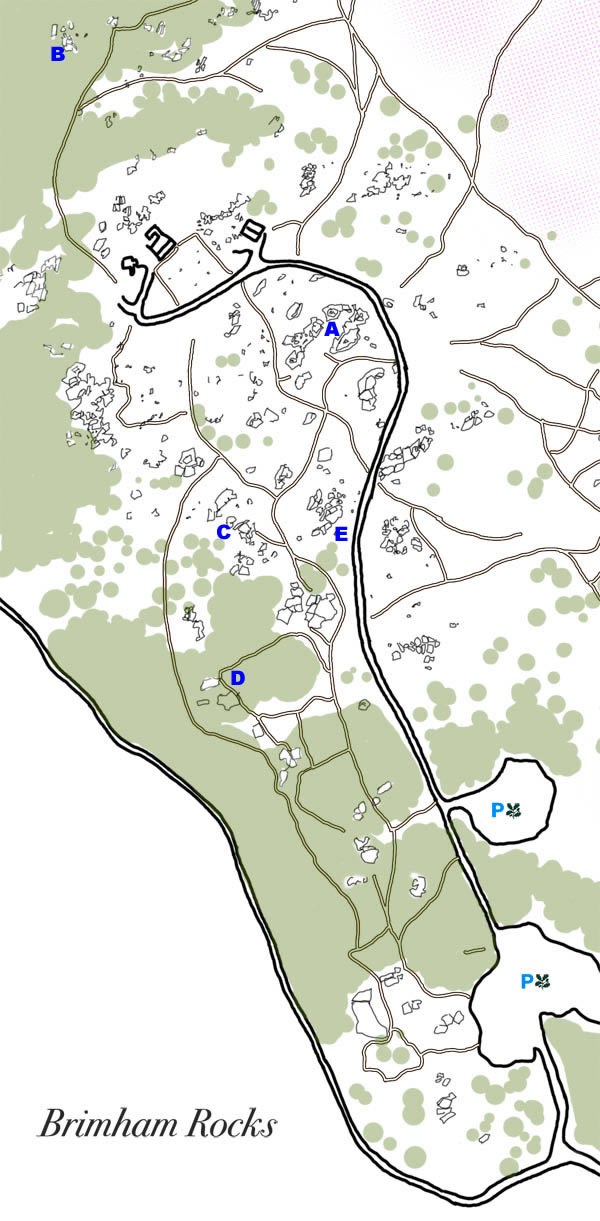
For those of you that are after the 'hotspots' then take a look at the image above. Area 'A' is the classic 'tree sticking out of wall' shot that has been done more than a few times. It's worth a play with as there is definitely loads of potential around this area that hasn't been fully explored though. Here's my take on it.

That Tree (so many of them aren't there!)

Location marked as B on the map is well known through Joe's National Trust shot. It's the Druid's Tablet, take a look here. Next to this is the classic balancing stone, a good hundred tons of rock balanced on a backpack sized mound.

The area around C has some wonderful views, well worth wandering around at sunset. D has the winter sunset views and drops down into the craggy edges beloved of climbers. Finally, my favourite location for sunrise, location E is a group of rockets that are easy to climb and give you an amazing view over Brimham Moor with the best looking group of stones in the foreground. This time of year is perfect to capture the sunrise to the left of the rocks. Just have a look at these.

Brimham Rocks isn’t an easy place to photograph by any stretch of the imagination. Mostly because of all that wonderful variety compressed  into a small area, it’s difficult to simplify things; sit in the middle of Brimham Rocks and you will easily end up with a complex mass of rocks and bracken. The key to getting good results is to work around the edges of the site or work with details. The far western edge, where the rocks drop away towards Glasshouses is an excellent choice for sunsets colour but also holds a valley towards the north west that fills with mist on cold mornings. The eastern edge is excellent for sunrise, especialy in Spring and Autumn.

I have created a google map that shows a sample of photographs from many of the areas on this site. The photographs are not intended to be great examples of composition but to inform as to what ‘ingredients’ the photographer might have to work with should they choose to visit these areas. I’ll be getting this map up on the website over the next few days (I’m not totally happy with the positioning of the photos yet).

I’ve also generated a set of 360 degree panoramic photographs that will hopefully give you a good idea of the types of environment that you are likely to encounter. This is live and you can visit it by clicking on the link below.

Brimham, a complex, frustrating place to photograph but with a bit of patience, a very rewarding challenge.

Geology

Although many Victorians were sure that the whole of Brimham Rocks was some sort of druidic temple to pagan gods (and without a strong geological understanding which would have to wait until the mid 1800s, it would be tough to explain some of the formations) the actual history of the rocks is natural but far from mundane. Even the late 1800s geologists got it wrong and thought that the tors of Devon, Yorkshire and Derbyshire were of coastal origin being worn down sea stacks. At the turn of the century, the formations were thought to be generated by some form of chemical weathering underground, and it was only in the 1960’s that geologists started to agree that most of these structures appeared when soil erosion revealed rocky outcrops and then freeze-thaw action worked on the structures to break down weaker areas, creating layers and clumps of rock. The extraordinary shapes that appear in Brimham, where large structures balance on tiny pillars such as Idol rock, are thought to be the result of the small area underneath the structure being compressed by the weight of the stone and hence becoming harder and resistant to erosion. This means that the non-load bearing material gets weathered away, leaving just the rock material that is holding the most weight.

The origins of the rocks are no less mundane, they being the layers of grit and sand that were layed down in the delta of a great river whose origins were in a mountain range that stretched down from Norway’s fjords through Scotland. The different layers in the rocks are the result of the changing flows of the water in the river delta, giving rise to multiple angles and textures of rock.

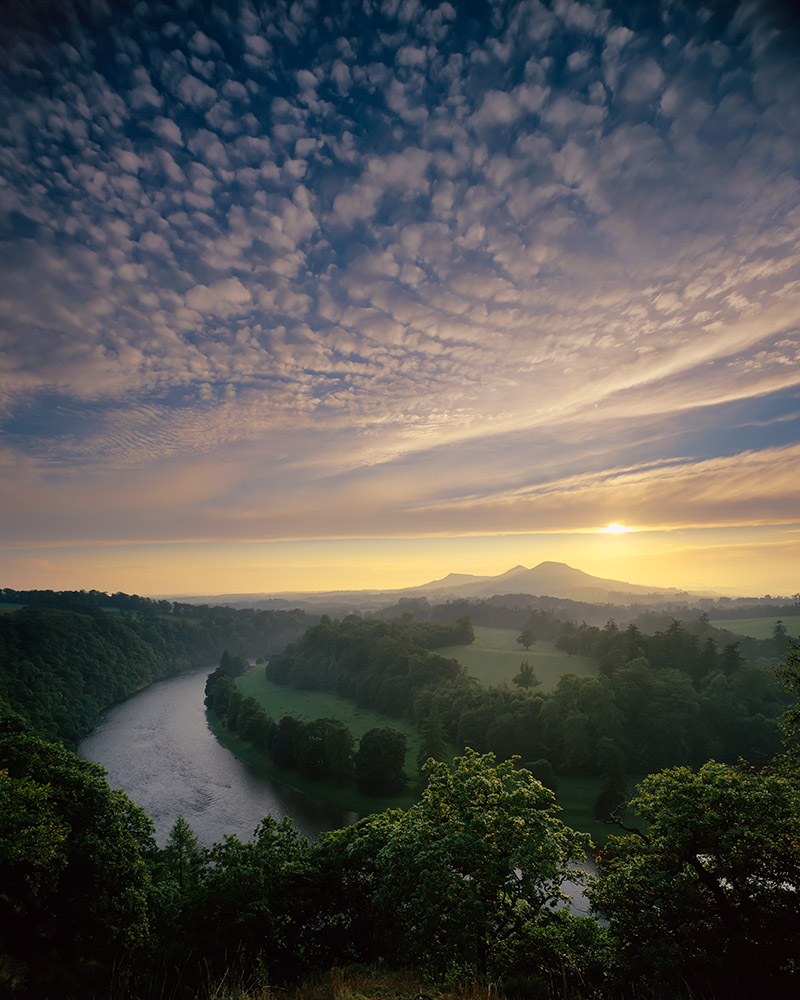
Borders Sunset

Borders of Scotland

We're hoping to include a regular column on post processing pictures in photoshop. This series won't be concentrating on individual techniques (although we will expand on some of these if subscribers ask for more info) but we will be concentrating on how to make pictures work better; How to balance light, emphasise structure and guide the eye.

The series starts with a photograph that Joe has had in his archive for some years but that was problematic because of very dark corners in the sky. A drum scan by Tim Parkin created a file that finally allowed the image to be assessed on its own merits.

The running length is approximately one hour and although the video that appears in the bottom corner is only visible for the first half of the screencast (due to technical problems - in other words, Tim made a boo boo). Although this image did not need a great deal of post processing, we hope you get an idea of how Joe approaches the post processing stage. There will be a second small screencast for this image where Joe uses large radius unsharp masking to enhance the texture in the middle area of the picture where the two lone trees appear.

Read other articles by Joe Cornish.

Winds of Change, Windows of Opportunity

The first fat raindrops slapped down onto the rocks around me. Above, an angry cloud had swallowed the mountain summit beneath which the mist of heavy rain swept down the ridge in my direction. Cursing the inaccurate weather forecasts I pressed on, head down against the storm, fifteen hundred feet of ascent yet to go.

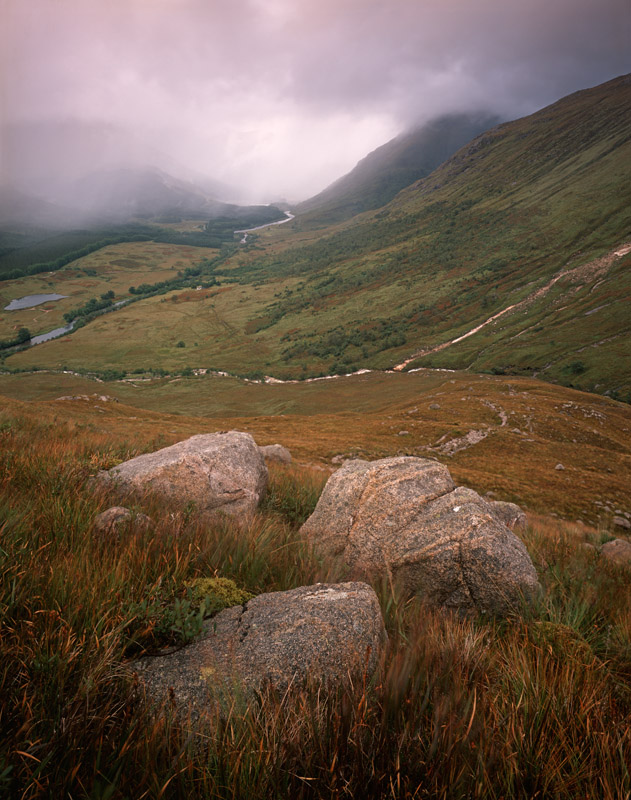
Glen Etive Storm 1

I had left my home near Oban under clear blue skies, as predicted a day of respite between the waves of Atlantic weather that had been the norm now for a week or more. The weathermen had lead me to expect light winds on the summits and an 80% chance of cloud free tops. Perfect for the image I had in mind, a grand view south from the summit of Beinn Starav to Ben Cruachan, the rocky tops and ridges in between lit by the last light of day and with any luck cloud in the sky to add colour and interest. Then a "relatively" quiet night on the summit, a dawn shoot and back to my car by mid morning.

A party of bedraggled hillwalkers descended towards me and a brief chat confirmed what I already knew would be the case; zero visibilty and worse, fierce winds that had driven them down into the valley early. Not a hope for me with a bulky, wind resistant wooden camera and slow film. As the crow flew I was only nine miles from home but here it was a completely different season and I was underequipped for the conditions.

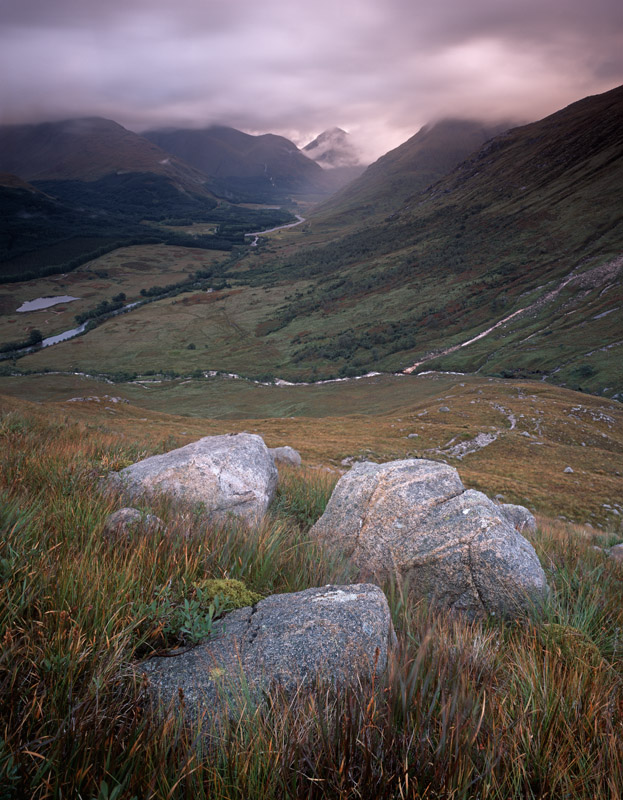
Glen Etive Storm 2

Working for the most part on the West Coast of Scotland this is not particularly unusual. I have learned during the six and a half years photographing here that you often need a plan B, C or D but rarely have to return home defeated by the weather. Pre-conceived images often take months or years to fulfil, relying as they do on a set of particular conditions to make them work. Every failed attempt however spawns a multitude of new ideas and images, often better than the original. I have no doubt that this constant need to adapt has allowed me to develop as a photographer and I hope produce a more honest portrayal of what makes Scotland so beautiful to me, it's geology and climate.

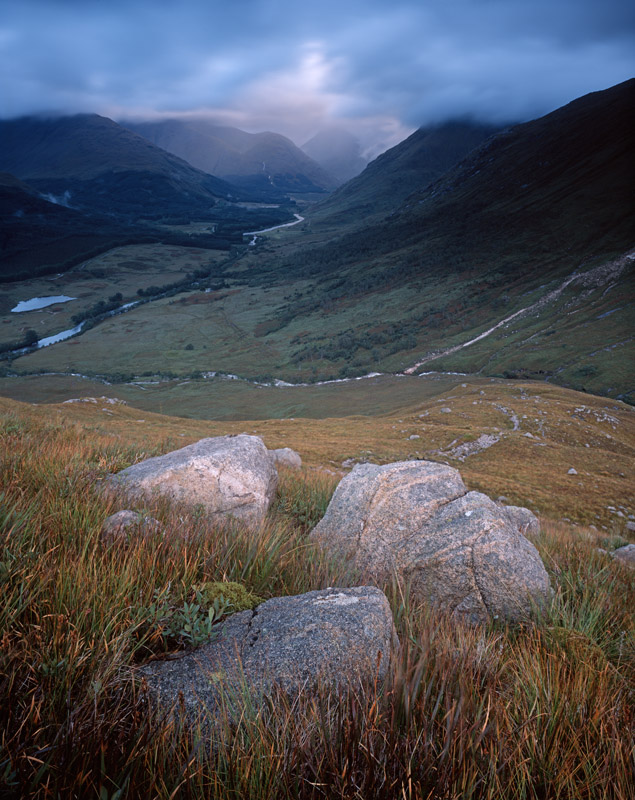
Glen Etive Storm 3

High on the mountainside I knew that the only chances of making any images would lie beneath me. Heading back down the ridge with the weather at my back I now had the luxury of time on my hands and the chance to check out some of the many groups of boulders strewn across the hillside that I had passed on the climb. Another heavy shower was entering the head of the glen, the peaks of Stob na Broige and Stob Dubh melting in and out of the cloud. Overhead, more cloud, lit by the Sun to the west was pumping warm light down all around me. Having looked at a few options I chose the group of three boulders that sat well in the foreground and chose to make a series of images from the same location as the weather and light developed before me.

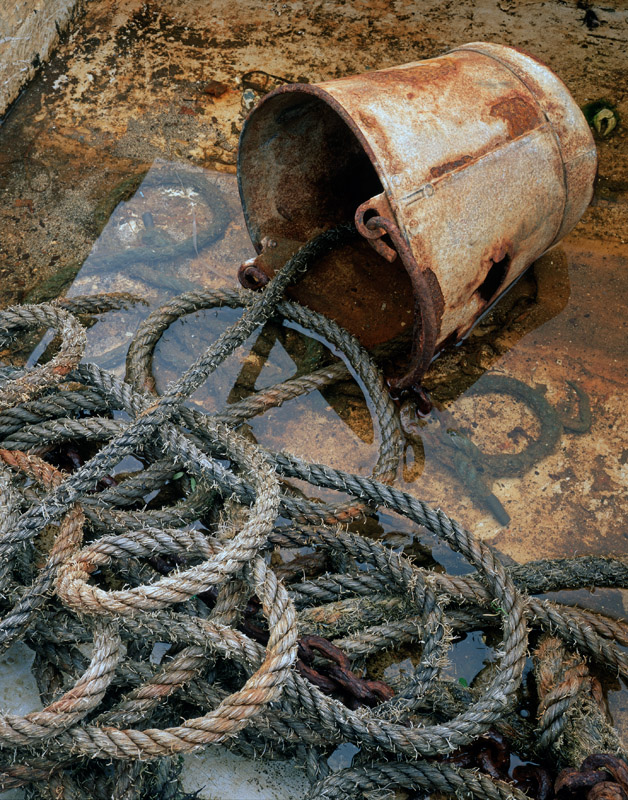
Berneray Bucket

While I feel that pre-visualisation can play an essential part in arriving at many successful images I believe there is also a danger that trying to make specific images in chosen locations can close your mind to the many other possibilities that present themselves along the way. By being flexible I rarely return home dissappointed after a days photography whether i've made new images or not. On a recent trip to the Outer Hebrides I emerged from my tent one morning to find that a thick sea mist had rolled in during the night. My intended image from the sandy shore of Berneray across an island studded sea to the hills of Harris in warm light had no chance of happening. The epic vista replaced by an image that has become one of my favourites from the week long visit, an image of a rusting bucket and coiled rope in the bottom of a rowing boat discovered as I wandered around the quayside beneath the dull, flat sky. An image that says as much to me about the island as my grand view would have done

And of course I still have my dream shots as a very good reason to spend more time in the future in those wonderful places.

The Letter from Scotland is brought to you by Richard Childs, a landscape photographer who works with a large format camera and is based around the West coast of Scotland. If you want to see more of Richard's work or take a look at his excellent workshops, visit Richard Childs Photography