

The Mysterious Case of the Missing Berries and Other Stories..


before
after

Picture at 100% digital but increased to 200% in order to show the differences (see below for more details)..

Here is the 100% only version

before
after

I’m not one to engage in the film vs digital debate from a ‘religious’ point of view. I happily use both (which makes me multi-faith I suppose) and own more digital cameras than film cameras. However, I do spend some time trying to work out the advantages and disadvantages of each and in doing so, some interesting things crop up.

I have two pictures to show you, not the most scientific of comparisons, but it’s enough to show an aspect of digital photography that it’s useful to be wary of (or at least to be a-ware of).
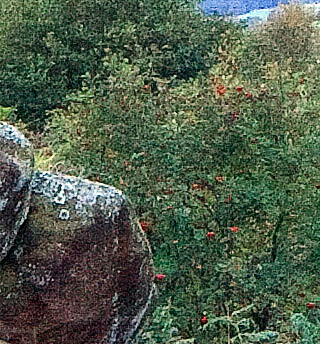
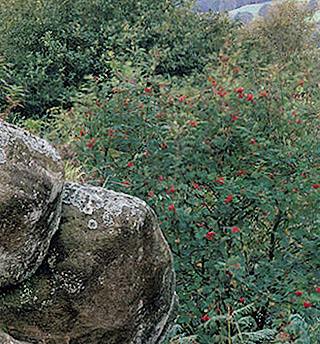
Most of you will no doubt have heard of the Bayer array or mosaic. This is a way of getting colour out of a sensor that only really records brightness per pixel. It does this by clustering four pixels together, two green, one red and one blue, and then interpolating between them to reconstruct the missing colours.

The main problem with this is the lack of red and blue pixels – it means that fine detail in red or blue can have issues. Anything with a red texture (or blue, but we’ll stick with red to reduce repetition) will end up with only a quarter of the supposed megapixels of the camera. However, there is also a more insidious problem in that if you have pixel level red colour detail and those pixels fall on the green or blue pixels (highly likely) then that colour just dissapears, completely.

Slightly less annoying but equally an issue is that if the red pixel level colour falls inbetween two pixels, then the saturation of that red colour is only half of the actual saturation of the pixel detail. This results in muted colour of anything with mixed colour texture.

So in the first example you can see that the red pixel berries have mostly dissapeared and that the a lot of the other pixel berries are particularly muted in colour.

Just for the record, the film has been reduced down to the same native resolution of the digital files but because of the anti-alias filter and various other degradations (24-105 lens and a little bit of diffraction at f/8 I think) the digital file looks less sharp than the film – which probably adds to the detail/texture issues – I said this wasn’t too scientific. However, also for the record, if you reduce the digital file and the film files by 50% you still see the same issues so…..

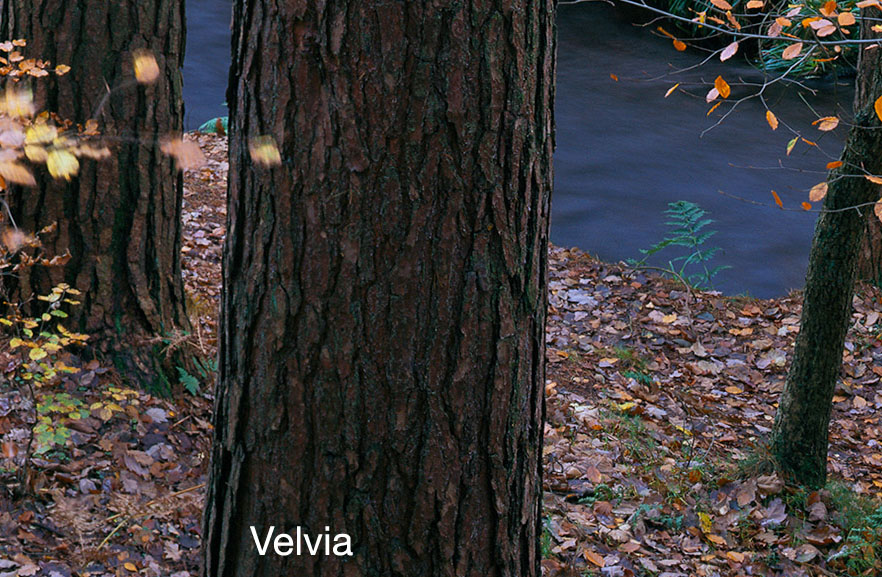
The last picture just shows the effect on other colours, in this case even the green specks of lichen on the tree are showing some diminution. As they say … “Just sayin’..”
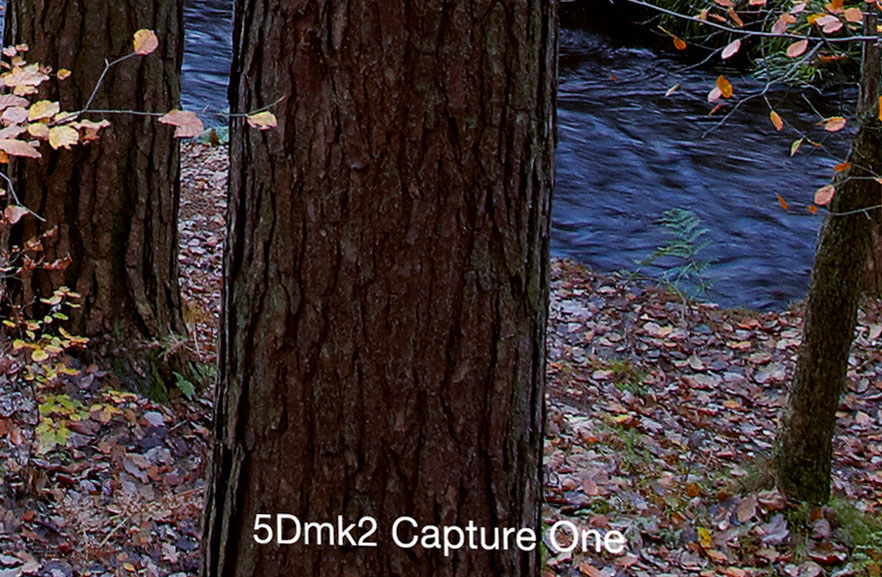
before
after

One photograph was taken with a 150mm Rodenstock Sironar S on an Ebony 45SU (Velvia 50) and the other was taken on a Canon 5Dmk2 with a 24-105 lens at about f/8 and post processed in Capture One (the Adobe conversion was even worse – Capture One’s demosaic’ing is a lot better)

p.s. Somebody asked whether the effect could be the anti-alias filter.. I tried blurring the film version to see what the effect would be ..
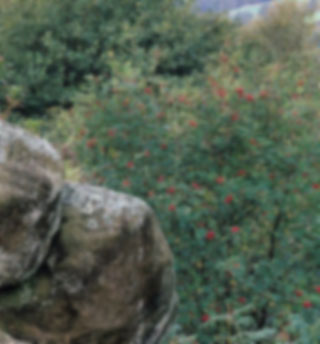
and resharpening
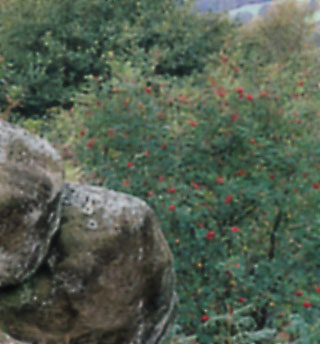
If people are interested, I’m hoping to write a more in depth peice on this with some more accurately framed pictures and covering the foveon if possible and different raw converters.. ? A good idea?

12 Responses

  1. temporary_access

    I wonder just how much of a part the AA filter (and consequent sharpening) has to play. It would be interesting to see the experiment repeated using an MF digital back instead of the 5d Mk.2 – or, for that matter, a camera with a Foveon sensor.

    • I’ve had a longer thought and I think that this can only get worse without an anti aliasing filter. If you get rid of the filter completely, no single red pixels will appear unless they sit on the actual red pixel sensor. The anti-alias filter (let’s get it straight – it’s a blur filter) will ‘spread’ the data across 2 pixels so even if you don’t get all of the colour, e.g. worse case scenario, three pixels of red that completely miss the red sensor. Hence no colour if you don’t have an anti-alias. If you have a 2px anti-alias filter, all four of that bayer cells pixels will have 75% red…

  2. Hi Jools, I’m pretty sure it isn’t just the AA filter, have a look at the p.s. above and you’ll see a simple blur (2px) and resharpen still shows most of the berries.

    And I’d love to try out the new Sigma (I think it’s a sigma) 15Mp foveon (yes I know they say it’s 45Mp – very annoying that I almost understand them too)

  3. michaelmarten

    Interesting – I’ve noticed this with intricate clothing (e.g. with tiny red thread as decoration that in part just disappears on a digital image) more than I have with landscapes. I assumed it was just to do with lack of detail/resolution even on a high MP sensor. It’s helpful to know WHY it is happening and what to do about it; I have shot the same model and clothing using 35mm film and the red thread is visible.

  4. Barkway Julian

    Hi Tim,

    Your update gets to the nub of what I was thinking. The AA filter adds an extra layer of uncertainty and any software will further muddy the waters. I guess what I was getting at is I’d like to see how bad this can be without other factors mitigating or exacerbating things. Obviously, as someone who likes putting loads of detail into the frame, this could have a big effect on how I use my digital kit.

    Oh, and thanks for sorting my user-id and other related issues!

    Julian.

  5. A lot of the time you mean photo-sites, not pixels, btw.

    Also just sayin’(TM):

    1. The big downside of the Velvia version (presumably being LF) is, in order to get the shot in focus, you’ve stopped-down a lot and consequently blurred the water detail.

    2. It would also be worthwhile considering optimum apertures of the lenses used.

    3. Digital workflow allows for focus-stacking and align+blending / stitching trickery. These might help resolve the case of the missing berries, but either way, one has to be alert to this kind of potential problem – so thanks for a new gotcha revealed.

    • Hi mr spod,

      Indeed the large format has a smaller aperture and hence longer exposure. However the issue can’t be resolved by stitching or focus stacking. I suppose you could stitch lots of zoom shots together to give an apparent higher resolution. The same difference in luminosity resolution vs colour texture resolution will show up though..

  6. Tim,

    Did you try that RAW image in RPP converter? That gives the best possible resolution so nay be worth a try to see the effects. The link is here – http://www.raw-photo-processor.com/RPP

    (when exporting in RPP you should choose interpolation other than “half” – that uses pixel binning and does not interpolate)

    • Hi Alexy – I just downloaded and tried processing and the results are the same. I think it’s just that these berries are being completely missed if they don’t correspond with a red pixel in the bayer array

      • Interesting. So what you are saying that if we say extract 4 channels from RAW file without any conversion and then view them directly then we will see no berries in any of them either? It would be interesting to experiment. The LibRaw library (here http://www.libraw.org/) in source/binary distribution has a utility called 4channels – that basically takes RGGB channels from RAW file and writes them as TIFF files so you can have a look at them in raw (pardon the pun) without any conversion applied. It would be interesting to see if berries are present on any of the channels at all with that.

  7. Hi

    thanks for making this post. I have just been struggling with the concept of buying a 5D or keeping my 4×5 (and panasonic GH1). The 5DMkII slider revealed again why it is I love my LF stuff and why its worth taking the time. If I may be so bold I’ll put in an image taken with my Toho using 400ISO neg on 120 roll and a 6×12 adaptor

    http://www.flickr.com/photos/pellicle/4413731276/

    just in case it tempts anyone back into film too

  8. haimesa

    I’d be interested in more on this issue and I’m sure others would too, particularly since Nikon have just released a camera with the filter removed. I should imagine a lot of people can’t work out which one to go for.

Notify me of followup comments via e-mail. You can also subscribe without commenting.