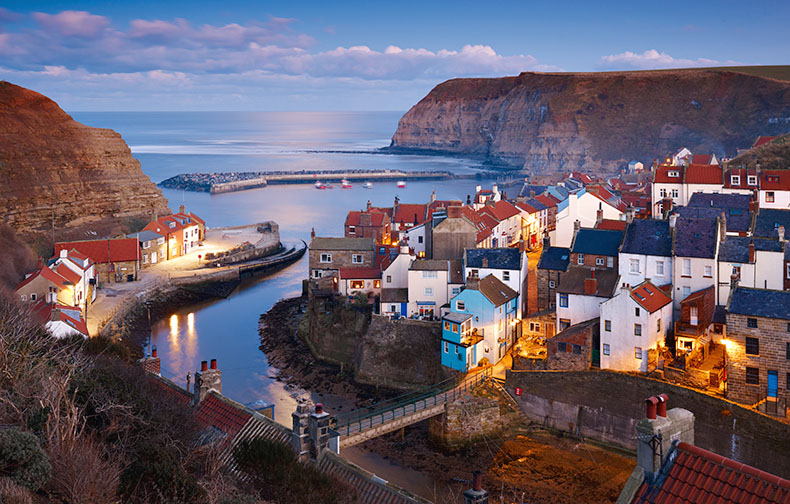
In this one hour video, Joe Cornish talks through his workflow for taking a file just exported from a digital Phase 45+ file using Capture Raw through to assessing the final print.
A Video on Printing “Staithes” with Joe Cornish
14 Responses
-
-
EmDashMan
Wow, a really detailed and candid description on printing an image. I’ve read a lot around this subject (haven’t we all, after initial disappointment with the difference between screen and paper?) and it’s great to see how Joe approaches this thorny problem.
I’ve gone the whole ‘build your own profiles’ route, and seemed to be getting great results for a while, then had a complete disaster after taking a little break from printing – something obviously changed during a software update (Epson? Apple? Adobe? Who knows!!) and had to resort to ‘Printer Manages Colours’ to get anything like a decent print (who knew there was so much magenta in my ink cartridges?!). Rebuilding monitor and printer profiles didn’t help (well, it helped my paper manufacturer
So, thanks Tim and Joe – lots to think about there. I think the things I take from this are 1. Try out the black point trick in a curves layer and 2. don’t get so hung up on trying to make the soft proof look like the unproofed screen version. Oh and 3. get loads more experience!!
On January 23, 2011 at 10:42 am • Reply -
stevefrance
I good introduction to those who may not have any printing experience. Lovely image.
Im still intrigued with Mr Cornish’s vision and values changing…seeing he now uses digital equipment. Film was always his perference.
His latest book, A Photographer at Work clearly shows that.Be interested to see how that will influence photographers…and if that is simply an admission that film is on its way out and digital has to be considered ‘the’ photographic medium now?
I do hope not.
On January 25, 2011 at 2:06 pm • Reply-
Joe Cornish
Steve,
Thanks for your comments. My thoughts currently on this are that, as a working photographer with printing my primary objective, digital capture is logical. In no sense do I think film is on its way out. The fact that so many working photographers still shoot film for their personal work testifies to that. I do still shoot on 5×4 when I can, though currently that is rare.
Interestingly, the expanded dynamic range that Tim’s drum scanner has given my (previously underexposed) transparencies has made me think seriously about reviving my Ebony.
Fact is, I enjoy both working methods, and can see the pros and cons in both. For me, digital only really has enough deep quality at medium format, and the initial cost of this type of camera system is fairly prohibitive. In this light, for the quality-seeking, creatively-minded non-professional user on a budget, 5×4 is brilliant, and still makes perfect sense.
JoeOn January 30, 2011 at 1:40 pm • Reply-
stevefrance
Thank you very much Mr Cornish for your response.
I think you have hit the nail on the head.
Being a professional using digital gives you a fully self managed work flow, quick turn around time for clients, benefits out in the field, as well as financial benefits to your business (despite the massive intial outlay).
I fully understand that MF/LF digital for landscape work would yield results close to, if not beating LF film ( be interesting what the image quality of the new Phase One 80MB back is like?) These systems are beyond many of us unfortunately
I guess as a film lover, and not shooting professionally, I dont have the demands on me as you do. I Just find it interesting how the profession is changing with the technology available,
and that photographers who once loved film change their cameras and working practises with that technology.Is it simply a business decision, an aethestic one..etc?
Yourself, Charles Cramer, Baxter Bradford, and many others have all gone digital… its a growing trend. Is it one that cannot be ignored, and for many of us who use film… for pleasure…will we have to one day face, or be forced to move to digital?
On February 3, 2011 at 2:05 pm • Reply
-
-
-
Rhysd
Just spotted the HD Download – Excellent! I can now watch at my Leisure on my 50″ TV or my tiny iPhone!
On January 27, 2011 at 6:12 pm • Reply -
-
Rhysd
Looks & sounds terrific Tim. In fact, it looks better on the TV than it does on my 17″ Macbook Pro.
On January 28, 2011 at 8:56 pm • Reply -
Tweets that mention A Video on Printing “Staithes” with Joe Cornish | Great British Landscapes -- Topsy.com linked to this.On January 28, 2011 at 9:31 pm • Reply
-
roteague
The photograph is but a pale imatation of the previous one Joe did on Velvia. I’m deeply saddened to see Joe moving away from the beauty of film.
On January 29, 2011 at 8:59 pm • Reply -
Thank you Joe and Tim excellent feature, already used the things I’ve learnt and can see a difference in my prints. One thing that struck me was the amazing detail, clarity and sharpness of the raw file even when viewed at high magnification! Then again I wouldn’t expect anything else after seeing Joe’s digital setup in his latest book!
On February 2, 2011 at 1:57 pm • Reply -
samantha
Excellent video and really interesting to the hear Joe’s thought processes behind his digital workflow. Will be revisiting this video in the future no doubt when i eventually round to printing.:-)
On February 7, 2011 at 11:49 am • Reply -
Only just got ’round to watching this this week (so much content!). Superb video which is really helpful as I’ve always struggled with matt papers so tend to use papers like Permajet Fibre Based Royal which have a less glossy feel – this will encourage me to have another go on art paper
On February 23, 2011 at 10:49 pm • Reply -
Monty.Trent
This video was worth a year’s subscription alone. Thank you Joe. I shall download this and keep it by my side when I next struggle to get my printer to behave as I want it.
On March 8, 2011 at 5:37 am • Reply