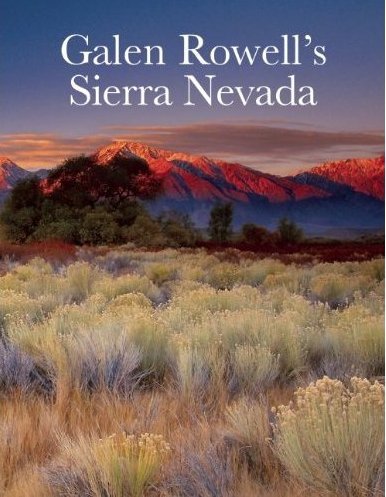
Book Review – Sierra Nevada

Galen Rowell, as you can read in the short biog in our ‘master photographer’ section, is one of America’s most famous landscape photographers. His career coincided with the massive growth in demand for colour images and adventure photography; his commissions took him all around the world. However, his ‘home ground’ was the Sierra Nevada and he eventually moved to Bishop in 2001.
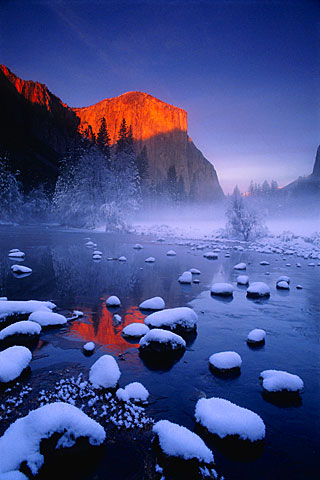
Winter sunset, Gates of the Valley

This book covers Galen’s relationship with the area and, as well as a great biography, includes wonderful, high quality pictures covering his photography from 1968 to 2002 (with a couple of earlier ones from his climbing photography). The reproduction in this book is excellent although it has to be said that some of Galen’s more over the top images are almost too garish for reproduction in any form. The most intense sunsets in the world shot on Fuji Velvia are an acquired taste I think, no matter how breathtaking the views. But the massive glowing lenticular clouds and sierra waves aren’t all this book is about and it does a good job of providing a balanced view of Galen’s photography.
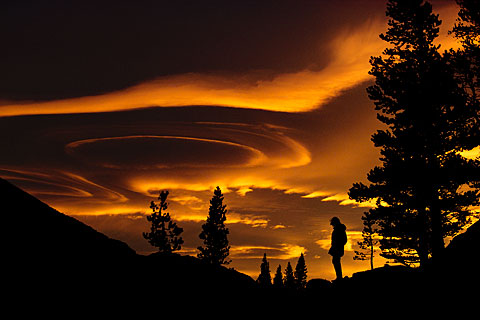
Sunrise on Tioga Pass, High Sierra

And the photography itself, whilst undoubtedly very good, isn’t the considered composition of Ansel Adams and only in the last years does it approach the depth of Eliot Porter. However, to rank it by comparing it with these masters is to misunderstand what it was that made Galen so special. It was his relationship with the land; the fact that he was a photographer second and that his primary passion was always climbing. Galen’s photography shows many flaws, from over-gradding to focusing issues, and I’m sure the shots will be soft compared to the standards we have today (he shot many of his photos at f/22 which, because of diffraction, see comments for more, means they would be the resolution equivalent of a seven megapixel DSLR).
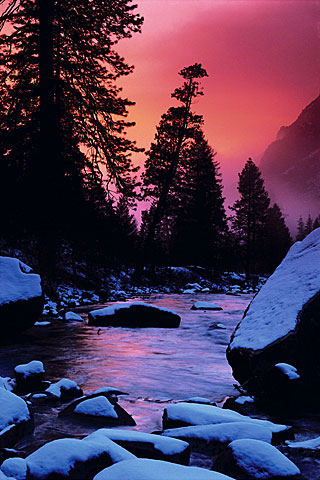
Twilight mist, Merced River, Yosemite

The thing to remember is that with Galen, it’s the package that counts; he was a brilliant climber and writer and a great photographer. To understand why people like Galen Rowell so much, buy this book and “Mountain Light” and get a taste of the ultimate adventure photographer..

11 Responses

  1. JonSparks

    Nice balanced comments. GR was very influential on me, especially “Mountain Light”, but have to recognise that some of the work is OTT.

  2. jlbatista

    Hi Tim.

    I’m a bit confused by this – ‘he shot many of his photos at f/22 which means they would be the equivalent of a seven megapixel DSLR’.

    What do you mean exactly?

    • Sorry – I should have been clearer – in terms of resolution, a full frame film camera at f/22 has the same resolution capability as a seven megapixel SLR at f/5.6 – f/8 – does that help?

  3. jlbatista

    I promise I’m not trying to be difficult! But I’ve always thought of image resolution in terms of dots and pixels, rather than f stops? Resolution, to me = how printable the image is and from my experience, a well focused 7 megapixel image, regardless of how sharp and wide the DoF, wouldn’t print (at any size) as detailed as a well focused 35mm frame.

    Am I being completely stupid and missing your point entirely here?

  4. I think Tim is referring to the optical effect called diffraction that starts to take place at higher f-stops.

    Basically at f22 on a 35mm format film/sensor, diffraction means that regardless of your sensor resolution or film grain, you are not going to get much more that 7 MP worth of information. See this link for more info:

    http://www.cambridgeincolour.com/tutorials/diffraction-photography.htm

    Tim – correct me if I’ve missed your point as well!

    • Absolutely spot on and you’ve linked to one of my favourite resources for this sort of stuff! Sorry if I wasn’t completely clear in the article, I’ll give it a tweak.

  5. Of course the problem with ‘in theory’, is that in theory, theory and practice are the same. Whereas in practice, they ain’t…

    Having carried 35mm SLRs into the mountains for many years, choosing my equipment for the same reasons as Galen (though mainly Olympus OMs rather than his Nikon), and often shooting at f22 for maximum DoF, I’d agree with jlbatista that the 35mm Velvia slide is capable of far out-performing a 7 MP DSLR, particularly when printed. Why isn’t entirely clear, but I suspect its principally down to the DSLR’s Bayer mosaic/ anti-aliasing filter combo and consequently reduced colour resolution. As I’m sure Galen would have pointed out, there’s also the perceptual element of a regular grid of pixels being more obvious to the eye than a random haze of dye clouds.

    So whilst it may be true to say there is only 7MP of information in a 35mm frame at f22, its not really fair to call it the equivalent of a 7MP DSLR. Perhaps a Foveon one with the AA filter removed, but not any I’ve used.

    From my practical experience – not always at f22 admittedly – I’d say Velvia at f11+ is not quite up to to my old Nikon D200 (a 10MP DSLR) in terms of detail – though superior colour – but comfortably ahead of my Ricoh GX100 (10Mp compact). This is based on pixel-peeping on screen = printing isn’t always so simple. Of course lenses, scenes, apertures aren’t directly comparable, but I think the perceptual element is really important. I’ve had a few images used BIG in shop displays, and once the grain is visible its far less obtrusive than pixels. So for my uses 35mm has really only exceeded by equivalently sized modern cameras in the last few years.

    I think you might have been a bit spoiled by your cameras Tim – am I right you started with a 5D and then went straight onto LF? The 5D was the game-changer as far as SLRs for remote environments went – every climbing photographer in the UK was still using 35mm until then.

    • Hi Adam, I certainly didn’t mean to demean film, just commented that the use of f/22 on a DSLR means smaller prints. As far as the relative resolution of Velvia, I’ve previously commented that I think it’s probably about 10-14Mp of linear information and in terms of colour information, I think you’d need a 18Mp digital camera to match a good 35mm velvia slide well scanned (see my article on film vs digital).

      However, when you factor in diffraction, the peak density of velvia of about 50-60 lp/mm (at a push) comes down to about 20-30 lp/mm at f/22 . This is a linear reduction in resolution of 50%, a fourfold reduction in ‘pixel’ count. Perhaps there is something else going on but having seen the difference between f/22 and f/45 in large format…

      So I totally agree about your Ricoh not matching up to the velvia slide, however I will disagree about your Nikon beating a velvia slide – maybe in linear black and white resolution but not in colour texture resolving power.

      Obviously I could well be wrong so I can see another test coming :-D I would have got even more flack if I had said that even at f/22, a velvia slide would be as good as a Canon 20D!!

  6. No beef with any of that, though as an empiricist the main conclusion I make from that is that your scanner is a fair bit better than mine!

    I think digital has made us all far more wary of diffraction generally. Often the main reason for using f22 on 35mm was because lens markings were optimistic at best, and previewing severely limited. DoF problems are always more obvious than diffraction softening. Not only can you see the problems more clearly with digital, its also easier to avoid them.

    • Heh – I do get spoilt using a drum scanner! Although as far as resolution goes, a well set up v750 almost resolves as much detail (let down on troublesome transparencies by colour, shadow recovery and halation).

      I think the test is an interesting one so we’ll do a feature one day comparing a few of these. I’m quite happy to be wrong though – nothing better than knowing for sure.

      Thanks for the discussion!

Notify me of followup comments via e-mail. You can also subscribe without commenting.