I really ought to begin this review by declaring an interest on behalf of On Landscape. As you no doubt know, Joe Cornish, along with Tim Parkin are the driving force behind this magazine. So reviewing this book lays us open to accusations of bias.
So in the best traditions of honest journalism (now there's two words you rarely see used together), I am going to endeavour to give an unbiased opinion on the book (as I try to do in all my reviews.)
I don't think I am overstating the matter to say that Joe Cornish is an up and coming landscape photographer who shows a lot of promise. Joking aside, I don't think there are many UK based landscapers who don't list Joe as an influence or inspiration in their work. Over the last 20 years or so, Joe has emerged, following in the footsteps of Charlie Waite, as one of our finest landscape photographers.
As such, each article he writes, each book he publishes, indeed, each video he now releases on On Landscape is eagerly awaited and then devoured by his devotees
(although, as the modest man he is, he will probably squirm if he reads this).
Those who visit his gallery in Northallerton leave in stunned awe at the quality of his prints, his composition skills showing remarkable attention to detail and his ability to capture the essence of the land, sea and sky in all weathers with supreme skill. As the Americans rightly revere Ansel Adams, many of us revere Joe Cornish.
So it was with eager anticipation I pre-ordered this new book when it was announced on Amazon. On it's arrival, I was even more eager to read it when I saw Joe reveal in his introduction that the period over which the book was written saw him embrace a digital workflow. As a digital photographer myself this is exciting. It means the technical side of his work has more relevance to us digital users for whom large and medium format photography remains a 'dark art' to be wondered at. (how do they cope without a histogram? And then there is this drum scanning business - it just baffles me).
It is important to note that this book, rather than being by Joe, is about him. The author is, in fact, Eddie Ephramus. He is a fellow photographer, writer and good friend of Joe. The premise of the book was for Eddie to follow Joe over an extended period (in actual fact, it was written over a period of four years) photograph and write about him at his work. We see Joe working at times with his beloved Ebony Film Camera, but also using a compact digital camera as a 'sketchbook' to hone compositions and crystallise ideas prior to setting up the Ebony. Joe has also tested using a digital SLR and finally settled on a Phase One Digital Back for his landscape work. (now Joe has made this momentous move, I wonder how many large and medium format film users will follow his lead?).
I have read and re-read Joe's foreword to the book. He describes his mantra of "craft, art, soul". Reflecting on how he defines the aspects of this mantra are thought provoking and have influenced me to examine my approach in the field. This foreword alone has made the book of great value to me.
The chapter titles give some hints as to the direction of the book. A Question of Balance. Intimacy and Connection. The Search for Order. Perseverance Works and so on. Each chapter shows Joe working on location. It is fascinating to see sequences of images made by Eddie showing Joe working a scene. Often we see Joe's expressions of intense concentration. We see a photographer who puts a great deal of effort into every image. The compact camera enables him to work an area making images of potential compositions until the ideal one is found. Then the Ebony can be set up to replicate the image.
We see Joe up in the Assynt mountains, working in very difficult weather conditions on images for his book on the Scottish Mountains. Although we might think Joe has his own ideal weather system that follows him around, it illustrates how he is at the mercy of the weather as we all are, but it also demonstrates how he will work in conditions many of us might decide is hopeless. Yet his diligence yields images that inspire us to persevere and to be far more open to the photographic possibilities of 'bad weather'. Other locations used include several in Cornwall (including a woodland where Joe discusses tackling the very difficult task of extracting order from the chaos of the forest), Bamburgh, Lindisfarne and his beloved Roseberry Topping.
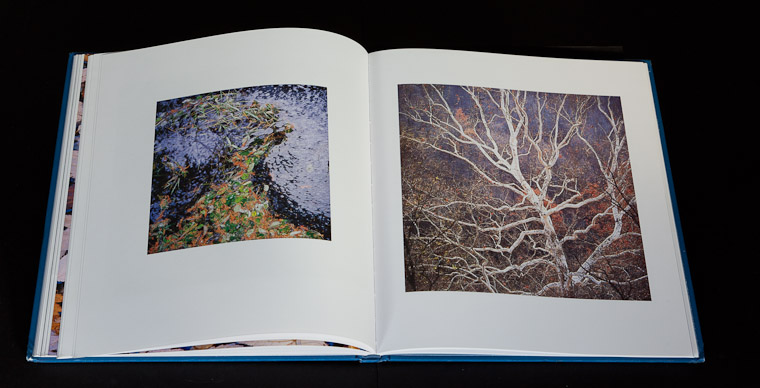
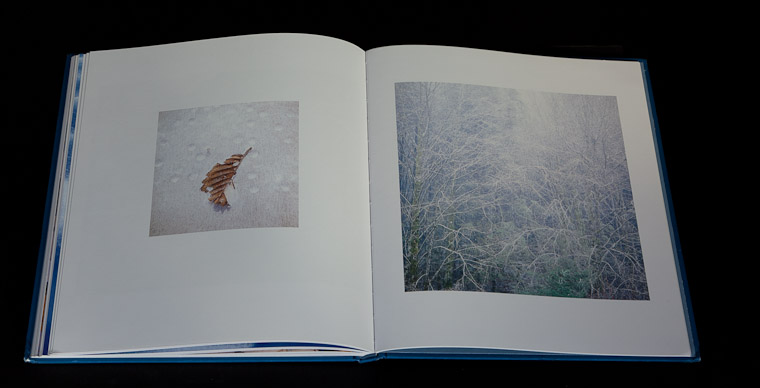
This is a book that rewards re-reading. I am reading it for the third time. Yes, it is full of Joes stunning images as we would expect. But most of the photographs in the book are Eddies images of Joe working and these are very revealing, showing just how much effort he puts into each image - this is a photographer who grafts for every shot. But for me, this book is most fascinating in the way it opens up Joes mind to us. It helps us understand his 'art', his approach, his philosophy. It has helped me think deeply about my own approach. How do I view light, the weather? Do I work hard enough on location? To I really seek out the finer compositions or do I gravitate to the obvious? Am I too quick to get the tripod up and get shooting?
Could the book be improved? This is tricky. On my first reading of the book I must confess to feeling a little disappointed. I felt the text was too brief. It was a quick read. I wanted more. I wanted more depth, more detail. There are lots of images (and I have no complaints about that) but I had the feeling the text was relegated to second fiddle. There just didn't seem to be enough of it. Also, I have to confess I thought the book was BY Joe, not ABOUT Joe. But that was probably just me being a bit thick.
Then on my second reading of the book I came to realise that, much as when we sit down to listen to a new music album, we feel a bit disappointed on the first listen. However, as we listen again and again we start to hear so much that we missed on the first occasion. The work opens up to us and reveals just how good it is. So with this book I have realised just how much depth is there in the text and images. Eddies insight and interpretation of what Joe is doing and saying opens up so much to us. Joes comments are as always very thoughtful without being drowned in 'art speak'. This is not a book to be rushed as I did on my first reading. It is worth reading in short sessions and then reflecting on. The images of Joe working are also worth studying. Especially on beaches as, clad in his rather splendid wellies, he really works hard to track down the shot. His patience is very evident as is his methodical approach.
My final verdict? This is a 'must read' for landscape photographers. Eddie and Joe have come together to produce a book on landscape photography which is unique in its approach (as far as I know). Eddie should be congratulated for tackling a very difficult task, that of trying to open up the mind of someone else to us. (although to have the opportunity to spend so much time with Joe, learning from him is one many of us would jump at). Both of them have stuck at a task for a very long period in order for us to fully benefit from all of the situations covered as well as opening up to us a crucial stage in Joes development, as he transitions from being exclusively a film photographer through to one who embraces the digital age.
Joe is to be congratulated for being prepared to be examined in this way. I imagine for a modest man, this might have been an uncomfortable process at times. Landscapers are solitary artists and so to be followed and questioned while trying to be creative must have been frustrating and perhaps a bit unsettling? Many photographers also seem to jealously guard their knowledge of locations and processes, being unwilling to share. Joe has here demonstrated yet again just how keen he is to help all of us develop our personal 'Craft, Art & Soul'.
If you haven't yet bought the book, do so now. You won't regret it.
Joe Cornish - A Photographer at Work
Author - Eddie Ephramus
Publisher - Argentum
ISBN - 978 1 902538 60 0
Cover price - £20
Amazon price - £10.74
Goredale Scar sits on the edge of the 15 million year old Craven Fault which passes from Cumbria along the bottom and eastern edge of the Yorkshire Dales. Many classic photographic locations sit on this fault such as Giggleswick, Attermire, Keld Head and Twistleton Scars, Thornton Force, Malham Cove and onto Linton Falls and Trollers Gill.
Like Malham Cove, Goredale Scar was (supposedly) created when an ice dam failed north of Malham Tarn and unleashed a maelstrom of water, carving the cove at Malham and creating a huge underground whirlpool at Goredale which subsequently collapsed, forming the open amphitheatre which has the waterfall at one end and the opening of the gorge at the other.
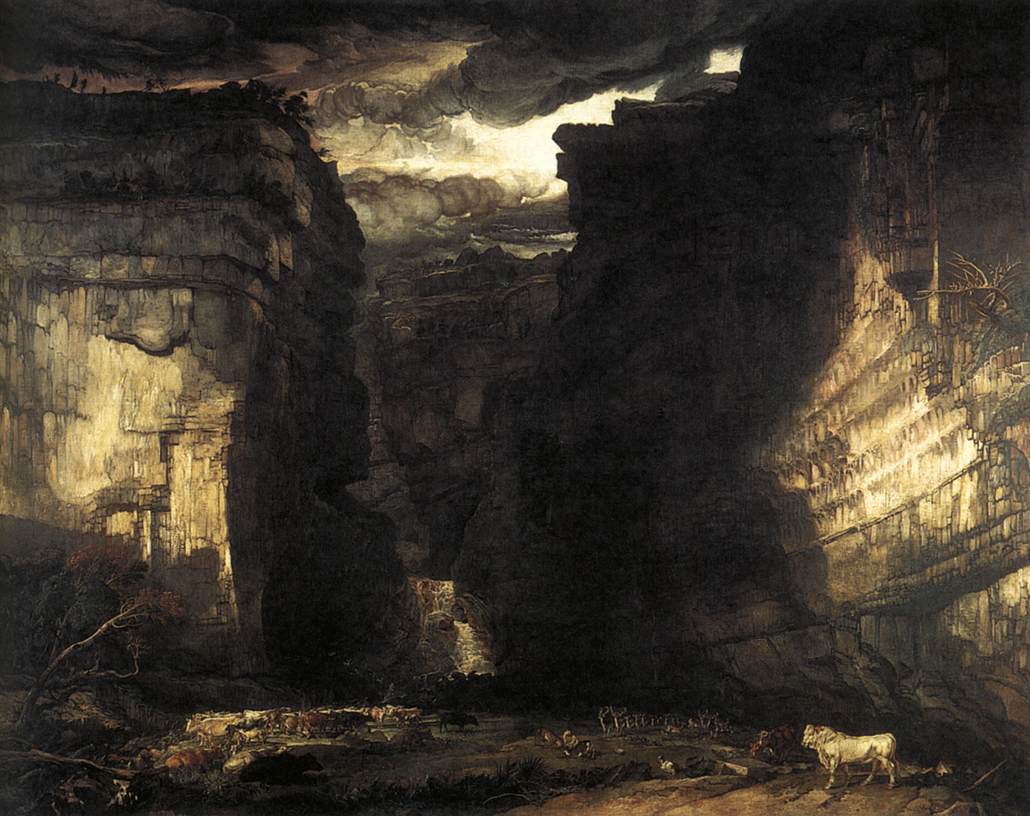
Goredale has inspired artists since the early days of the sublime movement. James Ward’s 3mx4m painting for Lord Ribblesdale captures some of the awe inspiring nature of the site (with a little artistic license it must be said).
Access to Goredale can be had coming from the north end (near Malham Tarn) which is a small 1.5 mile walk or the simple and quick way, from the south side where there is a half mile walk up a well maintained path that starts at the Goredale camping and campervan site.
It is often quite amusing to see people following the public path marked on OS maps as it winds its way up Goredale gorge and then straigh up the waterfall, a route only really recommended for a fit and able with a head for hights and who are happy with some three points of contact scrambling. Don’t try this route with a heavy pack or when the waterful is icy or in full flow (unless you know what you are doing).
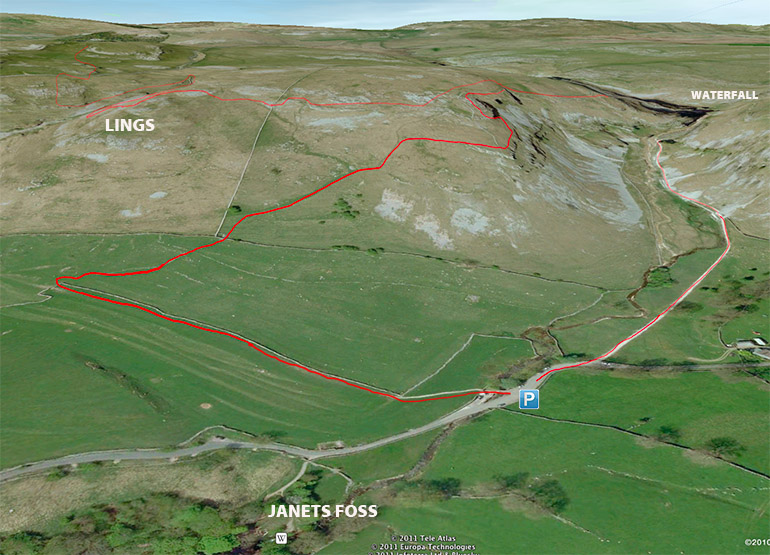
We’ve made a few 360 panoramas to show you around the area and hopefully give you an idea of what you can get up to. My personal favourite route is to go and have a look at the waterfall itself and then come back out and climb up to the top behind the ever present sandwich van as marked on the map below. There are some great shots to be had looking down into the gorge from the top and if you didn’t have the head for heights to climb the waterfall, you can climb down to the same place from the other side to see the upper falls.
While you are at the waterfall, take a look at the areas where the water flows fastest at the bottom of the falls and you’ll see that there is a slow build up of limestone deposit known as ‘tufa’ (the same stuff that the columns in Mono Lake in the US are made of).
If you want to get to see some areas that are less well known, take a walk from the top of the falls west south west towards the Malham Lings where there are a couple of trees, some wonderful limestone pavement and a particularly great scree slope and stone wall, all overlooking Kirby Malham and Otterburn (and some great setting sun in the winter).
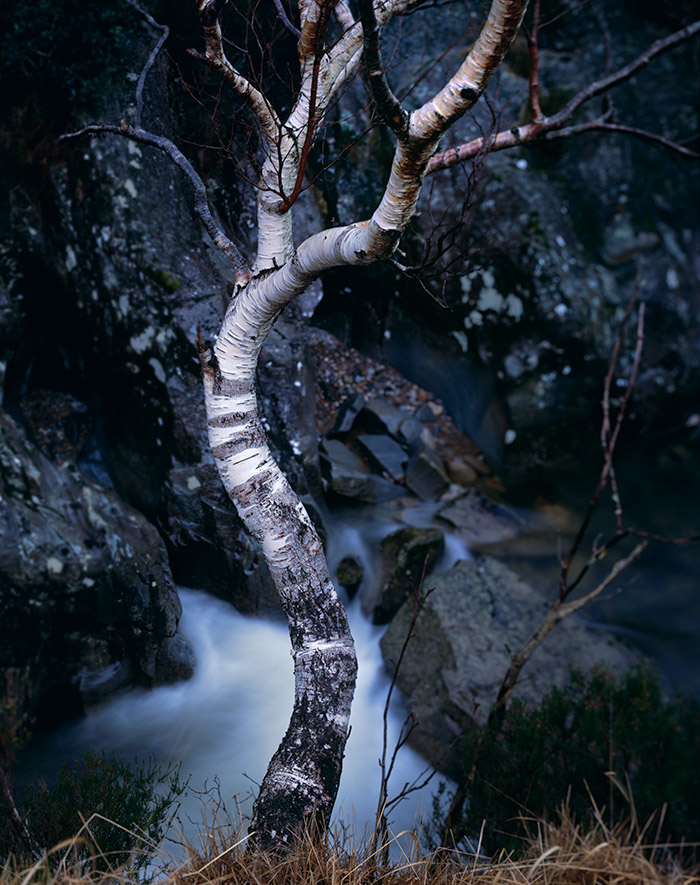
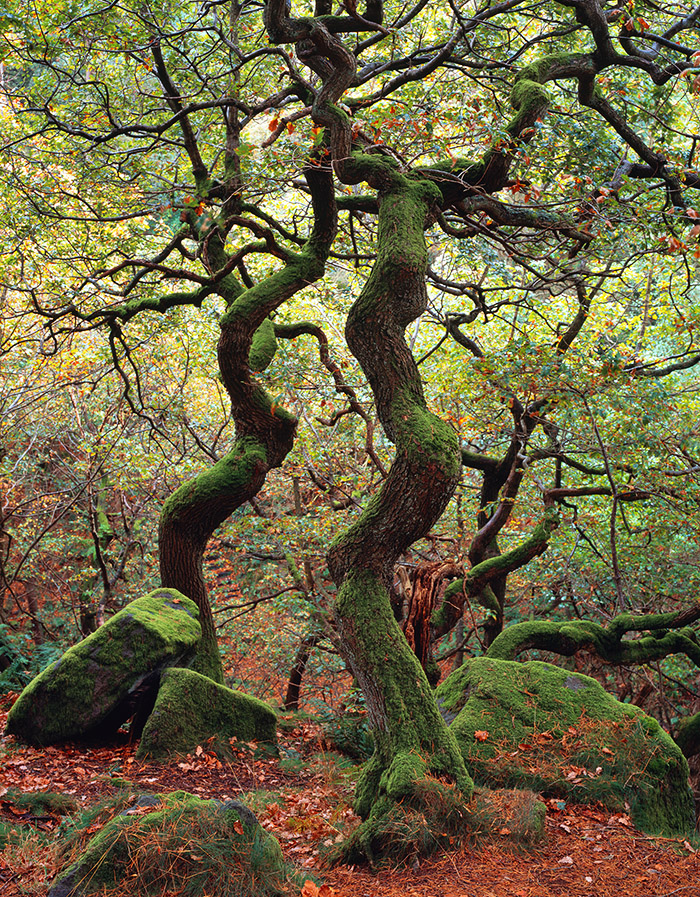
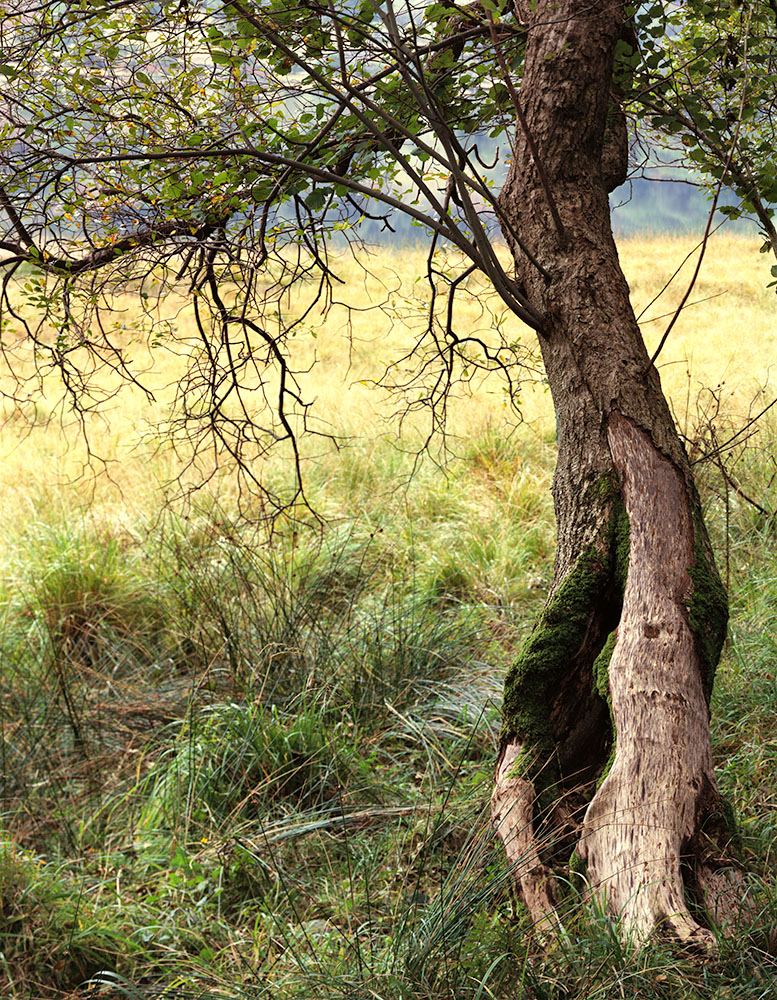
This issue of the Hindsight series takes a look at a set of images from Joe Cornish's back catalog. If you have Scotland's Mountains then you will have seen a couple of the images before but there is also a final image from Padley Gorge in the Peak District (interestingly of the same tree that Dav photographed in our Padley Gorge guide in Issue Two).
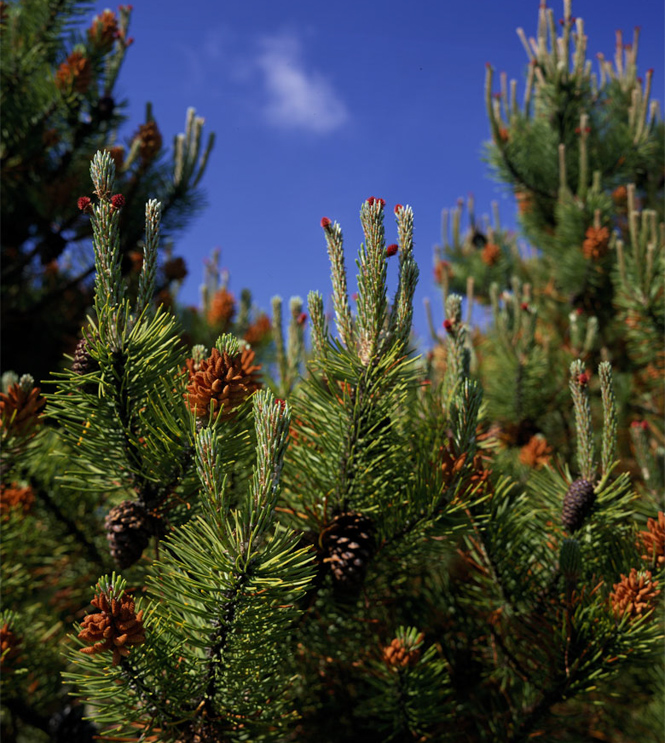
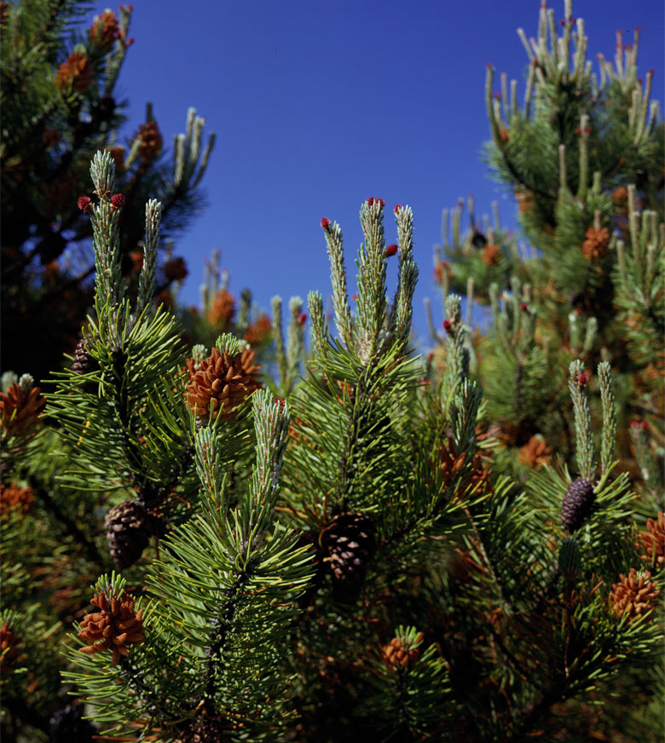
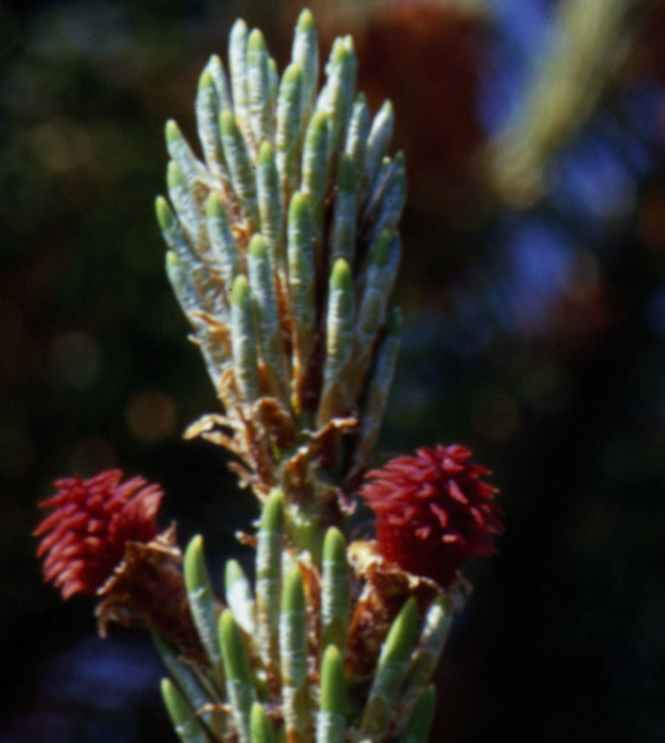
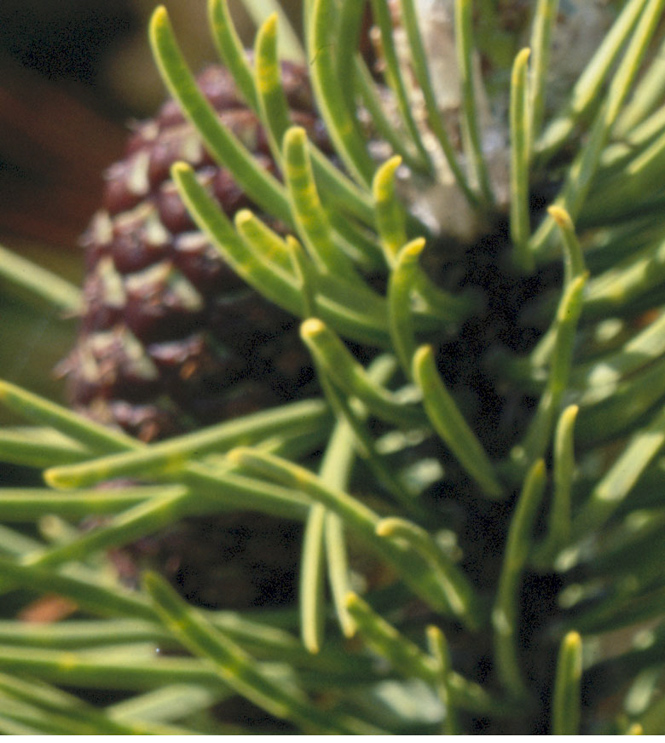
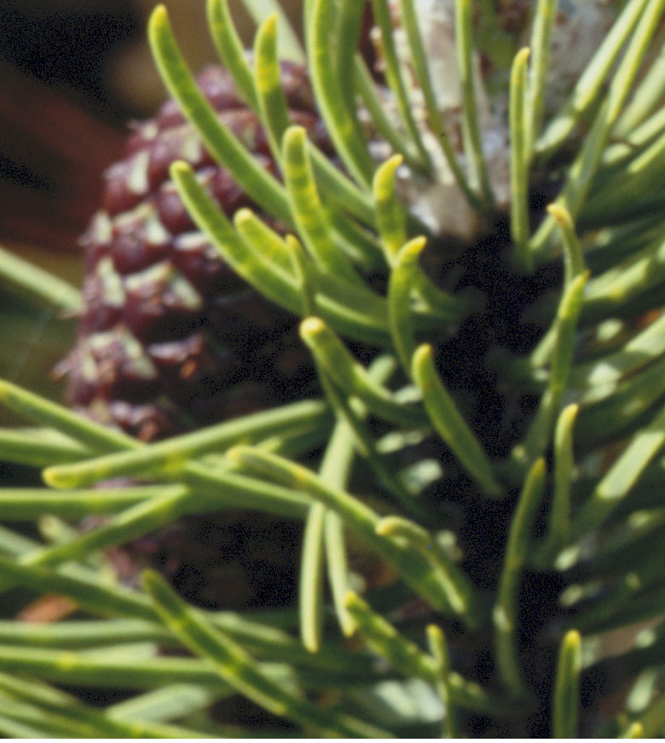
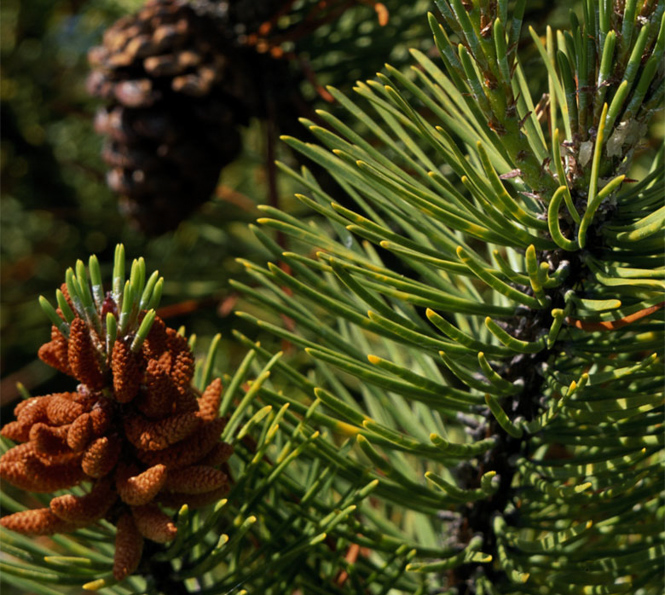
We're back on the film comparison tests again and this time we've got a polarised blue sky and some fir tree greens and pine cone reds and browns. As in the previous tests, the comparisons are between colour films available in large format sheet sizes (comparing roll films is expensive and time consuming).
Digitalab of Newcastle have kindly offered to develop all of these films for us and we will be mentioning them in support of their contribution. See footer for more details.
Methodology
The use of a large format camera makes this sort of comparison a lot easier (if a lot more expensive) as it is very easy to switch between film types from shot to shot. I am also using two graphmatic backs for the film to make things even easier. If you don't know what a graphmatic back is the picture below shows them in comparison with dark slides. They hold six films each and allow you to change to the next sheet by simply lifting the whole body of the magazine out of it's container, allowing the next film to pop to the front. Once you get used to this process (which I hadn't on this first test - see the story at the bottom for more details) then you can change from one film to the next in about five seconds. The main stumbling block in the methodology is keeping track of which shots have been taken, where you are in the series and adjusting the exposure for the different film ISO's. These seem trivial but can get quite stressful out in the field when the light is changing.
Light will inevitably change a little bit between pictures but we will be trying to choose scenes where comparisons are still valid. Additionally, we have bought new film of each type and stored them together. The film has been taken at rated speed for all but the Velvia 50 which was taken a third of a stop down (40 iso or a third of a stop over exposed) as otherwise the comparisons are quite difficult. We've tried to match up mid tones for the transprency work.
We have also placed film that may be used as alternatives as close to each other in the series as possible. For instance, all of the velvias are together, the portras are together, all negatives are together, etc.
The negative film presents the biggest challenge because there are so many different ways of converting them to positive images. To this end, although we have made our own conversions using colorneg at close to standard settings, we have also corrected colour casts where a simple colour curves adjustment allows it. We will be working on the negative inversion process over the coming months and will reassess these as we do. We are also providing the scanned negatives for you to try yourselves (scanned using as colour accurate a process as possible so the scans look like the negatives on a lightbox - possibly with different gammas).
The scans were made on a Howtek 4500 using profile generated with the Hutch Fuji colour target which have proven to have very accurate colour.
Please be aware that the Velvia 100f was overexposed but is included for completion. Also, my technique when taking these shots was probably a little too fast and I haven't given enough time for the camera to settle down in between shots and so there is some movement. Therefore please use these examples as a guide for colour differences between films.
Here is a full list of the films being compared.
Transparency
Fuji Velvia 50
Fuji Velvia 100
Fuji Velvia 100f
Fuji Provia 100
Fuji Astia 100
Kodak E100G
Kodak E100VS
Negatives
Kodak Ektar 100
Kodak Portra 160NC
Kodak Portra 160VC
Fuji Pro160S
Kodak Portra 400NC
The viewers below allow you to pick which two film types to compare. Click on a film type from the list below the image on the left and then do the same on the right and you can then move the comparison slider backward and forward.
Evergreen Tree, Polarised Sky Results
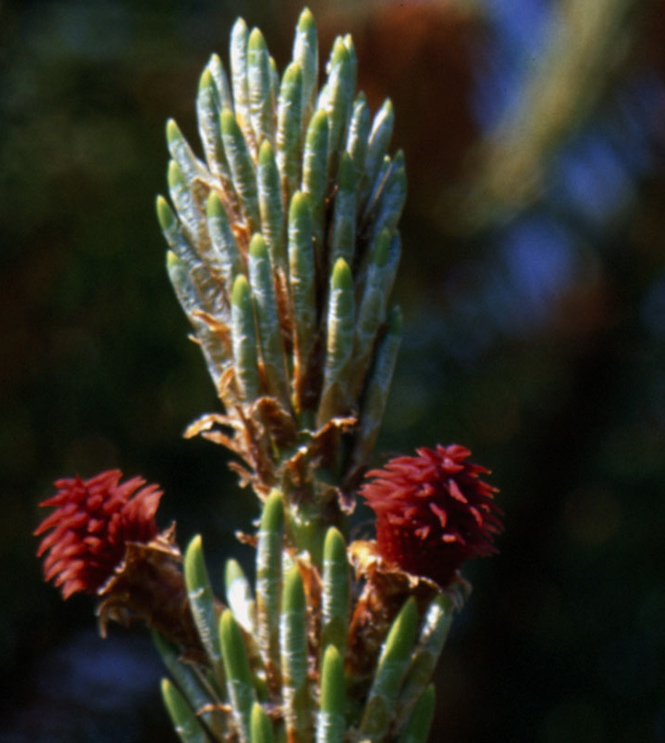
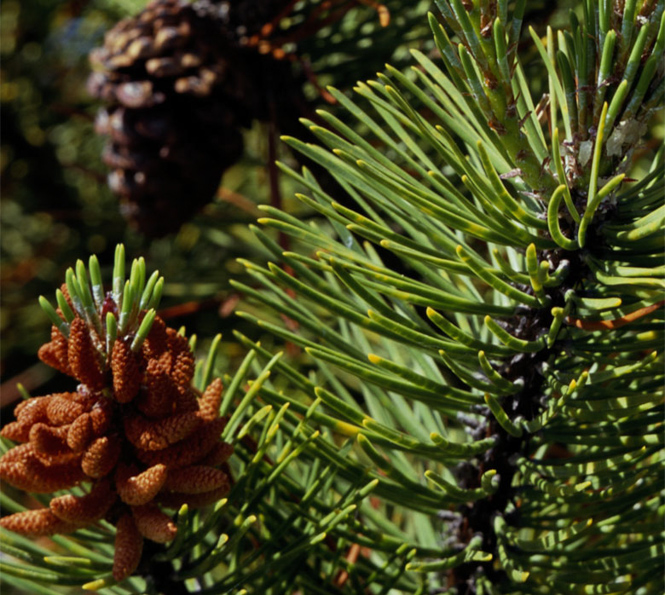
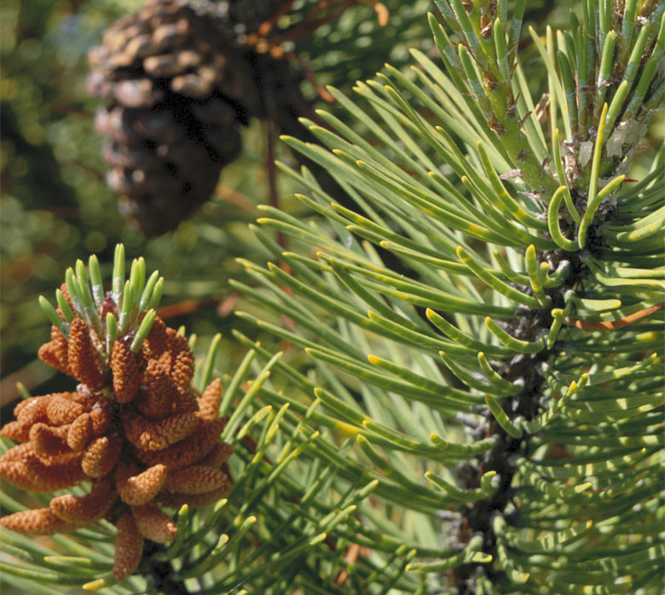
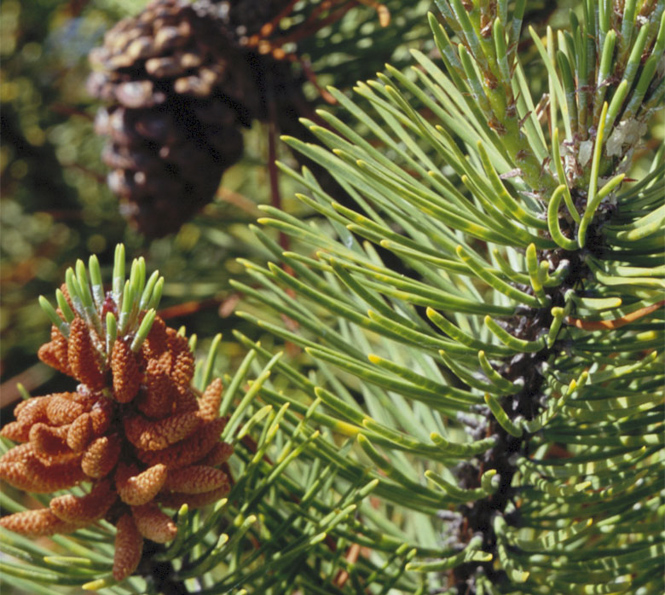
This second set of results were taken whilst on a trip to Northumberland and I wanted to capture a subject that contained some intense colours, including natural greens and blues. The clear blue sky was a great start and adding a touch of polarisation upped the ante a little. The evergreen tree I found had some wonderful rich orange red female cones and some older bluey green male cones.
Were talking to Peter Hyde this issue, a great photographer from Lancashire who has been recommended by a few people as someone we need to talk to. We hope you enjoy the read and Peter's pictures.
In most photographers lives there are 'epiphanic moments where things become clear, or new directions are formed. What were your two main moments and how did they change your photography?
Perhaps the first such moment occurred in late 2004, whilst on a holiday in Florida. We were in a small Everglades’ village where there was a cafe cum craftshop and so we wandered in for a brew. Whilst in there I noticed a row of books on a shelf and picked one up to browse. It was a book of photographs of the Everglades by Clyde Butcher. Looking at his superb black and white images was the first time I had really recognized that landscape photographs could be such a powerfully beautiful art form and, although it took some time to gestate, I believe this was the real starting point of what I now find a near obsession.
The second moment came some years later (March 2009) when I had actually bought a DSLR and taken a place on a L & L photography tour in the Lake District. On the first morning I was crouched on the shore of Ullswater trying to make something of the scene before me. Standing next to me was Clive Minnitt. As I struggled Clive turned to me and quietly said “Have you seen this?” (or words to that effect) and passed me his small compact camera with a shot displayed on the LCD screen. This image was part of the scene I was looking at, but I had not seen it the way that Clive had. His image stripped down the scene to far fewer elements than I had been trying to include, ... my first demonstration of ‘less is more’. Under his guidance I recomposed my shot and a print hangs in my hallway.
You’ve made some magnificent pictures of the American South West, tell me a about this journey and how it affected your photography.
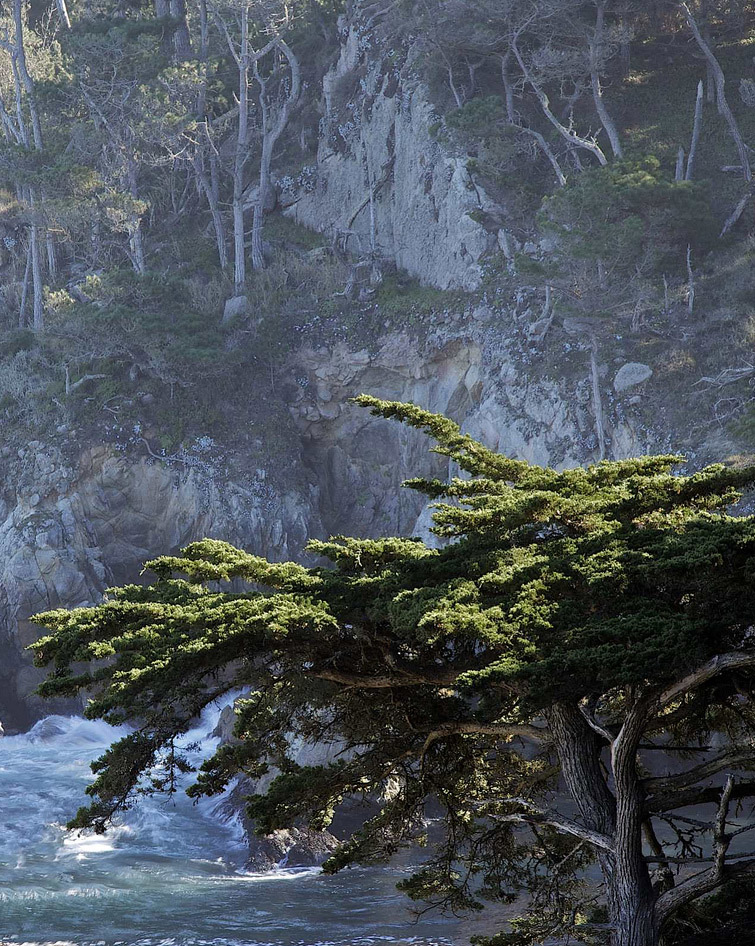
Thanks for the compliment Tim, I certainly enjoyed making those images. The first two weeks were on an organised photo-tour, [Canyons in Fall with Nigel Turner] the itinerary of which included many ‘iconic’ locations, including Zion Canyon, Bryce Canyon, Antelope Canyon, Monument Valley and Canyon de Chelly. Afterwards I spent some time exploring the area around and south of the Monterey Peninsula.
I think, as with all the photo-tours I have attended, it did benefit my photography. Simply having so much time to spend immersed in new and interesting locations, with no other ‘focus’ than taking photographs provides lots of practice in looking for subjects and compositions. Utah and Arizona have such amazing geological features that vistas scream out to be taken, but one thing I also recognized was how much I enjoy looking for ‘alternative’ views or more restricted landscapes, and I certainly made more images of bits of rock, dead wood, and patches of forest floor than I had anticipated.
Whilst in the States I was also fortunate enough to visit several galleries and exhibitions. In particular I visited Michael Fatali’s gallery at Springdale and an exhibition of Charles Cramer’s photographs in Carmel and I would challenge anyone not to be inspired by viewing such work close up.
You have a very bold compositional style, using graphic shapes and flow in your images - how did you learn to compose this way?
I find this very difficult to answer but would say, in general, I go with my instincts as to what ‘feels right’ and gives what I hope is an aesthetically pleasing image.
I do look at a lot of photographers work, both in books and on-line, as well as visiting galleries when possible, and this must influence how I want to present images. One style I do adopt at times may result from my working life as a mycologist and plant scientist. I particularly enjoy images that place some intricate detail, such as a plant or lichen, within its wider environment. In order to do this I frequently use a wide angle lens held close to the foreground, and I often choose a vertical format to include the more distant landscape. I sometimes feel such compositions are reminiscent of rather old fashioned field guide illustrations, and maybe this is why I like them.
Nowadays I always compose using ‘live-view’ which I think is helping me to improve this aspect of my photography. I also know that I will often crop an image to a different format and this allows me to tweak a composition on the computer screen. My principle reason for going ‘full frame’ was to let me do this more effectively, ... perhaps I shouldn’t admit to that quite so publicly.
Could you tell us a little about the cameras and lenses you typically take on a trip and how you came to choose it.
My main camera is a Canon 5D mark2 and, as I indicated above, one of the reasons for choosing this was it has a lot of pixels to work with, allowing some post-capture cropping without loosing too much resolution. I only have two lenses, the Canon 24-105mm 1:4 L and a 17– 40mm 1:4 L wide angle. I also use a set of Lee soft NDgrads, and I have a 10 stop ND, which is a fairly recent acquisition that I still consider ‘experimental’.
A couple of months ago I bought a compact Panasonic Lumix DMC-LX 5 principally as a “taking on walks camera” but I think it will also get some more ‘serious’ work. As yet have no filters for this.
You take many of your photographs at between f/18 and f/22, something that many 35mm photographers would look in horror at (because of diffraction). Obviously this is done for increased depth of field but will reduce the resolution of your photographs. Did you consciously decide that depth of field was more important than extreme sharpness?
I suspect several of my practices would be looked at “in horror” by more experienced and able photographers Tim, but the small aperture decision is one I often take, especially when using wide angle shots with a low point of view, very close to the selected foreground. I think my approach is somewhat pragmatic in that I mainly want the maximum depth of field and I am not too worried if, as a byproduct, there is sometimes a little softness in the final image. [Possibly I should invest in a tilt and shift lens].
Tell me what your favourite two photographs are and a little bit about them.
I am not too sure about “favorites” but I have chosen two shots from my US trip.
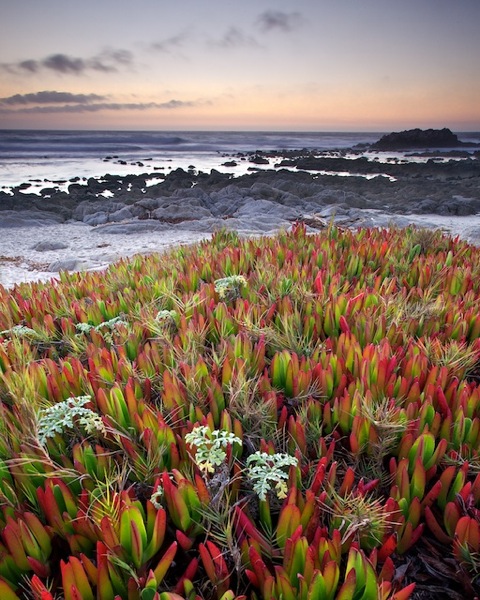
Asilomar State Beach:
This beach is on the Monterey Peninsula, Cal., facing westwards. I like this simple blocked composition with the extended foreground being composed mainly of Hottentot Fig leaves (the main subject), interspersed with a few other leaves of different shapes and colour. The overriding red/green, complementary colour combination provides impact and this was the primary aim here. Beyond the foreground the image is much softer and moving through the layers of rock, sea and sky more muted colouring gives a background which sets the scene but does not compete with the foreground subject matter. The sunsets here are often veiled by sea frets and I think a more colourful horizon and sky would have provided too much distraction from the leaves.
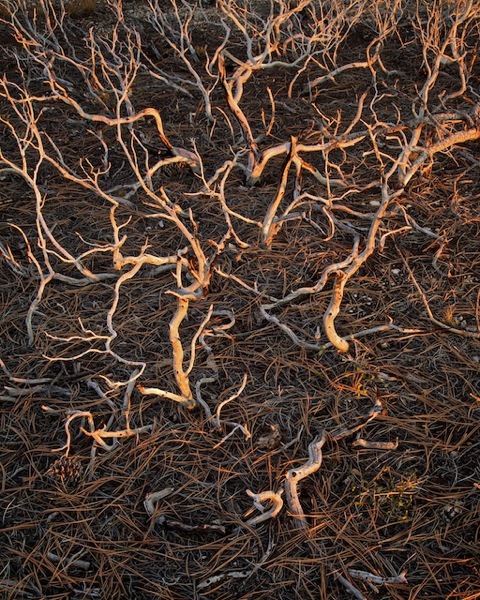
Fire damaged Manzanita:
This shot was taken near the Rim Trail, Bryce Canyon National Park. To my eyes this image is somewhat ‘abstract’. The twisting shapes are produced by bright morning sun striking dead Greenleaf Manzanita stems. The background of pine needles are, as yet, still shaded as a result of the slope of the ground. There are no strong colours, but the contrast between light and dark appeals. I selected a region where there was a gradual gradient in the density of the stems to give some variation as you move from bottom right to top left.
When you are ‘in the field’, what is your usual workflow? i.e. How do you find a picture? Do you take sketch shots and then go back to a choice spot and wait for light? etc.
Photography is something I do purely for personal pleasure and so I don’t have any specific constraints on what I photograph or how I do it. When out with my camera I look for things that interest me and try to be receptive to all aspects of the landscape from wider views to more restricted subjects. If I see something that I like I try to imagine how it would look as a picture and experiment with view point and framing possibilities, excluding or including different parts of the scene. If things look promising I will then try to make a composition on the camera screen. After making a shot I usually take advantage of ‘using digital’ and check exposure histograms and if necessary adjust the filtration and/or exposure before reshooting, sometimes with the intension of blending exposures. If I think the conditions are changing in an interesting way I may hang around and take another version of the scene. I will sometimes have three or four versions of a similar shot some, or all, of which may end up in the computer’s trash bin.
I don’t take ‘sketch’ shots, but I do sometimes return to certain locations that I have photographed before. I hope that as I become more familiar with a location and see it in different conditions, I will find new possibilities and hopefully exploit them more successfully.
What sorts of things do you think might challenge you in the future or do you have any photographs or styles that you want to investigate? Where do you see your photography going in terms of subject and style?
I am aware that I still lack experience and I need to spend time practicing to improve all aspects of my photography.
I have yet to set myself any specific project but this is an ambition I have, with the intention of creating a collection of images exploring a particular subject or location. One notion that I am considering would be based around the theme of grasses, a family of plants that I have had a long term interest in, but which I now want to explore purely from an aesthetic point of view.
With regard to subject and style I recognise that I really enjoy looking at images of ‘small scale’ landscapes and I would like to develop some skills in this direction.
Who do you think we should feature as our next photographer?
Difficult, ... there are lots of people whose work I admire, but I would be very interested to see a ‘feature’ with Julian Barkway or David Langan
We've all seen them on photo-sharing sites: images of grand vistas with strong colours, dramatic perspectives, apocalyptic lighting. We've read the comments: "wow, great shot", "wow, amazing colours", "stunning composition", "I'm blown away", etc., etc., etc. We may have seen these images walking away with the top prize at our local camera club's competitions. But hold on a moment. Aren't they all a little bit, well, samey? Don't they all seem to use similar techniques, effects and compositional devices? Haven't we seen the same handful of famous locations before?
Photography is a means of communication and, like other means of communication, depends on mutual understanding of a common language. So, what are all these very similar images trying to say? What is their message? It seems to me that mostly what the photographers are saying is, "I've seen images that sort of look like this one and I think they're fantastic. And, what's more, I can do it too!" When everyone is shooting much the same few locations from much the same viewpoints in much the same light, you have to ask: where is the personal vision? Where's the individual voice? Has photography come down to using some tried-and-trusted formula to elicit the hoped for single syllable response, a simple and basic utterance of 'wow!'?
Well, I certainly hope it hasn't. There are still photographers - both amateur and professional - who seek to communicate using a visual language composed of more than mere monosyllables; who can create images of the landscape that are thoughtful, provocative, evocative, mysterious, beautiful and which speak to the viewer on many levels. So why is it that so many landscape photographers (mostly, but not entirely, in the amateur world) are content to reproduce the Standard View and do not seek to show something a little more personal?
Mist 4 - Christian Vogt
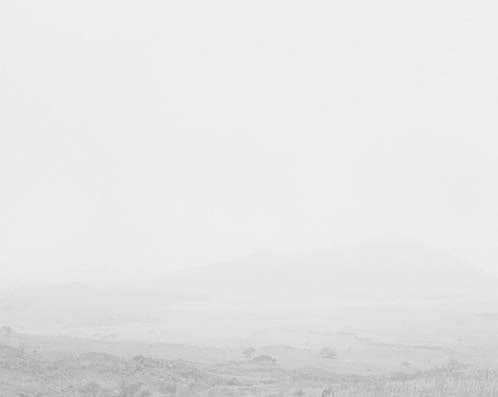
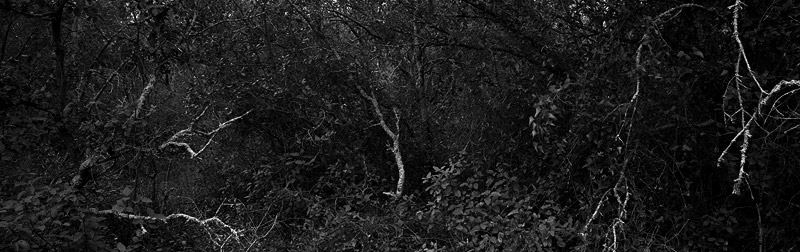
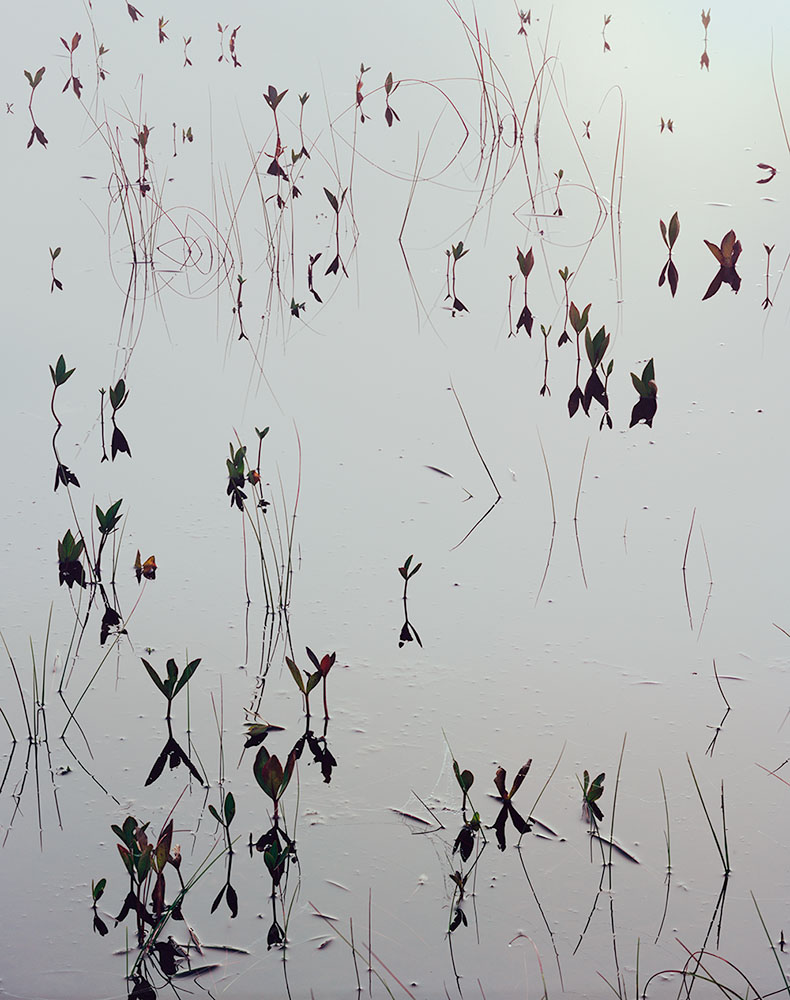
Recently, I went to an exhibition of work by the Swiss fine-art photographer, Christian Vogt.Vogt is not a landscape photographer per se but he does use landscape as subject-matter when it suits his artistic goals. Walking around the exhibition, I encountered two or three large prints which, from a distance, seemed totally white and devoid of anything that might loosely be called 'photography'. Thinking this was some kind of ironic statement, I walked closer and as I did so, intriguing details emerged from the seemingly blank sheets of paper. They were Alpine scenes in fog - part of Vogt's 'Mist' series. Not so much low contrast as practically no contrast - just shades of pale grey. I remember being utterly captivated by the emptiness of these images and how brilliantly executed they were. Moving on, in another part of the gallery I found images from the same photographer's 'Naturräume' (natural spaces) series - huge monochrome panoramas of forest scenes, rich with detail and essentially chaotic; the total antithesis of the 'Mist' prints, in fact. Although the enormous scale of the prints was impressive, it was the careful composition that drew my interest. There was a great attention to detail and the way tones and compositional relationships were handled made the images appear almost three dimensional. You felt you could, as the old cliché has it, step into the scene and become part of the picture.
What struck me most about these images, however, was not the mastery of their execution so much as how unnecessary it is for an image to have the 'wow' factor to be interesting. Apart from their sheer size (something of a trend in contemporary 'fine art' photography), there was nothing intrinsically impressive about them. Nothing that made me gasp with admiration. In fact, they were 'anti-wow' images. Like classical music or modern jazz, the images demanded that the viewer make an effort to meet the artist halfway. They were images that make you think for yourself.
Contrast this with what we see daily on all our favourite photo-sharing websites. Images which are designed with the goal of making the viewer go 'wow!' don't generally speak quietly or invite concentration. As in the world of advertising, it's about a simple message shouted very loudly. Advertisements are, by and large, not designed to be subtly ambiguous or to be lingered over. They are about making the maximum impact in the shortest amount of time. They are instantly forgettable even if they have already done their job of carefully implanting a message in our minds.
Of course, it should not be forgotten that 'wow' images, when done well, are highly commercial and artists such as Peter Lik have built profitable businesses out of this style. If you have customers to please and a bank manager to appease then what the customer wants the customer should get. But what if you are taking images for yourself or for an audience of your peers? Differentiating your work from that of others makes sense. If the ultimate goal is to develop your own style, how can it help repeatedly copying a style that is all too ubiquitous?
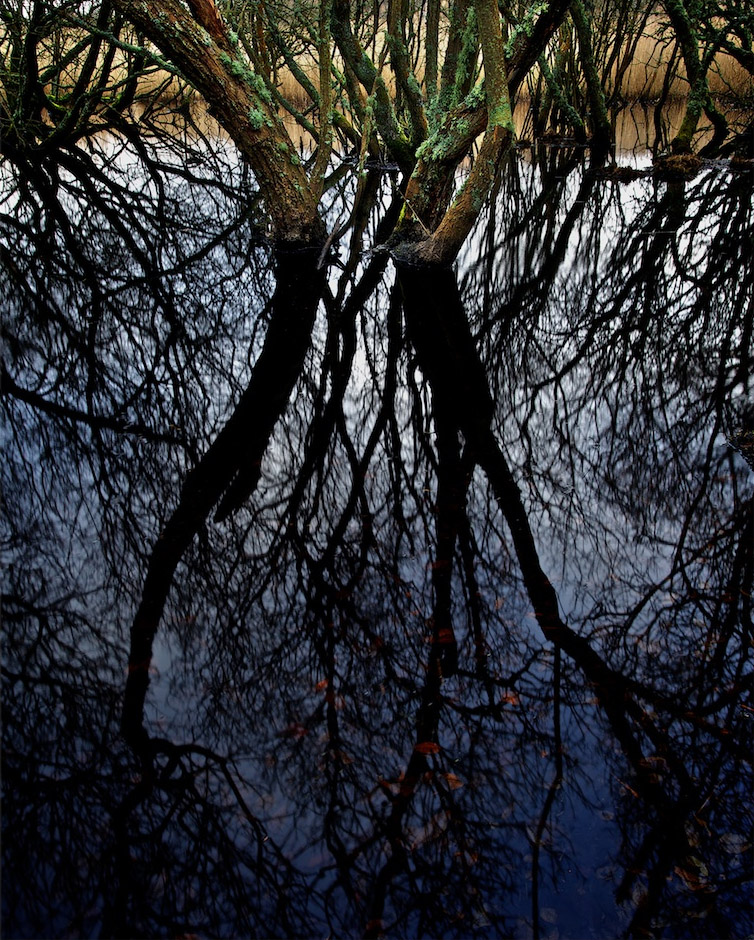
Reflected Branches - Julian Barkway
So why is it that so few photographers seem to be creating images which demand that viewers put in a bit of effort to understand them? Isn't it also a good feeling to have someone lingering over your work, finding new levels of meaning or more subtle details with each passing minute? Perhaps, in our modern age of fast food, instant sharing of every experience with (potentially) many thousands of people and, let's face it, fast photography we have lost the skill of simply taking the time to appreciate art. If it doesn't stimulate in the first few milliseconds then it's discarded in favour of the next image. After all, there are thousands more every day.
I feel we are short-changing our potential audience. It's as if landscape photographers want to be anonymous. If we want people to think of photography as art then isn't making a statement that is not only personal but complex and subtle to be desired over bright colours and melodramatic effects? In short, if you have something worthwhile to say, then make sure it comes across in your photographs. I'm put in mind of that scene in the Monty Python film, 'Life of Brian', where Brian is trying to get the large crowd of followers gathered in front of his home to disperse. He is imploring the crowd to think for themselves. "You are all individuals!", he shouts and then the crowd chants with one voice, "Yes, we are all individuals". Everyone wants to be an artist yet also seems to be forgetting that the phrase 'be true to yourself' lies at the heart of being an artist.
So, if people say you should use the very widest of wide-angle lenses, then use a telephoto; if they say you should only photograph landscapes at dawn and dusk, go out at midday; don't use golden light, shoot in the rain; find your local area of beauty or personal significance instead of travelling to the same few locations as everyone else; shoot landscapes on a more intimate scale, not just the grand vista. Above all, make people think about your photography! Give them a reason to remember your work. Make them want to linger over each individual image. Make them say, 'this reminds me of my childhood' or 'this is rather melancholy' or 'you know, I've never seen trees that way before' or even just 'hmmmm'. Anything, in fact, but 'wow!'
Julian Barkway is a landscape photographer from the UK who is currently living in Switzerland. Working with a 5x4 camera and a full frame DSLR in the mountains has created a wonderful portfolio of pictures that I recommend you take a look at. His main website is at http://www.quiet-light.com/ and you can see his regularly updated Flickr stream here. Many thanks to Julian for this article..
Castle Crag is one of the highlights of what Wainwright called "the loveliest square mile in the Lake District" and when I got together with a group of photographers at the end of January we were treated to a great display of why he thought so. We stayed in small self catering cottage in Manesty on the outskirts of Grange which was a great base to explore the bottom of Derwent Water and on our last day, to walk up to Manesty and through to Castle Crag itself, exploring the small quarry on top and the views over Rosthwaite and Longthwaite.
You need to be a paying subscriber to see this content
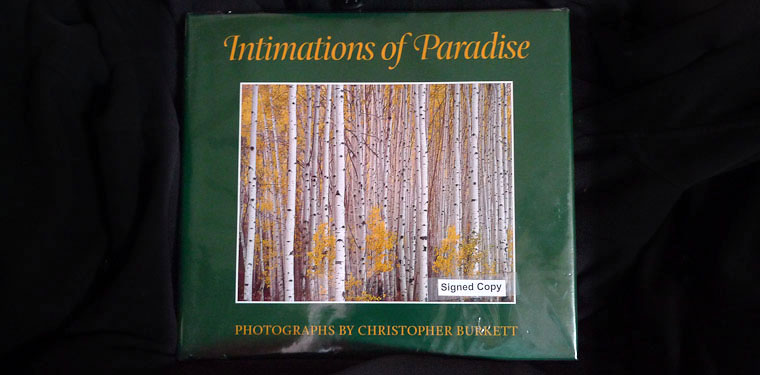
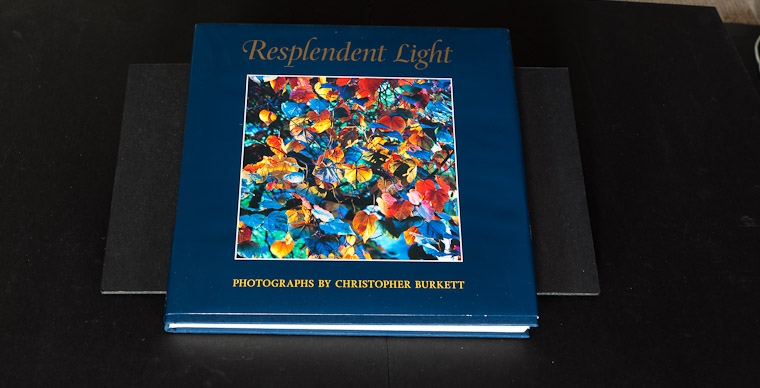
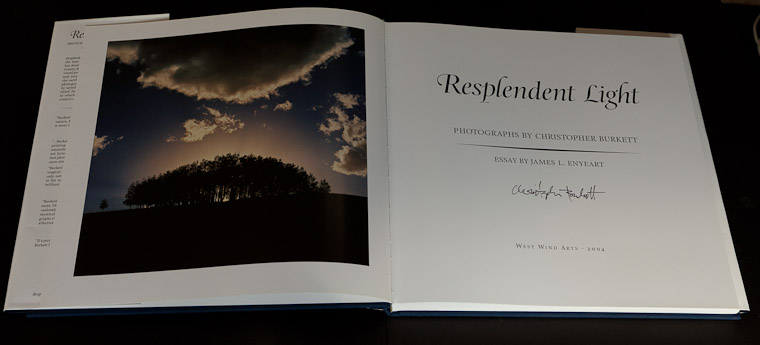
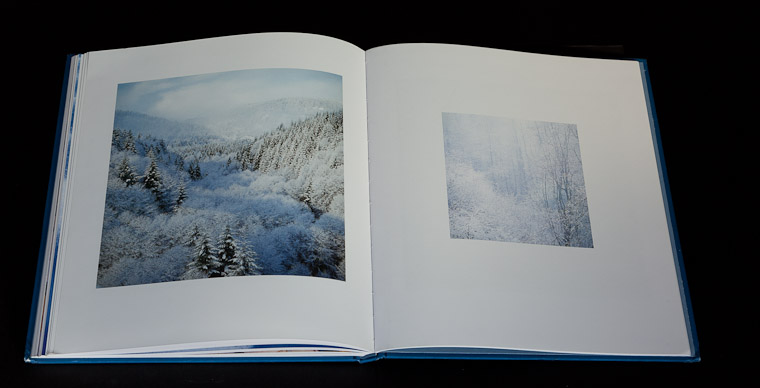
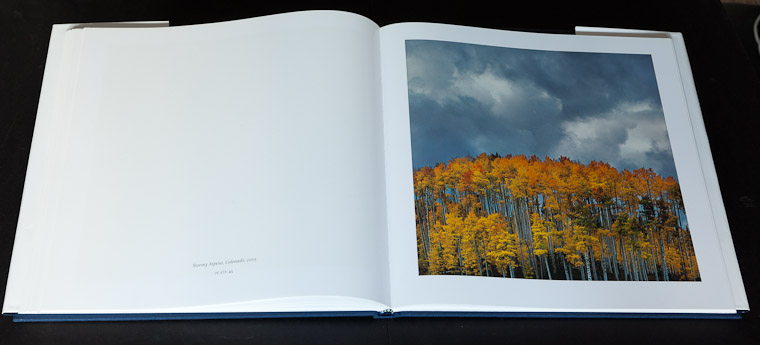
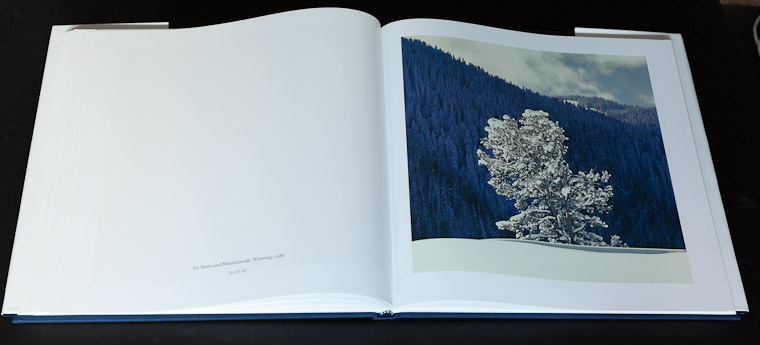
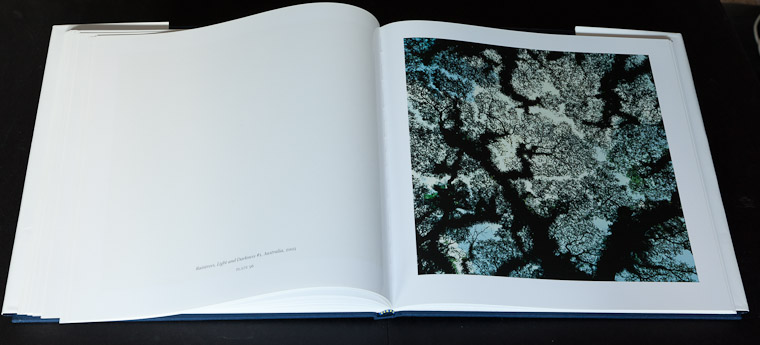
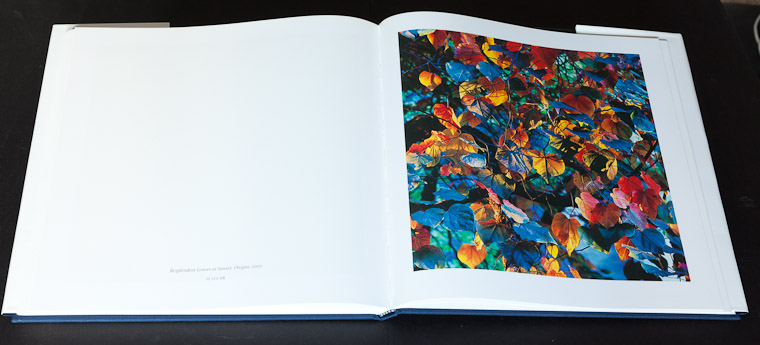
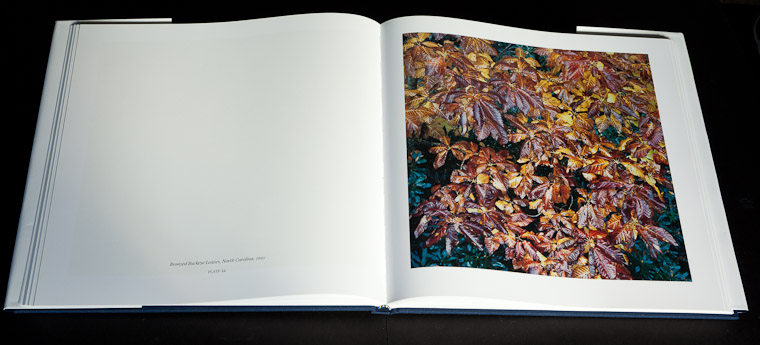
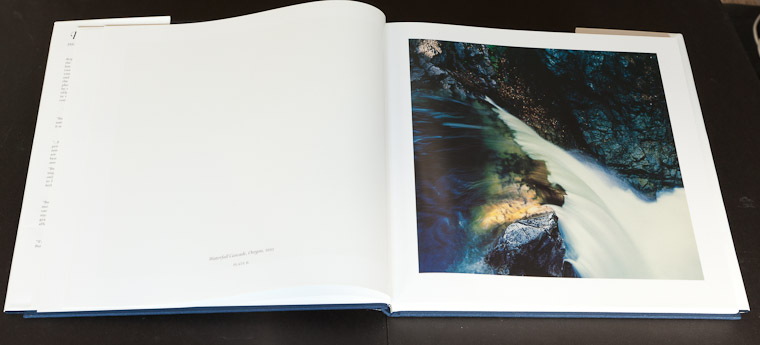
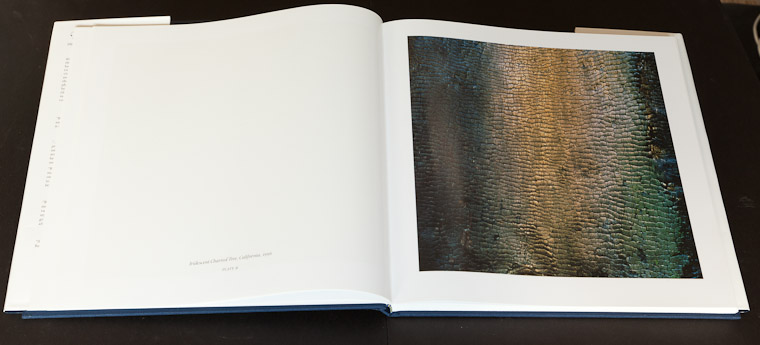
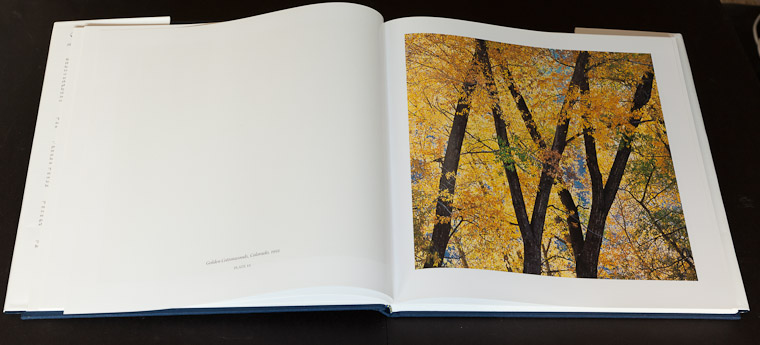
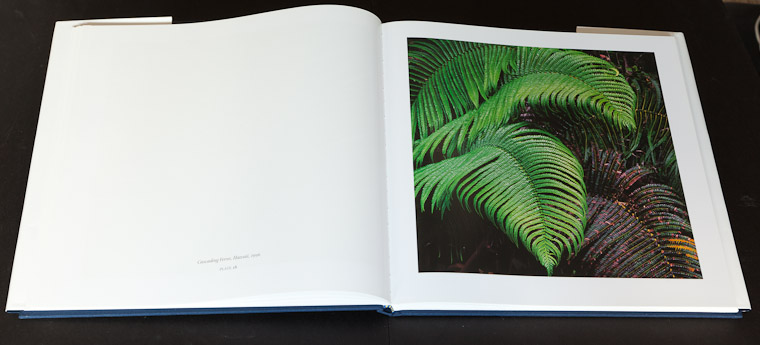
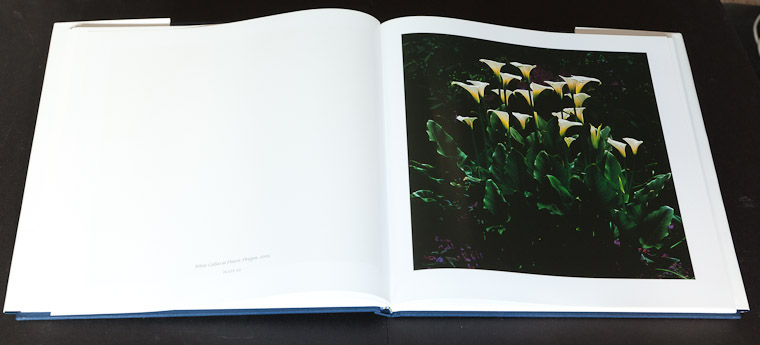
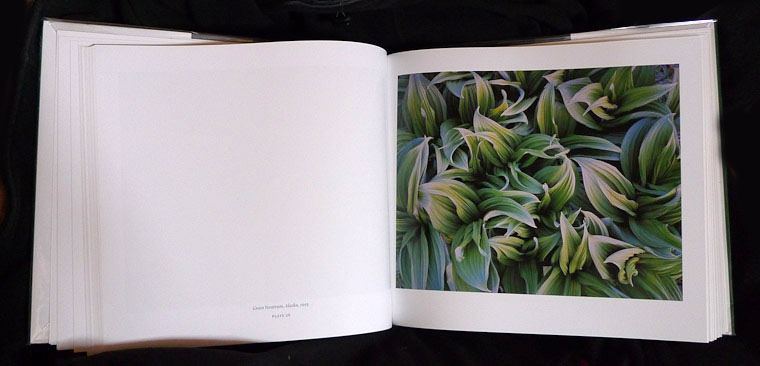
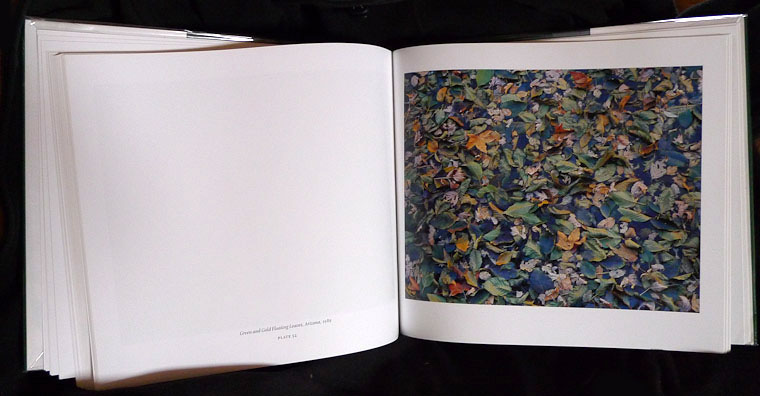
As we’ve seen in my Christopher Burkett mini-biography, Christopher is an extraordinary photographer by any account. However, he has also realised that the best way to disseminate his work is through publishing books and even went to the lengths of working in a scanning and printing companies to learn the skills of colour separation and printing. These skills have informed the creation of his two self published photography books, Resplendent Light and Intimations of Paradise.
The two books represent two aspects of his photography, Resplendent Light contains his Hassleblad work and Intimations of Paradise contains his 8x10 work. The separation of the two books into camera formats leads to an interesting subject/style split which I’ll talk about in a moment.
We’ll start looking at what must assume is Christopher’s main work, Intimations of Paradise. I say this because he admits that he uses the Hassleblad camera when the conditions preclude the use of the 8x10 Calumet camera. These photographs are studied works of nature and light and there most beautiful. Quite often the pictures could be described as ‘simple’ in composition but anyone who has tried to compose in the complex environment of forests and grassland will realise how difficult this really is.
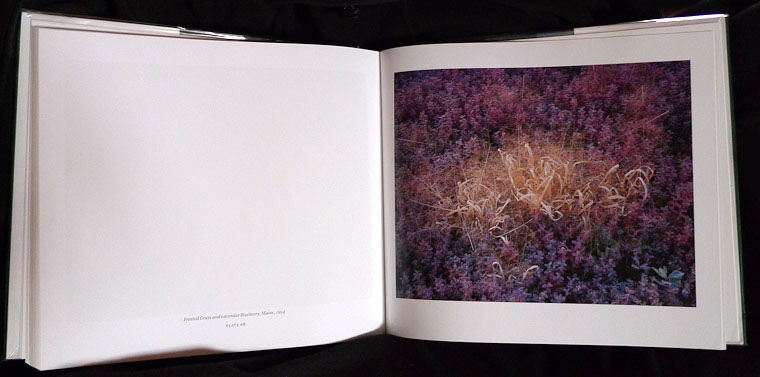
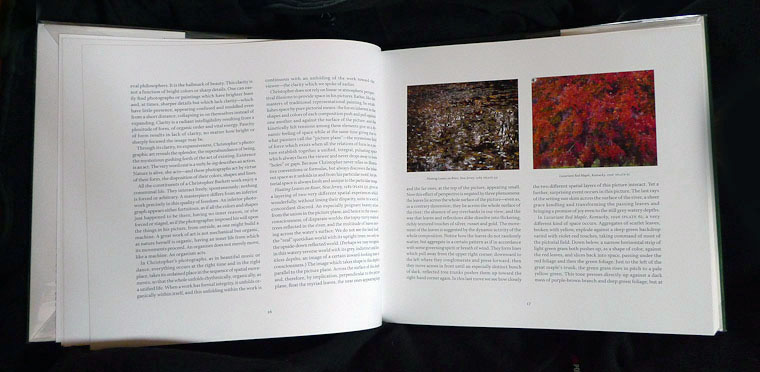
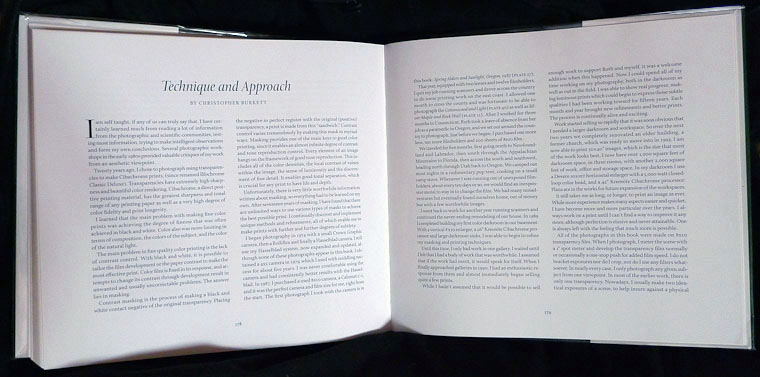
Before I talk about the photographs themselves I should give you an idea of the amount of attention to detail that went into it. Christopher ordered a specific type of paper for it that wasn’t available in the right size so he asked the supplier to make a special batch. The printers couldn’t get the colour right on some pictures so he created an extra colour channel in addition to the normal CMYK channels that allowed him to get a couple of troublesome blue colours just right. This is attention to detail way beyond what most commercial publishers can manage, and it shows in the end results. These prints are luminous and rich in colour with a very fine, almost invisible screen.
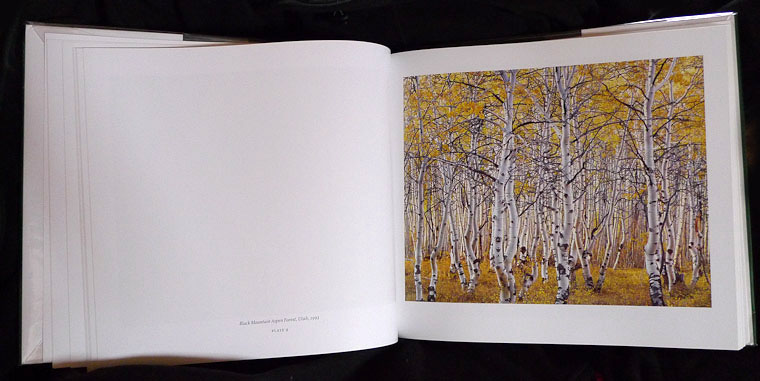
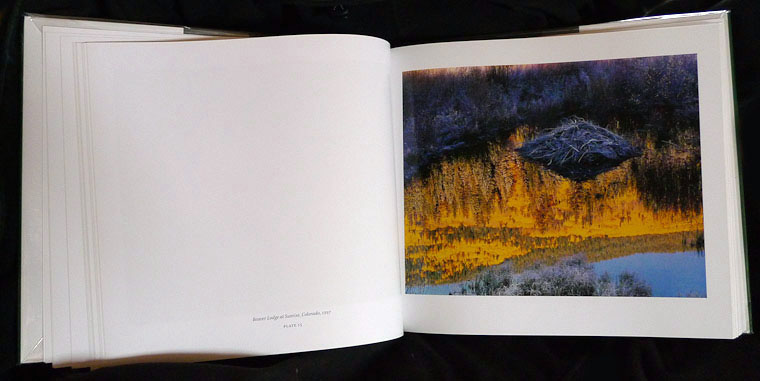
The pictures are what really sells a photography book though and Intimations of Paradise has those in abundance. The pictures are stately in their magnificence and avoid most compositional ‘tricks’, probably because these are nearly all about texture and organised chaos, light and colour. Don’t take my word from it though, you can get a preview of the pictures included by looking at Christopher’s 8x10 section on the website where you most of the images in the books are included. It also has three introductory essays singing the praises of his work (possibly a little over the top but you can’t argue with their opinion) and also two sections describing Christopher’s background and technical information.
Resplendent Light is in it’s physical production, a very similar book. the printing is again beautiful but they are undoubtedly different. It was only when I was sitting down with David Ward recently and looking through both books back to back that it became very clear that the Hassleblad work is in many ways a lot more creative. It seems Christopher takes a few more chances with the ‘blad; photographs that probably fall outside his ‘expected’ material (less trees for instance). This makes it a very different proposition and I think this is the ‘supporting’ book that show the alternative side of Christopher’s work but is no lesser a book photographically.
These books are two of the best photographs I’ve seen and at least Intimations should be included in any serious romantic landscape photographers book collection.
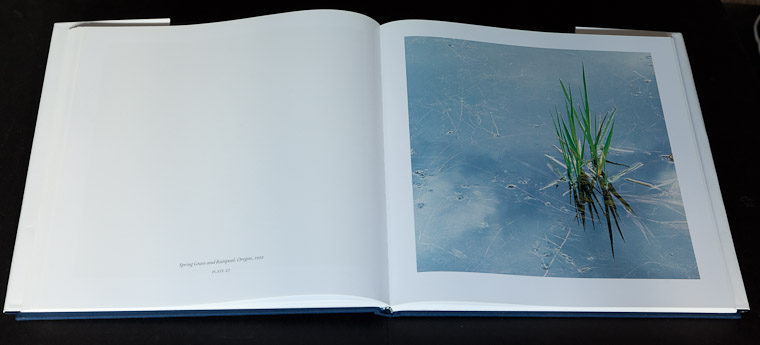
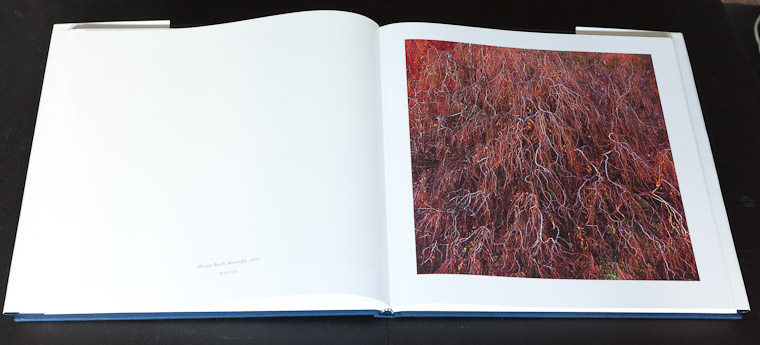
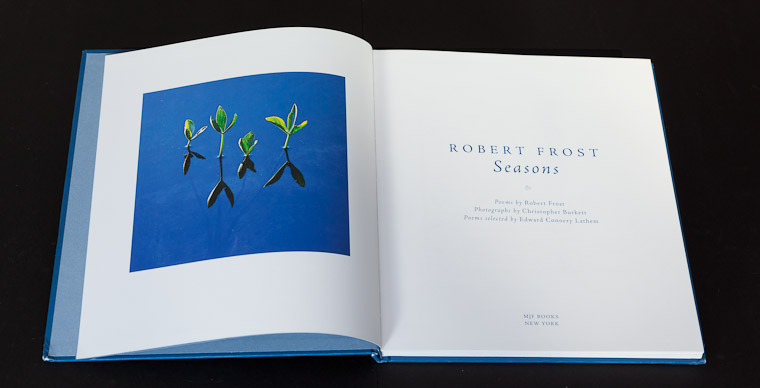
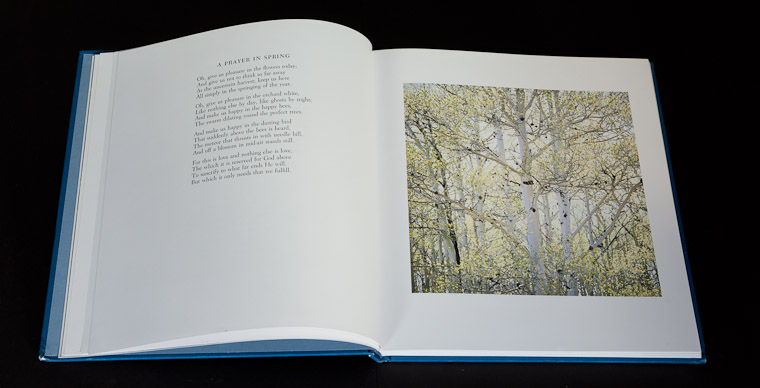
As an additional item to this review, you should also consider the book Seasons by Christopher Burkett and Robert Frost. The book is a collection of poetry covering the four seasons and each season is followed by a series of plates by Mr Burkett. About half of the pictures appear in the two books reviewed but there are a substantial number that don't. The pictures are very good as well and for the completist, despite the printing not being as good, this is worth the purchase (try Abebooks or Alibris).
Tim Smalley was one of our early subscribers and Dav Thomas and I had already met him when he came on one of our one to one workshops (actually two to one - we like intimidating our clients). He's an engineer by training (studied for degrees in material science and computational science) but has ended up as an entrepreneur who develops online businesses for a living. He's now on his third business, a new online magazine which has some photography connections, but still finds time to get out into the landscape.
We asked Tim where his photography currently stands and he mentioned that the new business was getting in the way a little, so much that despite having his own printer, he has decided to farm out his print services in order to optimise his available time, just printing a reference to give to the supplier (wise move).
Tim got into the outdoors from an early age as a scout and cub and his first camera as a 'back of a cereal box' offer which was upgraded after using the schools SLR camera and experiencing the magic of seeing a print appear in a darkroom tray. The SLR was used as part of a GCSE art project photographing tree stumps - the germs of a landscape photographer in the making. Once the GCSE's were out of the way, a Canon EOS300 followed and was used for a couple of years at college where he also went on his silver and gold Duke of Edinburgh awards in Glen Shiel and Glencoe (and another course in Skye) - how could you not fall in love with Scotland after seeing those places!
Moving to London for his first degree killed things off a little, his old camera got sold and he ended up borrowing a camera from a friend for what little photography he managed. It was at university that the 'internet entrepreneur' appeared, developing a now famous techy website bit-tech.net. He started another degree in Loughborough once this degree was finished but ended up leaving early because of the success of the web business.
Losing a loved one provided the trigger for his re-engagement with photography. The lack of photographic memories urged him to get back into photography, especially landscape and things took a significant step when he finally got a 'professional' tripod. This period coincided with the purchase of "Developing Vision and Style", a book that he said inspired because it was about the art of aspirations of photography.
He now uses a Canon 5Dmk2 with a range of lenses - 24 and 45 tilt shifts (the 24 being the new version of which we were both singing praises). An old 28-70 is the zoom workhorse and a 70-200 2.8 provides the long end of the range. When out in the field he uses a Panasonic LX3 and an Olympus Pen to compose with and the Canon to finalise the picture. He's recently started a project of ice features and the idea of working to a theme appeals.
When I started my photography path, I was enamoured of the ‘vista’ photographers, Joe Cornish, Colin Prior, Charlie Waite, etc., probably because of ease of finding books by them but obviously because of the instant ‘hit’ of a great vista. Once I started looking around the internet for other photographers, I found people like David Ward, Charles Cramer and Jack Dykinga, people who were looking at texture, shape, form, etc. It was just after this that that I ‘found’ Christopher Burkett. I can’t remember who introduced me but I think it was David Ward whilst on a trip in the Hebrides. Despite Chrisopher’s books costing £50 each, I had to buy both of them immediately (well - after I’d saved a few coppers). The books blew me away, showed me a way of composing texture and form, distilling chaos, creating an order without cliche. Hopefully the following biography and pictures will interest you as much as they interested me.
Christopher Burkett’s early life was a fuzzy, orderless place. A severe myopia meant that anything further than an inch or two from his eyes faded into a universal bokeh. This did mean that his early experiences were of the textures and details of life, blades of grass, leaf litter, etc. It was only when he was six that he finally got a prescription that allowed him to see the infinity of the world.
As a young man he was still mostly a loner though and despite college and a couple of jobs after school, he was still looking for something when he entered a religious order when he was 19. The order worked in the community helping the homeless and helpless.
How to know where to photograph
A passion for the light entered his life during the years as a brother and he started to use a Crown Graphic 4x5 camera and a Rolleiflex (around 1974), using black and white at first and teaching himself Ansel’s zone system. This passion needed more time and he left the order (but not religion) and married Ruth who was also in the religious order in 1979.
His focus on this passion was so single minded that he took jobs working in printing and scanning so that he would know how to distribute these images that he was creating. Since then he has worked diligently to capture the light and vision, to share his vision of the light of god.
Whatever your beliefs, his photography captures something numinous, an occasional display of light that transforms subject.
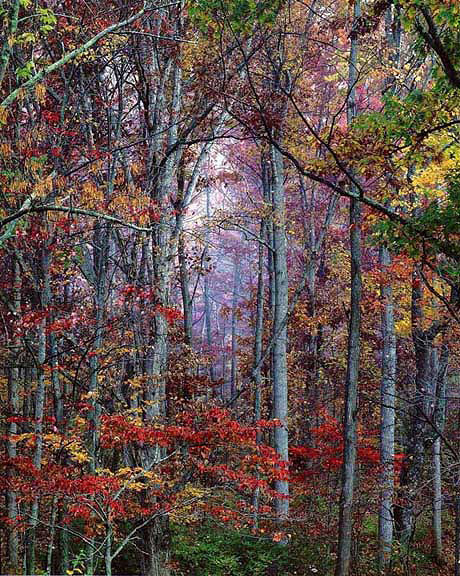
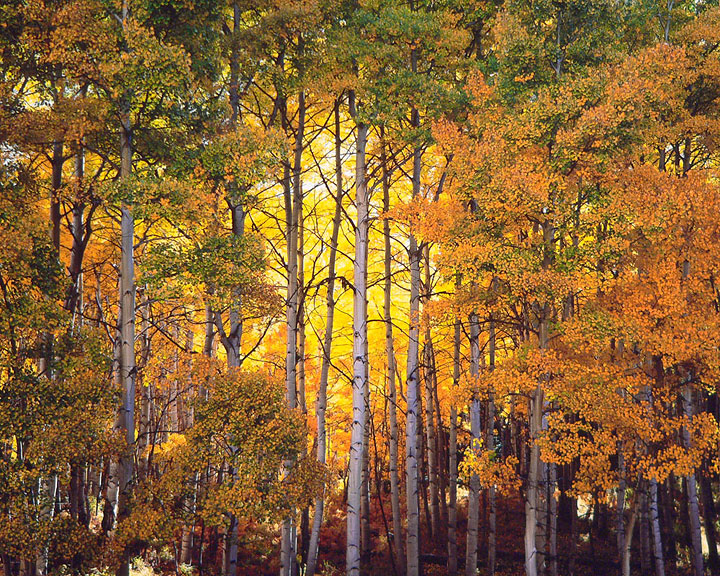
Glowing Autumn Forest Virginia
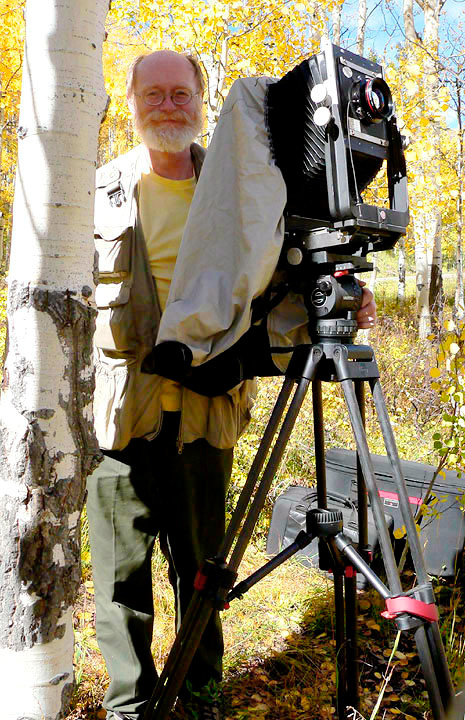
Christopher works mostly with a 10x8 camera (jumping up via 4x5 in 1979), although he also originally used a Hassleblad when he left the order and still does for subjects that aren’t suitable for the 10x8. He has only been using the 10x8 (a rather large Calumet C1) in 1987 and it is amazing that he has produced such a wonderful portfolio, all starting with buying the 10x8, quitting his full time job and spending five months on a tour of the states with Ruth followed by an extensive printing session. The galleries reacted very positively and he soon had to build a bigger dark room (see the amazing pictures alongside this article and on Christopher’s website).
It is worth mentioning that Christopher prints all of his pictures himself and spend an extensive amount of time separating each picture into three fundamental colour components (imagine each colour channel as a black and white negative). He will then use typical darkroom techniques to adjust the tonality of each channel in order to tweak hue and saturation (a difficult job in photoshop, never mind doing it by eye in a darkroom). The technique is called contrast masking and when the final print is made onto Cibachrome, the range of tones and colours is sublime.
Christopher’s website is well worth looking at. Many of the photographs have small narratives next to them, discussing the situation in which the photograph was taken and sometimes more. There are also a few articles and interviews.
I hope you’ve enjoyed Christopher’s work, it isn’t instant like much photography but it rewards attention and time.
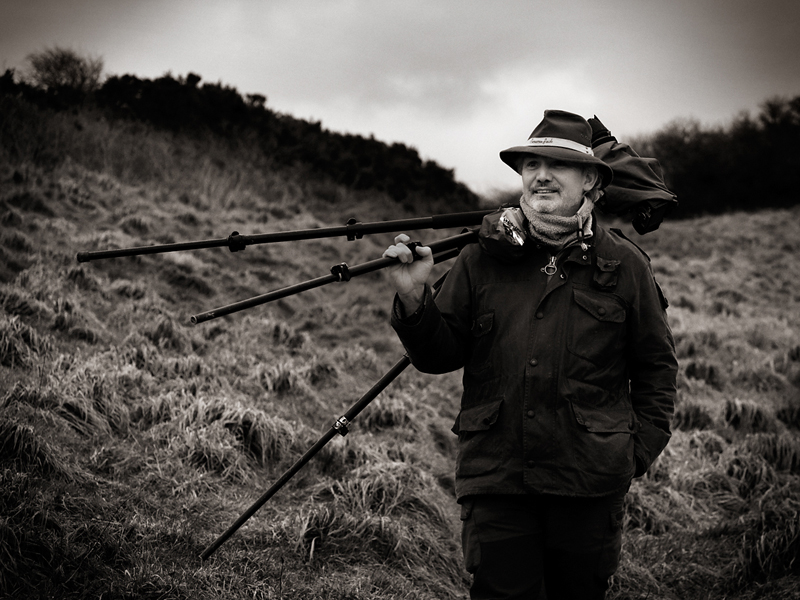
Chris Tancock is perhaps best know in the landscape photography world for his colour Quiet Storm series for which he was highly commended in the very first Landscape Photographer of the Year competition in 2007. There is a double irony here, firstly because at least 99% of his work is black and white and secondly because he denies being a “landscape photographer” at all, preferring to label himself as a “rural documentary photographer”. But don’t be put off that this is not relevant to you as a landscape photographer, trust me there are some huge lessons to be learned from this man and his application of method and technique and although he pursues his own angle the work still deals with the things we can all find in the landscape around us. His work is poetic, magical and original and maybe shows a route to furthering the depth and meaning in all our work and surely that’s a conundrum we all face from time to time. You may, though, have to stomach some blunt and candid criticism of the landscape genre from him before you see a route to the creative future, for it’s only through criticism that we can move forward.
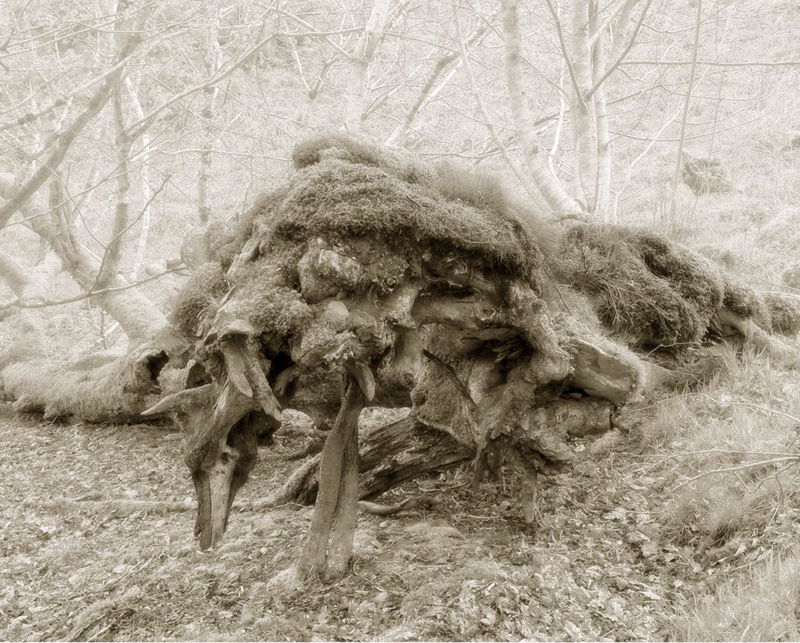
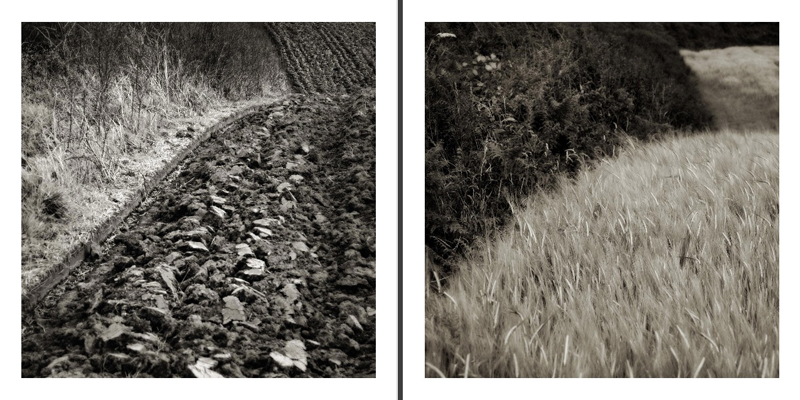
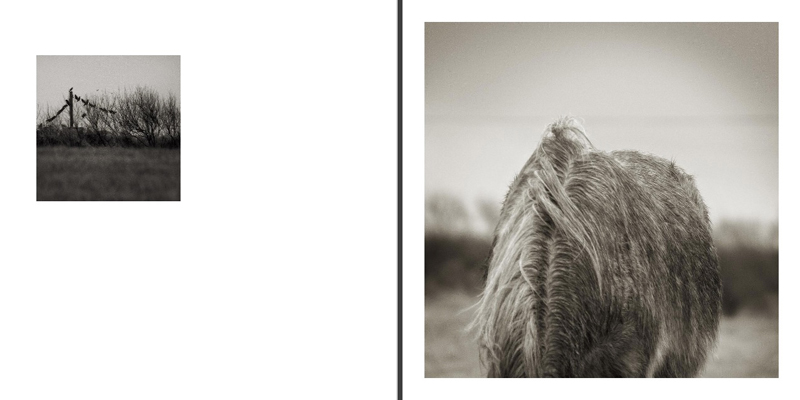
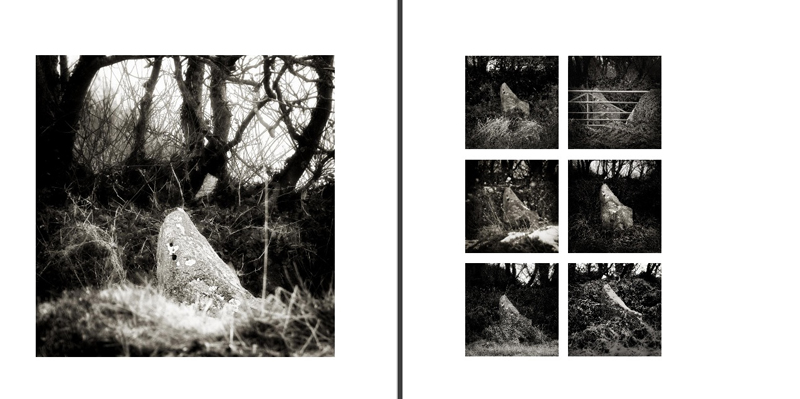
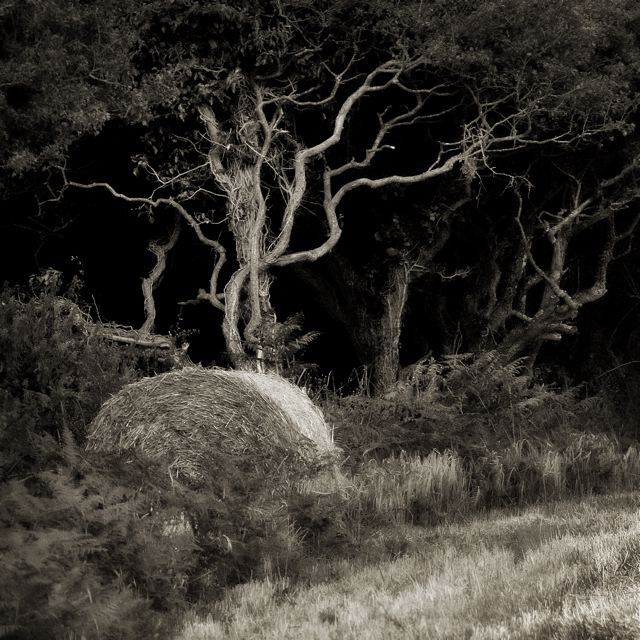
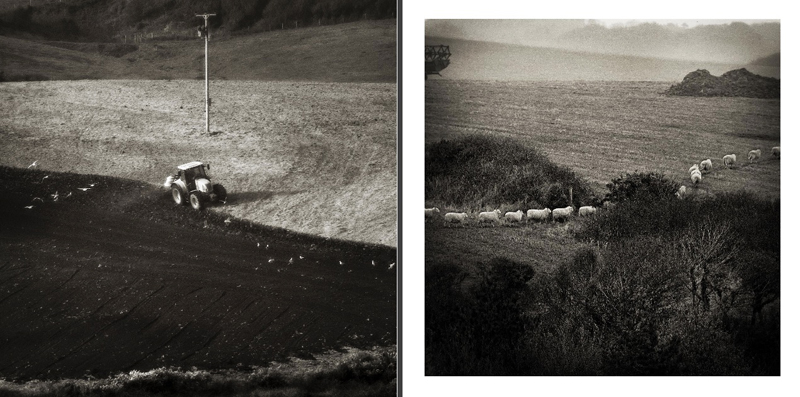
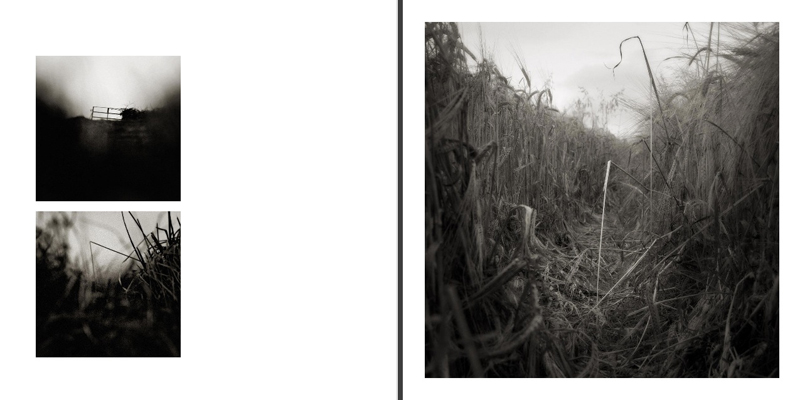
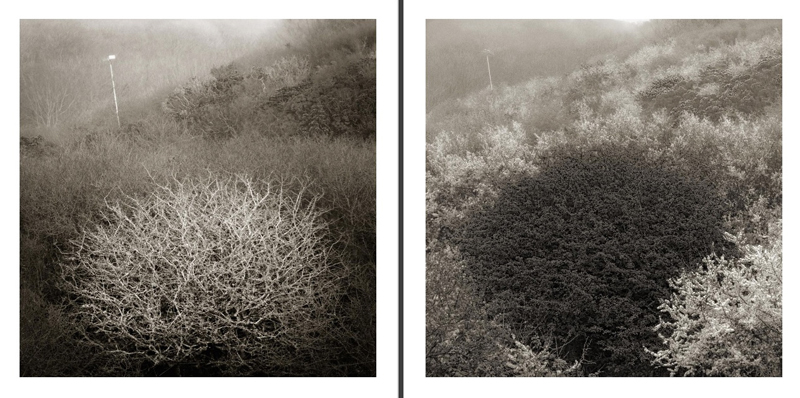
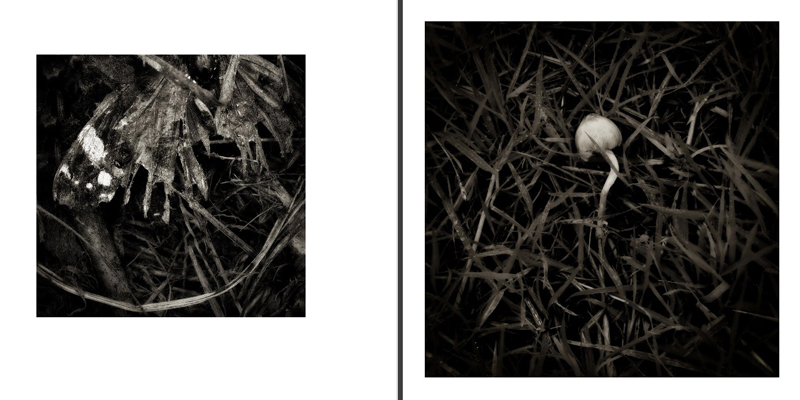
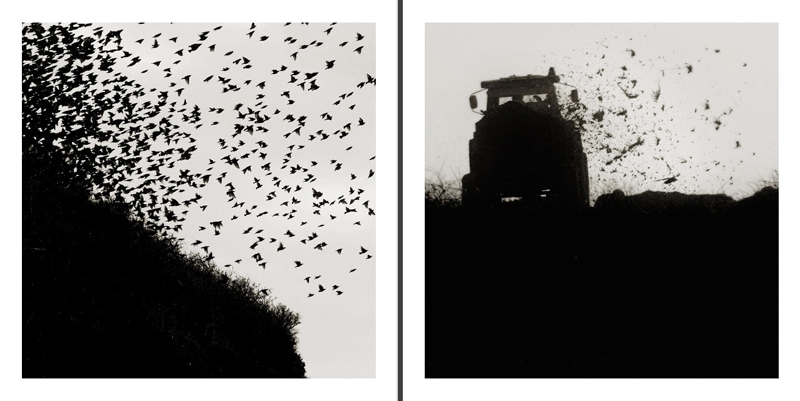
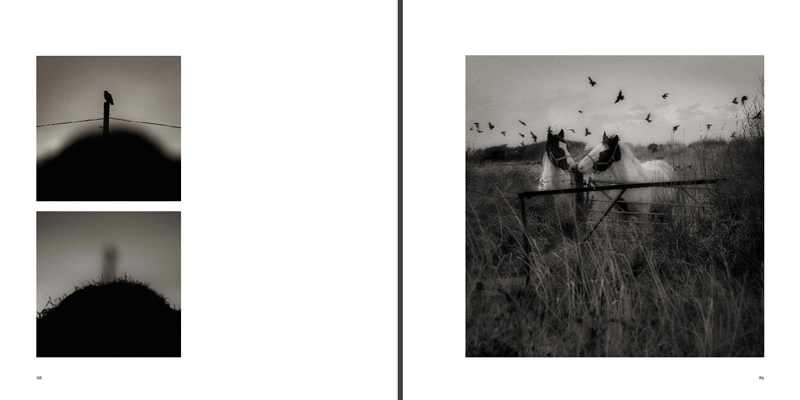
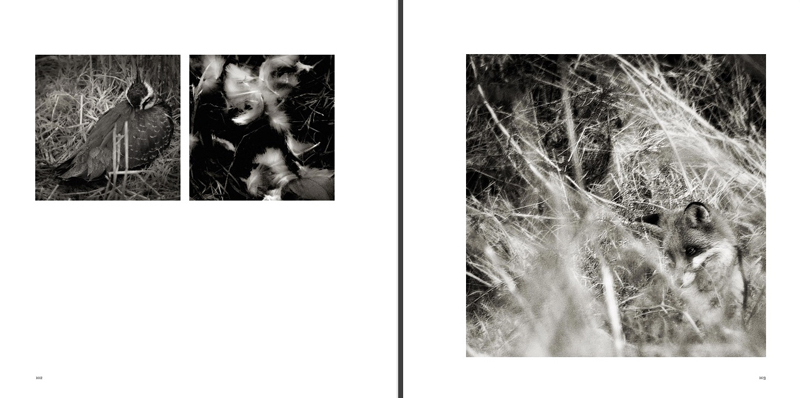
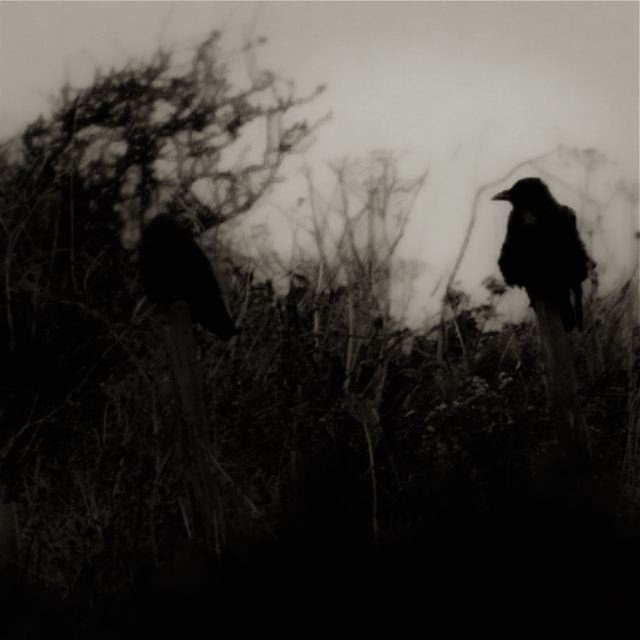
The Quiet Storm project represent only 12 images, although apparently ongoing he hasn’t added to them for nearly two years. He should perhaps be better known for his other work, all of which is black and white; Wildwood which explores the way we see images through the exploration of animal like forms in ancient woodland, the Stones series which examines the relationship between man and his environment in closely framed images of stones and the changes wrought be nature over time and finally and perhaps most importantly the major project Beating the Bounds that has been three years in the making and has another year or two to completion. Simply subtitled “five fields, five years” it is a substantial body of work already and to my mind the most successful to date. In essence it is a journey through time in five fields that are completely unremarkable to the casual visitor and certainly your average landscape photographer would dismiss them without a second thought. But that was a deliberate choice, one that has forced him to confront the norms of composition and subject and to weave together a series of images that represent the remarkable things that happen in such unremarkable fields, the passage of time and in the end his relationship with his chosen plot as it evolves throughout the project.
As we sat chatting in his kitchen, the table between us soon became strewn with his beautifully crafted prints and books representing his influences such as Fay Godwin’s Forbidden Land and most often referred to was John Berger and Jan Mohr’s Another Way of Telling. Other names that cropped up included people such as Josef Koudelka, the poets John Clare and Alice Oswald, the magic realist author Angela Carter, the naturalist Richard Maybe and the photographers Keith Carter and John Blakemore. They not only represented the breadth of his insight, but also his infectious passion for photography as he continually drew out complex ideas and strands while referring to them. I found the ideas inspirational and, as if I needed more, I was constantly reminded of the power and poetry of his work by the liberally displayed prints scattered around the walls of the room.
What do you think of the Landscape Photographer of the Year Competition? (Chris Tancock was highly commended in the very first one in 2007)
“Um, it’s a very good commercial enterprise and that’s all I feel about it really. I mean it’s great for the people who run it and the amateurs who enter it but it shouldn’t be called the Landscape Photographer of the Year. The thing about photography is that you can accidentally take a brilliant image. I often look at the winners website and they have one good image and I look at the rest and they’re not as outstanding as the winning shot, a lot of them are just copies of other photographers and in exactly the same location. In America in the 30s when Kodak was really trying to push itself, all the beauty spots in America they had these plinths with footprints on them and it was a Kodak plinth, you stood on them, pointed your camera in the direction of the arrow and you had the “perfect shot”.”
“I keep waiting for there to be another brilliant landscape photographer, somebody like Fay Godwin or Bill Brandt or even Koudelka - his landscapes in Wales especially. Or Raymond Moore he influenced so many landscape photographers. Fay Godwin went on one [of his courses] when she was doing a cross over from portraiture. His work now looks old hat, because it’s what you see all the time, but for it’s time, you can see there’s a Koudelka feel to some or a Michael Kenna feel to this [pointing out images on his laptop], but this was done way before any of that, photographing things in the landscape that most amateurs would ignore. I’m always getting told off for leaving telegraph poles in, but they are there and they are wonderful and they wont be there much longer.”
“I don’t want to hurt people’s feelings, but I don’t like boulders in the foreground, sunsets in the background, diagonals in between them, repeated again and again and again, hunting the countryside until you find these things. What does that tell you about the landscape? Nothing, it tells you about composition and the photographer, it doesn’t tell you anything about the landscape, but they’re commercially viable. They are very easily read images. People forget we read images on different levels and an image like that has the reading age of a 5 year old, it’s the equivalent of a Janet and John book. If you call it the Landscape Photo of the Year I wouldn’t have any problems with it, but to call it landscape photographer makes it sound like this photographer has done amazing things with landscape, but they’ve taken one good shot - it could have happened by accident. They might have one good photograph, they might have half a dozen, but that doesn’t make you a good photographer, especially if you have a digital camera. To me that’s the main difference between different sorts of photographers and what I call calligraphy photographers, which is definitely, what the LPY is about. It’s about good composition; it’s about crispness, all these things, that is calligraphy. What is that person telling me about landscape? What is he telling me that he feels about it? Forget the composition, forget the detail, what else is there and I look at those and I don’t see anything else.”
So how did it affect you, being commended?
“Well it was the first year, I didn’t know what it was going to be about, I didn’t know what sort of people were going to enter. You know, the idea excited me a bit because even though I’m not a landscape photographer I thought there isn’t anything out there being done. I consider myself a rural photographer and I consider myself a documentary photographer who falls into fine art, I love the idea of mixing documentary and fine art together.”
“I was quite excited to start with, there are some lovely landscape photographers out there, nothing amazing, nothing that’s making me go “oh my god ,I wish I could do that!” But there are some interesting people out there, they didn’t enter and that’s why I haven’t entered again, it’s not what I do. When I went to the winners exhibition my work was scattered about (which is understandable) I talked to people about how I’m using set locations and I use the same locations again and again and again, and I’ve only got 12 places I go to [for his colour Quiet Storm series] and it’s about photographing storms, it’s not about the landscape. If I lived in the city they would be cityscapes. The storms tend to happen on the beaches because there’s big open sky to show the storm. I did shoot myself in the foot in a way and that project has been a big learning curve for me. I decided in the beginning to choose a dozen locations so that hopefully I get multiple storms in the same place making the landscape look different, I also wanted to use really simple compositions, thinking that if the composition was really simple people wouldn’t focus on the landscape and it didn’t work, it backfired.”
Do you think you’re now known for those colour images?
“Well I am, I’ve got 12 colour photographs and the rest is all B&W, more than 98% over 30 years of photography is B&W. I don’t see the point of colour. Just because a photograph can do colour, can do 3D, can do movement, it doesn’t mean we have to use it. For me to do a 3D image there would have to be a really good reason for that, for me to do a motion picture there would have to be a really good reason, for me to do colour there has to be something really important about it to my story.”
“The idea with the storms was that I’d seen two or three storms in the middle of the day, that looked like sunsets, and I thought wow this is amazing! So I started to photograph storms, where through exactly the same reason as sunsets, filtering out light, created these really weird colours, so it had to be colour. I didn’t want other aspects entering into it, so that’s why I chose to use exactly the same camera, exactly the same location and exactly the same simple composition each time, I was trying to eliminate everything else. It didn’t work out quite the way I wanted, but then things don’t always work, you know I wish they did!”
“The biggest thing to remember about photography is to remember a photograph, never, ever, ever, ever shows you reality. It’s one of the reasons I’m not keen on landscape photography (this is going to sound terrible, but I’m not) is that people think they are showing reality, or they are trying to. They want it sharp and they want the tonal range to be like the eye sees, I can’t be bothered with that. I talk to so many [landscape photographers] and they say that is how the eye sees and I say yes, but the eye sees movement, they say photography doesn’t show movement and I say yes it does. What’s film? One still after another still after another showing you the illusion of movement, photography is an illusion.” CT reaches for a print, pointing and continues: “This doesn’t exist. What are we looking at here? A piece of paper with ink on it, can you see the piece of paper with ink or can you see the picture? It’s an illusion, your brain does not look at the ink, it reads all these lines, tones, shapes and your brain recreates them into an image in your head, it doesn’t exist. It feels like they’ve forgotten what photography is. Photography is showing the world as a photograph, not showing the world as it is, it’s saying wow, I wonder what the world looks like as a photograph.”
“They seem to ignore 90% of what photography is and keep hold of that 10%, they focus on detail, on depth of field, tonal range and they think that’s the most important thing. When they want the colour to be exact they have these profiles, what’s wrong with your eyes? When I was in the darkroom, I’d produce test prints, and look at them and I’d say yes that’s good and I’d do it!”
“Photography for me (I’m quite old fashioned about this I suppose) is about juxtaposition, it’s about telling stories through images, it’s a documentary idea, the old fashioned idea of documentary, the John Berger idea, you selectively show people, it is about a body of work. I cannot for the life of me get excited about most individual images, because an individual image can tell you very little unless it’s extraordinarily good. Some of the best Cartier-Bresson can go beyond that, but they’re one in a million, or a great Atjet. There are people out there who’ve achieved those individual images. What most landscape photographers do I would call calligraphy, they produce pretty pictures and they use standardised techniques, so you have the thirds system with foreground interest and a strong diagonal and they hunt the countryside to find images that conform to some compositional ideal so they keep moving on until they find somewhere else that fits. For me that’s where it all falls down, you end up with these random images and nobody bothers, on the whole, reading the image. It’s a bit like having a poem written in calligraphy, you stand there and go wow. The funny thing is that this calligraphy has very little to do with the photographer, the calligraphy is also the technical side of photography, number of mega pix, quality of the printer etc. Composition is a bit like spelling, it’s no big deal. We all have to learn to write so that others can understand what we’re saying. It’s exactly the same in photography, we shouldn’t be praised over it, we don’t praise writers because they get their spellings right, so why do we praise photographers for doing good composition? I don’t understand it, it’s bizarre, it’s just a basic but important starting point.”
Is your choice of camera important to you?
“Think of a photographer like a carpenter. If I gave a carpenter a chisel, what could he make for me? Give him a saw and a chisel and a plane he starts to make something interesting. I’ve lost count of my cameras; I’ve got a large format, a little Leica, medium format, a pin-hole camera. At the moment on Beating the Bounds, I’ve got two or three of these little Olympus’ [DSLR]. I like them because they take all my Leica lenses, whereas for the Quiet Storm project, I’m using an old Minolta 4.5mp because I don’t want detail. For the new farm project, I’m using a 12mp camera. I’ve got my film cameras and I’ve got a large format. They all give you different looks, they are all different tools. You choose your tool for your job. The idea of having one camera, I don’t understand it! Cameras don’t cost a lot anymore [second-hand], the crazy thing about buying the latest Canon or what ever is they’re gonna have to replace it a year down the road because they’ve got to have the latest mega pixels or the latest features. I hate features on cameras, oh god I hate them! I take all my photographs on manual. I was going to say, I use manual focus but my eyesight is not what it was. So what I do is set up the camera on auto focus and then go to manual [to take the photograph]. I use the spot focus - that’s another thing, why would anyone want to let the camera focus on anything it bloomin’ well likes! Matrix focussing, what is that about? It’s the same with the amount of light coming into the camera; I want to choose how much light comes into the camera because I want to show the world as I want it to look. That’s what photography is about. A camera doesn’t understand what you’re looking at, it doesn’t know anything about what you want to say and how you want to say it, it takes averages. I hate averages! Focus, exposure and depth of field, they are the three basic things within photography and people don’t want to be involved with them. They are what make your photographs yours, rather than the cameras. It’s the same reason I don’t like a lot of landscape photography because you can see the camera’s taken the photograph for them.”
Tell me about post processing, how has that changed over time?
“I photograph in RAW (at least in digital), with a film camera I have to make decisions; I have to decide what a photograph is going to look like. So if I wanted a warm tone image, I bought Kodak, if I wanted a cold Germanic image, I bought Agfa, if I wanted punchy bright coloured images I bought Fuji. They all had different dye saturations, different contrasts even; you choose your film to get your look. These days a RAW file collects so much information it’s possible for me to have a little add on and as soon as the RAW file comes into Lightroom it gets converted to look like Fuji. So it means all your images are going to be standardised as they were when you bought film. Then I dodge and burn, for me (this is really personal) a photograph that hasn’t been dodged and burned is a snapshot. I dodge and burn mainly to control how I want people to look at my photograph and to give a sense of depth and mystery and all the things that bring an image to life. Then when it came to printing in the past, you had a choice of papers to give you the look you wanted. Your developers would give you different tones, all these things would give you completely different looks. I was a Record Rapid man. Same with colour, the paper I loved, even though it was really expensive, was Cibachrome. So I’ve got my printer set up to put down exactly the same colour saturation as a Cibachrome print. All my colour images are printed exactly the same, so any changes in the colours are to do with the reality of a moment in time.”
So what about the B&Ws?
He uses post processing to dodge and burn and give them the tonal range that would have been achieved with “Record Rapid” paper, “Because I haven’t got that option anymore, I have to do it myself, rather than have some chemical manufacturer do it for me. That is the great thing about digital photography - in the past I would dream of a film or a paper and unless I’d been a billionaire I couldn’t have achieved it. Digital photography is not cheating, that’s what photography has always done. A photograph is a chemical or now a digital process that alters the world from what it is into a photograph and to think of it as anything else is silly, really silly - I can’t emphasize that enough - it’s not a window onto the world, it’s just not.”
“So I’m processing my images to give them tone, I’m setting the contrast to get the contrast I would have got with the paper, if it’s a digital shot I even put some grain back into it. I love grain and I hate the fact that a digital camera doesn’t give you grain. Noise isn’t the same, because grain clumps and works in a completely different way.”
“I do everything by eye, so I drag out some old Cibachrome prints and the original slide and put it in the computer and play with it until the look is as close as possible. John Blakemore, darkroom wise, was my guru. I still use the techniques I learnt in the darkroom. Now, I like to use Photoshop sparingly as if I was back in the dark room but what I do love using it for is my initial test strips and for dodging and burning. They could do with somebody like John Blakemore or some old time darkroom photographer to say, “If you had this in Lightroom...” it’d be great. Although Lightroom now has ‘dodge and burn’ it feels nothing like working in the old darkrooom, which is a shame. Whereas in Photoshop I’m more able to work as I did in the past. I would, for example, work with templates cut to shape.”
“It’s a funny one because I love digital and film but with digital I can work on a five year project like Beating the Bounds and I can just get on with it, I haven’t got this mound of negatives. So it’s a bit like a writer who says I don’t need to use an old typewriter anymore, I can use a word processor, it doesn’t change what he writes, it’s just a tool. There are for sure limitations, but some of these shots in Beating the Bounds are digital, some are film. Digital photography is going to supplant film, the same way wet collodion isn’t about anymore.”
“On my Wildwood project it’s not about the wood, it’s about how we look at images. It’s about photo’s being nothing more than photo’s We read an image and the thing is we make mistakes. What I was photographing in this image was a wolf”. [Looking at the image Wolf Study see below] “And when I put it out on display some people said, “it’s not a wolf, it’s a deer” and others, “I see a sheep with it’s wool falling off” others “I see a tarantula” and for the life of me I can’t see a tarantula. I had a young lad come who said, “I see your wolf, but I see a big ear and a nose and an eye and I see a rabbit.” It just went on and on people seeing more and more things, so this project is about how we see things. On a superficial level it’s the wood, I love the ambiguity of images, this project is about reading images and reading into them. It’s a slow project, I have to find all the things, most of my projects are slow. I work like Keith Carter does, I have my boxes and I just keep adding to them it can take years, but what’s the hurry. It’s about understanding, exploring photography, exploring the way you communicate, it’s not about wanting to produce pretty pictures that people will say “Oh that’s nice”.”
“ I have none of the shots that I took from the first year of “Beating the Bounds” because that year was about getting to know what I wanted out of the project. I didn’t know how or what I was going to photograph in those fields. I have an idea, like the idea of Beating the Bounds about walking the same route, about photographing things that aren’t clichéd, beautiful things that other people may not look at. Hedges! I always wanted to photograph hedges but how do you photograph hedges? Most people don’t even look at a hedge; don’t even look at fields but as I walked those fields I got more ideas about looking over boundaries, to do with separation, with focusing on what’s yours and what’s not. It’s also about the way a field looks as though nothing happens in it. After walking it for a year it really came home to me that the great thing about a field, unlike photographing in a city – photographing on the street is like photographing a second-hand on a clock, there’s something happening all the time, photographing a field is like photographing the hour-hand, you know it’s changing but you can’t see it happening. You may have to wait weeks, months, years before something happens. Now I can walk up the field and photograph nothing because nothing happened, but you may go up on one day and a lot is happening. Maybe there’ll be a change in the seasons and suddenly a lot happens.”
“What I love as well is things you’ve looked at before a hundred times, that never caught your eye, will suddenly become really important and things you’ve been photographing for three years suddenly die away and you don’t want to photograph them anymore. I love that idea of photographing over very long periods in one place. All my projects have been long periods, the shortest one I’ve done was a year and I felt that was too short and I don’t think I’d do one for just a year again, it’s not long enough! Five years is a good time, three years is the average, but of course you’ve got to have some work under your belt if you’re waiting for five years for a body of work.”
“It’s important to mention that the things I say about photography, what I believe, I really don’t expect other photographers to buy into it, I hope they don’t because that would be boring! Finding your own way is the important thing.”
Tancock has some fascinating ideas about how his images should be seen, or displayed.
“I think all pure photographers should be pushing the boundaries, photography is going through a very stale period at the moment. It probably did every time there was a technological jump, like when we went from wet collodian to dry collodian or from plate to film. The impact of the technology just made everyone brain dead, so they weren’t looking to do new things, then suddenly once they got used to it and it wasn’t new anymore then they thought “Oh my god, what can we do with this?” How different is it to use a Leica from a plate camera? So I’ve got a digital camera, how is that different to when I was using 35mm and film? Doing this project [Beating the Bounds] is one of the experiments.”
“The idea is to have a project that will have four to five hundred images at the end of the day. To be read, in the form of sentences. images feeding off each other in a structured way, size is one way I am trying.
People think that an image can be any size, that it will make no difference, the main reason for it is a large image is powerful, a large image has impact, it’s just the nature of the beast. Any image blown up large is amazing!”
“My ideal way of seeing images is in a book, you sit down on your own and you look at it, you experience it. The largest I’ll go in an exhibition is 40x40cm, it’s a two person experience, I’m happy with that, just about. I’d much prefer they were smaller, but people want big images and the biggest problem with my work is that I don’t see my work as individual images; I don’t want somebody to walk to that image and look at it individually, because it is part of a body of work. It’s like approaching a piece of literature and only bothering with one sentence. So many people seem to have got it stuck in their heads that a photograph has to be like a painting, it has to be an individual image that can be appreciated like a painting, now personally I don’t believe that can happen; a painting and a photograph are nothing alike.”
l have to hint I think, give them a certain amount of help; I don’t want to have text. Text and photography has its problems, it can work, but if it’s just a description of the image you’re looking at then it’s pointless. People still want to look at my photo’s as individual images, until I get it in a book or a plasma screen and I’m controlling how people look at it. In my last exhibition I was watching people they were going to one image and across to another one, looking at the big images and ignoring the smaller ones. They think it’s a big image so that must be important. It wasn’t working, I learnt a lot from that exhibition, what I expected people to do they didn’t. I need to learn how to help people.”
How important is a sense of place in your work?
"It works in reverse, it isn’t important until I start photographing something then it is very important. [In Beating the Bounds] I chose the fields at random, the place wasn’t important. The project was initiated by ideas, ideas of retracing steps, photographing from set points, photographing something other people don’t look at. People come on holiday to Pembrokeshire and they stand and look at the sea, with their back to the fields. Fields are really amazing nature reserves. The farmer maybe goes into the fields four times a year and he rarely ever gets out of his tractor. In the nature reserve where I photograph the trees that look like things, I see far more people than I do in the fields! Basically I don’t meet anybody in the fields.”
“I can’t think of anything where I’ve thought, “oh I must photograph there”, it doesn’t start like that, it starts with an idea like “I want to photograph life on a farm”. How do I want to photograph it? It’s only once I am really well into a project that the sense of place seeps into my work. I’m looking for new ways of doing documentary photography, so I’m incorporating things like fine art into documentary; I’m incorporating things like wildlife photography into documentary. I really feel photography needs a shake up; it needs to be thinking of doing new things, otherwise we all go out and do the same photographs again and again and again.”
Is part of art personal expression?
“It is! Documentary is. There’s no documentary photographer that’s very been out there that’s ever photographed objectively. It’s all subjective, we choose what to photograph, what not to photograph. That’s what photography is, when you look at a photograph you are looking at the tiny, tiny amount of time and place that the photographer chose to show you. We leave out most of everything, most of the world, most of the time, it’s completely subjective and it lies. I love the fact that it lies, that’s the power of a photograph and everybody believes it tells the truth. It’s all an illusion. Like I said before a photograph is a piece of paper with ink on it and everything else is read and people read things differently. It’s all about what’s not shown, as much as anything.”
“I’m using very, very passive compositions [in BTB and Quiet Storm]. In other words I’m not cutting my subjects in half, I’m not having them in and out of the frame. Everything is within the frame, the trees aren’t cut off, unlike street photography where you get in very close and say an arm leaves the frame, that’s active composition. Passive framing is like Michael Kenna where everything is very pure, not cut off, suspended in the image, very passive. Cartier-Bresson’ s photographs are very active; he was always cutting people off, severing the tops of their heads and their arms. That is a subjective way of looking at things. People underestimate photography; it’s very, very complex. There are so many things you can do to make a photograph have a different effect on people. People who use “template” photography don’t understand that. They need to look at artists, one of the best artists to look at, as a photographer was Degas, he was one of the first artists to actually crop people. It hadn’t been done in art before, if there were people in the painting, they were all in the painting. So photography is totally subjective in the way you crop and reduce the world to a tiny element. Like Cartier-Bresson’ s Decisive Moment, it’s impossible to pick up a camera and not be subjective. The amount of people that come to me and say “did it really look like that?” It’s a crazy thing to say about photography. Because of course the world is not flat, the world’s not frozen in time, the world is not blurred, it’s not cropped, I mean what are you talking about!”
What are the limitations you’ve placed on yourself for Beating the Bounds and why? “The basic limitations I’ve placed on myself are the same limitations that most artists apply to themselves. The constraints actually help, without constraints it’s all over the place. I’ve always needed constraints because the more constraints I’ve got the better my photographs become and that works for any photographer I believe. So by physically creating restraints – by not leaving the track I can’t think, “oh if I was over there I’d get a better shot” therefore I can’t just do this or that. I have to start thinking “I am walking down this track. How can I tell my story?”
But is it forcing yourself to see afresh, is that the point of the restraint?
“Afresh yes, but also to look at the things again and again to try to find the magic in them. So I’m not thinking, “I’ll find something magical to photograph” which is what so many photographers do. I get so many people on workshops who say, “Where should I go to photograph? Should I go to Tibet? Should I go to Peru?” Why? What do you know about Peru or Tibet? Let somebody who lives there photograph it; there are enough photographers all over the world for that. If you’re a landscape photographer you think I must go to Iceland or I must go to Glen Coe. If you’re a documentary photographer you think I must photograph drug addicts or whatever.”
Is there an element of contradiction in you denying there’s a sense of place until you photograph it? “No, that’s not the same. I still start with an idea, I never start with ‘I want to photograph there’. There are a lot of reasons why I photograph around myself and one of them is because I believe people should photograph what they know about. I also believe why go anywhere else. If somebody from Tibet comes to Nolton Haven it’ll be the most exotic place in the world to them because it’s different, that’s all it is but what do you love about Nolton Haven? What would I know about Tibet if I went there? What could you photograph? Just the exotic. You’ll end up with National Geographic type photographs. I don’t like that genre, they don’t tell you anything, they are just pretty pictures, they are really so superficial.”
“I want to think, “what’s interesting about the things that I love?” So hedges, the countryside, farms (because I was brought up on a farm), basically rural life. That’s what I know about so that’s what I want to photograph.”
What’s the route of placing these barriers in place? What forced you into that?
“I just found the more barriers I have, the more restrictions I have, the better photographs I’ll take.” But what actually took you to that idea? “Commercial work, if you’re doing say interiors, you’re working to somebody else’s criteria, they come up with the idea. For a magazine the look has to be the look that the company needs. I can’t make them all dark and broody! So I have all those criteria that I had to work within and I found that helped me take good photographs. Artists have always worked like that. Magritte didn’t one day paint a Turner, one day a Constable, he had an idea and he set constraints on himself. Turner would choose a particular palette; he worked within that palette, he didn’t think, “I can have any colour I like”. Artists, writers and musicians have always worked within constraints, some more than others. Why don’t more photographers?”
“Once you’ve got constraints you can then focus on what you want to say. Then you don’t have to worry about all these other ideas. You can really focus on what you want to say and how you can communicate that to the person who is looking at it. They may not work, people may not get what you are trying to say, that’s not their fault it’s my fault. I then have to work harder to find other ways of doing it?”
“I know with BTBs I’ve gone quite extreme. Initially, I sat down and wrote out a list of the things I’m interested in, just randomly. I wrote down things like “folk tradition”, I’m fascinated by folklore; “ artefacts”, rural artefacts and the “visual history of the landscape”. So you could see where there’s a mark, you get hints of a hedge or a ditch, so you can start unravelling the past. The “memories tied up in somewhere”, I’m interested in that. The “wildlife in the landscape”, you know I never understand when I looked at all these landscape photographs, where are all the animals, where’s the wildlife? I’m interested in magical realism, and how music or literature can be incorporated as a basic form - a structure within photography.”
“I’m interested in how a photograph looks, one of the things I love about a photograph is how people forget that depending what shutter speed you use, you can leave things out just by letting less light in. Bill Brandt was passionate about that; he could leave out half the world, not by not having it in the frame but just by not letting enough light in to show it. I’m happy to have big chunks of things missing. I love negative space, I find white negative space much harder to work with than black negative space but I do love black negative space. In my storm shots people say to me “why is that silhouetted, they didn’t look like that?” and I say no, the world doesn’t look silhouetted to my eyes, but it did to the camera. The world doesn’t look frozen or blurred but it does to the camera. I’m interested in how the camera sees the world not how I see it.”
You talk a lot about memory, especially in BTB...? (I’m cut off in mid question)
“I agree with John Berger, photography is so like memory, you open a draw of family snapshots, you’ve got all these jumbled memories, visual memories and when you look at one photograph it will spark off a memory of something else but there isn’t a time line, like maybe in literature. One image can feed off another image, that is very similar to memory. Like Proust with his smells, you can trigger off a whole line of memories just by a smell, well an image does the same. A photograph can trigger a whole line of memories about a person or a place, or something within yourself.”
For you, does memory have a visual or verbal route or both?
“Good question! I think memory is very emotional. Emotional can be both verbal and visual. When you look at Another Way of Telling it is all visual, but it’s also very emotional and I think that it’s the emotion triggered by the photograph that creates the story line. Usually it’s emotions that trigger one memory to another memory to another. The most powerful photograph is the photograph of a loved one, especially if that person has gone. You’ve suddenly got this almost physical, emotional memory in your hand.”
On our walk through the five fields, Tancock began to expound further on his ideas for controlling the display of his images and how he can weave themes throughout the exhibition. This is perhaps the revelation of our discussion.
“People aren’t taught to read images and definitely not taught to read multiple images, whereas we are taught music and we are taught literature, taught to read and it’s a crazy one for me because I reckon maybe 80% of communication in the world is visual but we’re not taught it, it’s as if it’s supposed to be picked up naturally. I think that when people look at a photograph they think it exists in front of them but it doesn’t, it exists inside their head and then they project it back on the page. A photograph has to be read and you have to learn to read images. It doesn’t come naturally, a newborn baby doesn’t see an image it just sees the ink on paper. With any image you can misread it, and people do.”
“Once we realise that we have to read images then we can take that a step further and ask how do we read images in conjunction with each other? All I’m doing is trying to carry on the baton for people like John Berger who thought of these ideas; I’m not nearly as important as they were. I think these ideas are great, but unless you put in an enormous amount of effort, or you’ve read John Berger, then it’s not going to hit you straight away. So my idea was to find helping hints, so I started looking at music. In music you have rhythms, or you have a refrain that keeps on recurring. So I would have a shape that’s not physically to do with the image, the shape of a curve, the line of sheep in a field, followed by the same shape running through a plough line, running through some geese flying through the sky. I use that refrain to draw a person down through that series of images and those images can have other images that are connected to those running along them. You’re trying to say to people stop looking at this as an individual image, forgetting it and moving on to the next individual image, there is something connecting them. And if those refrains jump out and make you look like that, then maybe you’ll look for other connections. It may not work, I’m not saying it’s going to work, but you’ve got to try.”
“So I started photographing the same bush, over and over again, which has been done a thousand times before by photographers but what I can also say is that I can photograph the same place again and again but from lots of different aspects, if they are grouped together and people have already started thinking about groups of images, then they’ll start looking at a more complex way of doing that in a new light rather than seeing them as a jumble of shots. Rather than seeing the photograph of the gate with the birds flying up, seeing a photograph of the birds flying up, it’s not it’s a photograph of the gat
e. Things happen around gates, gates have lives; I want to photograph those things that happen. It’s not sterile land where the gate just sits on it’s own all the time. What I want to do is show lots and lots of different aspects, but if I’m going to do that I’m going to have to help people to try to understand what I’m saying.”
Do you think of yourself as following in the Romantic tradition?
“Oh definitely! But not as we think of romance nowadays. John Clare was a Romantic poet, but he was also a scientific poet in the sense that much of the information we have about flora and fauna in his period was because he wrote poems about them. He wrote poems about them in their environment. A naturalist once said, “Romanticism is about finding the relationship and the way things live together”. Now that might be a field with a tree in it, now how do the field and the tree relate to each other?
A scientist will just look at the tree whereas a Romantic will look at how they live together and how I the viewer interpret it, the story I weave round it . John Clare documented orchids, he gave them addresses, but it wasn’t a Latin address or a geographical address, it was “Mr Blogg’s back garden” or “the meadow thatused to be common land, but isn’t any more” and it was all about how things lived together, how everything is intertwined. So that’s the sort of Romanticism I’m interested in, not the Disney sort of romance, or the chocolate box view of nature. It’s a Romance of the history of that gate, or how that gate has come there, what happens to that gate. That’s why I get so bored with landscape photography, there’s no Romance in landscape photography, its all composition, calligraphy. They try to make it romantic by taking sunsets. That’s crazy, that’s not my idea of Romance. I’m very much into the way the past and the present intertwine and how they can be seen in each other and that is Romantic. I’m also interested in the way a hedge has grown into the shapes it has because maybe at one time it was layered or it’s been confined. Like I said I’m interested in folk tradition, I’m interested in myth and local tradition.”
“ You know, in documentary photography some people want to be a fly on the wall. I’ve always believed you can’t be a fly on the wall. I am more than happy with the idea that as soon as I walk into that field I change everything. I’m photographing cycles in a way. There’s my own cycle (beating my bounds), also the seasonal cycles but I’m also photographing the cycles that the animals have, they beat their bounds. So the magpies, every evening they sit in that Elder bush and every morning they sit in the other one but I’ve never seen them do the opposite. I love the fact that I have this ritual of walking the boundaries and the animals have their rituals. I walk my boundary and the fox walks his boundaries and our boundaries intersect. I like that aspect of it and again that’s Romantic. Its not very scientific, its part of understanding the environment. John Clare said it’s no good catching a butterfly, taking it into a lab and studying it; you need to study it in the field or where ever it lives. There’s a composition that I use a lot, where the fox is in the image although he’s a tiny speck really but that’s him in context. So many wildlife photographers don’t do that, they zoom in on the animal, it’s like catching your butterfly and pinning it on a board, no Romance!”
So what can we learn from a man who admits to, at the very best, working marginally outside the landscape genre? Firstly, the documentary approach gives some great insights into both ideas and techniques, that can introduce far more originality, complexity and far more of ourselves and our interests into our work.
Secondly, Tancock’s localism, his found passion for what he already knows and loves, should give us all pause for thought. I can hear the refrain of “but where I live is boring” coming from a thousand minds. But it’s not as if those five fields he uses for Beating the Bounds are anything remarkable, quite the opposite, I’ve seen them, they are as unremarkable as any fields you have seen anywhere.
And what of the restrictive methodology, the constraints and barriers he uses? We can learn from them that there are indeed ways to break the conventions we all carry with us in our heads. He has found himself forced to make images out of what he finds in front of himself and created a body of work that is magical, elegiac and unique. But they also serve to shine a light on landscape photography, documentary photography and many of our preconceptions, to find them wanting. Could it be that light also shows a route towards a more artistic sensibility? That is a question I’ll leave you to make up your own mind about.
We're taking a break from the Joe Cornish videos this week and looking at some photographs by another large format proponent, Dav Thomas. Dav lives in Sheffield, on the edge of the Peak District and travels the 15 minutes from his house to one of our most loved national parks on a regular basis. Dav is following the video format that Joe and I have developed, one popular shot, one personal favourite that hasn't had much exposure and one that didn't quite make it for various reasons.
Working out of Sheffield on the edge of the Peak District, Dav Thomas has created a portfolio of images that bring together the essence of some of this national park's wild places. His pictures eschew the vista for the characterful portrait of the ingredients that make up the environment. Trees, gritstone, grasses - the results, usually captured on film - vividly portray the areas usually ignored by photographers.
In most photographers lives there are 'epiphanic moments where things become clear, or new directions are formed. What were your two main moments and how did they change your photography?
I think the turning point for me came with a visit to the Joe Cornish gallery in Northallerton. I was becoming more and more dissatisfied with my digital equipment, at the time a Nikon D200 and a Kodak DCS Pro and had a nagging voice in the back of my mind telling me that large format was the way to go. After the visit to Joe's gallery I knew this was the way forward for me – I was totally blown away by the quality of the images (I realise this wasn't just down to equipments and was just as importantly about Joe's skill), the details worlds apart from the tiny digital files and the Velvia tones were stunning. I think I ended up buying my 4x5 camera about a week later and haven't looked back.
I suppose a moment that stands out in my mind was something Joe told me when I was out on a one day workshop with him soon after I got that first large format camera. I think my photography at that stage was quite run of the mill, wide angle, sunsets, views – he said something along the lines of – don't take photos that you expect people to like, take photos that you like and if you're any good sooner or later people will start to take interest in your work. Horribly paraphrased Joe, sorry! This is something that has lived with me and is advice I pass on to others. These days I don't follow trends or make 'keep your granny happy' photos, I just shoot compositions in the landscape that interest me despite others might think to them.
Much of your photography has been taken with an 4x5 camera but many of your photographs are square. Do you use a combination of 4x5 and medium format or do you crop your images?
I used to have a Hasselblad which I really enjoyed using but the problem was, I couldn't feasibly take the 'Blad out with its 3 lenses and my large format equipment at the same time - I tried a few times but I had to compromise on both in a bid not to do my back in! So I ended up just taking the 'Blad out on its own and often ended up disappointed that I didn't have my large format equipment with me when a composition arose that required LF movements. So in the end I reluctantly sold the 'Blad and I now work with the large format camera and digital SLR on occasion.
I have two options with the large format - I either work with a square plastic mask on the back of the camera so I can compose square on the ground glass,using a full sheet of film, or I use a smaller mask and use a 6x6 roll film back for the large format. The good thing about using the roll film back is that the cost per shot is reduced meaning I can bracket if I'm not feeling confident about the exposure (I know, it does happen!). The crop factor effectively means that I can use my 300mm large format lens as something like a 450mm in 35mm terms. The crop factor also means that I am using the sweet spot of the lens, combined with all the camera movements this means that the results are superior to the 'Blad.
I do love the medium format 6x6 format though, I have an ancient Agfa Isola, equipped with a lovely sharp 75mm lens and a wopping 2 shutter speeds plus B, and 2 apertures which is great to use – the limited controls really focus the mind, making you shoot in a different way. In the future I'd love to get a Mamiya 6.
Trees, trees, trees... Well, ok, there are a few other subjects but what is it about our arboreal friends that drives so much of you photography?
It's not entirely a conscious decision I must admit! I've always had a love of trees (and I'm a keen woodworker, so I like them in their sliced up state too!), I find their textures and ever changing colours fascinating. On a deeper level I'm moved by their longevity – I know I'm (hopefully) photographing something that is going to live and grow long after I'm gone. I also like the slightly ungainly tree - the underdog that isn't generally noticed by everyone else – this is a repeating theme in my work – the elements in the landscape that are by and large ignored by everyone else – I love the subtle beauty of the landscape more so than grand views.
You are a graphic designer in your other life, how does this affect your photography?
When I set out as a landscape photographer I went down the same tried and tested routes that we are told repeatedly about, I'm not sure where this formula comes from but it goes along the line of – shoot only in the golden hour, use the rule of thirds (ROT!), have a rock in foreground and bolt a super wide angle lens to your camera and don't bother taking it off. It's taken me some time to realise this just isn't me – I was ignoring what I love as a graphic designer, or the minimalism I love in architecture and furniture design. In these things I'm drawn to the smallest details – perfect typography, honest of materials and throughout; attention to detail.
Thankfully now I've turned my back on the populist view and I hope that my photographs are 'designed' in much the same way I might consider a brochure design, piece of typography or a table design, I concentrate on composition, not necessarily obvious, resolved scenes but images with tension and emotion. I would hope that many of my images are more about graphic compositions rather than scenes as such. I s'pose that's why I love shooting in mist and fog so much – it makes images so much more graphic, almost flat – they could in some cases be screen or block prints.
There are many ‘standard’ compositional tricks that are used in a lot of landscape photography. You seem to avoid these quite often and I’m wondering is this a conscious avoidance (too obvious) or just a result of the way you vision works?
I never really consider rules when I compose an image, I'm normally drawn to a small element in the landscape, it may be something like the way two colours sit next to each other or the curve of a branch intersecting another. As in my graphic design work I like to have areas of space – not using 'safe' traditional compositions all the time, I might put the trunk of a tree over on the far side of the frame and leave large areas relatively empty, I also like putting elements right in the middle – I don't think I'd go down well in camera club photo competitions!
As for 'standard' compositions, they're all well and good, but for me they need to have a hook – something different, if I never see another rock with long exposure sea washing around it with a golden sunset kicking off behind it I won't be too sad! If it's a rock that's thoughtfully photographed for a particular reason other than 'we have to have foreground interest' then great, it might make for a photograph I'm interested in. I figured out early on in my photography that if I did wide angle vistas in beautiful light there's little change of me coming up with anything original, do that and you're just going to end up a poor man's Joe Cornish.
there is a mix of digital and large format in your work, do you take both cameras out and how do you know which is going to get used?
I often take my digital camera out with me as well as my large format. I have an excellent Photobackpacker Kelty backback which makes carrying a reasonably heavy set of equipment pretty painless (although my backpack is as light as a feather compared to David Unsworth's bag!). At the moment I take out either my Chamonix 045N-2 or Linhof Technikardan 4x5 camera with between 3 and 5 lenses and my Sony a900 with a 28-70mm and 70-210mm. The reason I subject myself to this much weight is really down to the fact that I am limited in focal lengths I can use with the large format, the 300mm is equivalent to about 90mm in 35mm terms, so not much of a telephoto! I find this limiting sometimes and that's when the 70-210mm come out.
I also find myself trying things out on the digital before I get the big camera out and sometimes I know that the light isn't going to stick around for long enough to get the 4x5 set up, so I have to make do with the digital. Still, it's not a bad camera to make do with!
We’ve just spent a long weekend in Manesty, Borrowdale in the company of a few other photographers. How does working in a group like that change your photography (for better or worse)?
I think that landscape photography is generally a solitary sport, I like to get caught up in my surroundings and feel a little pressured if others are around wanting to do something different. Thankfully the great bunch of photographers which gathered together in the Lakes were all happy to immerse themselves in the same kind of environments I love to explore so there was no sense of having to move on prematurely.
One of the great benefits of being out with other photographers is that you tend to push each other to stay out longer – when I'm out alone I tend to stay out for 2 or 3 hours then I'm happy to go home and warm my feet up, when you're out with others I find you tend to stay out longer and maybe try out new things in light you wouldn't normally shoot in – it does make for a tired few days afterwards though! It's also interesting to see what other photographers are drawn to, it's fascinating so see great compositions I'd have completely ignored – it's interesting to see how others choose the compositions they choose to photograph.
Camper Vans as landscape photography accessory - discuss!
Ahh, my not so trusty VW T25 - Mr O'Leary! Unfortunately my van hasn't seen so much action as a landscape photography accessory over the last couple of years due to me completely stripping out the interior and refitting it all from scratch. It's now getting there though and I intend spending more time away - they do make for a great base when photographing away from home – it makes getting up for sunrise (if you're in to that sort of thing) a whole load easier because you're already at your location and it's a fantastic being able to get back to the van to put the kettle on and cook up a decent breakfast. I'm looking forward to a tour around Scotland for a week in April - I'll have to get the clutch sorted first though!
As a web developer/designer, what irks you most about landscape photography websites..
I suppose the most annoying thing for me is tiny images and massive watermarks, there's no way you can engross yourself in a photo if it's got the photographer's name scrawled all over it! I'm not entirely sure such paranoia is necessary, if you are displaying your images at 600 pixels across it's unlikely that anyone is going to pinch it and do anything with it. I also dislike Flash based websites, with the advent to jQuery and HTML5 there really shouldn't be any need for difficult to navigate, slow loading Flash sites. It should be pretty easy to design a website for a photographer, all you need to do is let the photos do the work. That said I really need to have a look at re-designing mine - if only there were more hours in the day!
What sorts of things do you think might challenge you in the future or do you have any photographs or styles that you want to investigate? Where do you see your photography going in terms of subject and style?
Well I suppose I need to photograph less trees! I'm currently working on a project based in the Peak District the idea of which is to investigate a relatively select area and revisit it over a matter of months, years even, to get to truly know it. This is a project I'm shooting exclusively in square format and I'd hope it will be a big enough body of work to present as a book and an exhibition (but who know's when it'll be ready!).
My aim as I move forward in photography is to keep on exploring what it really is that draws me to the landscape and try to present the emotion I feel when I'm in an environment as successfully as possible to the viewer. I suspect my photos will become more insular and even less popular!
Who do you think we should feature as our next photographer?
I'm a big fan of Pete Hyde's work. As for 'Master Photographers', you've already featured a few of my favourites – Jan Tove and Eliot Porter, but it'd be great to see Shinzo Maeda,Christopher Burkett or Paul Wakefield.
Thanks to Dav for some great answers - you can see (and purchase!) some of Dav's large framed prints at the Hassop Railway Station cafe in the Peak District (http://www.hassopstation.co.uk) and he will also be taking part in the Derbyshire Open Arts weekend there on 28-30th May. His next talk is at the Nottingham and Notts Photographic Society (www.nnps.org) on the 8th March where he will be talking about using the large format camera, composition and showing work from his on going 'From edges' project. You can also visit his website at http://www.peaklandscapes.com
Dav also runs large format and advanced digital workshops with Tim Parkin including one day intensive large format workshops where all the large format equipment is provided, weekend and week long large format workshops and weekend composition workshops. Find out more at http://www.landscapephotographyworkshops.com
This image was taken on my third ascent up Stac Pollaidh in as many days. Only then were the weather conditions interesting enough to get the camera out.
After a recent 15-day trip where I only got half a dozen images worth mentioning, I’m feeling slightly jaded. Not because I mind waiting days on end for the rain to stop (well I do a bit) but because I made the mistake of working out how much it had cost me to be there with so little to show for it, and then dwelling on how many things I could be doing if only I was back in the office. This kind of money-oriented thinking is death to my creativity. While I am certainly not motivated by cold hard cash - what landscape photographer is? - I do have to keep one foot in reality and pay the bills at the end of the month.
This shot was one of four taken within minutes of each other that have all been published at various points. It is exceptional to get so many useable shots in one day.
The costs of photography are going up, however the prices paid for my images are not – in many cases they are in decline. You might think the answer is to create more work to sell, however a threshold has been reached as there are a finite number of top quality photographs that I can make each year. This threshold is determined by the fact that I cannot spend any more hours making images than I already do, otherwise I would have no time to market them and do all the other things necessary to sustain my business. The only way I can produce more images is to make do with so-so light, which goes against every aesthetic principle I hold, resulting in substandard shots that in all probability have less chance of selling anyway. Either that or I need to learn how to bi-locate so I can double up my chances!
While landscape photography has never been the best paid of jobs (and I understood this before I started) the situation is getting worse and it has most definitely been exacerbated by the proliferation of images available online. It seems that every other person with a digital SLR now wants to be a professional photographer, although some might be put off if they knew the difficulties involved. The issue is when people are willing to have their images published for next to nothing or for free, perhaps under the mistaken assumption that it will lead to paid work. Once you start giving work away people certainly won’t offer to pay for it. This is the paradox – potential publishers can see your work’s worth to them but not it’s financial value to you. There was a time when I somewhat naively thought that people would stop asking me if they could use my images for free, alas that day has not yet transpired. People continue to try it on because although I say ‘no’ the next person on the list may well say ‘yes’.
After an unsuccessful morning shoot, I started the long slow climb to this spot. As sunset was around 9.30pm it was nearly midnight before I got back to my car, making the total working day around 20 hours long!
Even after all these years I still find myself in grey area between two worlds: art and commerce. I think like a fine artist, as that is what my degree is in, however my personal experience tells me that the art world is not all that bothered by representational forms of landscape photography. Although I still yet hope to be proved wrong on this front. Consequently I sell the majority of my work to commercial clients, some of whom are willing to pay a reasonable fee, others who understandably want to pay the lowest price possible. I am not pleading a special case only on behalf of photographers, as equivalent problems plague many of the artists, writers and musicians that I know. My conclusion as to why the creative arts are so vulnerable is because, first, it is incredibly hard to get established until you have the requisite experience. For many the only way to gain this experience is to start at the bottom, which often means working for free in exchange for exposure or a foothold on the ladder. Second, unless you are yourself involved in that particular creative activity, it is unlikely that you can truly appreciate the time it takes to make it all possible.
After four visits over the course of three years I finally got the combination I was looking for, the thrift in full bloom accompanied by dynamic lighting.
Before I leave you with the impression that it is all doom and gloom, I still love my job and feel fortunate to have got as far as I have. It is a real privilege to spend so many hours in the great outdoors, observing nature and reminding myself what is really is important in life. For the foreseeable future I will continue to walk the tightrope, rewarded by the immeasurable joy that comes from creating photographs that celebrate our amazing planet.
Fran Halsall has worked as a professional photographer and writer for nearly 7 years, taking as her inspiration the wild landscapes, diverse geology and different habitats of the British Isles. She is the author of two books, The Peak District (Frances Lincoln, 2008) and Light and Shadow (Frances Lincoln, 2010), and is currently working on a third.
Fran is passionate about promoting the value of our natural heritage through her work and hopes that the national obsession with landscape photography is a sign that we moving towards a better appreciation of our environment.
Even though this was taken only a short drive from home, it took many attempts to arrive when the heather was at its height and the light was suitably flattering.
After four visits over the course of three years I finally got the combination I was looking for, the thrift in full bloom accompanied by dynamic lighting.
After an unsuccessful morning shoot, I started the long slow climb to this spot. As sunset was around 9.30pm it was nearly midnight before I got back to my car, making the total working day around 20 hours long!
There are many locations that can only be shot in one particular season if you are to achieve the ideal lighting. With these south-facing cliffs winter is the best time.
This shot was one of four taken within minutes of each other that have all been published at various points. It is exceptional to get so many useable shots in one day.
This image was taken on my third ascent up Stac Pollaidh in as many days. Only then were the weather conditions interesting enough to get the camera out.
In my previous article on this topic, I concentrated on the physical characteristics of Large Format gear and how understanding these might help encourage digital photographers towards a slower, more considered approach.
In this second and final article in the series, I look at two further workflow differences between film and digital, namely uncertainty and scarcity. In my discussion of these differences, I suggest that such technological advances as instant image review and near-infinite image storage can be more carefully managed in order to get the most out of them.
Digital photographers have the luxury of being able to review their image and histogram at the time of capture at no immediate cost. We can check our compositions, zoom in to locate tiny protrusions at the edges of the frame, identify any blown highlights or underexposed areas, check for focus, and (perhaps most importantly) check that the image has the desired emotional impact. We also have practically unlimited storage capacity for our images, even out in the field. The benefits are obvious, and operation of these tools is the subject of many technical articles. However, I think it's worth looking a little deeper at the impact this rich functionality has on the photographic process itself.
How much do we, as digital photographers, take these tools for granted? Are we getting the most we can out of this technology? Could having all of this information at our fingertips challenge the underlying creative process of photography? To see how the digital tools work for and/or against us, we can start by looking at photography without them: with film.
Film and Uncertainty of Result
Film photographers, as we know, must wait to see the fruits of their labour until long after they have left the scene they attempted to capture. They must afford themselves the possibility that the image in their mind's eye may not have made it onto the film. Further, they must hope and trust that their method was accurate and precise enough to render their intent. Because they do not have access to instant visual feedback, film photographers must rely more heavily on the fundamental instruments common to almost all cameras: namely the viewfinder and light-meter.
Film and Scarcity
Film photographers also have to deal with having a limited amount of expensive film out in the field with them. This unavoidably imposes a clear limit on the number of images that they can make in one trip. In other words, when they are out in the field, film is a scarce resource. Large Format photographers represent the extreme case in terms of scarcity: they carry limited amounts of particularly expensive film with them.
Constraints or Opportunities?
There are two ways of looking at uncertainty and scarcity: as constraints or as opportunities. Those who argue that they are constraints will say that rapid, highly accurate feedback, such as that given by a standard dSLR LCD, provides for a shallower learning curve: you'll get things how you want them sooner rather than later. This, in combination with the ability to capture large numbers of images at no initial cost, gives you a powerful combination that sets you free to experiment with your images risk-free, and with immediate, constructive feedback on where you went wrong. Something I commonly hear that ties up this line of thinking nicely is that, “With a digital camera, on any given day, you'll end up with a higher percentage of 'keepers' than with film, and you don't have to pay for the ones you don't want.”
While there is no doubt that this can be true, for me it's missing the point somewhat. As you will have seen from my first article on this topic, I put a high value on a particular type of strong, graphic composition. I would estimate that 80% of the time I spend on any one image will be on getting the composition 'just so', and that is not counting the time spent finding that composition. So, overall, it's probably 95% finding the image, 5% using the camera to compose and capture it. In a given day of landscape photography, by the time I get to making my first image, I've surely already 'missed' hundreds of other opportunities. Having spent that 95% of my time looking, listening and thinking, why would I not spend the remaining 5% working through things methodically? “I'm here now and I've found something that speaks to me” is something I find myself thinking with excitement when I settle on a subject. Sure, the light could be changing quickly, but hopefully I've anticipated far enough in advance that I'll still have enough time to think everything through. And what if the light is changing quicker than I had thought? Knowing what I’m doing without checking the LCD frequently may even save me enough time so that I’m able to capture that coveted ‘fleeting image’. If not, then I will probably end up with an image that doesn't quite work: I will come away having learnt something, but with no 'tangible' result. So be it.
In this context, the rapid feedback that a digital camera provides me becomes a 'nice to have' rather than an integral part of the process that I 'can't live without'. Of course I'll make use of it when I need to – it would be daft and obstinate not to do so. Having gone through all of that walking, thinking and careful set-up, I want more than anything to come away with an image that I am ecstatic about. Reviewing the histogram and checking focus and exposure is a valuable toolkit for ensuring, as far as is possible, that I will do that. But that's where it ends.
And what of that almost unlimited card space? Well most of it may well sit unused for a while longer, unless I'm on a particularly long trip. Certainly, it's nice that I don’t need to burn money in processing fees for some images that might not turn out as I'd hoped, but at the same time, if I've done the subject-finding, composition and execution to my satisfaction, then I shouldn't have too many worries regardless of the equipment that I'm using.
So, overall, what am I saying?
On scarcity and the cost of film: I'm not suggesting that such considerations are always at the forefront of a Large Format photographer's mind when out in the field. And I'm certainly not suggesting that digital photographers cannot come to the conclusion that making fewer images can be better (I have done). But surely knowing (or imagining) that you always have a limited number of potential images with you can help nudge you towards thinking of each exposure as what it truly is: a precious resource, rich with the possibility of self-expression.
And on immediate feedback: I think that if we are not careful, the rapid feedback provided by digital cameras can result in a glossing over of important aesthetic considerations in preference to chasing the elusive 'desired image' there and then. For me, this is akin to focusing on winning the battle whilst ignoring the fact that you're losing the war. You may have achieved the shot that you desired, but how much did you learn about yourself, your surroundings and how you interpret them? At the extreme, you may even be sacrificing your ability to create ever more compelling images in the future because you aren’t honing your craft now.
Those of us who use digital cameras are in many ways lucky not to be subject to the same constraints as our film brethren. But studying such constraints and how they affect workflow in the field offers a valuable opportunity for us to learn and grow as photographers.
Ben Stephenson is a photographer who draws his inspiration from the natural world. Specialising in landscape and abstract macro work, he sees photography as a way of interpreting and sharing the beauty he experiences day-to-day. His photographs distil the complexity of the world into artful compositions that exhibit clarity, intensity and graphic simplicity. You can see more of his work, along with the work of his co-conspirators at www.incphoto.com



 I really ought to begin this review by declaring an interest on behalf of On Landscape. As you no doubt know, Joe Cornish, along with Tim Parkin are the driving force behind this magazine. So reviewing this book lays us open to accusations of bias.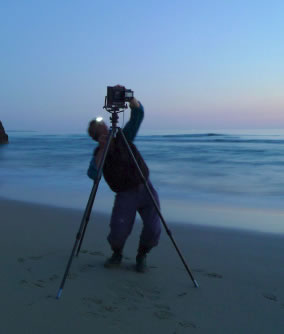
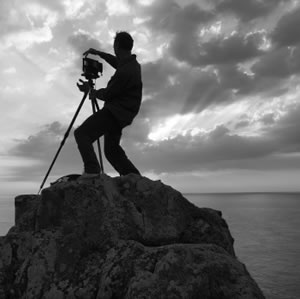 It is important to note that this book, rather than being by Joe, is about him. The author is, in fact, Eddie Ephramus. He is a fellow photographer, writer and good friend of Joe. The premise of the book was for Eddie to follow Joe over an extended period (in actual fact, it was written over a period of four years) photograph and write about him at his work. We see Joe working at times with his beloved Ebony Film Camera, but also using a compact digital camera as a 'sketchbook' to hone compositions and crystallise ideas prior to setting up the Ebony. Joe has also tested using a digital SLR and finally settled on a Phase One Digital Back for his landscape work. (now Joe has made this momentous move, I wonder how many large and medium format film users will follow his lead?).
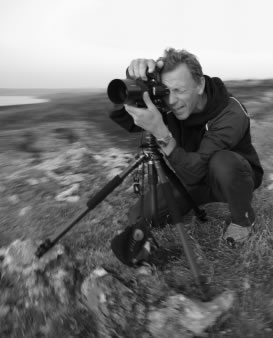 The chapter titles give some hints as to the direction of the book. A Question of Balance. Intimacy and Connection. The Search for Order. Perseverance Works and so on. Each chapter shows Joe working on location. It is fascinating to see sequences of images made by Eddie showing Joe working a scene. Often we see Joe's expressions of intense concentration. We see a photographer who puts a great deal of effort into every image. The compact camera enables him to work an area making images of potential compositions until the ideal one is found. Then the Ebony can be set up to replicate the image.
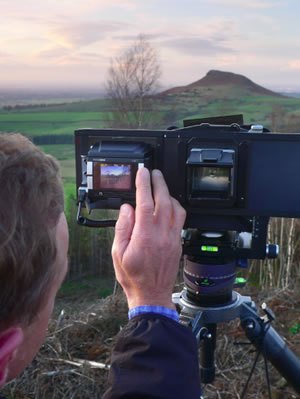 This is a book that rewards re-reading. I am reading it for the third time. Yes, it is full of Joes stunning images as we would expect. But most of the photographs in the book are Eddies images of Joe working and these are very revealing, showing just how much effort he puts into each image - this is a photographer who grafts for every shot. But for me, this book is most fascinating in the way it opens up Joes mind to us. It helps us understand his 'art', his approach, his philosophy. It has helped me think deeply about my own approach. How do I view light, the weather? Do I work hard enough on location? To I really seek out the finer compositions or do I gravitate to the obvious? Am I too quick to get the tripod up and get shooting?
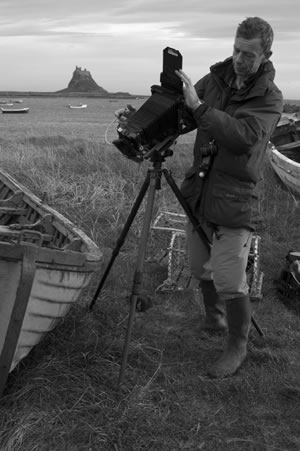 Then on my second reading of the book I came to realise that, much as when we sit down to listen to a new music album, we feel a bit disappointed on the first listen. However, as we listen again and again we start to hear so much that we missed on the first occasion. The work opens up to us and reveals just how good it is. So with this book I have realised just how much depth is there in the text and images. Eddies insight and interpretation of what Joe is doing and saying opens up so much to us. Joes comments are as always very thoughtful without being drowned in 'art speak'. This is not a book to be rushed as I did on my first reading. It is worth reading in short sessions and then reflecting on. The images of Joe working are also worth studying. Especially on beaches as, clad in his rather splendid wellies, he really works hard to track down the shot. His patience is very evident as is his methodical approach.
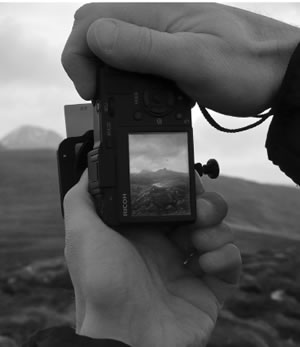 Joe is to be congratulated for being prepared to be examined in this way. I imagine for a modest man, this might have been an uncomfortable process at times. Landscapers are solitary artists and so to be followed and questioned while trying to be creative must have been frustrating and perhaps a bit unsettling? Many photographers also seem to jealously guard their knowledge of locations and processes, being unwilling to share. Joe has here demonstrated yet again just how keen he is to help all of us develop our personal 'Craft, Art & Soul'.