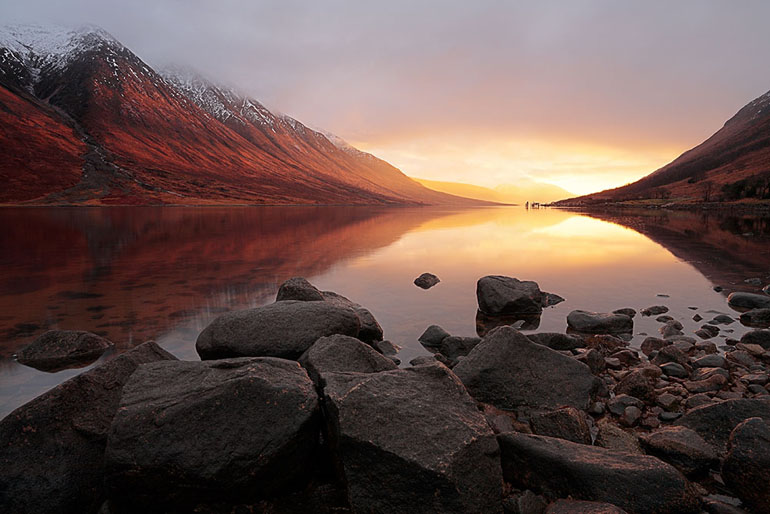

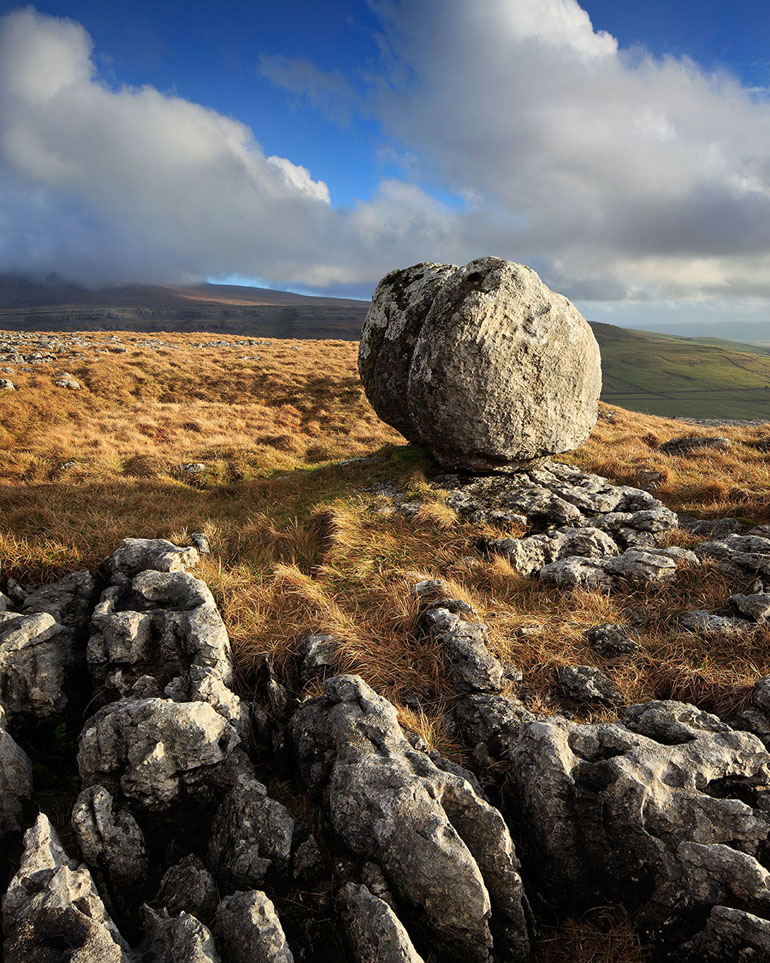
Robert Garrigus volunteered his photographs to be the subject of Joe Cornish and Tim Parkin’s photography critique and what a good couple of compositions they were too. Many thanks Robert.
Critiques – Robert Garrigus
18 Responses
-
-
Dennis_Bromage
Firstly, fantastic images Bob, they’re both absolutely beautiful and I’d be VERY happy if they where mine. I thought Joe and Tim’s comments on the Loch Etive image where right on the money and agreed with them in every way. I also agreed with what they said about the Twistelton image but the thing that struck me was the way Joe thought little of making what I saw as quite large changes to the balance of light within the image. Now I’m not saying I didn’t like the end result but I am a little surprised that he thought it was acceptable to make local adjustments like that…
Maybe I’m deluded or have been deluding myself or maybe I’m just very naive, and I am also VERY nervous of the consequences of writing this and airing my reservation in a public forum and effectively criticising arguably Britain’s best landscape photographer BUT I always put large format photographers and Joe in particular on a pedestal . I believed large format photographers shared the philosophy that you should get everything right in camera and print straight from the transparencies or straight from scans of the transparencies with little more than a small degree of colour correction and maybe dust spot removal and other minor adjustments. This has been the philosophy I’ve tried to follow myself, with my digital workflow, getting everything right in camera so that the image on the back of the camera is an accurate representation of the scene in front of me. Then processing the final RAW file to look like the image on the back of the camera. I’ve always done this with aspirations of being as good as the great masters of our art and I was hoping (again perhaps naively) that with the resurgence of the use of ND Grads and the like that others had similar aspiration and that the tide might finally be turning back to more traditional values as to what was acceptable. Now after seeing this critique and several of the other video interviews over the previous weeks I find myself feeling a bit deflated and confused, maybe my bubble has just burst as it appears that even the great master’s tinker with their images and think little of making what I at least see as quite major changes to local contrast.
I really admire Joe’s honesty and transparency about his workflow and it is very refreshing seeing one of the biggest names in landscape photography talking so openly about what adjustment he makes and considers acceptable but I do wonder what the general public, who are already very sceptical about photography would make of it as Joe has been put on pedestal locally as being “a proper photographer with none of this digital manipulation that everybody else does these days”
Right I’m off to crawl under a rock and hide for a considerable amount of time as I’m guessing must people will think of me as naive idiot but I must finally apologise to Bob as this is all rather off topic and it wasn’t my intention to draw attention away from his wonderful images. It also wasn’t my intention to criticise Joe (or anybody else) and I hope my comments don’t offend anybody it’s just that I’m surprised about the amount of local adjustment that is considered acceptable and I was wondering what other people thought?
On March 22, 2011 at 7:20 pm • Reply -
I don’t think these comments are too scathing. I too was quite surprised at how much modification in Photoshop Joe undertakes.
I think it is probably a reflection of changes in practice rather than “he’s been cheating us all along”. For example, moving towards the use of digital backs (and digital cameras for that matter) the raw is not equivalent to the scanned transparency, but to the pre-developed film which could have reasonably been treated to a range of in-development modifications followed by further modifications during the print stage – think traditional dodge/burn and use of filters during enlargement and printing.
Photoshop is simply the modern day application of these time tested methods – most of the brushes even retain the names for historical value.
I haven’t seen joe clone out a telegraph pole or unsightly rock in a photo yet, and that would tip me in the direction of unacceptable
These videos are most enjoyable and I may well subject myself to the torture at some point and send some images in.
On March 22, 2011 at 9:44 pm • Reply -
I would also like to add my thanks and appreciation to Joe and the participants for what is turning out to be a really interesting and useful series. I am a little surprised about the concern expressed above about the level of manipulation. I think this is pretty subtle and very much the acceptable face of Photoshop. What is striking with the Twistleton image is how effective the slight rebalancing of light/shadow and saturation is on the composition as a whole. There is no way that these subtle tweaks could have been achieved in camera and I see no reason why this should take anything away from Robert’s obvious skill as a photographer. I am just wondering why I bother slogging through all those tedious books about Photoshop when I can just watch these brilliant videos!
On March 22, 2011 at 10:38 pm • Reply -
As a relative beginner (I used to use colour slide film on mountains and moved to a dSLR a little over a year ago), I would say that I would have been surprised to find that Joe didn’t dodge and burn images before completing them (whether by printing or displaying on a screen).
I’ve read enough in the last year to know that Ansel Adams’ prints were very different in tonality to what was captured on the negative, as were/are those of many other ‘masters’. I also realise that this wasn’t possible until digital imaging came along and added the potential for extra workflow, even to film captures. Surely, the fact that /colour/ images were not manipulated in the past was simply since it was technically impossible, or near-impossible, to do so? In contrast, B&W has a wealth of techniques for adjusting the range of tonality both globally and locally, and people have used it to create their finished vision ever since photography began i.e. not just dodging and burning, but use of variable contrast papers and other techniques which all modify how the final print looks.
You can add to that – and this relates to the ‘this is what I saw’ argument – the fact that cameras, whether film or digital, do not record light in the way that the combination of our eyes and brains process an image and enable us to perceive it. It seems to me to be almost inevitable that the majority of captures will need some form of manipulation, even if the objective is to come as close as possible to ‘what I saw’.
And finally, I’m not at all convinced that photography should invariably attempt to show exactly what was seen. It is an art form, after all, so surely the vision of the photographer should play a part in determining whether it’s appropriate to lighten or darken various parts of the image?
All the above is purely opinion! I’m not remotely saying that anyone’s view on the ethics – to be somewhat grandiose – of manipulation is right or wrong, merely expressing my take on it. Personally, I’m happy to dodge and burn but have never yet cloned anything out, or in – and I probably wouldn’t do so; but that’s just /my personal take on photographic ethics …
Mike
On March 22, 2011 at 10:47 pm • Reply-
Hi Mike, I don’t want to step into this conversation yet (very interesting though it is). But I did want to point out that early colour photographs were being manipulated in terms of colour and luminosity from the early days. e.g. The dye transfers and contrast masks that were used quite often that although difficult to do well, allowed extensive changes. The ability to make these changes in photoshop has revolutionsed things in terms of ‘ease of use’ and the abilty to make complicated adjustments. Even with Cibachromes, extensive dodging and burning was needed to make the most of the prints. That these can now be targeted with precise creativity should be seen as a bonus.
On March 22, 2011 at 10:52 pm • Reply
-
-
Oh! And I meant to say again: this is an excellent new feature and I look forward very much to seeing more of these analyses.
Mike
On March 22, 2011 at 10:48 pm • Reply -
-
“Dodging and burning are steps to take care of mistakes God made in establishing tonal relationships.” Ansel Adams
I personally find Joe’s suggestions quite acceptable in subtly enhancing an image while maintaining complete verisimilitude. I never get to use that word but that’s the litmus test for me. If Joe starts switching our skies or cutting and pasting deer into our foregrounds then he’ll probably lose me
I guess everyone has to draw their own ethical line when it comes to their work and post-processing but I tend to believe that their is no ‘right’ or ‘wrong’ in this equation. Deceit in post-processing is my pet peave – cases where people are not up front about having made adjustments and claim to be displaying images “straight out of the camera” when they clearly, or very probably, aren’t.Whatever you choose to do, be up front and do it the very best you can to realize your vision.
On March 23, 2011 at 6:08 am • Reply -
Dennis_Bromage
I don’t want to add too much as I’ve probably said too much anyway but I just want to say that I hope nobody thought I was suggestion Joe or anybody else was a fraud or cheat. That couldn’t be further from the truth. I very much admire Joe’s openness and honesty and find it incredibly refreshing hearing a photographer of his calibre talking so candidly. I also hope I stopped short of saying that I though any of this was right or wrong. I just wanted to state that I was surprised and to hopefully start an intellectual conversation around the subject.
I think my point was this; I’ve seen Joe’s large Cibachrome prints and they are stunning. I’d assumed they where straight prints from the transparencies and didn’t think it was possible to make local adjustments to Cibachrome prints. Maybe I was totally wrong about that but if they are straight prints my point is, why do we apparently ALL now feel the need to tweak our images. I think the digital darkroom maybe gives us too many options and makes us feel that all our images need to be perfect, even if they’re good in the first place?
Interesting that a couple of people have mentioned cloning as I will clone from time to time (out never in) and if for example there is a bit of chewing gum suck to a pavement, that I couldn’t remove on location I would think nothing of cloning that out and I have also removed the odd stray TV aerial and the odd ghost duck in the past too. Maybe this makes me the biggest hypocrite of all? I think maybe I need to look at my own ethics again and after writing the original comment I do find myself scrutinising everyone of my images and wondering if I am a total hypocrite…
I would also like to add my thanks for introducing this feature and for introducing the site itself actually. It’s amazing to be able to gain such an insight into the artistic visions of other photographers and I think it’s brilliant that we can add our own input and have the opportunity to have intellectual conversations around the subjects too.
On March 23, 2011 at 9:08 am • Reply-
Joe Cornish
Denis,
Jumping in here, having been out of the loop running a workshop. Very interested in your comments, and pleased with the thread of responses they have provoked!
I don’t take your comments as accusations of fraud, although I do sense your anxiety about my approach. Many of the responses have covered the ground extremely well, but allow me to add my own thoughts on it.
The brain is the best ‘image processing engine’ we know. Because it manages light and exposure locally through a seamless integration of focussed (foveal) vision and peripheral vision it effectively interpolates the world for us perfectly (and with no noise, banding or digital artefacts!). Photography on the other hand, is an honest to goodness light recording instrument. I have a feeling that, one day, cameras will incorporate brain-like interpretations, but that is for the future. So, to cut to the chase, what the eye/brain sees, and what the camera sees are totally different, as we all know if we are honest about it. Thus, photographers have ‘manipulated’ photographs in the darkroom or elsewhere ever since the dawn (or perhaps early morning) of the photographic process. Sometimes those manipulations are intended to match what we saw (or believe we saw), sometimes for other purposes entirely (propaganda, titillation, provocation etc).
Using a view camera, and seeking to get everything right in camera remains a classical and ‘correct’ approach in photography. But it still cannot capture everything as the eye sees it. My ‘manipulations’ are usually an honest(!) attempt to recreate the way the brain ‘opens up’ shadows or easily ‘recovers’ highlights that the photograph itself struggles to achieve. It is also my way of tweaking the interpretation, to put the emphasis where I want to, should I feel the original photograph falls short in that sense.
Almost all the photographers I really admire used the darkroom to – how can I put this politely? – to full effect in printing their work. I truly believe that printing skills are a part of the work. In cooking, you would expect a good chef to not only source good ingredients but also to prepare, cook and present their creations with care all the way through. A poor analogy perhaps, but printing can be seen as the equivalent of presentation in cooking. I agree with danfascia, Photoshop is simply the modern darkroom for colour photography.
Of course, interpreting the work of others is potentially fraught with controversy, and I am acutely aware of this responsibility. My last word on this is that I strive to do the absolute bare minimum to make an image really work, or ‘sing’, and no more. No moving of telegraph poles, or adding or subtracting (dust spots excepted). Or even chewing gum. That could be a significant element of post-modern irony…On March 28, 2011 at 9:00 am • Reply-
Hi Joe
Thanks for responding. Am I anxious about your approach? No not really. I think if anybody else had made the adjustments we’ve seen you make in recent videos I wouldn’t have thought anything of it and I think that is perhaps the crux of the matter. I’ve always put you on a pedestal, as I know many others have (photographers and public alike) and I wanted to believe that you where different. I wanted you to remain up there on that unattainably high pedestal, getting everything right in camera so I had something to aim for in my own images and my own ethics. I guess that was unrealistic and possibly unfair too.
The videos and this thread have given me a lot to think about, maybe I don’t need to feel so guilty if I make small local adjustments and on the flip side maybe I do need to rethink my stance on cloning and the removal of small distraction that it wasn’t possible to remove in the field? I think the big problem is that the digital dark room gives too many options and too many opportunities to tweak our images, especially for a perfectionist like me. How do you know where to stop and what is acceptable? Is it ok to make whatever subtle adjustments you need as long as the final image looks natural and believable and is a true representation of your vision of the scene as you experienced it when you released the shutter?
On March 29, 2011 at 11:15 am • Reply-
Joe Cornish
Hi Denis,
No pedestal please, that is for statues! I am simply a photographer trying to do his best, like so many others out there. I may have said in the past that I try and get everything right in camera. In transparency film that is an essential element of a technically sound approach. But I still do strive to get it right in camera, shooting digitally makes no difference to me in that respect.
I learned my trade in the darkroom, so controlling the print has always been important to me. When I have Cibachromes made I ask my printers to tweak the colour here, the contrast there, darken a bit, lighten a bit etc. But I am aware that (short of contrast-masking) local controls with this type of printing are fraught with difficulty. Digital printing allows much more accurate, targeted tweaks and adjustments as you have obviously seen and understand yourself.
To my mind this is not some kind of moral issue, it is a matter of philosophical position, and artistic judgment. My philosophical position remains rooted in the power of photography “as a document”. In that respect, a genuine ‘credibility’ must be preserved. The fact that I may use a camera filter, and/or Photoshop adjustments to achieve that credibility is simply part of the reality of good photography (I refer you to my earlier thoughts about the difference between the eye/brain and the camera.). So that is the philosophy (“credibility”) whereas for many in photography it is for “effect” or “impact”. Not that effect and impact are mutually exclusive from credibility. But they are not my philosophy.
Finally, artistic judgment: “Is it ok to make whatever subtle adjustments you need as long as the final image looks natural and believable and is a true representation of your vision of the scene as you experienced it when you released the shutter?”
Hopefully, you can now see that, essentially, your question is my position. As for where to stop and how much is acceptable, that is for you to decide. I am still learning that one and expect to continue to do so in the decades ahead.On March 29, 2011 at 12:09 pm • Reply-
Thanks again Joe that’s incredibly enlightening and gives a lot of food for thought. I find your openness to discuss these issues incredibly refreshing and eagerly anticipate watching the future videos and reading future articles
Cheers
DennisOn March 29, 2011 at 5:49 pm • Reply
-
-
-
-
-
Regarding printing of cibachromes, for those not familiar with the process, this has always been a very tricky business. Just to match the original transparency requires great skill. Shadow detail is particularly prone to block up and skilled printers use various techniques, such as dodging and burning, to compensate for this. The fact is that the print does not, unfortunately, match the transparency. This has always been the case and the same is true of digital capture. When you think about it, this is not really surprising, as the various media involved (film, photons, paper, ink) have radically different properties. The skill of fine art printing has always been about bridging the gap between these different media and, where possible, compensating for the inevitable limitations of the capture and printing technologies in an effort to articulate the photographer’s vision. In short, there is no such thing as a straight print. I would go further and say that there is no such thing as a straight photograph, but that’s a discussion for another day.
On March 23, 2011 at 10:04 am • Reply -
Reading the post from Dennis again, he doesn’t mention having an issue with post processing to match a transparency by dealing with the shadows or adjusting colour saturation to match the original – Dennis’s issue I think is with localised adjustments which I take to mean working on different areas of the image to aid composition, lead the eye or detract from certain areas. This is much different to adjusting the digital file to work in print or on screen.
Everyone’s opinion of what is right or wrong when it comes to “photoshopping” is different and no-one is correct, the camera is a machine that captures light – it’s up the the photographer to decide what to do with it afterwards depending on their vision (I hate that word!). Personally my aim with an image is to make something that I hope someone connects with as an artistic piece of work – if I have a photo, either on film or as a digital file that is more balanced or gets my message over better if I digitally remove a leaf or branch or darken an area to improve composition then I’ll do it – why not, would you not remove the leaf if you’d have noticed it when you took the photo? I remember read about someone’s photo (can’t remember who – Charlie Waite maybe?) who said he was disappointed that a leaf was present in the road which spoilt the image – how silly when it can be so easily removed!
For me it’s important to not make the changes look obvious, they shouldn’t draw the eye by drawing attention to themselves but you can make quite large local adjustments and, if you’re skilled they’ll remain transparent (as Joe’s generally do). Problems occur when post processing is done ham-fistedly; bad over saturation, silly amounts of vignetting and the like – when you look at the finished photo and the first thing that hits you is the processes that have been applied. I certainly don’t think that’s the case with Joe’s or Tim’s finished photographs.
How far you go with manipulation is a matter of personal preference, in one of David Noton’s DVD’s he removes whole buildings – too far in my opinion, and I’d never add stuff, but I s’pose if people want to – go for it, there’s no law against it!
On March 24, 2011 at 11:31 am • Reply -
Seamuscamp
All claims as to “correctness” are specious. Often it is obvious that what is claimed as “true” photography never existed historically, for the technology of the time didn’t allow it to come out of the box in a pure form. Manipulation is manipulation and often the ability to manipulate, to see what could be made of an imperfect image, was exactly what made great photographers great. They worked the technology of their day to produce their visions. They used physical intervention where we use electronic intervention. The ethical considerations are what they always were – the presentation of falsehood as truth (as in presenting a domesticated wolf as a wild one). There may be a further ethical question – judging the work of others solely in terms of what the judge does or would like to do.
On March 24, 2011 at 8:19 pm • Reply -
Joe Rainbow
A quick thought on this topic, which is quite fascinating and relevant to all of us I feel. I think we need to consider what it is we are trying to present. A photograph is inherently a fabrication of the ‘truth’. Are we trying to present a slice of ‘reality’ or are we presenting an individual interpretation of a scene. I think lining up several photographers and asking them all to try and capture, process and print the scene as accurately as possible would give tremendously varying results. What do you then look at as the ‘control’ for the truth of the scene? There is no way of saying that was the definitive version of how something looked, short of seeing it for yourself. As soon as you have seen it, the scene becomes a memory and memories are notoriously unreliable. Thanks to the changing natural environment, the scene will never present itself in the same way again. So in conclusion, I think we are left with no choice bu to interpret. Whether we choose to label the interpretation as ‘accurate’ is up to us, but clearly many people want to add some individual ‘signature’ to their work, otherwise known as a style. (above and beyond their choice of subject matter, focal length etc…)
In short, a photograph is not the real thing. A painting is an interpretation no matter how hard you try to disguise the paint. The viewer is the key to the whole thing I think. It is up to us the viewer find the right balance of technique, style and believability, or understand that conscious manipulation, has been applied. The photo is intended for us to decide if it is on display. I was looking at David Ward’s images online today and thought how saturated many shots look. I like them, whether or not I think they are too colourful or not to be ‘real’. Good article and discussion thread.On May 21, 2011 at 8:40 pm • Reply