


 Join the conversation
 Subcribe to comment rss feed
Fran Halsall considers the place of simplicity in landscape photography

Fran Halsall
Fran Halsall specialises in photographing the UK landscape, particularly the wilder parts of the coastline, moorlands and woodlands, and has a particular passion for creating interpretative images of geological formations.
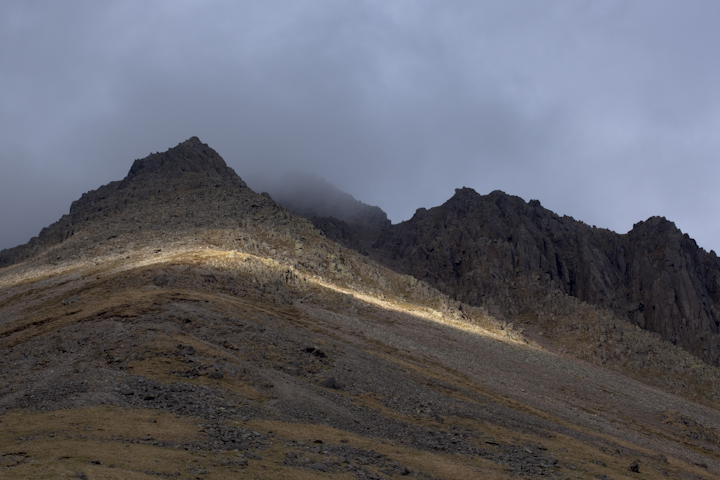
Dark and threatening clouds hang over Great Gable's impressive southern flank.
Representations of landscapes throughout western art history have taken a back seat to works depicting the dramas of human existence. In many cases landscapes were reduced to a stage set in a historical painting or a stylised backdrop for a portrait. This is unsurprising as for much of our history the untamed landscape was considered a desolate place that was best avoided. However, in the latter part of the 18th century attitudes began to shift towards a new aesthetic appreciation of the natural world and this was in part due to ideals promoted through Romantic art.
Of the artist’s working in this era two have become synonymous with painting the emotional subtext of the landscape, the German painter Caspar David Friedrich whose images feature epic mountains towering above diminutive figures and dark trees in moonlight overlooked by gothic towers; while in Britain there was J.M.W. Turner whose paintings are so full of light and life that they are still fresh after nearly 200 years.
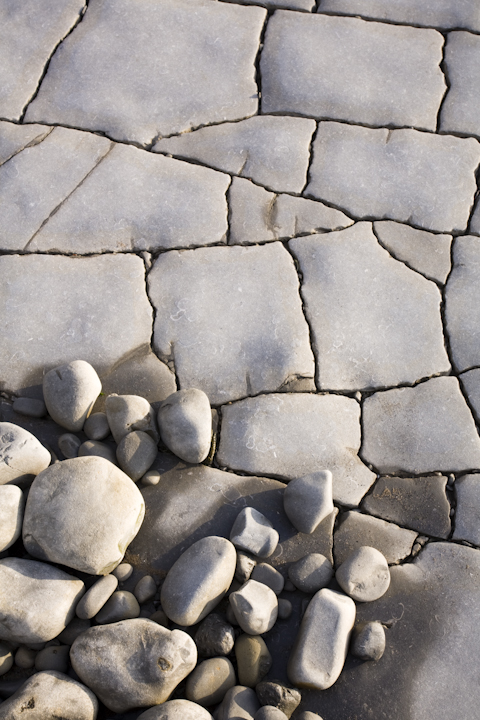
The cliffs of the Glamorgan Heritage Coast
Both painted from direct observations of nature rather than the imagined landscapes that characterise the work of earlier artists. It is this immediacy to the subject that conveys the spirit of place, which in turn demands an emotional response from the viewer.
While landscape photography is an obvious successor to what the romantics set out to achieve, in terms of its ability to document nature in its truest form, this idealistic heritage is almost an impediment to the contemporary landscape photographer, as in the minds of some the art form is considered backward–looking. This misses the point of what I believe both my work and that of others is about. Personally speaking it is about engaging with nature in a philosophical way that is as much about finding its structural essence and observing light as it is about exploring its environmental significance and my psychological relationship with it. This latter point is of particular interest to me as our place within nature is ambiguous, for we are both part of it and at the same time intellectually removed from it. It has the ability to stir profound feelings of belonging and yet as a species we are able to wreak havoc upon our environment in the name of progress.
This questioning of the relevance of representing landscapes through photography has made me conscious that it is far too easy to create images that can be dismissed as picturesque, forcing me to think about how to avoid repeating clichés. However this is easier said than done, as one has to be derivative before one can be innovative. Through my art education I have been exposed to many different ideas that have helped me see my way through such problems. One area that has greatly influenced me is the reductive principle of Modernism or the ‘less is more’ approach. This has interesting parallels with how our brains process sensory input and how much we can be said to be truly ‘aware’ of at any one time.
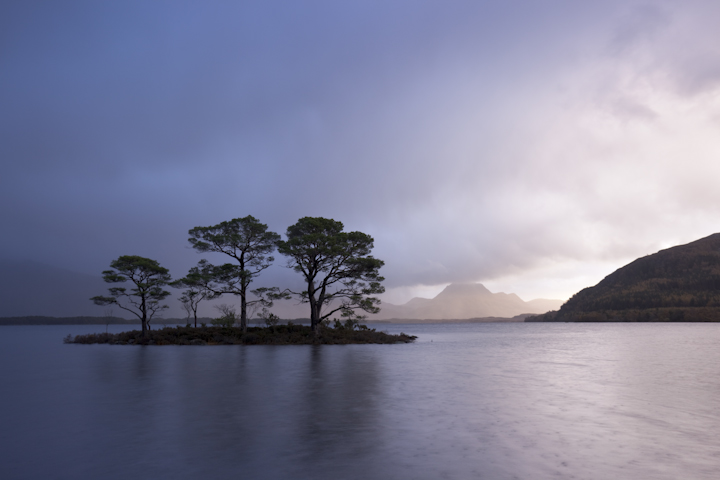
Loch Maree, Wester Ross.
The writer Aldous Huxley in his seminal work, The Doors of Perception, described the conscious mind as a ‘reducing valve’, bringing selective attention to events experienced unconsciously as and when they become significant. The reason the mind works in this way is to prevent confusion occurring as a result of multiple sensory inputs. This notion is especially relevant to photography as the camera will record everything that is in front of it, to the point where it is possible to include so much within one image that its meaning becomes unclear. To avoid this the photographer needs to minimise the wealth of information contained within the whole scene to its fundamental parts, identifying those elements that are intrinsic to and those that are a distraction from the idea that is to be communicated.
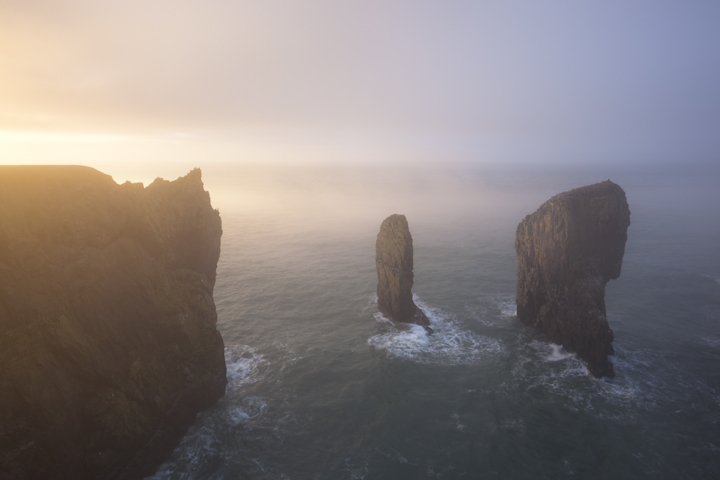
Sheer limestone cliffs fringe Flimston Bay near Merrion in Pembrokeshire.
Removing clutter leads to bolder compositions that both entice the eye and engage the viewer’s imagination. The less that is presented in one photograph the stronger the remaining features become. The problem with this is that one person’s beautifully simple is another’s definition of boring, such is the subjectivity of art. Although I would argue that a tendency towards simplicity is in the back of most photographer’s minds when they analyse the view, however strictly they choose to apply it. On a practical level it can be surprisingly hard to reduce complexity. Not all landscapes lend themselves to a simple treatment as they are often chaotic in appearance, making it difficult to get a fix on the main components. A clear-cut image might give the impression of being easy to create but this belies the effort necessary to find the pattern within the chaos.
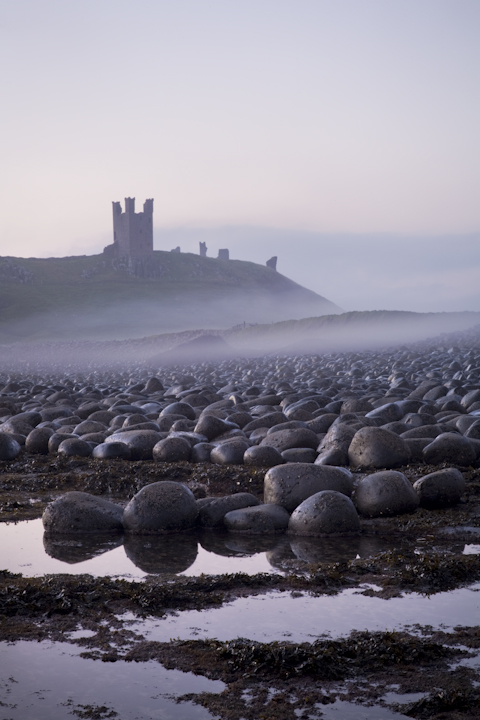
The atmospheric ruins of Dunstanburgh Castle
In this attempt to establish visual order in response to the dynamics of nature it is important to not become overly controlling. When reacting to the environment my aim is to follow the flow, which is a somewhat vague concept that is by no means easy to define. For example there is a subtle something about the curve of a hill, the shape of a rock or the growth of a tree that suggests a direction intrinsic to the ‘feel’ of the landscape and it takes a certain amount of sensitivity to find this. A preconceived template of how landscape photographs should be composed that is too rigid could potentially squeeze out the very spirit that brings the subject to life. Each of my photographs is therefore the result of an emotional response as well as an analytical deconstruction, marrying the openness to experience the sublime inherited from romanticism with the stylistic and conceptual rigour encouraged by modernism. When a balance between these two different ways of interpreting the world is achieved to my personal satisfaction then I feel able to say that the image ‘works’.
Fran Halsall © 2011
Fran Halsall has worked as a professional photographer and writer for nearly 7 years, taking as her inspiration the wild landscapes, diverse geology and different habitats of the British Isles. She is the author of two books, The Peak District (Frances Lincoln, 2008) and Light and Shadow (Frances Lincoln, 2010), and is currently working on a third.
Fran is passionate about promoting the value of our natural heritage through her work and hopes that the national obsession with landscape photography is a sign that we moving towards a better appreciation of our environment.