
Unwanted Sales Opportunities?

Whilst I was working on the content for this issue, I received a disturbing phone call from a colleague, Jason Theaker. He was calling from Whitby where he was about to lead a photographic workshop and, whilst scouting for said workshop, had found a website called ‘whitby art’ (whitby-art.co.uk – I won’t link to them as that would give them undeserved ‘google juice’).

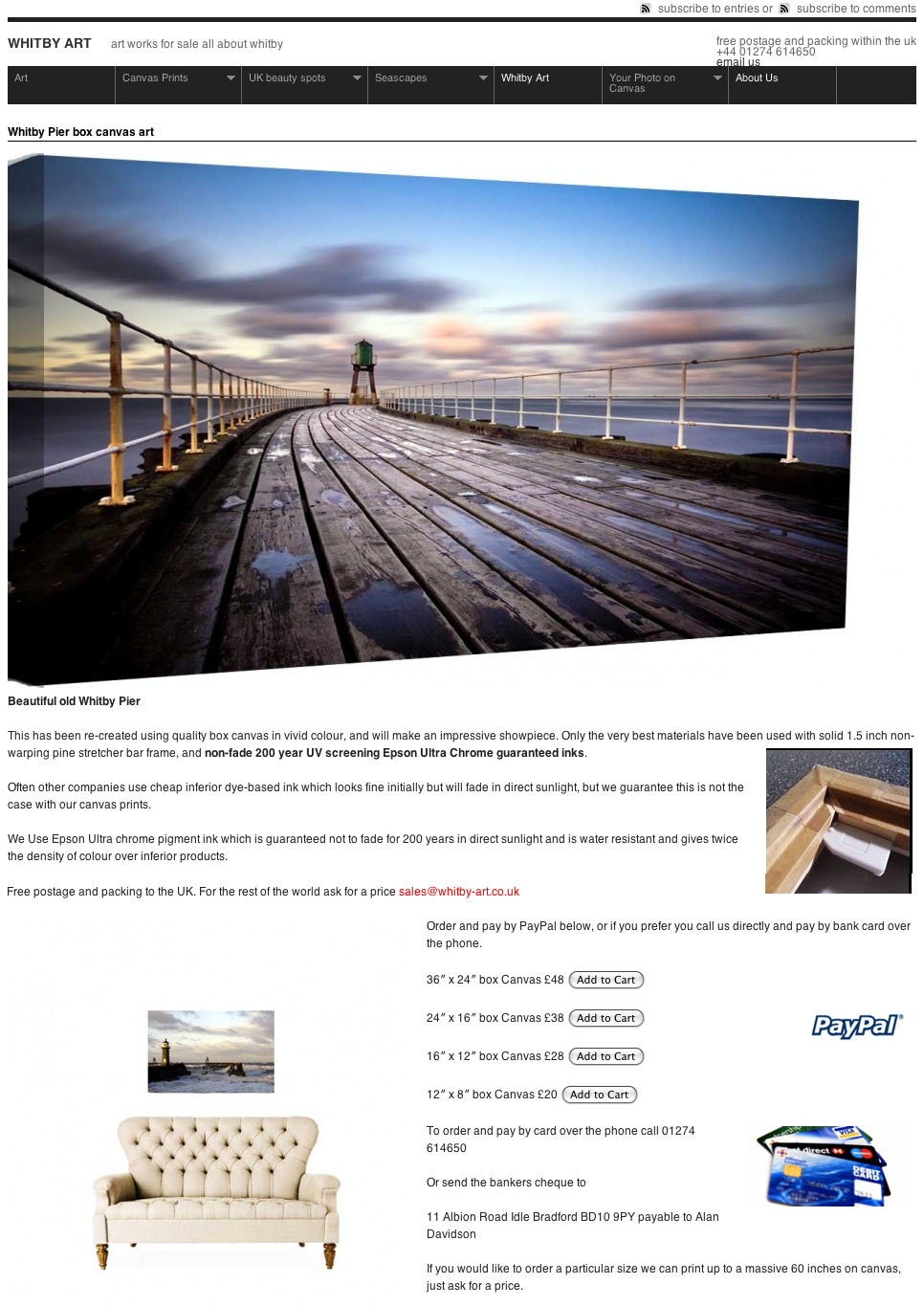
The disturbing part of this website was that they were selling one of Jason Theaker’s pictures which was badly printed. The badly printed thing was something we must assume as the photograph had been stolen from Jason’s Flickr account and posted on their website as ‘for sale in canvas sizes up to 60”’ – well, from the 1200px wide original that makes a 20dpi print!! (or less than one pixel per millimeter).

Lest anybody proclaim that having pictures at this size on the internet is asking for it, I have also spoken to people who have had their commercial prints purchased and then scanned for illegal art repro purposes.

Whilst browsing the website, Jason also found another print by one of our featured photographers, Antony Spencer – amazingly including a ‘certificate of authenticity’. Well, as you can imagine both parties were all ready for a frontal advance into Whitby to snatch their property off the walls of said gallery – apart from the fact that they couldn’t find it! Perhaps it doesn’t exist and is merely a figment of said pirates imagination?

I was asked what the best approach was and despite having no legal experience, I have had a fair bit of business experience and was fairly certain that going through the legal system wouldn’t result in anything except expense and stopping the guy using the pictures. I suggested that a bill be presented for ‘unrestricted royalty free usage’ of said picture. Well, the end result was that the images were removed from the website quite quickly.

Fortunately, stories like this where commercial operations try to profit from image theft are fairly rare and, as mentioned previously, the only way to guarantee it won’t happen to you is by not putting your pictures on the internet and also not selling your pictures (or comprehensively vetting everyone who purchases them). There are websites that can help you track image use such as the ‘Tin Eye’ reverse image search engine. Sadly, the way that this particular website has (badly) presented the image in some form of box canvas means that the image search engine couldn’t find it (it does work with colour changes, small clones and crops though).

Here is a Google cache of the offending page on the website that was selling Jason’s picture and here is the google cache of Antony’s.

Jason has written a little about the experience here.

The website has since been removed and an apology uploaded

“Whitby Art is now permanently close and would like to apologise if we mistakenly represented anybody’s pictures which were sent into a Facebook competition in December.”

Make of this what you will, the lack of a link to said competition makes me a little suspicious. And the fact that he is still using stolen images on his personal website makes me even more suspicious.. Here’s a Google link to Whitby Art’s proprietor – Page on blog – and here is a link to the original photo on flickr flickr page for photo

7 Responses

  1. Well I didn’t enter into any Facebook competitions and I’m sure Tony wouldn’t have either considering his recent competition win!
    This does open up other interesting questions. Say somebody else downloaded the image and entered into the competition and said it was their image? (Ironically like they did with another of my images of Whitby that somebody sent into ‘Paul the weather man’ last year, but that’s another story!) The offending party could have a licence to sell the image from the ‘image thief’ and still be breaching copyright, without his knowledge! That said this isn’t one of those situations (and Tim’s link to other images the perpetrator has used from flickr, does suggest that this is a common method for him to retain imagery for his myriad of ‘trotters incorporated’ businesses).
    There is another irony in this situation, if you do a little digging; you will see his ‘art gallery’ in Bradford is actually an alarm shop! So this trusty alarm fitting security expert is steeling (and selling) images in his spare time!
    Anyway, I haven’t decided what to do regarding the next step. I sent him an email offering to draw up an official licence with some compensation included, but he declined stating that he haven’t sold any! (Like I trust him!) But he did offer me the chance to have a couple of large prints as compensation!!! (You know I’m almost tempted just to see how the very small image looks blown up to 60 inches!) But seriously the thing I’m most upset about is that he may have made money from my work without proper remuneration for my efforts!
    Anyway, I have an appointment with a lawyer but don’t want to say too much here for obvious reasons! Apart from that I do sincerely think it a shame that Tony and I didn’t get arrested retrieving our own work from the walls of a gallery! Would have loved to see the newspaper headlines, who knows an interview on breakfast news from behind bars too!

  2. Jason, that sounds like a clear case of copyright theft to me. It is tricky if he claims he didn’t profit from it but the intent to profit is evidenced by his actions. On that basis he should be liable to pay you a reasonable license fee.

  3. This man’s cheek is unbelievable, I’m stunned. Good luck with the lawyer Jason.
    Cath

  4. JonSparks

    Yes, please keep us posted.

  5. I hope you succeed it taking im to the cleaners Jason! What a kick in the teeth!!

  6. garyeason

    As of today (March 14) the whitby art website is back online – with, as you say, an apology.

  7. If you need to tackle an issue like this the ‘tool’ you need which will. help to a point, is the DMCA. The Digital Millennium Copyright Act. This places an obligation on the ISP and Google to not host nor link to stolen images.

    To file a DMCA complaint you must contact the offending ISP where the image(s) are hosted and give written and signed declartion of ownership, with proof, and to Google send a similar letter but also provide as many web search strings from Google that lead to the offfending images.

    I had one of my images used hundreds of times in a USA-based business site and sent a cease and desist letter which was ignored. I tackled the woman through her several other companies email addresses and got spam-binned on each of them. I contacted her ISP and Google and the images were down in a matter of days.

    If the offender refuses to remove the image Google’s threat is to permanently remove ALL links leading to the offending images, basically destroying someone’s online business presence in an instant. The ISP can pull the site also.

    Do you get compensation? No. That take a wholly separate legal approach involving the courts and can be problematic across international boundaries.

    DMCA is controversial as it has obvious routes for misuse, but for the types of issue we might find with unauthorized use it can prove useful and give errant image-users pause for thought.

Notify me of followup comments via e-mail. You can also subscribe without commenting.