Beyond Beauty

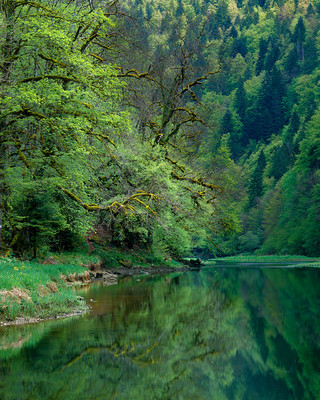
Classic beauty?

What is ‘beauty’ in landscape photography? On the face of it, it’s almost a question that doesn’t even need to be asked. We all know intuitively what a beautiful landscape looks like, don’t we? But is it so intuitive? And what makes the landscape ‘beautiful’? Why do we respond better to certain types of terrain and not others? Is the landscape intrinsically beautiful or are we looking at it through the prism of our own experiences and cultural associations? And why is this even important? Well, beauty is undeniably fundamental to good composition – we try to arrange the elements of our photograph in an aesthetically pleasing way, do we not? – so understanding our perception of beauty is a key part in transferring our vision of the landscape to a meaningful photograph. To do this we first need to analyse how ‘beauty’, or more generally, ‘aesthetics’, relate to photography.

I often travel to relatively remote mountain areas to make photographs and it was during one such trip that I found myself musing on why wilderness is such a powerful draw in landscape photography. I didn’t need to search much further than my own feelings of elation and well-being whilst enjoying the mountains to find the answer. But this came far too easily to be truly satisfying and I was left with the feeling that there must be more to it than that. Let’s try framing the question in a different way: is there something profound in the human psyche that makes the experience of wilderness so alluring? Or is this a comparatively recent phenomenon? If we look back to the pre-industrialised world, to a time when mankind was much more a part of nature, wild nature was something to be feared. Crossing a mountain pass was so fraught with all kinds of dangers – some natural, some arising from unfriendly or downright malignant locals – that it was only ever done out of absolute necessity. In addition to these perils, the harshness of daily life gave people little time for travel or reflection. When you have to struggle with nature on a daily basis you have an entirely different relationship with it.

Then came 19th century industrialisation and the urbanised lifestyle that went with it. People began to find themselves increasingly cut off from the natural world so, partly in response to this, poets and novelists, belonging to what became known as the Romantic movement, were busily imbuing the landscape with distinctly human qualities – we need look no further than the novels of Thomas Hardy for evidence of this. Artists as diverse as Constable and Turner were depicting the landscape as a sort of bucolic fantasy or as a dramatic turmoil of the elements. At the same time, the quickly improving transportation infrastructure was allowing greater access to areas which were previously considered to be far too dangerous. And shortly before the turn of the last century, our relationship with landscape had changed so much that Sir Arthur Conan Doyle was thrilling readers of ‘The Strand’ magazine with tales of his exploits as an early Alpine skiing enthusiast in Switzerland. Wilderness had started to become exciting, interesting and alluring. People had more free time and were increasingly taking advantage of better transport links to travel.

These days we can visit wilderness in comparative comfort and safety so, more than ever before, wilderness is symbolic of freedom and reconnecting with a lifestyle we have largely lost. Above all, being in a wild place gives us pause for thought. We think about our place in nature, the fragility of life, how small we are in comparison to the vast landscape. We might even see ourselves as akin to explorers, happening on a wilderness for the first time. It’s these attitudes and associations which drive our fascination with nature in the raw.
Is nature intrinsically beautiful?

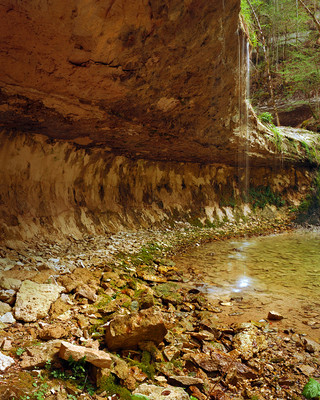
So when we talk of ‘capturing the beauty of nature’ or ‘capturing mood and emotion’, what do we really mean? Are we simply responding to cultural associations? Is beauty there just waiting to be captured by our cameras or is it created by the act of making an image? Can nature be intrinsically beautiful? To this last I would answer, no it can’t. And neither is it intrinsically ugly. Nature just ‘is‘. For example, a flower looks the way it does to serve a purpose – that of attracting insects for pollination – it’s just coincidence that we humans also find most flowers sensually attractive. Similarly, a pristine landscape is fundamentally the product of the quantifiable and deterministic forces acting on its underlying rock and, as with the flower, humans are simply an irrelevance. In the same vein, can nature really be moody and emotional? Of course not. A stormy sea, for example, is caused, as we know, by high winds which are in turn a product of the rotation of the Earth and the effects of the Moon and our local star, the Sun. Even at a smaller scale, nature has evolved forms which, after millennia of natural selection, are the most efficient and energy-saving for the jobs they have to do. Even if, like a mathematical equation reduced to its simplest and most concise expression, we humans perceive such things as ‘beautiful’.

Human vision systems contain, by a long way, the best pattern-recognition ‘algorithms’ of which we know. We are pre-programmed to seek order in the essential chaos of nature; to look for patterns and symmetry since this is what makes the world around us so much easier for our brains to assimilate. When these symmetries are not readily apparent, the task of our visual cortices becomes much harder and this extra effort required is reflected in feelings of uncertainty, disorientation or a vague sense of unease – feelings that are not present when what we see can be understood more effortlessly. After all, a scene which we do not readily understand may contain hidden dangers so such feelings of unease would, in more primitive times, be a necessary survival strategy. But it isn’t just pattern and symmetry that we find attractive. There is also shape and form. Down through the ages, artists have associated a preference within all of us for curving, bulbous shapes with the female body and, in particular, that part of it which is bound up with our earliest tactile sensations.

By making images of the landscape, we are doing two things: we are placing a frame around a part of nature which contains, at the most basic level, an arrangement of forms which the human mind finds easy to process – Modernist reductivism, if you like. But, at the same time, we are also essentially photographing a metaphor. A stormy sea is not inherently emotional but seeing such a scene does trigger a slew of associations – vulnerability, emotional turbulence, awe, excitement, which, if the photographer is doing their job properly, is perceived by the viewer as emotion – the Romantic approach. There is no hard and fast dividing line between these two strands of landscape photography and they are not mutually exclusive. Thus, on one level, beauty in landscape photography is about how we arrange nature and what shapes or forms we choose to photograph and on another, about the meaning, or semantics, of those forms and patterns.
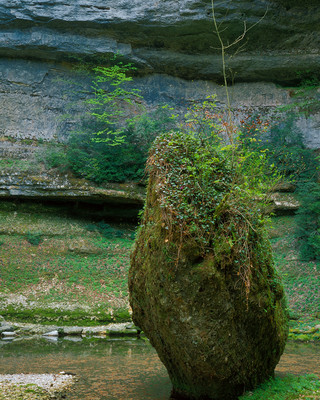
Blues and greens are associated with a sense of calm, stillness and contemplation.

It isn’t just a matter of choosing a subject which is rich with associations, though. Colour has a very large part to play as well. Colour theory tells us, amongst other things, about the emotional associations of individual colours and intensities. We all know there are ‘warm’ and ‘cool’ colours (reds, yellows and oranges vs. blues and greens) which are clearly associated with such ‘elements’ as fire, water or ice. Strongly saturated ‘warm’ colours are associated with heightened emotional states while the ‘cooler’ end of the spectrum puts us in mind of calmness and contemplation. The same can be said of highly saturated colours as opposed to pastels. Strongly contrasting colours lead to visual confusion whereas toning colours have an inclusive effect; bringing disparate elements together in an unforced way.

When we photograph, say, a sunset over the ocean we are essentially playing with layers of metaphor and association, allbeit in a very obvious way. Think about it. The ocean represents our own smallness in relation to nature. A gently lapping sea evokes tranquility; a rough one, excitement and drama. In the sky, warm colours reflected from clouds are associated with feelings of contentment and security while the cool blues of the sky and the ocean underline these feelings with a sense of calm. In such a scene, our experience of ‘beauty’ is essentially a product of the pleasant sensations which the scene evokes.

Of course, I’m not saying that you should go around consciously trying to play with metaphor or associations in every image you make. Some subjects are obviously more amenable to this approach than others. However, it can be a useful tool if your aim is to add layers of meaning to your work. Similarly, reducing every scene to its simplest expression can work well but that doesn’t mean that showing the raw complexity of nature isn’t also valid. Understanding the ‘tools of the trade’ is what it’s all about. Not just the physical tools with which we capture, store and process our images but also the mental toolkit of ideas and aesthetics which we all take with us into the field and employ before we have even triggered the camera’s shutter.

If we are to make images which go beyond merely providing the sensation of ‘beauty’ in an obvious way, we need to be aware of how we perceive it. Formal composition distills the chaos of nature to the barest essentials revealing form and structure; associations of form and colour evoke emotions and, on top of all of this, our cultural associations help to finely tune those emotions. Not that we are aware of any of this when we view an image – it all happens at too deep a level – but if we take control of these aspects when we place a frame around a segment of the wider landscape then we might just end up making subtler, more evocative and more finely-nuanced images, and perhaps even go ‘beyond beauty’.

28 Responses

  1. I like the space in which you’re thinking. Two more ponderings for you.

    I sort of agree about colours meaning things – your green illustration is ultimately relaxing (to the extent that I sometimes wonder if roads have been planted with trees around to enhance relaxed mood). Humans have some innate ideas about beauty, for example, naturally regarding more symmetrical faces as more beautiful. From symmetry flows composition and balance and flow.

    But there are limits. From an analogy: I expect we all know the musical story Peter and the Wolf (http://en.wikipedia.org/wiki/Peter_and_the_wolf). Now, take a recording of that, and strip the narration. Analyse it a little: there are simple musical themes played on individual instruments. But unless you’re explicitly told the story, would you ever in a month of sundays discover a mapping from the bassoon to the character “Grandfather”? If I say that the Hobbits’ theme in the Lord of the Rings soundtrack makes me think of the same kind of green cricket-playing English summery countryside as Butterworth’s _Banks of Green Willow_, do you also conjure up the same kind of images – from the same notes? I contend that we do not read messages from works of art very well without some clues and/or training to ascend above a trivial reading of innocence. The problem comes when the photographer has a message in mind but how do you put that message into a photograph in such a way that another person can deduce and share similar ideas?

    • I agree with you up to a point but there are definitely layers of association from the innate response to colour and sound up to the more abstract ideas which can only be properly conveyed to those with the necessary background – whether they’re ideas which we take in merely by being part of a certain culture/tradition or those that we have to learn. And beware of taking things too literally: messages in art are deliberately vague as the purpose is to get you thinking for yourself rather than to convey an overly specific meaning.

      Since you brought up the analogy, music is the same. Certain melodic intervals are intrinsically linked to joy or melancholy but other associations are part of our culture and may change over time. The obvious example of changing associations being the opening bars of ‘Also Sprach Zarathustra’ by Richard Strauss. We all know this as a rather triumphal theme from its use as an accompaniment for images of the Apollo missions – but that link only came about because it was used in Kubrick’s futuristic film, “2001: A Space Odyssey”, where a mission to the moon was an important part of the story. However, the passage was originally intended by Strauss to evoke the sun rising over Zarathustra’s cave (which Kubrick totally got, judging from how brilliantly he used the music).

      Anyway, getting back to your question about the ‘Hobbit’s Theme’ and the images it evokes (because this is a good game and I love Howard Shore’s music for LotR): to my way of thinking, rather than being specifically ‘English’, the ‘Hobbits’ Theme’ draws on a rich history of pastoral allusion in music going back to Beethoven and Vivaldi (amongst others) and conjures up a folksy bucolic fantasy with strong Celtic overtones whilst, at the same time, putting me in mind of the famous largo from Dvorak’s ‘New World’ symphony (harmonically and via certain melodic gestures). Not bad for a film-score, eh?

      Since we’re in danger of straying into the territory of Tim’s piece on music and photography, I think I’d better stop right here… ;^)

  2. Thank you for an interesting and thought-provoking article, Julian. I agree with the broad thesis of the essay and have a couple of additional points which lead from it.

    Your last paragraph talks about the ‘need to be aware of how we perceive it [beauty]‘; this can be inverted to our needing to be aware of how our intended audience – assuming that we have an intended audience, rather than just ‘someone else’ – will perceive the finished image. This, of course, will vary according to their specific cultural heritage and the emotional associations they have with particular components of the image; colour, shape, etc., as you describe. I would contend that, unless the intended audience is decidedly specific, such deliberate evocation of response through metaphor and emotional associations is ambitious, at the least – not impossible of course, but possibly a step too far in trying to appeal (in the widest sense!) to an audience. For example, some cultures read left to right, others right to left, so any image relying on a direction of reading will suffer when read ‘the wrong way’.

    Perhaps another interpretation of the undoubted effect of all these factors which go to make up the perceived beauty, or aesthetic value, of an image is that they are best seen as a revelation of the aesthetic sensibilities of the photographer, rather than an appeal to those of the viewer? It may be that some photographers can deliberately play with their viewers’ responses, but it’s probably more realistic to suppose that how a photographer chooses to present the landscape they’ve photographed is more an indication of the photographer’s own vision of ‘beauty’, rather than a conscious effort on their part to influence the viewer? I feel that the photographer’s vision of beauty is more ‘valuable’ than their perceived idea of what their viewers will find beautiful.

    I’m sure that all photographers are subconsciously instilling an element of guidance in their images, trying to show the viewer how they perceive what they have photographed, but I see this more as an instinctive behaviour on their part, and that it’s less useful to be consciously manipulative of the viewer. It seems to me that trying to convey meaning and emotion too actively could lead to a loss in subtlety.

    Just some thoughts really; I’m not at all disputing all the connections you’ve made, merely pondering on how they can be used in the image-making process, and whether doing anything deliberately is a good thing or not. Perhaps the answer is ‘sometimes it is, and sometimes it isn’t'!

    Mike

    • Thanks, Mike!

      I have to confess I rather ducked out of suggesting how one might make use of all this.

      My own feeling is that this is an area that hasn’t really been explored in landscape photography (although Rob Hudson is doing some interesting work making use of association and evocation). I currently have a project underway which I have called ‘hidden pathways’ and I’m starting to look for opportunities to ‘put my money where my mouth is’ and consciously work with metaphor.

  3. Julian – another very interesting article – you should take this writing business up. It covers a lot of areas of great interest. My main motivation for landscape photography stems from being in what might be termed wilderness areas which you allude to in the article. What wilderness is or is not has always been debated. I am not going to try to define it here, but I agree in the main with Ansel Adams’ comment ‘the real wilderness is a hell of a place’. Within wilderness is nature and much of it is, I think, intrinsically beautiful. I could not describe it as just ‘is’. I react to it and that is when the camera comes out of the rucksack.

    The American West was regarded as ‘wilderness’ for many years for various cultural reasons that you have identified. However to the American Indians it was not wilderness as we might believe it to be. To them it was where they lived and moved across vast tracks of it depending on the seasons. They were at home and at ease living there, despite the difficulties. They revered it and worshipped it and found much of it ‘beautiful’.

    Many landscape photographers would connect with the Indians’ view. I feel that I am in a wilderness area when there is a sense of apprehension and/or elation. Being alone contributes to the feeling of apprehension or elation.

    I have been in Wilderness areas where nature is intrinsically beautiful – eg when the light is on a mountain face or reflecting in some magnificent way. The mountains of Torridon in Scotland or the dunes of the Empty Quarter are intrinsically beautiful – to me anyway. Elements of a clifface can be wondrous or watching grains of sand being blown off the tops of dunes can be mesmerising. Strong winds and darkening light on a mountain top make me apprehensive, and yet I will press on to get the photograph because I can see beauty before me or have some sort of feeling inside that what I see is magnificent and worth photographing. Granted – the photographer can make these places look even more stunning by selecting a viewpoint, a lens, film, an exposure and waiting for the moment when the elements that cannot be controlled come together. The photographer can make a mountain or a river look incredible, but I think needs to feel a sense of something out there, and that will often be beauty.

    The book ‘Wilderness and the American Mind’ and Wallace Stegner’s writings go a long way to explaining our natural obsession with wilderness, beauty and the landscape. But they do not explain the photographer’s desire or need to photograph it. That is another story and you have certainly hit on it in your article.

    with thanks,

    Malcolm

    • Thanks for the vote of confidence, Malcolm. You might be interested to know that I am actively considering a second career in writing and I have just started a blog (although I prefer the term, ‘web journal’) which is linked from my website. It’s early days yet but the need to generate regular content should help me get my writing ‘chops’ up together.

      One of my main motivations in writing this piece was to articulate some ideas that have been knocking around my head for a while. This sort of stuff doesn’t get much of an airing in the photographic press so I welcome debate as it gives me the opportunity to refine my thinking and see if it stands up to closer inspection.

      Your comments about Native Americans are interesting. I was, of course, writing from a distinctly Western perspective. I know that aboriginal peoples necessarily have a more intense view of the land they inhabit, revering and respecting it in ways we have sadly lost in the West. It would certainly be interesting to explore this further.

      That Wallace Stegner book sounds like it might be right up my street so thanks for drawing my attention to that.

      • Malcolm MacGregor

        Julian – thanks I will definitely be a reader of your web journal and look forward to it. You are right about the thinking/mental side of photography and understanding the culture of environment in which landscape photography is practised. Wallace Stegner’s Wilderness Letter (1960) in which he pleas with the authorities to leave ‘the wilderness’ alone is inspirational and a ‘must read’ for anyone interested in the subject. He argues for the idea of wilderness in the american psyche rather than its uses, such as climbing, walking, fishing, photography etc.He was quite friendly with Ansel Adams, who in turn was inspired by the writings of John Muir. Also Robert Macfarlane’s ‘Mountains of the Mind’ and ‘Wild Places’ are excellent. There is definitely a connection between those type of books and landscape photography. In many ways these writings if done well, can depict how a place looks and feels better than a photograph. You feel part of a whole, which in turn leads to a better photographic experience, even if the photography itself does not work out.

        I have found a similar thing with documentary and/or war photography, particularly in respect of Afghanistan where I have been twice now – even with the trusty Ebony. Understanding the actual culture and why certain photographs were made goes a long way to achieving better photographs in that field. Susan Moeller’s book/tome ‘Shooting War’ (If you can find it) is a brilliant expose of the culture and ideas behind war photography since 1900 – in respect of America. Perhaps not a subject to mix with a landscape photography website, though there are parallels.

        Anyway it is all a very interesting area and as you say is hardly ever aired and discussed. The mental challenges of landscape photography are as substantial as the physical.

        Malcolm

  4. This is a very interesting piece indeed and does make me literally pause for thought as I read it. There’s a lot here we could discuss and even argue about. Jools, you say that Nature just is and does not have intrinsic beauty. That makes me think back to beauty being in the eye of the beholder, so I can probably agree with you. You also say flowers are commonly regarded as being attractive. Agreed. Flowers present themselves to insects very differently to the way that humans see them – and their attraction to insects is based on survival of the species (the flower) whereas to humans flowers in themselves are perhaps not at all important (other than being part of a broader eco-system). So, did the good Lord make us appreciate flowers (their intrinsic beauty) so that we don’t destroy them and thus ensure that they continue to exist for insects – eaten by birds – eaten by bigger mammals – eaten by humans etc?

    What about beauty in rocks? Some of us are very attracted to beautiful veining, colours, shapes and textures. But the chap who enjoys architectural photography probably won’t give rock subjects a second glance. So if rocks are not intrinsically beautiful and attractive only to a particular group, how is that group defined? Goodness Jools, you’ve touched on a very broad topic and we could go on for weeks!
    If I may go back to Confucius: “Everything has beauty but not everyone sees it”. Really? Interesting! Rgds., Adam

  5. steve

    Very interesting point of view, and well written.

    But i do disagree with parts.

    “Even at a smaller scale, nature has evolved forms which, after millennia of natural selection….”

    What do you mean by evolve?

    If we’re talking about evolution in the sense of random chance and chemical processes and no creator (God), then I’m afraid you cannot provide a naturalistic mechanism for macroevolution… other than God.

    For a start you haven’t even thought about information, where did it come from? Nothing evolves.. natural selection can only select options from the pool of information already available… and this is clearly seen all around us in nature. So I ask where did the information come from?

    Also I believe you see things as beautiful because each and everyone of us is created in the image of God.. and we have the gift of conciousness to discern God… as creator. We are created to worship God, and thus we see his beauty. Romans 1:20 says “For since the creation of the world God’s invisible qualities—his eternal power and divine nature—have been clearly seen, being understood from what has been made, so that people are without excuse”

    Just cause you can’t see the architect doesn’t not mean there isn’t one. On the contrary, the whole of the universe proves there is as creator, and God says we are without excuse in believing that He is.

    The very laws of nature prove it.

    I mean take the laws of logic. Having this discussion proves these laws exist, and thus there must be a creator of such laws
    All reasoning must be based on the laws of logic, which are the tools we use to reason correctly and identify fallacious arguments. For example, according to one of the laws of logic, the law of non-contradiction, two contradictory statements cannot both be true at the same time and in the same sense. Without laws of logic, a discussion would be useless nonsense. Any meaningful communication assumes these laws.

    While an evolutionist might seek to explain the laws of logic apart from the biblical God, his explanations fall short. If the universe consists of only matter in motion, abstract laws of logic would not exist, and no one could prove anything.

    Of course, the evolutionist does use laws of logic as he tries to defend his worldview…..The fact that he is able to make an argument at all proves that he is wrong! :)

    In spite of my answer here, which i thought about not giving, seeing this is supposedly a photography online magazine, I do feel that if the magazine is going to start publishing such material, that I hope the photographers out there, like myself, who have a biblical worldview are taken into account, just as this humanist point of view was.

    • We’ve had a couple of replies to this post that have taken offence at the mention of ‘evolution’ and ‘natural selection’. I don’t wish to censor comments but I would like to keep them on topic if possible. I’ll happily let this one through in order to allow me to comment on it.

      We live in a secular society that teaches certain ‘facts’ based on peer reviewed knowledge. Evolution and natural selection are one of those ‘facts’. People are free to disagree with them as much as they like but this is not the place to do so. The fact that natural selection or evolution is mentioned should not be a bone of contention just as mentioning the tides, gravity, properties of light, etc are not.

      We will be taking people’s personal viewpoints into account and will try not to post any inflammatory opinion. However, as I’ve said, certain things are taken as facts in education system and these aren’t up for debate. We’ll try to keep the magazine as secular as possible but can’t censor ‘accepted fact’ just because it conflicts with one belief system or another. (and everything is likely to upset somebody at some point – e.g. we couldn’t include photographs of animals if we were to ensure not offending orthodox sunni islam)

      We have also opened up the comments to non-subscribers but would like to ensure that comments always have names and email addresses associated with them (although the email addresses will only be available to the administrator). If Steve could email me, I’ll be happy to keep this comment here – if not then both of these comments will be moved to an ‘FAQ’ page

  6. Hi Julian – I’ve wanted to write something about this article for some time now and sorry for being a bit late on the uptake.

    There is so much in your article and in the replies and I think this actually gives away the enormity of the question. I’ve been in love with landscape photography for about 20 years and have always pondered on the question of why do we find the landscape itself, and landscape art (to take a broader picture) so emotive? I am still trying to find time to answer these questions myself and hope, at some point (soon), to embark on some research along these lines.

    This is why your article has been so interesting to me. I could rabbit on for decades about this; make associations to story telling and folk art, the esoteric movement, aesthetic philosophy, but you’ve already touched on this and I would bore people and ramble (that’s what a PhD thesis is for!). Incidentally, I’m definitely looking forward to reading your blog and would be interested in having a further chat with you at some point about your research into this area.

    However, one point that I would like to bring in is semiotics and symbolism in the physical photographic medium. Our understanding of composition in landscape photography is in most part dictated to us by our great painting forefathers and the great landscape photographers of the 20th Century. Mostly, but not all together, in the late 19th century pictorialism in photography (a movement that coveted the artistic goals of the great painters) dwindled and soon was eclipsed by other more exciting and popular forms of photography – the Box Brownie, social, travel and war photography and so on. Now for us sitting in the 21st century we can’t help but be affected by the ramdomised affects of a 150 years of wonky, peculiar, fish-eye, out of focus, speckled by dust, short depth of field, left in a ditch for six months and put in a frame on the mantelpiece photography.

    These artefacts of photographs have only added to our perception of what is beautiful (you can just see how its affecting popular visual culture by looking up the term ‘lo-fi’ on flickr). I think also the ability now to recreate, or at least have more control over these randomised affects through digitisation has led to a resurgence of a pictorial photography rich in created or added content from photographic history, I’m guessing this will continue and grow.

    Just one point of a big subject. It would be great to hear more on it in this magazine at some point.

  7. An incredibly well written and thoughtful piece Julian, in only wish I had time to respond, but I fear that only an essay would do this text justice as a response…

    • Thanks, Jason. Very much appreciated. If you can find the time to pen an essay, maybe Tim might consider publishing it here as a follow-up?

      I’d certainly be interested to read your thoughts.

      • Bloody hell that’s quick…. and regarding the second article, wow man that’s a big one (especially if I answer the evolution / god question)…

        • Oh please don’t address the creationism/evolution thing – we had enough problems with just one sentence never mind a whole article :-)

  8. One aspect of beauty I think is intrinsically linked to the same reasons why we find one person more attractive than another. Most people are familiar with the idea that we find perfect symmetry in someone’s face or physique more alluring than without because our ancestors had a better chance of survival by mating with others who displayed these physical qualities. As with the animal kingdom, birds are a good example, spending a lot of time in the run up to mating season making sure they look their resplendent best. So I think we somehow transfer the recognition of perfection, symmetry, vibrancy of colour e.t.c. to the landscape which was originally tied up also with our notions of deity, ‘mother’ nature. Within nomadic primeval culture we sought out areas of country that had similar aspects of human physiology where we might prosper with in a birth/death/rebirth cyclical relationship. Also I think the notion of the ‘Savage garden’ is an important one, we find comfort in living with an ordered society where we are offered the safety and protection of structue and organisation. The idea of ‘wilderness’ however is a wild and chaotic area that co-exists without and within, clawing pschologically at the back of our psyche, a fear of chaos, natures wilderness doesn’t recognise our claim to superiority, it is a wild force that marches on regardless of standing, only the ‘law of the jungle’ applies. So we as photographers try to look for the solace of order and familiarity within our viewfinders and harness a sense of order and composition to these raw elements by placing them within the constraints of a crop.

    • Some excellent points although I’m not sure I agree with you on all of them.

      The idea of perfect symmetry in our appreciation of human beauty has largely been refuted by studies in which people were asked to rate their preference for a natural image of a face and one in which the left side had been replaced by a laterally reversed image of the right side – giving perfect mirror-symmetry. The results showed a marked tendency towards the natural image being preferred. We all have slight asymmetry in our facial appearance so perfect symmetry simply ends up looking slightly odd, but it’s hard to pinpoint why, exactly.

      Regarding wilderness, yes of course we live in an ordered and safe environment but, rather than fearing wilderness, I think we like to seek it out – and not just as photographers wishing to impose order on this chaos. Why else would people go to such places to practice a variety of outdoor pursuits? We want to get back to nature – even if we are cocooned in modern clothing and with every technological aid at our disposal to minimise the very real risk of being in the wild. On the other hand, we certainly fear those ‘shipwreck’ occasions (unless you’re Ray Mears, I suppose ;) ) where our technology lets us down and we land in a wild environment without the necessary tools or preparation…

      Photography from wild places can also provide the vicarious thrill of ‘being there’ for those who lack the desire to actually engage with nature, of course. But that’s wandering off the point a bit.

      Julian.

      • Hi Julian, thank you for the reply and your brilliant insightful article, I think that it is so important to continually asess and question our attractions to, preconceptions of, what we regard as more ‘beauty’ I do understand the point on symmetry you have made but I was referring to a natural symmetry rather than a perfect one, I don’t think many people, if anyone, has true perfect mirror symmetry as mentioned in the study, I was meaning the ‘natural selection’ of good proportion over mis-proportion. I personally gain more satisfaction in including elements in an image that jar with notions of balance or perfection. On the other issue, I totally harmonise with the idea of wanting to ‘get out there’ considering that the length of time our race has regarded itself ‘civilised’ is but a fraction of our existence as ‘hunter-gatherer’ survivalists and therefore our I think brains are still ‘hard-wired’ with ancient urges to get back to nature and commune with her on a basic stripped down level that is enormously envigorating and of course we naturally want to take a form of this communion back with us. I also think that on some level, even though we have modern apparel and a host of gadgets with us, we still get a indulgent rush out of taking ourself out of our comfort zones and flirting with the danger aspect of exploration of harsh/wild environments. I think we should have a sense of fear when in isolation in such environments as it breeds respect and keeps us sharp.

  9. Just to say that unusually, I enjoyed the read simply because it was nice to see someone writing down what goes through most artists heads when they are dealing with landscape (though equally with most other subjects too).

    However I am also of the opinion that over-analysing anything can become rather unnecessarily academic. For me at least, everything you described goes through my head all the time, every time, has done since I was a teenager, and that all that really matters is what the landscape means to us as the artist, not the viewer. There will of course be much shared experience of such places but 20 artists at the exact same location will ALL see different things and have different emotions and responses – therein lies the uniqueness of it all – the landscape is nothing more than a catalyst for stimulating very personal responses, spiritually, emotionally and even aesthetically, based on the individual, regardless of their being a product of a bigger society.

    I lost interest in pleasing people years ago with my work, and concentrate purely on creating images which please me )at whatever level) – since doing that I have found a vastly increased empathy with my gallery visitors, who seem delighted that I have touched something of their own experience – and these visitors are from different cultures and backgrounds.

    This is a better topic for verbal discussion than writing ! :-) ) Come in for a cuppa one day matey ! :-)

  10. Rob Hudson

    Thanks Jools for a wonderfully considered and intelligent article, one that needed to be written here. I might have written it myself, but I wouldn’t have made nearly such a thorough, cogent and inspiring job as you have done.

    Although I have never been completely convinced by the dialectical analysis of landscape beauty. It has one serious flaw, starting with feudalism, as it would being a Marxist analysis. Sure toiling in a field for a pittance most of which you have to handover to your overlord would be a pretty grim existence. What about our earlier ancestors, the animists who worshipped hills, trees, rivers and lakes, what about sun worshippers (they still exist and to my mind are a strange type!) I’m not trying to claim we should all be hippies by the way, it is no doubt still cultural and borne of a sense of wonder and mystery, but is far more deep seated than having been generated a couple of centuries ago because we worked in factories. Isn’t there something in that magic? Don’t we all need a patch of grass and some warm sun to appreciate nature? Just visit any city park in summer to see evidence of that.

    Idealised landscapes existed in art long before the industrial revolution took hold, they may have had a tendency to celebrate man’s control and influence rather than wilderness per se, but then there was always the client to satisfy (and we still see plenty of that) and the risks of travel to remote locations were probably real, but imagined more so but the pussy cat educated elite who wrote about these things.

    What is undeniable is we have a relationship with the landscape, as individuals we warm to some places more than others, some places have memories for us and others feel empty and unyielding. We are always expressing our relationship with the landscape whenever we pick up a camera, whether cultural, emotional or intellectually, what we seek to create is a product of ourselves as much as what nature happily plonked in front of the lens. So why not celebrate that relationship, explore it, deepen and widen our relationships (like any good lover would) and go beyond beauty towards the essential expression of human existence that is art?

  11. Thanks, Glyn and Rob, for raising some interesting points.

    I have to admit that I did omit a discussion of the attitudes of more primitive cultures mainly because I wanted to keep the piece fairly concise and not have it turn into a sprawling epic that no-one would have the time or energy to read… ;)

    I do feel that monotheistic belief-systems with their emphasis on more abstract concepts have helped shape our modern attitudes to the land. Without multiple spirits and gods to respect and appease, the land does lose a lot of its magic. That said, I do wonder if primitive peoples ever saw beauty in their environments. Food, danger, shelter, yes but would they have had the time to appreciate the more aesthetic qualities of their surroundings? I’m not so sure.

    Once again, thanks for all the contributions. This is turning into an interesting and illuminating discussion.

    Julian.

    PS Rob, thank you for the kind words about my piece. Given that reading your articles was the catalyst that caused me finally to put fingers to keyboard, I’m sure you could have written a quite excellent article on the subject.

  12. If you get a chance to read “Mutant Message Down Under” about a nomadic aboriginal tribe, written by a woman immersed for months in their culture which is all about survival – you will also see that for 1000s of years they have also had a deep visual and spiritual appreciation for their wild environment, that goes way beyond it being a simple resource. We are the mutants, as we have lost our way in the trappings of ‘modern society’ -we now have to desperately re-find our original wonder and appreciation of everything nature provides.
    Check it out, it changed my life, it may change yours :-)
    http://www.amazon.co.uk/Mutant-Message-Down-Under-Dreamtime/dp/1855384841

    • Thanks, Glyn. I might just do that… And if I ever find myself on Anglesey, I’ll be sure to drop by your gallery for that cuppa… ;)

      Julian.

Notify me of followup comments via e-mail. You can also subscribe without commenting.