
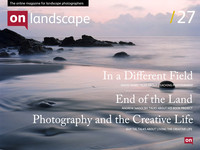
End of the Land – Andrew Nadolski

Andrew Nadolski’s ‘End of the Land’ represented a watershed for many photographers in its discovery  of a unique beauty in a small beach in Cornwall. For me, it showed me my first glimpse of an alternative style of photography, both in terms of composition and palette. Andrew visited in October and we recorded an interview where we discussed the origins and creation of the book in a conversation that often veered onto other topics (what a surprise!).

You need to be logged in to see this part of the post

10 Responses

  1. Great interview Tim & Andrew, and a wonderful insight into what is probably one of my all time favourite photography books.

  2. jonb

    The ‘installation’ idea is a great way of clarifying his visual style, which is very unique. I found it difficult at first.

    That feeling he describes of wanting to touch the rocks is translated in the photographs. More than wanting to make images there myself, I actually want to collect some of those pebbles and marvel at their beauty!

    Perhaps my monitor gamma is off, but I noticed there’s considerably more shadow detail in the video images than in the book. The photographs in the book are a little darker – but no less fantastic. Has Andrew since reprocessed the work? If he’s anything like me he probably tweaks them every other day!

  3. AndrewNadolski

    Jon
    There is a bug in the way Quicktime/Final Cut Pro seems to handle the imported still images. They look fine within the editing program but on export seem to have the shadows lightened. I spent quite a while trying to sort this out only to find it was a topic featured on a lot of video user forums. The pictures are always going to look brighter ‘backlit’ but you are correct in what you have spotted.
    Andrew

  4. Some very thought-provoking content here, which may help me to get back into landscape photography after recently concentrating on flowers. In the north-east of England, the area around Marsden and Whitburn has some similarities in terms of interesting geology (and difficulties of access !).

    I was interested to hear that many of the images were taken on Fuji Reala. Although I’m moving towards Kodak negative films now, Reala is my favourite of the Fuji colour neg films. Fuji don’t class it as one of their “Pro” films and yet it is actually more expensive than Fuji Pro 160 or 400H.

    We tend not to hear so much talk of Reala and I think this may be because it’s not available in large format, only 35mm or 120 – hence a number of skilled and influential large format photographers don’t have the chance to try it out.

  5. Joe Rainbow

    A really enjoyable interview Tim and Andrew. It was nice to be able to hear the commentary whilst spending some time staring at the images. I have visited this particular spot many times having grown up in Cornwall, and living here still. It is such an unusual location not just in terms of a National perspective but also the local one.
    Some beaches hint at the forms found there, but nowhere is quite like it (that I have come across)

    I think the tendency in such a visually rich location like this is to try to do too much and fit too many elements into the frame, so what impresses me in your photographs Andrew, is the ability you have to condense the underlying characteristics of the place into an economical and subtle final result. I think many people would glance at these images and on first impression could be dismissive due to their limited palette, low contrast nature. But spending time with them really does them justice in terms of their power and presence. Some shots were particularly ‘complete’ in terms of overall balance and composition, whilst describing the wonderful natural creations that I know and love.

    I also think the early morning light is making them stand out from the crowd as so many shots (including my own) are shot nearer sunset. At least it is the type of place that can cope with any number of visitors taking photographs, as it it is always different and has so many separate little nooks and crannies to explore.

    I would love to have a go at shooting square comps there, and medium format is a good compromise between image quality and portability. I just need to get me a medium format camera! I totally agree about the feeling of natural sculptures there by the way. It has a gallery feel.

  6. Great collaboration to produce a wonderful accompaniment to an important photo book. At least to me.
    I studied physical Geography and made field trips to Nanven before ever I thought about photography.
    I came across Andrews book the day after a visit to the beach on a kind of pilgrimage to visit old haunts.On my 50th birthday and with the family.
    The next day, I was in Truro and found the book in waterstones. you did not mention Tim Smits comments, which resonated most strongly to me at that moment in time. All life contained in a grain of sand.
    I am no boffin. But the dof issue, is I think a diffraction issue, which effects full frame digital at f22 before medium format film.Bauer patterns, pixel size blah blah.

  7. Really enjoyed this Andrew / Tim. I agree with Joe R’s comment about being able to view an image and listen to the background simultaneously. Makes it all the more enjoyable.
    Good to talk to you yesterday Andrew.

  8. Nigel

    I have been waiting for this since Tim trailed it a while back. It was interesting to learn more about how the book was won from the landscape (or perhaps composed would be a better word) and what motivated and guided Andrew while he was creating it.

    What struck me on first opening the book were the skies. The images were taken on film which did not need an ND grad filter and the skies have been left to speak for themselves with little intervention. I found the results quite arresting. In digital there will usually be a need to blend a couple of raw conversions but it was brought home to me looking at Andrew’s images that I need to be aware of my temptation to over-darken the conversion for the sky to produce tones which were not actually present or even perceived. I was interested to see however that the skies in many of the video images had significantly more detail in them than the images in the book which, I felt, created a slightly different mood and made the sky much more a part the image rather than it being the backdrop for the stage performance by land and sea as I felt it was in the book – if that makes sense.

    I thought the book was magnificent but I have returned to it after the watching the video and already I can feel that I am having a much more insightful reaction to the images. Before I was interested in and attracted by what I was looking at but now I feel I am beginning to really understand Andrew’s images and the story he is telling. Thanks Andrew for guiding me on my journey and thanks to Tim for facilitating, and I like the new slicker editing of the video too, it works well.

  9. My favourite ever book – thankfully signed by Andrew. And to be honest the best workshop I’ve been on was the one with Andrew and Joe at Brimham Rocks. I wanted to say thank you for all the help you gave me that day and the valuable lesson of shooting in the rain.

    From that day forward my favourite conditions have been shooting in the rain!

  10. Custard

    I’m embarrassed to confess that “End Of The Land” was the first (and happily the last) book that motivated me to go and virtually replicate the photographs it contained. With the book in one hand and a camera in the other, I spent two days at Porth Nanven. I’m pleased to report my shots were complete rubbish…which serves me right!

Notify me of followup comments via e-mail. You can also subscribe without commenting.