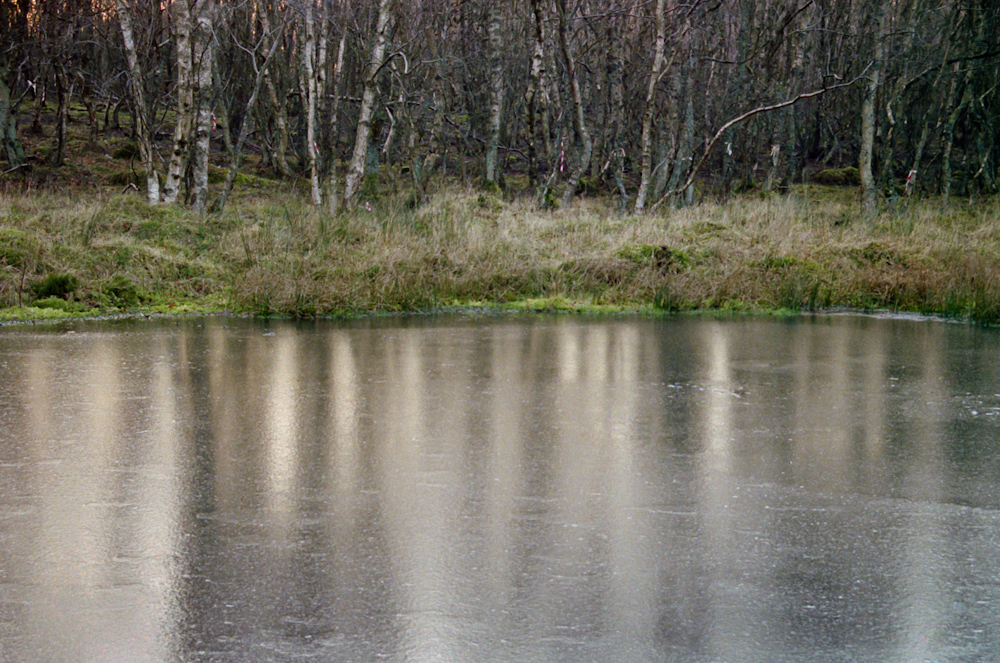
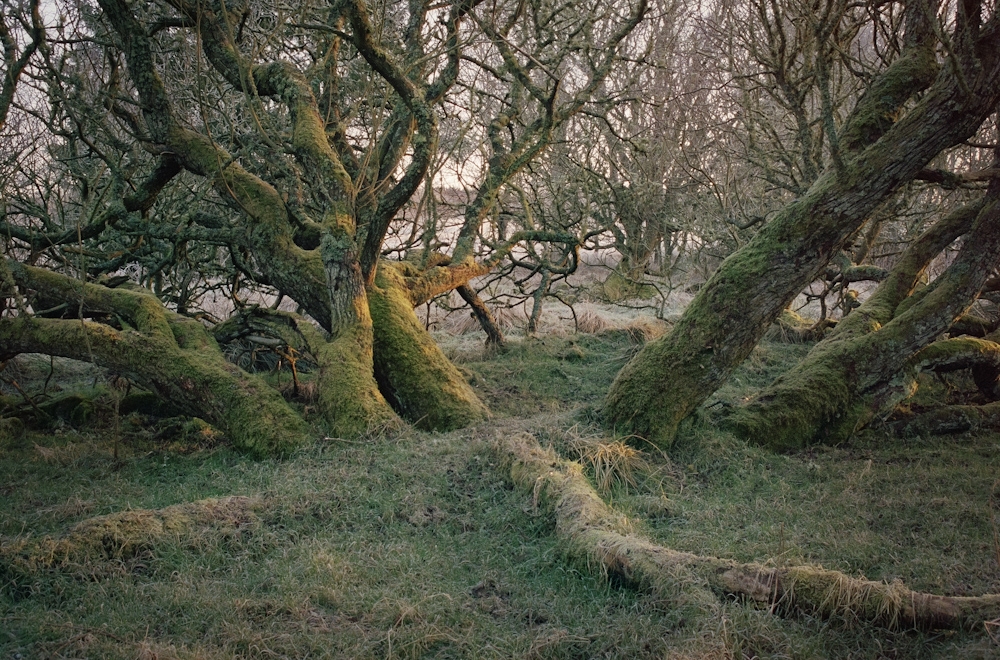
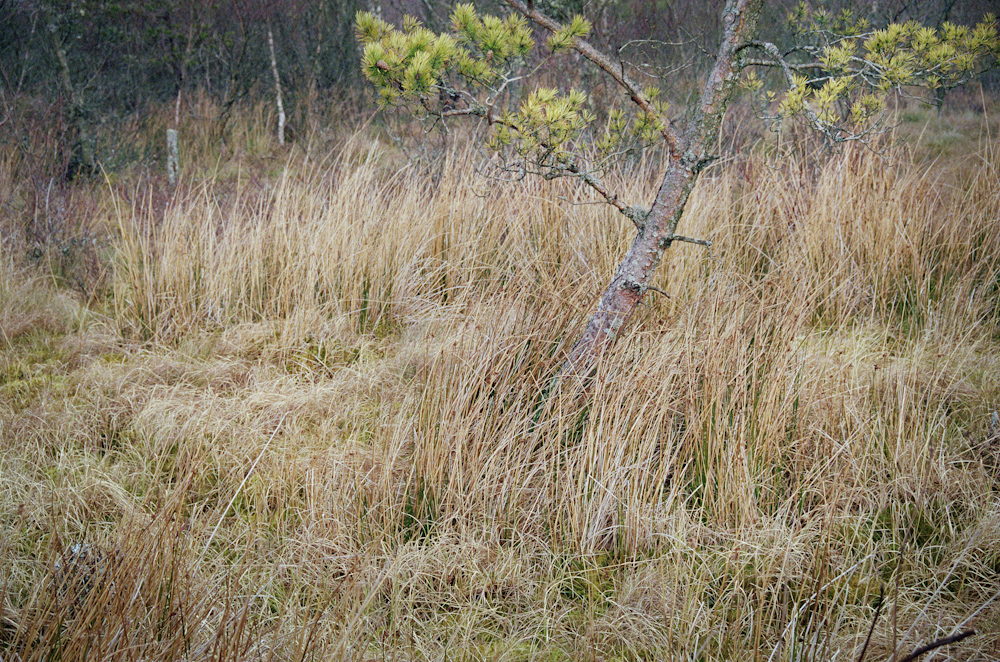
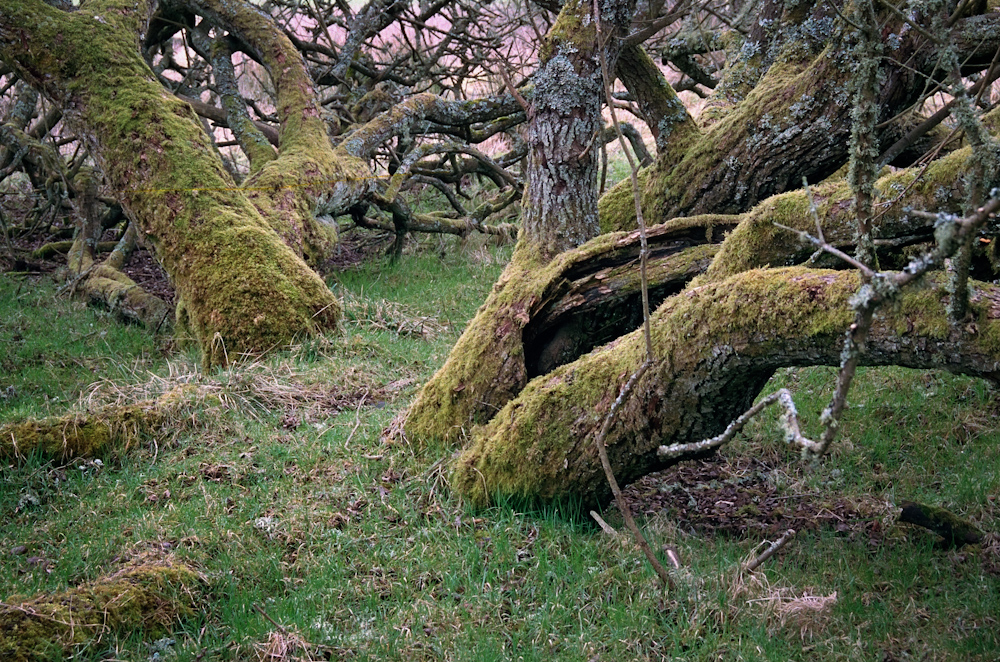
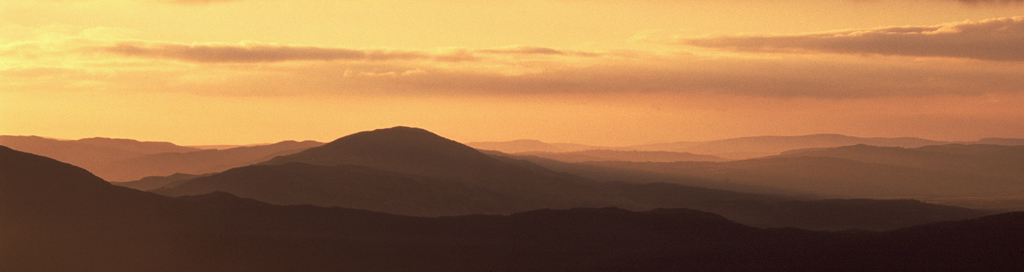
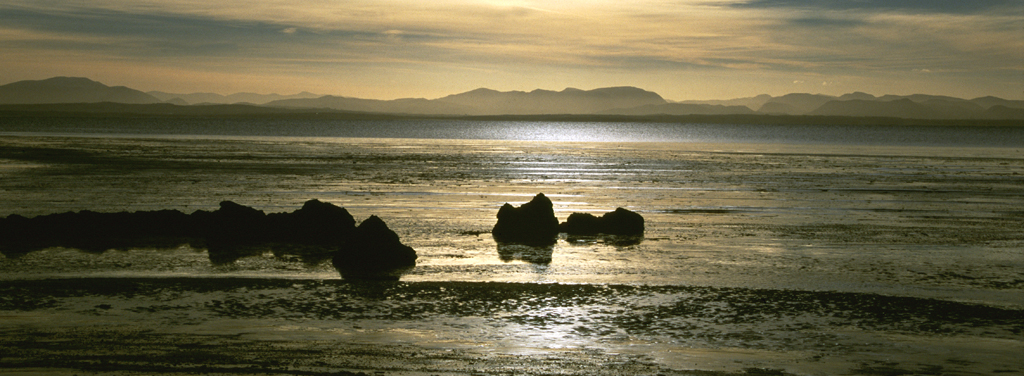
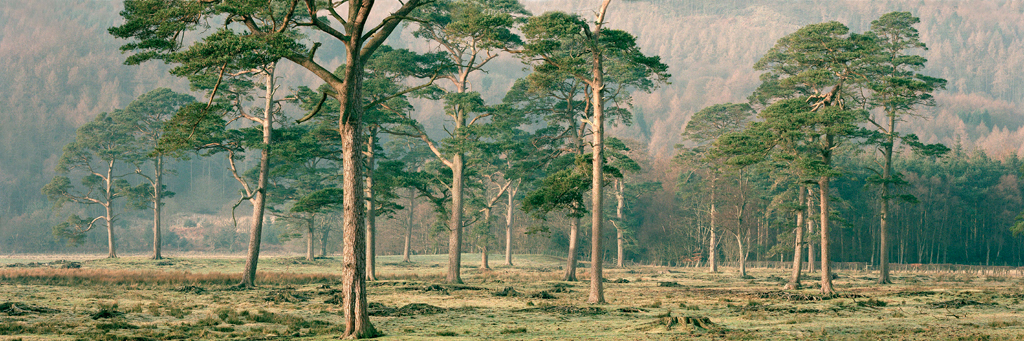
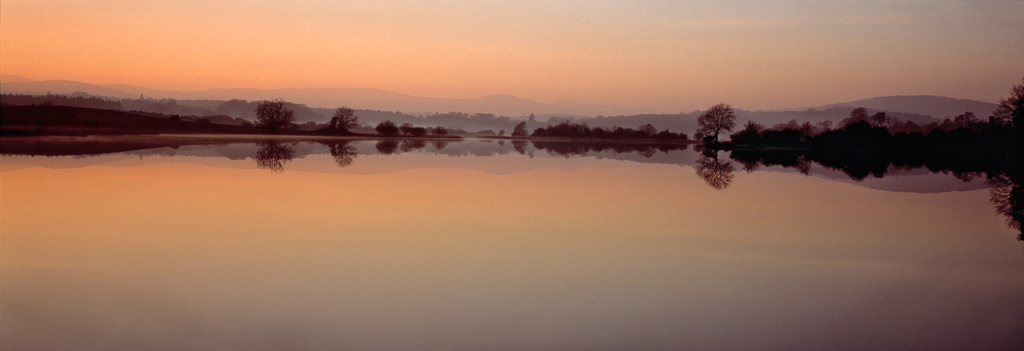
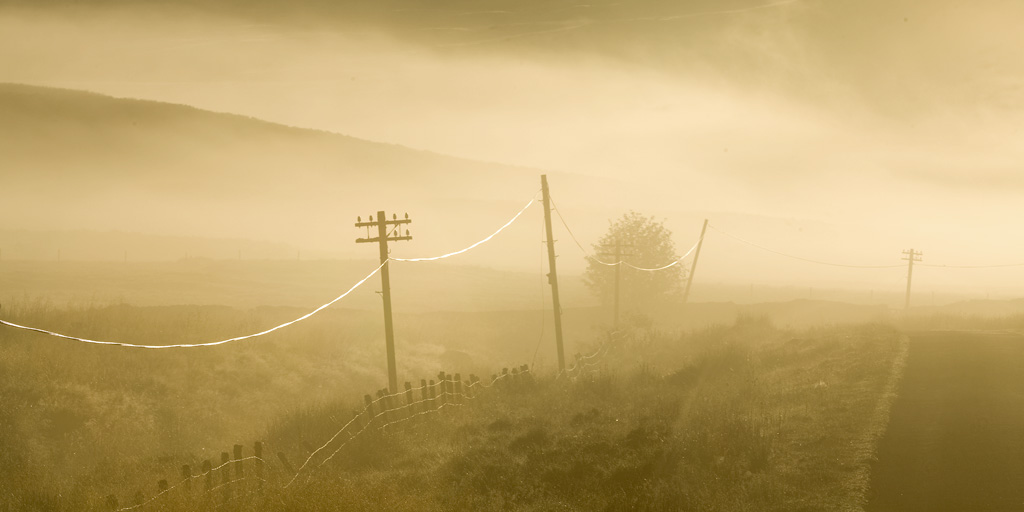
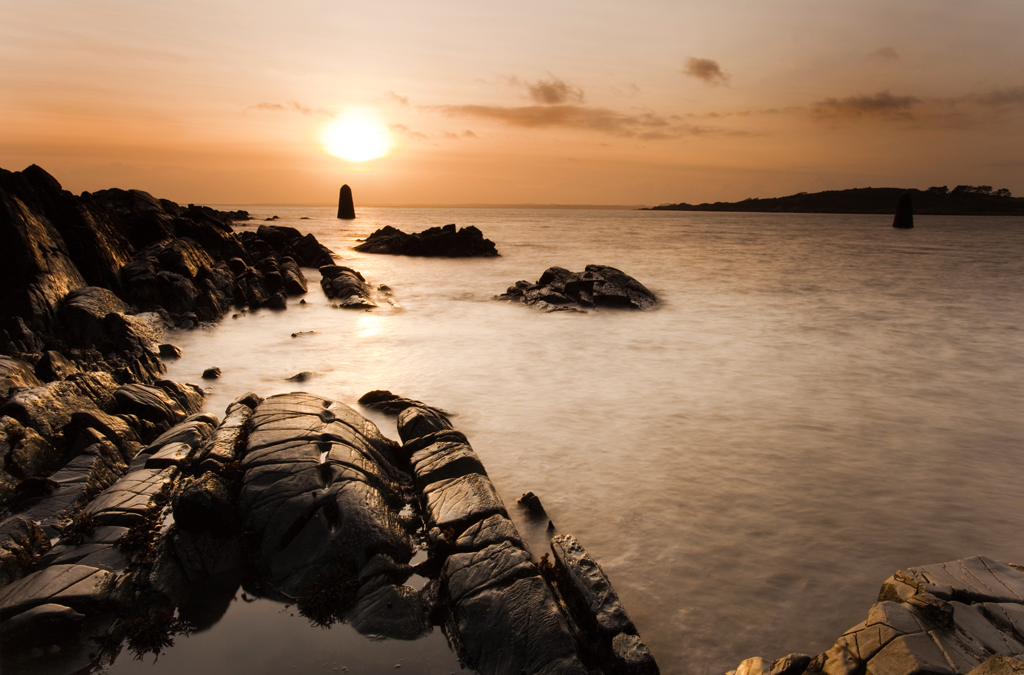
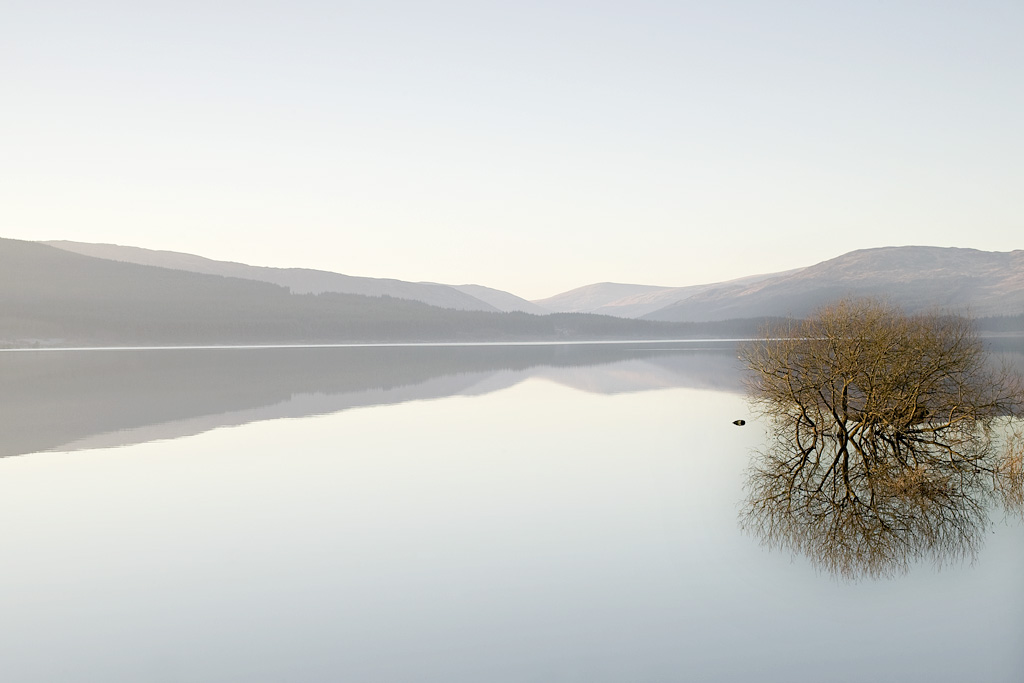
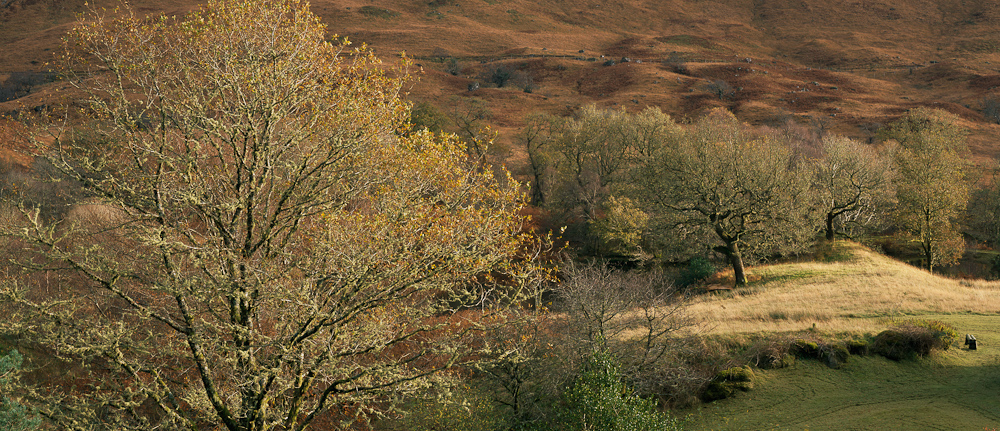
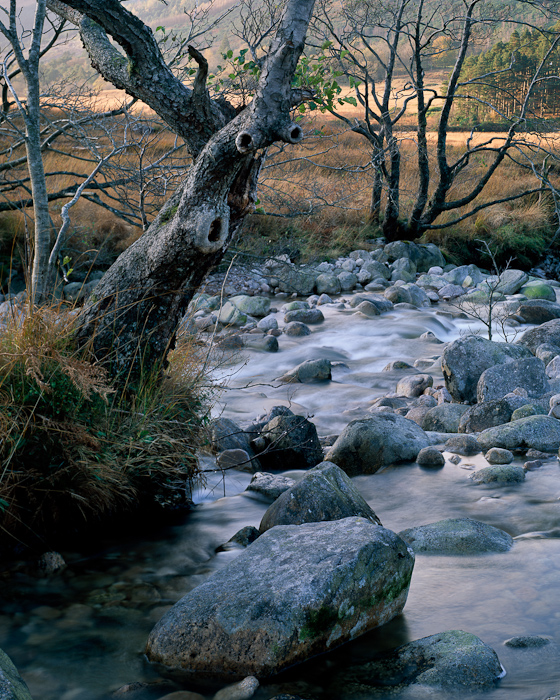
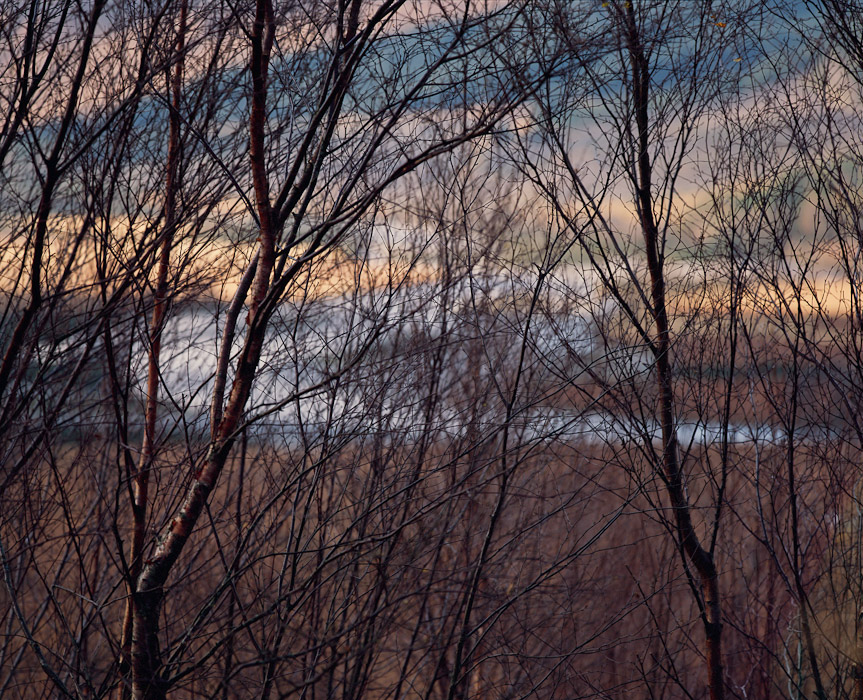
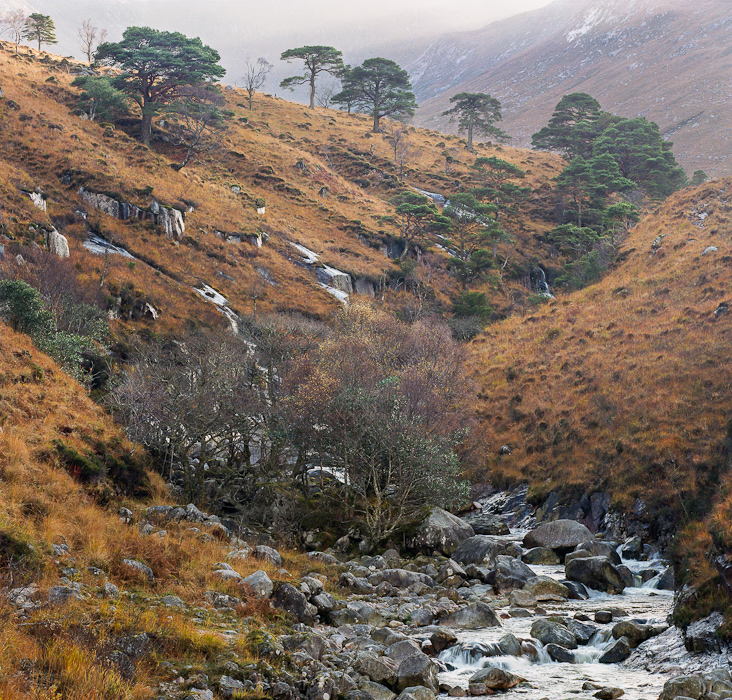
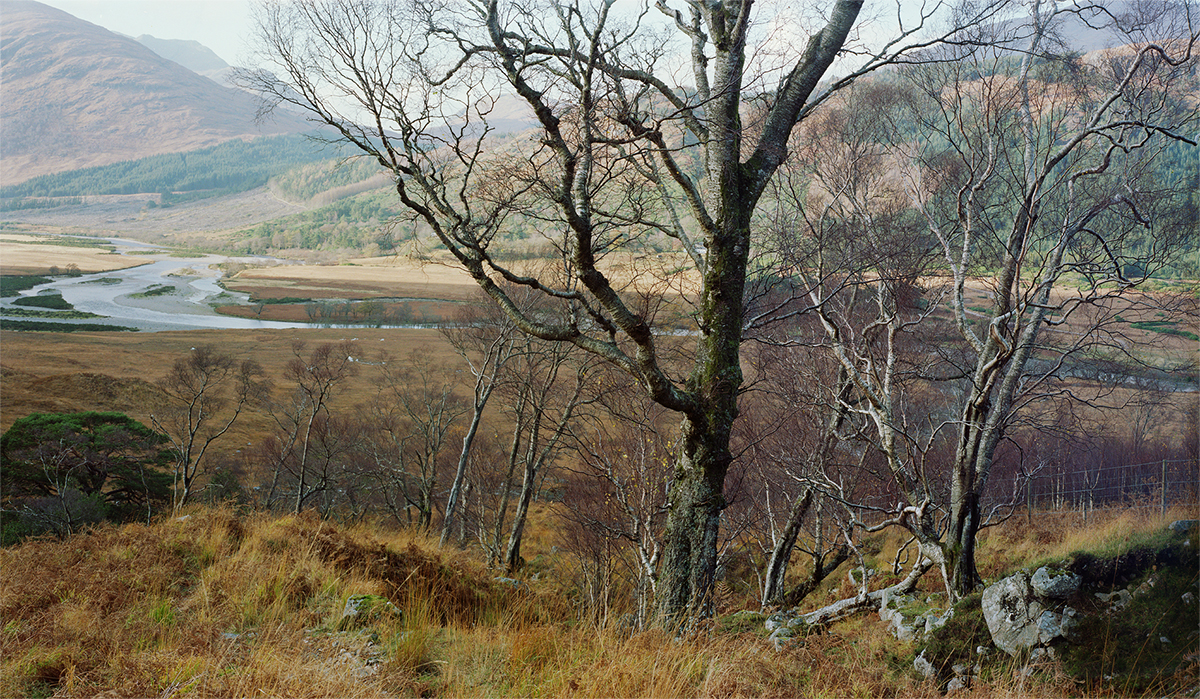
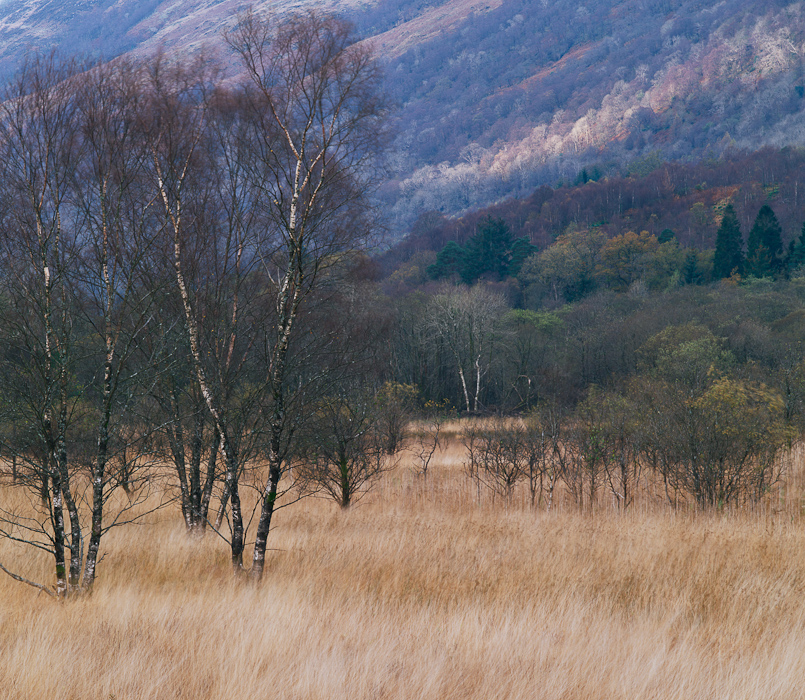
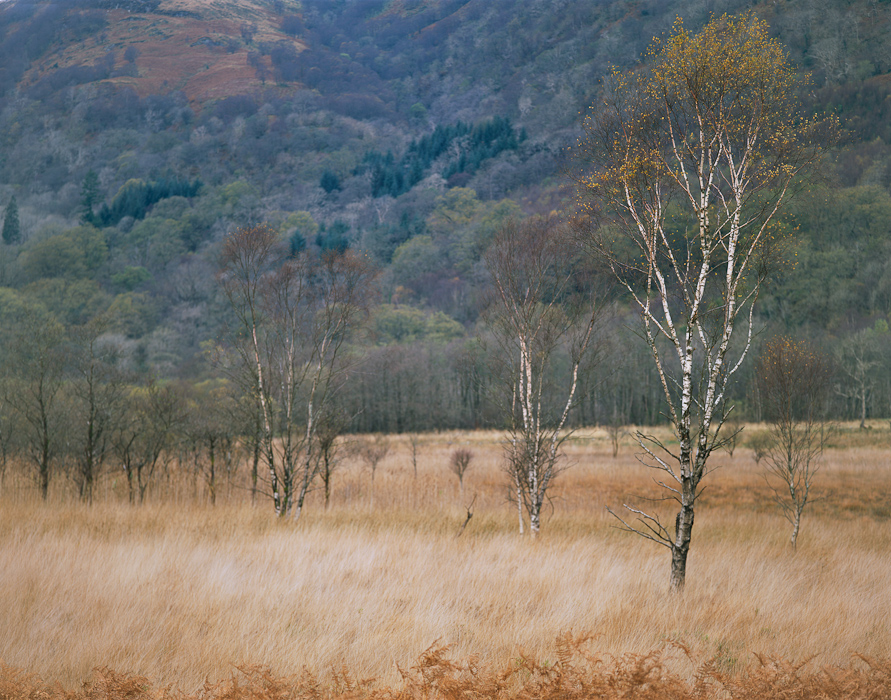
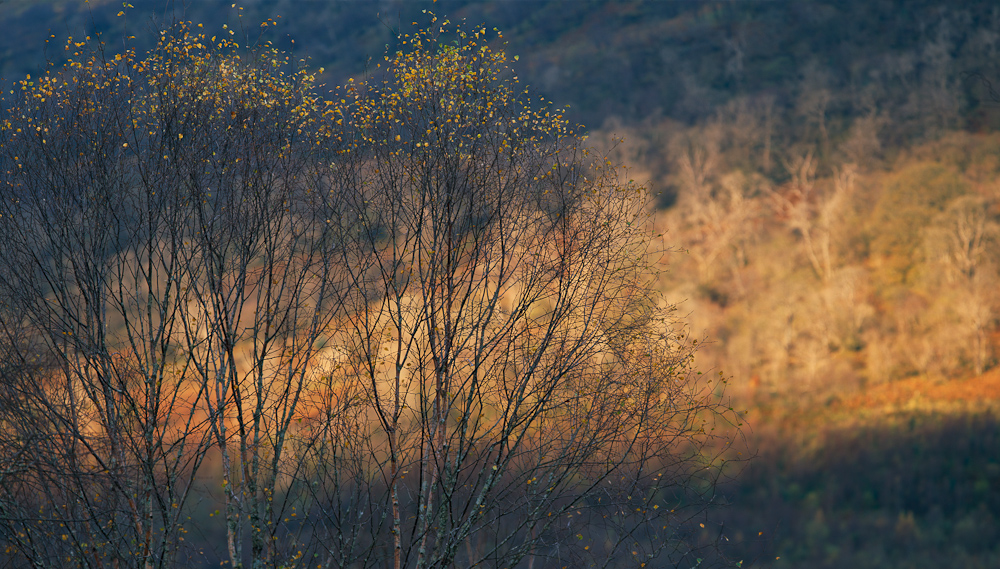
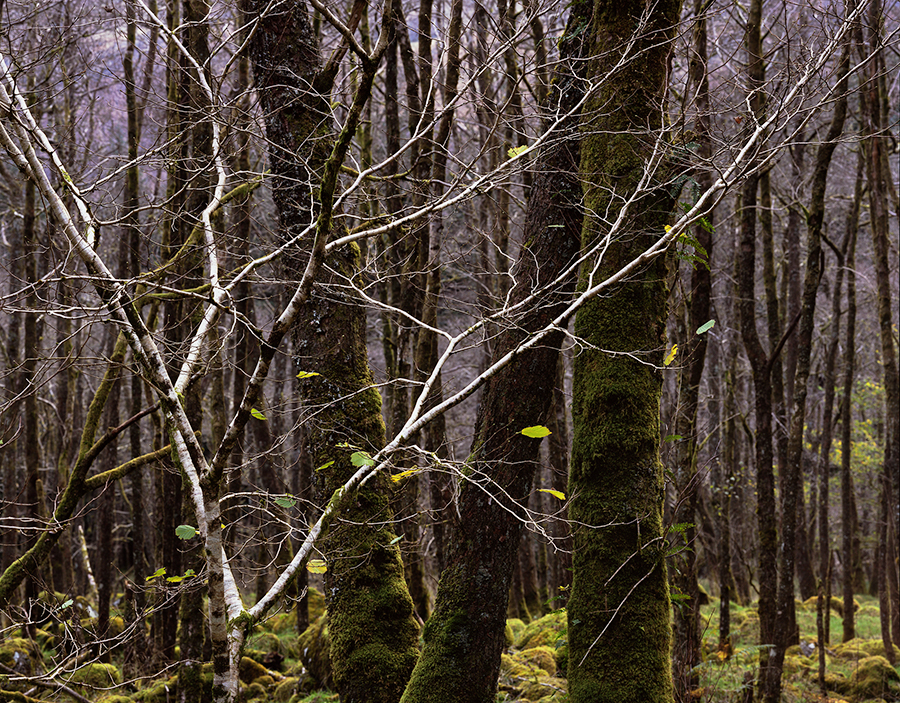
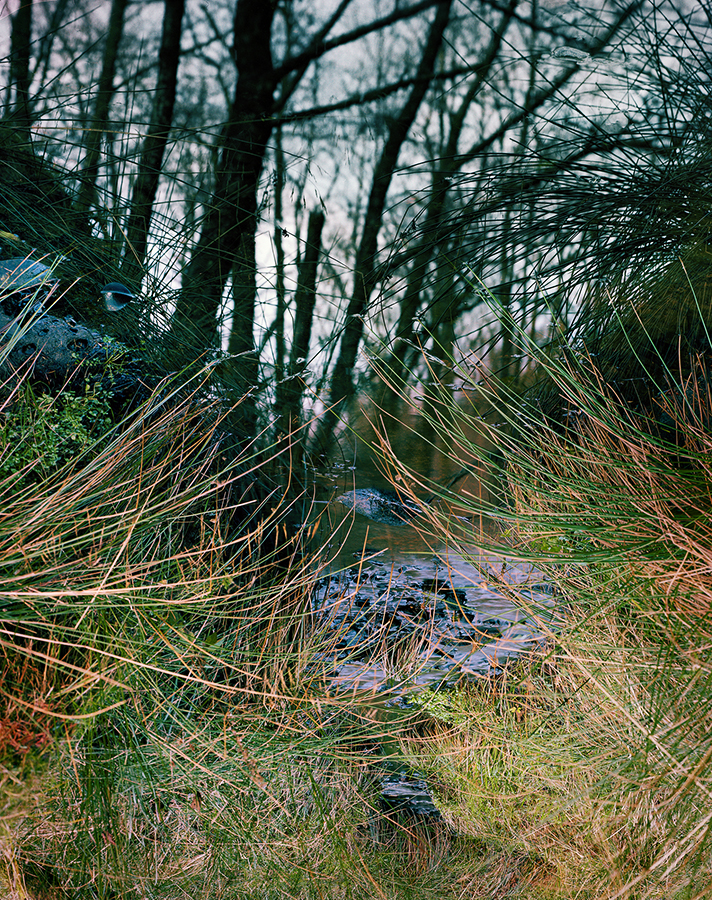
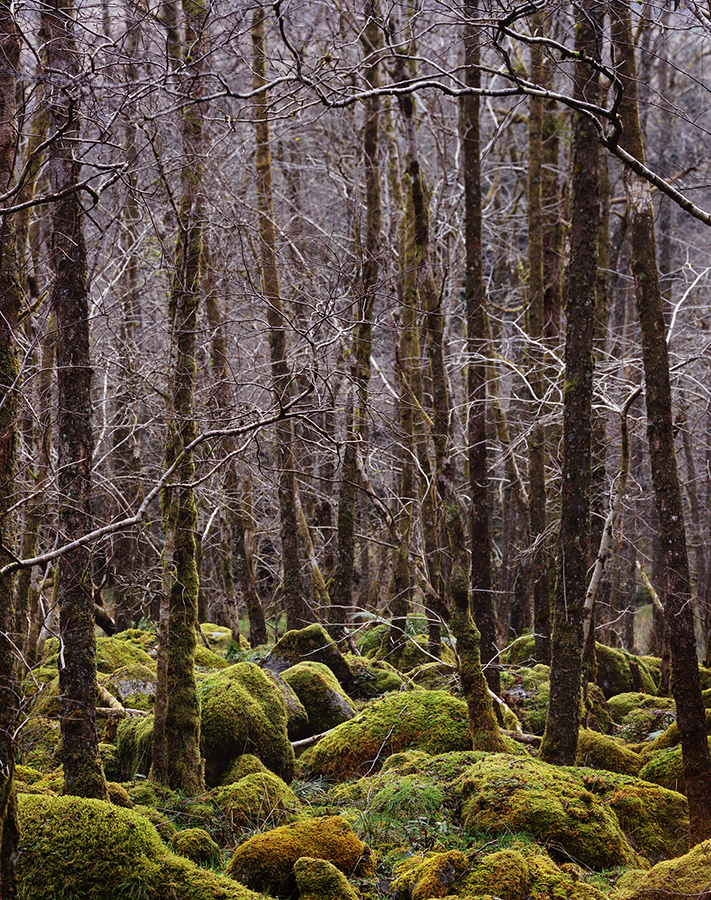
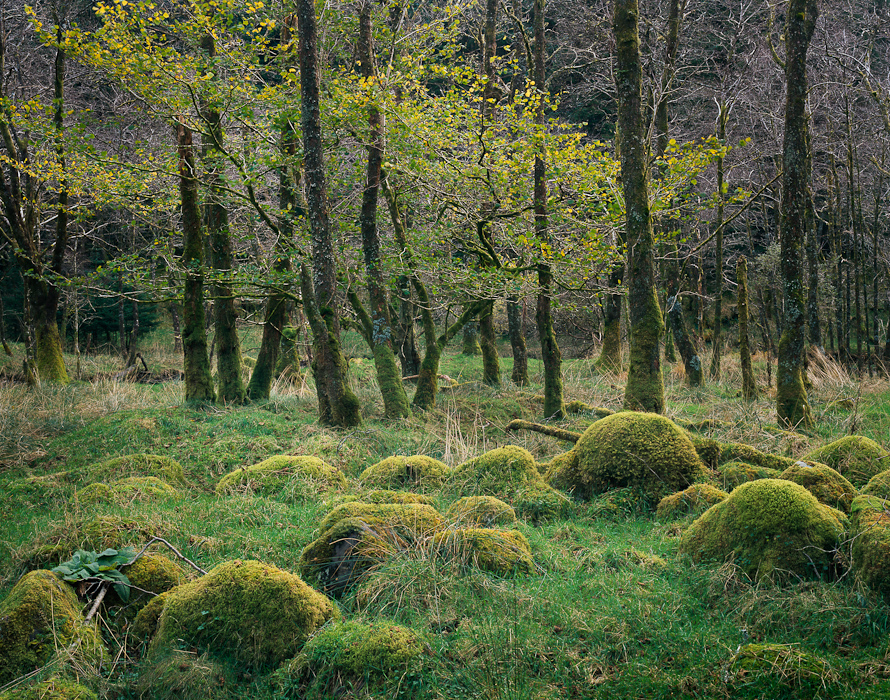
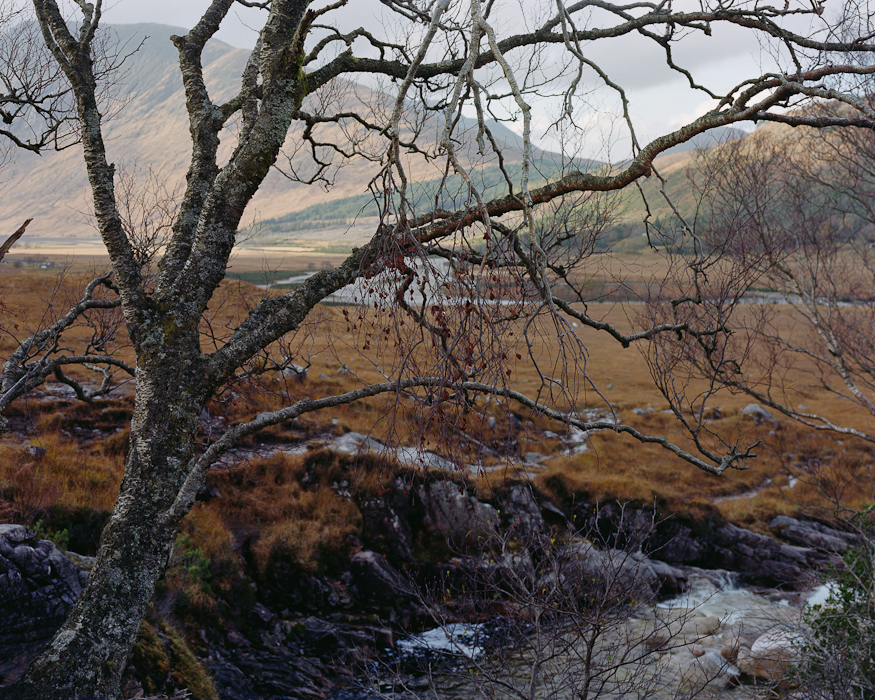
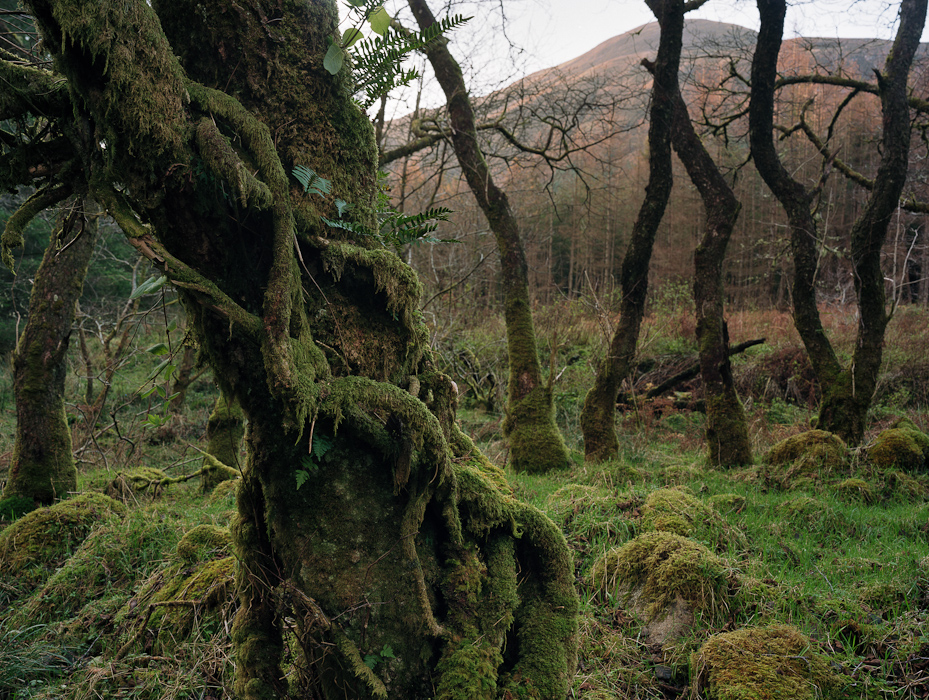
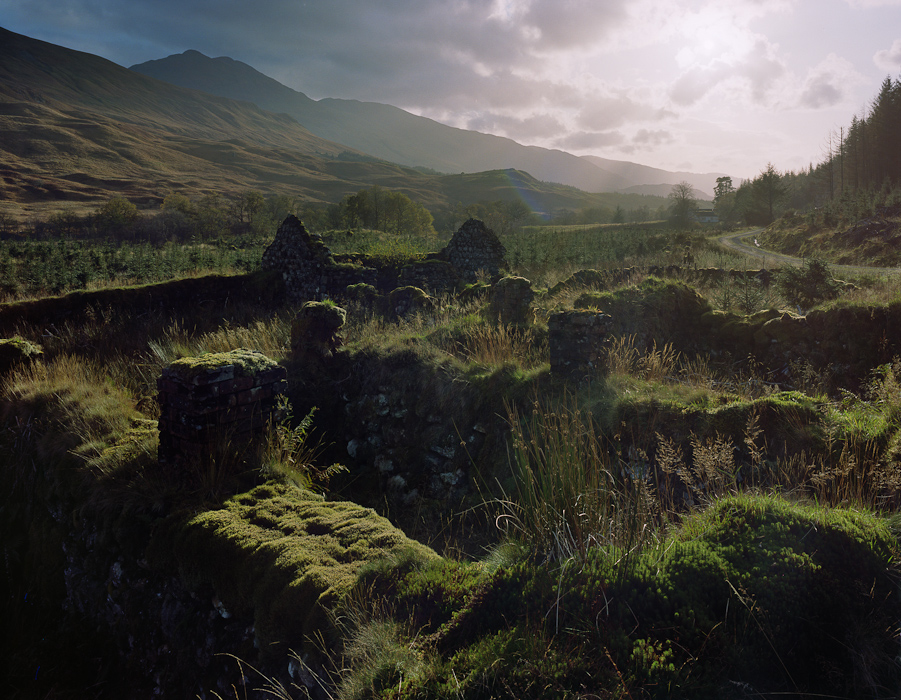
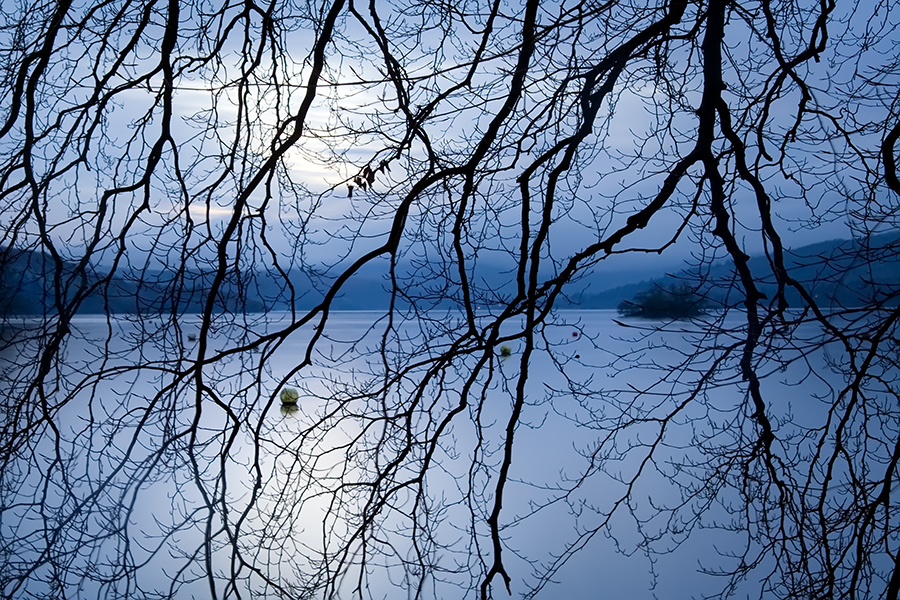
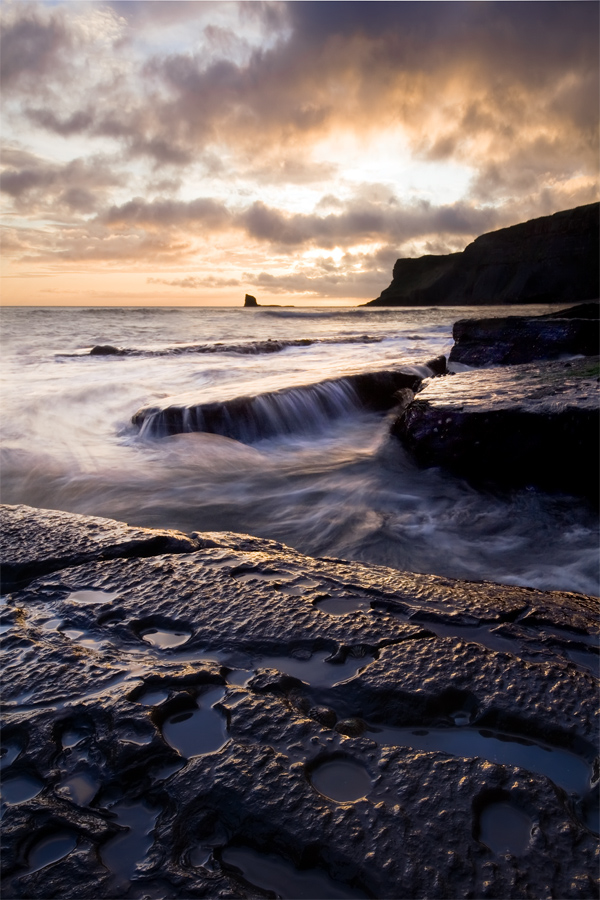
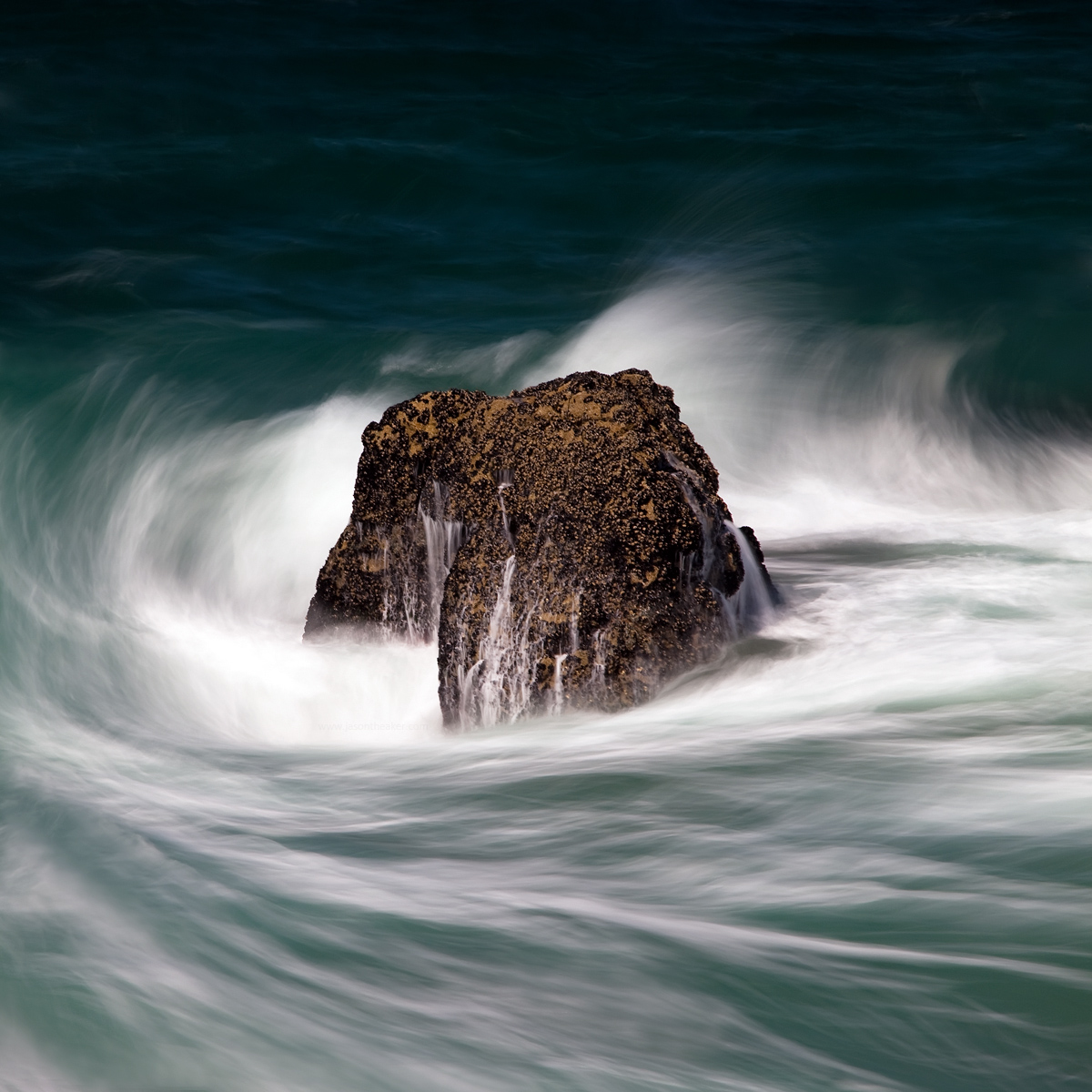
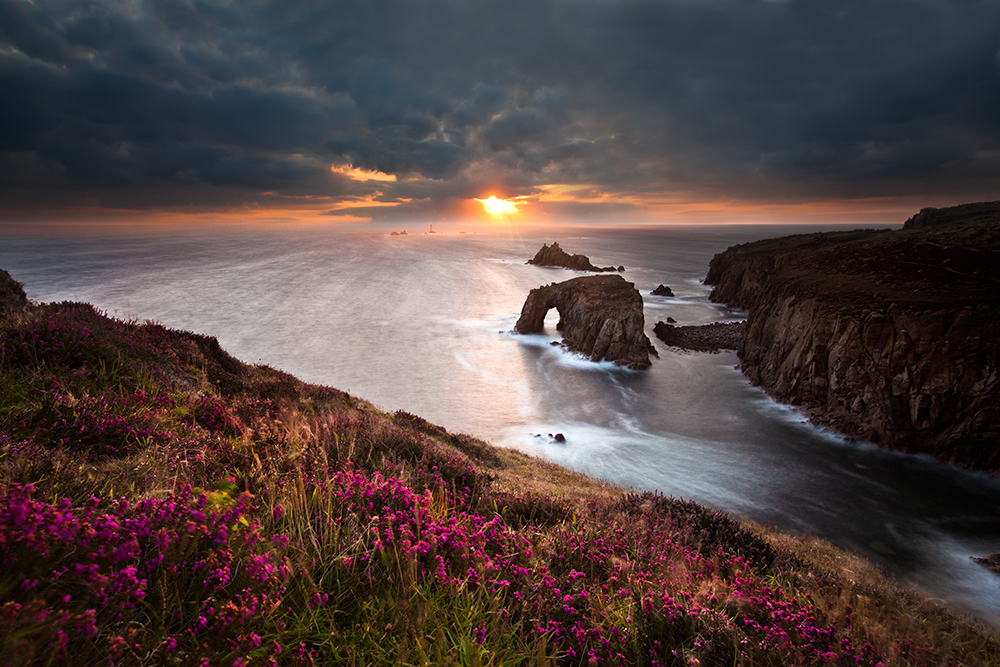
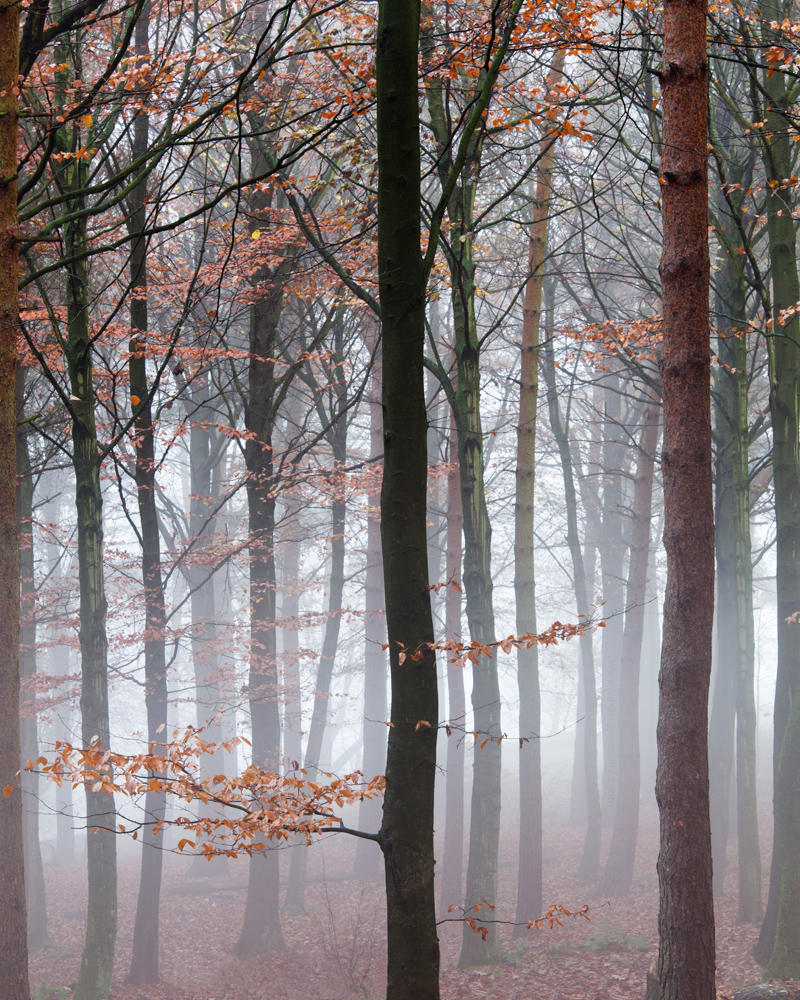
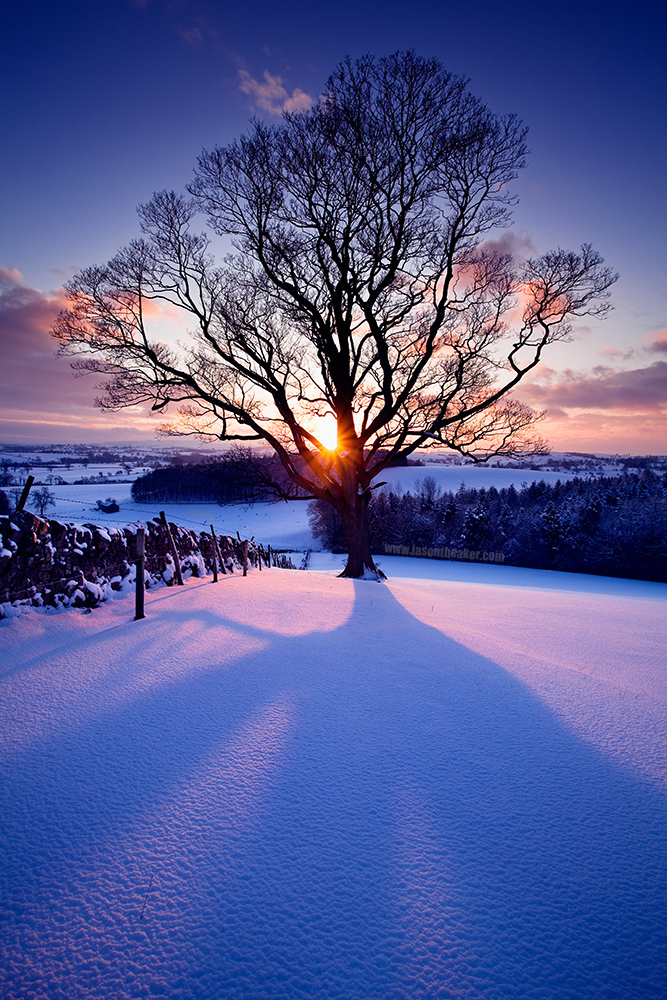
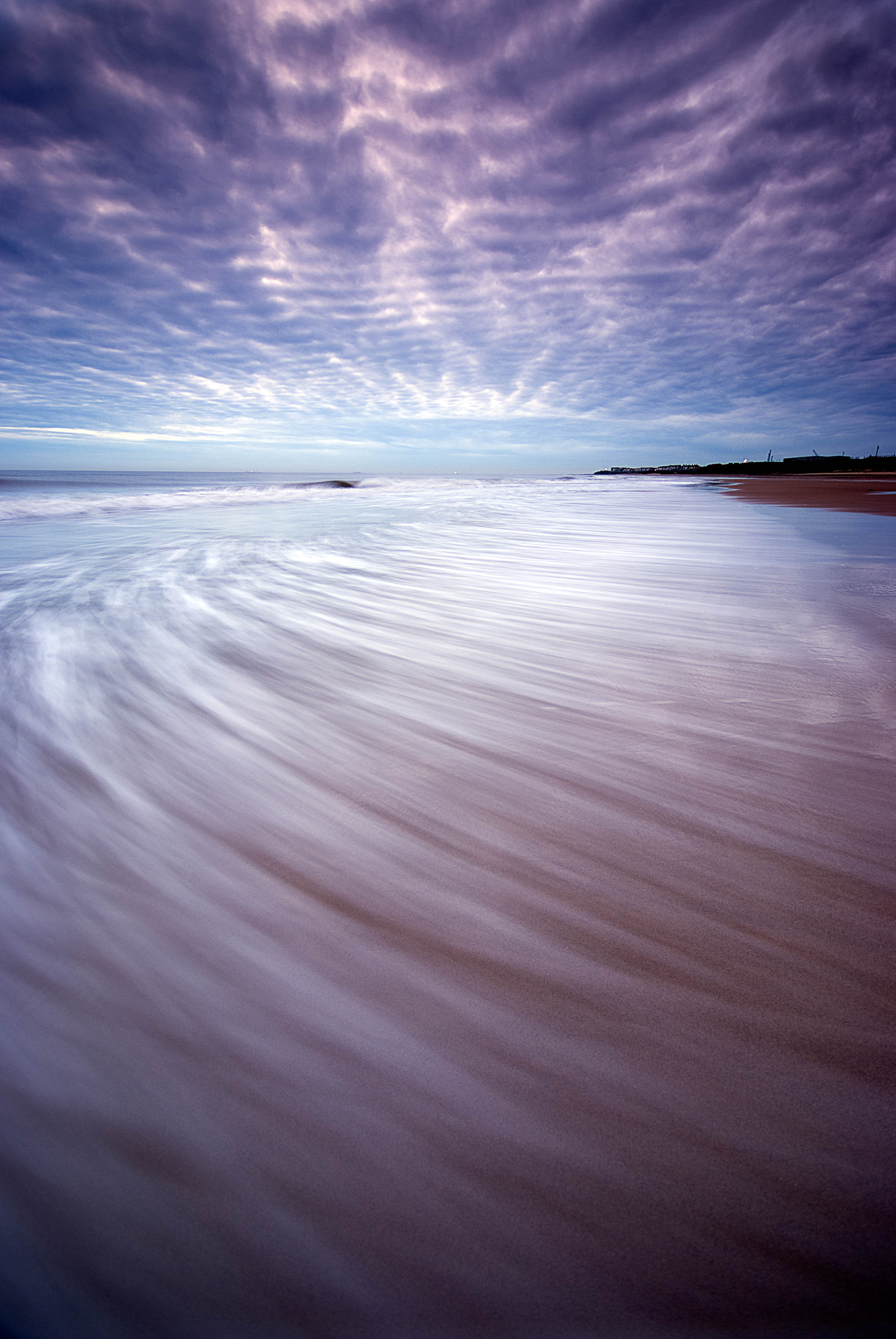
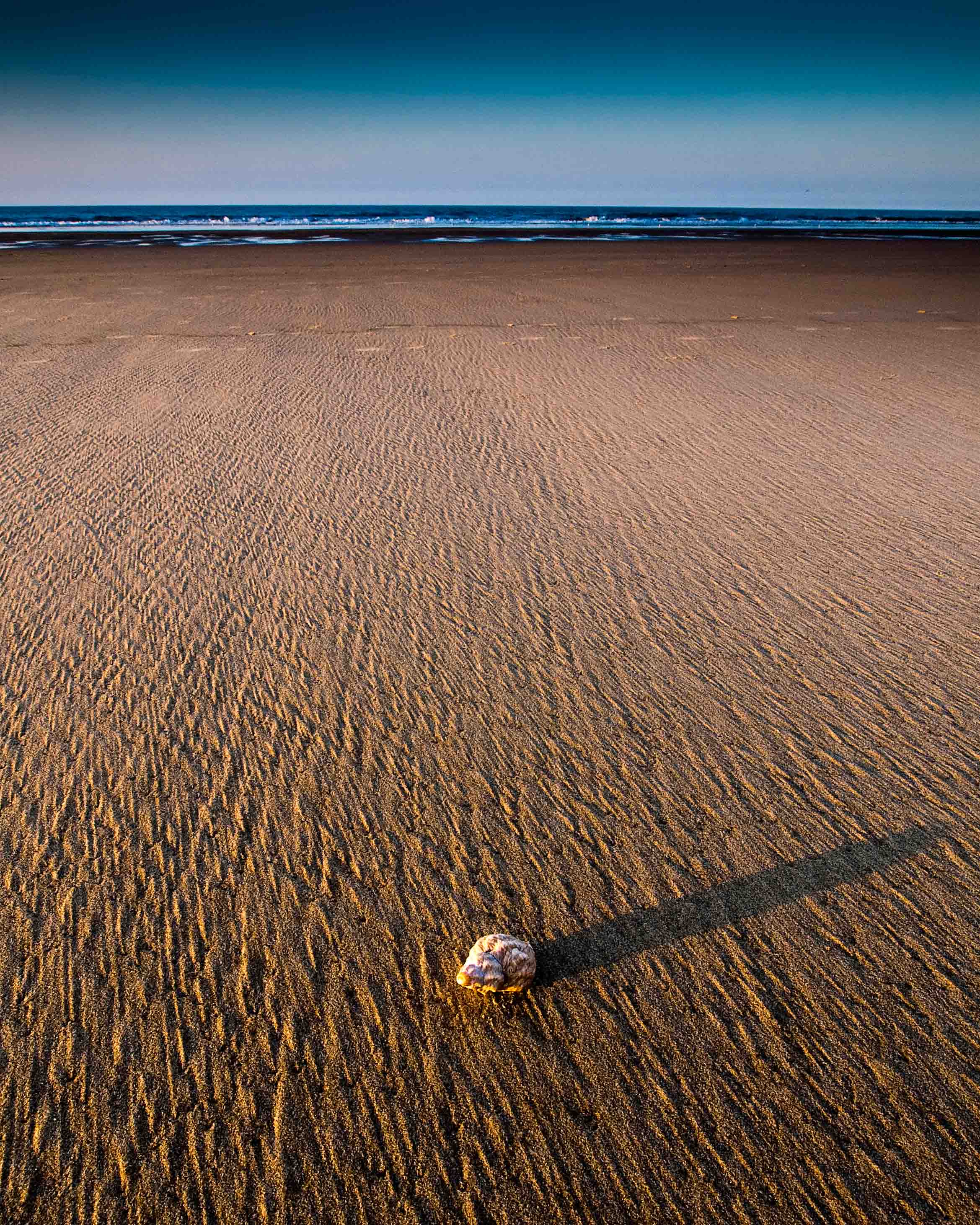
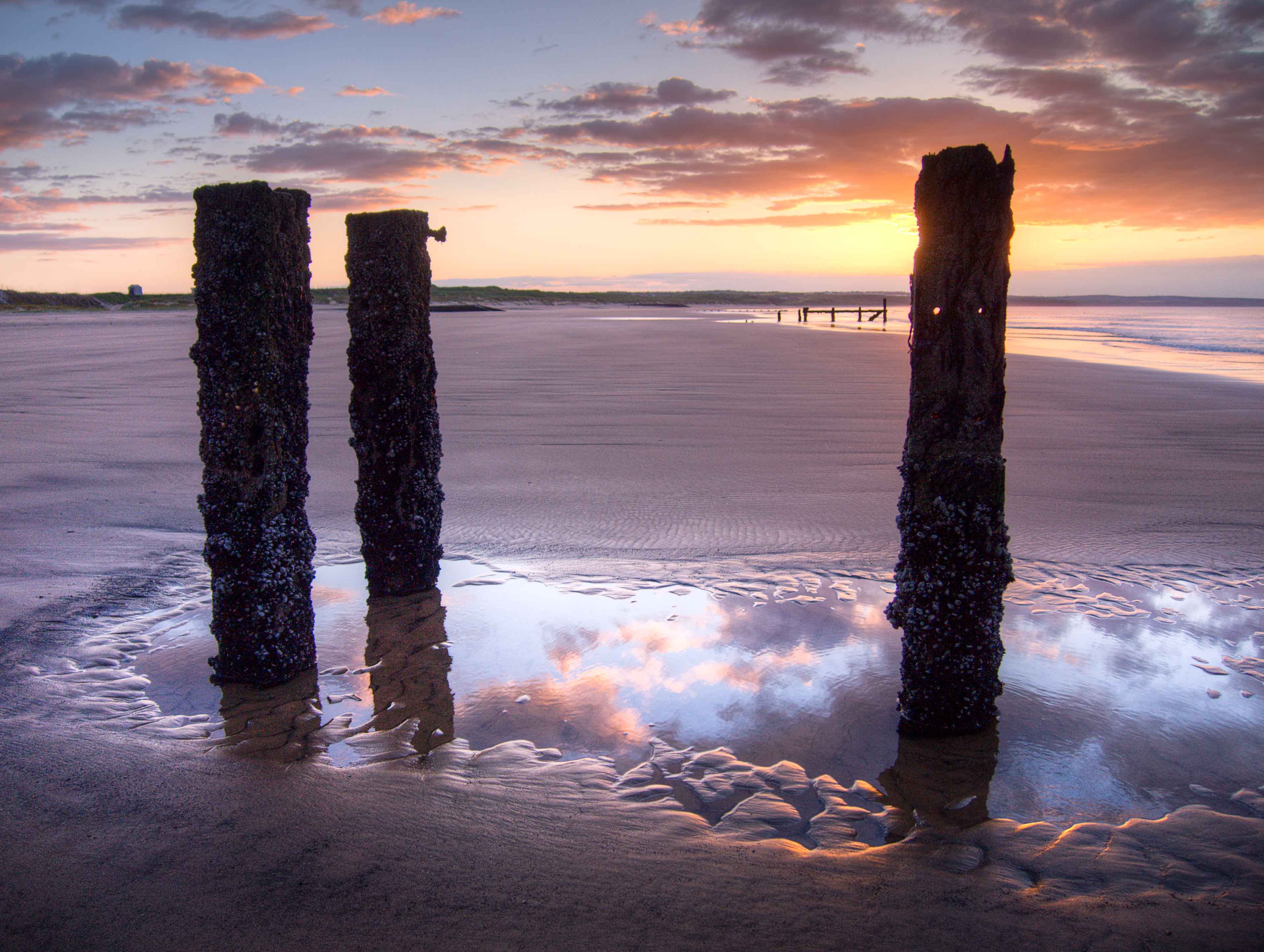
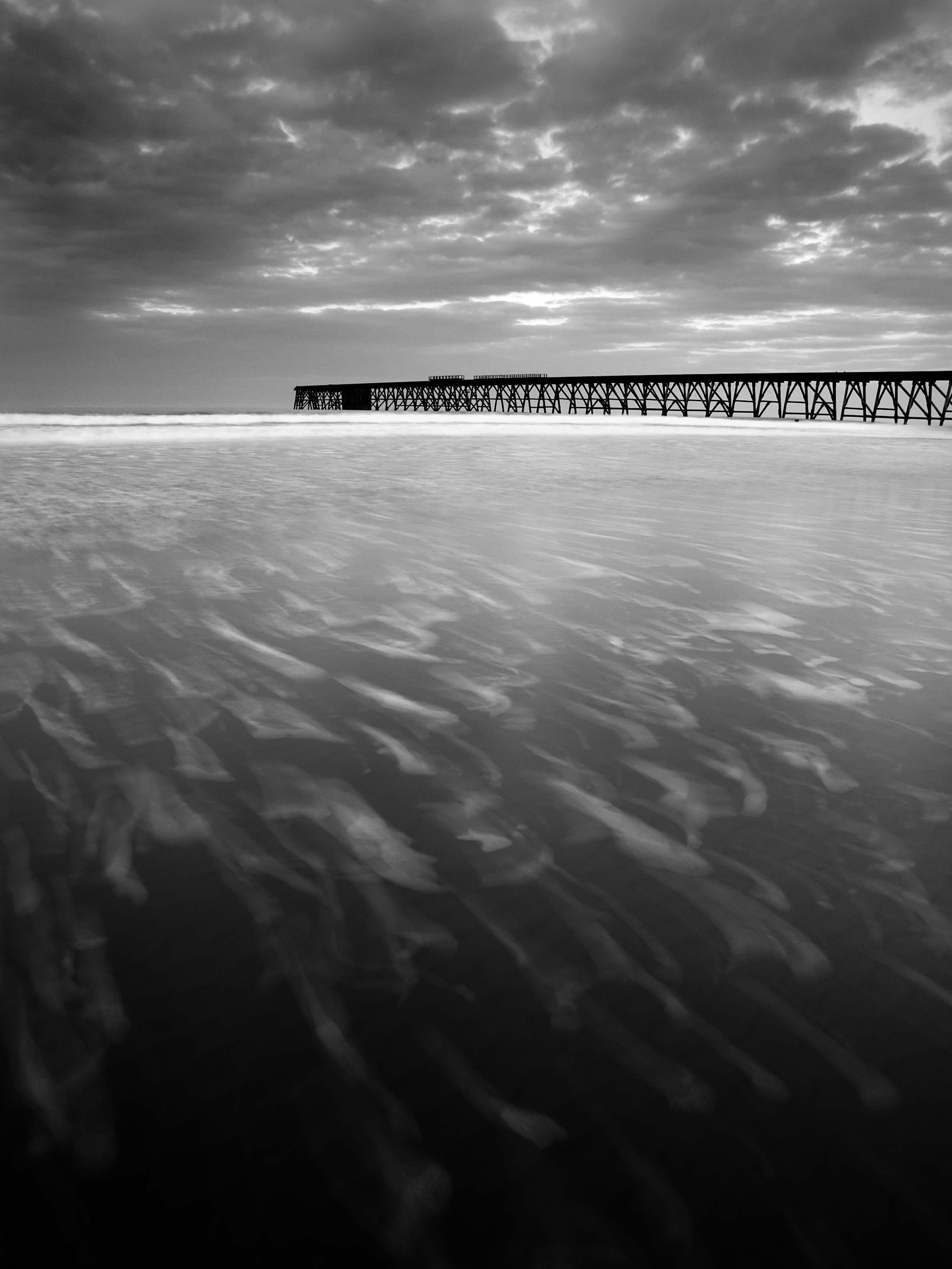
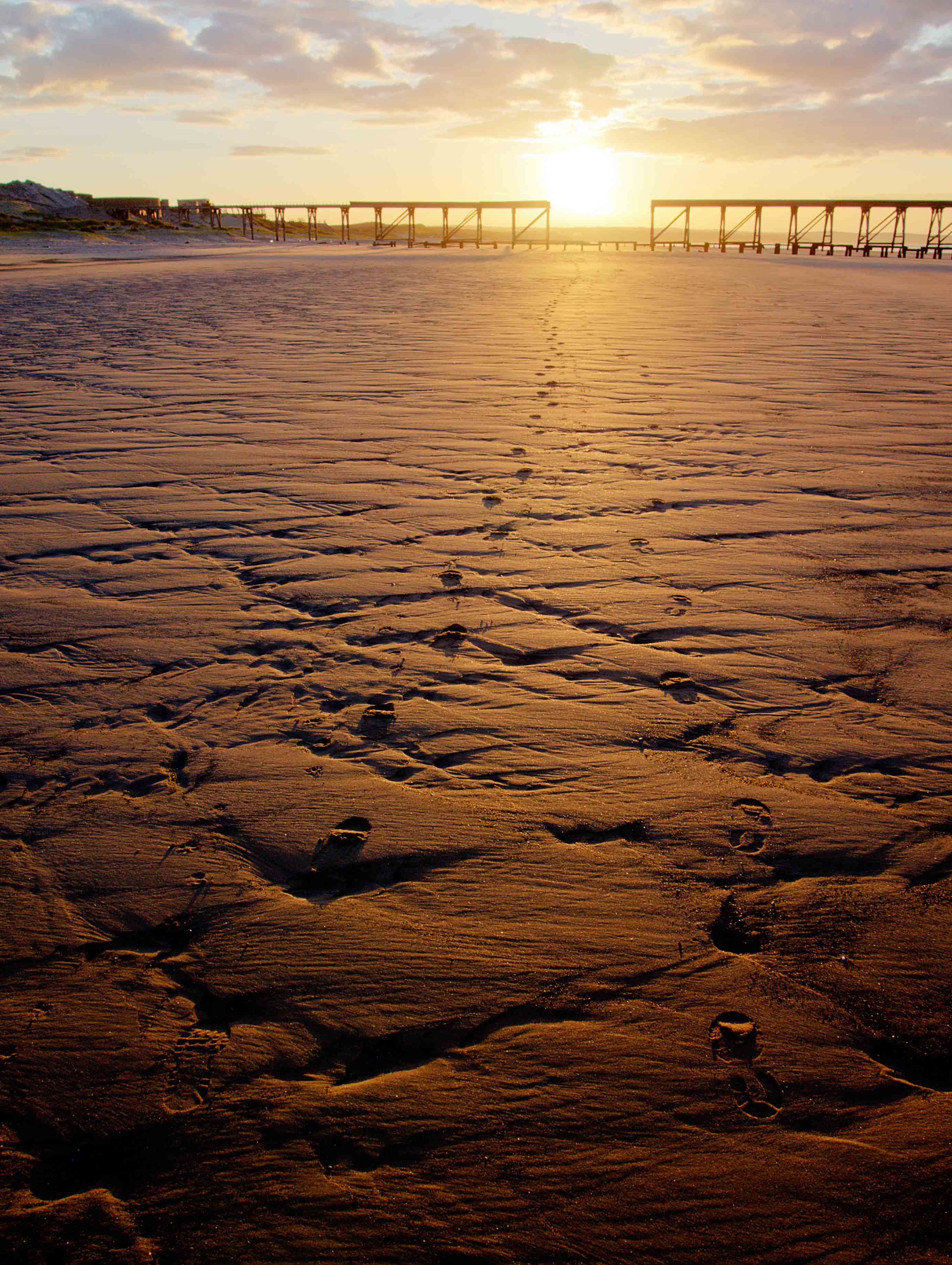
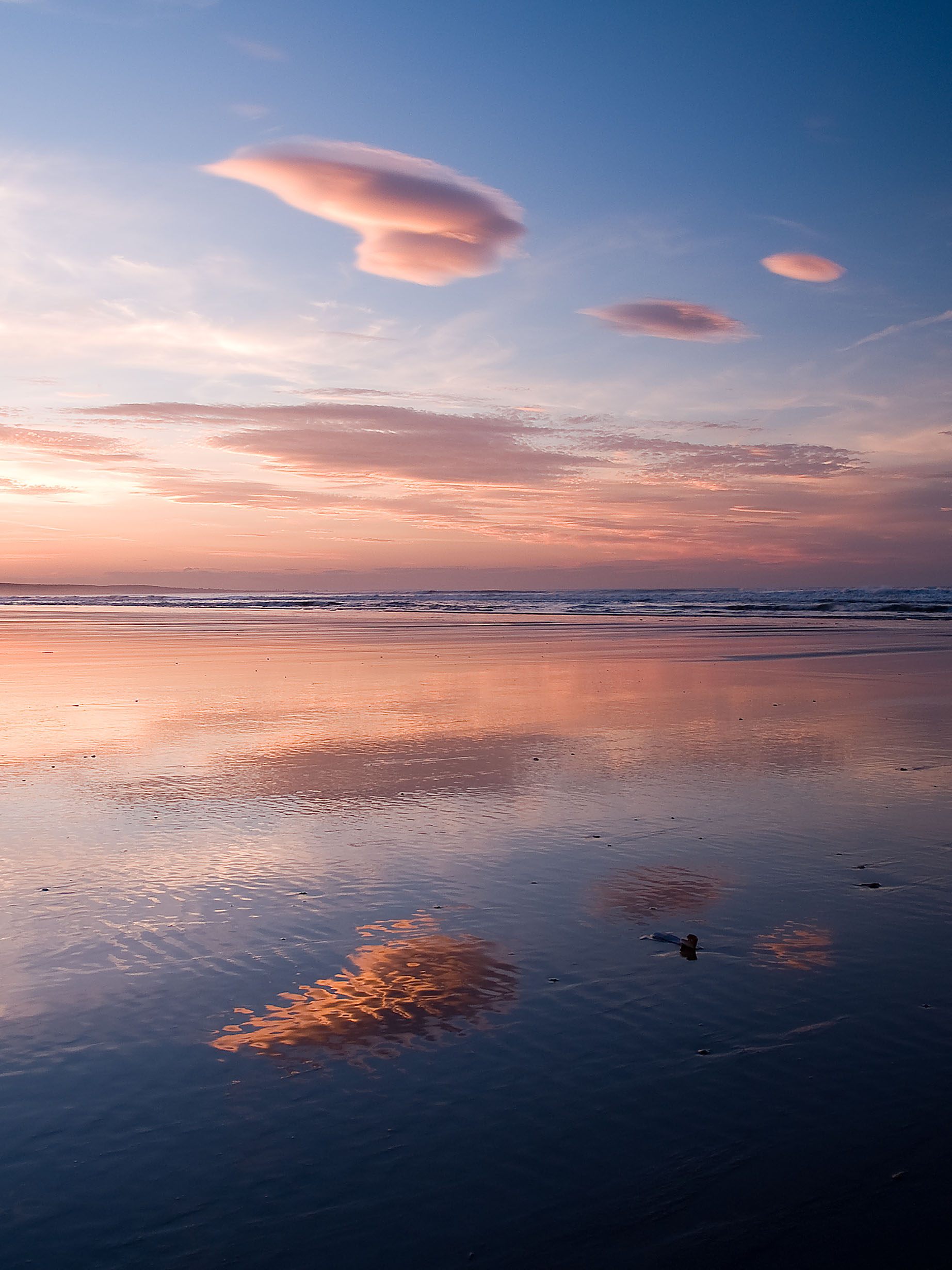
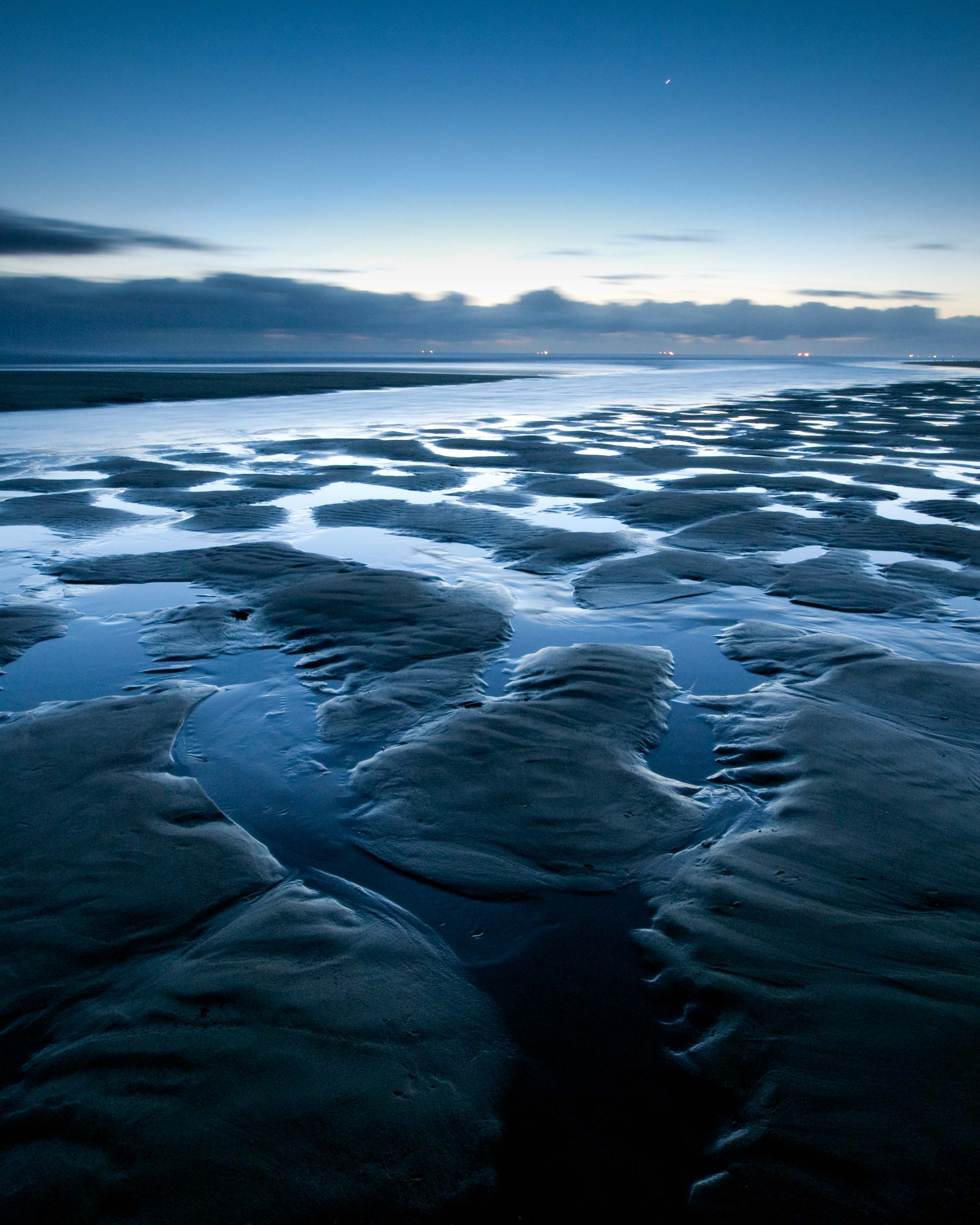
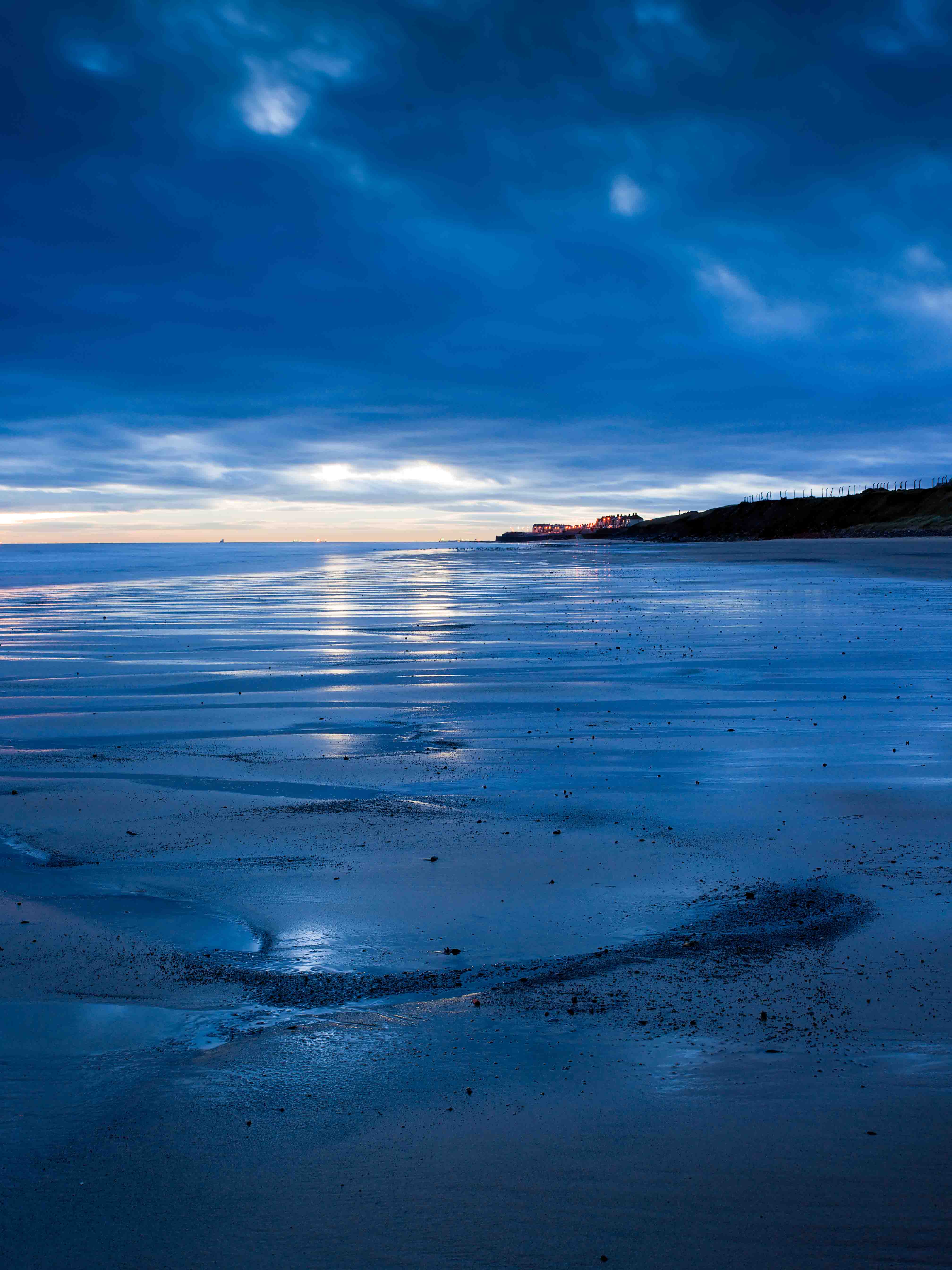
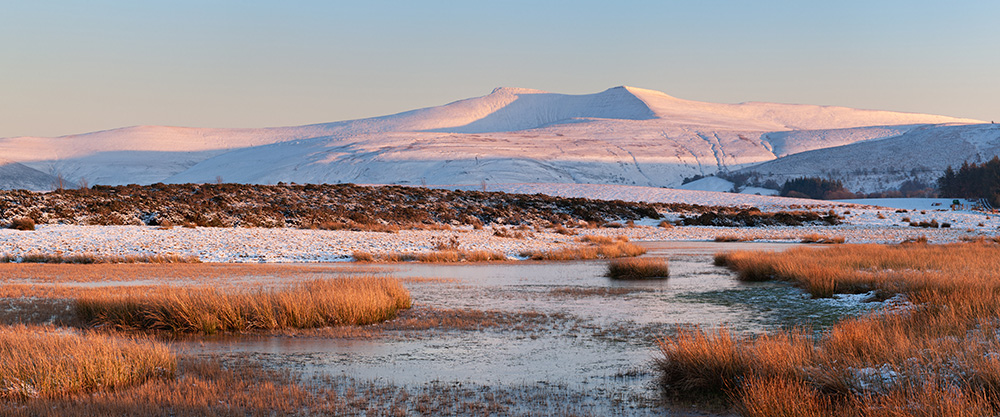
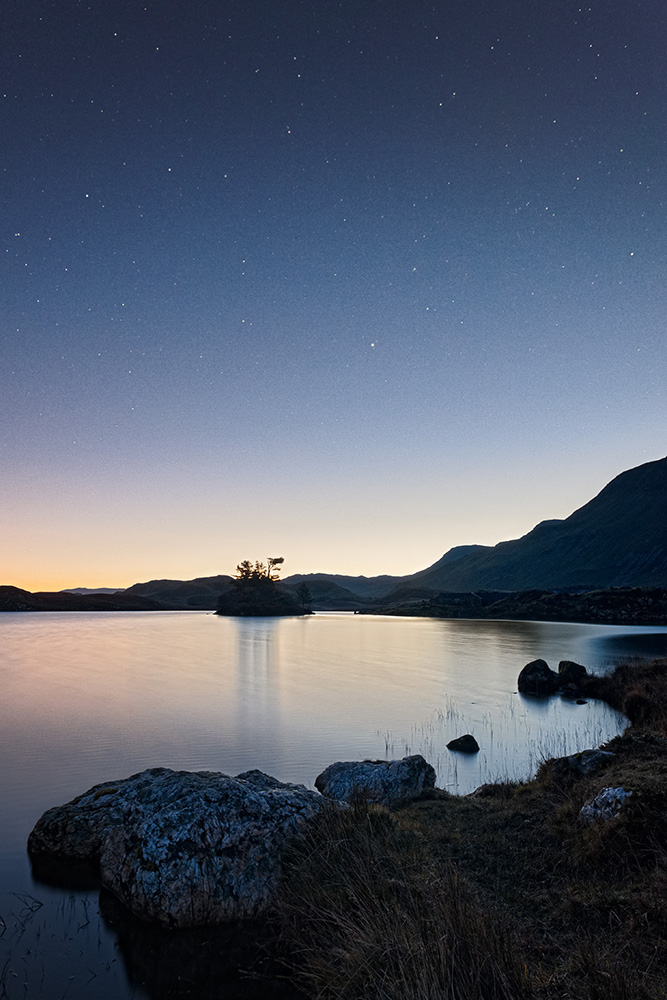
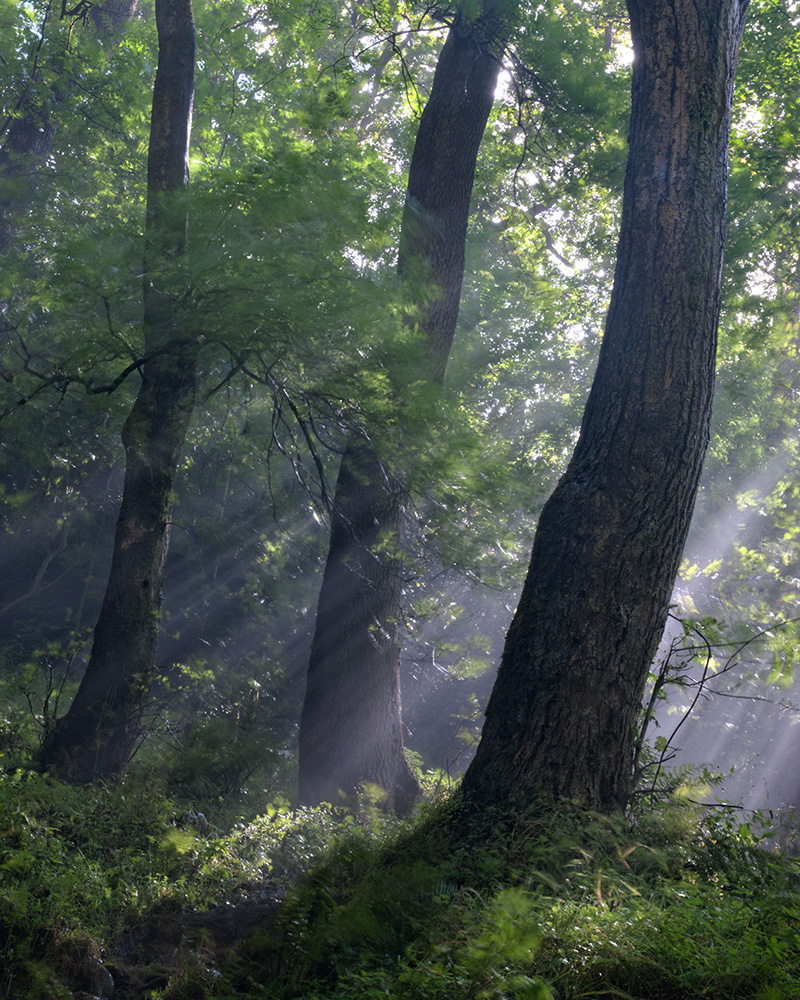
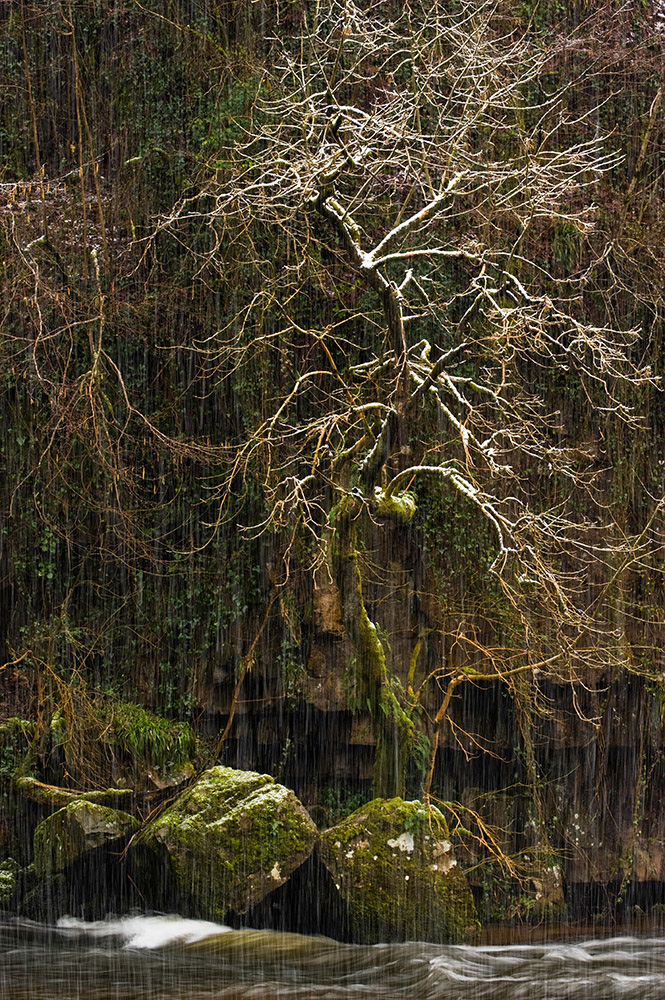
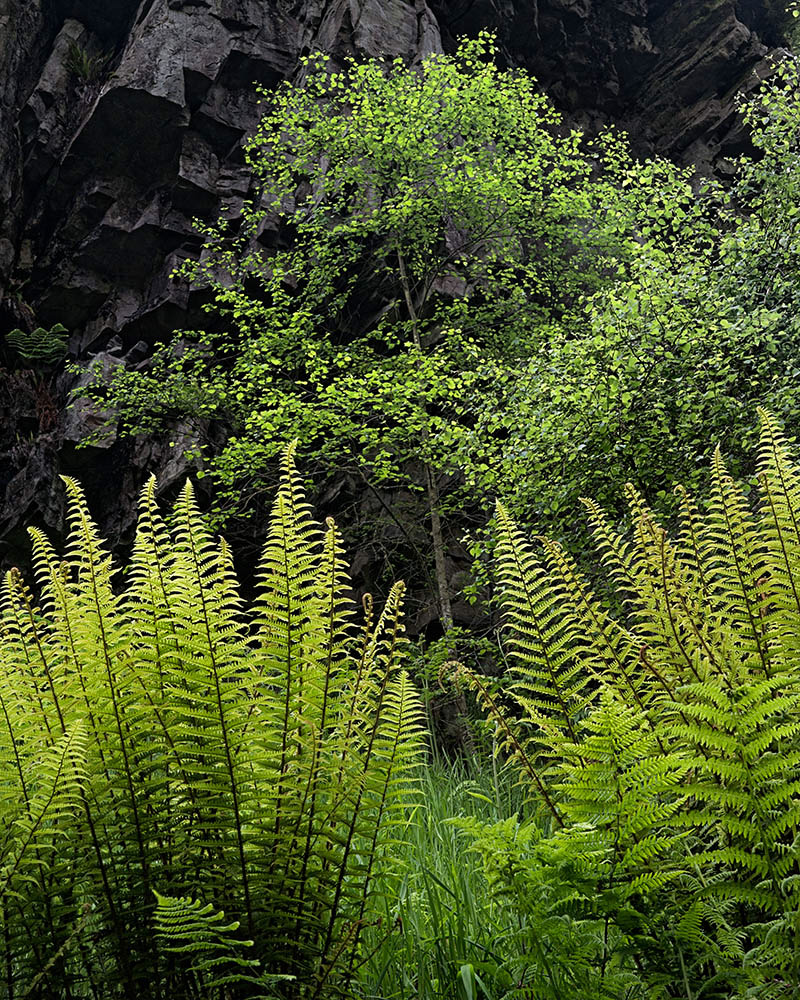
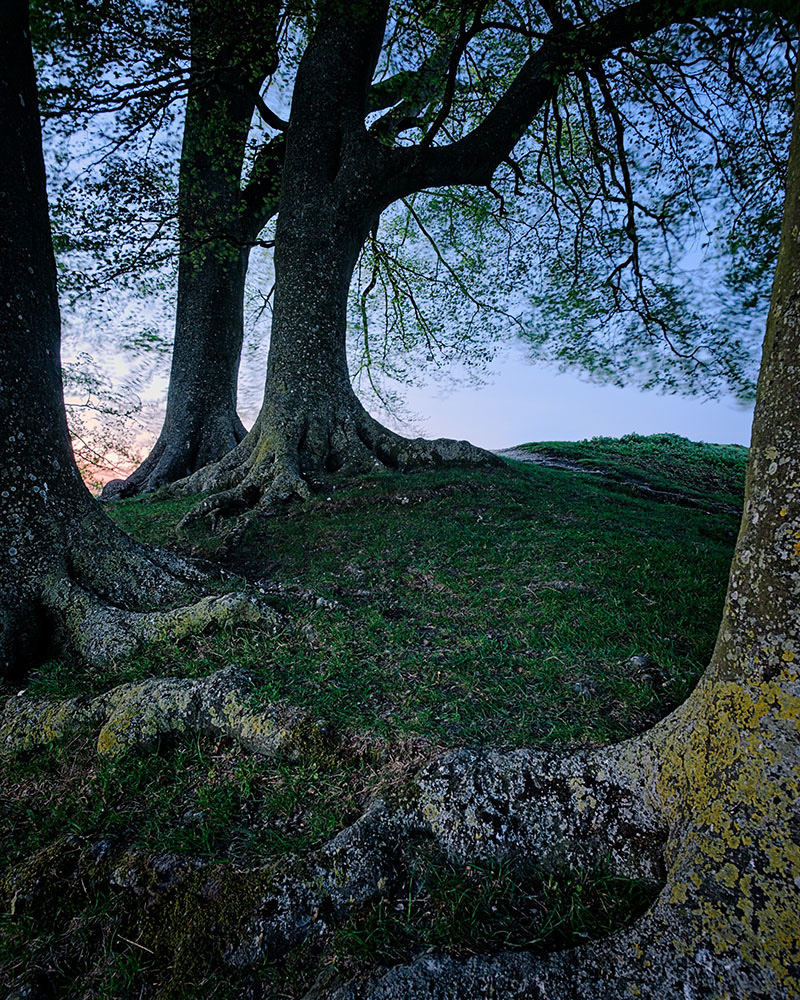
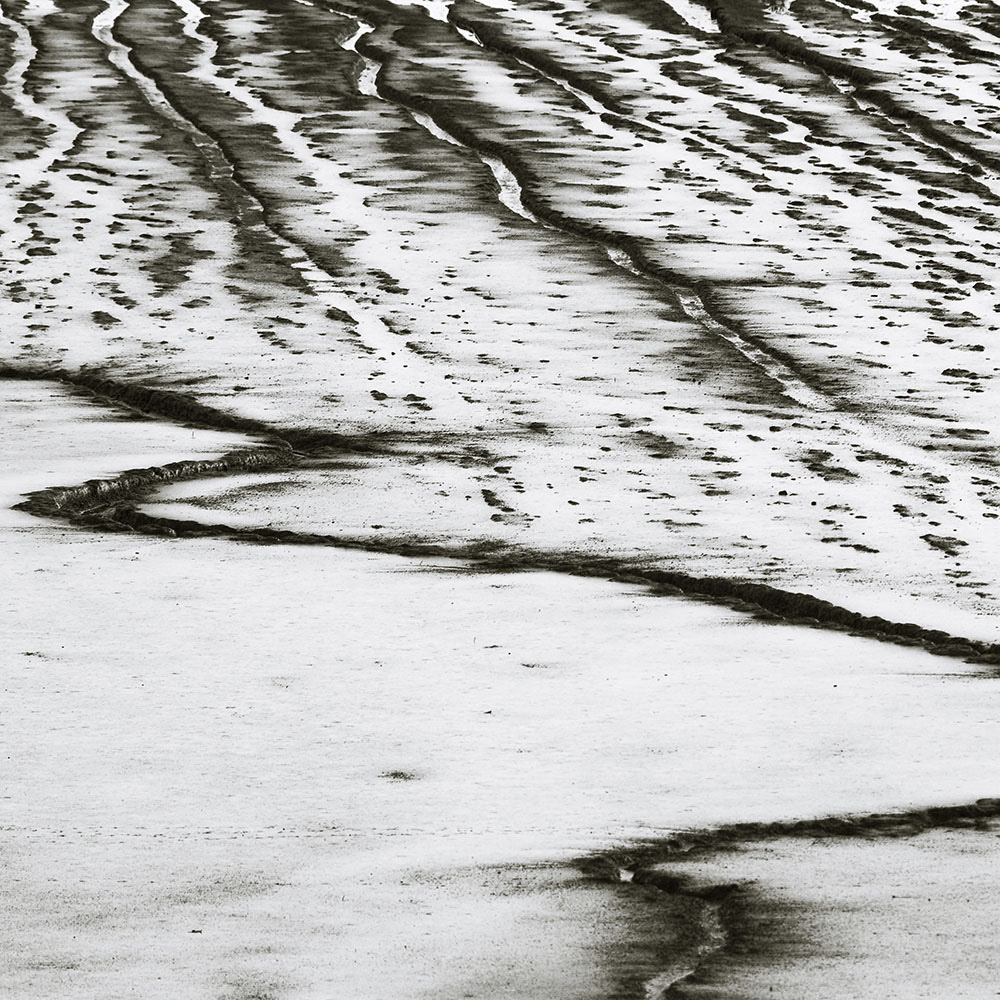
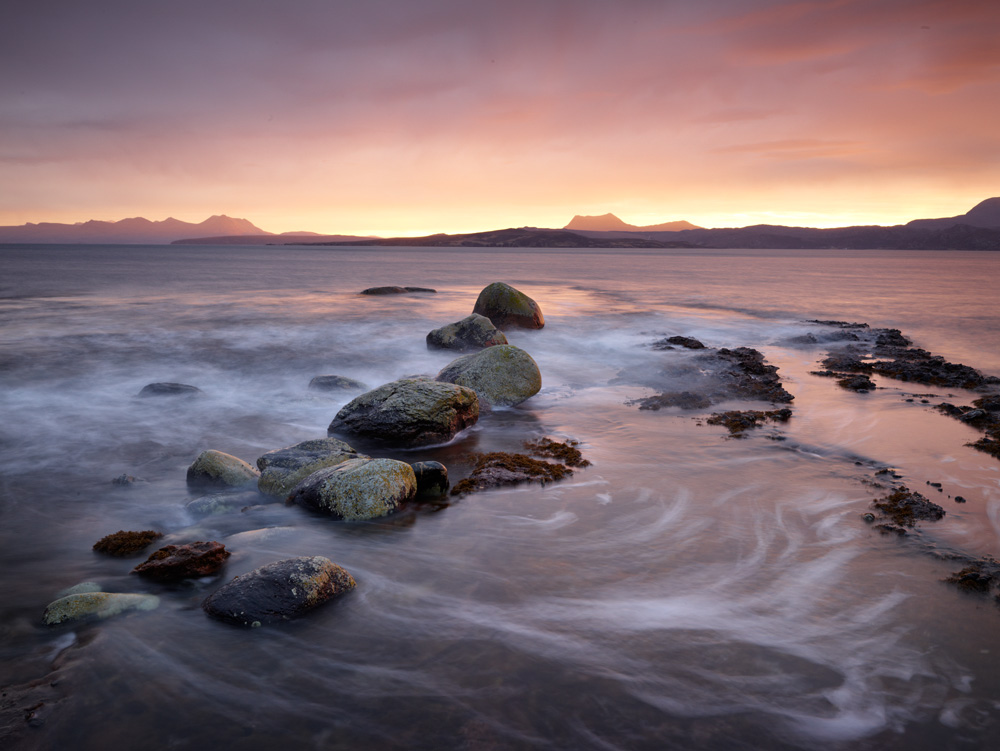
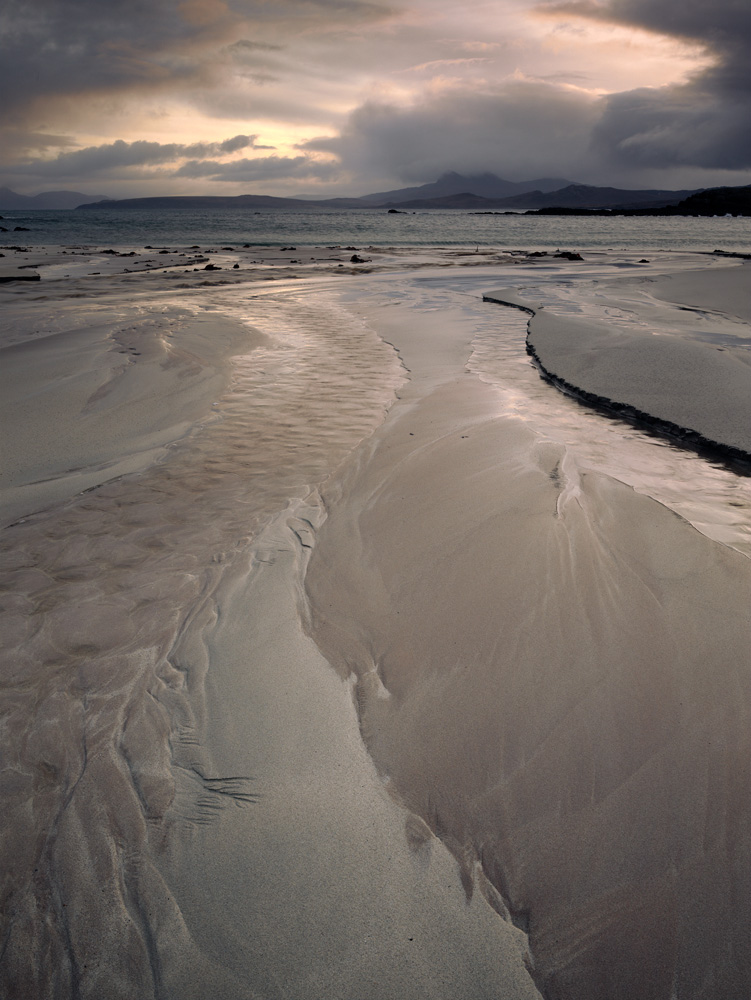
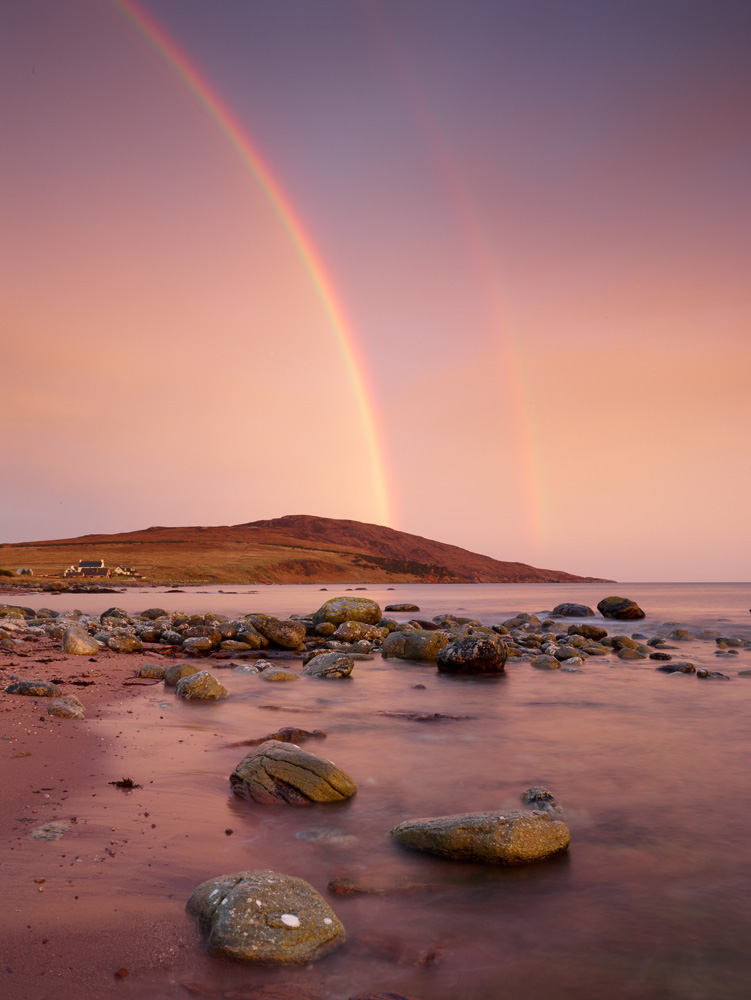
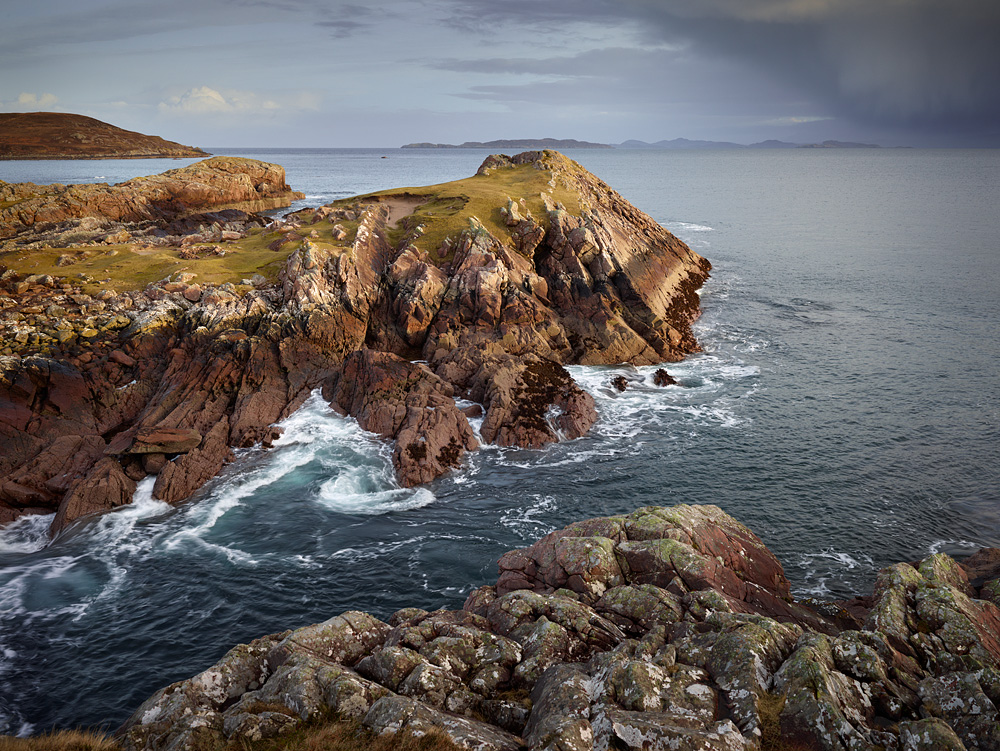
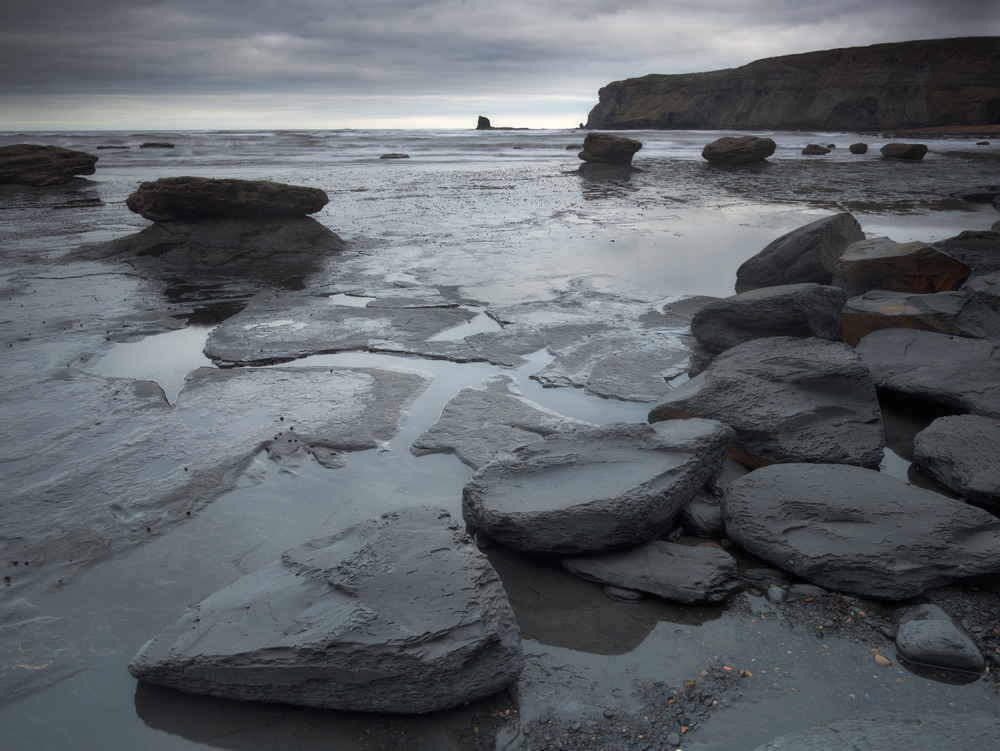
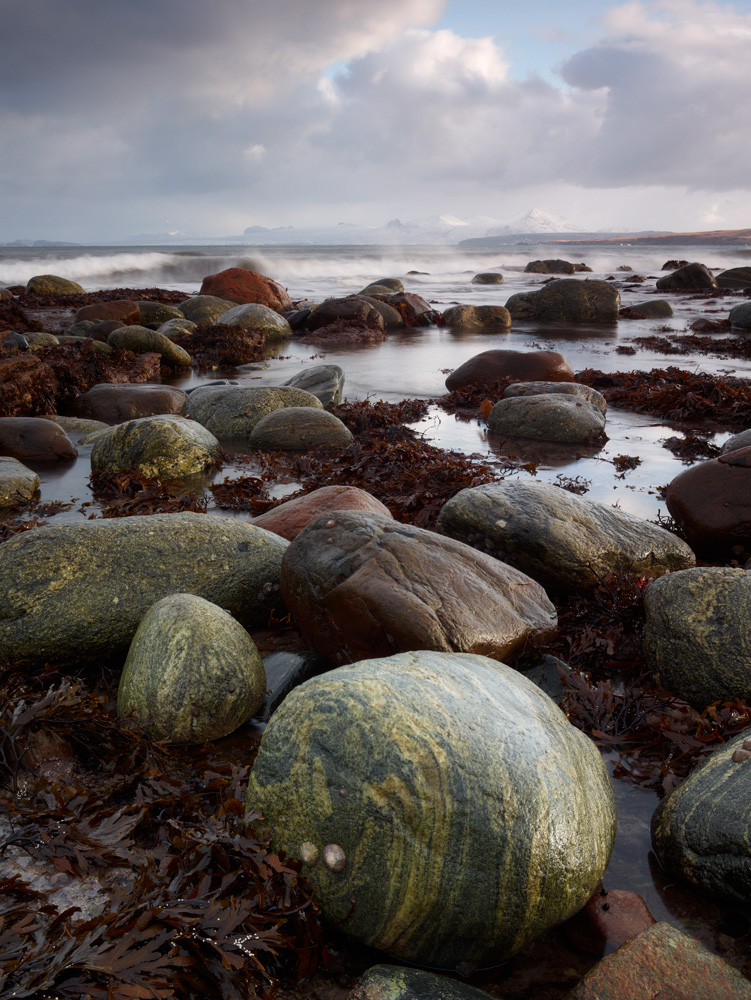
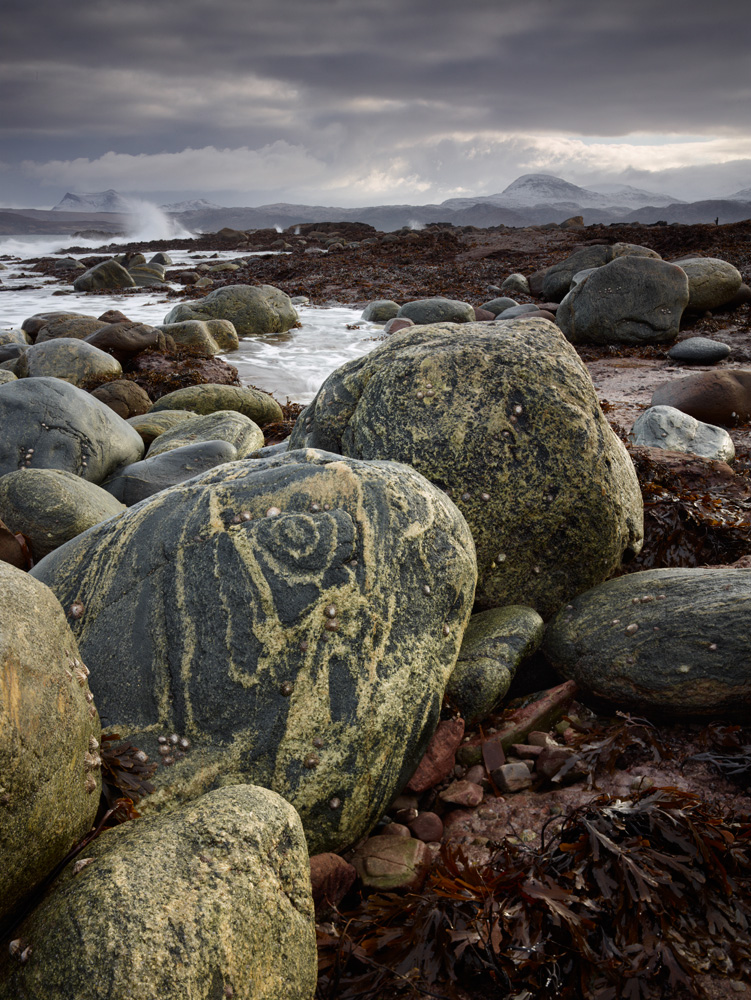
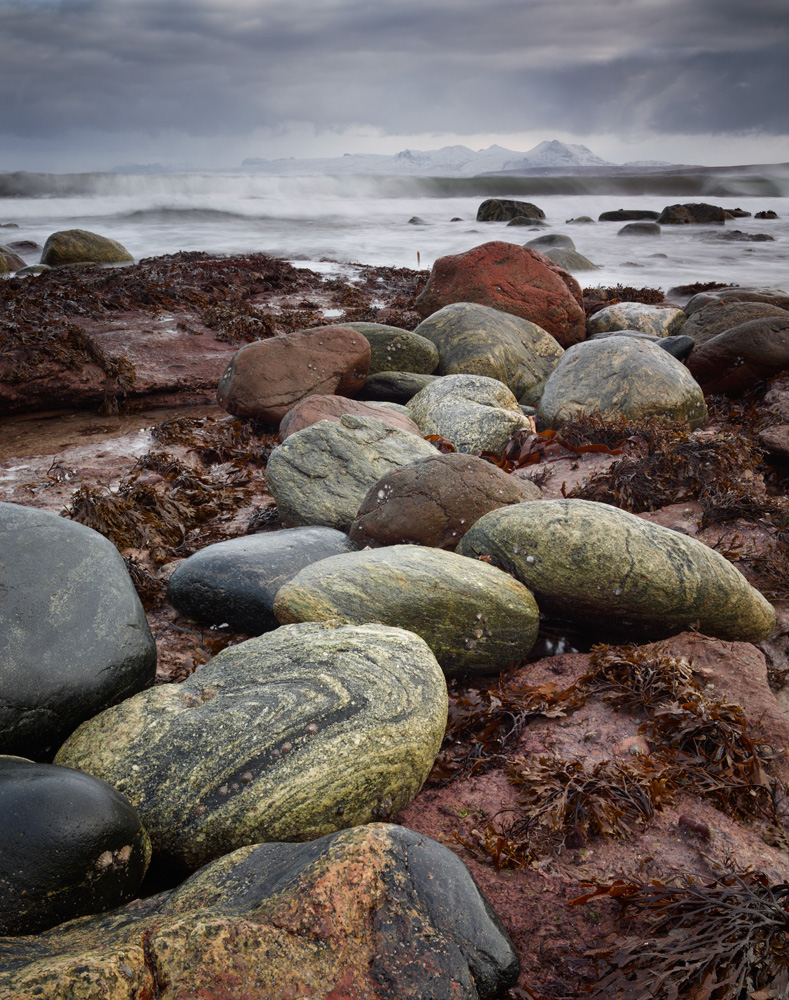
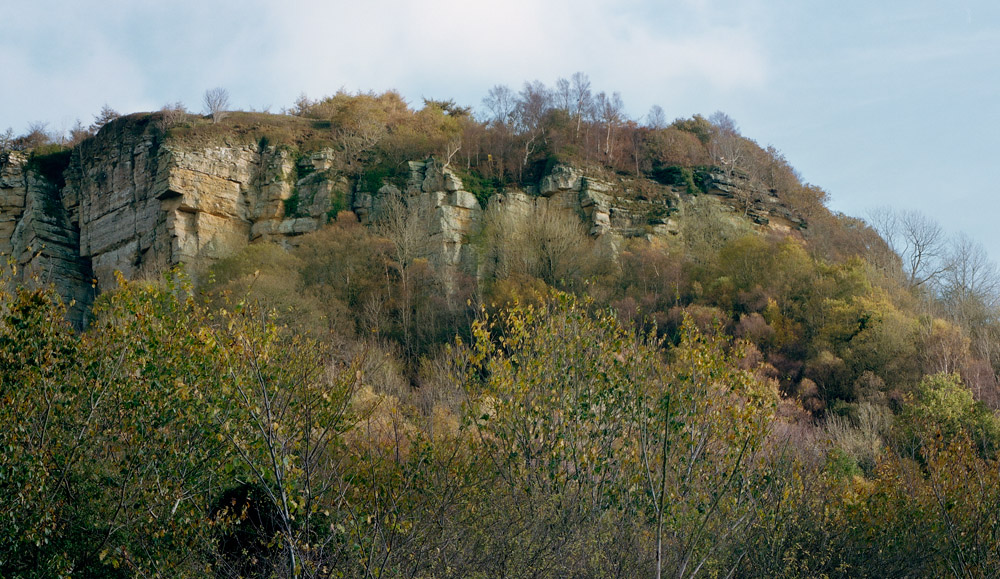
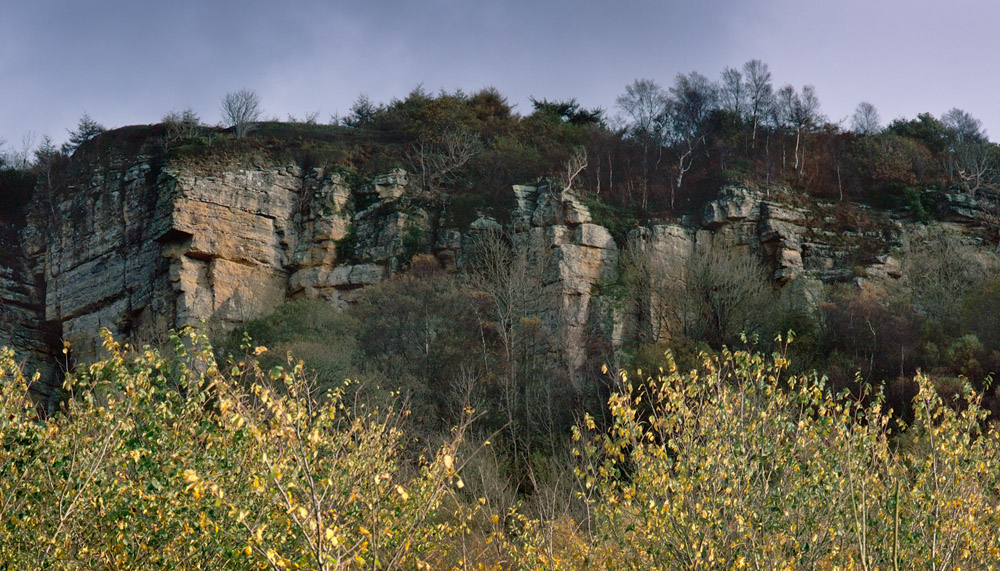
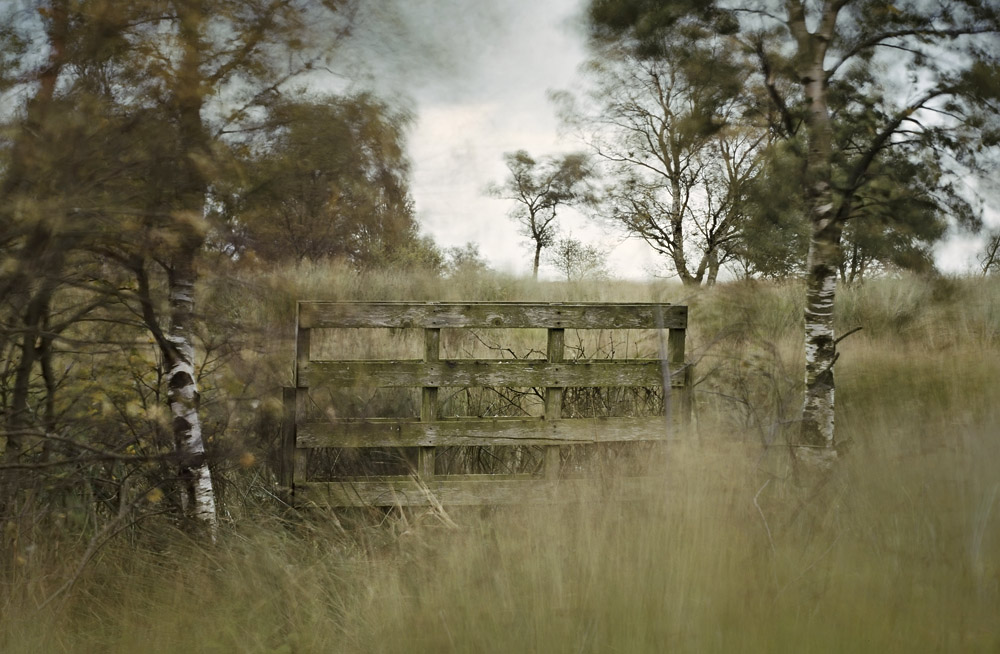
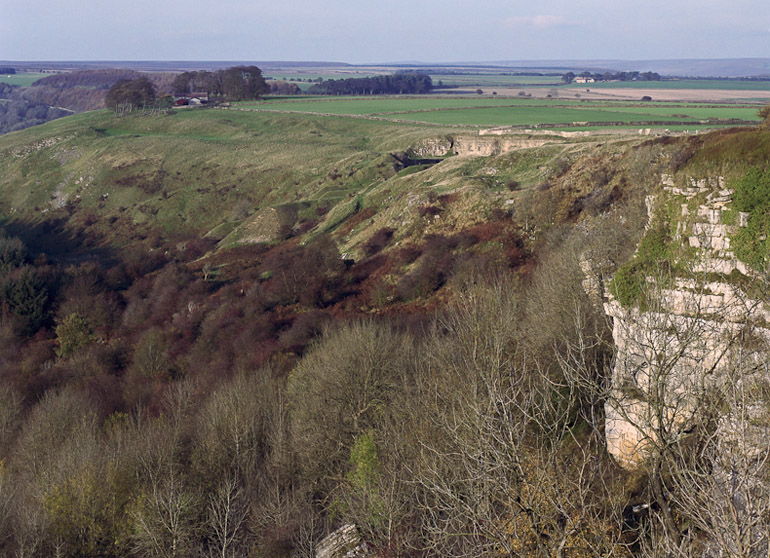
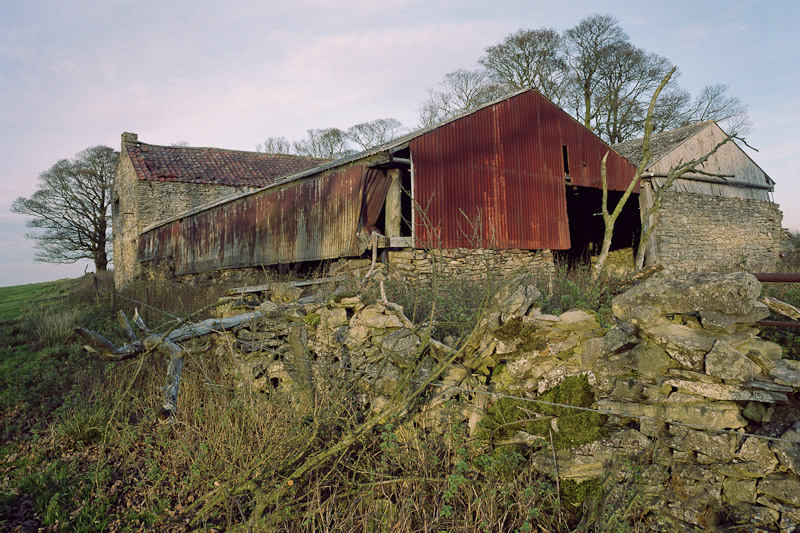
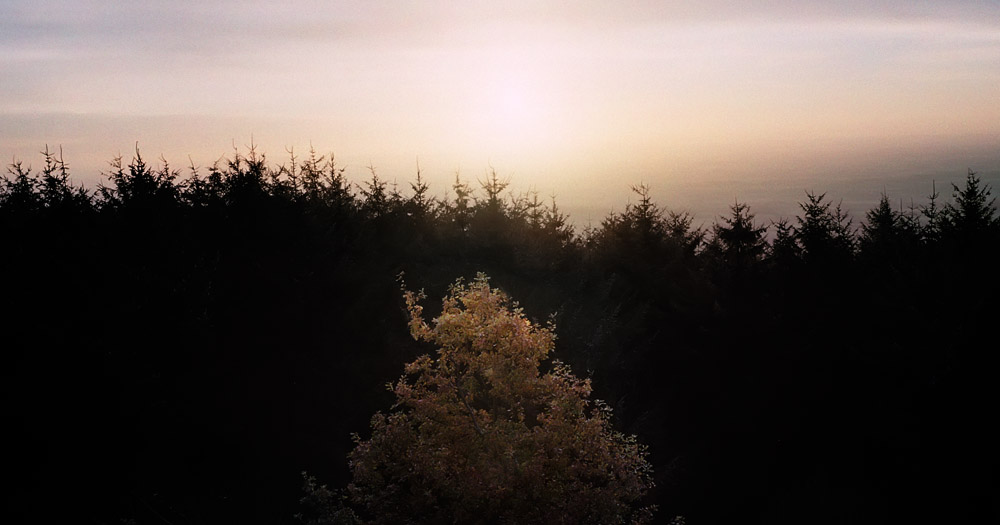
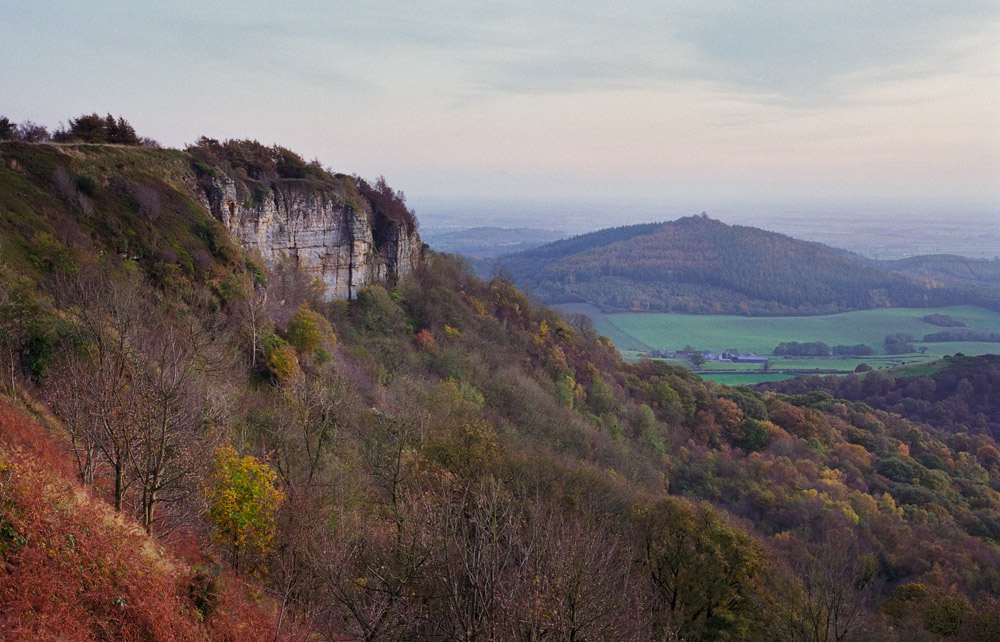
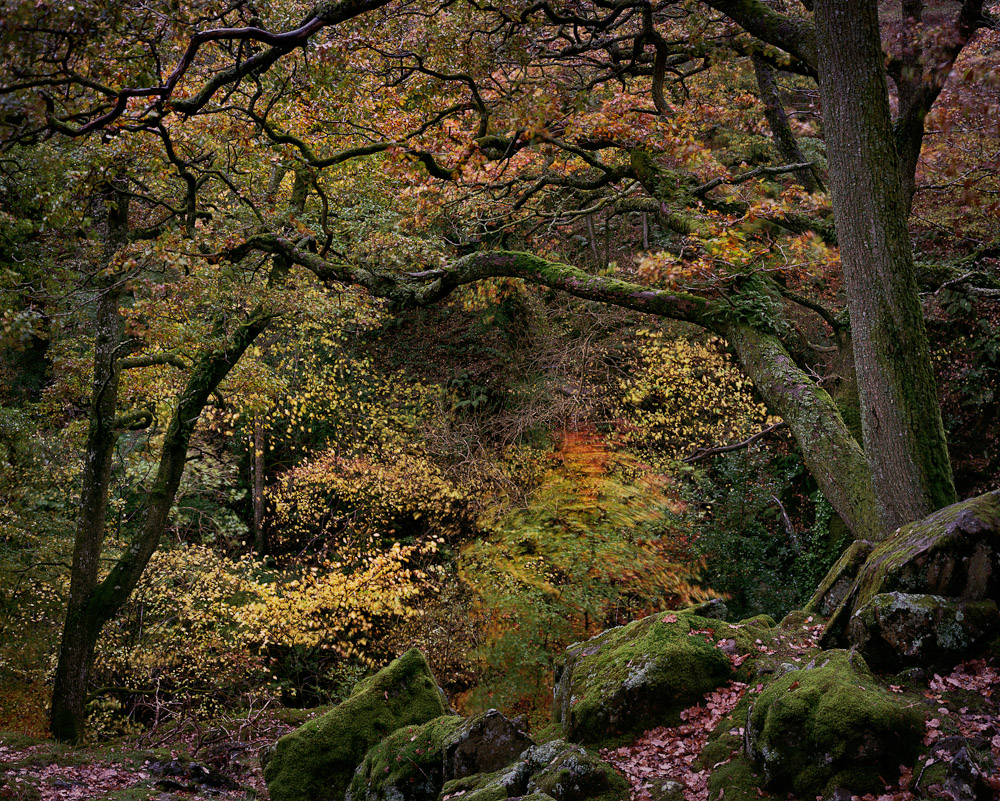
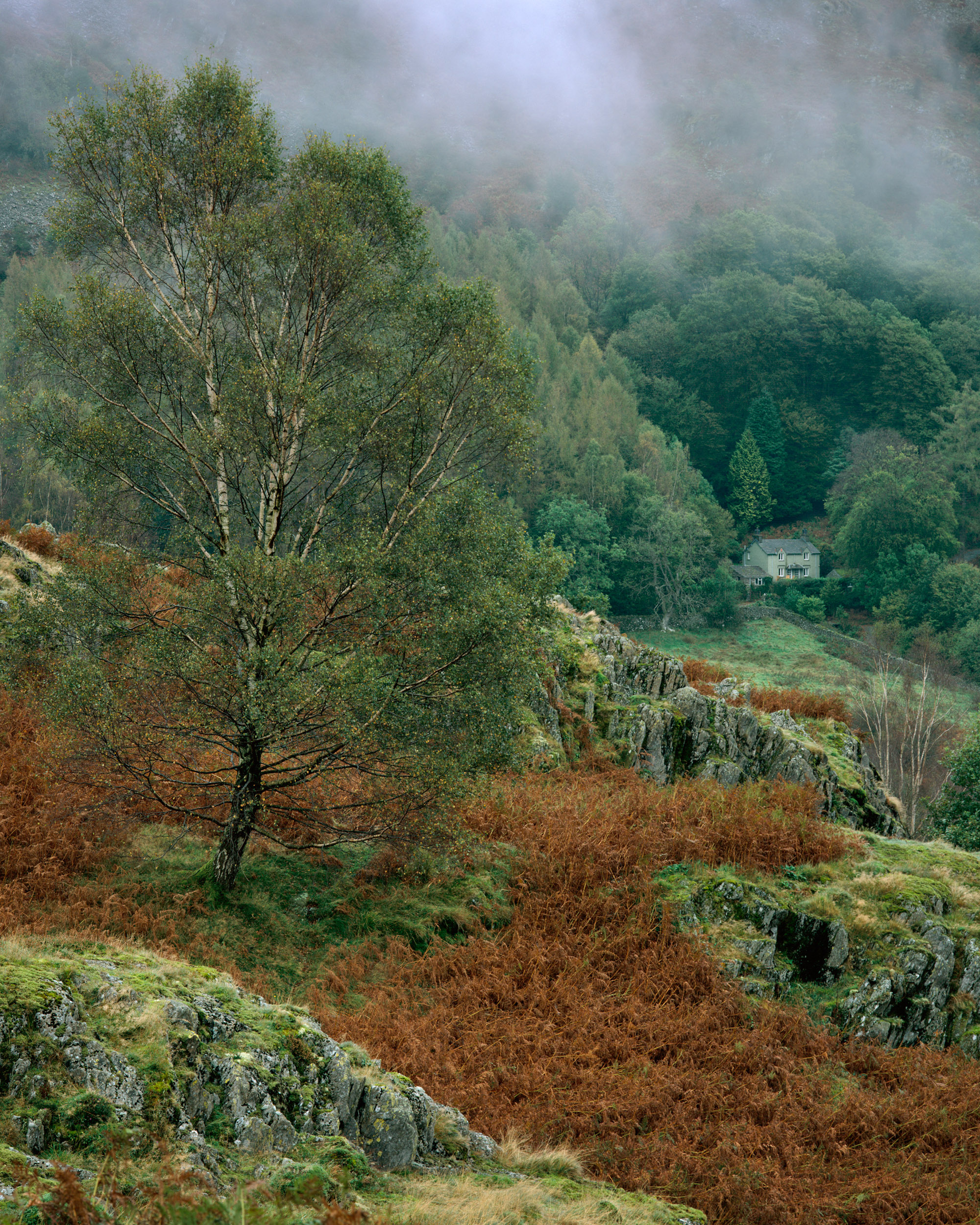
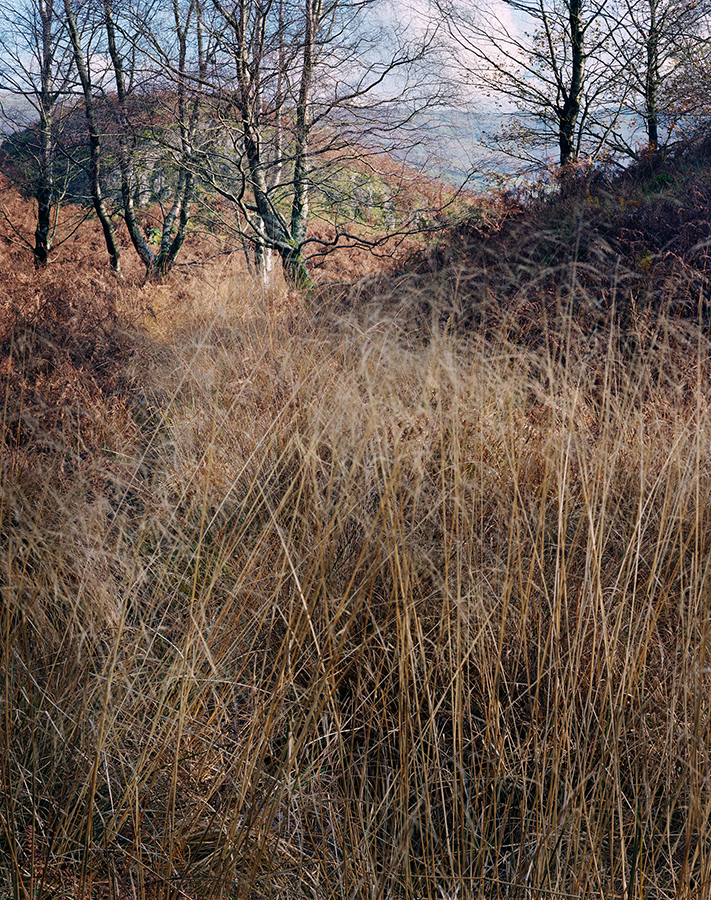
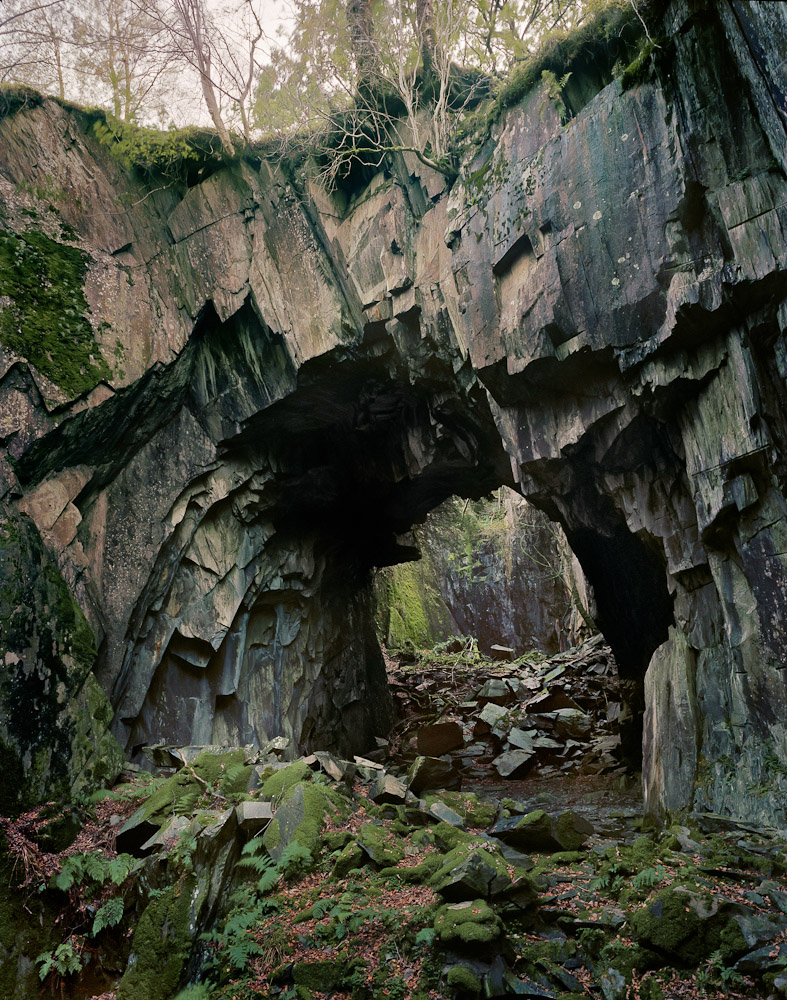
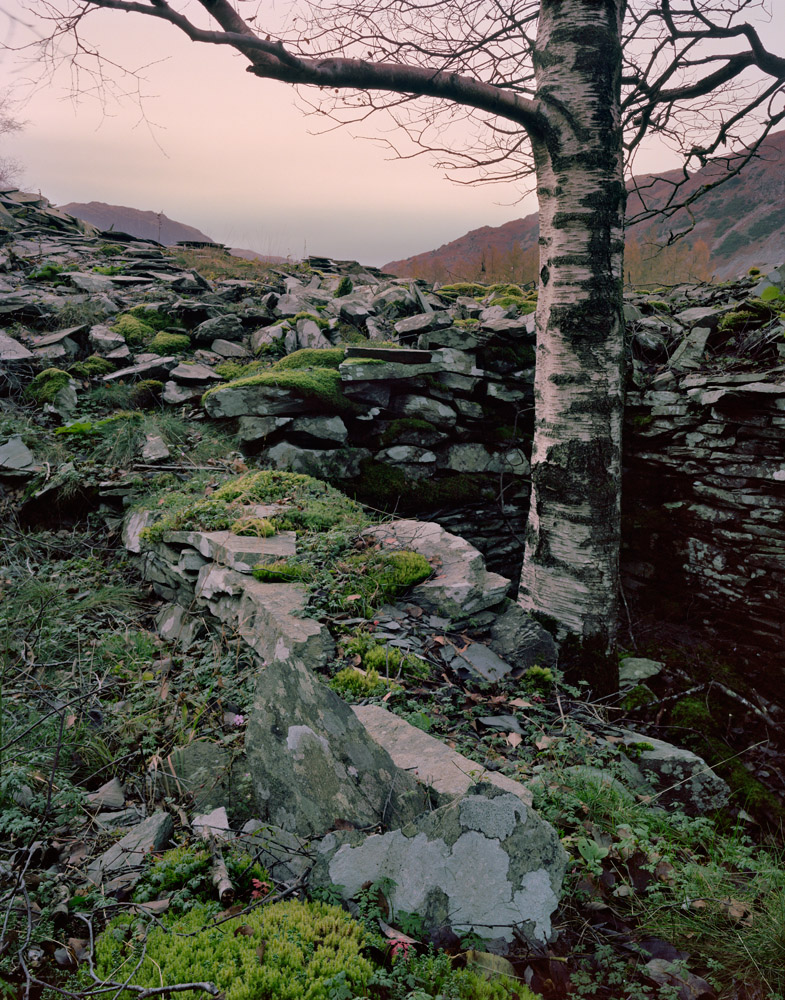
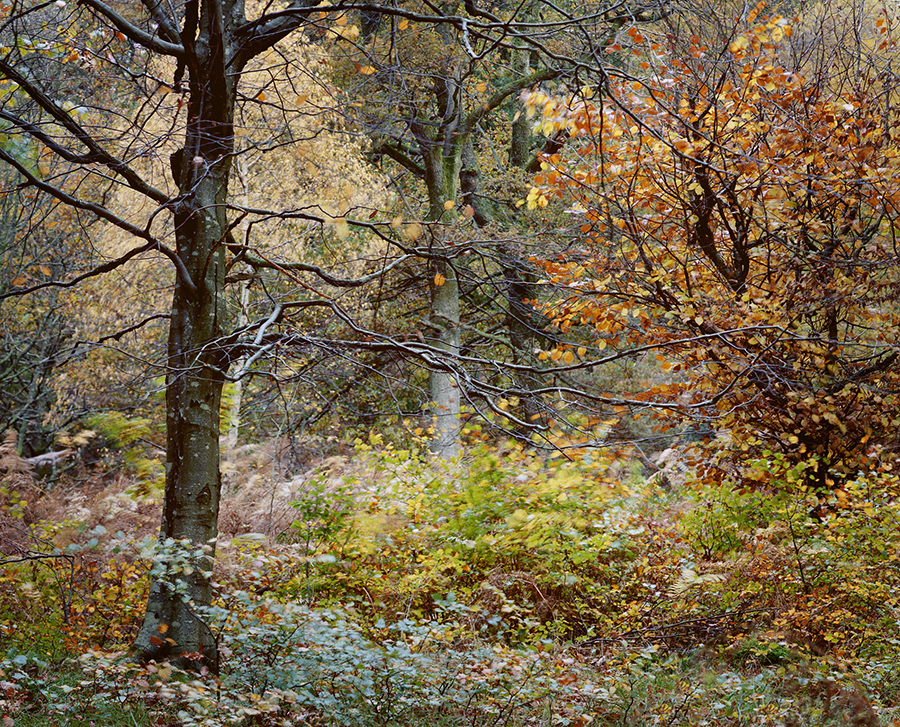
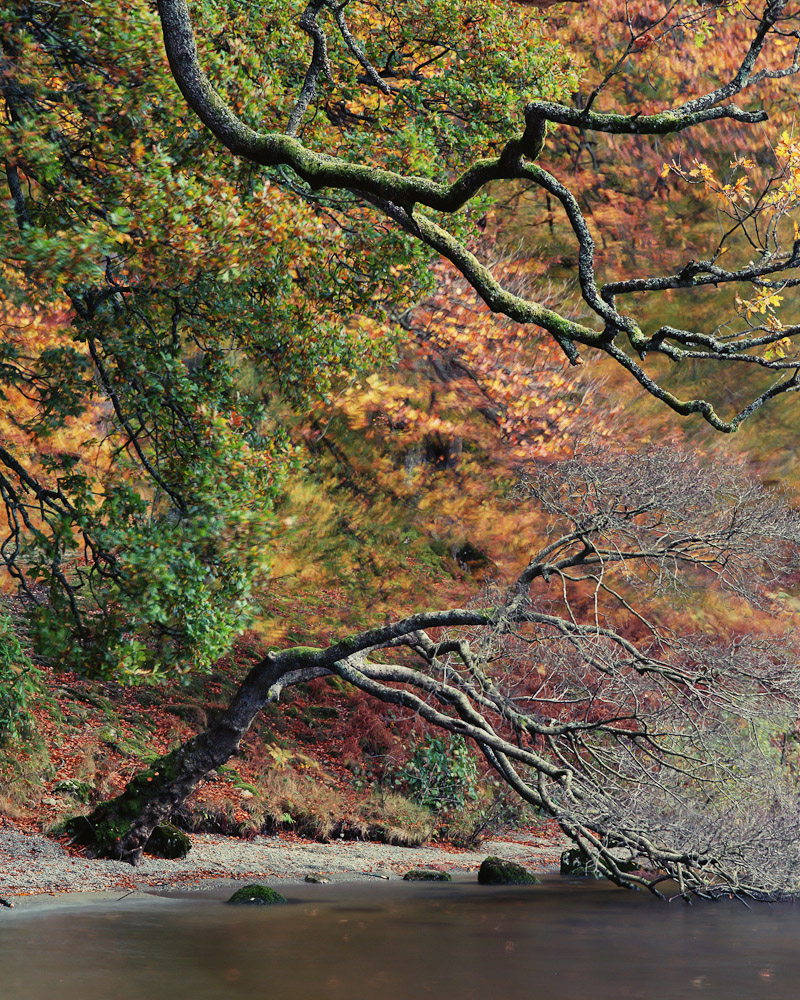
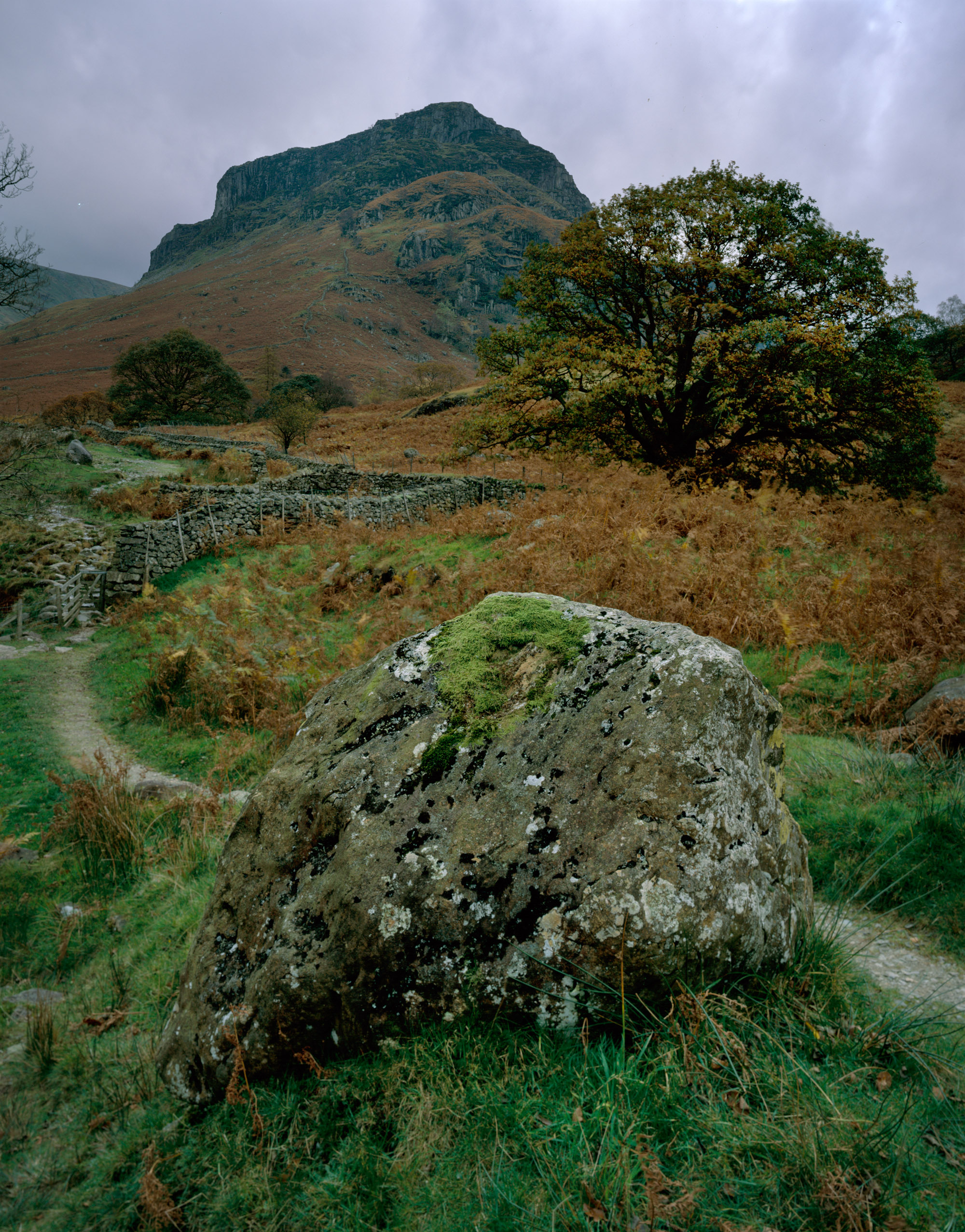
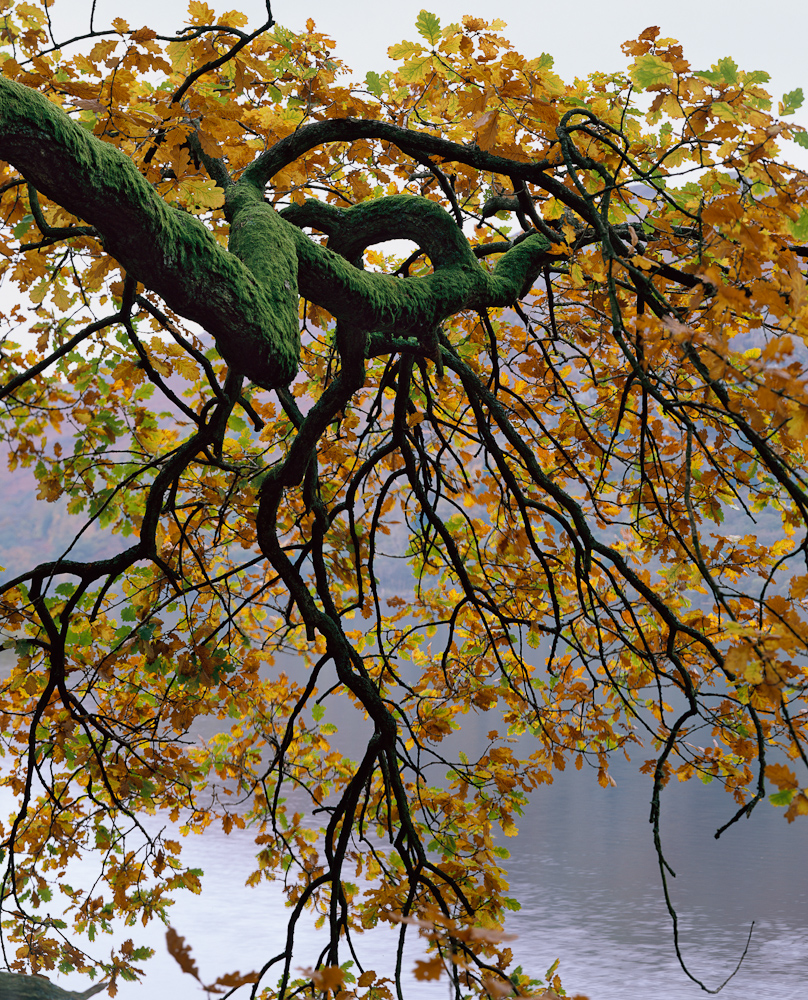
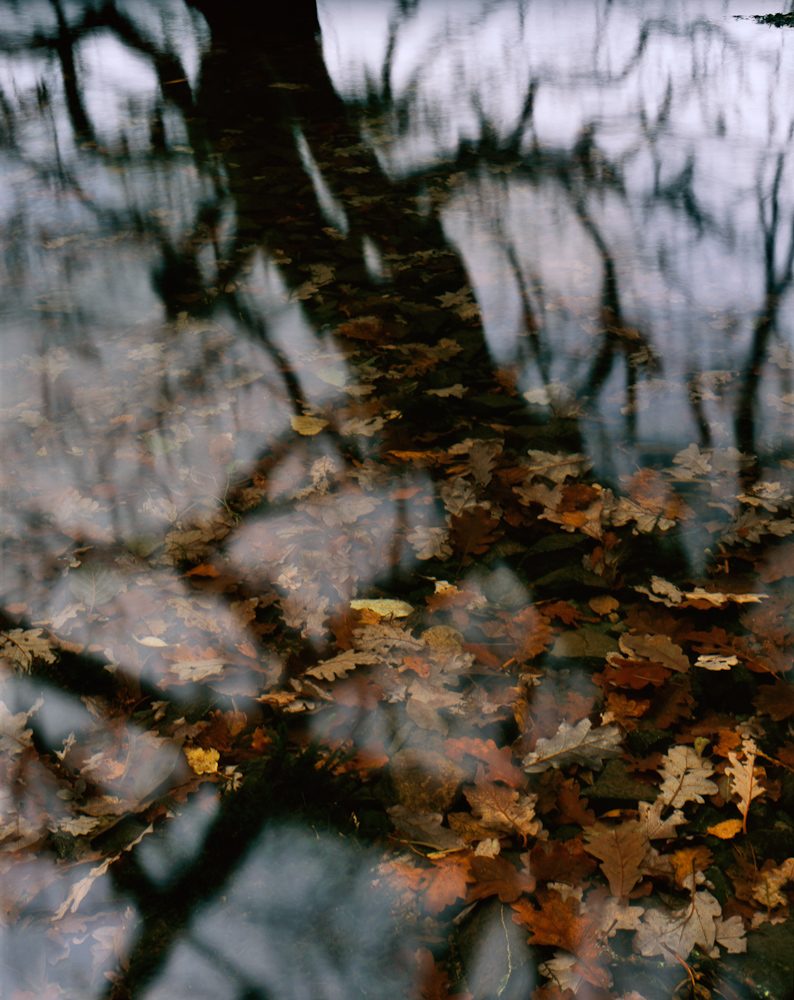
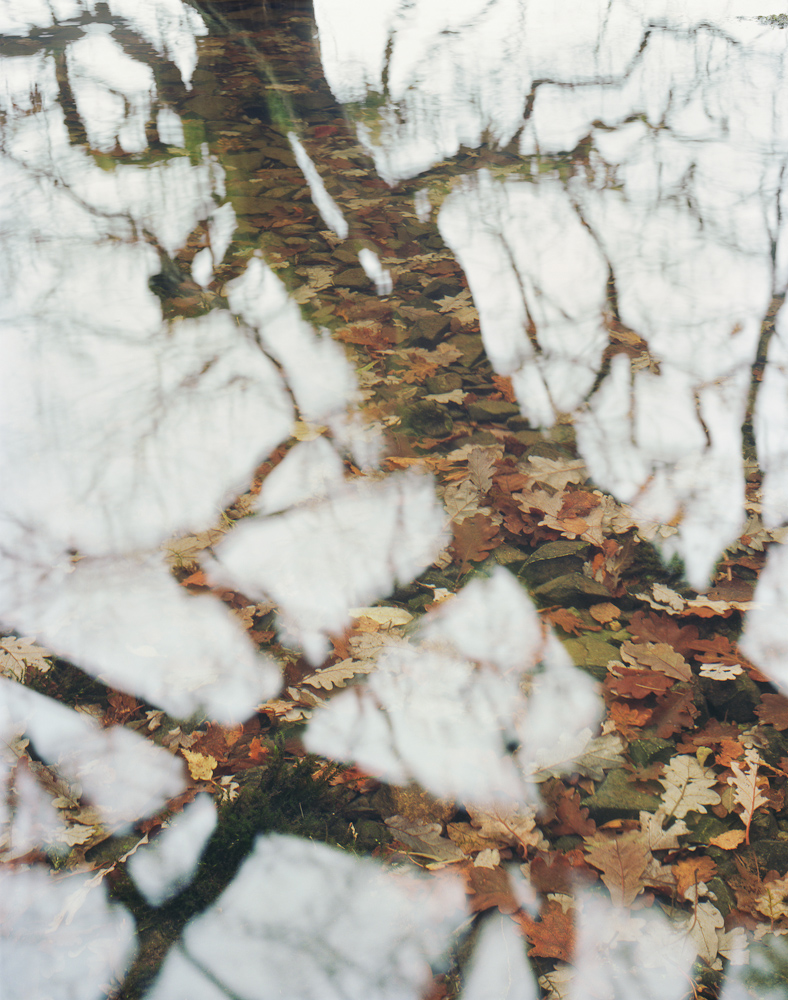
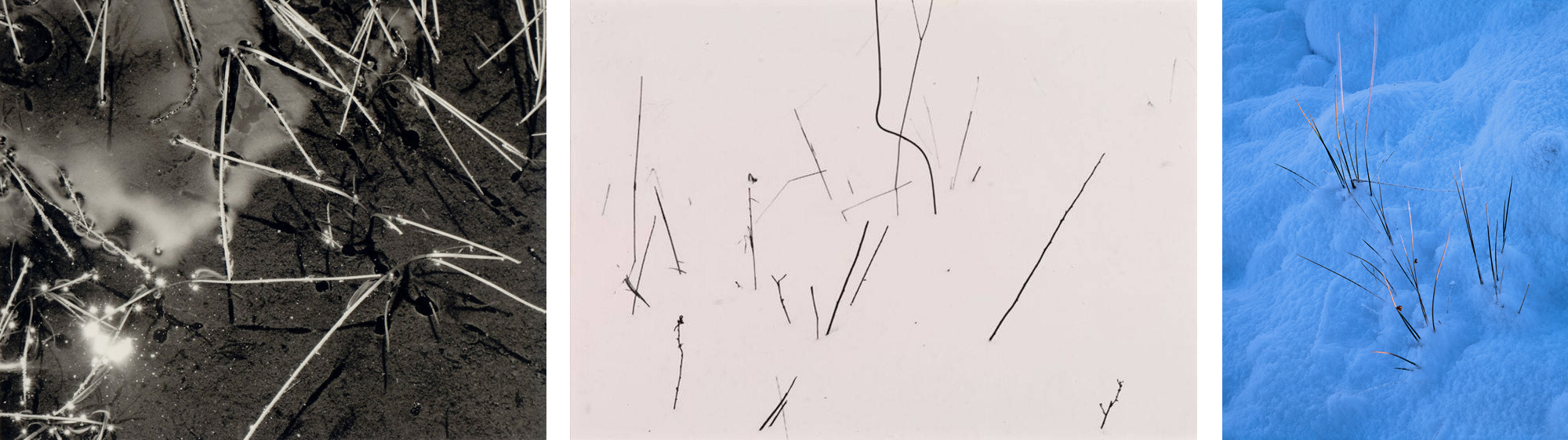
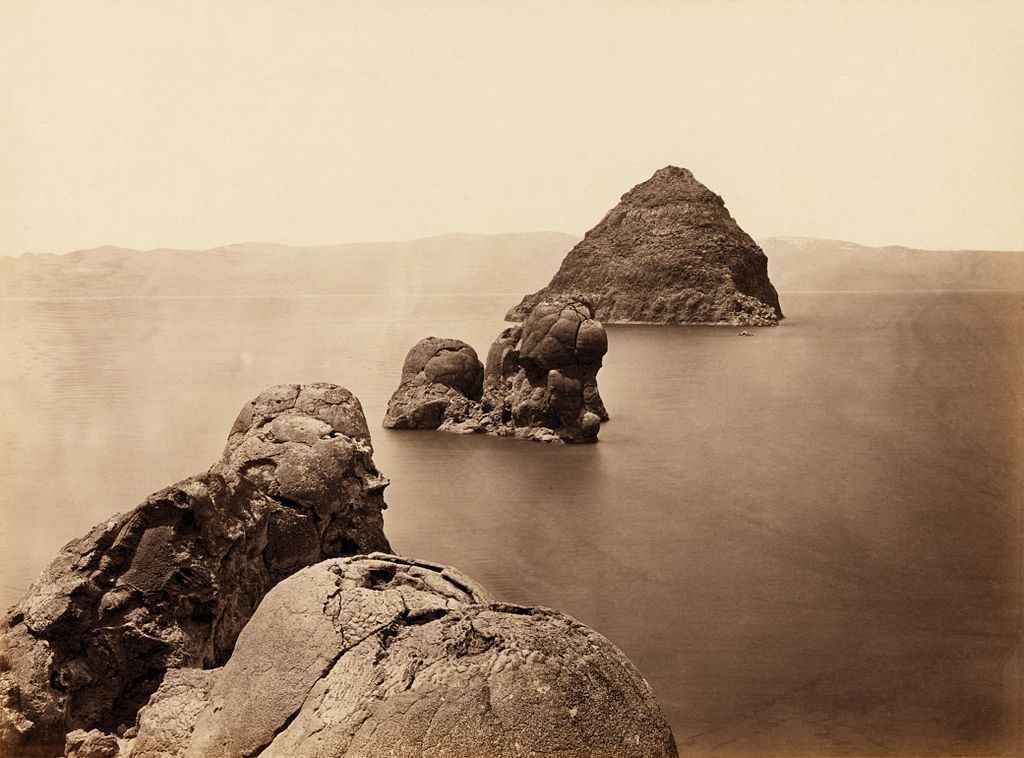
It's been a few months since we sent the prize to David Langan, although with the task of having his first pictures put on show and the dubious honour of being forced to write about it, it may not have been quite the 'prize' he was thinking of. Here's David's report from his first roll of film.
It was with a certain amount of trepidation that I received the Olympus OM-10 from Tim through the post. Save for putting a roll of film through an old EOS Elan I have been exclusively a digital shooter so far. I knew I would be able to make pictures with the camera but never having used a film camera seriously coupled with having my efforts broadcast to the landscape photography community had me feeling decidedly nervous!
What if I couldn’t expose properly? What if they were all out of focus? What if I mucked it up completely? With all these questions running through my head I took the tiny little camera along with me on one of my regular visits to Grandhome Moss for my ongoing project. The camera was dwarfed by my EOS 5D2 and looked positively silly sat atop a tripod but I quickly got to know the camera (or so I thought!!) and began making pictures.
I had taken the camera with me on numerous outings to Grandhome Moss and on a trip to autumnal Perthshire. It had been a good few months since I had taken delivery of the camera and thought I must be getting close to using up the 36 exposures. A quick check of the counter dial had me sweating ever so slightly. It was on “E”. Hhhhmmm, that doesn’t seem right at all.
When I got back home I went into a cupboard and opened up the back of the camera in the dark. I wound the film on making sure it was feeding right. All seemed fine. Relief! Although I had no idea how many photographs were exposed? It then occurred to me that I should have been taking notes on each photo as I at least would have an idea. D’oh!
I am a reluctant photographer. Reluctant in that I do not commit many photographs to pixels/emulsion. In fact on a trip out with LF photographer Dav Thomas last year he joked that our roles were reversed as he was the one who was making many photos with his view camera whilst my 5D2 stayed mostly in the bag. How long was it going to be until I came to the end of this roll of film? Now into February it had been 5 or so months since I received the camera and began to feel the pressure to get the article written.
I got right into the swing of things getting the OM-10 out on nearly every outing. But I had no idea if any of the result were useable, no idea if the camera under or over exposed as there was not that safety net of instant playback and histograms etc.
Now the end of February I still had not got to the end of the roll and decided just to get the film out and get it developed to see what was happening. When I got the negatives back I was relieved to see that I had made useable photographs.
However, the last half the roll was not exposed. GGGRRRRR. It looks like I did not start the film off properly and only corrected what ever error had occurred when I opened the back up in the cupboard. A lot of pretty decent photos gone forever! At least mishap gave me something to write about rather than exposing the 36 frames correctly first time! (Keep telling yourself that!).
The camera itself is fun to use and the operation simple and intuitive. I will definitely keep the camera loaded with film and take it out with me and use it in the same way I use the Hipstamatic app on the Iphone; provide a bit of light relief from serious picture making. But taking so long to expose 36 photos sits uneasy with me. I like instant results. Or at least not having to wait months to see the results!
As I still very much want to make photographs on film perhaps it all lends itself to the inevitability of going large format one day (have been thinking about it ever since I saw some David Ward transparencies in Glencoe in January 2009 and then interest further piqued seeing Richard Childs develop his own stuff in Harris a few years back). At least then I will see the results a bit faster!
Response to the scans
I have now had a chance to peruse the scans (courtesy of Tim) and I am pleased with the results. Considering the cost of the camera and a lens is cheaper than the cheapest of DSLR lenses it is all the more impressive. And the 12 MB jpeg file from the scan is more than large enough for any printing I would ever consider doing.
I used a roll of Portra 400 for this article so you would expect the results to be grainy, and they are but still very useable images.
Now I can see what is capable from such a cheap set up it puts into context this tech race which inevitably means buying more equipment that you probably don’t need at steep prices. And for what? Are these cameras, laden with options like Active D-Lighting, in camera HDR, Auto Lighting Optimizer etc), actually helping make better pictures? Probably not. Are users of these cameras using the equipment to its maximum potential? Probably not. Are users of these cameras utilizing all those pixels printing huge pieces of work? Probably not.
So before you go and spend perhaps thousands of pounds upgrading your camera you might consider keeping what you have and invest in a cheap film system. You can get a quality camera with quality glass and have more than enough money to buy all the film you would ever need and still have £££s left over. You will be surprised with how good the results are and your images will have something that, currently, your DSLR can’t offer, that lovely filmic quality.
We landscape photographers aren't well known as an overly social bunch and adding to that a hidden undercurrent of competitiveness (or possibly a gushing waterfall in some people's cases). However, there is a lot to be gained from cooperating for mutual gain. A few photographers from Galloway have done just that - combining their forces to create "The Galloway Photographic Collective" with a mission statement to..
increase our presence as professionals in the field of photography
highlight the attraction of Galloway as a place worthy of a visit
join forces to increase our strength as a marketing force
introduce the concept of a trail through the region to our galleries and studio spaces
advertise our work
improve the standing of photography as a valid and worthy art form in its own right.
I asked Phil McMenemy, one of the groups members, a few questions..
The idea of a collective of landscape photographers almost sounds like a herd of cats, how did you get to know each other in the first place and how did the idea come about? I presume things like this need some patience and hard work to kick off.
"I think we always had an awareness of each other and an awareness of the types of work each of us were trying to create. I think, historically professional photographers have tended to operate in splendid isolation – working terribly hard and carving a niche for themselves on their own. This sometimes works but sometimes leads to frustration and almost burnout. Some of us were closer to each other as natural friendships would occur but I think we all had a healthy respect for one another previously.
The journey, to date, has had its ups and downs I think this was inevitable as we all, in some ways, have had to sacrifice our complete/total independence for the mutual benefits of the group – this has been hard as previously we only had ourselves to answer to!!
However, having said that, we remain independent practitioners with total control over our own spaces and creative practices. The fun and games making apparent ‘easy‘ decisions like naming the group were, I feel, an understandable outcome of the group process and dynamic "
Galloway is the part of Scotland that everybody drives past on the way to Glencoe, discuss...
"Galloway has riches, undeniable riches. It has always historically been ignored, it was the last part of the UK to be completely controlled – it has a bloody and surprising history of feudal control and isolation. This won’t change overnight but along with other interested parties we are trying to bring the beauty of this special region to the attention of others. Try it, I think you’ll be surprised – the light has attracted artists for hundreds of years. I think we are just continuing this tradition."
You state that one of the goals is to improve the standing of photography as a valid and worth art form. How do you plan on making this happen?
"Good question – I think it’s about attitudes, prevailing attitudes. For some photography is seen as a somehow secondary art form and seems to fall in the shadow of other more ‘worthy’ art forms. This is not an attempt to decry other artists who work in different media but to be proud of the work and energy we expend in the hours, days, weeks, months and sometimes, in my experience, years, we spend creating those moments of almost magic. Other countries absolutely hold photography in the highest esteem....I think we need to be proud of our achievements and continue the fight to elevate photography to the same level in our country. Photography is our attempt at portraying our world in our terms."
I notice you have support from some local public bodies - how did that arise and what does it mean?
"When setting up the group we were aware of the possibility of support and mentoring from the Creative Clusters programme being rolled out in our region run by Dumfries and Galloway Council and funded by the European Union. So, we invited representation to our earliest meetings to ensure we were on track to meet their targets and philosophy of assisting the programme of creativity and collaboration. This help has been without parallel and without it I don’t think we would have go to where we are at this juncture. We are all extremely grateful for the guidance and support."
You mention promoting Galloway as a place to visit - can you tell me a little bit about a favourite part of it for you (or all of you)
"A favourite part of Galloway, hmmmmm? Too difficult – I think all of it. If one restricts oneself to a specific location it can limit possibilities – I think one needs to be as open as possible to all opportunities and all settings, the only restriction is one’s own imagination!"
Is this a sort of "do it yourself" camera club? and do you recommend it for other people - what would your advice be for someone trying to get one together?
"I think it’s up to other people to feel if its ‘right’ for them, it felt right for us but we’ve still a long, long way to go. I think the comparison to ‘Camera Clubs’ isn’t a fair one, Camera Clubs are an absolutely vital part in nurturing, encouraging and promoting photography for all enthusiasts – I respect them tremendously. We have to trust each other and trust each other’s creative practices – we don’t offer critiques of one and others work, for example. We have joined forces to promote our work, our Galleries and the region in these difficult financial times. We see our efforts as fighting back!
I think us giving advice would perhaps sound a bit arrogant – there is no quick-fix solution, it will be hard work and there will be bumps along the way – that’s the way it has to be, I guess. Its more about the journey than the arrival. However, having said all that these are early days and perhaps you could ask again in a year’s time!"
The group are having a launch party which opens on the 31st of March starting at 6pm with guest speaker Colin Prior, well worth seeing talk, talking at 7:30pm which includes around 45 images from the members. The exhibition will run until the end of May.
Photography competitions, there are literally thousands of them. Most of them are thinly veiled attempts to accrete free images for commercial use (we recommend you read more about this here before entering any competitions). But all photographic competitions have a couple of major issues
The first is the fact that people must want to enter in order to 'win' - this sounds obvious but no competition can hope to declare the 'best' of anything you have to enter, usually through 'fee', in order to be included.
The second is that photography as an art can have no 'winner'. A photograph or photographs can be selected as 'best' by a group of people but in most competitions, one bunch of people judge the first round and then a completely different set of people come and judge the second round bringing with them different perspectives on photography - where's the consistency in that?
Now there is nothing intrinsically 'wrong' about either of these things - a competition is what it says on the tin and you enter at your own risk.
However, I've been thinking about a better way of dealing with the issue of recognising great landscape photography for some time and after consulting quite a few other photographers we've decided to go public with our ideas and have a 'launch'.
The 'Award'
Well, it's probably obvious from the title that we're talking about an award here rather than a competition. What does this mean then? Well, the first thing it means is that you don't have to enter - our judging team can give the award to someone who doesn't even know about our magazine. The idea of the award is that is doesn't exclude anyone and hence has the scope to recognise any photographer.
The next thing we wanted to address is the cult of the single image. Just as you wouldn't judge a chef by a single dish, we don't think judging a photographer by a single photograph makes any sense and so we wanted to look at a group of images. The number of images is difficult but we came to the conclusion that four would probably be a good balance between enough to recognise consistency in a photographers output and restricting the amount of images our judges would have to look at.
The question you might be asking is, if you don't have to enter, how do we find out about you? Well, you can enter - it's just not necessary. And you can also recommend another photographer - you don't have to pick four of their photographs, we'll happily pick a set, but if you want to you can show us what you think works well.
Another question. Won't the first year be the fairly predictable 'best' photographers who publish books etc? Well, our 'brief' for our judges will be fairly loose. We'll be asking for originality, composition, narrative, etc and each judge will have their own quite strong opinion on what makes for great work. On top of this, we will have a section for 'contributions' to landscape photography. We would expect this to include some of the famous names along the way.
Who'll be judging it? Well, the first judges will be people connected with the magazine in some way, myself (Tim Parkin), Andrew Nadolski, David Ward, Rob Hudson, Joe Cornish and a couple more to be confirmed. Next year we'll feature some different judges to keep the variety of results moving.
How are you judging? We'll be looking at various things but originality, creativity and technical excellence will be factors. As will the consistency across the images chosen. Each judge will get to select his or her favourite and then there will be two or three group selections. We'll be keeping things as open as possible in order to ensure that the final set of awards makes sense and shows a great cross section of landscape photography.
Who can enter? For the first year we're going to limit this to pictures of Great Britain from British photographers - it would be unfair with the cross section of judges to do this differently. If all goes well however, we fully intend to open this up and try to extend it internationally as long as we have the resources to do so.
And what does being selected entail? We hope to be able to have a small exhibition of the selected awardees and a permanent section of the website dedicated to the awards which will do the photographs and photographers justice. There isn't any money involved but we're hoping that being recognised by your peers is reward enough.
If you want to make us aware of your own work or to recommend others, you can send your nominations to 'awards@onlandscape.co.uk' and include the name of the photographer as the subject of the email and a link to the four images you have chosen in the body of the text. Feel free to add some text to explain why you nominated them if you like. We'll publish nominations on the website in the coming months.
We'd love your feedback on this as our goal is to build an award that the landscape photography community can be proud to take part in and that represents the qualities we all strive for.
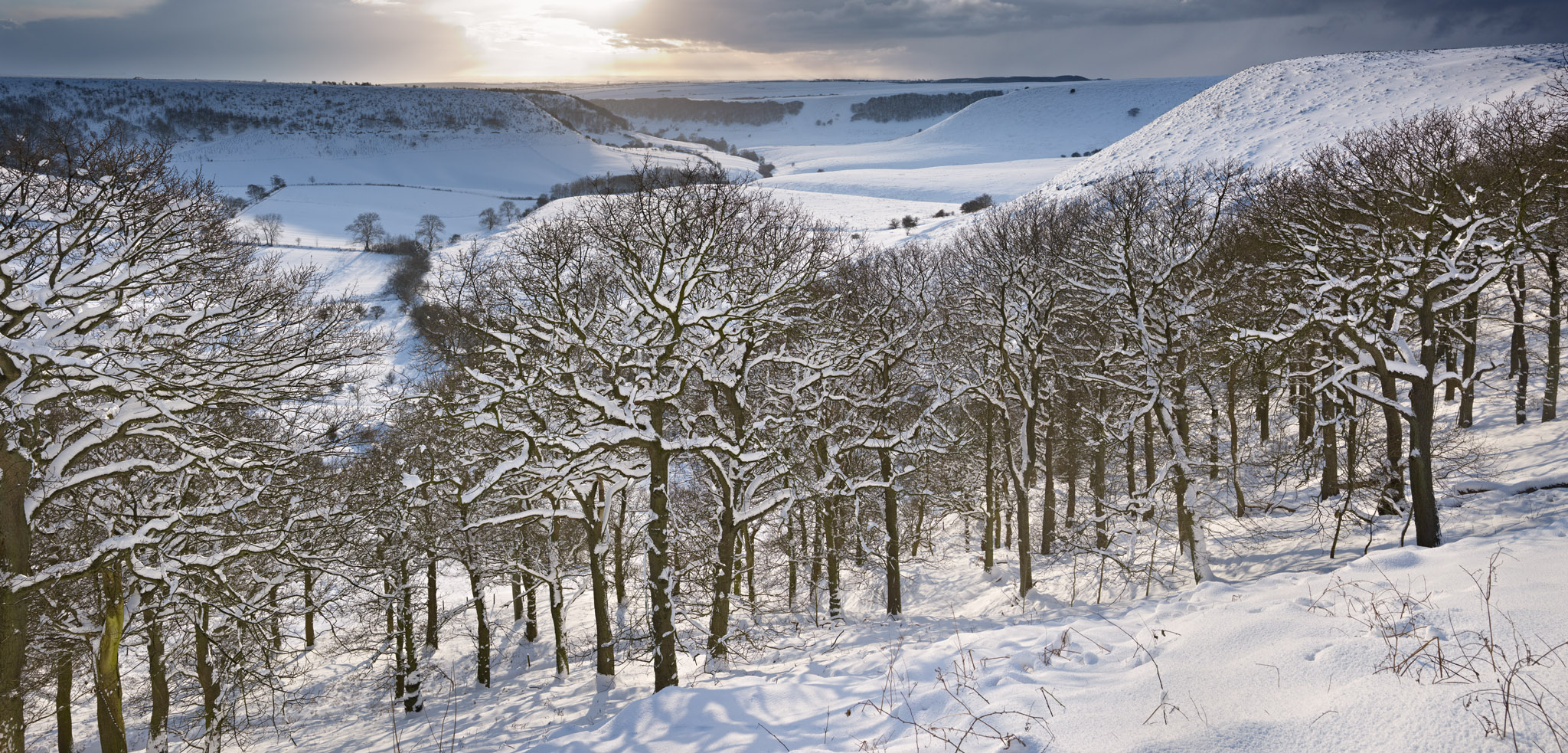
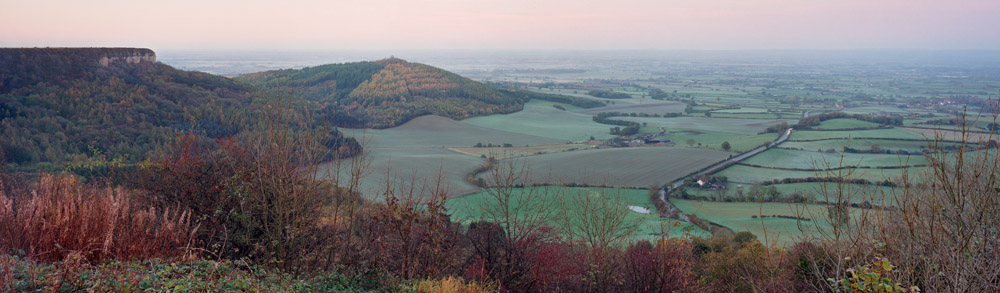
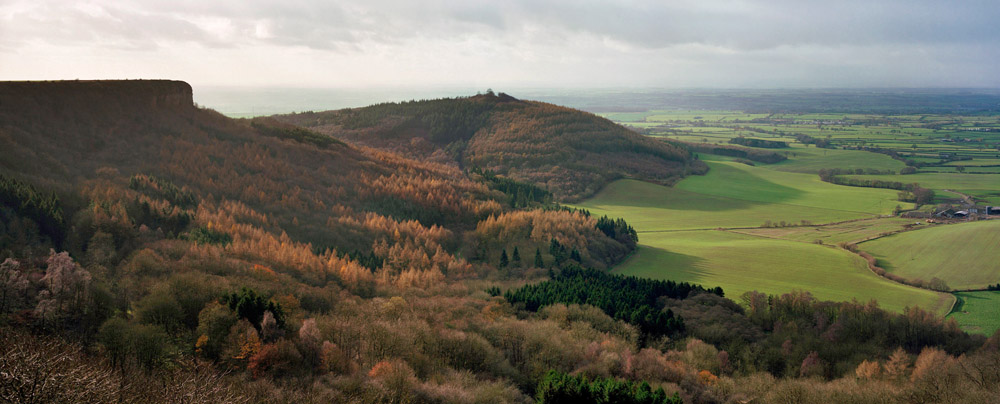
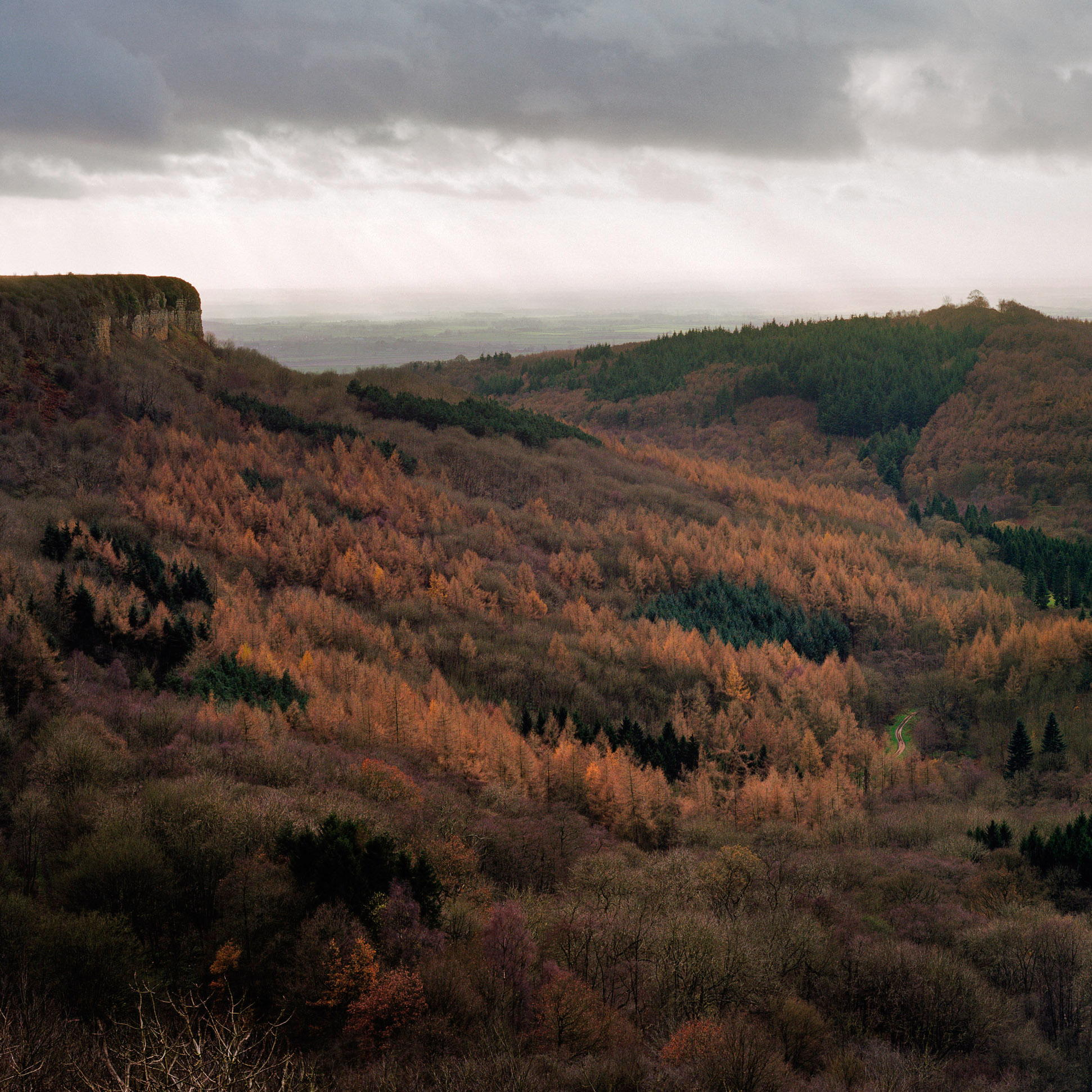
One of your favourite features of the magazine, and one you've been asking us to feature as often as possible, is the Hindsight series where we talk to Joe Cornish (and other photographers) about a few of their photographs. This issue we're back with Joe and talking about a set of pictures taken in difficult light and that also happen to reflect the change in photographic medium that Joe has made over the previous decade. Firstly we have what would have been the front cover of Scotland's Mountains, a shot taken on Fuji Provia with Joe's Ebony large format camera. Second up is a panoramic stitch of the Hole of Horcum in winter taken on the Phase P45 back and featured in tableau, ultra large size at the joint exhibition "Landscape Revisited" with Kane Cunningham at the Scarborough Art Gallery. Finally we have a photograph taken last month during a scouting expedition that Joe and I made in Wester Ross and using the IQ180 digital back. We hope you enjoy the range of pictures and discussion and please ask any questions or add your own comments at the bottom.
If you want to take a look around the image from Wester Ross, Joe has kindly allowed us to include a 'zoomify' version which you can access by clicking 'this link'.
In a previous issue we introduced the idea of Photoshop masks - many of you will have already had some experience of masks but if not, recapping the previous article might not be a bad idea.
In that intrduction, we only really talked about masks in terms of a graduated filter effect; making changes to a large area of an image - in the sky or foreground for instance. Sometimes we want to make changes that target only the darkest areas of the image though, perhaps our shadows need to be warmed slightly or we need to remove a cast from our highlights. Luminosity masks allow us to make these changes. They also help us to mask hard contrast edges more accurately - we'll come back to that later though.
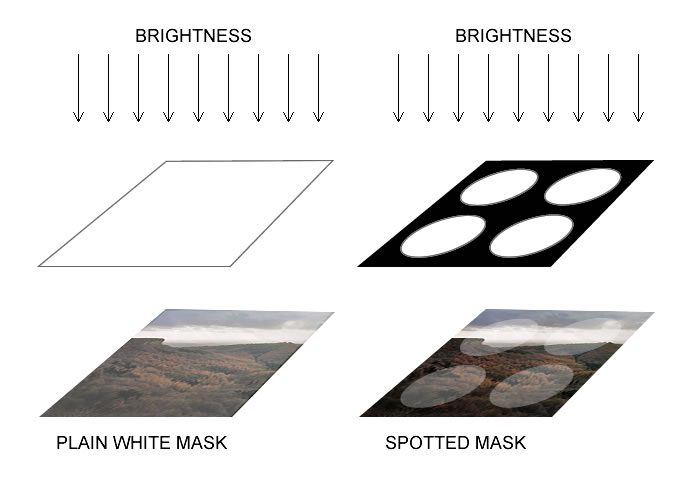
If you remember our introduction to masks, you will recollect that a mask is just a black and white layer where whites. The diagram below shows how the mask is just like a cardboard mask that is used in a real darkroom.
The difference between a real cardboard mask and a photoshop mask is that the photoshop mask can have shaded areas that limit the amount of the effect rather than just switching it on and off. In this way the mask is like a sheet of black and white film that limits the light (or effect) being passed through. The following diagram shows the idea
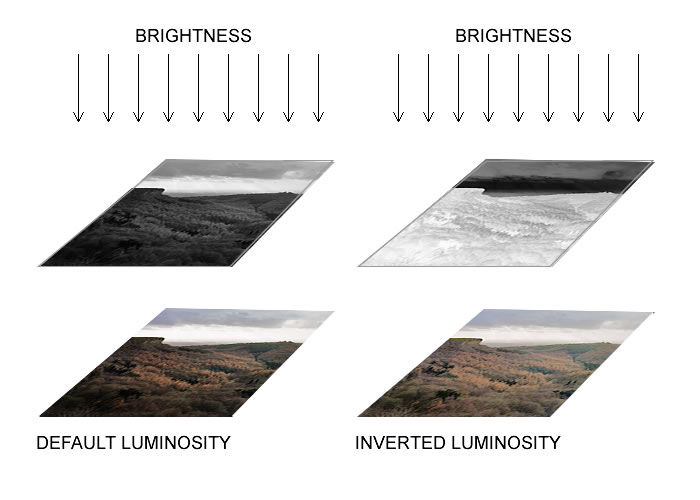
As you can see in the first picture, a default luminosity mask ends up applying the brightness (or whatever effect) to the bright areas and stops the effect for the dark areas. We can invert the mask to apply the brightness just to the darker areas. This just ends up reducing the contrast of the picture though, which is achievable without luminosity masks.
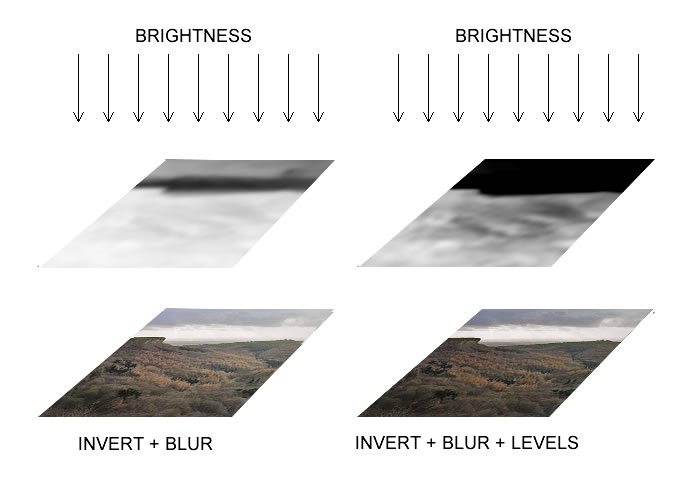
The real magic of these masks come when you realise you can edit the mask just as you can edit any other picture. This means you can blur them, darken them, lighten them, use levels to move much of the picture to black to limit the effect. Here is an example of blurring the mask.
We can see here that the blurred mask is now raising the brightness of the darker areas of the picture - however, it is also brightening the brighter parts of the picture too, reducing overall contrast. In the second example, we have used the levels tool to clip the blacks and to increase the contrast of the mask. This has now limited the brightness to just those dark areas of the image so it lifts the shadows in the same way that the shadow/highlight tool does.
The following video should give you more of an idea of how we are achieving this.
Last issue I talked about the first half of my epic photography 'vacation' where I finished a commission for the National Parks authority and a week giving a large format workshop. As soon as I got back it was off to Glencoe in the camper van with my ever loving (and occasionally despairing) wife.
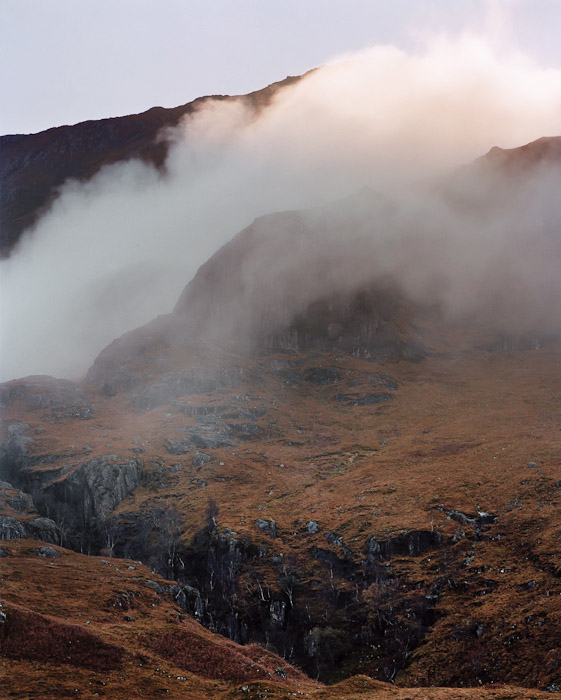
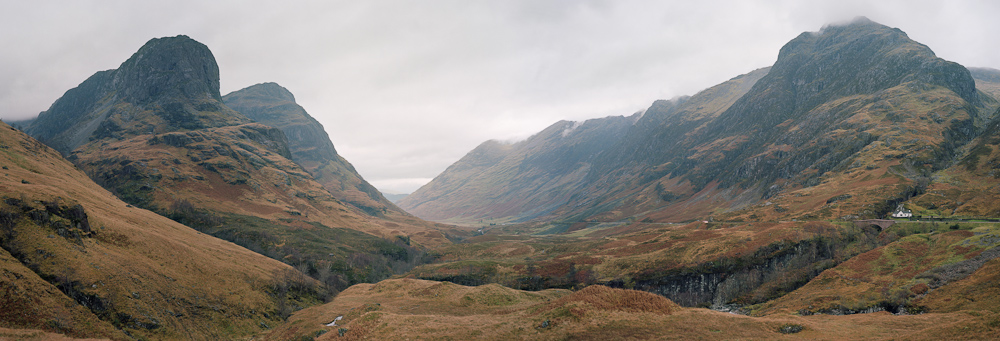
Now having visited Glencoe a few times and having done the ‘icons’ in the past, I was interested in looking for some different locations and/or different viewpoints in familiar locations. Our first goal was to take a walk up into the Lost Valley, a hanging valley that sits in between the three sisters. After parking up we saw some an incredible sight of mist overflowing from Rannoch Moor into the Glencoe Valley, after a short run up the valley and a fight with the cold air dropping down the slope - sadly, as is often the case, the view didn’t translate well into a photograph as seen.
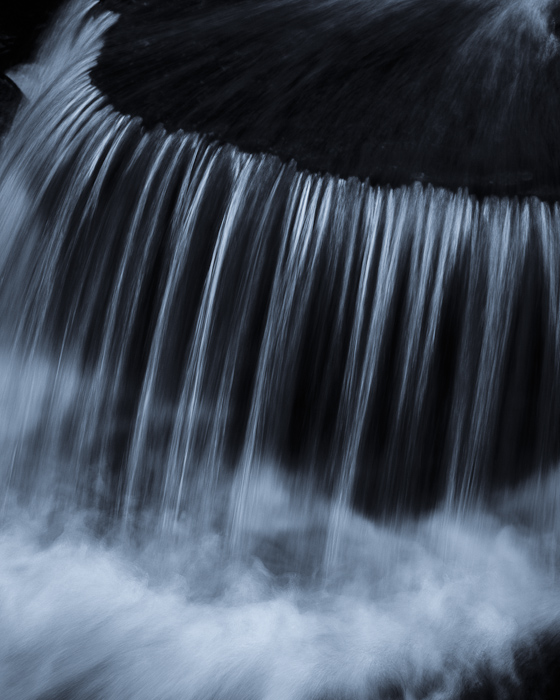
The walk into the valley is fairly easy, although there is a sneaky bit where you have to climb over a tree that has fallen across the path with a 50ft drop just to the left of you but it's not dangerous. Once you have reached the place where you cross the brook, you are basically there bar a 100 yard scramble. I took at small detail shot of a water drop in the brook reflected in the very cool light from the pure blue sky above. I reduced a lot of the colour saturation in this image.
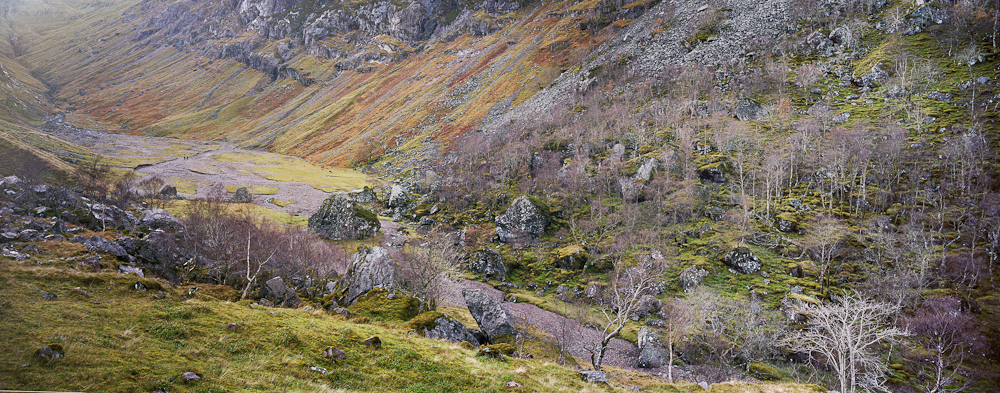
Once you get over the talus (a massive skree slope/rockfall that blocks the exit of the valley) you get to see an overall view of the valley. Even thought the subject wasn’t the most photogenic, it was still impressive and sometimes it’s good to get a record shot of a location for future reference, so I captured a side by side panorama using the shift feature of my camera (basically the equivalent of holding the lens in one position but moving the sensor from side to side to capture a wider image). I’ve added a zoomify image to show you the location below.
One of the downsides of walking in November is the short days so we didn’t have long to spend in the valley before it was time to return - we really should have started walking in before daybreak.
On the way back from the valley, we took a quick trip to the hospital Lochan below the Pap of Glencoe, catching the last light. I wanted to work around the reflections of the last sun on the Pap and walked around the edge of the Lochan. Fortunately I found an opportunity and turned it into a composition fairly quickly and I’m happy to say it turned out to be one of my favourites of the trip.
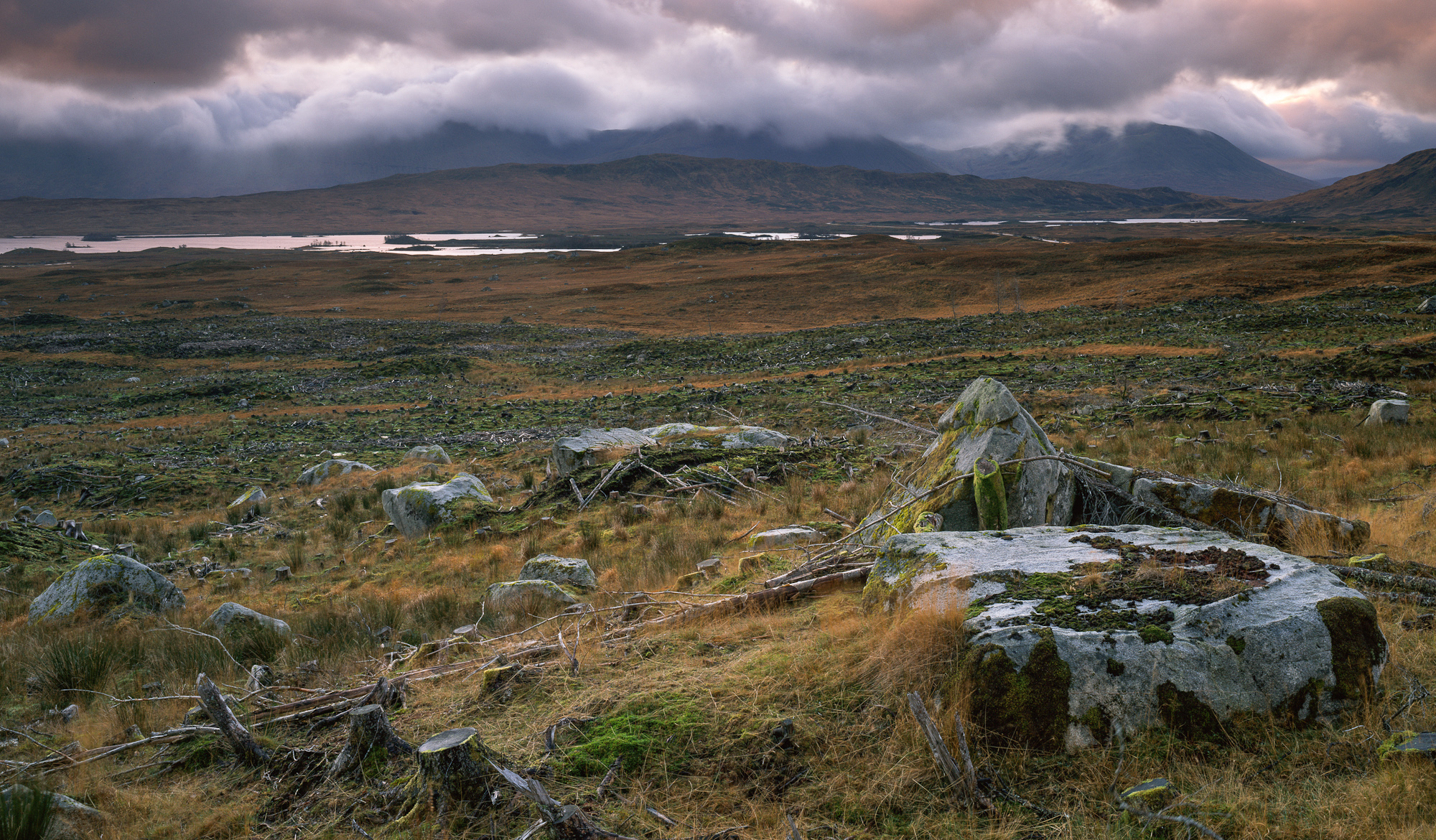
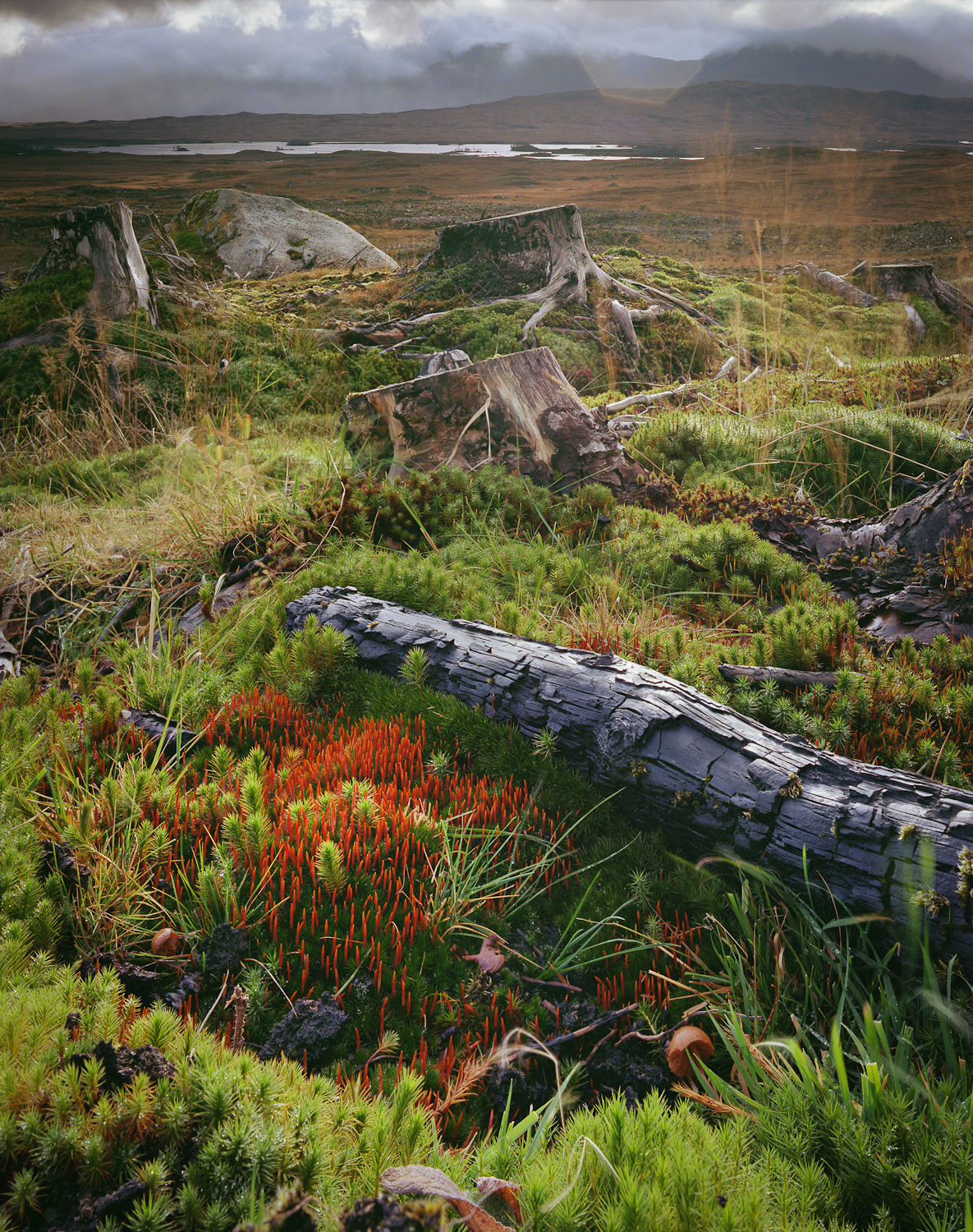
The following morning we drove over Rannoch Moor to take a look at the area of clear fell that I had been looking at for many years - originally I thought the area was a blight on such a beautiful, wild environment; then, later, I understood it's necessity to transform an area of commercial monoculture back into something that was complementary to the moor but that was still ugly; now I'm more sanguine - the area is what it is, the landscape is constant flux and any part is transitory and is interesting possibly for just this reason. Because of this change in viewpoint, I wanted to spend some time in the area just to see what was happening - how the transformation looked from close up. I was quite surprised to find that the area was brimming with new growth. Admittedly this new growth was small plants, mosses and the occasional sapling but it was incredibly luscious. I would be guessing but it seems that where the clear-fell has been burned, the ash has fertilised the soil and boosted growth.
I spent a while looking for a view that would allow me to include this effect and to put it in context. In order to do so, I had to work very close to the ground and using tilt to show a glimpse of the moor and Lochans in the background under a rolling morning cloud. Unfortunately, the location wasn't particularly inspiring to my other half and a retreat to the camper van for a well deserved cuppa and shelter from the wind was soon required.
Later that day we took a walk from our cabin up the Glencoe valley with the aim of exploring areas we had not seen before. Most of this wasn't photographically productive, either my eye wasn't "in" or the light wasn't inspiring me. We reached the end of the valley early and decided to walk down to the river opposite the late Jimmy Saville's house (which had flowers on the gate and scottish flag at half mast - a bit too much reverence in my eyes) and once we reached the river we realised it would be easy to cross and so we decided to have a wander around on the land opposite. After climbing around for a while, I reached a viewpoint where I could see down the valley and also overlook "The Study" and the road through the head of the valley. This view had a wonderful symmetry and showed the meeting of the waters to great effect. Even though the weather wasn't particularly complementary, the effect was worth an image and so I decided to try a first for me, a three shot rotational panorama on my large format camera. The result is shown below and is one I'm quite happy with. It shows the a pair of the Glencoe sisters (the pretty ones, of course) but it also shows the meeting of the waters in full symmetry.
While I was up there, I also took a quick shot in the other direction to show how the glaciers scraped away the head of the valley in all it’s geological glory (not particularly well colour balanced this one ..).
I’m hoping to return sometime to capture this view under more inclement weather and possibly more dramatic light :-)
We could have been a little disappointed with the fact that all of the trees in the Glencoe area were nearly leafless, despite having had some glorious colour in our previous week in the lakes (see the photograph below taken on the edge of Ullswater one morning). The Autumn was quite ‘varied’ to say the least.
Fortunately, our next trip was to meet up with Richard Childs who was to take us to an ‘alternative’ location that showed a little more chromatic vigour. So after a circuitous drive down to Barcaldine and then back up past Invercreran, we ended up not a few miles from where we started but on the other side of Meal Mòr. Incredibly, just the back of this valley had luscious Autumnal colour and full bodied heads of hair .. err.. leaves.. I can only presume that the cold air I had experienced sweeping down the Glencoe valley from Rannoch Moor had hastened the leaf loss.
Although it was only 2pm, the glancing light skimmed across the glacial moraines (lumps of rocky crap left over when glaciers melted... moraine sounds quite posh though so I’ll carry on using that) as shown below. The head of the valley definitely needed further investigation which I was to do later in the week.
I was joined by Mr Dav Thomas and his better half in the middle of our trip and we spent a day pottering about the foot of Robbers Falls at the end of Glen Etive, a wonderful, boggy location with some wonderul grasses and trees. Once particular tree was quite surprised to see myself and Dav with such big cameras.
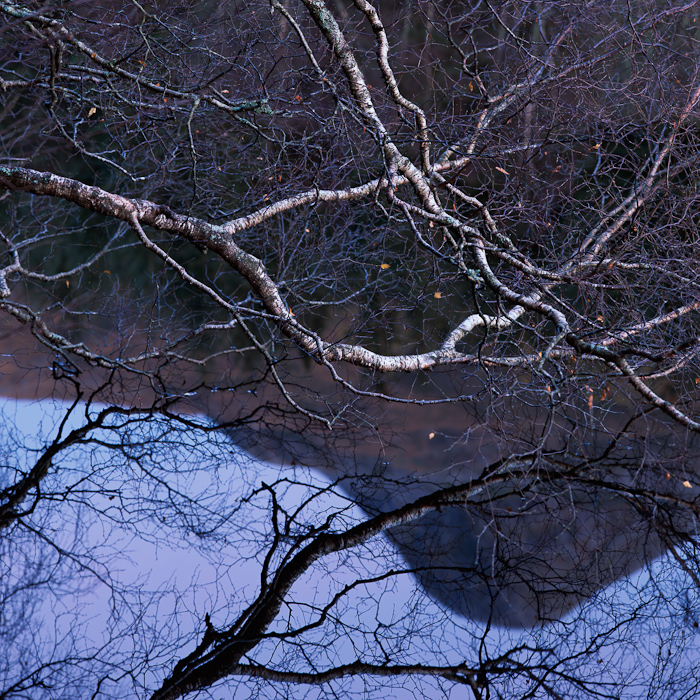
I don’t know whether I’d been influenced by the Friedlander book I had read recently but I’ve had an urge to shoot through trees and branches recently, hiding the background and ‘scenery’, tantalising a little perhaps. I took the idea a little further when we walked into a small fenced area (to allow saplings and bushes to grow without deer grazing them) and I shot through the fresh birch growth and abstracted the background even further. Quite pleased by the results.
Further toward Robber’s Falls itself, we could see massive landslips that have blocked the ‘scoop’, a feature that Richard Childs has introduced to various people producing beautiful photographs such as David Ward’s and Roger Longdin's. Here is a view looking up from the scoop itself.
Dav Thomas took a fine shot looking down in the opposite direction from here producing something almost looking like a vista, an uncommon occurrence I've been told.
by Dav Thomas
The next day both myself, Dav and Richard Childs returned to Glen Creran. Within the first few minutes of arriving, Richard had shown us an area of grassland scattered with birches and the first light was skimming into the valley and pin pointing areas of the hillside. Within the first ten minutes I had taken three photographs (unheard of for those of a large format persuasion - so I’ve been told).
All of these were taken with a long lens (at least long for large format, in 35mm terms it was about a 150mm). These moments when you arrive in a location and there seem to be an infinite amount of possibilities are few and far between but can be a combination of not just the location but your state of mind. Dav and Richard weren't having the same experience and so we moved on.
Dav had his moments of inspiration later on however, producing this trio of shots from within a hundred yards of each other.
by Dav Thomas
by Dav Thomas
by Dav Thomas
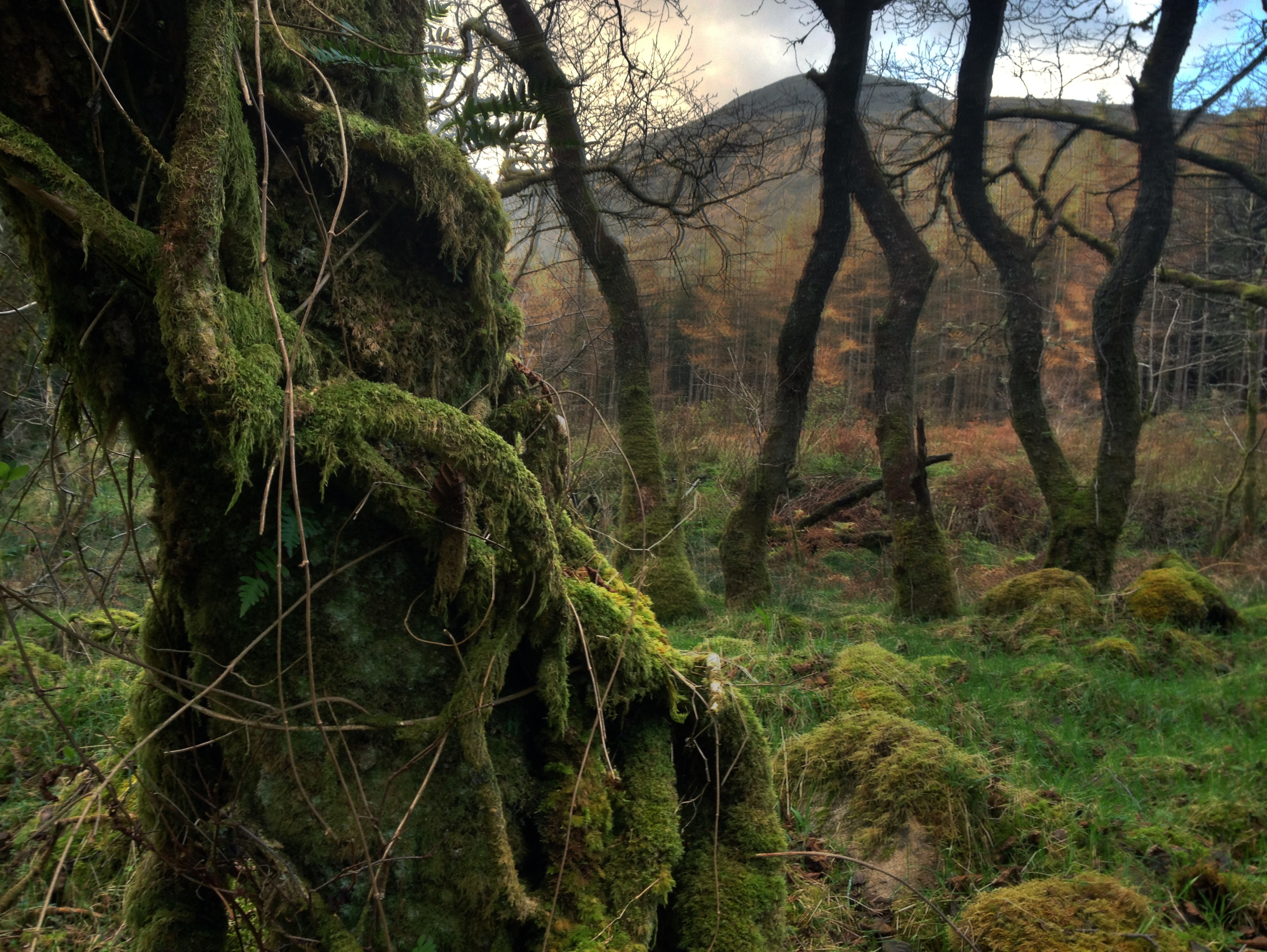
The end of Glen Creran was wonderful; a mix of old growth birch, fir, marsh, brooks, dams, etc. etc.. There was once particular picture that I was desperate to get but despite developing all of my sheet film it appeared to have disappeared. However, last week we found a random darkslide behind the collapsible bed in the camper van so I'm hoping that is the one. The picture below is an iphone shot of what I'm hoping it might look like. This was taken with the iPhone 4S and the ProHDR app, which is evidenced by the ghosting in the trees on the right where my ageing hands had problems keeping things steady.
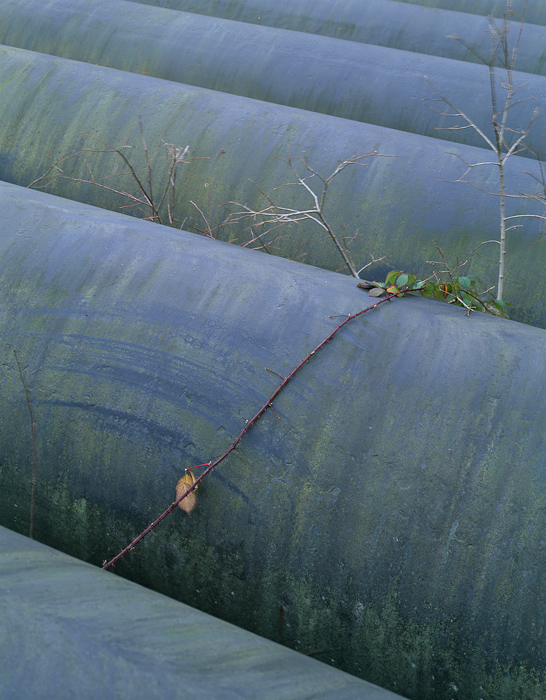
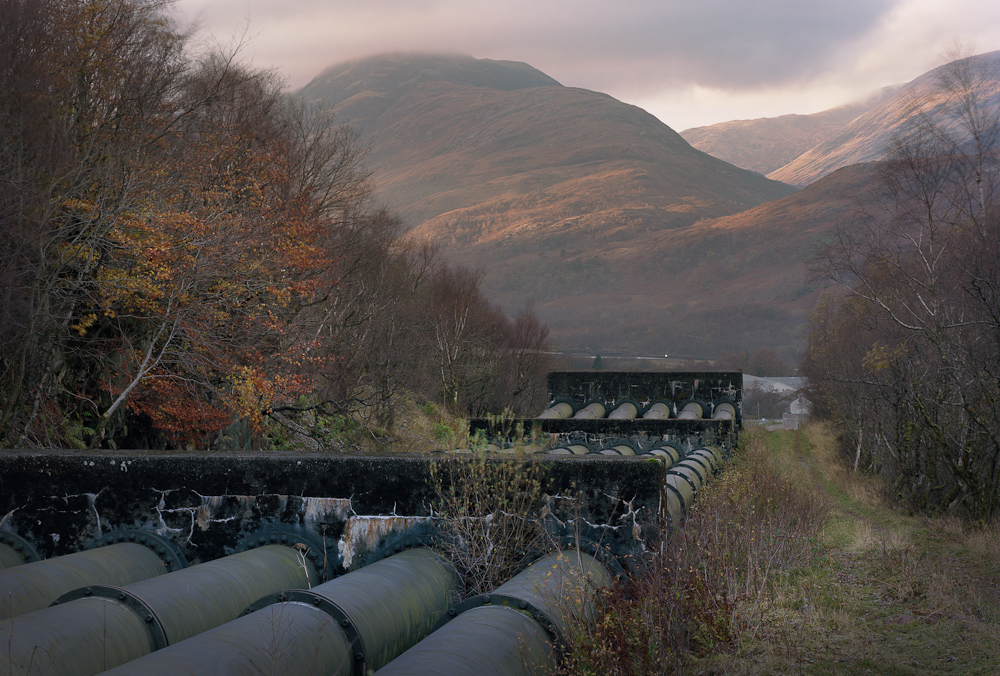
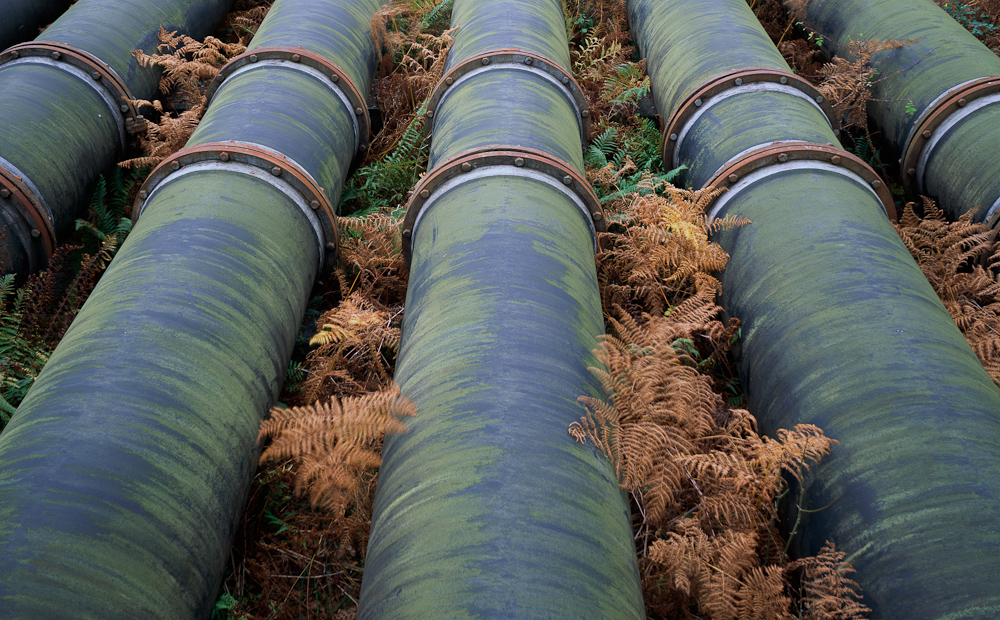
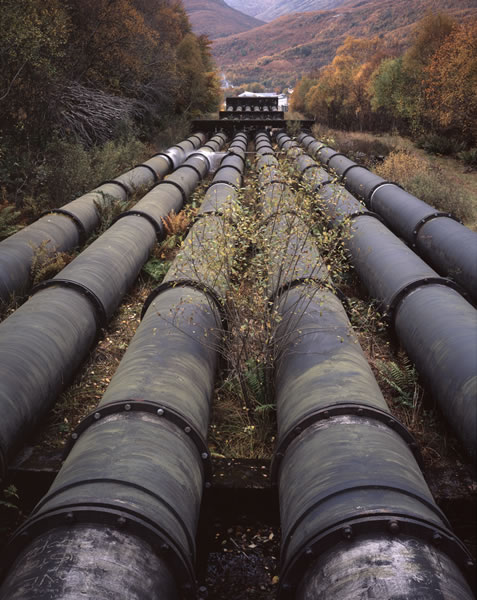
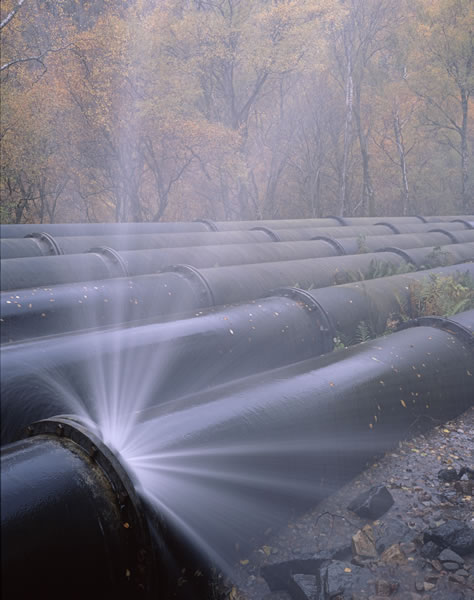
Our last walk of the holiday was to follow the feeder pipes flowing from the Blackwater reservoir behind Kinlochleven. A recommendation from Richard Childs was very well received and although we were supposed to walk up into the woods, I got attracted to the pipes themselves - starting to understand the attraction that Richard has for the location (see here and here) in the end I made three images, using the graphic shapes of the pipes and the way that the local flora had managed to get a foothold back again.
There is something slightly odd about making a living out of something you absolutely love to do. It sounds as if it should be idyllic of course; getting paid to travel the world and make photographs? How much better can it get? Yet somehow pro photographers often seen as grumpy, dissatisfied, cynical and frustrated (sometimes even more so) as everyone else. Regrettably I would have to include myself in that number. I now realise that satisfaction in life is 90% dependent on expectation. If pro photographers think their lives will be spent on glamorous shoots every day, they will be disappointed. And arguably an enthusiast photographer in a 9-5 job will get more satisfaction from their photography because when they are out with their camera it is always a highlight.
Jason Theaker was one of the first photographers I saw on flickr some time ago now and his regular photo uploads with their associated essays, discussing his thinking on photography, gathered him many followers. He lives and works within the Leeds/Bradford area and most of his photographs are created either around the Yorkshire area, quite often a short distance from home, or down in Cornwall where he spends regular family holidays and has lead a couple of workshops with various photographers. Take it away Jason..
In most photographers’ lives there are 'epiphanic’ moments where things become clear, or new directions are formed. What were your two main moments and how did they change your photography?
When my son was born 12 years ago, we bought a digital camera to record the memories. Up until that point I had used film, so the freedom of instant feedback coupled with next to no cost in the production, gave me the freedom to explore a greater range of subjects. It stimulated a kind of experimentation development cycle that enabled me to critically evaluate, ‘literally in the field’ and pushed me forward. I found the type of subjects I began to explore opened up and I was like a kid in a sweet shop, eyes wide open with possibilities!
At about the same time and whilst our kids were still very little (and would tolerate being in backpacks), we use to head out to the Yorkshire Dales for long country walks. Yes we had the obligatory memory shots of us all in front of waterfalls, vistas and humorous shots of the children, but I found my camera lens irresistibly drawn towards streams, walls, forests, mosses, fungi, than to shots of the family. This wasn’t unusual behaviour, (well….) because as an art student many years earlier I use to spend hours in nature with my old Pentax ME Super and then print them up in our makeshift attic darkroom at home.
This antisocial behaviour coincided with my first encounter with the internet, more specifically blogging, which truly stimulated my desire to progress and gave me a purpose to explore, experiment and develop. I had found a new audience, one that offered immediate feedback and I found the social elements it offered motivating. I could now not only speak to kindred sprits, but learn from them, be inspired, and find justification for spoiling my wife’s walks!
Tell me about why you love landscape photography? A little background on what your first passions were, what you studied and what job you ended up doing
I love landscape photography because it combines everything I feel so passionate about. I could go on and write an entire article about just this question, but if I try and summarise; the profound love of nature is up there at the top. I feel totally at one with myself when I’m immersed in nature, time drifts and there is no other place I would wish to be, it's truly a meditative experience. I cite my childhood as the catalyst to this feeling. I use to spend many happy hours in forests, swimming in rivers, damming streams, making dens and adventuring. The freedom I was lucky enough to have as a child and the subsequent desire to escape into it remains with me still.
The other side to this question comes from my desire to be creative. Again an essay in itself, but I have this profound need to engage with what I see and find ways to create. I’m sure it’s an evolutionary trait, but for me it was, (and is) profound. I use to make my own cameras from bits of broken ones that the college was throwing out and I even made my own pinhole movie camera out of 12 toilet roll cardboard tubes and made a time-lapse from them in Otley town centre! College for me was a passionate and truly inspirational time and I embraced everything that I was exposed to with open arms. I was lucky that the people I met helped fuel this excitement and my interest widened to encapsulate set construction, characters, lighting, drawing, painting, music and editing. Animation brought everything I was interested in together and the sky was the limit to what my imagination could dream up.
After graduating with an animation degree I pursued a career in stop motion and worked on projects such as Mars Attacks, Chicken Run, and dare I say it Bob the Builder…I was following my eagerness to create, but my photography fell slightly by the wayside in this period. I was fuelling my creativity with other things…
I went even further away from photography when I decided to move into computer graphics and took a job in a games company as a modeller and animator. I loved the work, but I was now in an office for 9 hours a day. Then as I’ve already mentioned it was revitalised again when I had children…
After a few years working as a computer artist we decided to move back to Yorkshire. I took this opportunity to change direction again and decided to give teaching a go. I loved the crit sessions I had with colleges in the CG studio and had always wanted to spend more time with people discussing interesting ideas. I’d also found my time studying inspirational and wanted to see if I could facilitate this in others. After a decade working in education I would like to think that I have helped in part to catalyse that motivation in others, that I found so very beneficial.
You work around film animation in its various forms, do the skills you have learnt transfer into your photography at all?
In a word yes. Animation as a moving image uses all the same principles of stills photography, after all animation is 25 still images a second. When I first got into animation, I used a 16mm film camera (Bolex) and began by experimenting with pixilation, (natural light animation). I can remember taking it up into the Dales and making time lapses of natural vistas. It was an extension of the stills photography I was already doing at the time. I remember loving how I could see different versions of reality by introducing photographic experimentation. It was kind of like a new toy that gave me new ways to visualise nature.
Moving this question to today, much of my work is inside the computer. But those key skills of composition, subject choices, movement, appeal, colour (I could go on), are still very relevant. Then there are the technical elements which are replicated in full with CG virtual cameras, (sharpness, noise, f stop, and shutter speed and lens choices) which make them both very relevant to each other and you don’t even have to worry about a massive backpack!
What animated films would you recommend our readership would enjoy or learn from?
Early on I loved the visual splendour of directors such as Peter Greenaway, David Anderson and the Brothers Quay, but now I just love the work of studios such as Pixar / DreamWorks, for their story and characterisation, Studio Ghibli for its amazing stories of innocence, tree sprits, and superbly crafted characters. I also feel inspired by the power of programs such as Maya After Effects and Photoshop to generate whatever your imagination can dream up. I see these software advances a mere tools that enable you to explore the recesses of your imagination. Not unlike a camera, it’s a tool that enables you to work with it to produce something of value.
Your role is also an educator and you lead your own photographic workshops - do you find you learn as much as you teach in both your business and hobby?
I love to see people develop. It’s the fundamental reason I’m in education, as both a lecturer in animation and as you point out delivering landscape photographic workshops. I feel honoured to be part of the development process in others. To be able to catalyse inspiration and passion in others, is a symbiotic experience that energises rewards, and it’s truly a privilege to be a part of.
There is a significant difference between my two roles as a lecturer at Bradford University and the workshops I take out. The first is bound up with academic objectives, grading criteria, lectures, and an entirely different learning philosophy directed towards research and industry. The second not only has an entirely different type of person, but is centred around their individual objectives. I borrowed a coaching tool from my wife who is a life coach and counsellor and ask participants to not only set objectives for the day, but to categorise how committed they are to those objectives. Let me stress, this is optional, as I respect that not everybody wants to go to this level of enquiry, but I find that many do.
The groups that I take out are small and tend to be people who share a deep passion for landscape photography, so as you can imagine the conversations are fascinating and socially rewarding to be part of and to answer your question, I do feel very energised at the end of each workshop, as I’m sure do the participants because thankfully they keep returning.
Could you tell us a little about the cameras and lenses you typically take on a trip and how they affect your photography
I use a Canon 5D2 and the standard 3 L lenses. I tend to favour my mid-range lens, (Canon 24 - 105mm) just because it covers a nice focal range. I also have a Canon 17-40 and 70 - 200 which come out of the bag when I need them, or more accurately when the subject requires.
Sometimes I do limit myself to one lens and I find that when I do this, (mainly with the telephoto), I have interesting creative experiences. It’s almost that if you put hurdles in your way, you find ways to work around them, or see things differently…I have also used a tilt shift (TS-E45mm f/2.8) and macro extension tubes recently. Again this limitation of the prime tilt shift and the macro forces a different reality and you see an entire new way…
As you have probably worked out by now, I tend not to place the technical before the creative, but having borrowed the TS-E45mm f/2.8 from work recently, I was astounded by the quality of colour rendition and crispness of the optics, you certainly do get what you pay for when it comes to glass!
What sort of post processing do you undertake on your pictures? Give me an idea of your workflow...
I tend to use adobe camera raw to get most of my post processing done. The general curves, levels, white balancing, colour correction, noise removal, dust removal and sharpening. I then take it into Photoshop to blend a couple of versions of the same raw file. I occasionally use bracketed shots when the dynamic range is big, but often spend a long time making sure the blend is as seamless as I can make it, without looking unnatural. The key here is not to let the technology take over and attempt to keep objective. Contrary to many other photographers, I love this process. I often feel like I’m on location again and I see much more detail than when I first made the photograph.
Do you have any particularly techniques you could share with us in your photographic post processing?
I think I’m pretty normal when it comes to post processing. I suppose I’m an advocate of blending exposures over using graduated filters, mainly because I feel you have more control. But I respect that many photographers don’t enjoy the post processing stages and want to reduce the time in front of the computer. Maybe my time as a CG artist has lasting influence towards my enjoyment of this part of the process.
Tell me about the photographers that inspire you most. What books stimulated your interest in photography and who drove you forward, directly or indirectly, as you developed?
I couldn’t really pick out particular photographers as being a big influence, I tend to try and synthesise different influences in preference to trying to replicate a particular style, but I respect and enjoy the work of many. Obviously Joe Cornish springs to mind for his use of colour and majestic compositions; also David Ward’s work and philosophy. His books and blog connect with my wish to think more about image making and encourage me to continue to question. Then people like Liam Frankland, Adam Cluterbuck for their utter mastery of composition and the use of colour and subject that Tony Spencer and Sandra Bartocha illuminate. I also enjoy the work of Federico Bebber, but for very different reasons. I have always loved the work of Francis Bacon and Federico visualises this type of work photographically, I would love to have a go, (when I can manage to make some time to do so).
Tell me what your favourite two or three photographs are and a little bit about them.
Choosing my favourite images is very difficult, mainly because it changes dependent on the mood I’m in, that said, I keep coming back to some images and have chosen to hang these three in my house, so I must like them…
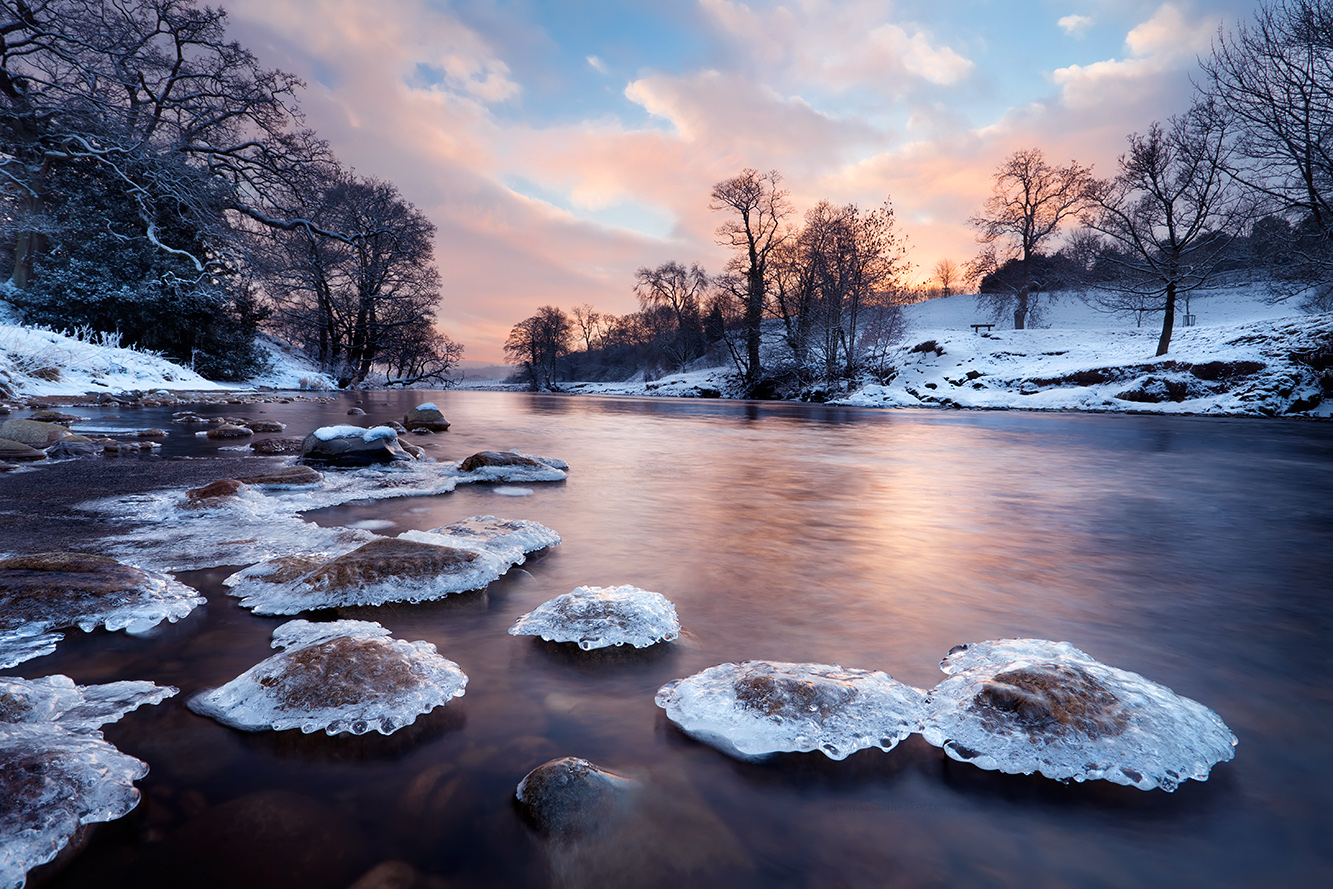
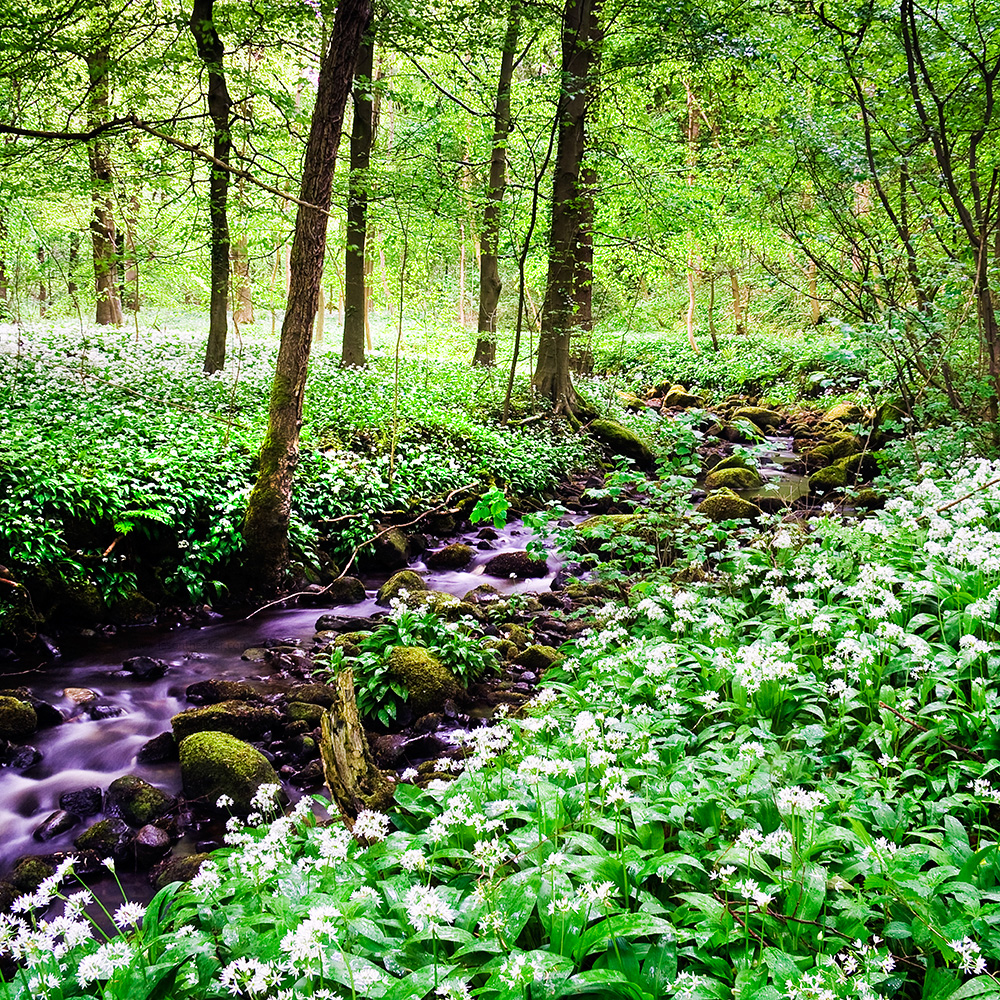
This image has very fond memories for me. Ironically it was pouring down with rain, which coupled with a long exposure has given the distance a kind of misty dreamy feel. I love the colour and mood. For me it has positive natural overtones and feels fresh bright and optimistic. It’s the very kind of place I would love to spend a few hours exploring, wandering up the stream seeking out compositions and escaping into the moment. The composition for me has depth and draws me into it. I feel a need to see what is up the stream, what is around the corner, it makes me want to be there every time I look at it.
In addition the story around it never fails to make me chuckle. The image was made one Sunday whilst I was giving my wife a break from our young energy packed overcharged kids. Whilst she peacefully had tea and cakes in the pavilion tearooms at Bolton Abbey, I spent a couple of hours trying to stop my kids from arguing! To put you in the picture, I was leaning over a rusty barbwire fence in horrendous rain, with one eye on the composition and one on the kids, who were now deep in argument on a little bridge about 10 metres to the left of this shot. Yes I know it sounds challenging and you’re probably wondering why I have fond memories of it. Well the scene is so tranquil and I know it wasn’t! Yes it probably says something strange about my dysfunctional psychological state, but the popular idea that landscape photography is a peaceful transcendental pastime, isn’t one that I’m that familiar with, well not here anyway and definitely not with my kids in tow!
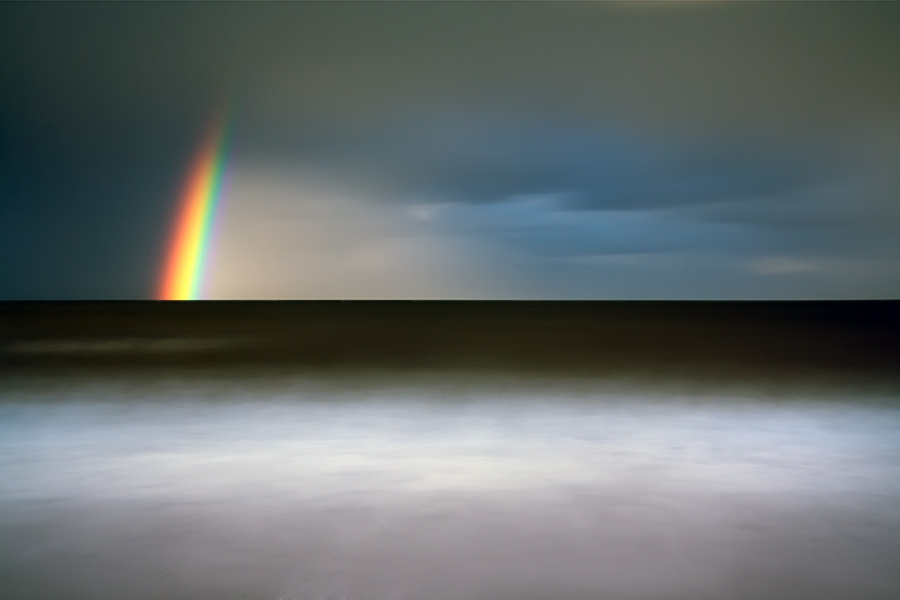
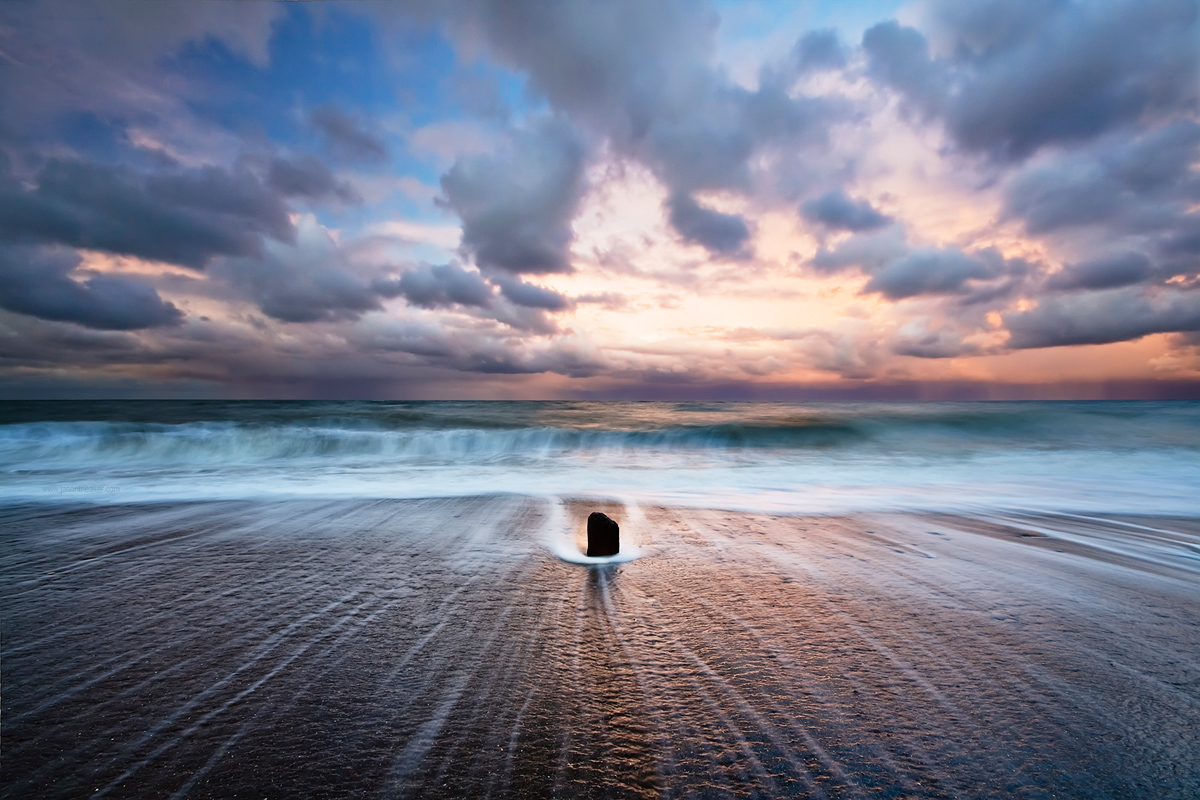
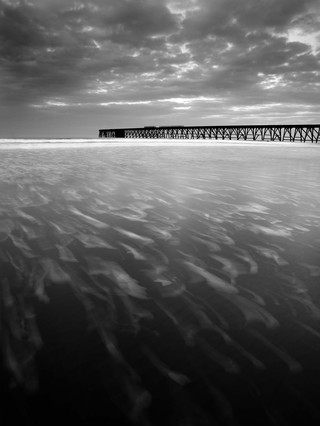
This image was made on one of my favourite beaches in Yorkshire. Its midway between Sands End and Whitby. One winter’s evening I had the pleasure of wandering along this stretch of coastline when the evening light began to materialise on the storm clouds in the distance.
For me this shot has depth, I just love foreboding clouds, especially storm clouds packed full of energy. I’ve always loved the power of storms and never tire of being out in them. But the peaceful natural evening light, coupled with the soft subtle leading lines of the receding surf, juxtaposed against the energy, in both the storm and turbulent sea, for me at least work well together. Then there is this groin that forms an anchor point in the composition. I like to think of it being simply there in conceptual defiance, holding on, defending, working to hold back the forces of nature, but naively failing. Again for me it highlights the arrogant human futility of working against nature and the desperate need to work with, embrace and put our trust in it.
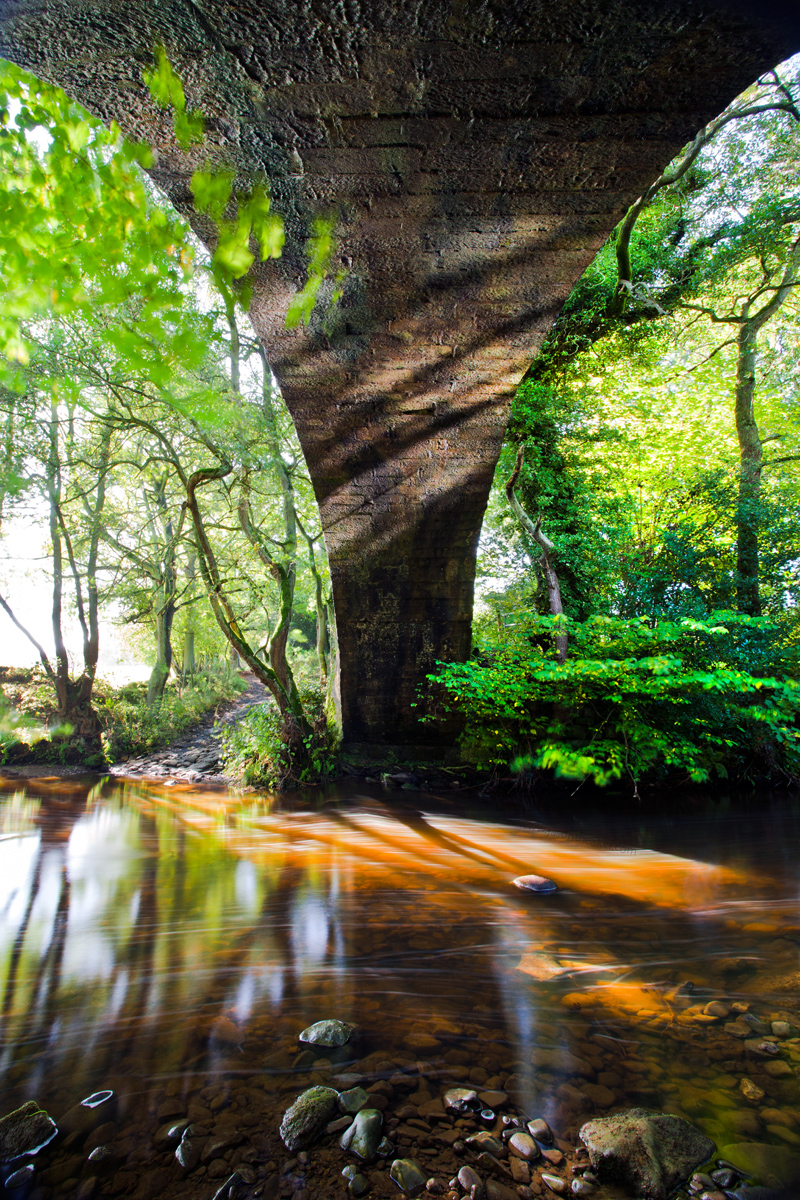
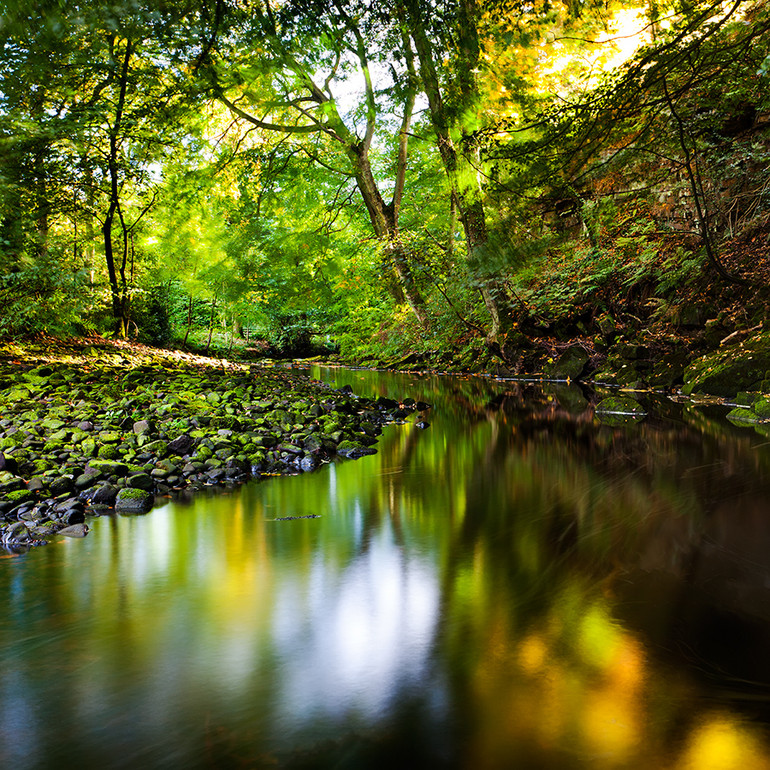
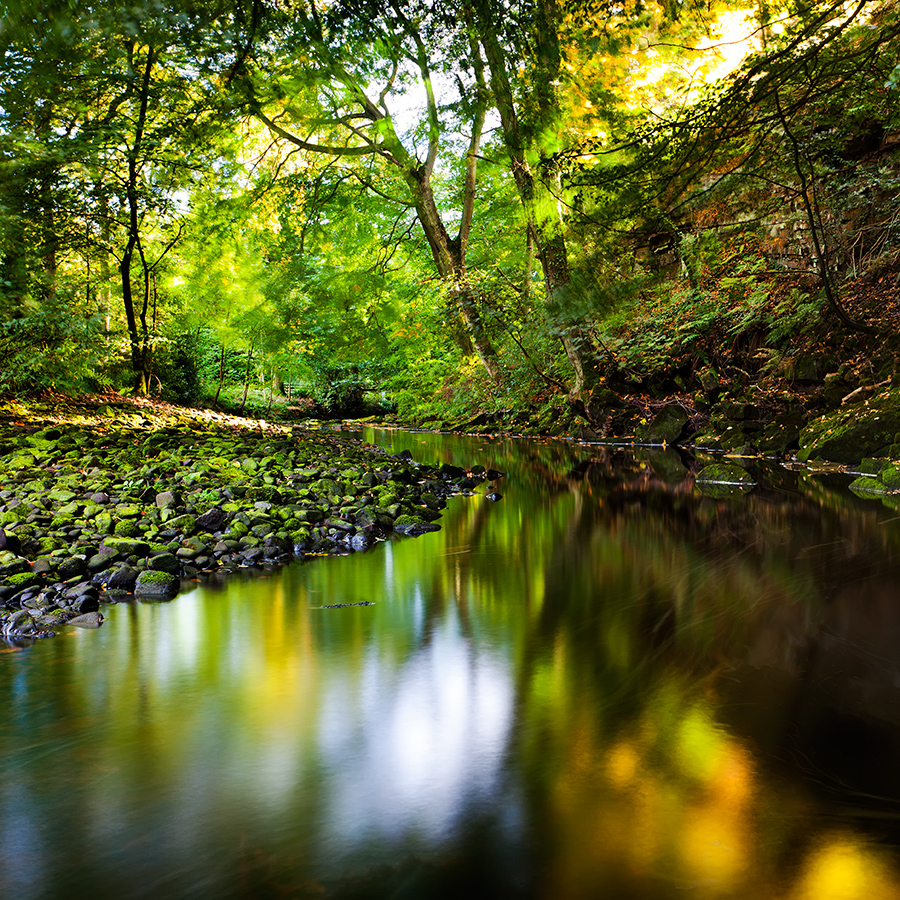
Finally a recent image that I made relatively close to home. This is the stream that meanders between Thruscross and Fewston reservoirs not far from Otley. For me the location has an enclosed protected feel, almost sheltered and encapsulating. The colour of the of late summer and the impending change of seasons are evident and the dappled reflections help to simplify the relatively chaotic woodland vista.
The image is working for me on different levels. Compositionally I like the contrast and texture difference between the soft mirror-like long exposure on the stream, the distorted mixed up reflections that the moving water has created and against the chaotic tangled environment. The stream naturally draws you in and is a convenient leading line into the image, but again it’s the kind of place I could spend hours slipping about in. I think I’m naturally inquisitive, (ok ok…nosey) and often find myself wanting to see what is around the next corner and this type of image stimulates the desire to seek out.
The image also helps me feel calm. I’m sure the subject is a large part in this and the colours complement each other pleasingly.
If you were told you couldn’t do anything art/photography related for a week, what would you end up doing (i.e. Do you have a hobby other than photography..)
Well if I were at home I would either, put some time in on the drums, (I have played for years, but recently signed up to some lessons to learn how to read music), or head out for lots of ‘long’ walks. If I could head further afield, I would be hill walking or body boarding…
What sorts of things do you think might challenge you in the future or do you have any photographs or styles that you want to investigate? Where do you see your photography going in terms of subject and style?
I have a couple of open-ended projects that as yet haven’t yet materialised into what I would like them to be. The first is centred around a patch of woodland that I use to play in as a child. I’m attempting to visualise this area with no concrete objective, other than to use my adventurous childhood memories as a starting point to connect the past with the present. I have many happy memories of the area, (making dens, climbing rocks / trees, camping, even finding some Victorian coins with a metal detector) and I want to in some way translate them into a study of the location with a sense of sentimental awe.
The second project is exploring how light reflects and refracts through moving water. Now this theme traverses many of my water subjects, but this project is specifically based on rivers and streams, mainly because of the dappled diffuse light and varying degrees of colour offered up by changing conditions. I’m fascinated by how complex this can be and find stimulation in the murky depths and unusual forms that can be uncovered. It is not my wish to attempt to represent any given location, but to simplify and abstract. Oh yes, I’m also irresistibly drawn to the subject and find hours pass by whilst meandering their water courses.
Who do you think we should feature as our next photographer?
Adam Clutterbuck. You might be surprised with that choice because Adam is fundamentally a black and white photographer, but I find his compositions magical! For me at least there are always elements of subtle tension in his work and I would love to know what he thinks about his work…
Thanks to Jason for spending the time answering our questions - I'm sure he'd be happy to field any more from readers if the have any as well. More of Jason's photographs can be seen below or at jasontheaker.com or at Flickr.
It was in October 2006 that I first set out to North Sands to take my first ‘proper’ landscape photographs. Armed with a tripod, some Cokin filters, and, oh yeah, a camera, I drove in the darkness along Cemetery Road, past skeletal remains of disused factory buildings and parked at the gates of the Victorian cemetery. Walking past gravestones is perhaps not the most inviting of ways to begin an adventure into landscape photography, but that’s how it started for me.
Once I skidded down the dunes and onto the beach at North Sands I was in another world. I set up my new tripod, fumbled around with numb fingers, trying to remember to set plenty of depth of field, and I let the camera set the shutter speed.
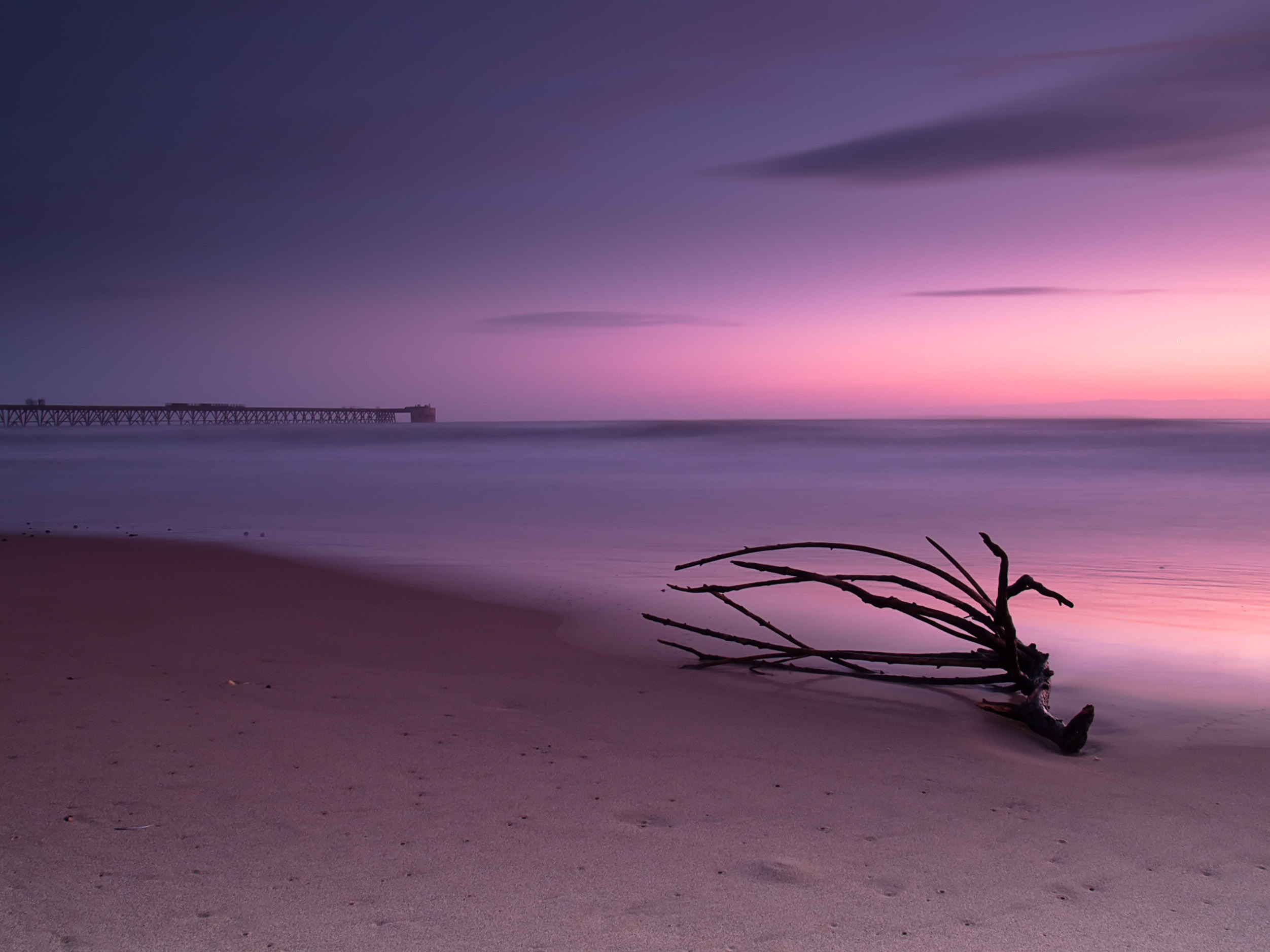
Branch and Jetty was the result of this debut outing. How lucky I was for that branch to be washed up there in such a perfect position. And the light! It would be a while before I made an image that satisfied me as much, but I was hooked. I was amazed that I could take images like this here at home in Hartlepool. It was a revelation. This light was everywhere, and anywhere is transformed in such light. I only had to travel a couple of miles to practice landscape photography, to study the light and to find new subjects on this small stretch of beach near my home. It was a place where I could experiment, learn and develop. Seeing as I had recently started a family, getting away on indulgent photographic trips leaving my wife, then girlfriend, holding the baby, were out of the question, so North Sands was my basic training ground.
This beach is no idyllic golden stretch of Northumberland sand though. A vast dilapidated coastal factory sits behind the dunes here. It’s a bloody mess, and its detritus finds its way onto the sand. Stuff gets washed up from ships. Sanitary waste appears when there’s a high tide and when there has been heavy rain. Fine particles of sea coal get deposited leaving a 1cm thick blanket of blackness across the beach. It’s this kind of thing that suggests why this coastline gets bypassed by photographers on their way north to Northumberland or south to the North Yorkshire coast.
I’ve enjoyed the challenge of dealing with the above, and I’ve no doubt it has contributed to my development as a photographer. Finding the frame can be a challenge here, but as time went on I found I could not turn my back on the ugly and unpleasant. I have ended up recording it as well as the beautiful scenes and have discovered a strange beauty in items washed ashore, or dumped on the sand.
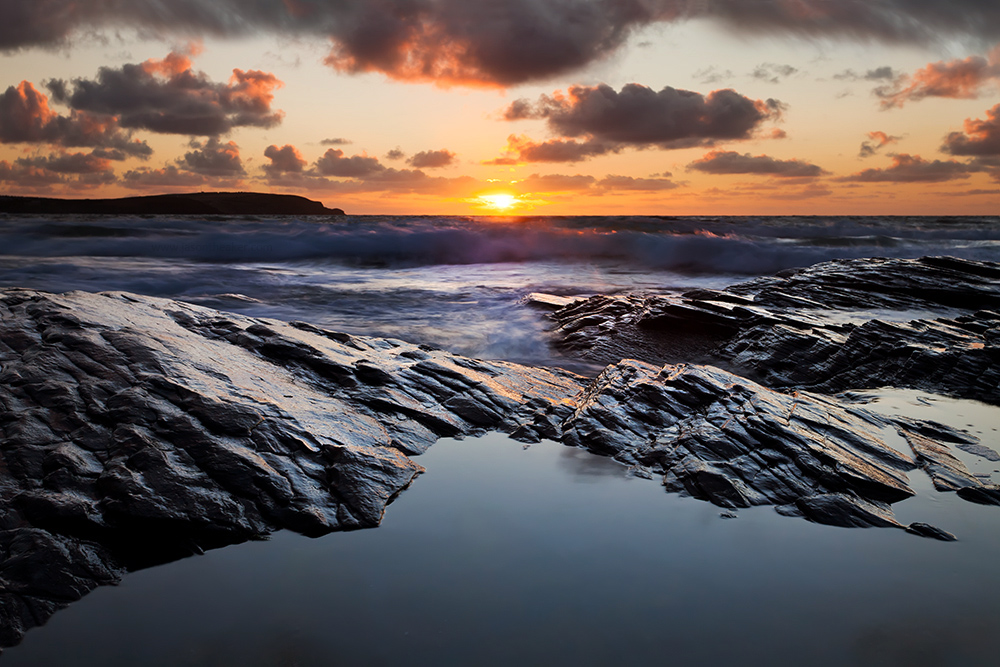
So why go to the same location time and time again? Well, convenience certainly plays a role. If I’m pushed for time, I can be here in minutes. Joe Cornish has Roseberry Topping and I get a slightly soiled beach! Also, no two days are ever the same; the light is always different, the tide changes and the state of the sea changes. The prevailing weather conditions change everything again. Also, you never know when something interesting is going to get washed up. There is always something new to learn, practice or discover. I’ve grown to love this place, warts and all.
This month we're featuring a photographer that previously offered some work as an image critique which we featured in issue 12. Chris Goddard is a ranger who works in South Wales but travels the country capturing some stunning imagery along the way.
In most photographers lives there are 'epiphanic’ moments where things become clear, or new directions are formed. What were your two main moments and how did they change your photography?
Where do I start? it seems like in the last four years of taking images there has been one epiphany after another (many small ones in succession you could say). I guess one of the main ones for me once I got over the usual technical problems like focusing, exposure and depth of field was an appreciation for the quality of light, that essential photographic ingredient. Epiphanies regarding light have also been many and since I had no formal training as a photographer I had to learn through trial and error, reading and looking. It seems strange now but for some time after I started taking images, I failed to see why certain images made with complimentary light really worked (composition aside). Of course, once I caught wind of this I started experimenting and using similar conditions for my own images. I started seeking shade and overcast conditions for close up studies and more direct, stronger forms of lighting for wider views. I generally avoid clear, sunny days and prefer to use this time looking for subject matter that will work in more favourable conditions. Having said this I like to remain open minded and I fully understand that it is important to be flexible at all times when out with a camera with the intention of making meaningful images. Other significant moments of clarity have happened whilst developing my skills later, at the computer with software like Adobe's Photoshop. For a long time I didn't want to go anywhere near Photoshop, as soon as I saw the program load I was baffled by all the menus and icons so, I used my camera's proprietry software for as long as I could. However, I needed more control and I decided to take the plunge and learn how to use Photoshop. Although I still have a long way to go I no longer find myself having a panic attack when I click to open it. I can use a layer or two to balance the light in an image or make a localised adjustment to the colour, affect the brightness and darkness and generally have a reasonable level of understanding of what the right tools are for most common problems. These skills are important to me, they influence my decisions about what is possible whilst in the field with my camera and help me to produce an image that is close to how I felt at the time of making it (a process that gets better with time).
Tell me about why you love landscape photography? A little background on what your first passions were, what you studied and what job you ended up doing.
I grew up on a farm in south east Wales, I studied Environmental Science at university and did lots of voluntary work for the Wildlife Trust after university. My reasons for picking up a camera in the first place was so I could record and identify all the plants, insects and fungi I came across whilst out in the countryside. I became a little obsessed with insects and flowers so I bought a macro lens and lots of i.d. books and charts. Spending time outdoors is something I have always loved doing and the realisation soon came that I can use much of this time to photograph the landscape itself, not just the wildlife within it. With lots of help, encouragement and inspiration from a good friend in Oxfordshire, I started travelling the country, visiting remote areas of natural beauty and discovering wilderness Britain (if there is such a thing left in this country?). I have been a ranger for the last three years for my local council and my working hours are such that every five weeks I get four days off in succession so, I usually dedicate this to photography.
Could you tell us a little about the cameras and lenses you typically take on a trip and how they affect your photography
I've been using a Nikon D700 for just over 2 years and before that I used a D200. I almost always carry three lenses, a Nikkor 17-35, a Sigma 24-70 and a Sigma 100-300. I also have a custom made panoramic head set up which uses Archa Swiss style rails and clamps which I use for all my stitching. The panoramic head has had the biggest influence on the way I work. With this I realised that I no longer need to make a single frame and crop it, it became possible for me to make any sized image by stitching them together. I found this process beneficial in a couple of ways. 1 - It takes a while to set up so it slows me down making me more considerate when it comes to composition and 2 - the files are larger so I have a few more pixels when it comes to printing. I'm really looking forward to the prospect of using the same methods with the next generation of dSLR's. I know I will be able to create images closer in size to that of larger formats (something until relatively recently was just a dream).
What sort of post processing do you undertake on your pictures? Give me an idea of your workflow..
As mentioned above I now do most, if not all of my editing with Photoshop. I often flick through my images for review using Bridge and select images that I like and are without flaws for editing (deleting ones that are flawed). Before any serious time is spent on an image I usually do a quick edit using Adobe Camera Raw (ACR), being quit aggressive with the sliders to get a feel for what is possible and with the knowledge that all these settings will be cancelled. If I feel there is something worth pursuing I will reset ACR back to its default so the image at this stage looks very flat. The only things I like to get right at this point are the white balance and exposure, the rest of the sliders I usually leave as they are. If I have a focus stack I will be sure to apply the exact same settings to all files in the set and the same goes for a pano stitch. I then open the file in Photoshop, with some idea what I want achieve with the image (from my quick edit mentioned earlier). I use tools like levels, curves, layers and masks to accomplish this. I also make use of selections for images that need to be blended if it was not possible to capture all the necessary information using a single file (i.e. one exposure for the highlight information and another for the shadows). For focus stacking I use auto-align and auto-blend in Photoshop and for panoramics I use PTGui.
Tell me about the photographers that inspire you most. What books stimulated your interest in photography and who drove you forward, directly or indirectly, as you developed?
There are lots of photographers that inspire me on many levels and for many different reasons - Bruce Barnbaum for his skill and knowledge and who has produced the most striking images of America's southwest that I know of, Eliot Porter for his passion for nature and his simple studies of flowers and trees to his wider, almost abstract views of some of the most beautiful places on earth. Joe Cornish with his flawless use of colour and composition and David Ward who's abstract work never ceases to amaze me. I should also say many in my friends and contact list on the website Flickr have been a constant source of inspiration. I've found they are always willing to help with honest feedback and advice, such a great community.
Tell me what your favourite two or three photographs are and a little bit about them.
I find my feelings often change about an image over time. If I put a lot of effort into an image I might find, initially that i'm quite excited by it however, given enough time to allow it to sink in I find it can sometimes lose its appeal. Other images can be very quiet and it may take a while for those subtleties to sink in, these on the other hand often have lasting appeal and become favourites, this is an example of one such image.
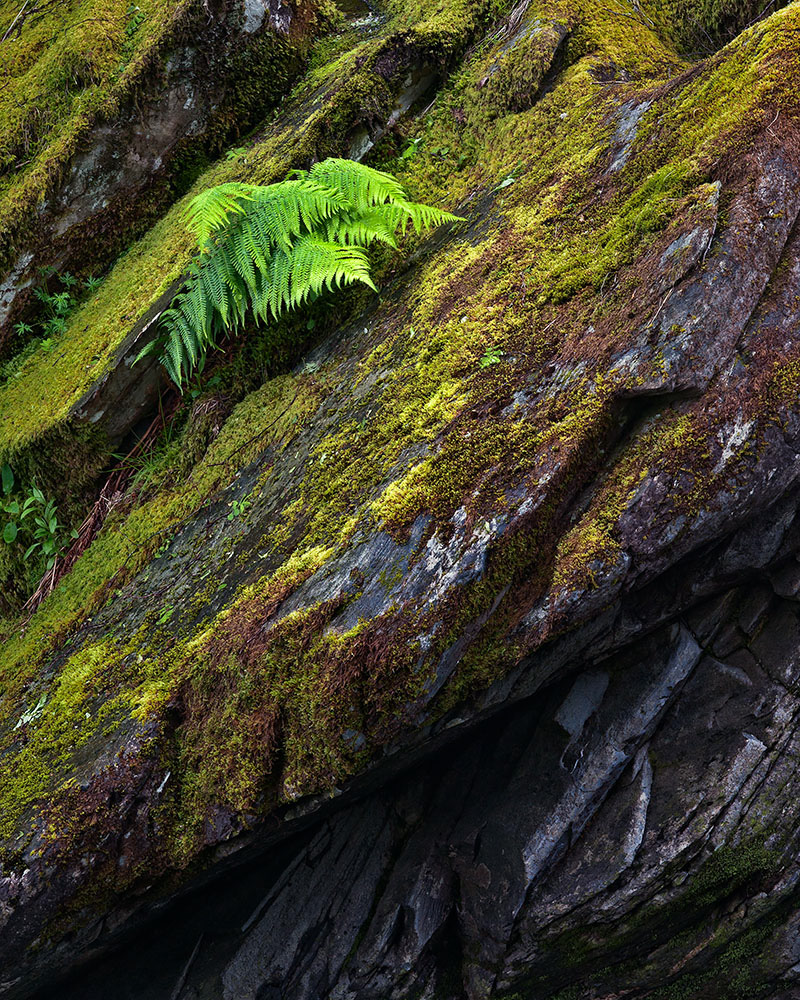
GLEN ORCHY FERN
This image for me is a favourite and made in one of those fortuitous moments after sometime of wondering and not being able to find an image worth taking. This ended up being the one image that I feel most summed up my experience in the wonderful Glen Orchy in Scotland, and it's just some moss, rock and a solitary fern.
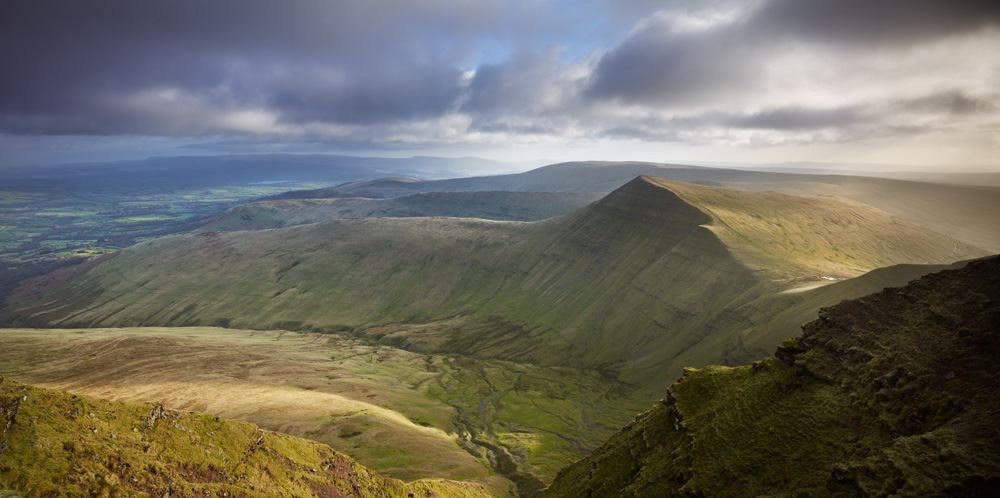
PEN Y FAN
This is an example of an image I made after some serious planning and many failed attempts. Ideas started coming together with repeat visits to the area, building a familiarity with the local landscape and how the light played across it and then, about two years after my first visit the conditions and light finally came together and I made this pano, one of my favourite images of Pen Y Fan.
If you were told you couldn’t do anything art/photography related for a week, what would you end up doing (i.e. Do you have a hobby other than photography..)
I would be spending this week with my wife and son, almost certainly outdoors visiting a beach or nature reserve. Apart from that it's not uncommon for me to be found sieving through the records and cd's of independent music stores or looking through the dusty shelves of used book shop.
What sorts of things do you think might challenge you in the future or do you have any photographs or styles that you want to investigate? Where do you see your photography going in terms of subject and style?
One of the biggest challenges for me is the business and marketing side of photography. I'm realising that this is at least half the battle and something I must get to grips with if my main ambition of making my photography pay for itself is going to be accomplished. I wouldn't like to restrict myself by pursuing any specific style, I hope to continue to be inspired by nature and the photographers I mentioned earlier and build my own portfolio. I find the skills I use whilst photographing the landscape are transferrable to other types of photography and architecture is certainly something I would like to do more of in the future.
Who do you think we should feature as our next photographer?
I would be interested to see Anna Booth featured here sometime. Thanks Tim.
Many thanks for Chris - if you want to see more of his photography you can look on flickr or 500px.
Now with all of these high megapixel cameras coming out, one of the clarion calls of the naysayers is that "we'll need more powerful computers and more storage" - well the more storage is a red-herring unless you really are heavy on the shutter release. However, it's true that 40+ megapixel images can be a pain, especially if you have many layers in your files. And once you do have quite a few layers, you can get close to the 2Gb Photoshop file limit quite quickly.
Now it's bad enough that it slows you down but this also gets in the way of your creativity and so anything that can give you a performance boost without spending a lot of money can help you produce better images. Now I'm probably a special case but when I scan my best 4x5 images in, I do so at 4000dpi and end up with a 1.8Gb file. These files were becoming a pain to edit - making a cup of coffee whilst you wait for a Gaussian Blur to finish gets tiring very quickly.
A couple of months ago I decided to do something about this and purchased 16Gb of RAM for my Mac Pro and I also bought two 80Gb SSD hard drives with a RAID card that combined the two into a single very fast scratch drive for Photoshop. Although this did improve the performance quite a lot, things were still slow enough to be a pain.
So I ended up looking at a technique I had used a couple of years ago when I was doing most of my work on a laptop. Most of the changes I was applying to my images were quite broad in terms of dodging and burning with large radius brushes or applying global corrections. I tried an experiment and reduced my master scan by 25% and then worked on it as I normally would. Obviously the performance helped massively. The trick now that I had finished doing my edits was to resize the image by 4x, open the original scan and replace the bottom layer in my Photoshop file with the original 4000dpi scan.
Hey Presto! hi-res file ready for printing! I could flatten this now and sharpen or apply noise reduction and print as needed.
Obviously this does have a few restrictions though. You can't make any changes that affect things on the pixel level, so no noise reduction, sharpening, high pass etc. and, of course, the changes you make have to be kept in layers.
Keeping your edits in layers is a very good habit to get into anyway as this means you can always back track and make changes if a layer is causing issues - non-destructive editing at it's best. However, there are a couple of tools that rely on a flat layer in order to work and that, obviously, cannot be used in this way. The most useful of these is the Shadow/Highlight tool and I spent a few hours trying to find a way to similar this tool just using curves and masks.
How Much Space do Layers Take Up?
Well this is a little tricky to answer because it depends on what is in the layer but there are some general guidelines for you. Firstly, a layered tiff file will almost always take up more space than the equivalent layered Photoshop psd file. When you add an adjustment layer to a Photoshop psd file, the size of the file saved to disk will not go up more than a few kilobytes - this is because Photoshop psd files have extra information in them that can identity a layer mask as being empty. However a tif file does not have this ability and so stores the empty mask layer as a full size, mono file. This means that an adjustment layer can take up an extra 30% of the image size even if it has no mask (the mask is stored as an extra image at the same bit depth but as a mono/b&w file).
If you use a lot of non-masked adjustment layer, this can add up to quite a bit. So, in short I would recommend that you always save your images as psd files rather than tiff files and you don't need to worry about removing those empty masks that end up associated with each layer.
As a side point, if you have a very big file without adjustment layers and you want to save as much space as possible, make sure you have fully flattened it to a background layer as a photoshop file that contains just a single layer with no background takes up significantly more disk space than a photoshop file with just a background layer. Oh - and one more side point. An LZW compressed tiff (one of the options when you save a tiff) will be smaller than the equivalent psd file. However, if you want to be really anal about saving disk space (and it probably isn't worth the bother with disk prices dropping as they do) then a zipped psd file is smaller still than an LZW compressed tiff file.
Non-Destructive Shadow/Highlight
NB: As pointed out by a reader - there is a non-destructive shadow highlight already but it relies on converting the image into a smart object. The problem with this is that you then cannot replace the bottom layer (as far as I know). If you want a similar effect that the shadow highlight produces, the following is a brief explanation of how this works. In a following article about luminosity masks, I go into more detail including a video.
Now most of the adjustments I make using shadow/highlight are to lift the shadows and even if I have to reduce the highlights, I tend to do this with a global curves brightness reduction and then use shadow/highlight to lift the remainder of the picture.
The central part of this technique relies on creating a rough mask that only allows the shadows to be accessed. In order to do this, we need to use luminosity masks - a subject we will cover in our next issue.
However, to summarise, you create a luminosity mask (go to Channels panel, click on 'make selection from channel' or press the dotted circle button at the bottom of the panel. This makes a selection based on the brightness of the image - 100% selection where the image is white and 0% selected where the image is black.
If you now add an adjustment layer, the adjustment will be masked by the selection. Once this is done, the clever bit is to blur this selection by a very large value. For most DSLRs blurring by 250px does the job quite well. How do you blur the mask? Well as long as the mask is selected - i.e. it has lines around it - then when you apply a blur, it only applies it to the mask.
Finally, you want to tweak the contrast of this mask because it will be looking mostly grey - to do this you should 'alt-click' or 'option-click' the mask which will show you the mask itself as a black and white image. You can now use curves or levels to make sure this mask has values from black to white to ensure that the masking effect works well. Now alt/option click to get back to your normal picture.
Finally, just add a brightness boost using the adjustment layer and it should only brighten the overall darkest areas. A video will be added here on Monday to show the process.
Next issue will go into detail about the luminosity masks, a very powerful feature that is especially useful when you want to use a non-destructive process.
"I was extravagant in the matter of cameras – anything photographic – I had to have the best. But that was to further my work. In most things I have gone along with the plainest – or without."
Edward Weston said many things that have resonated with me over the years and this quote is one of them. I include it here because it would be all too easy to assume that any owner of a Phase One IQ180 might simply be a wealthy dilettante. My decision to invest in this enormously expensive item was based on having a reasonably successful medium format digital workflow, a camera system with which it was already fully compatible (Linhof Techno), and an opportunity to buy a used, demo version of the IQ. Even given the latter, and my existing Phase OneP45+ back, and a Horseman camera to trade in, this was still a huge investment. Fortunately, Mrs C became resigned to my curious priorities many years ago!
I certainly don't want to appear defensive, but I do think it is important to set the context. Yes I do make my living from photography, mainly as a working photographer. Yet many of my photographic contemporaries and colleagues are artist or enthusiast photographers who cannot necessarily always depend on their photography to 'bring home the bacon'. You may be one of them. In which case you may feel this article is completely irrelevant. On the other hand, I remember as a teenager being addicted to Car magazine. I would always turn to the latest Lamborghini/Ferrari/Aston Martin test on my first dip into the mag, which sadly (for a nascent environmentalist) was my excitement 'fix' in those youthful days. Was I ever likely to buy one? Of course not, but my curiosity as to how these ultimate driving machines actually drove was intense. The cost of an IQ180 is somewhat less eye watering, but for anyone whose disposable photographic income has to be considered carefully, this may seem a fair analogy.
I digress. The IQ180 replaced my Phase One P45+ (39mp) and is intended to play the role of workhorse landscape camera. Although I do still shoot 5x4 (and have ideas to shoot on 10x8 in the waiting room of my imagination) I admit that my film shooting days are recreational now, although no less important for being so. My daily work is done digitally. I should emphasise that I had no particular need of more pixels. It was other considerations that prompted me to change.
When we did the Great Camera Test back in December(?) I had the chance to see the IQ at work properly for the first time. Undoubtedly its performance then persuaded me to take the plunge, so to an extent I knew what to expect. As well as having stellar resolution it exhibited immense dynamic range, excellent colour and a simple intuitive touch screen interface.
Since having it I have mostly used it mounted on the adapter plate that fits it to my Linhof Techno. One of the first things I did was to run an exhaustive (if not especially scientific) series of diffraction tests, outside, using my longer and mostly older film lenses. This was in part to test their absolute resolution, but also to see how they compared to one another. The first thing I discovered was that focusing the Techno is even more critical with the IQ, as there really is no hiding place once the image is at 100% on screen. Saying that, I was able to discover that several of my venerable 5x4 optics performed stoutly with this sensor. The testing procedure even gave me the confidence that, used with care, a solid tripod and an absence of wind, even my Schneider 210mm f/6.3 Xenar (single-coated, four elements) would perform well. At the right aperture (f/11, no more, no less!)
Diffraction is one of the mysteries of practical optics. It is not a mystery theoretically, as my 18 year old son Sam explained the reasons for it to me from his A-level physics. But in practical terms what does it really mean? I am sure that most readers are aware that images viewed on screen at 100% will exhibit loss of fine detail at smaller apertures due to the effects of diffraction. What diffraction creates in essence, is a fine detail vs depth of field trade-off. Which of these two is more important, when, where and how will need addressing another time. It is my hope to do a more in-depth look at this, what it means in a practical final print-making context in a future issue of OnLandscape. But for now we should remember, "Use the wider or mid-range apertures unless depth of field is critical" is a wise tactic, and in terms of most medium format lenses that means f/11 or wider.
Second digression over. What is the IQ like to use? For anyone with a 5D Mk2 and an iPhone 4S, nothing that the IQ does at the user coalface will seem especially amazing. But coming from the P45+ it is a giant leap forward. The P series backs, robust and practical as they are, have a good histogram and a bomb-proof feel. That is really the nicest thing that can be said about their user interface. Which is fine if, like me, previously you have been shooting film. But the IQ is great to use, encourages careful scrutiny of the playback image, and inspires huge confidence. The resolution of the screen is amazing, like the retina display of an iPhone 4, and the touch screen is accurate, progressive and predictable. There are various playback and display modes, and they are very simple and easy to understand. I am from the 'click buttons until it works' school of thought rather than the 'read the instruction manual' academy. The IQ explains everything very quickly and easily through its short menu system, and all the essentials are in the main browsing playback mode.
For landscape photographers it has a stunning 'fore and aft' live spirit level (so does the Techno itself, but experience has shown me that the IQ's is more accurate!). This can be used full screen, or viewed smaller in the browsing side bar. There is an excellent exposure warning system, and a focus mask, straight from Capture One (Phase One's raw processing software). This is also an enormously helpful quick fix for focus checking when time doesn't allow for an extensive scrutiny of the picture at 100%. The back has an auto feature which formats the image to the orientation of the back, but it can also be customised to play back at 90 or 180º, the latter being especially desirable for ex large format photographers wishing to inspect their images inverted. As far as I know Phase One are the only camera maker to have followed this suggestion (mine). Now, in live view that would be even better…
Live View is a 'feature' which is symbolised by a small movie camera icon in the modal display. I have tried it, and was hopeful that this feature would be one I could use, as in the future I imagine myself using a much lighter outfit. (My working pack remains solidly stuck at around 18kg!) That might well mean using a camera that relied on an accessory viewfinder and guesstimated focusing (no sliding back).
Of course I wouldn't be happy with guesstimated focusing and this is where live view, and its potential for magnification, would come in. In practice, so far with the IQ I have found the rendering of live view rather grainy, oddly-coloured and slow (1 second plus refresh rate). For now I have abandoned it as I am getting such great results with the Techno and the sliding back (and my Silvestri 10x loupe). So for anyone expecting anything as smooth and impressive as the live view in a Canon 5D Mk2, disappointment awaits. I am sure this is a CCD vs CMOS issue. Chris Ireland of Phase One/Direct Digital Imaging assures me that improvements are in the pipeline and that he already has some workarounds. We will see.
What of the much-discussed 'inferior viewing experience' going from 5x4 to the 6x4.5cm viewing size, when using a view camera? I make no bones about, 5x4 wins by a mile for viewing. But, once accepted and persevered with I have found my ability to compose upside down on a ground glass screen at this size is perfectly possible. I often use a Hasselblad 'top' viewer, which has a 3x magnifier and shows the whole screen. I finish the process with a Silvestri 10x loupe, and this gives me reasonable security that I have done any tilt adjustments correctly. In practice, setting up a Techno and a medium format back actually takes me a little bit more time and trouble than a 5x4inch Ebony. Of course all the preceding comments would apply to any technical view camera used with this format and not just the Techno.
Within the menu of the IQ itself, most of the features are self explanatory and the power saving management features are highly configureable, and needed, as I will discuss later.
The huge capture files take their toll in memory. To avoid the irritation of running out of card space and to keep the waiting time on the raw writing to a minimum I load a 32GB/60mbs CF card, and carry a spare; small beer investment these days when everything else is taken into account.
The final operational point to consider is battery consumption. There has been some discussion of this on the internet, and there is no doubt that, compared to the P45+ the IQ is a hungry beast. When I first started using it on the Techno I took advantage of a setting in the menu called 'Zero latency'. This allows the IQ to be used with a technical camera and without a wake-up cable. The absence of wake-up cable makes timing of exposures far easier, especially in relation to sea waves and anything where timing is fractions of a second critical. But, it does mean that the sensor is live all the time that the back is on. With normal latency the sensor powers up nanoseconds before each exposure is made (or for an up to five second delay when using the half pressure of a wake-up cable).
Now, while all this might seem obscure, the effect is significant. In my first month I was getting just about 20 exposures per battery before the back complained of insufficient power! As I discovered, this was partly down to the batteries I had being a few years old and starting to lose power as their charge declined.The IQ needs a hefty shot to keep it alive and a failing battery causes problems when the P45+ would plug along a good while longer. I was also over-using the editing potential of the back while waiting for the light etc, as it is such a pleasure to use. But the main issue was the zero latency. I could either go back to normal latency and use a wake-up cable, or continue using zero and keep turning the back off during downtimes. The latter tactic has been used and the effect has been to prolong battery life a lot. Nevertheless, I still carry at least three batteries (now new ones) fully charged with me for a full days shoot. In terms of fuel consumption the IQ is rather more Range Rover V8 than Polo Blue Motion.
So much for minor irritations. The great thing is that while I found my previous Phase an excellent tool that did the job, the IQ makes the capture process a great deal more fun and enjoyable. That is not a matter of image quality, but quality of life! Such accurate feedback also inspires confidence.
However, all of these considerations will seem minor compared to the matter that Phase One have put at the forefront of our collective minds with the name of the back. IQ. Intelligence Quotient? Perhaps, but to photographers it is all about Image Quality. To an extent we have already covered this in the previously mentioned Great Camera Test. But that was one day, and as Tim would I am sure acknowledge, not a very inspiring one when it came to the images we were able to make, whether inside or outside of the studio.
* * *
Back in the Brecon Beacons in December I was impressed by the breadth of the landscape, and the rhythmic flow of the hills and ridges in the middle and far distance. A wide and moderately panoramic format would emphasise these qualities. The 40mm Digaron-W is my widest technical camera lens, and now it is wider than on the P45+, since the IQ has a larger sensor. Even so, stitching two horizontal exposures together was required to achieve the effect I was after, and this was done easily using the sliding back offset positions. However, even using a centre filter ND on that lens, which I now always do with offset captures, the colour cast was intimidatingly extreme.
Colour casts are not an occasional irritant of using the back on a technical camera, they are a fundamental consideration that cannot be ignored or glossed over. The nub of the issue is this. Every view camera lens capture has, to some extent a degree of colour cast (Phase One's DSLR lenses have their cast, and any other aberrations, mapped out automatically in Capture One). With standard and long lenses these can often be overlooked as the native colours in the scene overwhelm the cast. But with wide angle lenses, and with any lens in a very low contrast or desaturated colour setting (imagine a misty, snowy scene for example) the colour cast is noticeable. Fortunately, all Phase One digital backs come with Capture One, and this software has a pretty well bullet-proof solution in the form of lens cast calibration (LCC) analysis. But you do need to shoot a lens cast capture image to analyse, and ideally as part of each image sequence in the session.
In the case of "northern slopes of Cribyn" the colour cast was enormous, especially at the edges, yet the LCC analysis sorted it out and I was able to make the stitch pretty well perfectly. Incidentally, while most people will never really notice much difference, the system can perfectly well be used with other cameras, and especially with wide angle lenses and with the afore-mentioned low saturation low contrast subjects, will very likely yield superior results. The fact that they can also be used to perfectly map and eliminate all dust spots, and, if desired, remove the effect of lens fall-off (not usually desirable in landscape, but nice to have occasionally) only serves to make this a worthwhile skill for the craft-orientated digital photographer.
The wider perspective that my lenses now give means that the 40mm works like a 90mm on 5x4in, and the 50mm like a 110mm. This was my preferred combination of perspectives on 5x4in, so the extra coverage of the IQ is welcome.
Having done a lot of stitching, and quite a bit of tinkering in Capture One and Photoshop over the last few years, one of my New Years' Resolutions has been to do less in post-production. The absolute minimum necessary in fact. Is it possible that we see a lot of over-processed work these days because the fundamental characteristics of the output from many digital cameras is pretty bland? What I am finding with the IQ is that the base characteristics (once the LCC analysis is in place) is much more like film and much more like my memory of the colour. I am aware this is a hopelessly unscientific thing to say, and pure anecdote. But this is genuinely how it feels. Consequently, it is becoming much easier to fulfill my New Year's resolution (and I am not sure I ever said that before!)
My next examples come from a week spent in Wester Ross, with Tim and Eddie. Apart from being a fantastic week in excellent company it gave me a chance to be out in the landscape every day with my camera. Sometimes I used the Techno, and sometimes a Phase One 645AFD camera which I had on loan. These very different cameras brought into sharp relief a major difference in the way photographs are made. The vast majority of the public make pictures in a casual and opportunistic way. Snap, walk away. The Phase camera, while bulky, makes snapping possible due to its ergonomic grip and easy to use operation (it even has autofocus for goodness sake!). It can be used as a point and shoot, which is saying something for a camera which, with the IQ180,
is the price of a nearly new S class Mercedes. Of course image quality is good, but as they say in Scotland, "ye cannae change the laws of Physics". Depth of field is the Achilles heel, for the landscape photographer, of any rigid bodied camera. Sure, focus stacking offers a software-based solution of sorts, but I personally still far prefer a one-exposure photograph where possible. Which is why I love the tilt mechanism of a view camera, and I'm also happier using filters instead of exposure blending.
So, my favourite Wester Ross images were made with the Techno, although I did have one especially memorable sunrise with the 645AFD, the results of which certainly do more than pass muster.
I have long believed in a photography which is essentially 'subject driven'. In other words the photographer works to place his subjects at the heart of the viewer's consciousness, rather than emphasising the photography-ness of his or her pictures, and by implication how clever he or she is. In other words, the more 'transparent' or invisible the medium is, the better. That to a large extent drove my adoption of 5x4in many years ago. I was interested in the qualities of 'the thing itself' to quote Edward Weston again. And while there are numerous ways in which one could say that is an impossible aspiration, the work of one of my favourite photographers, Peter Dombrovskis, goes a long way to achieving that aim and convincing me to keep trying. In order to do so it is necessary to master the medium so that the artefacts and by-products of the photographic process can be eliminated, and the landscape essentially recreated in the imagination of the viewer of the print, a window onto a moment in time and a point in space. For me, this desire underlies my obsessive pursuit of perfecting the craft.
Essentially the IQ180, used in its low ISO mode creates the equivalent of large format transparency film, because we can see the positive colours, but with the flexibility and dynamic range of colour negative film. In practice the resolution may be equivalent of 5x4 or perhaps rather better, depending on the subject surfaces, but at this level that seems to have become slightly immaterial. The image on screen, enlarged to 100%, is so physically present, so three dimensional, that it does not look like digital at all. But as there is no grain, arguably it doesn't really look like film either (a little noise could be applied if that was the goal). To my eyes it represents the most organic photography I have ever seen, and that makes me confident that, if I keep working to improve, I will be able to create the images that have the physical presence, atmosphere, feeling and significance that I seek in the landscape, to help the viewer connect with air, the light, the place, so long as I do my bit. I could ask no more of my main working tool.
The IQ180 may be my only Ferrari/Lambo/Aston Martin moment in life, but if I use it for ten years I suspect it should pay for itself OK. It should also continue to give me pleasure, satisfaction and confidence in use. Rather as I felt when I finally figured out how to shoot with 5x4 on location, it feels a lot like coming home. I will be hoping that Phase One can continue to provide the occasional aftercare that any piece of working hardware like this is bound to require. Meanwhile, digital will no doubt have moved on several leaps and bounds by then. Although in image quality terms I am already wondering how it could possibly be better than this. And if, like the cars, it has depreciated meanwhile I'll just have to hope I can afford whatever has followed in its wake.
Like many photographers, my family holidays and my photography trips blend into one, limited only by the patience and tolerance of my wife. Ever since I began to have an interest in photography, we have been spending time in Glencoe with the occasional day trip further afield. In 2008 we changed this and spent a fortnight in Kintyre and last year we had a short break in the Lake District as we were launching this very magazine. So it was with great pleasure that we returned to Glencoe again in October 2011, booking into the Clachaig Inn; one of the log cabins around the back with a view over Stob Coire Nam Beith.
Sutton Bank
Let’s backtrack a bit though - for the last year I’ve been doing very little photography, running the magazine and supporting its income with my ‘other jobs’ (scanning film, large group photography and web development) has been very demanding. The two trips I had made were to the Lake District with a group of excellent photographers in January (group photo pool on flickr here and also the Castle Crag location guide here) and a trip to Ardnamurchan with Dav Thomas (documented here). I did manage a day trip out with Paul Moon and also a couple of shoots in the Peak District and Bamburgh but it was really quite a poor year for photography up until October.
October did get a bit silly though. It started when I was commissioned to produce a set of photographs for the new Sutton Bank visitor centre in September which preceded a workshop in October where myself and Dav Thomas teaching large format to a group in the Lake District. From here I would have to head straight off to Glencoe after a few hours to pack. As it turned out, I ended up with nearly three, back-to-back weeks of photography (if we are allowed to include the family holiday in this count). This trip guide will hopefully summarise the whole of this.
To begin with, the first day of this trip report had had me trying to get a set a final of photographs for the Sutton Bank visitor centre - I had been putting this off later and later as the autumn colour was so slow this year. I couldn’t delay any further though as the following three weeks were workshops and holiday.
The brief for the job was fairly loose but they had wanted something a little less ‘picture postcard’ and had expressed an interest in a few of the images that I had taken with negative film (they had found me whilst browsing websites of Yorkshire based photographers). They also didn’t necessarily want images taken in beautiful weather conditions; the goal was to create images that a typical visitor to the park could relate to and would be expected to see.
So, for the last trip of this commission, I packed a full large format kit - Ebony 45SU and five lenses - and also packed medium format camera - Mamiya 7 and three lenses - plus 2 liters of water and a Panasonic LX5. Suffice it to say that everything was a little heavy. I also packed my 8x10 camera, a Toyo 810MII fondly referred to as ‘Black Betty’ due to the sense of awe she instills all who look upon her (well, OK, it might be a sense of “what the hell are you doing with that thing” or, as a colleague was once asked when he was deploying his similar camera “Is that a barbeque?”!). Black Betty wasn't going for the walk with me (although with two tripods underneath her she doesn't look like she's ready for it), she was only deployed for a couple of morning shots of the wider view with the potential of a very large print for the walls of the centre - possibly 8m x 3m.
Fighting with the 8x10 camera can be a little frustrating at times, using two tripods and a dark cloth big enough to sail the Fastnet can be unwieldy to say the least - however, there is something magical about seeing the scene projected onto such a large surface. The picture is the goal with any camera though and so I was hoping that the slight frost would add some tonal highlights to the winter greens and the early morning sun would gently colour the sky..
8x10 Early Morning, Sutton Bank Outlook
The second shot was taken a couple of days after returning from the Scotland trip, a stitch of two 4x5 shots side by side. I loved the way the larches glowed and the light was breaking through the passing rain clouds. I have always thought that panoramas are one of the hardest of formats to create pleasing compositions in. Very often they seem to solicit a technique that shouts ‘Never mind the quality, feel the width!’ but when they are created with care they can suggest more than just a side to side sweep of the eye. I’m far from an acolyte in this medium, never mind a master, but I really enjoy them when done well - a recent purchase of a 617 camera from Joe Cornish may be the push I need to try something more creative in this format.
Late Autumn Panorama, Sutton Bank Outlook
The square aspect ratio on the other hand offers the photography more flexibility in terms of composition. Despite the potential need to produce panoramic images for the commission, I also took the opportunity to take a couple more personal images and so I waited for the rain clouds to close the top of the composition I was looking for and even though I was using Portra 160 negative film, I still used a 2 stop soft graduated filter to bring the weight of the sky down a little (the film can cope with the highlights but can get grainy if you try to darken a sky that was taken without a grad too much).
Square Larches under Storm Light, Sutton Bank
The big mistake I had made in planning the remainder of the day after taking the initial picture was that my ‘goals’ just happened to be scattered across the full length of the park - realising this, I started the day with quite a ‘pace’ and as I made my way down into Garbutt Wood, stopping on the way to take a picture of Roulston Scar as listed in the brief (well OK - a little bit of artistic license here).
Through the Trees to Roulston
One of my goals was to get photographs of Whitestone cliff but with so many other pictures of this location, I knew I would have to do something a little different to give the park some original imagery. Taking a photograph from below the cliff was a possibility but trying to find somewhere to do this without trees getting in the way was difficult. In the end, after much thrashing through bracken, I found a rock perched on a small prominence that allowed to me see the whole of the cliff edge. The only issue was trying to see the ground glass on my camera once it was all mounted on the tripod. After a good fifteen minutes of tiptoeing and stretching I managed to get a position to take a shot. My first shot was taken as the sun was being diffused by the edge of a cloud - a technique I often use to soften the contrast in a picture without losing direction light.
Whitestone Cliff in Sun
However, as I was about to pack up I glimpsed a dark cloud through the trees behind me, where the wind was coming from. I thought I’d wait a few minutes to see what it would bring. 15 minutes later and a dark cloud had crossed over where I was and then sat behind the cliff just as sunlight came out to pick out the trees in the foreground and the edge of the cliff.
Whitestone Cliff, Stormlight
The next six hours passed in a bit of a blur, up and down the cliff to capture images of the grassy fields at the top of the cliff and back down again to try, unsuccessfully to make something of the cleared forest areas. I was quite happy with a shot of a lonely fence who'd lost all his fency friends though - made a little more interesting by removing the magenta/green saturation (trying to give it an 'aged' look - sort of - OK, I got the developing wrong and it was the only way I could fix things - However nice it would be to have people think I was being creative, I'm useless at lying).
Sutton Fence
Finally it was one last thing on my checklist - High Barn. This must be an important barn though as it was featured high on my list of goals. Checking the map at this point was a bit disheartening.. I had another two miles to walk, back up the cliff and then three miles to get back to the van again and I was already feeling a little whacked. Sometime later, cursing the decision to carry so much gear, I saw my first sight of the fabled barn in the distance.
Nearly There
Sadly, there was still someway to go and about half an hour later I was approaching the barn and my imagination had been working it up into being some sort of gothic splendour - a barn that bales of hay dream about. Sadly it was not to be so - to the stupefied sounds of a photographer shouting "is this it!?" bags hit the ground and I though "what am I going to do with this". Well, at this point in time the answer was probably 'not much' as I had 30 minutes until sunset. To add insult to injury, the barn was fenced off with barbed wire so I couldn't get any other angle apart from by the path. So be it..
barn
And now the walk back which, after checking the map, worked out at about an hour and a half hours - for a fit man with no rucksack. For a beleaguered photographer with a bad back and half his camera collection in his rucksack, who knows how long. Even more annoying was the fact that the evening light was wonderful. At one point I found myself persistently swearing at it, accusing it of "taking the michael" I seem to remember - passers by were giving me the odd look - perhaps I was slightly delusional at this point. It got so bad as I was walking past a stand of fir trees that I swear the yellow tree below was shouting "ME! ME! TAKE A PICTURE!!". Of course I couldn't ignore a talking, jumping tree so here's the result.
Me! Me! Me!
As the sun finally set, I pulled out my head torch - or would have had I got one with me - doh! Ah well - how dark could it get in an hour? ... one hour later ... Ouch! Bloody tree ... hmm, is that the cliff?
Well, OK, it wasn't quite that bad but when you got inside the woods it went dark enough to not see where your feet were. It never ceases to amaze me how our eyes adapt to the light once the sun goes down. The first surprise is always that it seems to get lighter once the sun drops - I've been told by a couple of people that they've actually measured this but I still think it's just that your eyes adjust to the brightest thing in the sky, which is normally the sun as it's above the horizon. Once the sun has dropped, your eyes start to acclimatise to the sky brightness. This is normally enough to see to walk by for a good half an hour and even after that, you can usually just about make out the outlines of objects for another half hour maybe (assuming no moonlight).
Even after half an hour I was still able to take a final twilight shot although we were getting into 60+ second exposures now. Fortunately all was still and so clouds kept their definition.
Late Twilight, Whitestone Cliff
So - back home at 8pm, pack the equipment again and Dav Thomas and I are off to the Lakes to put on a large format workshop.
Lake District
Dav and I have been putting on the occasional workshop for the last couple and have wanted to run a longer workshop for some time. We were fortunate to find a beautiful location just near Ullswater to hold our workshop and had six great participants that we knew or who had come on previous workshops. The goal of the workshop was a combination of enabling people to work with large format cameras and film and also to give people guidance on composition and finding the picture. We met up with our clients on a rainy day at Aira Force and spent a few hours looking around the site. Aira Force's main attraction is the waterfall but as photographers, the shape of the land arranged around the gorge and the trees make an autumnal visit a beautiful occasion. I was talking to our guests and at one point was working with Joe Wright on a composition which I've included below.
Arch of Colours, Aira Force
I used the trees as a pseudo frame for the picture, an arch over the whole image. The colours in the tree in the centre were wonderful but the light was too low for a short exposure and so there was more movement than I would have liked in the picture.
We spent the remainder of the travelling to a few locations within the lakes, firstly to White Moss about Rydal where I had taken this shot on a previous scouting session that myself and Dav Thomas had made. White Moss is a beautiful location that I can heartily recomend with a view over both Rydal and Grasmere and a wonderful selection of white birch, bracken backed by the coffin run.
White Moss Cottage
Later in the day, Dav Thomas took a great picture looking in the other direction here ..
White Moss View, Dav Thomas
.. and then onto a location that our colleague David Unsworth had introduced us to called 'Black Hole' as shown below.
Black Hole
The light had fallen when I took this shot and so I ended up exposing the film for seven minutes - during this time Dav and David wandered around the other side of the cavern, in the photograph throughout my exposure. However, no trace of them can be seen in this image, even though they were standing still quite often. The sad thing about this location is that to my left is a large, deeper hole and at the top of the cliff to the left is the end of a road - the result is an impromptu local tipping point. It's sad to see somewhere so dramatic and beautiful ruined by rusting washing machines, old nappies and car parts. It's often difficult to understand that people local to the area don't see the beauty all around them. About 50 yards outside of the cave entrance I took a second shot that had an even longer exposure. This picture was used as an example of extreme tilts, complex bellows factor calculation (the bellows factor is affected by the length from the lens to the sensor - when you tilt you get a longer length for close subjects than for subjects further away - hence the close area needs more exposure. This is equally true of 35mm tilt shift lenses). By the end of this, we could hardly see to get back to the van.
Slate Boxed Tree
The following day and we managed to talk our clients into a morning shoot, with the possibility of a mist over Ullswater. Somehow I had the feeling that our clients weren't natural morning people, the conversation was pretty one sided although the occasional grunts were heard from the back of the van. We decided to keep it local and so stopped at Mossdale Bay, just North of Glenridding. Typically the light wasn't spectacular but the autumnal colours were beautiful. We had been trying to get pictures of the sunrise across the lake but most of the good photographs produced made the most of the autumnal colour such as this by Dav Thomas
By the short, Dav Thomas
After helping a few of the clients, I sat down on the beach for a moment and as I looked around I saw the 'bowing' tree that seemed a little cliched earlier become mirrored by branches hanging down from above. Whilst I was waiting for clients to regroup, I thought a photograph was worth taking. It was a little windy though and I realised I would have to wait for this to die down in order to get the photograph. This took some time and I was about to give up when I realised the wind was coming in waves and if I could time things right I could get movement in the background trees but could keep the foreground branches still. The result? below...
Still, Ullswater
Later that day we drove over to Stonethwaite in Borrowdale where we met up with David Unsworth who had offered to help our clients if they wanted it. The area, just below Eagle Crag, is beautiful but I was a little tired at this point and potentially coming down with a cold - which probably explains why, when Dav asked a client where I was, he said "Oh Tim's just fallen asleep in a field over there!" Customer service - always our primary consideration! I was actually in the middle of taking a picture when I fell asleep - which just goes to show how exciting large format photography really is!
Eagle Crag, After Dozing
We spent the following day photographing in the garden of our accommodation. Or rather our clients did whilst we developed film from our days out and then talked to our clients through the scanning process. Joe Wright even managed to take a picture in the garden, have it developed and scanned an hour later and then retook the shot a few minutes later. This is the shot.
After a splendid evening chatting with David & Angie Unsworth we started the final day below Hallin Fell in Hallinhag Wood (cool name!) where we helped our clients for the first couple of hours but were then told to go and take some photographs. One of the things I like to do when I'm working at a location is to try to work out just what it is about where I am that I find unique - it isn't that I will be blinkered about that subject but it helps guide me to areas that might give me something that evokes that location. My first impression was the beautiful oak trees hanging over the water. My first shot was a drawn directly from this and although I like it, it doesn't say anything beyond this.
Golden Locks
As soon as I walked to the edge of the lake, I noticed that the oak leaves had fallen into the water and were forming a layer just below the surface. I looked around for something to cast shadows or to shade the light from the sky to allow me to create shapes across the water, areas where shadow would allow you to see through the surface of the water and where the reflection of the sky would block these. This was inspired by a couple of photographs I had taken in Ardnamurchan earlier in the year (the two green feet). I played around with using a polariser at first but was surprised to find that I could only block an 'area' of reflection using the polariser, this made sense when you think how a wide angle lens and a polariser cause unevenness in the darkening of a blue sky; in this case the unevenness was in the reflection from the surface. I did try a shot using the polariser but it was the last picture shown that worked the best. This was shot on negative film and I loved the way that the oak leaves don't look like they are underwater and the reflection looks like a double exposure of some sort.
Bed of Oak Leaves
Mirrored Leaves
All in all things had worked out quite well so far and the following day I was driving to Scotland for a ten day holiday with my wife - more on that next week..
I recently spent a few happy hours searching for photography books in Hay-on-Wye, the second-hand book capital of Britain. On previous visits very little of interest has turned up, despite searching for hours through the racks – it’s strange how searching when we can’t find anything that fits our criteria seems interminable but browsing takes on the aspect of an exciting hunt when we catch sight of even a small amount of ‘game’. This time, however, I definitely struck it lucky. Virtually every bookshop that I went into had a few interesting titles. My haul - an appropriate word as my arms were brushing the ground by the time I finished - included a number of books that I’d never even heard of before (of course this might just be a measure of my ignorance): “Ansel Adams, New Light”, “William Henry Jackson, Framing the Frontier” and “Timothy O’Sullivan, America’s Forgotten Photographer”.
Timothy O'Sullivan - From the U.S. Library of Congress
The early American landscape photographers fascinate me as one aspect of their work – recording ‘wilderness’ - has largely set the tone for the majority of landscape imagery produced today. Of course the full range of their work was much more varied than the ‘greatest hits’ that are typically reproduced. O’Sullivan, for instance, photographed mine workings as well as images of ‘wilderness’.
O'Sullivan - Gould and Curry Mill
The mining images weren’t meant as criticisms of the despoiling of nature. He saw no irony in photographing both scenics and industry without ascribing precedence to either, perhaps because he didn’t feel our modern separation between nature and man. Even the great Ansel wasn’t above a bit of commercialism, one of his snowy images of Yosemite graced a tin of Hills Brothers Coffee. (However, Rockwell International’s posthumous and unauthorised use of “Clearing Winter Storm, Yosemite”, in an advert supporting tactical nuclear weapons, was considered a move too far by the Adams’ Publishing Rights Trust!)
Yet, the view that we have of these photographers’ work, edited by successive publishers and writers, would suggest an almost saintly relationship to the land. A passing knowledge may well lead to misapprehensions so it seems blindingly obvious to me that anyone who takes their craft seriously should try and understand its history, and ideally in the broadest sense possible by looking at many different kinds of photography. How else might we come to a fuller understanding of our own position?
Unfortunately, some recent conversations with photographers have led me to despair of what seems like a growing insularity. To be fair, I’m not sure that photographic insularity is anything new, or, more accurately, perhaps it’s always been a characteristic of those who are relatively new to the medium. However, I find one thing very worrying; the explosion of published photographs via the web hasn’t been accompanied by an explosion of articles on the history of our medium in the printed press. The photographic horizons of these nouveau photographers are bounded by Flickr, ePhotozine and the popular photographic press. It seems that for these individuals, very little happened in photography prior to the digital age. They might have heard of Henri Cartier-Bresson and Ansel Adams but it’s unlikely that they would know of Bill Brandt, Man Ray, László Moholy-Nagy or André Kertész.
One up-and-coming photographic leader even asked who John Blakemore was and, depressingly for John, posed the additional question“…is he still alive?” Rather than art, these photographers are only looking to make ‘good’ photographs. And how is a ‘good’ photograph assessed? Why, just by looking at other recent photographers’ work - hence the endless repetition of ‘classic’ views and aesthetic points of view. Anything outside this milieu of ‘the recent’ is, seemingly, felt irrelevant. As they used to say in the 1960’s, if it ain’t ‘happening’ it’s nowhere. (That’s post-modernist irony, for any of you in doubt…) The photographic style that these innocents aspire to is, therefore, self-referential, with little regard for the wider landscape of ideas that is propagated throughout art. But we should always recognise that our current aesthetic sensibility didn’t arrive fully formed with digital technology. It’s the product of thousands of years of human development and tens of thousands if not hundreds of thousands of artists’ work and that history shouldn’t just be ignored. An attitude that only ‘now’ is relevant leads to people pointlessly reinventing the wheel - and mistakenly believing that what they’ve done is really neat and novel. Knowing the history, on the other hand, can lead to ‘knowing’ photographs such as this collection of self portraits.
Leni, Ansel, Moholy, Anon
Lest you misunderstand, I should make it clear that I’m not blaming the newbies for their paucity of understanding. In my mind, the blame lies squarely on the shoulders of commentators in the monthly photographic press – I know, I know, all the photographic information you ever need is out there on the web! But you have to realise what you’re missing before you can find it. What we need is some positive education. I feel that educating photographers about the history of the medium (and not just telling them about the latest whizzo gadgets) should be part of the magazines’ remit. However, in their frantic scramble to keep things current, they never seem to think to set today’s photography within a wider historical context. Whilst I can understand that there’s no financial imperative (understandably, the major imperative they’re interested in is keeping the advertisers happy) I don’t see any reason not to explore the history of the medium in the magazines. I’m not asking them to do it out of the goodness of their hearts either. Such an article strand could, if written and presented well, help to keep readers on board, something they’re all desperate to do in these difficult financial times. I’ve heard that many readers cancel their subscriptions at the end of the typical 24-month cycle of technical articles when they start to see topics repeated. But there’s no reason why the magazines should ever run out of material on the history of the medium. And, for all the reasons given above, there would be numerous benefits to photographers from looking back. Surely a win, win situation?
Might not camera clubs and societies also take a more active role in educating their members? Perhaps I’m doing them a disservice but it seems to me that they do very little to introduce their members to wider influences, beyond inviting a few guest speakers. In “Ansel Adams, New Light”, John Pultz writes about a visit by Ansel to a Detroit camera club in 1941 and the influence his workshop had on Harry Callahan, then just starting out in photography. During the camera club visit, Adams was fierce in his criticism of people’s work and technique - so much so that it apparently set some people’s confidence back years - but this was exactly the shock tactic that Callahan needed to realise his dream of becoming a photographer. Describing the prevailing cosy camera club ethos that had failed to galvanise Callahan, Pultz wrote,
‘Camera clubs called for personal expression in their rhetoric, but in practice they discouraged it. Their members won guaranteed pleasure and satisfaction by forswearing spontaneous personal expression for strict adherence to conventions and formulas, which would ensure success in print competitions and juried salons. Camera clubs and photography magazines encouraged amateurs to abandon simple snapshot photography for more carefully structured “pictures”’
Plus ça change… It seems to me that there’s still today a formulaic approach to making images for judging in competitions. Whilst it’s hard to pin down exactly what might characterise this approach I think that those are the pictures that surprise us and may make us exclaim, “How did he see that?!” eloquently proclaim the absence of a formula.
* * *
Perhaps there’s no appetite amongst club and society members for this kind of education but I can imagine something akin to a book reading circle where great photographic works are discussed and critiqued. At the very least the governing body for photographic societies should provide a list of books for background material. (I’d be really pleased to find out that they already do, so please tell me if I’m wrong in my assumption that they don’t!)
And we shouldn’t just limit our horizons to the history of photography. If we are serious about thinking of photography as an art – and we should be! – then we need to look at the wider worlds of painting, sculpture and music. For me, the most exciting find, by far, from my visit to Hay was a pristine copy of “Memory & Magic”, a retrospective look at the works of Andrew Wyeth. I’m a long time fan of Wyeth’s austere and emotive style of realist painting. His work is a million miles away from the abstracted landscape photographs that I love to make but this doesn’t stop me learning something from his work. No matter how spare his paintings, each leaves room for the viewer to weave a story from the slenderest of clues and cues. On one level they are simply descriptive, in the manner of a photograph, yet each is packed with emotion. Studying them to try and feel how he achieved this emotional charge is surely a lesson worth learning and applying to photography.
Painters seem to see art in a wider sense, but too often photographers see photography as a special category and one that need only refer to itself. Of course, it’s not the only medium that has this tendency, movies and television are also famous for their navel gazing. But that doesn’t make it right. The only way out of this solipsistic trap is to try and broaden our horizons. (I’m very aware that I’m probably preaching to the converted here, but please bear with me as I believe that we can never know too much.) Tim has already done a sterling job of bringing photographic books to your attention and introducing some of the great figures such as Stieglitz. But I think it would be great if we could start a library list of photographic and art titles to expand our horizons. I’d like you all to suggest books (send ideas to books@onlandscape.co.uk) and I think we could build up a really broad and interesting selection of recommended books that could become a useful resource for photographers of any ability. To start the ball rolling I’ve written down the books that I have found most important and interesting for me and my photography. We're splitting these into groups of four so next issue we'll have another four to suggest to you next issue, until then.



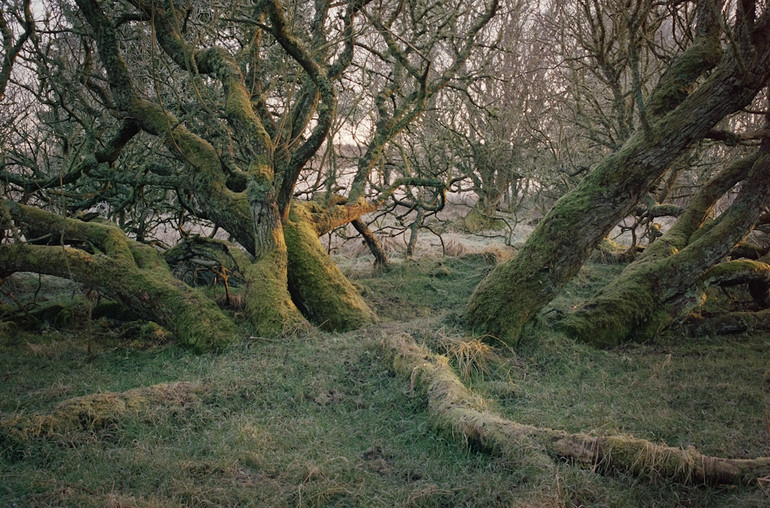
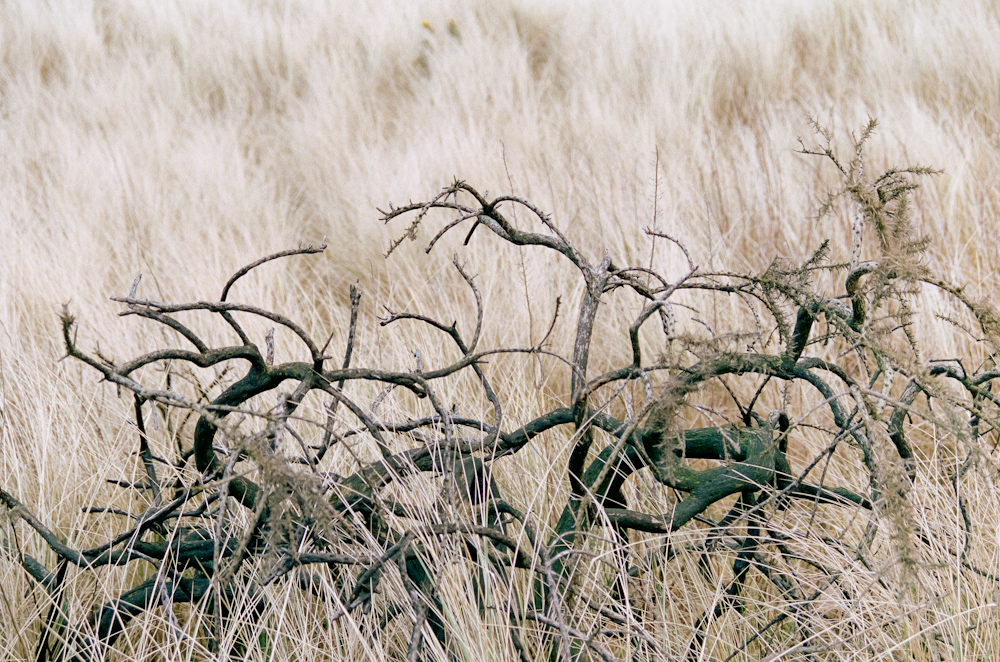 What if I couldn’t expose properly? What if they were all out of focus? What if I mucked it up completely? With all these questions running through my head I took the tiny little camera along with me on one of my regular visits to Grandhome Moss for my ongoing project. The camera was dwarfed by my EOS 5D2 and looked positively silly sat atop a tripod but I quickly got to know the camera (or so I thought!!) and began making pictures.
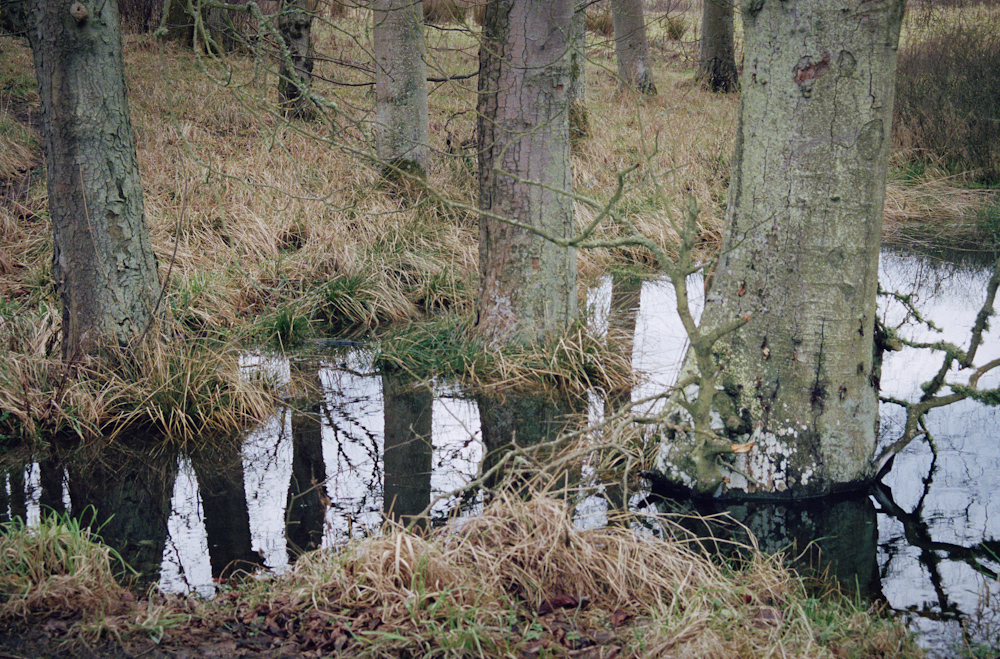 I am a reluctant photographer. Reluctant in that I do not commit many photographs to pixels/emulsion. In fact on a trip out with LF photographer Dav Thomas last year he joked that our roles were reversed as he was the one who was making many photos with his view camera whilst my 5D2 stayed mostly in the bag. How long was it going to be until I came to the end of this roll of film? Now into February it had been 5 or so months since I received the camera and began to feel the pressure to get the article written.
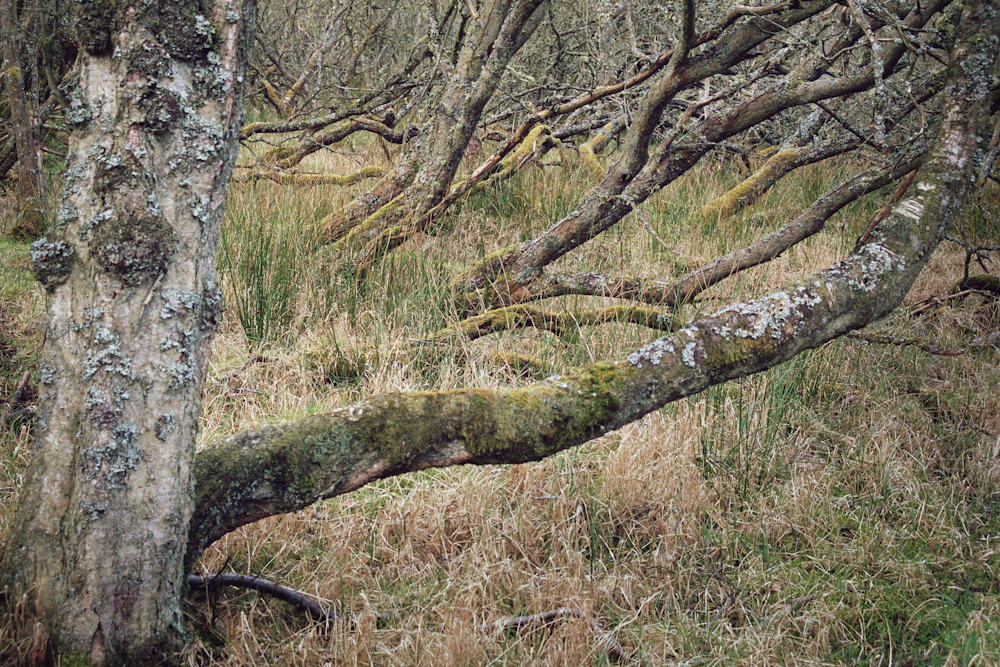 However, the last half the roll was not exposed. GGGRRRRR. It looks like I did not start the film off properly and only corrected what ever error had occurred when I opened the back up in the cupboard. A lot of pretty decent photos gone forever! At least mishap gave me something to write about rather than exposing the 36 frames correctly first time! (Keep telling yourself that!).
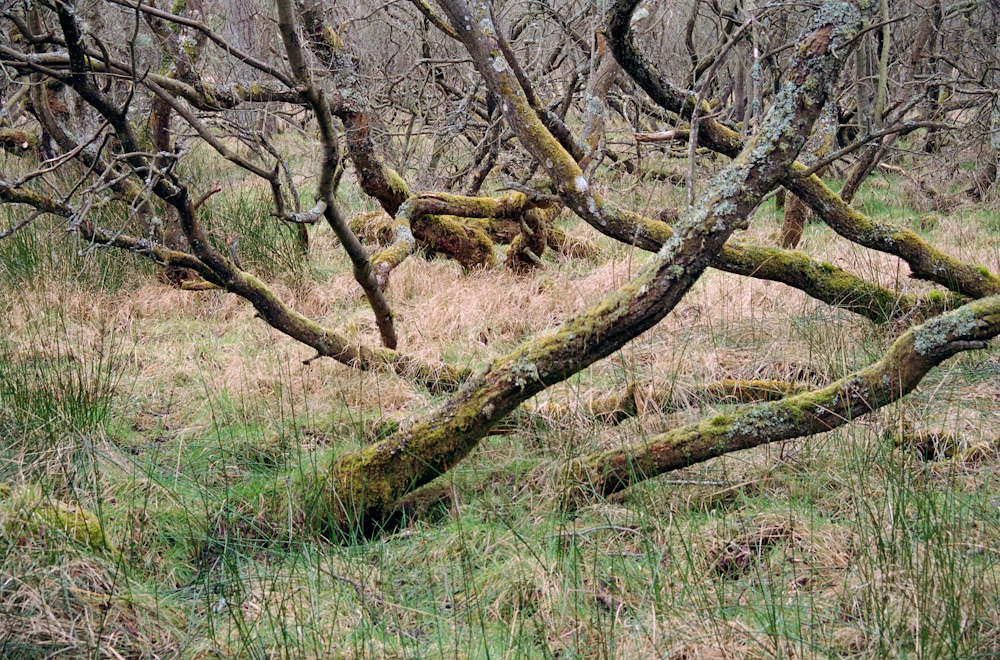 I have now had a chance to peruse the scans (courtesy of Tim) and I am pleased with the results. Considering the cost of the camera and a lens is cheaper than the cheapest of DSLR lenses it is all the more impressive. And the 12 MB jpeg file from the scan is more than large enough for any printing I would ever consider doing.