In a previous article about books and photography David Ward challenged us to come up with some helpful titles. One such could be Georgia O’Keeffe and Ansel Adams: Natural Affinities, published in 2008 to coincide with an exhibition in the USA of the same name.
Whilst there is an undoubted link between painting and photography, there are very few books combining landscape photography with landscape painting. Ansel Adams was enthused and inspired by photographers like Timothy O’Sullivan who had gone out into the American Wilderness to record their feelings for the landscape. Where Georgia O’Keeffe got her inspiration from is difficult to say. But she was married to Alfred Stieglitz who was primarily responsible for photography being accepted as an art form between the two world wars. Stieglitz helped launch both Adams and O’Keeffe in their respective careers, and his relationship with the two of them was complex, not to say crowded.
Most landscape photographers will be familiar with the work of Ansel Adams and probably own not just some of his monographs, but also biographies about him, such as those by Jonathan Spaulding or Anne Hammond. Photographers may not be so familiar with the work of Georgia O’Keeffe, except in the context of her life with Alfred Stieglitz. Whilst O’Keeffe is well known for her floral abstract paintings, she is less well known for her paintings of the wild and unforgiving landscape around Taos and Ghost Ranch in New Mexico. An area she visited every year, and then settled after Stieglitz’s death. So like Ansel, landscape was in her blood. Both had a deep affinity for the natural world and travelled together through the South West of America and into Yosemite in 1937 and 1938.
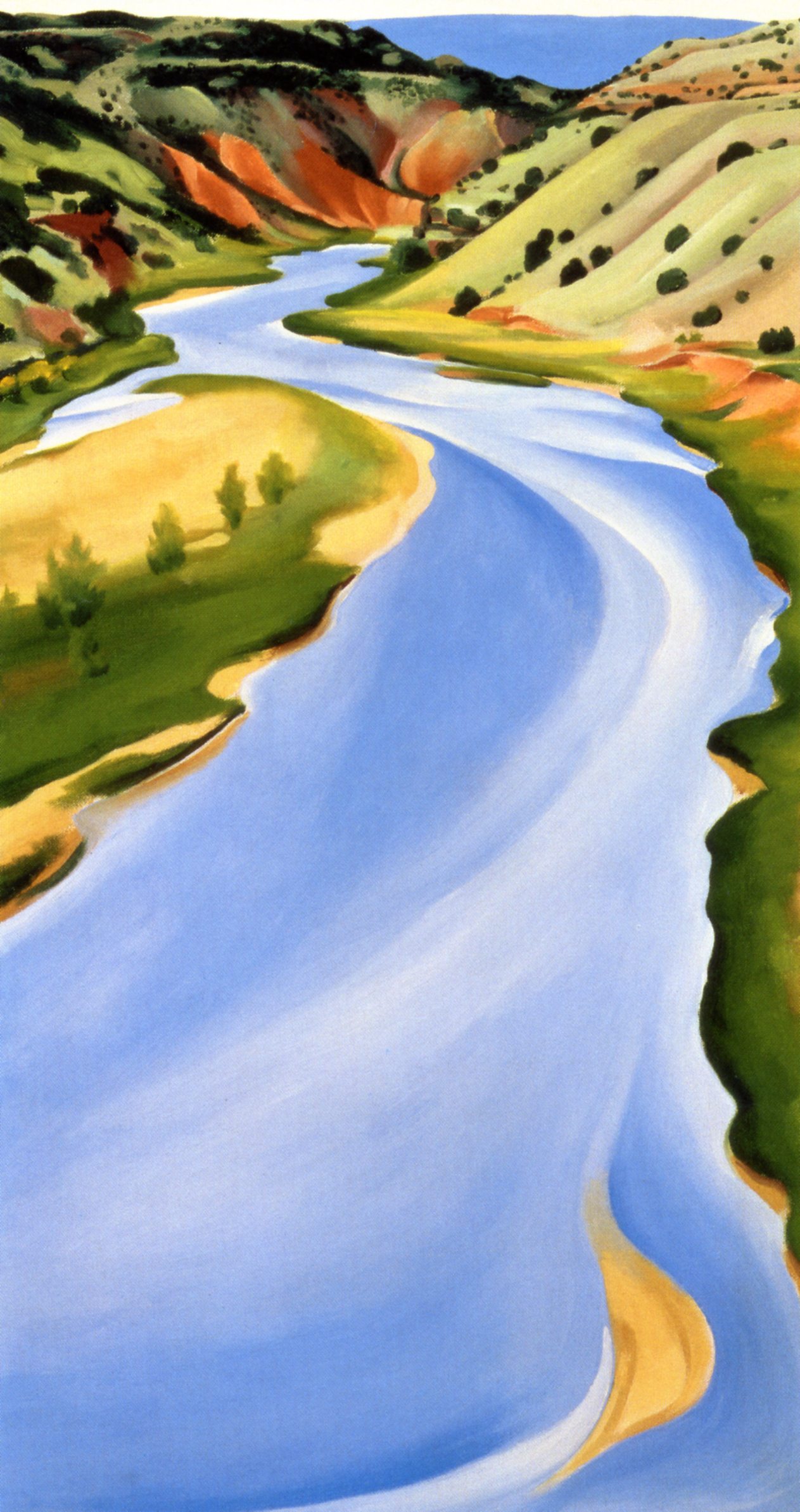
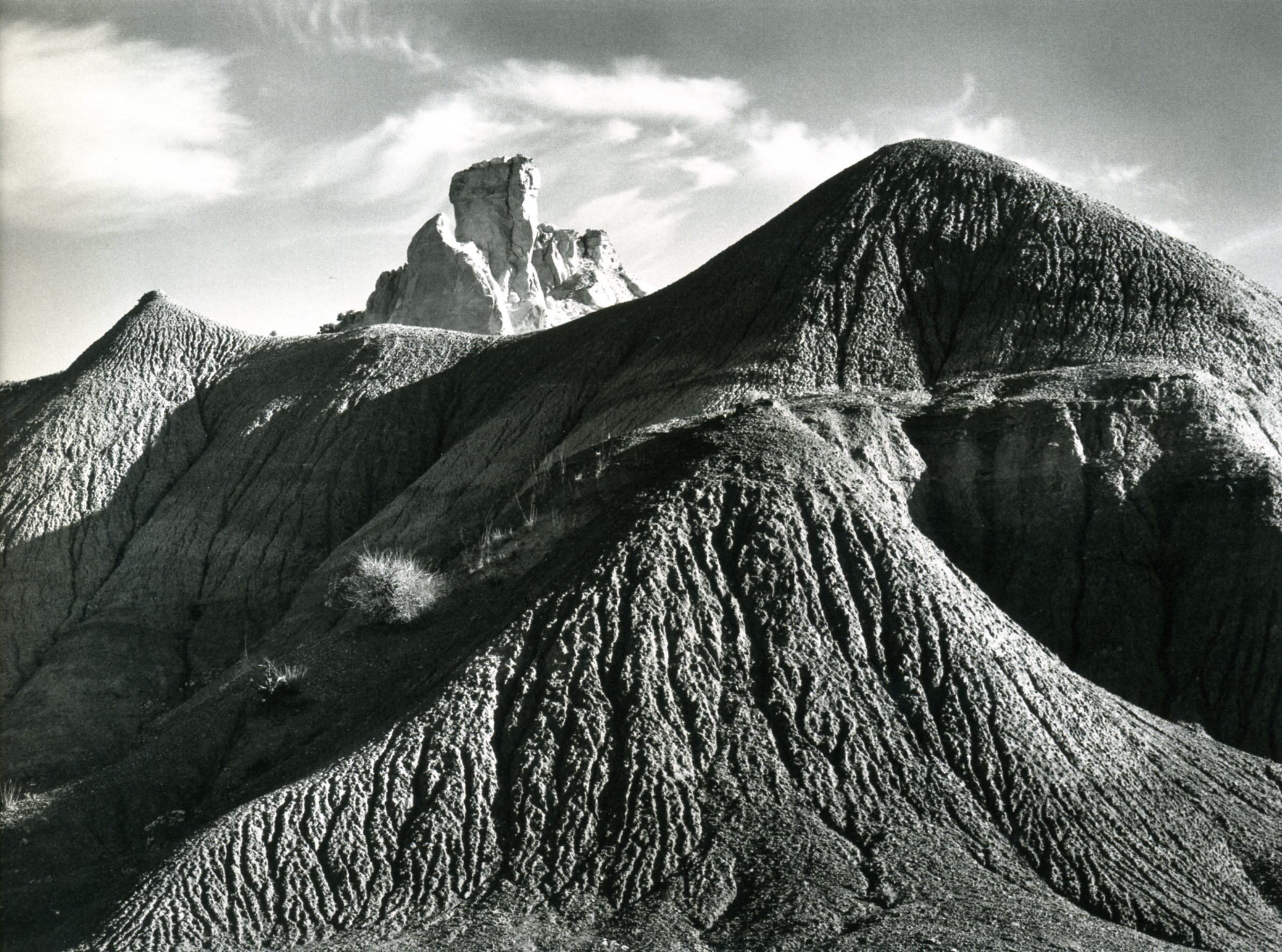
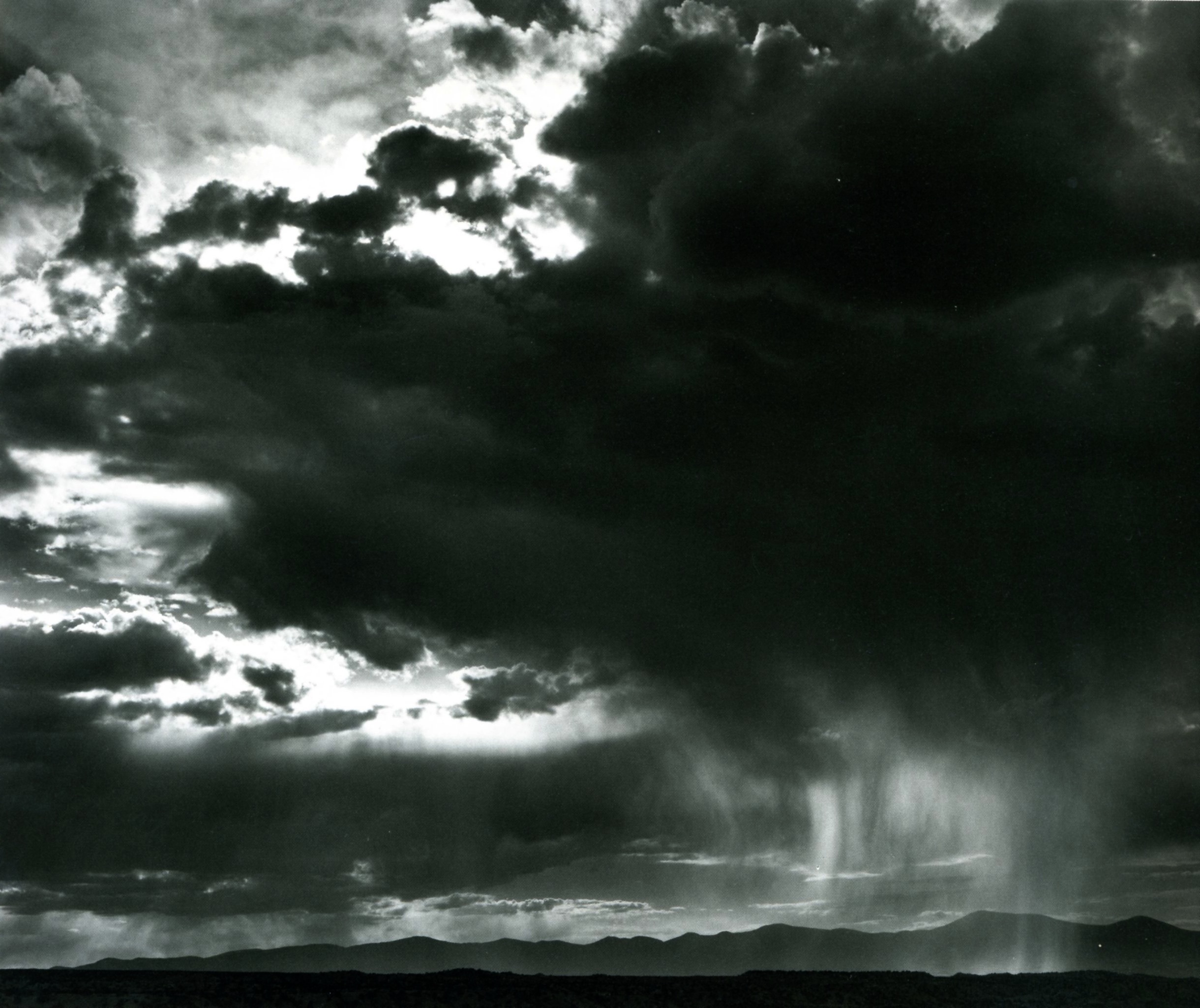
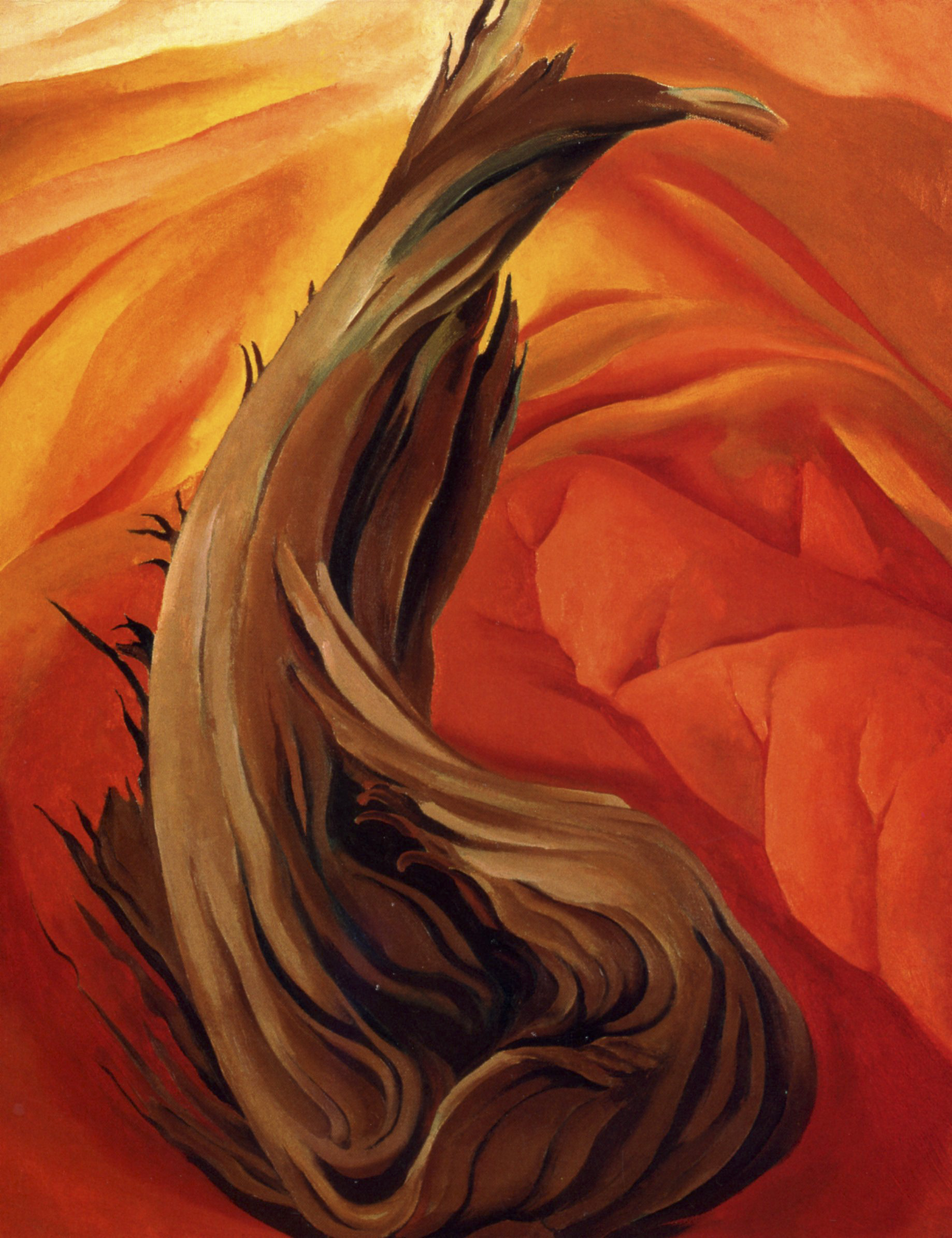
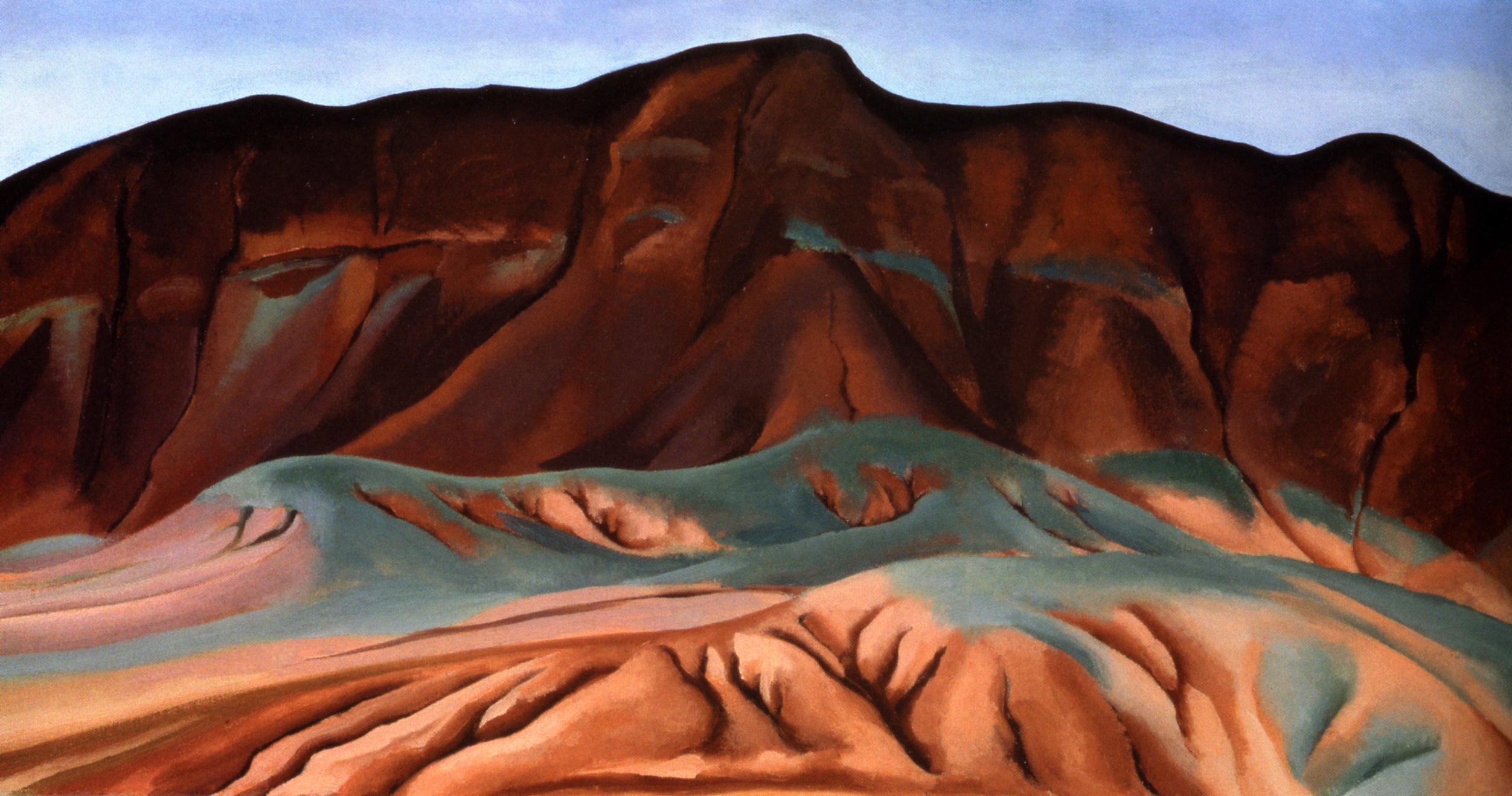
It was the harsh landscape of New Mexico which produced reactions in both painter and photographer. Red hot mountains, sunburnt forests and trees, deserts, weather patterns and adobe architecture were the subject matter. These are reflected well in the section of O’Keeffe’s work along with the sense of blistering heat. But not so well in Ansel’s section of photographs as many of the photographs come from the cooler and easier California. Some of the snow detail photographs look out of place. It would be fair to say that O’Keeffe’s strong colour paintings dominate Ansel’s black and white photographs. He admits that the South West belonged to O’Keeffe saying that “noone else has extracted such style and color, or has revealed the essential forms so beautifully…..” Of course Yosemite was Adams’ territory commenting that “there is no human element in the High Sierra – nothing like New Mexico”.
The essays by Richard Woodward and Barbara Lynes explain their character traits, and there are excellent descriptions of their different motivations for being in the South West. In the case of O’Keeffe it was to get away from the ‘arty’ scene in New York and experience an isolation in which she could devote herself to her art. For Adams, it was an opportunity to meet some of the avant-garde New Yorkers, such as Paul Strand who stayed with O’Keeffe on occasion. Indeed it was seeing Strand’s negatives that did it for Ansel – their impact on him made him become a photographer rather than a concert pianist. Sharp focus and minimum manipulation in the dark room were qualities that stood out in Strand’s negatives.
The best essay though is by Sandra Phillips as she actually makes a good comparison of the artwork of Adams and O’Keeffe, or at least says what the influence was on their work. We hear how Adams admits to being ‘stirred up’ by O’Keeffe in Yosemite ‘to see things for himself’.
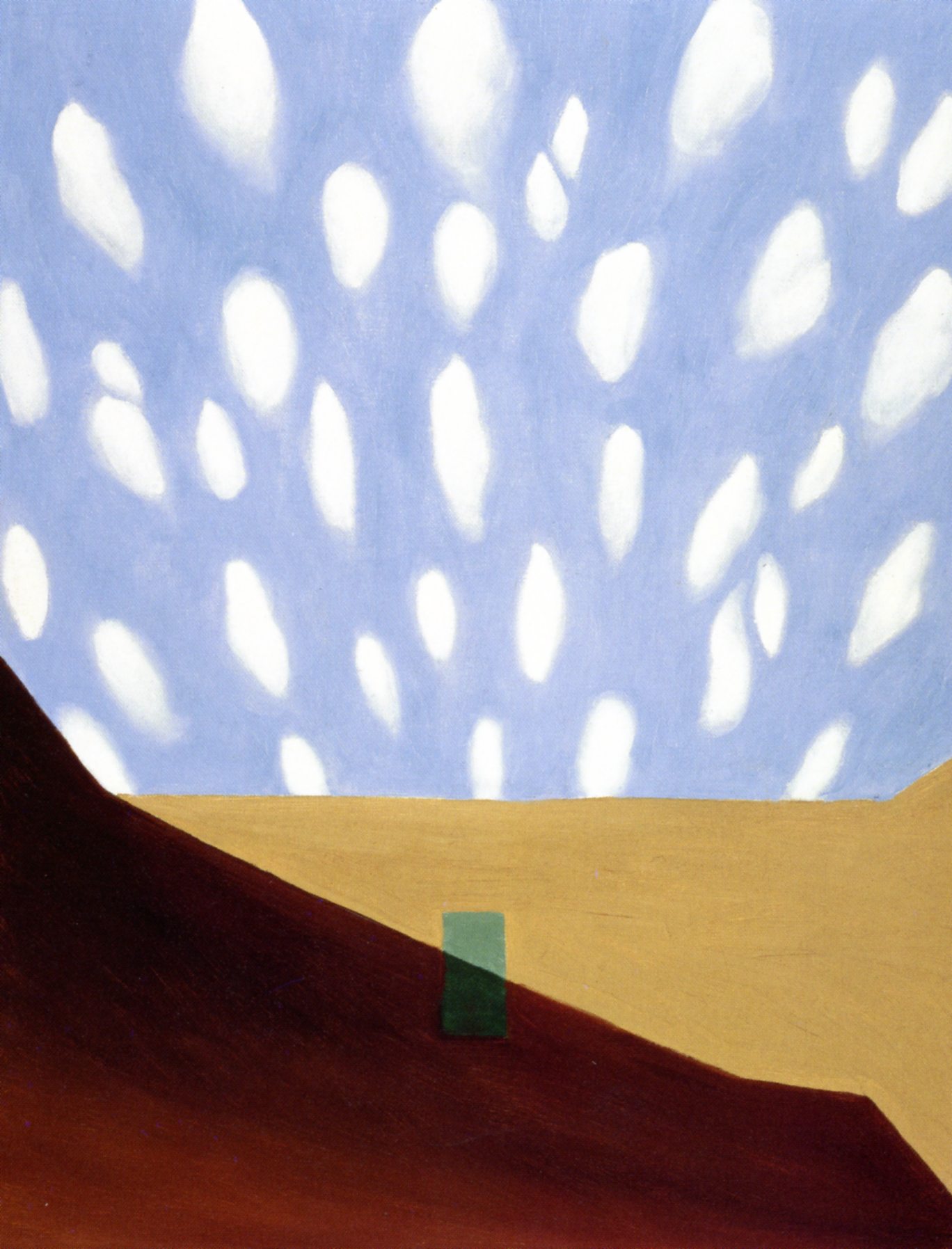
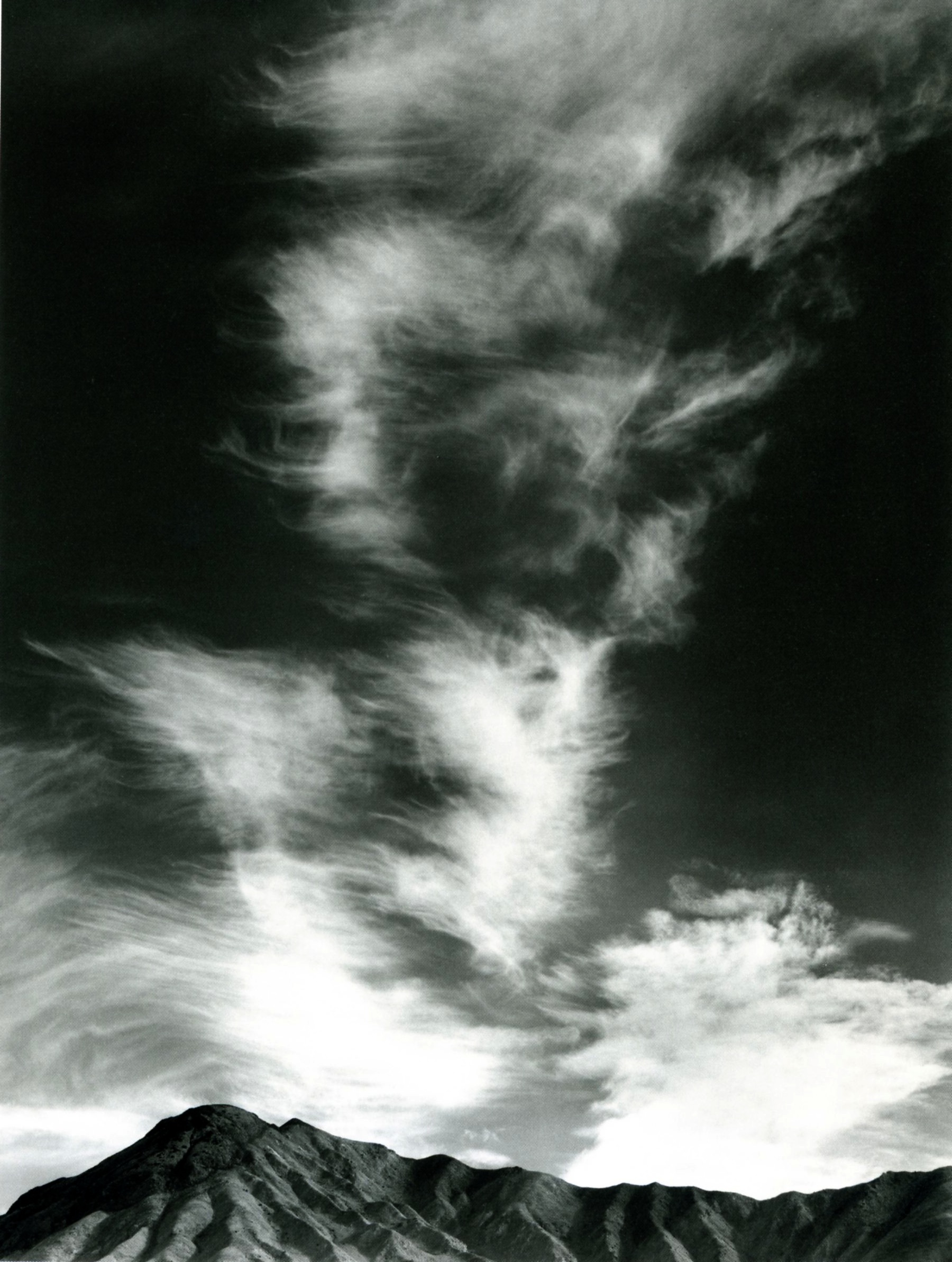
Whilst many photographers have identified a painterly influence, O’Keeffe said that photography was an influence on her painting. This may not be surprising given her relationship with Alfred Stieglitz. One of her paintings, entitled In the Patio VIII consists of a stream of clouds which certainly suggest the idea of equivalents, as espoused by Stieglitz. Ansel’s High clouds at Golden Canyon in Death Valley also reveal the ‘equivalent’ influence.
The feeling I get from the book is that it is more about O’Keeffe and her elusive personality than Adams. More assessment of their approach to art and photography would be of greater interest, rather than how they dealt with their fame. Both had a deep awareness and sensitivity to the natural world. The book would have greater value if this aspect of their lives was explored in greater depth.
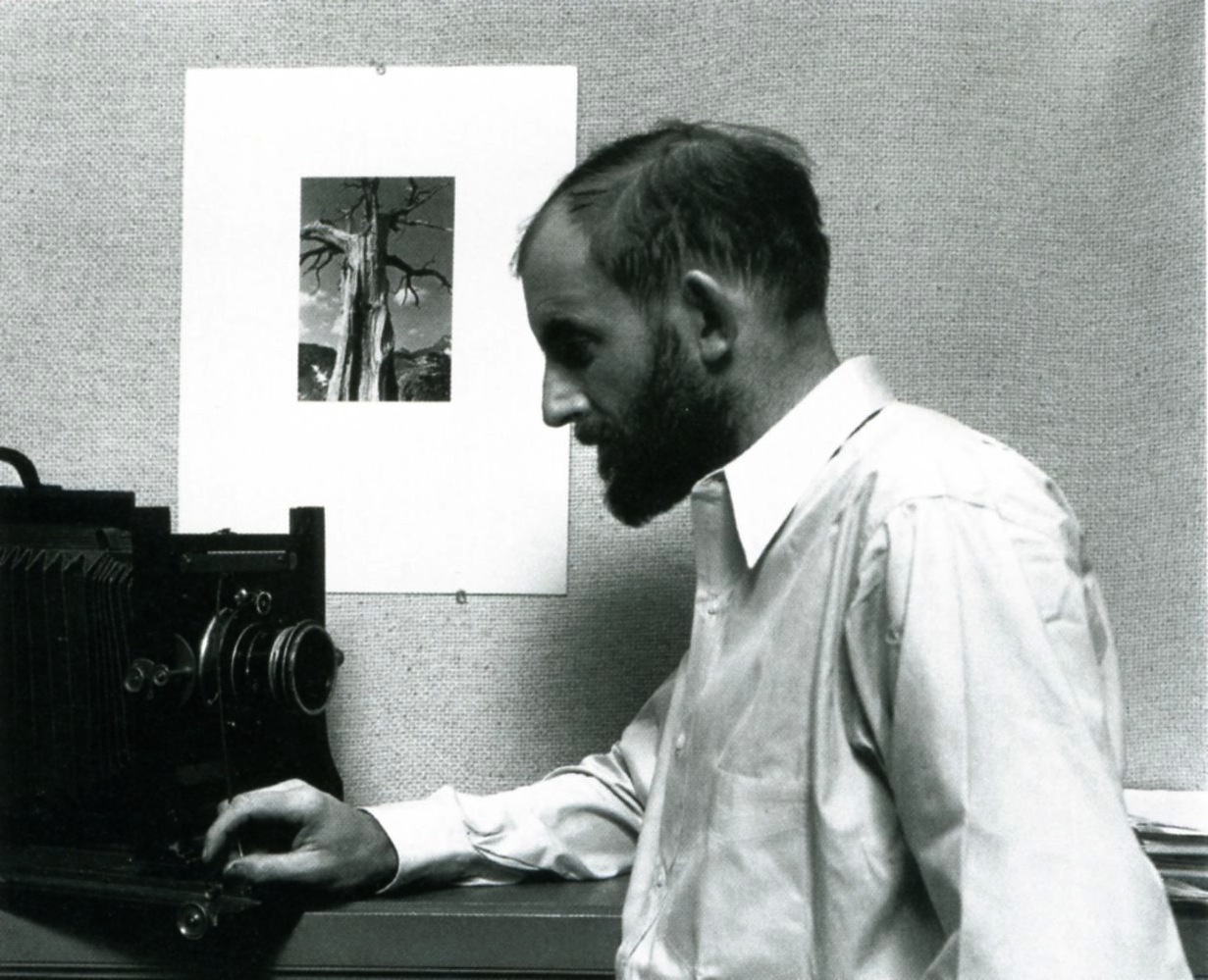
However we do learn of Ansel’s other interests such as membership of the Sierra Club and the wilderness Society which tells us something about the man and how those aspects of his life drove his photography. We hear that he made over 13,000 prints from about 2,000 negatives of the 40,000 or so he made. He made 1300 prints in various sizes of Moonrise, Hernadez, New Mexico 1941. He was instrumental in establishing the Photography Department at the Museum of Modern Art in New York and at the California School of Fine Arts, latterly the San Francisco Museum of Modern Art.
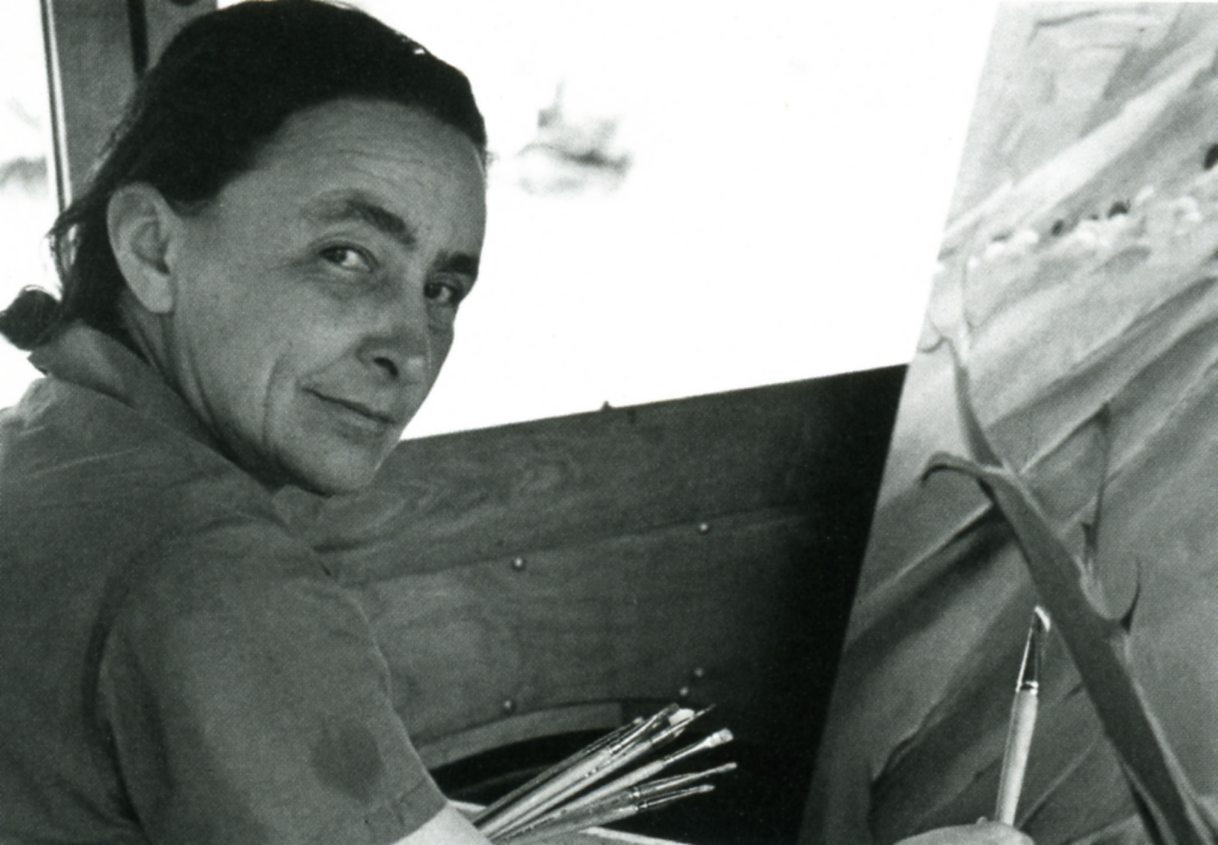
Adams as a personality comes across as more generous of his time with great importance attached to people he knows and loves. O’Keeffe on the other hand does not seem to rely on anyone – not even Stieglitz. She could devote her entire life to her art without distraction, unlike Adams who revelled in social interaction and his open house attitude.
The difference in characters is summed up by O’Keeffe writing that “ When I got to New Mexico that was mine. As soon as I saw it that was my country.” Contrast that with Ansel’s arrival in New Mexico which is non possessive or proprietorial. He writes to Stieglitz: “ It is all very magical and beautiful here – a quality which cannot be described……the detail so precise and exquisite….”
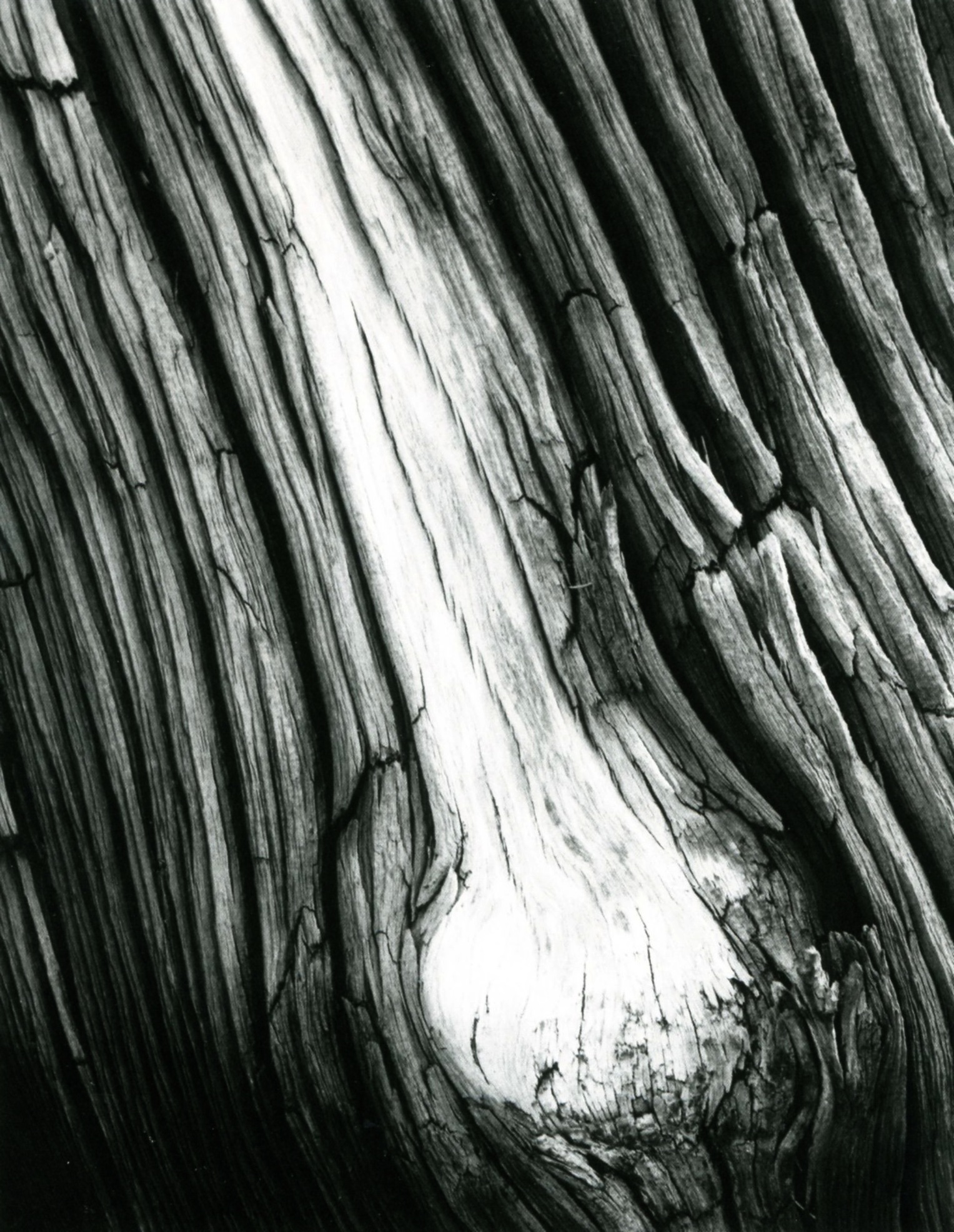
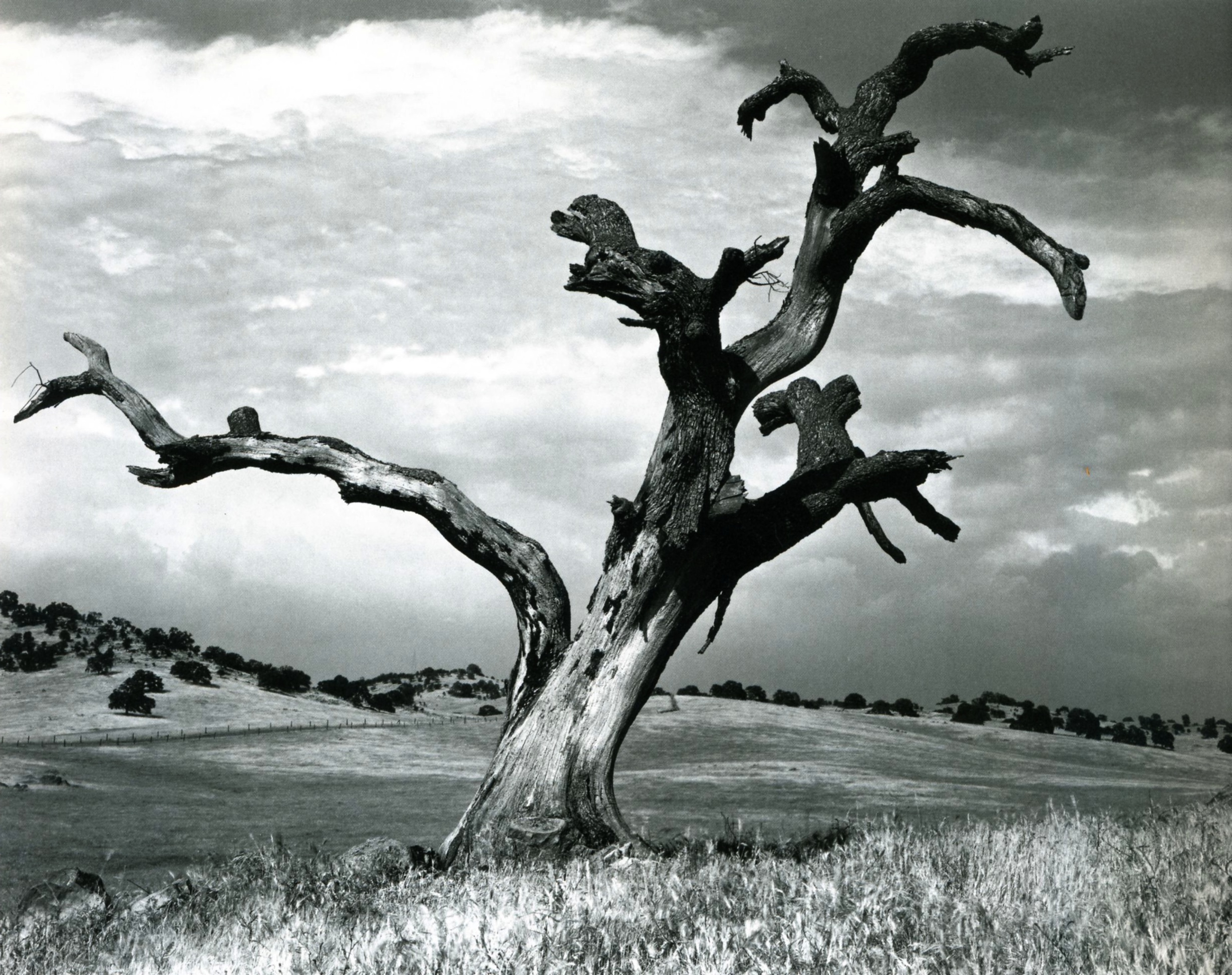
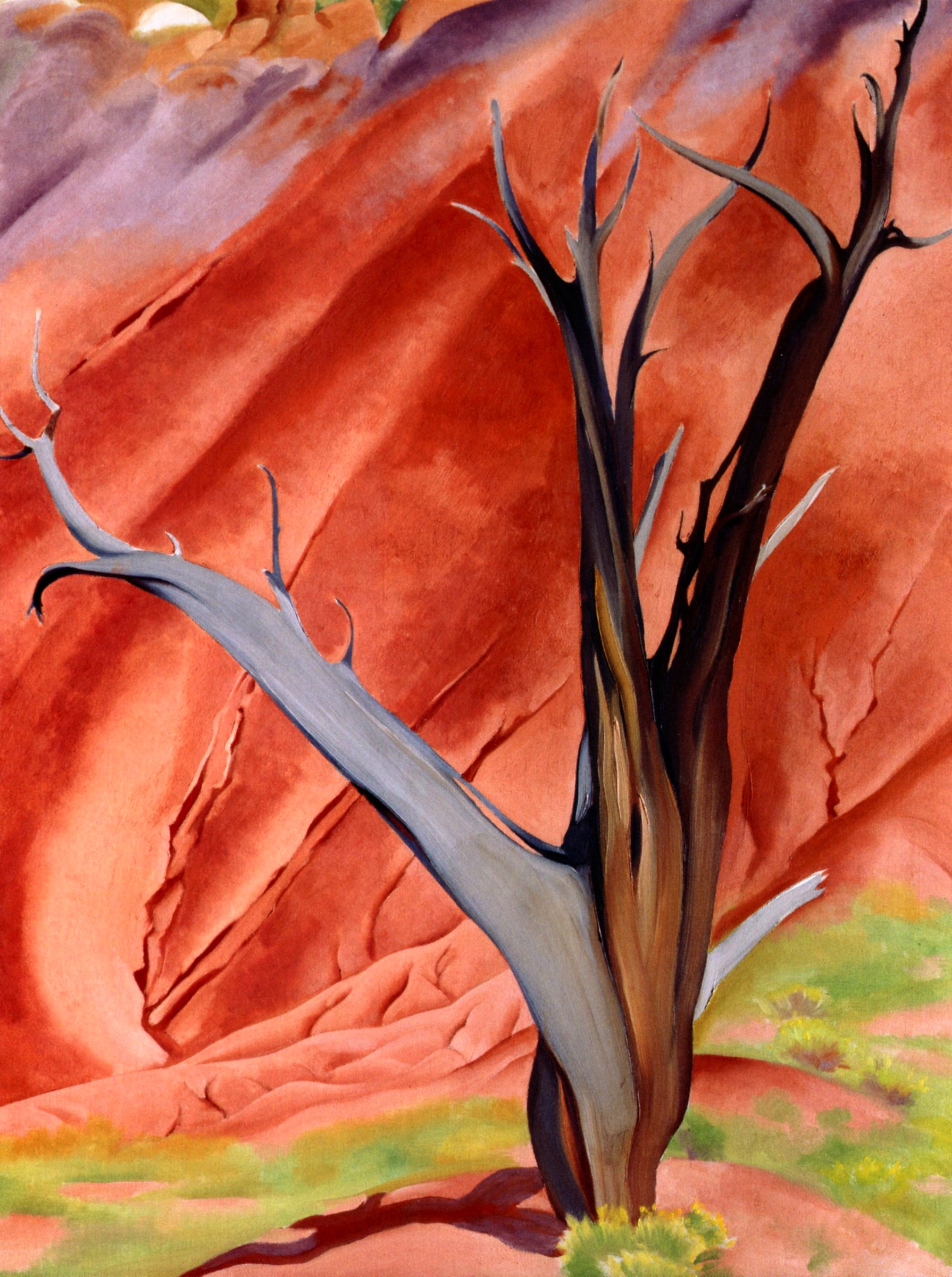
Comparing the photographs and paintings takes some work on the part of the reader. Examples are Saint Francis Church, Ranchos de Taos, New Mexico, painted and photographed in the same year, 1929. Ansel’s Dead Oak Tree above Snelling is similar to Gerald’s Tree painted by O’Keeffe. The quality of light and luminosity is there in both depictions, but they are pages apart.
The book itself is high quality – good paper and print and, well laid out with about 50 plates dedicated each to Georgia O’Keeffe and Ansel Adams. There are useful chronologies of events and detailed bibliographies for those who wish to research further. For anyone interested in the history and development of landscape photography as it relates to the work of one of the great painters in America, who was herself heavily influenced by photography, then this is a book to acquire.
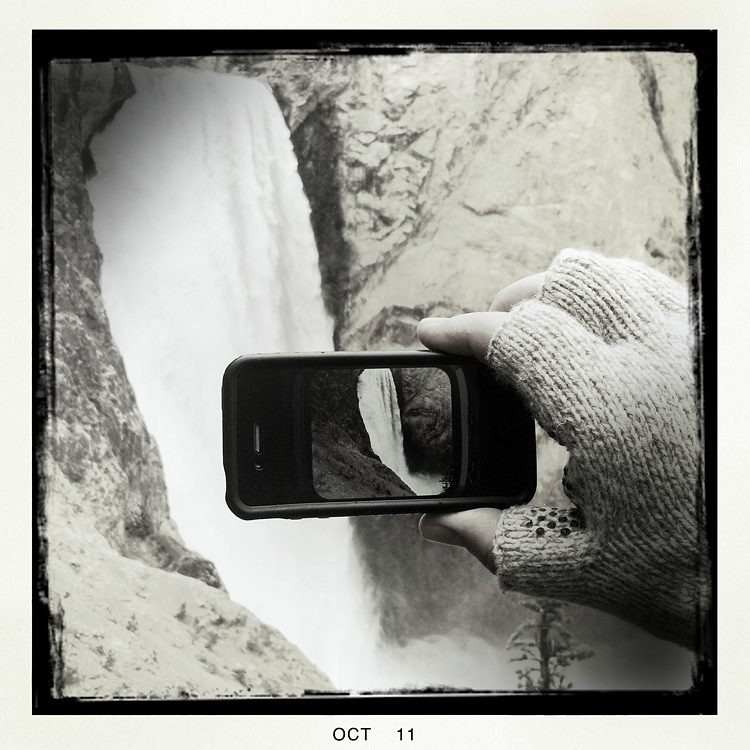
The recent sale of Instagram for $1 billion to Facebook has got me thinking about how many people use cameras today and how we - as “photographers” - might learn something from the playful approach of ‘casual users’.
First, a little history: the rise of Instagram has been truly meteoric; the service was launched in March 2010 and by March this year had over 30 million subscribers and a billion images stored on its servers. Another aspect of the business was quite extraordinary; there was never any charge for the app or for sharing the files. Set up and run on just $7 million of venture capital and with no way of generating cash, sceptics might speculate that Instagram’s strategy was always to be bought by one of the big players. (No doubt the investors and the thirteen engineers who work at Instagram will be pleased with the pay out resulting from this strategy!) The creators of the Hipstamatic app have been hugely successful too, with more than 10 million downloads in less than two years. Numerous other camera apps, including Tadaa and Lo-Mob, are doing almost as well. The question is why?
I have a confession to make, before you read further, you should know the following article isn’t really about photography at all. It is about a place, a place I love and my personal history in that place and how and why I have come to love it. But if place isn’t important to landscape photography then I don’t really see the point; surely there is a reason we go out to capture what we do? Okay I’ll admit it is something to do with landscape photography really, but first I’m going to have to explain why I feel so close to this area and that’s quite a long story.
If you are sitting comfortably, then I shall begin.
I sit on a late winter patch of russet bracken about three quarters of the way up the north-facing slope of the Skirrid. The first warm rays of sun hint at the coming spring, there is a gentle breeze carrying the cries of lambs exploring their new world, birdsong in that joyous way that birds sing when the end of the cold, the meager rations of winter are at last in sight.
Looking north I can see the rounded hills of mid Wales; to the east, across rolling fields lie the Malvern Hills; southeast is the escarpment of the Cotswolds. But west, hard up, close by is the familiar ridge of the Abergavenny Hills (properly the Black Mountains). Hatterall Ridge, the border, below it the long winding remote Vale of Ewyas. It leads past the stony ruins of Llantony Priory and to Capel Y Finn which housed a more modern monastery, founded after local people reputed saw a vision in nearby fields, the farm is still called Vision Farm. A deep remote retreat from the world which was also home to artists from the 30s such as Eric Gill and his followers including David Jones artist and author of the First World War poetry book In Parenthesis.
Further to my left hand is the Hill Fort of Y Gaer, high on a promontory, hummocks of yellow gorse gracing its ditches and proudly topped with a rocky cairn – one I had to rebuild before I last photographed it. A little way further left lies the volcano like summit of the Sugar Loaf, just short of 2000feet, but it more than makes up for this apparent failing by being a proud point amongst the rounded ridges, purple when in summer heather.
So this is my country, I don’t live here, although I’ve come to love it over many years, it is special in so many ways, ways that can’t all be explained by the way it looks. The Sugar Loaf for example is the hill that on most Sunday mornings in my childhood I would climb with my mother and brother, my mother pointing out and naming the wild flowers. Whilst my grandparents (who lived near the foot of the hill) would go to the dour, dusty, dark Methodist chapel to listen to thunderous sermons denouncing ‘the young people of today’. But we would have the freedom of the hills, the sunshine on our limbs, the fresh air and the grassy paths to the summit. Our return, miraculously timed to coincide with Sunday lunch, maybe there was something to this religion after all!
This was also my childhood escape from the claustrophobic industrial valley we called home – an escape from “real” life. Although only thirty miles away, Abergavenny was the first proper country town after the coalmines and steel works that scarred the valleys back then. And the first proper, untainted, countryside separated from the industrial wastes by the vast bulk of the Blorenge Hill, big enough to blot out the view and polluted air.
In the school holidays we would be packed off to our grandparents, and spent a lot of time walking in the lower hills with my granddad – his dickey heart precluded the heights. Or driving the lanes in his Reliant Robin three-wheeler, wheezing and whining up hills, my brother and I would lean into bends like a yacht so unstable was it. Like many men of his class and generation a car seemed an impossibly distant dream, so he only had a motorbike license, which by some quirk of law allowed him to drive two wheels or three, but not four. Nonetheless motoring equaled a new found freedom and we would crisscross the countryside by the most obscure lanes avoiding the highways where we would slow up faster traffic. Colours flashing through the windows, flashes of bluey purple in the bluebell season, the almost shimmering fresh greens of spring, that spoke of renewal and the yellow, reds and browns of a kaleidoscopic autumn.
These trips gave me a thorough appreciation of how everything fitted together over a wide swath of countryside for the first time and like none I’ve experienced since. This was more than thirty years ago and at times I struggle to put it together in my mind. A stranger would soon be hopelessly lost, mainly as the local tradition of turning the road signs to face in the wrong direction still persists into the twenty-first century. But keeping to the main roads would mean missing out on the real delights, as every landscape photographer should know.
Had I been a poet this would have been like Ted Hughes’ Devon, Dylan Thomas’ Laugharne with it’s “heron priested shore” or of course Owen Sheers’ Skirrid Hill, the place of safety of contemplation and refuge, a reason to exist amongst the daily mundane. I was just a child back then, however, but it has come to mean all that and more in my deepening adult life.
Stopping to think about the places I love the images that come to mind are predominantly this rolling landscape hemmed in to the west by sheltering hills. It has become so familiar that I feel I couldn’t get lost, even on a moonless night I could safely navigate back to civilization. It’s that intimacy which has become important for self-expression. Even when I don’t have a particular image in mind I know where to look. Be it in the dark, untidy wood of the Skirrid or the bright valleys that cut into the Sugar Loaf or the airy tops that speak with an open heart. I need that depth of knowledge, but more so I need that interconnectedness.
In a way I suppose it has become a muse, a paint box on which I express my feelings. It is still an escape – I live in Cardiff - and for the past three years this land has become the way I express who I am, how I feel and how I interact with the landscape. More than that it actually feeds into who I am, it has in some ways reflected back into my self-definition. Sometimes I feel like a hefted sheep, so accustomed to my part of the hill that I can’t begin to imagine wandering to somewhere new. On those rare occasions when I do venture to photographic pastures new I feel I am struggling to find an engagement, the fires of creativity too weak to crack the spark needed. Not that I’m worried by this, the days of wanting to rush from one grand vista to another are well behind me. I have learned here what I love about landscape photography, and it is more to do with finding the magical amongst the mundane than it is about adding some extra magic to the already impressive.
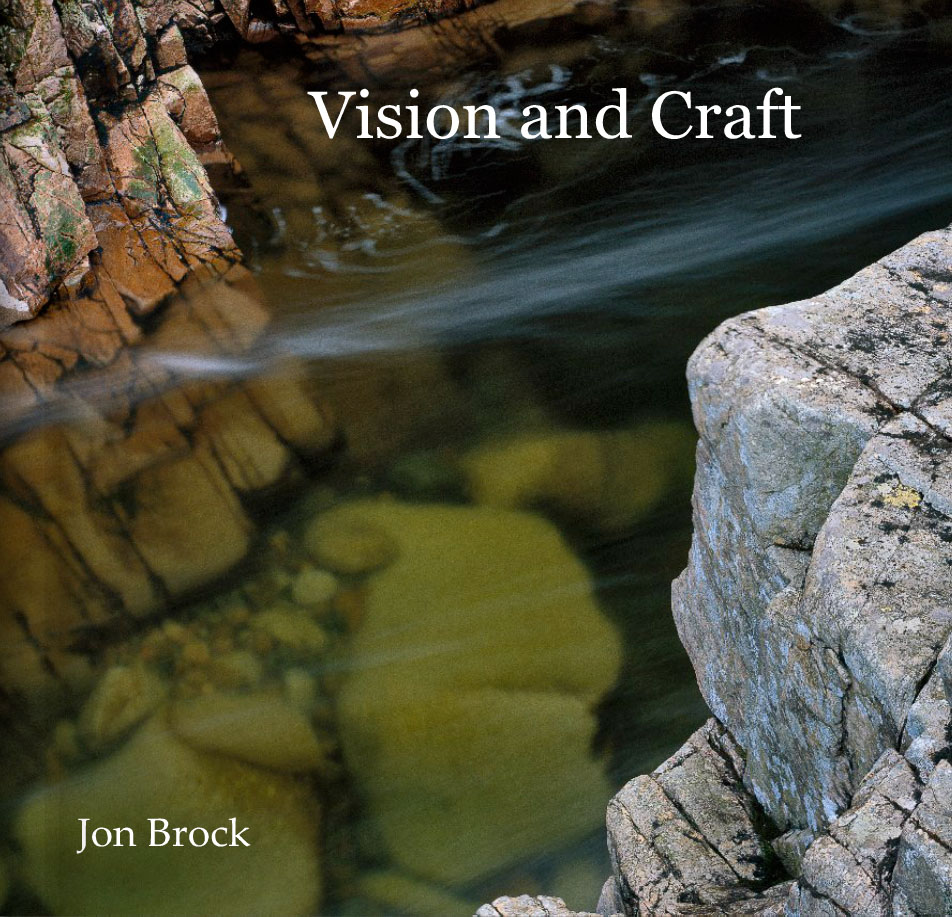
It took me a long time to realize that what I wanted to express with the landscape was the inner vision. Well the outer vision of landscape is quite compelling! I take a certain delight in the fact that this landscape doesn’t conform all that well to the norms of landscape photography, it’s lacking in well formed mountains, there just aren’t those clichés to tempt me, no jetties, no piers, no slow waves, no limestone pavements with lone trees, no waterfalls, only one lake. It is landscape in the common, everyday sense, tree topped hills, hedge lined rolling fields and mostly featureless moor. I have to work hard here to find ways to express myself, I can’t rest on my laurels and copy all those ideas I’ve seen others use in the past. I might stoop to the odd pointy hill for which I apologise most humbly, but for the most part big vistas don’t work here. It’s the intimate expression of connection that fascinates me in any case. I’m not really interested in showing you how it looks to my eyes, you have eyes of your own, I’m looking for a narrative, which represents the experience. And when you get into representing – denoting, signifying - rather than illustrating, then it opens up a whole new world of expressive potentials. Pablo Picasso once said, “A painter paints to unload himself of feelings and visions.” it’s why I photograph too and I believe we can do that with a camera as well as a painter can with paint if we only but try.
Some charge me with of having an agenda or a dislike of Romantic landscape photography (capital “R” Romantic in the artistic tradition rather than the pink fluffy stuff). But I am a Romantic, I feel the world me inside, I just have a need to find new ways to express it, in order that I might discover new revelatory expressions, ways that don’t replicate the ideas of others, but are as much as possible my own, that come from within. I’m not claiming to be Byronic, but the Romantic tradition originated as a reaction to the industrial revolution, the age of enlightenment, the scientific codification of the natural world and the right to express our emotions. Of course this brought it’s own codification - of emotion, that is what I fight against, not emotion itself, but a cosy, repetitive realization of those emotions. There are new ways to say it, that is all I want to explore. If my experience and photography doesn’t represent that, then everything above is mere falsehood.
So do you fellow landscape photographers have a special place, a place that has both taught you how to love and taught you how to photograph? I would love to hear more!
In most photographers lives there are 'epiphany’ moments where things become clear, or new directions are formed. What were your two main moments and how did they change your photography?
I think perhaps the first instance would have to be around the time I was first introduced to photography by my father when I was still quite young. He encouraged me to experiment and explore what the camera could do and the processes involved. One of my earliest memories – possibly the event that started it all – was standing over a developing tray in the converted downstairs loo, the strong odour of chemicals mixing in the darkened room, as an image began to emerge like magic on paper. I can’t remember what the image itself was but that experience clearly had a lasting effect, I knew that what ever I ended up doing I wanted to include photography somehow.
Another moment of particular clarity was when I decided to change my career as a research scientist to photographer. I recognised the opportunity to satisfy my creativity and inquisitive nature and am glad I made the transition.
Tell me about why you love landscape photography. A little background on what your first passions were, what you studied and what job you ended up doing.
I have always been fascinated by science and the natural world. I grew up with David Attenborough videos virtually on constant replay and a monthly feed of National Geographic so pursuing my interests in science, studying physiology at university up to MSc level seemed natural. Sadly my photography took a bit of a back-seat making way for academia, the camera was never far away but I didn’t devote enough time developing any skills or any hint of a style. I started working as a research scientist shortly after completing my second degree and reacquainted myself with photography but with much more intent to actually be creative rather than merely ‘take a picture’.
I allowed my inquisitive nature to investigate photography more thoroughly and realised it is a wonderful combination of being both incredibly technical, requiring a level of proficiency with the cameras and equipment, and an outlet for my creative side.
The pursuit of landscape photography is not a static one, you have to put yourself out there and experience the environment the subject exists in to create the image. I enjoy the physical challenge of getting to a location be it travel to another country, climb up a mountain or merely a stroll along the beach. You have to get away from the car park to see what’s out there, it’s an adventure to head off and discover for myself what secrets a location is able to reveal.
Countering all the activity and effort with the quiet contemplative moments of formulating and distilling everything in front of me to successfully work up a composition is a curious mix I find captivating. Once at a location I can spend hours poking around and investigating to see if I can craft something that I feel works. I have been known to get myself in precarious positions to make an image as a result of this blend of physical and investigative nature…occasionally.
There’s also the side of things that we cannot control that have more of an effect in landscape photography than perhaps any other form of photography, there’s only so much we can do, after that we’re just observers. There’s nothing new in saying light transforms the character of a subject from one moment to the next, the skill becomes how to balance what you can control with what you cannot. It’s a curious contrast but being immersed in this process is what I really love. There are many avenues of photography I enjoy, certainly as a professional photographer I end up shooting a huge variety of subjects for clients but it’s landscape photography that seems to combine my interests and passions, bringing the most satisfaction and sense of accomplishment when I end up with an image I’m really pleased with as a result of everything coming together just right. Even if I don’t get anything I’m still spending time enjoying the outdoors!
You’re working as a professional photographer, can you give me an idea of what your typical day is like (and what recent exceptions to that have been). Challenges over come?
The transition from research scientist to full time photographer did present a few challenges, not least overcoming the gnawing self-doubt of ‘is this really a good idea?’ but once I’d made a start there really was no question in my mind. I suppose the first rule is there are no rules and you really have to maintain a level of discipline to follow through on things in order to make any sort of return on the time and effort spent. No two days are the same which can be both rewarding and frustrating in varying measures, for example within a 7 day stretch recently I went from standing on a frozen lake in Norway watching the Northern Lights to shooting rowers on the Thames to shooting kids running around in some woods to a day of chasing up clients and contacts to plan the next few weeks. Some ideas turn out to be successful and others less so but the important thing is to keep pressing on.
If I’m on a trip, for either commercial or personal work, the day usually starts the night before with furious weather and sunrise-time checking, this could all amount to nothing when you open the curtains the next day to see ‘not as advertised’ rain lashing the window. This happened on my first major commission last September (2011) working in Norway for a global oil company putting together a book tie-in for a newly built off-shore oil platform. The brief required landscape images from the area surrounding the on-shore base and some of the base itself. For the first four days (of seven) it rained. A lot. But I was able to fulfil the more commercial aspects and do some location scouting in the meantime (I got very good at imagining huge peaks behind the low clouds). Good weather eventually arrived but as we all know ‘good weather’ isn’t for landscape photography and I had three very long days trying to get a cloudless sky fit with my compositions. Thankfully the client was very happy with what they got and a few more trips are being planned. I think that experience taught me that you just have to do all you can and go with it, not to stress if things don’t go according to plan but be ready to get going as soon as things improve.
Could you tell us a little about the cameras and lenses you typically take on a trip and how they affect your photography
I currently use Canon digital SLRs, the 1Ds mkII and the 5D mkII are my two main cameras, along with a selection of lenses covering 17 to 200mm. I think my approach verges on experimental, upon reaching a location I would dump the bag and just wander around for a short while, one camera and one lens just making small grab shots and working out what to settle on depending on what the situation calls for and the composition I want to work up. My most used lens is my 24-70mm which gives me a great range to start with when exploring a subject. If I need to get in a bit closer I use a 70-200mm but rarely do I go much wider than 24mm. I do have a 17-40mm but tend to leave that at home (unless required for a commercial reason) – although a great lens I find it just too wide for my tastes.
I also have a couple of tilt-shift lenses, the 24mm and 90mm, each of which have their purposes. The 24mm tilt-shift lens is perhaps my favourite for landscape ‘views’ as it combines both a reasonable field of view without being excessive and the tilt-control allows me to focus from inches away from the lens to infinity. The 90mm is a great ‘detail’ lens and comes into it’s own when shooting the close-up/intimate images, allowing me to get in close and has that control of focus plain that other lenses just don’t. A positive side effect of having lenses with such movements is they make you slow down. With careful use, get it right and the results are stunning but get it just a bit wrong and you kick yourself. I only got the 5dmkII with live view 10 months ago so doing it all by eye prior to that advantage really made me slow down!
What sort of post processing do you undertake on your pictures? Give me an idea of your workflow.
Although the intention is to get it right 'in camera' by the nature of digital capture at least some editing is required to get the best out of the files. I use Lightroom for 99% of my processing, as much as an image processor with all the raw processing controls of it's bigger brother photoshop, it's a fantastic tool for organising files and keeping track of things. My standard edit involves the usual temperature and colour corrections, contrast curves and general cleaning up. Adjustments I make tend to be fairly minimal beyond that, with an emphasis on ensuring the result is more of an optimisation rather than harsh editing and remains faithful to how I saw the scene at the time of capture. The advantage to having so much technology available is that I can easily go to photoshop for a much more precise edit if I need to, such as using the lasso tool to highlight specific areas needing attention or running it through the stitching processor in photoshop (beyond a crude edit brush on of lightroom’s limitations is that it lacks the ability for precise editing).
Tell me about the photographers that inspire you most. What books stimulated your interest in photography and who drove you forward, directly or indirectly, as you developed?
As a child I spent a lot of time drawing and was encouraged to appreciate and enjoy art which no doubt nurtured my passion for photography. As I became more aware of landscape photography as a discipline I picked up a copy of David Ward’s Landscape Within which certainly had an effect in the way I approach making an image (I read it during a 2 week holiday to Scotland. It rained a lot!). Not in the least thinking more about what I was doing but also the way photography differs from other artistic practices being subtractive as opposed to additive.
Certainly one side of things that I do need to improve on is my landscape photography library not just on photographers but artists in general. I do enjoy slowly wandering through museums, – particularly
Increasingly more photographers are turning to the web in the form of sites such as facebook and flickr to share their work. Unfortunately for the most part constructive criticism tends to be absent, more a back-patting exercise but through them I’ve met some talented photographers and made good friends who I do stay in touch with. The opinions of people you know and trust mean a lot and having someone dissect an image, whether good or bad - and give reasons - is worth more than any number of one line compliments. When I meet up with other photographers I thrive on the discussions thrown around, be it out shooting on location or later ‘back at base’ (red wine tends to be a contributing factor!), the sharing of experiences and ideas on such occasions I find truly inspiring.
Photography as Art... ?
The definition of ‘art’ is essentially as follows:
“The expression or application of creative skill and imagination, typically in a visual form such as painting or sculpture, producing works to be appreciated primarily for their beauty or emotional power”
Clearly a great deal of photography falls within this definition and why wouldn’t it? A lot of work I see is both pleasing and, whilst may not be ‘emotionally powerful’, does elicit a response of some kind but to my mind there are limits. Inevitably there comes a point where people end up making either what’s expected of them, or bland clichés, with little or no thought behind the creation of the work itself. Ultimately it’s an interesting question that no doubt rages in the minds of photographers. Certainly for me the intent when creating an image is that the result will be of an artistic nature and appreciated for what it is, and hopefully connect on some level with the viewer. Photography in this country is gaining momentum as an ‘art form’, we are somewhat behind the US in this respect but it’s getting better. It is a question though that warrants further discussion beyond this Q and A
Tell me what your favourite two or three photographs are and a little bit about them.
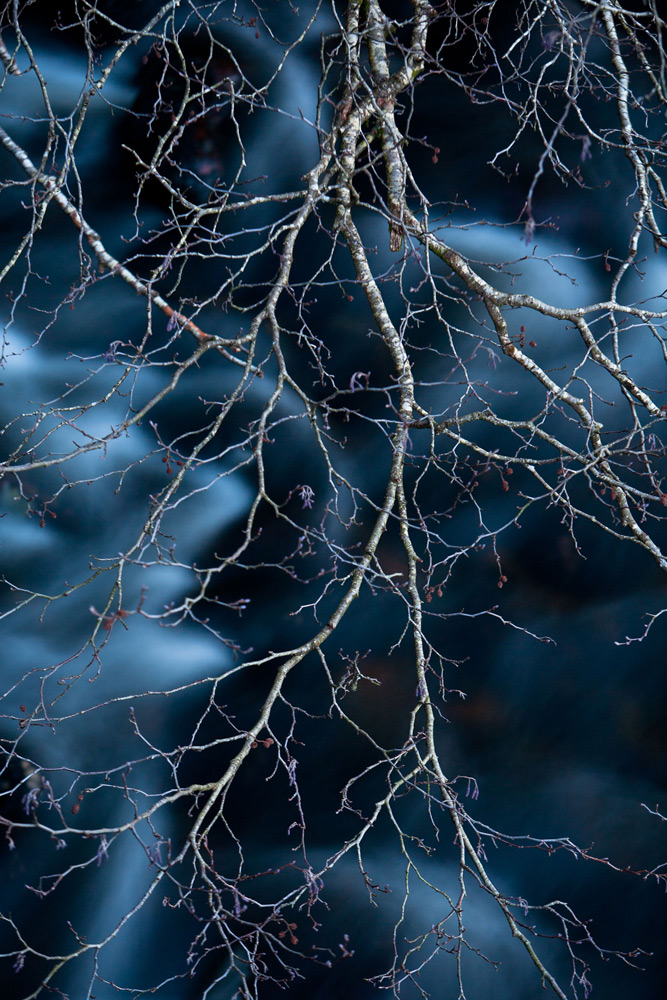
The Lightening Tree. I made this image at the end of a walk along the river Dart in Devon, a few years ago at the end of January. I hadn’t made anything I was especially happy with during the walk until half way across a bridge beside the car park I saw a branch out over the water, it’s angular skeletal form contrasting with the rushing water below. I used my 70-200 lens and zoomed in to exclude all but some of the branch and water in the frame. The light levels by this stage were very low and even at f/5.6 I had to use over 10 seconds, I think my final frame ended up around 30 seconds. Thankfully the air was quite still and the branches came out sharp whilst the movement in the water below blurred all shape and form within it. The resulting image, to me at least, has a quirky oriental feel. The relationship between the two subjects is not an unnatural one but you still have to take a moment and look a bit closer to work out what’s happening.
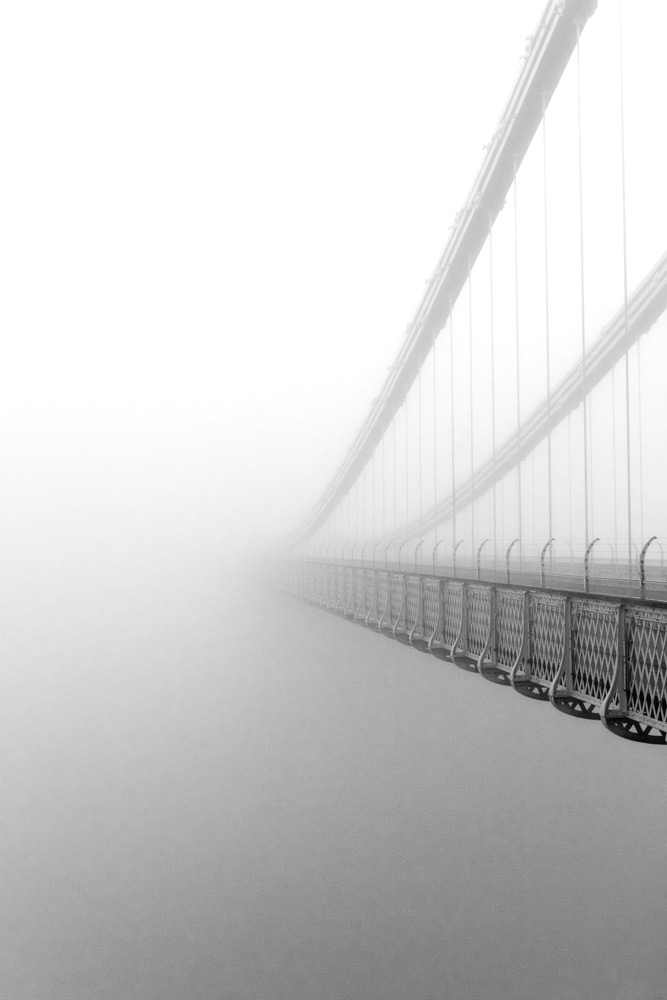
The Misty Bridge. This was one of my earliest digital images and I remember the day I made it quite clearly. I used to live in Bristol not far from Clifton Suspension Bridge that spans the Avon Gorge, occasionally heavy mist would settle in the gorge creating a strangely quietening atmosphere on a typically busy part of town. This particular misty morning I crossed the bridge to take the dog for a walk before work in the nearby woods. The mist was so thick the bridge just disappeared into the cloud halfway along and I was compelled to make something of it. The view was quite monochromatic but I converted it to black and white to emphasise the structure of the bridge and the way it vanishes into nothingness.
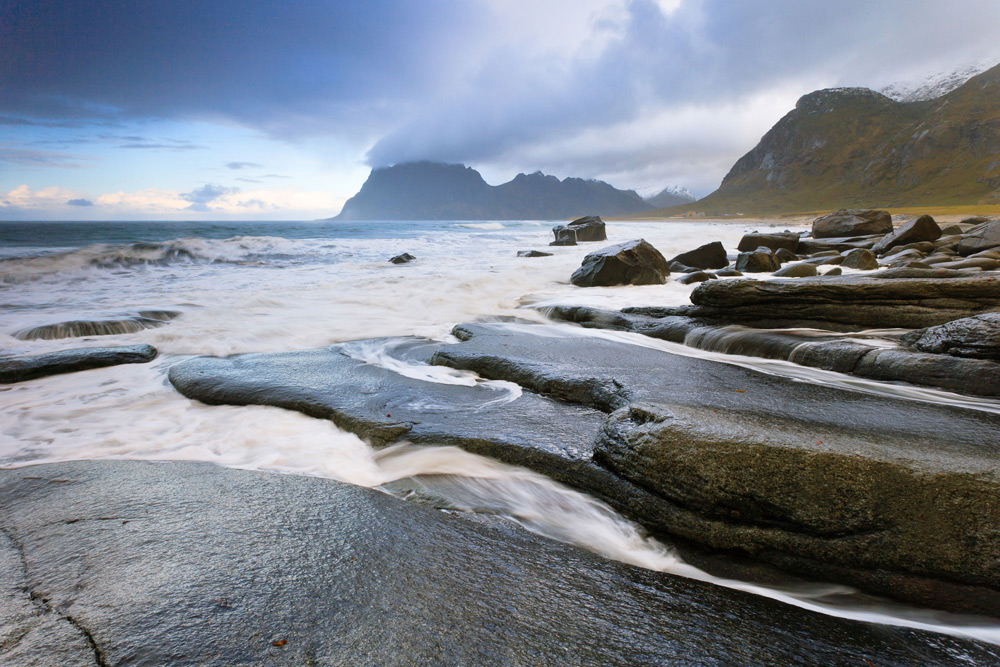
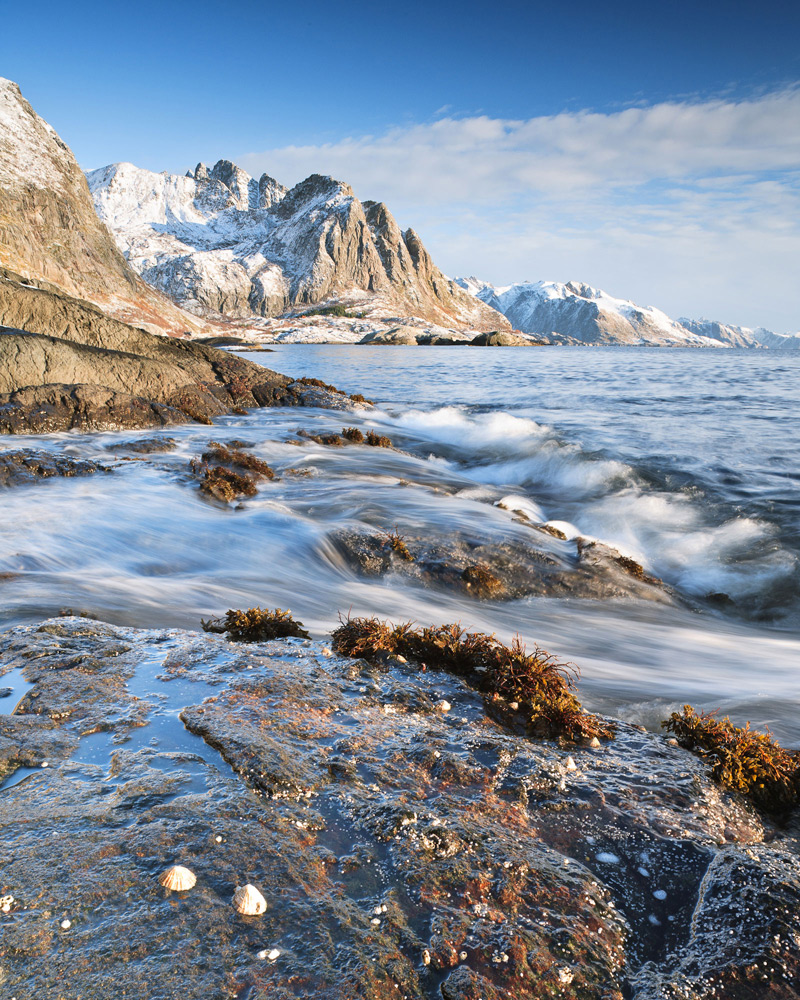
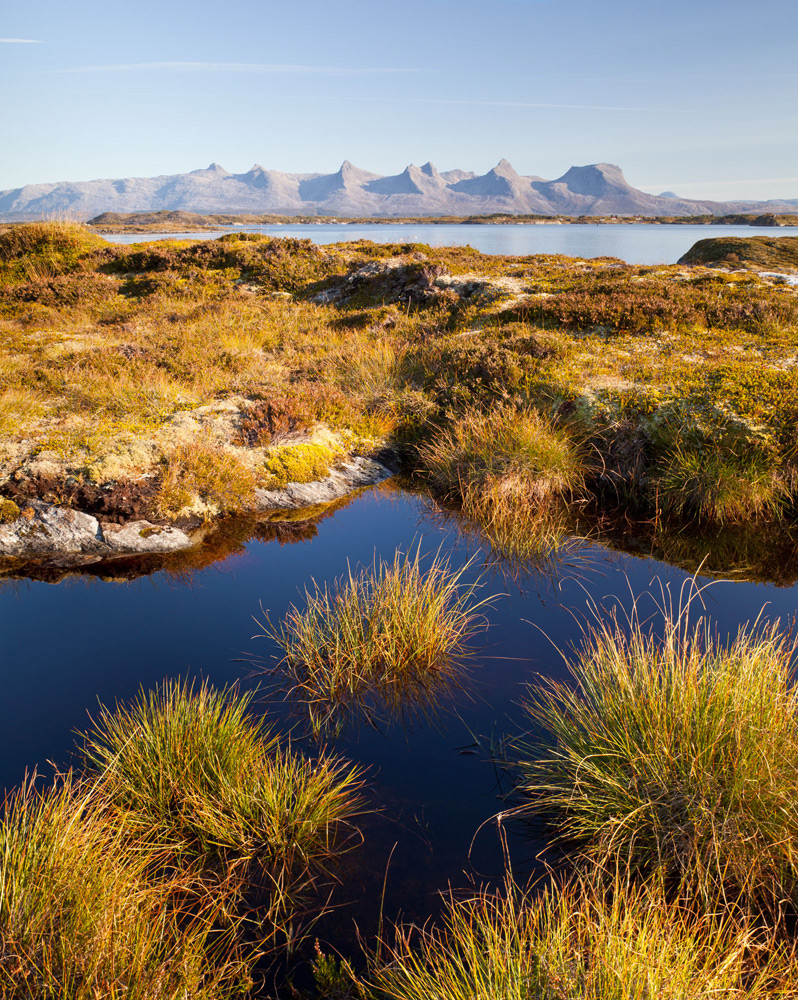
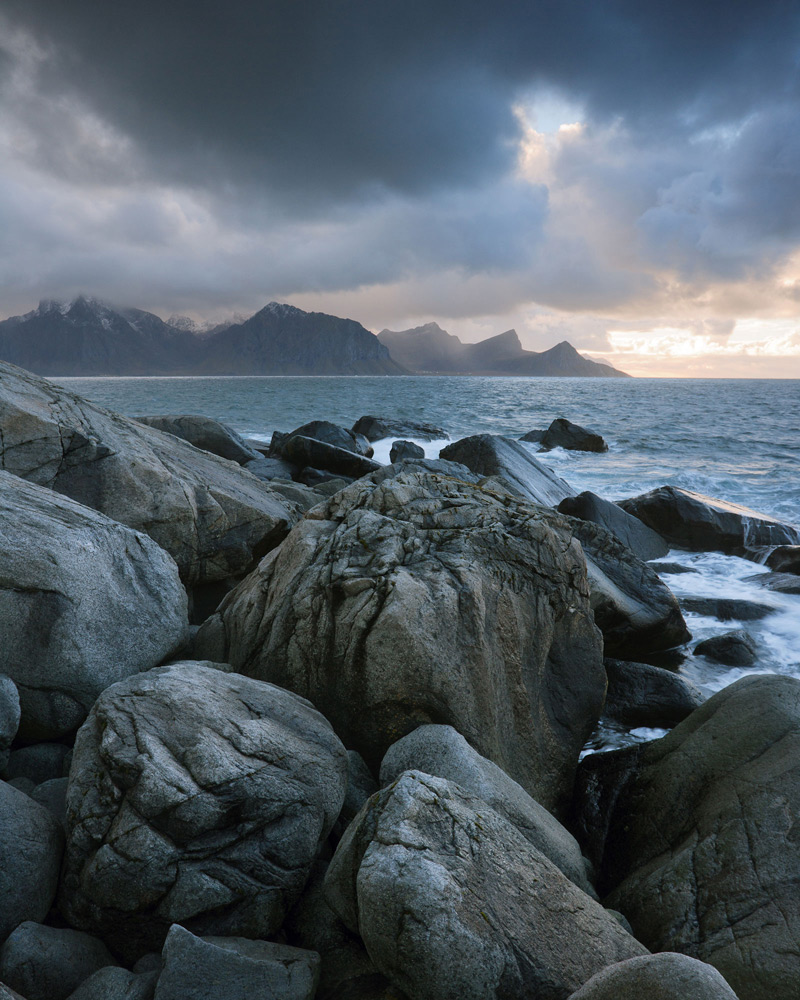
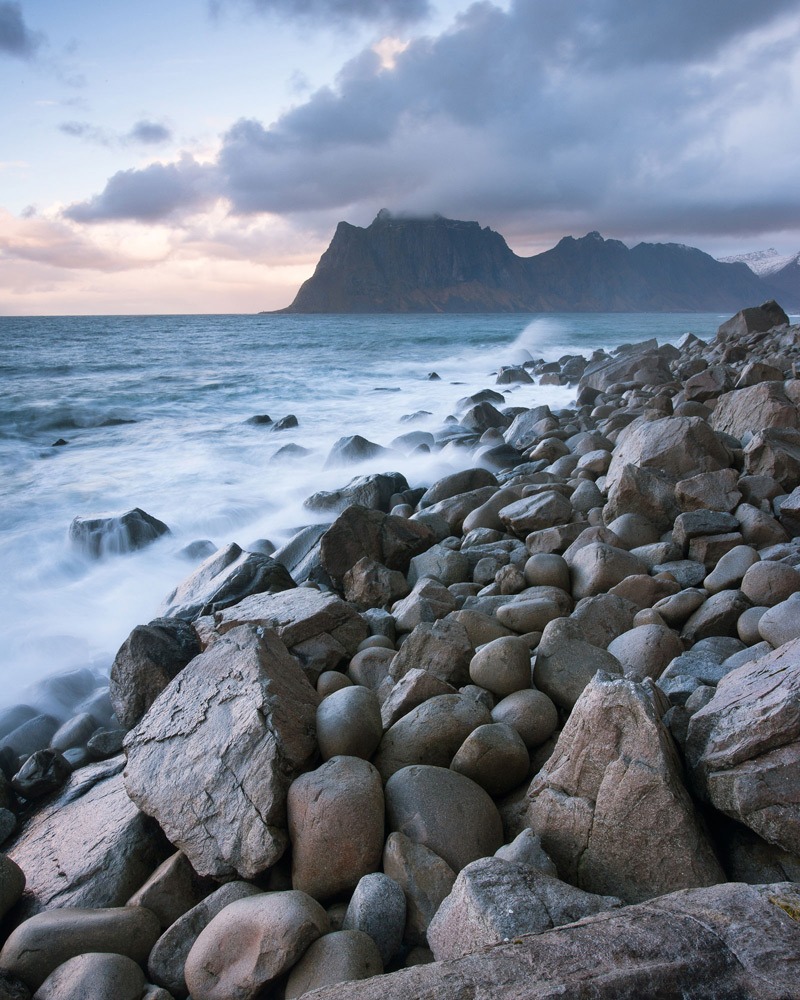
My final image is from Norway made on my first trip to the Lofoten Islands in the north west of the country, famous for their dramatic landscape of towering peaks and deep fjords. It’s an environment that has precisely what I love in abundance: mountains and water. On arriving at one small fishing village – complete with fish-drying racks, red huts on stilts and boats slowly bobbing in the harbour – I climbed over a rocky outcrop beside the road and dropped down to the shore. I remember standing looking at the view quietly taking it in, the gentle waves across the rocks in front of me, the warmth of the autumn sun (even at 5oC) and the clarity of the air with the chain of mountains disappearing off into the distance. Perching on a rock I set up with the 24mm shift lens with half an eye on the waves and waited for one to wash over the ledge (without giving me a soaking!). Blurring the water with a moderate shutter speed gave me what I was after.
If you were told you couldn’t do anything art/photography related for a week, what would you end up doing?
I think my penchant for being active would drive me towards something physical. For many years I trained to quite a high level as a rower and although the sense of accomplishment is an entirely different dimension to that of photography, I loved the way at it’s most basic level exercise is a fantastic form of escapism. I think it’s important to have something with which you can completely detach from every day life in some way and makes you feel good about yourself at the end of it. If I didn’t jump in a boat I’d either go mountain biking, climbing or simply get out for long walks in an environment I just love spending time in.
What sorts of things do you think might challenge you in the future or do you have any photographs or styles that you want to investigate? Where do you see your photography going in terms of subject and style?
As a photographer I think I am always learning and evolving and I would like to be able to combine my interest and past research experience in extreme environments with my photography. I’ve already travelled a fair bit in cold countries, such as Norway and Iceland, maybe I should try somewhere warm next? In a slightly different direction I’m now making short films which is quite exciting and I’ve also recently returned from Iceland and begun planning trips leading small groups there – watch this space! I enjoy learning new things and developing ideas around them so, who knows what the future holds.
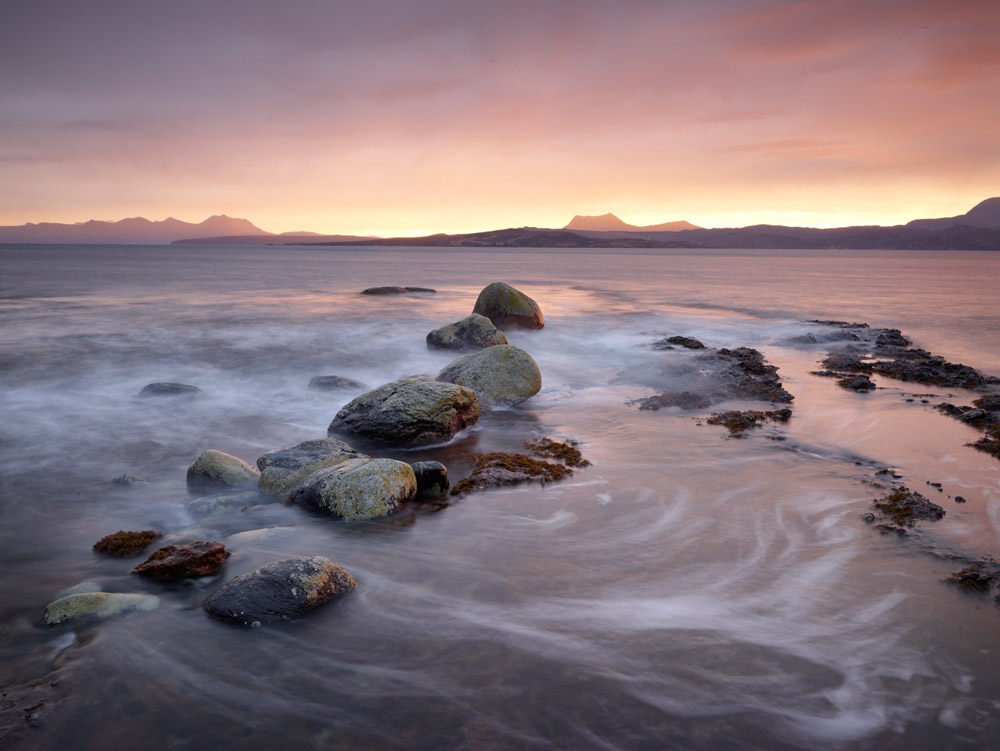
We've covered printing in a video with Joe before but with it being such a minefield it doesn't hurt to go over another example to perhaps pick up on a few more details. In this example, Joe is printing an image captured whilst on a scouting trip in Wester Ross whilst he was also testing out the Mamiya 645 camera with the Phase digital back.
The new iPad. Resolutionary, supposedly. But is it a big improvement for photographers? Well, hopefully this article will go a short way to informing you even if we can't tell you what the next iPad will be called (New new iPad? New iPad mk 2?). Firstly, it doesn't look much different to iPad 2 - it's slightly thicker, about half a mm, but it still fits in cases meant for the older iPad 2. It's slightly heavier - although I can only just tell when holding them in each hand; and the new one gets a bit hotter - but not beyond body heat in mine so far. Overall then, from the outside at least, there isn't much to tell them apart.
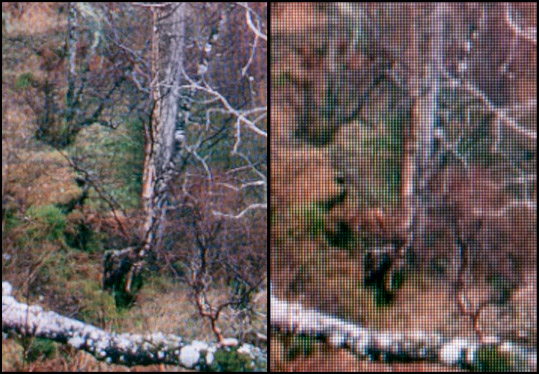
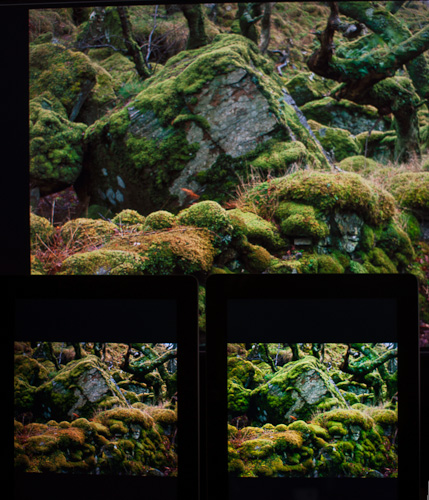
When you start the new iPad up though, it just looks crisp. Looking closer it's what you don't see that makes such a difference. Pixels.. You can't see any of them. In fact you can't really see any evidence of them at all. near horizontal lines that usually have anti-aliasing - jaggy edges - just look like smooth, crisp lines. Text looks sharp, easy one the eye and the icons have a 'depth' to them. But it's what happens when you upload some photographs that makes this a revolutionary device for photographers. The old iPad made photographs a pleasure to view and it was on a trip to Cornwall where I met up with a few other photographers that I saw my first iPad. Images looked vibrant - almost like a lightbox - and it made it a great device to share images with friends. The new iPad is almost indistinguishable from a lightbox though - images now looks amazing. Putting the new iPad along side the old iPad and it becomes clear just how large that difference is. Here's an idea of just how much the detail improves from the old to new. Bear in mind this is probably four times life size (otherwise you wouldn't see the gaos between pixels) and the new iPad image on the left is suffering from a bit of moire (I couldn't focus close enough with my lens to clearly make out individual pixels on the new iPad)
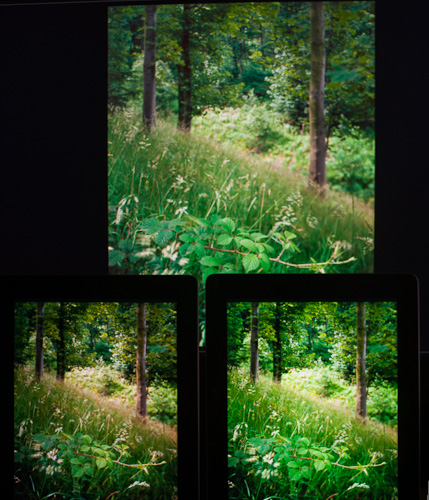
The best way to get an impression of sharpness is to load up an image onto your main computer screen (which I'm presuming is probably 1600px to 2000px wide and is about a 24" diagonal) and then step back until you are about three times arms length away from the screen. That's what the ipad looks like when you are holding it in your hand! Even then, the new iPad screen is 2048 by 1536 pixels - a higher resolution than most large monitors but in a 9.7" diagonal! But there are more things than resolution, how is the colour. Well, it's a mixed bag. If I was comparing it with commercial monitors I would say it's probably good but the big problem with the iPad is that you can't profile it. The good news though is that it's a substantial improvement over the old iPad in most ways. The 'gamut' is a lot better, saturated colours look great and subtle gradations look good. However, there are some colour shifts in the iPad's we own. I tried to photograph these and only a couple could be seen properly. The following are a couple of shots that did match what I could see visually. Old iPad on the bottom left, new iPad on the bottom right and my calibrated monitor at the top.
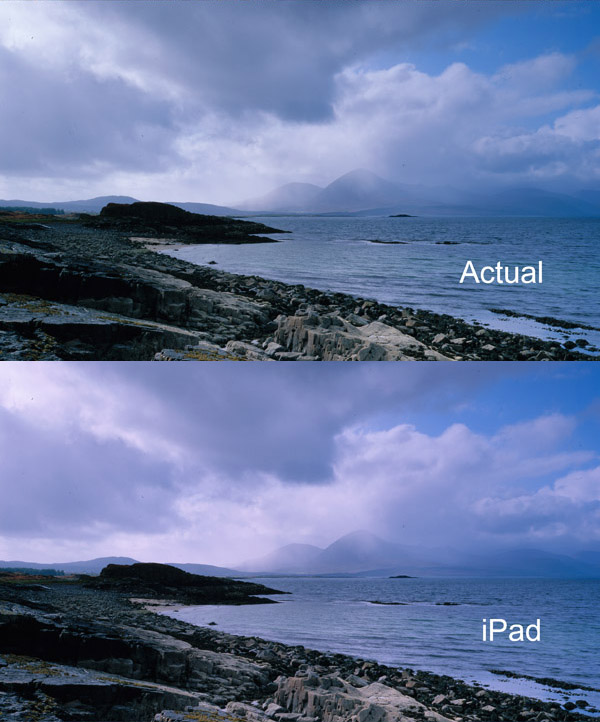
This first image is typical. The iPad shows an increased contrast due to the high gamma but the colours are fairly accurate and the saturation is in line with that increased contrast. The old iPad in comparison shows a generally warmer result with muted greens. Here's another comparison.
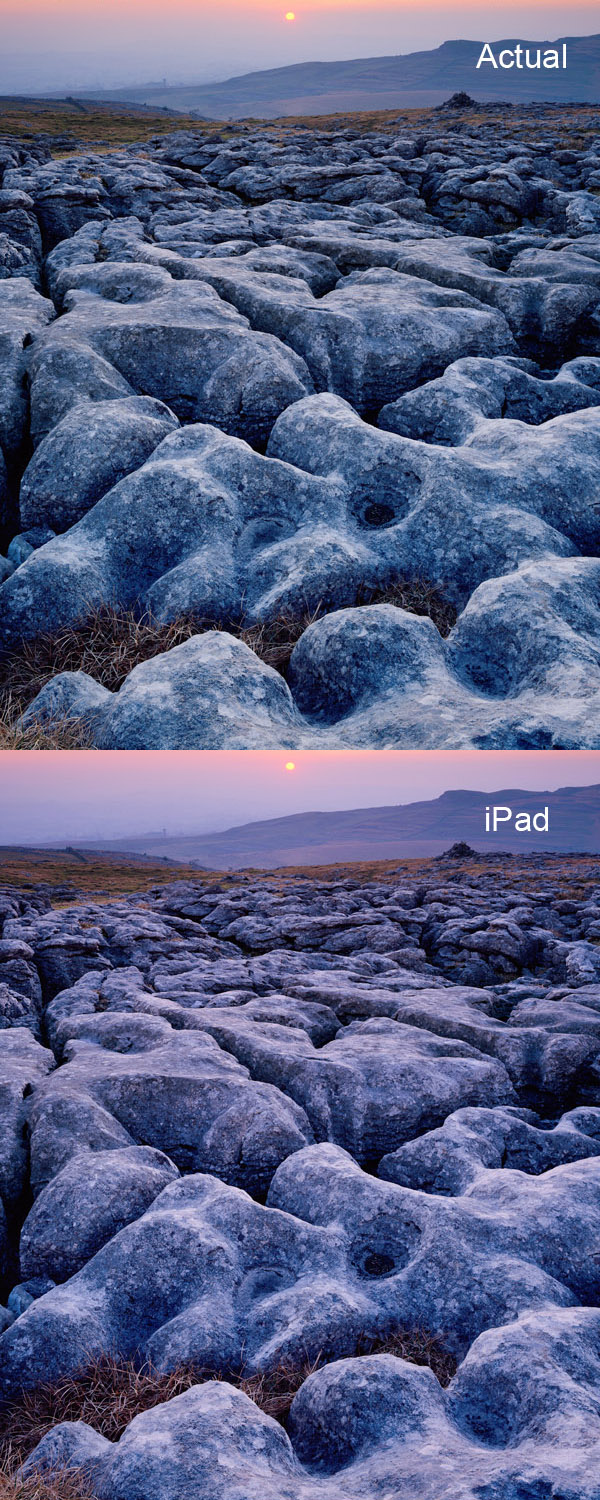
Here is another example showing how the new iPad has increased contrast but generally accurate colour. The old iPad 2 looks muted in comparison. I spent a little time matching a couple of pictures to show the exact hue shift on the new iPad. In general it has a warmer appearance but with a slight magenta tint, especially in the highlights. This is quite a strong colour cast but it mostly shows when you have neutral or lightly cyan subject matter (although this is by far the worst example of my library of large format images). If you want to use a portfolio on your iPad, it is fairly easy to create a curve setting in Lightroom or Photoshop to 'pre-fix' this to give true colour. Alternatively you could use the Spyder Gallery which is a Gallery which includes a colour calibration from the Spyder colour tool. It's annoying to have to use a single gallery for all your images however - hopefully Apple may include some form of ICC correction in a future iOS. So - in terms of a gallery tool, I would say that it's absolutely stunning. If only Apple could fix the colour calibration issue it would be just about perfect. I'll be testing out using the iPad as a 'live view' tool in the next iPad installment.
Would I recommend this as a photographic accessory? If you like to share you photographs with other people, I think this will probably end up more useful than a printer for many people. Oh, and it supposedly does more things than just being an amazing picture frame too!
I am a firm believer that limitation can feed creativity. Imagine if you were going out to make a photograph without any defining boundaries, the chances are the image could be vague and unfocused in relation to communicating the subject. Now imagine going out with a series of self-imposed constraints; automatically you will have to look harder at a subject to satisfy the criteria, and hopefully, photograph something previously unseen.
Being able to get your picture sharp where you want it to be is one of the key aspects of a landscape photographers craft. It is also one where there is a lot of misinformation and confusion. We hope to provide a brief overview of the different techniques accomplish this goal and to make this the start of a series of articles where we will dive into each technique in greater detail.
F16 3sec ISO 100. Raw file processed in Lightroom and Photoshop. Nikon 24-70 f2.8 focussed manually. No filters
It wouldn’t be an understatement to say that the Nikon D800 has been hotly anticipated. Since the rumours of a 36mp Nikon DSLR started to appear on the internet last year interest in this class-leading camera has been steadily building. Landscape photographers, probably more than most, have been eager to get their hands on it and find out if cramming 36mp into a 35mm format body can live up to expectations.
If you are like me you are always searching for the ‘goldilocks’ camera - the one that isn’t too large or too small, the one that can deliver the resolution to make exhibition size prints yet be small enough and light enough to be truly portable. I want a camera that I am comfortable working with on a tripod and one that I can use handheld for my urban landscape/documentary work. And to add more to the list of desirous features; can it deliver good results in low light and if needed can it work as an ‘action’ camera for sports etc. All this would seem to be an impossible ask but on paper it looks like the D800 could deliver the goods. The length of the waiting lists seems to point to the fact that a number of photographers feel it might be ‘the one’.
Luckily for readers of On Landscape, and even luckier for me is the fact that I have had one for over a week now. I have managed to get out and about with it and to use it in situations that are relevant to landscape shooters. Rather than a ‘button-by-button’ review this is aimed at seeing just how useable this camera is in the field.



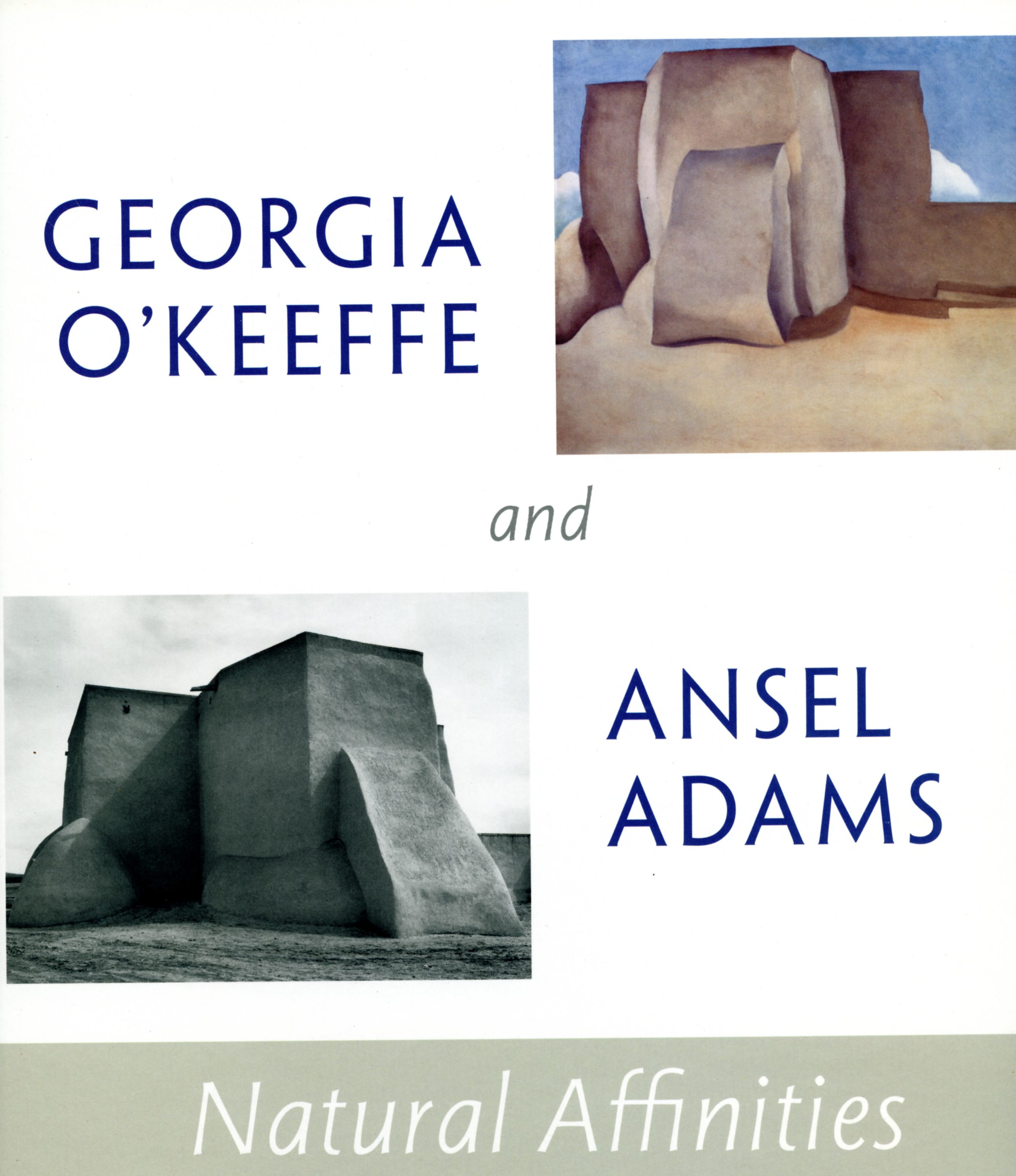 In a previous article about books and photography David Ward challenged us to come up with some helpful titles. One such could be Georgia O’Keeffe and Ansel Adams: Natural Affinities, published in 2008 to coincide with an exhibition in the USA of the same name.
 It was the harsh landscape of New Mexico which produced reactions in both painter and photographer. Red hot mountains, sunburnt forests and trees, deserts, weather patterns and adobe architecture were the subject matter. These are reflected well in the section of O’Keeffe’s work along with the sense of blistering heat. But not so well in Ansel’s section of photographs as many of the photographs come from the cooler and easier California. Some of the snow detail photographs look out of place. It would be fair to say that O’Keeffe’s strong colour paintings dominate Ansel’s black and white photographs. He admits that the South West belonged to O’Keeffe saying that “noone else has extracted such style and color, or has revealed the essential forms so beautifully…..” Of course Yosemite was Adams’ territory commenting that “there is no human element in the High Sierra – nothing like New Mexico”.
 The essays by Richard Woodward and Barbara Lynes explain their character traits, and there are excellent descriptions of their different motivations for being in the South West. In the case of O’Keeffe it was to get away from the ‘arty’ scene in New York and experience an isolation in which she could devote herself to her art. For Adams, it was an opportunity to meet some of the avant-garde New Yorkers, such as Paul Strand who stayed with O’Keeffe on occasion. Indeed it was seeing Strand’s negatives that did it for Ansel – their impact on him made him become a photographer rather than a concert pianist. Sharp focus and minimum manipulation in the dark room were qualities that stood out in Strand’s negatives.
 The feeling I get from the book is that it is more about O’Keeffe and her elusive personality than Adams. More assessment of their approach to art and photography would be of greater interest, rather than how they dealt with their fame. Both had a deep awareness and sensitivity to the natural world. The book would have greater value if this aspect of their lives was explored in greater depth.
 Adams as a personality comes across as more generous of his time with great importance attached to people he knows and loves. O’Keeffe on the other hand does not seem to rely on anyone – not even Stieglitz. She could devote her entire life to her art without distraction, unlike Adams who revelled in social interaction and his open house attitude.