on Distant Horizons
It must have been rather fab to research this, and it's terrific to encounter artists involved in the genre.
- milouvision, 11:20 16th Junon Camera Survey
It might be interesting to see how the votes would stack if you asked in three months to repeat the survey, I for one missed the original request. It's a very interesting survey and nice to see that Pentax still have such a large following, likewise the medium and large format categories, [...]
- Douglas Salteri, 08:54 16th Junon Is Adobe Creative Cloud Bad For Photographers?
Great article Paul! I hope Adobe will continue to develop Photoshop with new features for photographers. I would love some new adjustment layers, how about midtone contrast (a.k.a clarity)?
- Magnus Lindbom, 07:32 16th JunDo you manipulate your images? - a response
Joe Cornish
Professional landscape photographer and chairman of On Landscape.
Other articles by Joe Cornish
Very recently I gave a talk on behalf of the Beacon Camera Club at the Swan Theatre in Worcester. In the q&a session at the end, I was asked the (apparently innocent) question, “Do you manipulate your images?” In fact I had already covered this territory with some deliberation earlier in the evening, and the question reminded me, a. that we (ie people) often only listen to what we want to hear, and, b. that there remains a deeply-held suspicion and anxiety about photography’s relationship with ‘the Truth’.


An interesting article and of course it bring back the digital vs. film debate again for me.
Personally, I feel that anyone that hasn’t ever used film should give it a try. Having something such as an Ebony or a hasselblad where you have no lightmeter or histogram is always a good eye opener for people. As well, I think people need to get out with some film and capture those golden hours on something such as Velvia or Provia to see how it reacts with the colour temperature of those moments.
I keep wondering whether to get rid of my Hasselblad but an impending trip to Provence has made me think again as I know that any well exposed Velvia or Provia slides will knock spots of what I do digitally
Joe, a fairly rational assessment of current events (and the public mood). I am asked the same questions on every evening class I teach (adults on a fast-track to learn digital usually) but the question rarely rears its head in my 16-18 A level Photography groups.
I like to muse with all my students on the ability to manipulate time in image making – extending moments into distorting interludes where movement is recorded in a way that other visual media can’t really go to.
And your invocation of both Adams (the negative is the score, the print the performance) and Turner somehow highlight our times and appetites. At the very least, if the camera can’t capture what the eye can see, then fair play to the ‘M’ word. Now, where are those files for merging?
It would be very interesting to know whether there is a generational divide around this issue. If so, perhaps those who have grown up with digital will find the truth v manipulation debate irrelevant.
Brett, I agree with your example of time manipulation – very short or very long for example – which the camera frequently does. No need for Photoshop here. It’s simply a by-product of the photographic process.
And thinking of students, perhaps what is needed is more universal teaching of photography within all curriculums (although, dream on!); that way modern humans might then be able to fully exploit photography’s strengths and understand its weaknesses and limitations without having unrealistic expectations of its veracity. We might then realise that it is, for the majority, an artistic medium, with all the potential for interpretation and creativity that implies.
A recent student of mine had come to photography though her mobile phone (indeed it was a challenge to get her to use a ‘real’ camera) and when it came to planning her exam image, she decided, quite cool-ly, to do a mutimedia (photographic and painted) image using a print of a highly manipulated photo comp of multiple images as a base (despite having never seen a copy of Photoshop… she just assumed that what she wanted to do would be possible). It was rather ambitious, not something I would ever have attempted at her stage, but appeared completely second nature to her (and ultimately succesful, according to the external examiner). Despite many of her images during the preceding year not conforming to what we would consider to be ‘correct’ (e.g. unfocussed, underexposed etc) the exam piece showed that she had complete understanding of what she wanted to achieve when she was being ‘serious’ and had just had rather different criteria for judging the success of her preparatory work than I had. That, and my 5 yr old son’s relationship to photography have persuaded me that the cameraphone generation have a completely different relationship to photography than us oldies… and I am looking forward to when they come of age and their work hits the mainstream.
Oh and by the way Joe, truth AND beauty, in one issue?! Whatever next?
Good story Giles, and perhaps shows that instead of photography having reached some kind of plateau it may still be in its creative infancy after all. As for truth and Beauty, any references to Grecian urns (Keatsian odes) seems very insensitive in the current economic situation (as in, do Grecians earn?). Please accept my humble apologies. Joe
Oh dear, Joe. Have you been sneaking a peek at David’s joke book again?
Julian, I can understand why you would think this but I promise you David is not the only photographer with poor puns and bad jokes tucked up his dark cloth…
Oh… You mean the “Great Man of Landscape” and I have a sense of humour in common? That’s worrying!
Methinks you fear your comic credentials are being undermined Professor Ward?! By the sheep-sharp wit of yours truly? Fear not, I know my limitations
! And I am going to have to take Ian to task on that moniker… I get my leg pulled quite enough as it is with you around!
a friend recently told me that the ‘top’ and ‘bottom’ quarks used to be called Truth and Beauty, until they looked and just couldn’t find truth. perhaps photography is the same… and then the act of looking at beauty would transform it into something else (maybe even shroedinger’s cat) depending on who was looking and how. strangely, I don’t think this will be treated with as much seriousness as sub atomic physics.
Quantum mechanics may well be easier to understand and encapsulate than this particular enigma, so, great analogy. Can I have your permission to put that one in a talk?!
Of course you can use it. Amazed the comment got posted; i have real trouble posting fromt he mobile! But I do think there is some mileage in the analogy, in the uncertainty prinicple kind of way.
Aren’t there also some quarks called strangeness and charm? I can think of a couple of photographers who would fit those descriptions very well…
Oh yeah… but we’ve known about strangeness and charm for ages. What I like is that i suspect that the physicists knew that what is truth for one person could well be beauty for another. And photographically speaking, the truth that one person shoots might not be the truth that someone else wants to see. I might shoot the truth, but the whole truth and nothing but the truth? Never!
P.S. In the immortal words of Hawkwind: “did none of the astronomers discover (while they were staring out into the dark), that what a lady looks for in her lover, is charm, strangeness and quark?”
Ahh, Hawkwind, I think I’ve got this on a 7″ single somewhere in the loft…
Einstein was not a handsome fellow
Nobody ever called him Al
He had a long moustache to pull on, it was yellow
I don’t believe he ever had a girl
Hawkwind clearly didn’t know of Al’s supposed relationship with Marilyn Monroe!
I know, David. By all accounts Einstein was a bit of a goer. However, I do think that the physicists appreciate that strangeness and charm, truth and beauty are very closely paired and sometimes interchangeable… we must not forget that quantum physics is as creative an endeavor as landscape photography.
By the way… Copernicus had those renaissance ladies crazy about his ‘telescope’.
“Copernicus had those renaissance ladies crazy about his ‘telescope’.” Oooh, err missus! Quite a “Carry On” moment.
I like the notion that photography and physics might be equally creative endeavours
Certainly cutting edge scientists have to think creatively… and some of the theories are simply incomprehensible unless [despite] thinking well outside the box. And they also seem to recognise beauty, indeed one of the criterea for a ‘true’ mathematical theorem seems to be that it beautiful.
… and Gali-”LAY”-o had a name that made his reputation higher than his hope.
Sadly a lot of particle physicists seem to prioritise beauty over any sense of practical truth though.. Not sure where the parallels there are
Oh and beautiful photographs have a practical application? Apart from covering up cracks in the wall plaster?
a primary distraction from the inherent pointlessness of it all… oops.. sorry for the brief existential crisis. They’re actually just good fun to make and look at.
And i expect if you asked all the thousands who work at CERN and who design and build it, they would say the same… and it pays the bills, which is pretty practical.
On a more serious note David: you never did respond to my comment/criticism of your comment about a picture having failed if it needed accompanyng text? My comment was that your photos (certainly in this forum) are supported by a text in the form of your often published opinions about what you pursue in your photogrphy…?
I was struck by Joe’s reference to the ‘natural’ palette of the film he was using. He was, of course, talking about the inherent characteristics of the capture medium. But to many people, the enprints from the high street processing lab or the jpgs churned out by their in-camera processor are natural. No-one seems to have a problem with this, despite the fact that the manipulation here is carried out without any human intervention (or even awareness!) whatsoever. Surely they would prefer their fine art photographs to be manipulated by a human being, and preferably the photographer who took them, rather than a machine. After all, you would expect an artist to mix his own paints and not just stick to the ones in the paintbox!
Since my original article (referred to by Joe, above) I have been impressed by debate it engendered and correspondingly by the number of dyed-in-the-wool truth-seekers amongst my photographic acquaintances who have started to lean with the wind to discuss (if not quite ready to admit and adopt!) that there are circumstances where minor artistic fibs are valid and forgiveable in the ‘honesty’ stakes. I am humbled that the Great Man of the Landscape considers that the two-in-the-morning, red wine-fuelled conversation he mentions was worthy of being remembered! For my part, I will not forget it: it was vibrant, enlightening and showed me that we are none of us too far apart in what we try to do. I repeat my previous mantra that if we are makers (for pleasure) rather than just takers (for record) of pictures, we should be allowed nearly the same set of rules which constrain our brush-bearing friends in the world of the Real Canvas. Unless, of course, we purport by dint of our vocation or specific genre to be purveyors of pure documentary or reportage work.
Joe
One thing I learnt in my previous profession (economics) from an old Cambridge sage (Joan Robinson for those who want to know) is that a 1-2-1 map is worthless and impossible. A map can not present all the details of reality, if it did it would be of no value as a map. A still photographic image can not possibly replicate our real time experience of the world. While there is common ground between our experiences of the world it varies in very significant ways. We may share pleasure in the scene before us but each experience is more or less unique. Equally when we look at a photograph our experience will vary across viewers. I look at Joe’s photographs I think “I wish I was there” – ok “I wish I had taken that photograph”. Am I seeing the “reality” before Joe when he exposed the film/sensor? No I am seeing Joe’s presentation of his experience of that moment. With Joe’s photographs I get a sense of what it was like to be at that place and at that time. It is that subjective response to the photograph that is key. If Joe’s photograph appeals to a wide audience then it is appealing to a deep sense of visual worth. Is that “reality” or a common / joint sense of visual pleasure? I have to suggest at best it is the latter. We do not experience the “thing in itself” we experience our reaction to the world. To aspire to a universal “true” experience of the world is dangerous as it requires some form of dictatorship that defines what is “true”. Let freedom reign and let there be more views of the world so we can enjoy their diversity, each giving an insight in a common scene.
What can I say? Here here! The 1-2-1 map analogy is fantastic; never thought of it that way before.
Perhaps if we replaced ‘truth’ in this debate with ‘connection’ that might be something worth aspiring to.
Took me a while to register the reference to ‘connection’ here. Internet cut and paste to follow! No apologies: Quote from E M Forster (Howards End) stolen from a music site I found using google!
“Mature as he was, she might yet be able to help him to the building of the rainbow bridge that should connect the prose in us with the passion. Without it we are meaningless fragments, half monks, half beasts, unconnected arches that have never joined into a man. With it love is born, and alights on the highest curve, glowing against the gray, sober against the fire.”
– Chapter 22. “He” is Henry, “she” is Margaret.
“Only connect! That was the whole of her sermon. Only connect the prose and the passion, and both will be exalted, and human love will be seen at its height. Live in fragments no longer. Only connect, and the beast and the monk, robbed of the isolation that is life to either, will die.”
– Chapter 22. The “her” is Margaret. The “beast and the monk” refers to the text mentioned just above.
My take on that in this context? I look at Joe’s photographs and my passion for the subject matter, the landscape, is stimulated. Joe’s photograph is “prose”, the vehicle of communication. Lying behind it is a common passion for the landscape.
As someone who wears glasses, my ‘reality’ is already manipulated!
It strikes me that ‘reality’ is a just a fashion or even an illusion. As light is forever changing, along with everything else in this world, it is impossible to ‘go back’ and check that reality was captured. There is no constant, someone else’s point of view can never be achieved exactly.
Just in terms of the media your ‘reality’ is presented on let alone captured with, is a huge barrier. A monitor (led, lcd), paper (endless varieties), canvas (varying materials and ‘tooth’), projector, t.v. screen, all affect the end result. You could turn to words to describe reality, but that is also subjective. Impressionist painters tried to capture the ‘true’ effects of light on the environment, but although natural in appearance are not necessarily a true portrayal of reality. The camera of course is not the human eye and will instantly convert colour and focal length whatever the style or make.
Even our eye’s ability to override specific lighting conditions can utterly fool the brain as to the true nature of the colour of things (as discussed by David Ward previously)
So how can you ever say what reality actually is, or was, in a definitive and accurate way? Every persons brain perceives the world differently due to their unique set of experiences leading up to that moment and cannot be synchronised in to a universal ‘human perception’. Perhaps the mass witnessing of an event brings our perception closer to the truth. I am not trying to make this topic so all encompassing, but at the heart of the argument is the fact that to understand if manipulation has been applied then you must know what the reality was it changed from? I think Joe has the correct point of view (philosophy) on this subject. Experience in the field over a number of years and a desire to capture the scene as close to reality (as remembered at the time) will eventually lead to perhaps the closest representation of reality we will ever get to. For what it is worth…
Great article
I agree with the last two posters (Abbeyfoto and Joe Rainbow), it’s not so much manipulation as the photographer putting their own interpretation on how they saw the reality. It’s subjective.
Film is manipulative anyway – Velvia is one Fuji interpretation, Provia another etc. They are all manipulating the reality.
Probably shooting Raw and using Photoshop is closer to reality than choosing a particular type of film. With Photoshop you have the opportunity (within the confines of what the various PS tools will do) to more accurately add your own interpretation of what you saw. With film you were trying to get close by using a particular film, a limited range of filters, but the tools to get close to how you saw it are far more limited than with Photoshop.
Another enjoyable article thank you Joe!
Aside from the basic ‘should you, or shouldn’t you’ manipulation debate, I believe that if more people could see how sensitively you ‘make changes’ to your scanned trannies or digital captures, I can only hope they might appreciate what manipulation really means.
I have previously enjoyed your video’s that show you working on images (both yours and others) and found it absolutely fascinating how you can make subtle amendments to those files in order that viewers (who obviously were’t there at the time) make better sense of what they are looking at.
For me I keep thinking how photography nowadays is like writing. You can write using a keyboard or use a pen (digital vs ‘analogue’). Once you’ve created your story (image), it does really help to go back over it and amend both the basics (punctuation etc) along with making other editorial changes to make the story more impactful / better – and obviously people exist who’s sole role in life is to do this!
Unfortunately I fear that what I have just written above is just the writing bit and requires serious editing and finessing
Thank-you Nigel, and indeed to everyone’s thoughtful and insightful comments so far. I have actually found these responses have done a lot to help me understand the complexity and tangled web of issues that surround this debate. Which I suppose is at least partly semantic.
The analogy with writing is spot on.
Joe
I perhaps have an overly simplistic view on this . To me a photograph is a moment caught in time, what ever the set exposure. Working LR or PS to work that moment is ok with me (cloning excluded) The moment I start mixing two moments or two photographs the image is unreal, as the moment never existed.
This view is perhaps clouded by my experiences 14 years ago, were somehow I managed to get a job working for a German pre press company.
My job, take images from fashion photographers – manipulate the images to give the models tans, a nip and tick here and there, and in some instances give models the legs and torsos of others.
Weeks later I’d see those images in catalogues presented as if those models were real. I knew this was of course not the case.
Hi Pedarmac – sorry to be late replying to this one but when you say that a photograph is a moment caught in time, shouldn’t that really be a series of moments caught in time. For instance with a long exposure, lets say one of a minute, the image represents both the start of that minute and the end of it. Is it any less valid to take two shots of 1 sec exposure at either end and to blend them? Not wanting to be pedantic – just another way of looking at it.
Excellent article, Joe! Isn’t an image by definition a simplyfied representation of reality? It can, by definition, never be realistic!
Super article Joe, and I really enjoyed the comments so far. Sure there will be many more!
Thank-you Steve, Carlo. One further thought that occurred to me last night as I watched an extraordinary sunset sky that made the showiest spring flowers look shy and retiring; part of our problem is, not only do many folk not take account of the extraordinary colours of nature, but neither do we necessarily always have the means to reproduce them.
If we take a slightly bizarre newspaper perspective on this for a second … imagine you are reading your (coffee break) soaraway Daily Sunset for a second (I know, I know, you’re a Nature’s Guardian reader, but bear with me), and you turn to page three to see the stunner (a sunset of course!) on show. I suspect I might find myself thinking “Phwoar! will you look at the out-of-gamut area on that!” In other words, it’s hard to believe that we are looking at is the real thing. Sadly our soaraway Daily Sunset does not have a very well colour-managed profile… and printing on blotting paper doesn’t really help.
Joe
I can only applaud the reply from Abbeyfoto. The “problem” for photography is that we have chosen to express ourselves as artists within a medium founded on its verisimilitude . We seem to find it difficult to escape the argument either amongst our peers or with our audience.
The realization of how beautiful the world is hit me hard 12 years ago whilst traveling around Australia. I had a 35mm film camera and began taking general photographs of things like the sun setting, the blue ocean, the red soil etc. Before this trip i never paid too much attention to the Landscape, but as i began to look i was amazed at the vibrancy of the world, the colors, light and textures fascinated me. The more i looked the more i saw. The act of making photographs was secondary to experiencing the landscape itself. The camera served as a tool to help me appreciate what i was experiencing it was almost as if i couldn’t believe what i was seeing, so i photographed it to prove it to myself. Over a decade later I’m still hooked, although recently i have found myself rejecting photos during the editing down process that are “too colourful” or “too vibrant” as people might think I’ve photoshopped it….. what has the world come too when you have to dull down your memories, in order to believe them? That’s it I’m not letting the Photoshop debate ruin my memories! Like it or lump it they are my photographs, believe them or not, i don’t care they’re mine.
Don’t get me wrong, i use Photoshop to help render what i see, but its the photograph that doesn’t live up to the reality not the other way round. To say you can enhance nature with a computer program is ridiculous, most of us have a hard enough time just trying to capture a photograph that does it justice.
Agreed, the challenge for us is to use the editing process in a way that is consistent with our memories and creative instincts. Sometimes that means working around the limitations of the process, whether that is the original film, or a digital file, or whatever. This is especially true with regard to colour. Like I said, Turner was scorned by many critics, critics who apparently had no memory or experience of the colours of a sunset sky. Crediting Photoshop with these colours is following the same blinkered view of reality.
Perhaps if the word ‘manipulation’ was changed for the word ‘editing’ we might make some progress.
Do we really need to go this indepth analysing what we do? I just thank that great God in the sky that I get to do this as a job.
Having worked in an office for a number of years it finally got to the point where I was spending more time staring out the window than at the screen.
When people look at we do and believe it to be unreal then too bad for them for not putting in the effort to get up at silly o’clock to see the wonders that mother nature bestows upon us.
I distinctly remember speaking to a lady in the office I worked in who was in her mid 40′s. She just been on holiday to Greece where she said it was the first time she had sat and watched the sunrise!
Hopefully, through what we do we can encourage others to get out there and do the same thing then maybe they will realise how colourful mother nature can be.
Oh absolutely some of us do [need to analyse]. Apart from the fact that is fun, I personally fiund it very inspiring to chew the cud good and proper. Being challenged throws up new ideas, and possibly also forces me to throw away some old ones as tired and out of date.
This is true and I do analyse what i do to an extent but I think going too far with it takes away the fun for me.
I don’t mind being challenged and doing magazine work has certainly forced me into improving what I do as it is going out to an “audience”.
For quite a while, I never used to photograph people. I’m certainly no portrait photographer. However, I do love photographing people at work and even more so people who are artistic in what they do.
Back in January I did two shoots. One in a bakery and one with an artist. The bakers were easier as they were so full of energy. Finding imagery for them was quite a simple task. The artist took much longer because she was very meticulous and because of this it also took me a lot longer to find that groove.
And are you going to get yourself a website Giles? I saw your Facebook stuff and loved it. I feel it’s a shame if it’s only being showcased there.
The website thing is a bit of an issue at the moment… distinct lack of time. It is my project for the summer, although the way things are panning out it looks like i will have very little time then either. I do have a veeery old and rather out of date website, which is still up and not hard to find
but is is neither relevant to what i do now, nor relevant to how things should look these days.
It is a good question: which is more liekly to drive me insane, not taking photos or not sorting out a site in which to display them? Given time constraints they are kind of mutually exclusive.
I know what you mean! I need to sort out my website with new images but it is time.
Right now I’m trudging through a backlog of images from April onwards. It is driving me insane as up here in Tours the weather is gorgeous and I’m conscious of that and my day to day stuff really has to be done.
Thankfully, in a couple of weeks the first of a number of trips will beckon: Provence; Florence; Salisbury (well you gotta go home sometime!) plus the Lake District in October.
Of course, once that lot is over will be back to the grind of sorting through images again.
On one level the question “do you manipulate” is just hopelessly naive. We all manipulate and always have. Choosing Velvia rather than Provia affects the quality of the final image and therefore is a form of manipulation. Making choices about contrast, saturation and so on is different only in degree. No photograph can be perfectly “objective” or neutral, any more than any description in text, or a map, can be. They all involve selection and interpretation.
It’s all relative and conditional, but that does not mean there’s no such thing as truth. If I look up on a nice sunny day and say the sky is blue, you’ll probably all agree with me. That doesn’t mean that your perception of ‘blue’ is the same as mine. But if – in the same conditions – I say ‘the sky is red’, you’d think I was either mad, lying, or suffering from some interesting affliction affecting either my visual cortex or my speech and language centre.
If we recognise that photography is an interpretation of the world, then there is clearly room for a wide range of interpretation. I don’t have to like it to respect it. The current zeitgeist, if you trawl Flickr or look at the majority of competition winners, appears to favour highly saturated and punchy images. I tend to shy away from many of these, and even more from the wilder excesses of HDR, but maybe these “exaggerated” images do help some people to see more of the richness of the world.
What is perhaps a separate issue but is often discussed, and is particularly relevant in more commercial contexts, is the sort of manipulation which involves cloning or otherwise removing unwelcome elements of the landscape such as pylons or wind turbines.
For personal work this is perhaps a personal choice but for me photography is about my personal response to a place and time, not about bending reality to what I would like it to be. But several times in a commercial or editorial context I have had discussions with clients and designers about this. I think it’s wrong, and conceivably actionable, in something like a tourist brochure, to present a place as you might like it to be and not as it is. Happens all the time, but that doesn’t make it right. If you as the Tourist Officer for X think that a windfarm on X Hill makes the place less attractive to vistors then you should have made that case before the planning committee at the time. You can’t, five years after it was built, lie to potential vistors by presenting a view of X Hill with no windfarm.
I point out to my students that the brain manipulates things anyway. In fact, the more you find out about vision, the more it seems the brain is the most advanced version of Photoshop ever.
That apart, my standard of “truth” is defined by my photographic intention. I would like everyone to see the beauty in the natural world as I do. To do this, I have to go a bit further than the car park, get up a bit earlier, stay out a bit later, crouch down, climb on something etc. Then I present the results to anyone who’ll look at them in the hope that they too will go and see this “other world” which, up until then, they hadn’t appreciated was there. But, as my landscape photography is essentially a recruiting tool, the final images I show have to be possible. In other words, can they go and see it for themselves? If they can, then it’s a good enough truth.
Just got me thinking about the influence of raw capture in this debate. Perhaps an assumption that raw needs tweaking, needs computer time, needs a degree of personal “remembered vision”, leads us inevitably down a road of manipulation as the norm, at least amongst “serious photographers”.
Really wish I could scan film, as is without trying to guess what I saw ? long ago. So (for me ) the scanning process is a bit like raw capture, an assumed degree of tweaking to try to get back to the slide I already have.
In many ways it’s a shame that we’ve saddled ourselves with the ‘m’ word with all its negative connotations, since most of the time what we are doing is ‘enhancement’ – applying tools creatively to subtly convey our own thoughts about, and interpretations of, the original scene.
I shoot film (mixed in with a little digital) and since moving away from contrasty transparency film to the more subtle delights of colour negative, I find myself very much in the position of the digital photographer using raw. In fact, given that the colours in a negative are hugely difficult to interpret from viewing the original, I’m actually at a disadvantage in that I must first perform some basic processing on my scans even to be able to see the image ‘properly’. So, whilst I shy away from the ‘m’ word, it would be hypocritical of me to suggest that image enhancement is wrong.
Where I draw the line is in changing what I originally saw – moving trees, distorting landscape features into more ‘aesthetic’ shapes or even adding in elements that weren’t there at the time of shooting. For me that goes against the whole documentary ethos of photography. In other words, the result must be understood by the viewer to have a strong relationship with the original scene. To break that relationship is to deny the main strength of photography as an art-form, imo.
It’s interesting that I’ve become a lot better at ‘reading’ pictures since I’ve been working with neg. I’ve also gone back to a lot of transparency work recently. Quite often quite some large tweaks to the transparency scan can transform a picture for the better where I would have left them alone before.
I agre with the last but I will rebalance light using dodging and burning to emphasize/de-emphasize curves in the landscape.
Julian.
” … that goes against the whole documentary ethos of photography.”
Are you sure that documentary photography is the only photography? Is it less valid to have an aesthetic purpose, a graphic purpose or an emotional purpose divorced from the documentary purpose? All photography is manipulative – it’s a two dimensional representation of what may be a three- or four-dimensional reality. All selection distorts reality – elision subverts inclusion
Fundamentally, all the camera can do is record reality, within the limitations of whatever recording medium is being used. Therefore all photography is essentially documentary in nature – at least in terms of a latent image. Now, if the photographer wants to take that latent image and apply any number of processes to it, that fundamental connection with what was photgraphed, that record of the photons hitting the sensitive surface at the time an exposure is made, is slowly eroded until it can disappear altogether. And it’s at this point, the point at which you lose that sense of a direct connection with reality, that you no longer have a photograph. What you have is some sort of derived artwork.
Julian.
Surely that is too simple, Julian: ‘…all the camera can do is record reality…’ The film records light patterns that come through a lens. The lens is already a form of manipulation – you might be using a wide angle or a telephoto, for example, and perhaps you have an ND grad to balance out the bright skies, or a polariser to help with water reflections etc. Even if you use a ‘normal’ lens and no filters, the whole process is still about transforming a three-dimensional scene into a two-dimensional image, which is not a record of reality. For example, think of the number of trees growing out of people’s heads in poorly composed portraits – of course we know that trees don’t grow from people’s heads in ‘real life’, but the act of making a photograph is already a form of manipulation of a scene, even if it happens inadvertently.
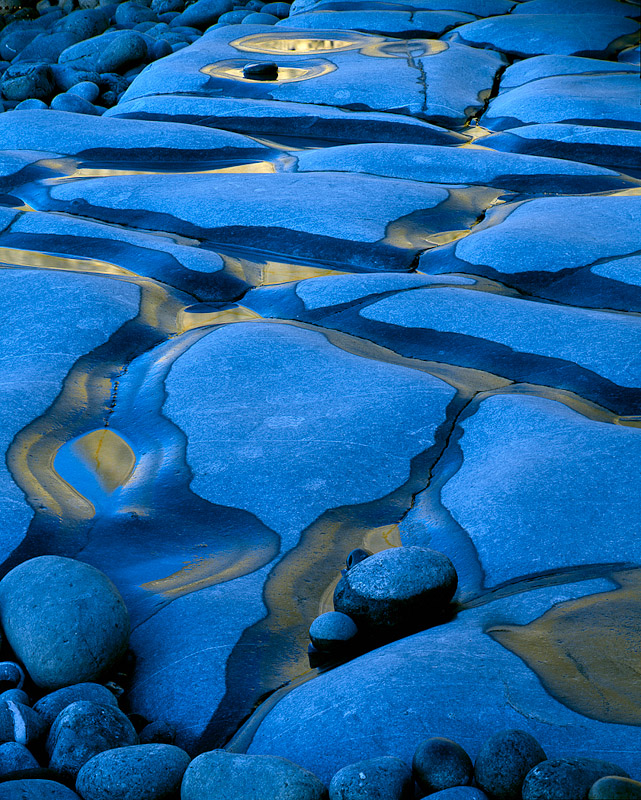
So yes, some kind of connection to the original scene is something that one might aspire to, but even that might not be a terribly useful marker as it raises another issue: using that criteria, is an image of e.g. a tree trunk no longer a real photograph if it is taken with a macro lens that shows detail of the bark that we would not necessarily recognise with the naked eye? Perhaps a rock formation might become more ‘abstract’ than ‘real’ – Joe’s second image here is moving in that direction – and the connection to the original scene is then perhaps becoming less tangible.
I think Joe’s original comment about believability is perhaps a more useful framework. After all, we recognise the silliness of the tree growing from a person’s head – even if it looks as if that is the reality – precisely because it’s not believable: our brain tells us that this can’t actually be right, it can’t actually be believed, because we’ve never encountered such a thing. The question then remains: how much colour/shape/tone etc. editing can be undertaken before the image becomes un-believable? And that, I’d argue, is entirely subjective.
Well, if we’re going to be pedantic about it, our eyes and brains are not entirely without blame, either. In fact, what is reality?
But the point I was making about the ‘documentary ethos’ of photography goes back to the fact that, unlike other visual arts, a photograph is a direct record of the photons which struck the recording medium at the time the exposure was made. Unlike, say, a painting which can be created over days, weeks, months even, a photograph captures a precise period of time. Furthermore, a camera must be present to record the scene being photographed but a painter can paint from memory, if he so chooses.
This is what makes photography different; it is immediate and is perceived to have a much closer connection with ‘reality’. This is what I meant by the ‘documentary ethos’ of photography and this is why it has a greater ‘believability’ about it. Push that too far and you risk losing the trust of your audience. And that, I think, we can agree on…

… and painters routinely move stuff around to suit their compositions, to the extent of including elements from other locations entirely. Doesn’t seem to make *their* work bogus.
Oh, and most oil paintings anything more than a decade or so in age will not even be the colour they were painted, as the oils and varnishes go brown with age
No doubt my lack of experience, confidence (and knowledge) but it can be difficult to define the line dividing an “honest” starting point, and manipulation. The process of raw development, or scanner to screen is a broad area, very easy to over develop at this point before having a proper look at the “honest”; “as is” or “as was” starting point. Though I expect this is an outdoor photographers problem, I anticipate the studio based people have sufficient control over things to be sure?
Great article Joe and I very much agree with some of the thoughts about interpretation and photography – intention is key but the end result must necessarily be some kind of interpretation, depending on our vision and the tools we use.
I also think that interpretation is key in terms of that complex beast that is the English language. If you look up the word ‘manipulate’ in the Oxford Dictionary, it lists such phrases as ‘deal skilfully with’ – in general, positive connotations. However, there’s no doubt it’s a term that can be used in a far more negative sense and so interpretation comes into play.
Just a thought to throw into this hotly debated topic:
Capability Brown was responsible for altering huge areas of natural countryside to please the viewers eyes. Although still ‘real’ it is not entirely natural. The manipulation just happened at an earlier stage.
I think film is likely to be closer to reality than a still image. Personally, as soon as I am aware that the photographer is more interested in the photo than than the place or subject, I feel ‘manipulated’ myself and less interested as a result.
The whole issue revolves around the premise of cameras recording reality in the first place. Once this obstacle has been hurdled and the viewer appreciates no camera can truly do this, then it is a question of post processing believability and account from the photographer. I really like it when a photographer says ” believe it or not, this how the scene really looked”. I am thinking of Joe’s own American sunset image from earlier in the issues. The sky is seemingly unbelievable, but due to past experience and trust in the ‘artist’ I am happy to believe in the images reality.
One that could run I feel
A couple of quotes from this fascinating series of comments: from Joe C we have “But I remain committed to a ‘believable’ rendering of nature in these pictures”
I couldn’t agree more: as long as the manipulation, enhancement, correction, adjustment – call it what you will – is believable to the viewer, then probably all is well. With the exception of mixing elements for different images, taken a long time apart and in very different conditions, when the result is some form of creation generated from photographic origins when I begin to get very uncomfortable. Thanks to Jools B for raising that. Though, and I am half-surprised at myself, Ian Thompson’s b&w creation from more than one photo referred to above is, to my eye very believable and so I am willing to accept it.
From Neville Stannik: “can they go and see it for themselves? If they can, then it’s a good enough truth.” Now here I rather disagree: a lot of David Ward’s work is such that you can walk right by it and never see what he saw. Yet his work is very believable even though it stops you in your tracks. I think that the key is in selective framing based on thoughtful seeing and rendering tonal values so as to guide our attention to where he wants it in the picture. Manipulation? Yes. But not so much that it departs from what was physically there in the field.
Now like Mr. Barkway I have started to use colour neg extensively but I have not yet gained enough experience to judge a picture just by looking at that orange masked film (I find B&W film much easier to decipher). So only when the film is pre-scanned and on my screen can I begin to think about how I want the final result to look. And sometimes my memory fails me (it’s an age related thing….) and if I have a digi “sketch” of the same subject, or even a positive transparency, I use that as my base “reality”. However, sometimes I prefer the softer look of the colour neg and leave it at that. The guiding principles for me are to process an image so as to please me and to make it look believable to viewers who weren’t there when I clicked the shutter.
Photography has simply become morere honest and open.
With film, there was a large mystique in the characteristics of the film, the processing and printing that was intangible for normal users so they perceived it all to be naturally achieved. In reality there were just as many variables being tweaked by other people, decisions made for the photographer at every step from emulsion formulation to print finishing. So I conclude digital is more honest, since everyone knows about postprocessing techniques and photoshop… If we wanted to get really anal about it, we could argue that we are still constrained by the the decisions the sensor makes for us in how it is receptive to incident light, and how the lenses bend the rays.
Sometimes knowing too much upsets people as it ruins an ideal they hold.
Lots of fascinating views here on what might or might not consititute reality. Might it be an angstrom too far to suggest that to go so deep with the debate is a touch facile and doomed to failure? Photography for me is much more than an existentialist pursuit. Or maybe it is much less. Am I really here? Are you part of my dream? Ergo, am I your god? Trees, sounds, forests, fridges, lights. Crikey, chaps, let’s keep our ephemeral feet planted firmly on the admittedly maybe imaginary ground. What is the point of a debate on reality, particularly in regard to a subject which leans (in my view) heavily in the direction of the artistic? I return to my former assertions which are that if you are a taker of ‘realist’ pictures: fine. If you are a maker of images to stir the soul: also fine. If you are in either camp and eschew the other, even finer, maybe. Vive la différence! Now get on with that which pleases you and leave the others to do the same, why don’tcha?
Nothing wrong with going a bit deeper that you’re comfortable with because that’s potentially when you make self discoveries. e.g. Questioning what is a real representation and what is an artistic creation has helped me to realise what it is that I am happy to work with; where the ‘line’ is for me.
The goal isn’t to come out with a final answer, declaring “this point and no further is the truth!”, it’s to work out what the various lines are and how they fit into the continuum.
I also hope that thinking a little about these things doesn’t preclude taking pictures
so I agree! Get out now before entropy wins!
I hope that by commenting here i am not preventing anyone from getting on with doing what pleases them?! There’s nothing wrong with a bit of lively debate, you either finding it stimulating or you don’t and if you don’t, no one is going to force you to take part.
Personally though, I would love to force people to take part, because then people might actually think about whhy they are making images, what they are making images of… and that would only be a good thing for the images.
It’s not about “truth” as much as it’s about “untruth”. A pencil can depict the truth just as well as a camera. But everyone knew the pencil could also lie, where as the camera could not. That’s what made photography special.
In other words photography once had evidentiary credentials, it was popularly regarded (probably wrongly) as the unimpeachable witness.
When I talk to youngsters to understand how they now view photography and how that’s different from previous generations, I conclude it’s this “inability to lie” that’s now been lost.
The next generation are simply agnostic about photography. Yes, they accept it may honestly portray a reality, but there’s nothing in the status of a photograph today to prove that it’s true or false…a photograph today is just another statement that may or may not be truthful.
“popularly regarded (probably wrongly) as the unimpeachable witness.”
I’ve just been looking at a photograph of myself on the banks of Lough Neagh, held in the arms of my mother, with my grandmother and grandaunt looking on – over 70 years ago. Were the skies really white, did old people not have wrinkles, were babies really featureless in those long-lost days of truth in photography? Or was my father the only non-photographer in a world populated by Julia Camerons?
Nostalgia isn’t what it used to be.
Seamus
Good article Joe and like Ian Thompsons article it has produced lots of debate, and the sort of debate that I find somewhat amusing and perhaps also slightly bewildering.
Now most of us would consider ourselves ‘artists’ of some sort and not news photographers (where the truth should be your driving force) and as artistic photographers why do we have to impose any barriers on what we produce. If its our image then we should be able to do whatever we want without fear of being hounded by a disgruntled pack because in their mind we have crossed a mythical line that they have created (which is usually in a different place depending who is telling you that the line has been crossed).
My usual reaction is ‘what right do you have to tell me that my work has crossed a line that you have created and as a result I should be branded as some sort of con artist’ . Unless a photographer specifically tries to state his work is not manipulated in any way (though what that would really mean I have no idea) all questions/snide remarks etc. about manipulation and truth and crossed lines should all be filed in the waste bin.
I have my own line (that moves about from time to time) that I choose not to go far beyond BUT that is mine and not yours and I would not and should not impose it on anyone else or expect them to operate within, that would be just a bit arrogant of me.
You can ‘not like it’, that’s fine and normal, and you can tell me you don’t like it and I can happily live with that. You can tell me you like it and I will be even happier but if you start to question what I did just so you can tell me I have crossed your own self imposed line and all the implications that go with it well you can go and……..
Get off the fence, why don’t you Peter!!
You have said pretty much what I think. In my view, the final arbiter is the person who will wish to acquire the image for his own viewing pleasure: if someone likes it enough to want to look at it again, then that is all there is to it. If a viewer doesn’t like it (or the process that produced it) then he/she should excercise some restraint and not look at it further. It’s a bit similar to the situation where someone will watch a ‘vile’ TV program all the way to the end, so as to be able to complain about it “from a position of knowledge”, instead of applying a digit to the ‘off’ button. The whole subject of ‘truth or not’ can be classed in the extreme as unimportant in a strictly artitistic sense and conversely very important for record shots, so my advice would be to determine the genre (or presentation framework) before crying ‘foul!’.
Friends,
I simply don’t understand what all the fuss is about?
In this 21st century, I’m sure most folk can tell if a photo has been manipulated or not. HDR is a process that can be overdone, but should we really care?
Personally I’m in awe of photographer’s who can photoshop their images to their heart’s content. I can’t ” do ” photoshop as well as I would like! Because I’m not the most competent user of it. I’ve got the gear – just no idea folks!
Since coming through 2 eye operations, I shall attempt to learn more fully, how my 7D works, plus to attempt to acquire the skills in using Canon’s DPP, aided with a little photoshop or paintshop pro.
The bottom line is this. No one would be willing to pay for one of my photo’s straight out of camera. So do we all really assume that noone ever enhances a photo?
FRank.