
How Thinking like a Poet can Inspire Creativity in Landscape Photography

“In all things we describe we merely describe ourselves” Voltaire.

We all ask profound questions about life from time to time from “why is there suffering in the world?” to “why do I have to die?” They are deep and meaningful questions, imponderables that unify us in life. So why does most landscape photography aspire to little more that “the rocks are hard” or even “the water is soft”?

I imagine the answer lies in escapism, the pleasure to be found in a seemingly ideal world, something which requires little effort to appreciate, but frees us from our mundane lives and promises us a sunlit upland.

The Joy of Solitude

There’s a power there that captures imaginations, inspires us to travel, explore and maybe even to take up landscape photography itself. It happened to me! But as I developed as a landscape photographer, learning many of the tricks of the trade until I could produce a passable image, I found myself wanting more profundity. Initially this resulted in more dramatic images and processing, it was a sort of inner resentment at the more superficial work I’d produced before, but on the positive side, I found myself genuinely responding to a place for what felt like, the first time.
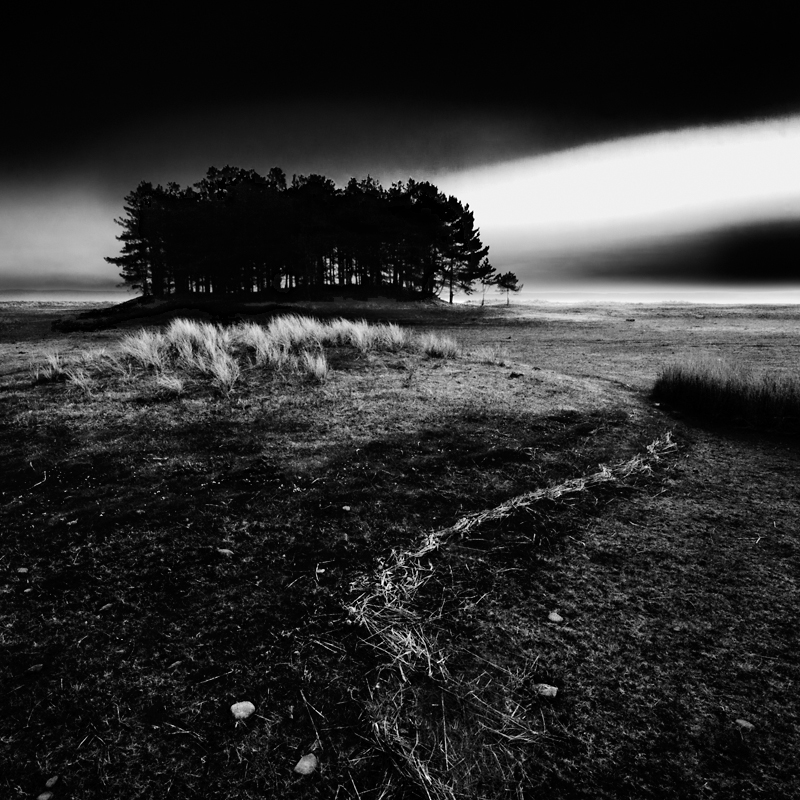
Conundrum

Indeed it was a turning point that sent me on a journey, an unpredictable and often surprising journey through art, poetry and the psychology of creativity that has potently influenced my working methodology and provided a mass of inspiration to pursue fresh avenues.

The importance of a project based approach.

Ever since I reignited my passion for photography in my late 20s I’ve worked on a project basis. Initially this was simply a way of getting the “best” out of a location, visiting in different lights, different times of day and year for example. Latterly the project has come to mean something more fundamental about my work and the way I produce images.

It takes time to find insights about a place, time to explore it, but more so time to find out what it means to you. The good news is that for many of us the places that have the greatest depth of meaning for us are near home, or at least where we spent our formative years. These are the places laden with memory, probably some of your first experiences of landscape were closer to home than you might imagine. Perhaps I’m lucky living in Wales where there is a plethora of beauty at every bend, but didn’t we all play in the woods or a park, explore the wider landscape and develop ideas about what the landscape means to us?
For me at least “home is where the heart is” applies equally to the landscape. Many of us have moved, sometimes long distances, but it is the feeling of those first experiences that are as important as the location. If we look back at our earliest childhood experiences we also come to realise how much of landscape appreciation is a social construct, a way we have learned to signify beauty. Who was never afraid of the dark woods, or intimidated by bleak, empty moorland?

Our understanding of the landscape as children develops hand in hand with our growing notion of self; loneliness, for example, is often the first response to a developing awareness of being an individual. If we are honest with ourselves do we wholeheartedly subscribe to the Victorian notion of all is grandeur and beauty or is there a nagging feeling that this way of seeing is partial and romanticised?

For me exploring a place is far more than merely finding the best viewpoints, but an attempt to discover our true feelings for a place and maybe to reconcile our learnt adult responses with the more genuine, immediate, but now vague reminiscences of being a child; and then trying to find a way of expressing that creatively and visually.

In recent times I’ve taken a turn with projects that may surprise some of you, I no longer try to impose a consistent style or approach on my projects. Perceptions vary over time; they develop, grow, diminish and change. The important point is the development, because in exploration, who knows where it may lead. Projects have become in themselves exploratory, consistency may come from subsequent editing and review for publication or exhibition, but I enjoy displaying the progress in almost real time on my Flickr [http://www.flickr.com/photos/robspages/] site. It does tend to confuse the hell out of viewers who confuse art project with something far more structured, for me it is a desire to explore through art, not to impose a single opinion or point of view, but the multiplicity that represents our own perceptions.

Understanding the Creative Process.

“Most current strategies for creativity consist of little more than praying for a Greek muse to drop by our houses.” – Po Bronson, Newsweek

In the popular imagination the right side of the brain is the creative side, but in the modern era of brain scanning, you wont be surprised to find it’s more complex than that. And what science can teach us about creativity should help inform your approach.

Modern neuroscience has found that if we tried to be creative with just the right side of our brain it would be akin to “living with ideas perpetually at the tip of your tongue, just beyond reach.” It’s only when solutions to problems (left brain attack) don’t become apparent that the right side of the brain becomes engaged, scanning for remote memories that are usually unavailable to the left side, searching for high-level abstractions and other connections that may indicate a solution. When it finds that potential solution the left side must quickly grab the idea before it is swept away by our rapidly moving consciousness, suddenly becoming far more focused. That’s when we feel pleasure of creativity the “eureka” moment if you like.

If we wish to become creative in the artistic sphere we should attempt to feed the left side of our brains with problems to engage the right’s creative impulses. There are many ways to feed the left side of the brain; the simple activity of photography itself may help, if you can find sufficient conundrums in your work, but we may also want to consider a more strategic approach using research and other forms of information gathering can help stimulate ideas. Its little wonder focusing on life’s imponderables has provided such fertile ground for the creative spark in art.

Using Language and Thinking Like a Poet.

To some extent artistic expression is simply about becoming more self aware, simply spending time thinking about what we feel, where we are in the world, what our stages of life mean to us or just why life throws up so many unpleasant experiences is not easy for the unpracticed. That is why I turned to writing. Sometimes prose, sometimes poetry and sometimes a simple “self examination” in words. This is where “thinking like a poet” comes into play. It isn’t strictly speaking poetry, but the processes involved are similar in that I use words to develop and define my ideas, which then feed into my photography. Then the photography and experiences of place also feed back into the words creating a virtuous loop.

The philosopher David Hume wrote “Man is a bundle or collection of different perceptions which succeed one another with an inconceivable rapidity and are in perpetual flux and movement”. Writing gives a focus to ideas where images alone fail to control the rapidity of our succeeding thoughts. I often start with little more than a few key words about my thoughts and feelings and use them to construct sentences, phrases and more refined ideas; it is in many ways the working method of creative writing. Words also have the advantage of freeing our creative minds and allowing the creative fires to flourish, freeing our minds from the purely visual, which may not throw up sufficient mysteries to ignite creative thought.

One other reason I specifically chose “thinking like a poet” as a title was to emphasise that this is a creative process, the results found should be in themselves complex, vague and all too human. Art raises as many questions as it answers, so if we are not to become too simplistic in our end products we must dig deep and always be aware of our own contradictions.

Combining using memory.

“We see with memory, which is why none of us sees the same thing, even when we’re looking at the same thing” David Hockney

The past is all we have, there isn’t anything else that makes us “us”, it is our sole point of reference and our only route into self-awareness. Memory, in other words, is one of the key constituents of the creative process and given what we know about the deep scanning of the right side of the brain, it strikes me as key.

Memory – the glimpse of history that surfaces in the mind, a conjuring trick we play with our own narration – is the fundamental building block of the self, but also they can become a touchstone for a shared experience, something that opens the door to recognition of commonality through art. In short we have more in common than divides us and it is the connections that drive artistic appreciation more than the differences.

It wasn’t accidental that I began this piece discussing our childhood experience of the landscape, it is still a fundamental element of my work, but so are more recent experiences – the death of a close family member, the love of a companion and an overwhelming sense of joy in nature. But these “modern” experiences have a tendency to provoke memory, to stimulate thought and question assumptions.

Tree Line 1

Conclusions.

I don’t think I’m able to reveal more about my personal working methods and I’m certainly incapable of explaining how all of the above will translate into creative output except by showing you my own. Each of us possesses our own histories and memories, our own synapses firing away and most of all our own places, so you’ll only gain an understanding of the translation process by trying it for yourself.

As the half Puerto Rican, half Welsh, New Jersey born poet William Carlos Williams put it “ the only universal is the local” and if he can subscribe that then so can we all.

You can see more of Rob Hudson’s work at the portfolio section of his website.

“…it’s not matter that matters,
or our thoughts and words,
but the shadows they throw
against the lives of others”

Owen Sheers from “Shadow Man and the book Skirrid Hill.

4 Responses

  1. Joe Cornish

    Hi Rob,

    Only just got around to reading your piece; I found it hugely stimulating. Describing the creative process in words has always struck me as enormously difficult, because it is so personal. You have done that superbly here. I often find myself saying on workshops that photographs reflect the sum of our experience, that they should at least hint at who we truly are. In that sense they are about soul, as much as music or poetry is about soul. Unfortunately the machine that is the camera appears to be an insurmountable barrier for many when it comes to acknowledging photography’s expressive potential. “Photography is tainted by associations mechanical”, as David Ward wrote so memorably in Landscape Within.

    Your explanation of your own approach provides a real insight into the creative process, as do your wonderful photographs. I look forward to revisiting it again soon. Many thanks.

  2. Rob Hudson

    Thank you so much for your considered and kind words Joe, it means a great deal to me. It was your work and in particular reading “First Light” that gave me the kick start to taking landscapes seriously. I may not be a very good advert for that particular book any more, as you can see I’ve moved into a more expressive sphere, but it was a vital step in my path and a most enjoyable one too.

  3. Jason Theaker

    I too have looked into Neuro science and psychology in the development of creativity, (it a mix blessing being married to a psychologist) and find that the deeper you look, the more you realise how little you know! That’s where for me feelings come in play. First in the internal and external reflection, (over simplifying but right brain focused) and then analysis (generally speaking left brain) which I find helps in the exploration of self and puts some context to what you ‘know’ intuitively.. That said, feelings are sadly largely overlooked in photography, but are fundamental to how we engage with the art! After all emotion is key to good art! (I often wonder why feelings are so generally overlooked in photography, I wonder if it’s because it’s considered feminine and in a male dominated society this is considered negative, or I wonder if the technology centred nature of the craft attracts many left brained logic focused people, that don’t want to consider something so vague…)

    Anyway, moving on, (before I ask for a group hug)…I too often explore my more subtle thoughts by writing to reflect on ideas with the aim to develop deeper self awareness. The reason I do this is so that when I go out the next time, I can bring into my consciousness the reflections and hopefully slowly fashion a creative direction…(again an oversimplified concise version)
    One last point, it’s true that we use the past to shape our particular realities, but Rob, “the past is all we have”! No, “the present is all we have” and the past is only a memory and you can’t be totally sure that it’s not deceiving you. I don’t want to (or haven’t time to now) but the deeper I look into meditation, quantum physics, and even spirituality the more I realise that there is no solid foundations apart from our self constructed. And the gaps between what we think we know and what we actually know become deeper and even endless… it’s like when you stand in front of a massive mountain, and the feeling you get of complete insignificance (is that just me) I find this paradoxically refreshing, even optimistic!

    Anyway I better stop before everybody here thinks I’m a total nut!
    Very interesting thought provoking article Rob!

  4. Rob Hudson

    Jason,

    “The internal life is as important, if not more so, than the external” Alan Moore.

    Now there’s a quote that can present problems for the photographer. Surely we can only take pictures of what is in front of us, only explore the external and the moment? So how do we progress towards art with such a restrictive tool as a camera as our sole method of expression?

    Well, first of all, you have to want to engage in that battle, to appreciate the restrictions are also the opportunities, it is within that limited frame of reference that the subtleties can be found, not despite it’s limitations but because of those limitations. Does the power of the Equivalent as expressed in Steiglitz’s cloud pictures exist because it is a picture of nothing that forces you to engage or because it is a photograph of nothing that forces you to engage? Well of course we all have a visual language of photography, rules that we subconsciously follow to “read” a photograph and these are confounded when presented with a near empty abstract sky. Where are the hooks, the leading lines, the POV, the angle, the land? These are swiftly confounded when we look at them. But more than that it is because it is indeed a photograph that we question the image, it is the very vagueness of the image that confounds our understanding of a photograph and how much can reality be bended to art in photography.

    So while it is true that the camera can only capture the present, the image in front of the lens, the interpretation of that image lies in far more complex waters. As a photographer we are made up of far more than the finger that presses the shutter. We have to choose what we photograph and how we interpret it. That isn’t merely the game of point of view, angle, and position, but also through our influences, be they 18th Century Romanticism or Ansel Adams, we cannot escape the fact we are influenced.

    On top of that, for our creativity to progress we are required to move beyond our influences, to find our own interpretations and ideas. And for that to mean anything to us it means we represent from our own perspective, our own memories become entangled in our work, we seek to express who we are, why we are unique through our photography. That is about more than having a personal vision as a defining construct to separate us from our peers, it is something much more fundamental and satisfying because it is about who we are. We are much more than the present and what the camera reveals is about us is much more than the instant the shutter is pressed.

Notify me of followup comments via e-mail. You can also subscribe without commenting.