
on Distant Horizons
It must have been rather fab to research this, and it's terrific to encounter artists involved in the genre.
- milouvision, 11:20 16th Junon Camera Survey
It might be interesting to see how the votes would stack if you asked in three months to repeat the survey, I for one missed the original request. It's a very interesting survey and nice to see that Pentax still have such a large following, likewise the medium and large format categories, [...]
- Douglas Salteri, 08:54 16th Junon Is Adobe Creative Cloud Bad For Photographers?
Great article Paul! I hope Adobe will continue to develop Photoshop with new features for photographers. I would love some new adjustment layers, how about midtone contrast (a.k.a clarity)?
- Magnus Lindbom, 07:32 16th JunAn enlightening trip report
I recently spent an amazing four days in Perthshire at the tail end of autumn. In truth the weather was far more wintry than autumnal. I encountered reedy frozen lochans, birch trees in deep glens covered in hoar frost, and snow capped mountains. However, the highlight of the trip actually started off with typical Scottish weather – drab, dull and cloudy!
I came down off the hills about an hour before sunset to thick clouds with no definition. I had still to check in to the B&B and the tug of a hot shower was pretty strong. However my time on this trip was relatively short and so I decided to spend the last hour of daylight finding a number of locations for the next few days.
I headed up the South road of Loch Rannoch until I came across a part of the shore where the trees thinned out next to an outflow of a stream. I parked at the conveniently placed lay-by and headed down onto the shore.
Due to the fact that the current water level of Loch Rannoch has been controlled by the Hydro Board there were plenty of dead trees sticking out of the water up to ten feet from the shore. I found the trees aesthetically pleasing, almost sculptural – they looked very unusual poking out of the loch. I instantly saw photographic potential realising that if I isolated the trees it would make for a very interesting composition.
I had started to play about with several ideas using the nearest tree which seemed to mimic the tree further into the loch and there was some lovely low lying cloud but the light was far from interesting.
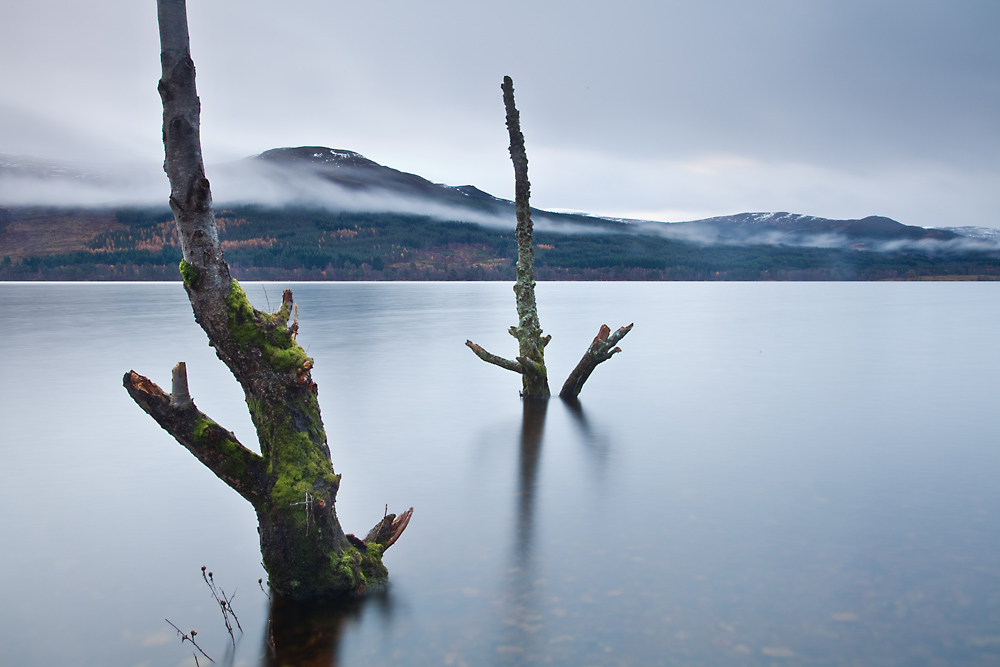
I liked the replication of shape of both trees.
I was not completely sold on the composition so I gently waded further into the loch until the water was perilously close to the top of my wellies. I was now much closer to the more interesting tree and started to frame my next shot, isolating the unique and framing out the ordinary. I did not spend too much time on the shot as it was more of a reminder so I could come back to the same location at a later date. I was thinking about heading back now but being the eternal optimist (and hating that feeling I have experienced all too often for not waiting long enough for the best!); I decided to stay put until the bitter end.
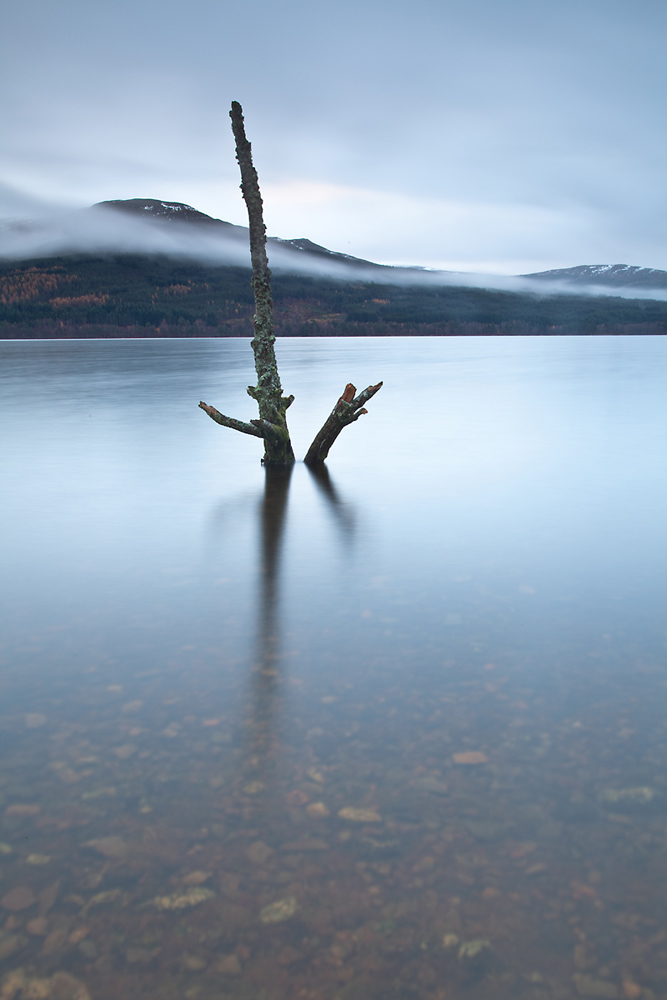
A more simple and pleasing composition, I loved the sculptural quality of the tree.
By this time the clouds had started to break apart at the West end of the loch. The sun was making an appearance for minutes at a time but due to the dynamic range of the scene and the fact I could not really get a better angle on the tree due to the depth of the water I could not make any meaningful shots. I watched with envy as the low cloud further up the loch was being illuminated in warm sunlight.
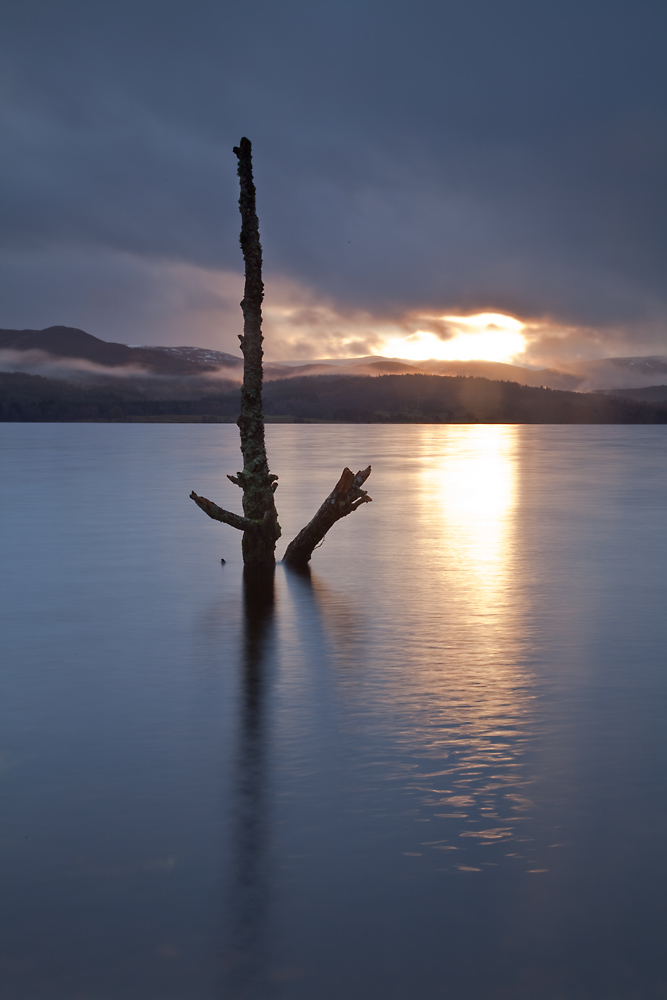
Intense light was piercing through the cloud but I did not like shooting straight into it
The ribbon of low cloud stretched all the way down the loch to my location and swirled around Meall Druidhe. My flight of fancy at that moment was for a sufficient break in the sky so that the cloud at my location would be illuminated with the same warm light. I watched, spellbound, as clouds parted further and that wonderful golden light slowly crept up the loch, punctuating the sombre tones of the scene with rich vibrant colour. It took a few minutes for the light to reach my location. The saying “the more I practice the luckier I get” applies very much to landscape photography in so much as if you are out often enough (and are prepared to wait) you will come across fantastic light regularly. It was most certainly true on this occasion.
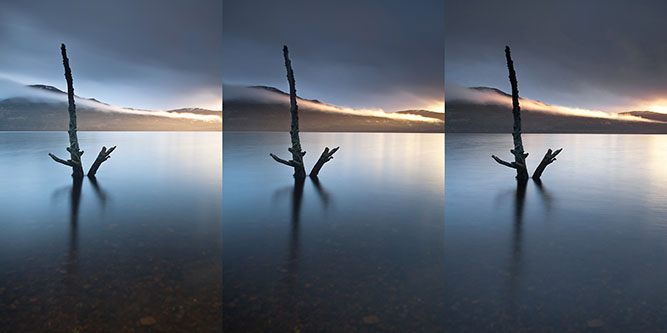
I watched with childlike anticipation as the lovely light slowly illuminated the low cloud.
When light as good as this occurs you are very wary that it can disappear as quickly as it came. Without changing my composition I made the shot when the light eventually illuminated the cloud at the Eastern end of Meall Druidhe. I need not have been so hasty. The light seemed to linger here for quite some time. I was struggling to control the highlights at the right-hand side of the frame and did not like how the mountain was sitting in the frame so I fine-tuned my composition.
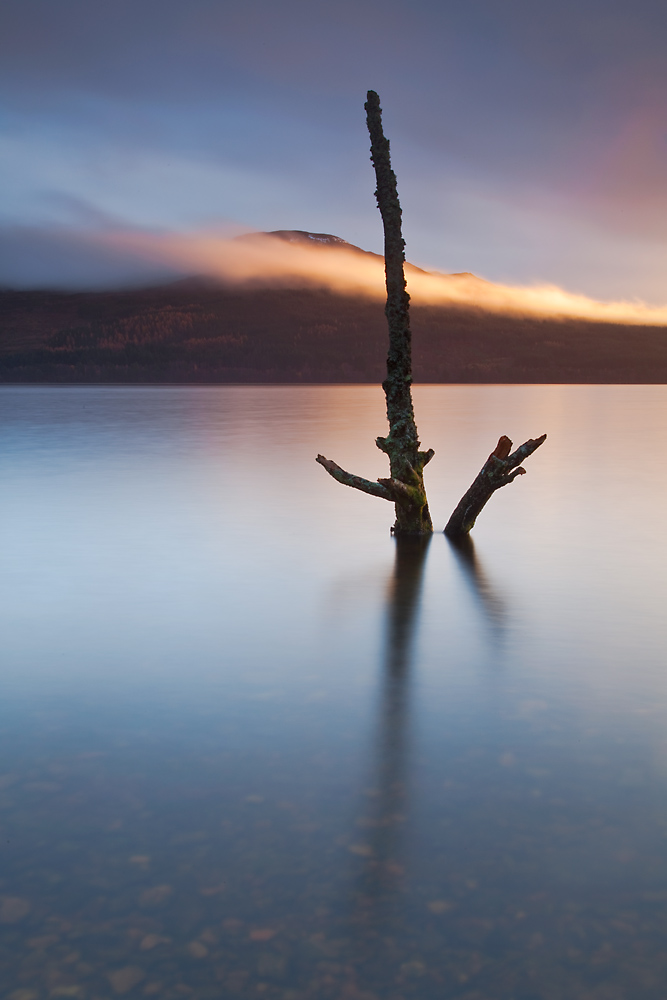
The finished photograph.
The photograph I finally settled for gave proper prominence to the mountain beyond. The orange-tinged ribbon of cloud swirling around a peak with a subtle dusting of snow seemed to dictate the composition. It felt right to place them there. The tree’s position was a by-product of this and, as oftentimes can happen in landscape photography, sat perfectly in the frame. Often, as mentioned by Tim and Joe in the first screen cast of ‘First Light, Still’, it is easy to over-intellectualise photographs when we view the finished result. Actually, most of what we do compositionally happens through primal instinct of what feels right and also our pre-conditioned way of seeing the landscape.
I find comparing the first and last photograph very interesting. In what is essentially the same photograph, the difference is startling. The wonderful light has transformed an essentially dull photograph to something beautiful. Checking the EXIF data there is an almost exact ten minute difference from when they where taken. To me, it illustrates perfectly that, even though you never can tell what the weather will do, we should always wait until the very end before deciding to pack up and go home.
David Langan is a photographer from Aberdeen. You can see more of his work at his website http://www.thenorthlight.com or see his workshops website at http://www.thenorthlightphotoworkshops.co.uk/


Very nice final shot. The first was quite dull and had the top of the tree cut off. I thought “is that it”, and was delighted to see the money shot at the end of the article.
Nice re-composition, and lovely detail on the lake bed in the foreground too.
Well worth exploring and waiting for the light.
David a fantastic insight into the mind of a photographer at work… I must say that some of the text you mention could have been pulled out of my own experiences. What I find interesting is that most of the time I’m alone in such situations and get use to my own way of behaving, so seeing others obsessing about compositions, and waiting for the perfect conditions to materialise is refreshing.
Really enjoyable report David, with a wonderful final result. For what it is worth I also really like the first composition with the two trees. I think it is well seen and strongly composed. I would have been interested to see this idea recreated with the magical light of the final exposure. (It is so easy to be wise after the event!) And of course the simplicity of the final image is great anyway, but the conversational relationship between the two trees was well worth exploring.
I enjoyed reading Davids process here, and the transformation of the scene with the light, but I would like to add something, seeing this issue has Tim discussing how DSLR users could learn a thing or two from LF photographers… perhaps this is an example of that… or not as the case maybe?
What was the purpose of the original shot? David was scouting for locations and came across these trees.
Digital allows one to compose shots without cost..so finding a compostion that David could go back to when the the light was right.
But David doesn’t mention the fact he was waiting for any particular light? The light just happend to change whilst he was there.
As David researched the image etc.. the light got better, and so we see this progression to the final image that obviously David is pleased with and is going to keep.
But how would of a LF photographer approached this? Im sure he wouldn’t of taken all these images trying out compostions.
Would he not of composed the shot in his mind, or used a viewer or card, previsualised it, and waited for the light? Wouldn’t He had waited for ‘the one’.
I think upon reading Tim’s article about how DSLR photographers could learn a thing from Large Format photographers is perhaps a valid one? If digital allows one to compose, and a viewer or card allows a LF photographer to do the same, the only difference is one produces images.
But, the fact is… the one keeper is the end one…not all the others. Therefore doesnt the LF technique of learning to compose and waiting show itself to be the more valid one? And that popping off shots clearly shows that nothing is gained what so ever from it.. you just end up with loads of images that aren’t any good.
The thought processes are seen with David moving around, and working his compostion, but the final image I dont think is thought about, nor about the emotion and what the photographer is trying to say?
Hello Steve, thanks for the in depth response to my article. I have to say I do not subscribe to your thoughts when you say “LF technique of learning to compose and waiting show itself to be the more valid one?” I personaly think that (without wanting to offend) is purely elitist talk which I do occasionally here from MF/LF users. Everyone works in different ways and in almost all cases any image made is just as valid as any other (regardless of quality). I also think that your comment about “popping off shots” is somewhat flippant. In this specific case the first two shots where genuinely memory joggers – I then used one of the benefits of a DSLR where I could shoot the light travelling up the ribbon of cloud incase the light suddenly faded – meaning I would definately have something when perhaps an LF shooter might not?
The other point I would raise is that I did actually pre-visualise the shot by predicting what the light might do – I didnt race around trying to photograph the great light somewhere else – I used my experience to wait and if the light played ball I would get my shot – if not I had the first few to as a reminder to go back. Yes the light did happen to change, but again from experience (particularly of Scottish weather) I knew to wait till the bitter end as fleeting light can break in almost any conditions here!
I do whole heartedly agree about slowing down and that DSLR users can learn alot from the slow pace and pre-visualisation that LF users employ.
@tobers, thank you very much for taking the time to reply
@jason – thanks for replying jason, it is interesting my experiences resonates with your own-i often wonder how other photographers go through their process. When I have attended workshops it is so interesting to see how others go about their business!
@Joe – thanks for taking the time to comment. Hindsight is indeed a wonderful thing but I can say with absolute certainty I will be back at some point to exlpore the further the relationship between the two trees. When I arrived on that location I instantly gravitated to both trees – it was my gut reaction which I have learned to trust – most of the time!!
“Popping off shots”, “slowing down”, “pre-visualise”, “elitist talk”….What does it matter how ‘we’ achieve the final result, be it “in camera”, “post processed” or even my particular favourite “aiming for reality” (there is no reality outside our individualised perception), as long as there is consistency in results, be it emotive engagement or personal exploration.
As a large format photographer, I quite often take photos as I’m working out whether a composition works or not (as do quite a few other people I know). The camera can be used as a ‘sketch pad’, recording work in progress, as well as the final tool of choice. Just because in this case the sketch pad and the final tool are the same camera doesn’t make it any less or more legitimate.
And if the first shot hadn’t been taken, it wouldn’t have had a chance to provoke Joe’s comment and get reassessed. There is a limitation with LF that it is more difficult to react to the light in the same way and I have been known to resort to using my DSLR instead when things have got a bit silly (although I have regretted it, wondering if I would have got the same picture had I persevered). This photo is an example of the latter.. http://www.flickr.com/photos/timparkin/4893252143/
In response to Steve,
I always remember at art college, “the final piece” was just part of
the journey, my lecturers were insistent we showed our sketches, photos cuttings and clippings, material and colour swatches etc, the journey is as important as “the final piece” its what helps us develop as artist. We must experiment, try, get it wrong and develop. Even Rory McIlroy takes a practice swing.