Composition – Photographing Trees

Blair Loch – Sony A900, Sigma DG 28-70

Well we’ve introduced the two most important aspects of composition, balance and flow, what next. Well, we could talk about these two alone for quite a while – the idiosyncracies of each of these will be part of our discussions in future episodes.

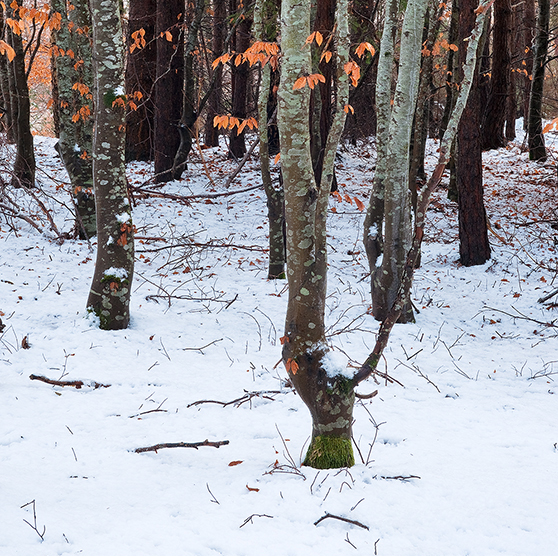
In this issue I’d like to talk a little about taking photographs in woodland, of trees and shrubs and other complex subjects. A lot is talked about the difficulties in composing in woodland and distilling the natural chaos and I hope I can pass on a few techniques for simplifying things.

I’ll start with an obvious one for many of you but it bears repeating. When you are wandering around the woods, you are seeing in three dimensions. When you take a photograph, you are seeing in two dimensions. Very often you will see a view that works really well with leading lines and background/foreground but you need to be really wary that this view doesn’t rely on depth perception in order to work.

You need to be logged in to see this part of the post

17 Responses

  1. RayFids

    This is an excellent piece and very opportune for me as my inspiration was fading at my local woods. I look forward to future articles on this subject.

  2. I’d mention contrast too, Tim, in terms of separation and highlighting: I think there’s one reference in the article but in the context of texture. Often foreground leaves and trunks can be picked out against a darker background, creating depth in the 2D image. Plenty of examples in the article in fact, but the way leaves in particular catch the light and seem sometimes to ‘float’ in space is one of my favourite themes.

    • Absolutely! Good point… I use it quite often, adjusting composition to place key parts of the composition against darker backgrounds. Thanks for pointing it out!

  3. Joe Rainbow

    Some truly stunning images in here Tim. Th topic is very useful, and it is surely one of the toughest challenges, to be able to compose in woodland. I wonder if large format gives an advantage/ disadvantage to that process? Would be interested what you and others thought.

    • I’m not sure it does give any particular advantage Joe, as (certainly from my perspective) most of the composing is done before getting the big camera out. I have already visualised the image by that point and usually scrap-booked it on a compact.

      With the camera on the tripod, it’s then a matter of fine-tuning the composition – that, to me, is the same for all formats. I’m only just moving to large format, but my workflow hasn’t changed much in the process.

      An excellent article Tim, full of good advice and excellent examples.

  4. I personally think that large format gives you the nice large screen to tweak compositions but being as we generally find our compositions using simple viewing cards, the camera can’t be affecting things that much. Perhaps the quality of pictures produced gives you more convincing feedback? I’d say that’s a pretty weak theory though..

  5. EmDashMan

    Wish I’d had this information _before_ I went on the bluebell wood workshop with Doug Chinnery and Anthony Spencer… :-)

  6. Pete Hyde

    A very interesting read Tim and some lovely images to illustrate your points. With reference to your question about over-saturation, the image looks very natural to me, wet … but not over-saturated.

  7. I find the key thing is to slow down, or even better, stop. Woodland and trees are not always obvious. Even after working through an area, I find that when you finally sit down and give yourself a break, new compositions emerge.

    • Absolutely – when I work on a large format camera, I often find a single composition and can’t find much else. Then after I’ve been under the dark cloth for five minutes, as soon as I come back out again other compositions jump out at me. John Blakemore said he used to sit in a wood a close his eyes and meditate, listening to the sounds and then when he opened his eyes things would appear for him (then again that could have been the recreationals)

  8. Although not done with my LF camera I recently did a set of 8 slightly abstract trees as part of my BA course work.
    http://nigelroberson.blogspot.com/2011/03/assignment-3-linking-theme-tree.html
    In my final year I will do more with trees, although like Blakemore I am happy to just sit and look at them, which helps the soul if nothing else.

  9. Nice work Nigel, the second one in particular is superb.
    You can’t rush in to woodland photography, I think you need to live with the trees – live with them, listen to them and see how they are interacting with their surroundings. It’s very good advice to look away and then look at your surroundings with fresh eyes – I found by accident that if I spend some time looking at my phone – when I look up I see things with fresh eyes. I know this isn’t quite as zen as Blakemore’s meditation but it’s the best I can manage! New and subtle compositions also slowly make themselves known when you sit and just take in the atmosphere – sit and eat your sarnies and look around!
    I’ve just started a new project just photographing a small patch of woodland, I’m really looking forward to observing the subtleties and changes throughout the year(s) and aim to photograph them with fresh eyes.

  10. Very nice work. I am curious to know if, in your picture Borrowed – Kintyre 2009, the blue-green lichen in the mid-bottom of the image was actually this colour or is, in fact, an artifact of using Velvia 50?

    • Very good question. I’m pretty sure the colour was fairly accurate. In fact it probably is, here is a shot from my 5Dmk2 (click for bigger view)

      And the velvia will be a cooler colour temperature and a bit of extra saturation.

  11. Just come back to this……one of the benefits of an on line Mag is that you can come back to articles and read them afresh, something I would not do with a paper magazine; in this instance, I might take my camera into the woods tomorrow and this acts as an excellent aide memorie.

    • I agree here. I have just been re-reading this article through the link on the latest issue and viewed it with fresh eyes. I printed out the issue to enable me to view the images in monochrome and this itself has illustrated another aspect: that a number of the images look “better” in monochrome. This possibility is unavailable in printed photographic periodicals – though it may not be quite what the original photograpgers had in mind when presenting their work! :)

  12. Custard

    As someone about to retire to the New Forest this terrific article was worth the year’s subscription in itself! Very well written, and very well illustrated.

Notify me of followup comments via e-mail. You can also subscribe without commenting.