

on Joe Cornish – Reader’s Questions
These interviews and Q&A podcasts are not only very enjoyable in their own right (like listening to a radio discussion), but also excellent to listen to while scanning or post-processing images. Thanks Joe for introducing the two wildlife photographers you mentioned: they produce different but equally inspiring and unusual work. Adam [...]
- Adam Pierzchala, 22:12 11th Febon Put Your Questions to Hans Strand
Yes, medium format will have a tough future. Though there are still people (including myself) who think it is worth the extra cost to get an extra edge. The difference is more obvious when you make large prints. A one meter wide print from medium format will convince you about [...]
- Hans Strand, 20:37 1st Febon Samantha Gibbons
Hi Samantha, it was great to see your images and to read how you feel about photography! I like what you say, "how beautiful the landscape around us really is.. It’s almost religious", as I feel almost the same! Your vistas have this subtle but intriguing light but I also like [...]
- Beata Moore, 10:09 30th Jan
One of the problems with using full frame lenses on a cropped sensors is that your focal length is ‘increased’ by the same amount so if you use a ‘normal’ 50mm lens on a 1.6x crop sensor it becomes a medium telephoto of about 80mm.
Not only that but the amount of light is also reduced so that the effective aperture becomes increased also. This means your f/1.8 normal lens has the same light gathering ability as an f/2.8 lens and also the same relative depth of field.
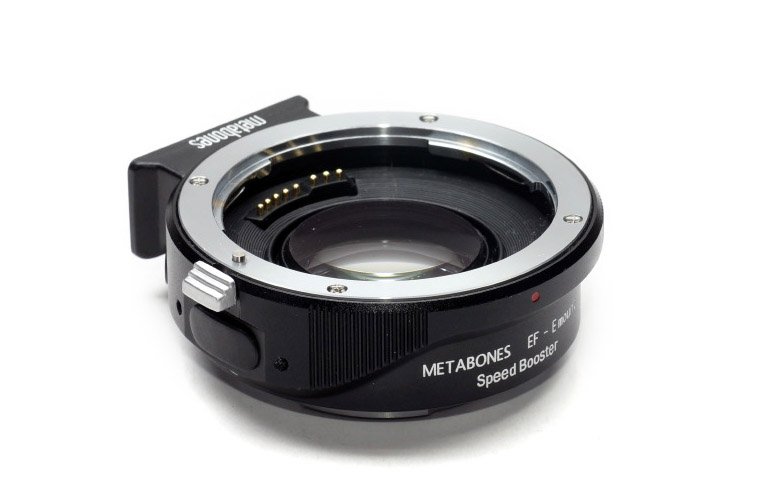
However, Metabones have created a focal length reducing adapter for the NEX that allows you to mount Canon EF mount lenses on Sony E mount. Only for Sony crop sensors though.
Effectively what is happening is it’s bending the light from the limit of the image circle of the lens so that it properly covers a crop sensor rather than a full frame sensor. It’s like an EF to EF-S converter!
Now Philip Bloom has been testing the adapter and seems to like it a lot (see Sony Alpha rumours website too) but obviously he’s only testing it in terms of HD resolution which is less than half of the resolution of the camera as used for stills. It remains to be seen whether the optics in the adapter are good enough to be used whilst retaining the optical performance of the original lens.
What it does do is allow you to use tilt shift lenses on a Sony NEX camera at the original wide angle focal lengths! Very interesting!!
We’ll try to get more information from the supplier about how good the performance is but Prof. Brian Caldwell who supplies the optical elements for the adapter has a very good reputation in lens design for scientific and archival purposes.
The lens is on pre-order at the moment and the price is a quite hefty £380 but it’s a definite sign of what the NEX and it’s short distance from sensor to lens mount allows custom manufacturers to do. Interesting times…
UPDATE: Here’s a quote from Brian Caldwell
“We designed an entirely separate optical system for micro 4/3. However, the magnification is the same as the NEX version: 0.7x. In order to get a significantly smaller magnification while maintaining excellent image quality we would have had to get much closer to the image plane with our optics. Unfortunately, the m4/3 cameras don’t allow this.
The good news is that the performance of our 0.7x optics for micro 4/3 is really good, and I expect that some pixel peepers will prefer it over the NEX version. If you look at the MTF curves in the white paper you can see that the m4/3 version gives higher performance in the corners than the NEX version. We could have saved a lot of money by re-using the NEX optical cell for the upcoming m4/3 Speed Booster, but we decided to maximize image quality instead.”
Which m4/3 camera do I buy?


If it doesn’t degrade the image quality this is going to be a ‘break through’ product. Being able to use the Canon tilt shift lenses would be a big plus to the NEX system.
The idea of using focal length reducers is apparently not new….
“Barry Green over on dvxuser mentions that “the Olympus 14-35 & 35-100 f2.0 zooms are just 24-70 & 70-200 lenses redesigned with focal length reducers”.
But these are integrated into the lens and custom made for each zoom. Although this is just speculation, as this has not been confirmed by Olympus.”
Using alternative mount lenses is pretty much the key to these compact systems for me. Mounting my Zeiss and Leica glass on the Panasonic GX1 has been a revelation, although the 2x crop factor limits this for wide landscape purposes. For documentary and portrait work, it’s a killer combo.
The NEX system doesn’t suffer quite as badly from the crop issue of course. Worth watching!
> Not only that but the amount of light is also reduced so that the
> effective aperture becomes increased also. This means your f/1.8 normal
> lens has the same light gathering ability as an f/2.8 lens and also
> the same relative depth of field.
That is not quite correct though. The f/1.8 on 50mm lens means that max lens aperture is 27.8mm and that stays the same no matter what sensor camera it is mounted on. The amount of light reaching sensor does not change. A more correct way of thinking of that would be that if on crop sensor an equivalent angle of view is required then 33mm (for a crop factor of 1.5) would be needed. For the 33mm lens to admit the same amount of light as 50mm f/1.8 on a full frame, the same size of opening/aperture of 27.8mm (therefore admitting the same amount of light) would require f/1.2 lens (1.8 divided by crop factor). If we are talking about using the same lens at the same apertures on different sensors, DOF does not change either.
Hi Alexy, hopefully my ‘caveat’ the ‘”effective” aperture’ makes it clear that it isn’t actually changing the aperture – just having the same effect as. The total amount of light hitting the crop sensor is less than that which would have hit the full frame sensor with the same lens.
Agreed that to get the equivalent lens you need a wider focal length and faster lens by the ratio of crop of full frame.
Your last comment that the same lens with the same aperture on different size sensors isn’t quite correct. The blur circle stays the same but because we have to enlarge the sensor image more to get the same print size, any blur is increased in the final picture.
Perhaps this needs an article of it’s own – do you want to chat offline about it as I only *think* I’m right
?
Yes the DOF point is arguable and if looked from enlargement prospective then you are correct.
>The total amount of light hitting the crop sensor is
> less than that which would have hit the full frame
> sensor with the same lens.
This however I don’t agree with (at least as it stated). Consider the image plane inside lens projected image circle, ignoring light fall off towards the edge of the projected image circle, amount of light delivered to a unit of the projection plane (say a square inch) is the same. This is regardles of whether that square inch is part of cropped sensor or FF sensor placed at that projection plane.
The usual measure of ‘amount of light’ is light delivered over the surface area. e.g. if you have a big window you would have more light but if you had a small window then you’d have less light regardless that the suns delivery is the same per square mm.
The window in this case is the same – say for 50 mm f/1.8 lens its 27.8mm regardless of the sensor size underneath this window.
I was talking about light hitting the sensor though – not light coming through the lens..
True the cropped sensor will receive less light overall surface because of the smaller area but the same area of bigger sensor will receive the exactly the same amount of light. Even more, each pixel will receive exactly the same amount.
I think I understand your position now will try to recap it here so let me know if I am wrong. You consider just the amount of light delivered at the overall area to cropped sensor in comparison to larger area of FF sensor detached from any other factors – is that correct?
This is imho not entirely correct starting point and leads to “confusing” statements about lens aperture and speed. The exposure itself does not change regardless of the size of projected are – smaller sensor can be considered just a crop of the larger one (say like crop mode in FF cameras) with all other parameters being the same. It does not change the lens focal distance, aperture or anything else for that matter. This is of course if we consider the lens alone isolated from all other factors (and this is usually a perception of generic statements like this about cropped sensors).
However if we are considering this all from the prospective of the scene being recorded, i.e. the same scene recoded on both cropped and FF sensors (meaning exact framing of the image is the same in both cases), then we can talk about equivalent amount of light delivered (because it has to be the same for the same capture). In this case my first post here holds – the lens focal length needs to be adjusted to match the angle/framing (assuming we are shooting from the same position) and that causes the aperture change (as it is relative to focal length). Which in turn will mean that in this particular case you are right and to get the equivalent exposure/amount of light to cropped sensor it will need a larger/faster aperture.
If however we leave the lens exactly the same and simply move the cropped sensor camera closer to the subject achieve the same framing as FF camera with the same lens, then nothing really changes exposure wise or light delivered to the sensor – it will be exactly the same. The only thing that changes in this case is DOF.