



 Join the conversation
 Subcribe to comment rss feed
The un-answerable question posed by some element or elements in the image

Hank Erdmann
Hank Erdmann is a photographer and photographic educator who resides in Will County, Illinois. He has photographed throughout North America, making the Midwest his primary geographic area of interest. A love of history, especially the maritime history of the Great Lakes, kindles a special interest in the ports, shorelines, islands, hardwood forests, prairies and other natural areas of Lakes Michigan and Superior and their surrounding environs.
"My photographs are an expression of excitement and joy at seeing a fleeting moment when nature takes light and subject and creates an image that leaves a lasting impression in my mind. Occasionally, I'm fortunate to record such images.
A sense of mystery is a quality I strive to include in my imagery. In writing a rhetorical question provides interest and depth, in photography mystery is the rhetorical question. An unanswerable question is a powerful source of interest. Mystery in a photograph is the un-answerable question posed by some element or elements in the image. The answer to that question, however, is only what the imagination of the viewer suggests and then often only in a subliminal manner. The “answer” is a perception, and a different perception for each viewer of the image as well as for the artist.
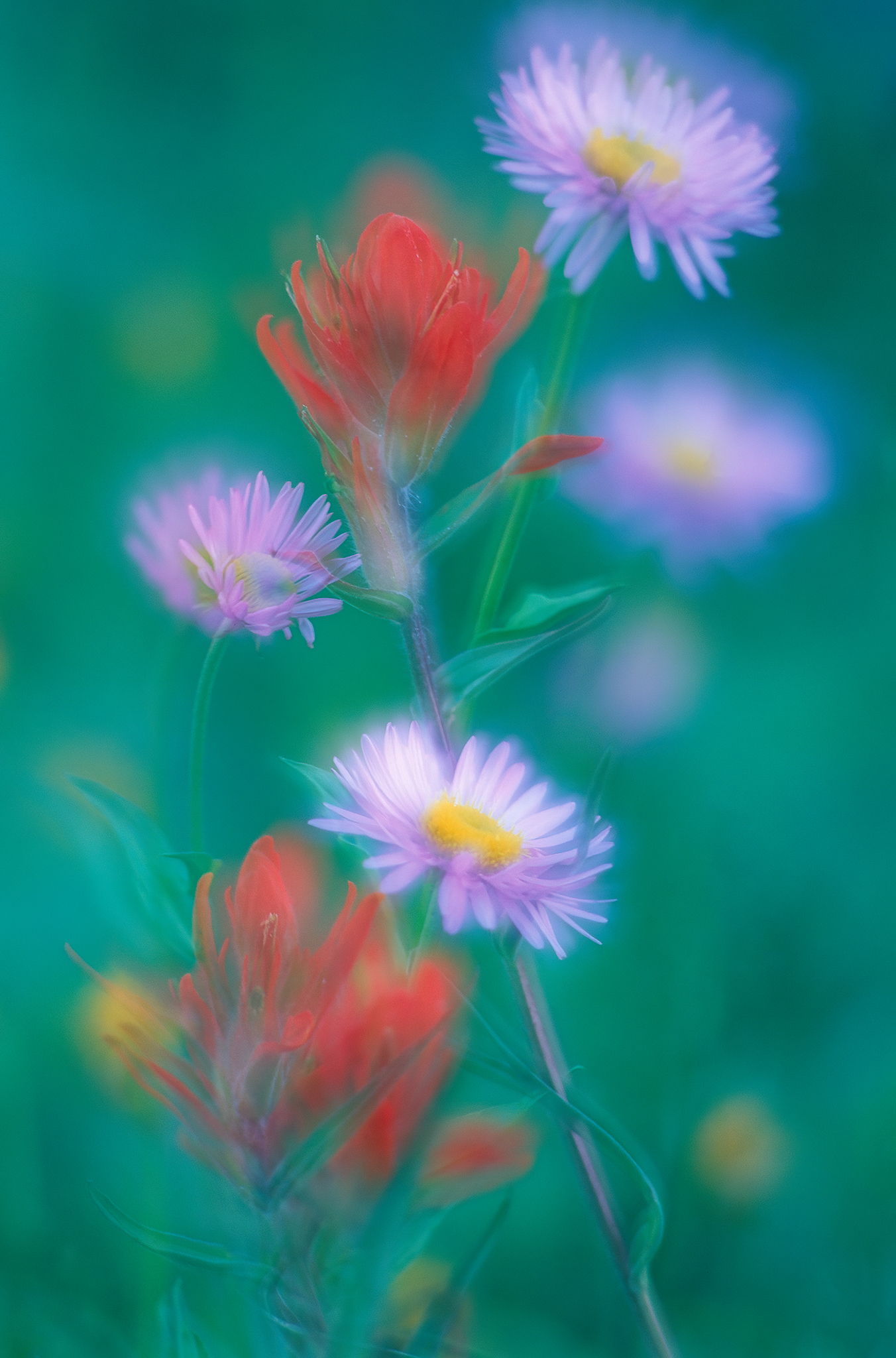
Painting with Wildflowers
Layered exposures with differing focal points creates this soft and sharp wildflower portrait with no clue as to where it was made, Shrine Pass mountainside, Summit County, Colorado.
As an artist, I desire to make art, not a document of nature or any other subject. There are times that images can be and sometimes should be, documents of reality or represent reality. If my art can also be useful for a documentary use, so be it. However, that is not my charge, it is not my reason for doing.
I have been awestruck by the natural world from a very early age. One of the greatest gifts my parents ever gave me was the gift of wanderlust. Go ahead and get lost, (but not too lost), was the mantra they installed in me. Look, see and learn, touch, but be careful, ask and learn were all tenants that were valued and supported.
Wandering the northern hardwood forests of the US Midwest, exploring prairies and grasslands, wading small creeks, catching (and releasing) frogs, lightning bugs, butterflies and all sorts of creatures; pressing leaves, planting gardens, spending hours studying maps are all precious memories. Such activities inspired learning, but more so inspired wonder, which has many elements of mystery embedded in it. Mystery has always created interest for me, and so it is with photographs or any art form. Mystery creates interest and intrigue, things that keeps viewer attention when observing your work.
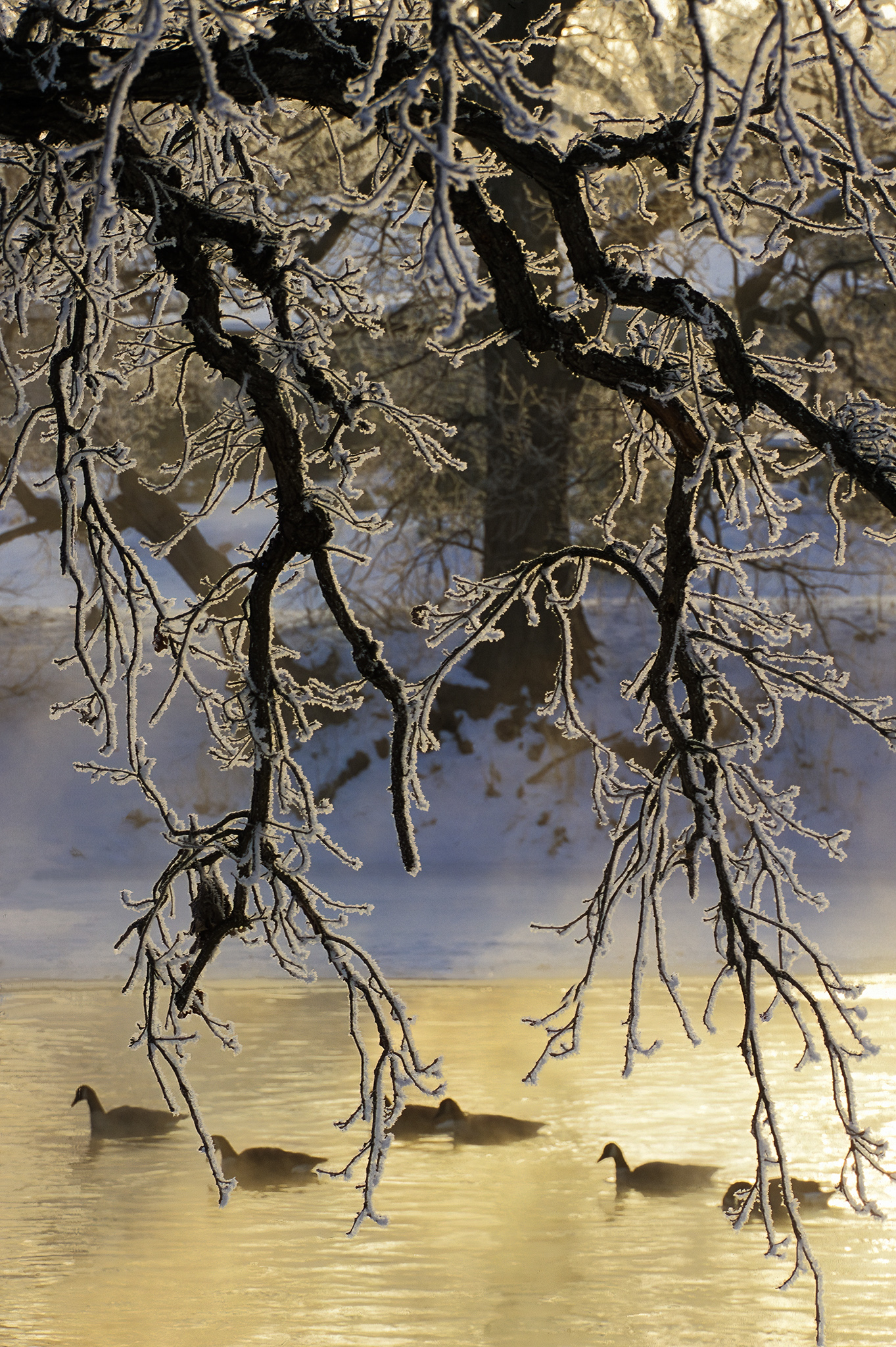
River Frost
Canada Geese swam into the image I was making of hoar frosted branches. Serendipity! The mystery is where did they come from, where are they going. DuPage River, Will County, Illinois.
My favorite works of art, whether my own or others, are those that push my big three buttons, wonder/curiosity, question, albeit a rhetorical one, and intrigue. Wonder and question can be issues of subject, of composition or structure. Intrigue is an issue of what else might be hiding within? All three of those buttons leave me wanting more, leave me looking for more.
A tenet of both good writing (be it fiction or history), good movie making, and good music is that you get only hints at the beginning of such works, the payoff is saved for the end. Without such structure, there would be little reason to read the whole piece, stay to the end, or listen to the whole work. Curiosity and interest die, and surprise is eliminated if we know the end in advance. Imagination is quashed, and tension is relieved.
When photographs are obvious, when too much visual information is included, when the image is ambiguous as to purpose or intent, when we provide no “visual satisfaction”, the viewer moves on, they may glance at an image but quickly move on and ignore the image.
When you leave questions unanswered, you create mystery. By doing so you attract and sustain attention. You also create an atmosphere where imagination is championed and interpretation is celebrated. Mystery gives the viewer a better visual experience, a broader experience, allowing them to have visual satisfaction, having their internal questions answered, or their wonder and awe excited.
Enjoyment appears at the boundary between boredom and anxiety, when the challenges are just balanced with the person’s capacity to act. ~Mihaly Csikszentmihalyi
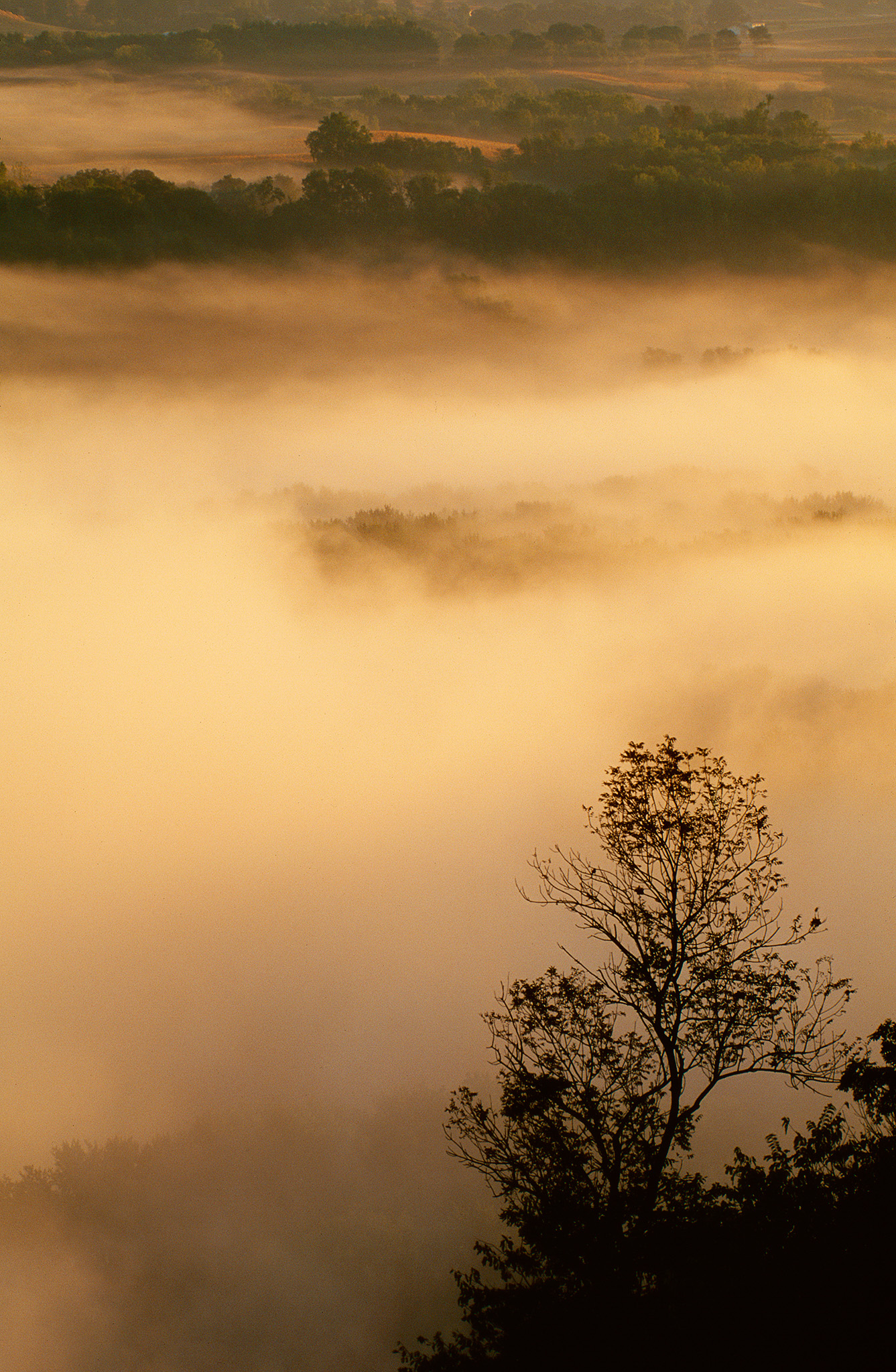
Wyalusing Mist
Fog fills the Wisconsin River Valley at sunrise, the mystery is what’s under the mist? Grant County, Wisconsin.
If an image is too obvious, we are bored by it, we ignore it. If an image is too complex, so ambiguous that any feeling or meaning would be too much work to fully enjoy, we give up on it. You need to give your viewer enough simplicity to instantly catch their eye, with enough mystery to give them room to investigate and ponder further.
The most beautiful experience we can have is the mysterious. It is the fundamental emotion that stands at the cradle of true art. ~Albert Einstein
Let’s turn to the compositional end of adding Mystery to a photograph. Just how does one do it? Mystery and the unanswered question is created with many tactics and compositional treatments.
Mystery can be created by making a line, usually a trail, creek, river, path, road, etc. leave or enter an image from within the image versus off of an edge or corner. The question asked is "Where does that go”? “Where does that come from?" Some images ask both questions, that of going or coming in the same image.
Mystery can be added by including only parts of the subject or center of interest within the frame. The old axiom, “Less is more” truly applies to creating mystery. Ask the questions “is this all, how much more is there, what is missing”, etc. By doing this sense of place can be lost, creating the question of where is this? The sense of beginning and ending can be lost, the sense of scale can be lost, even the sense of what the subject even is, and can all create questions of mystery.
Hide a subject's face. This tactic is not creature specific. We’ve all seen portraits of people and animals looking out into space, seeing either just part of the side of the face or even just the back of a head. When done right, such compositions produce spectacular imagery. Any subject however can have an animate viewpoint. Using the “looking out or off” viewpoint can work with just about any subject.
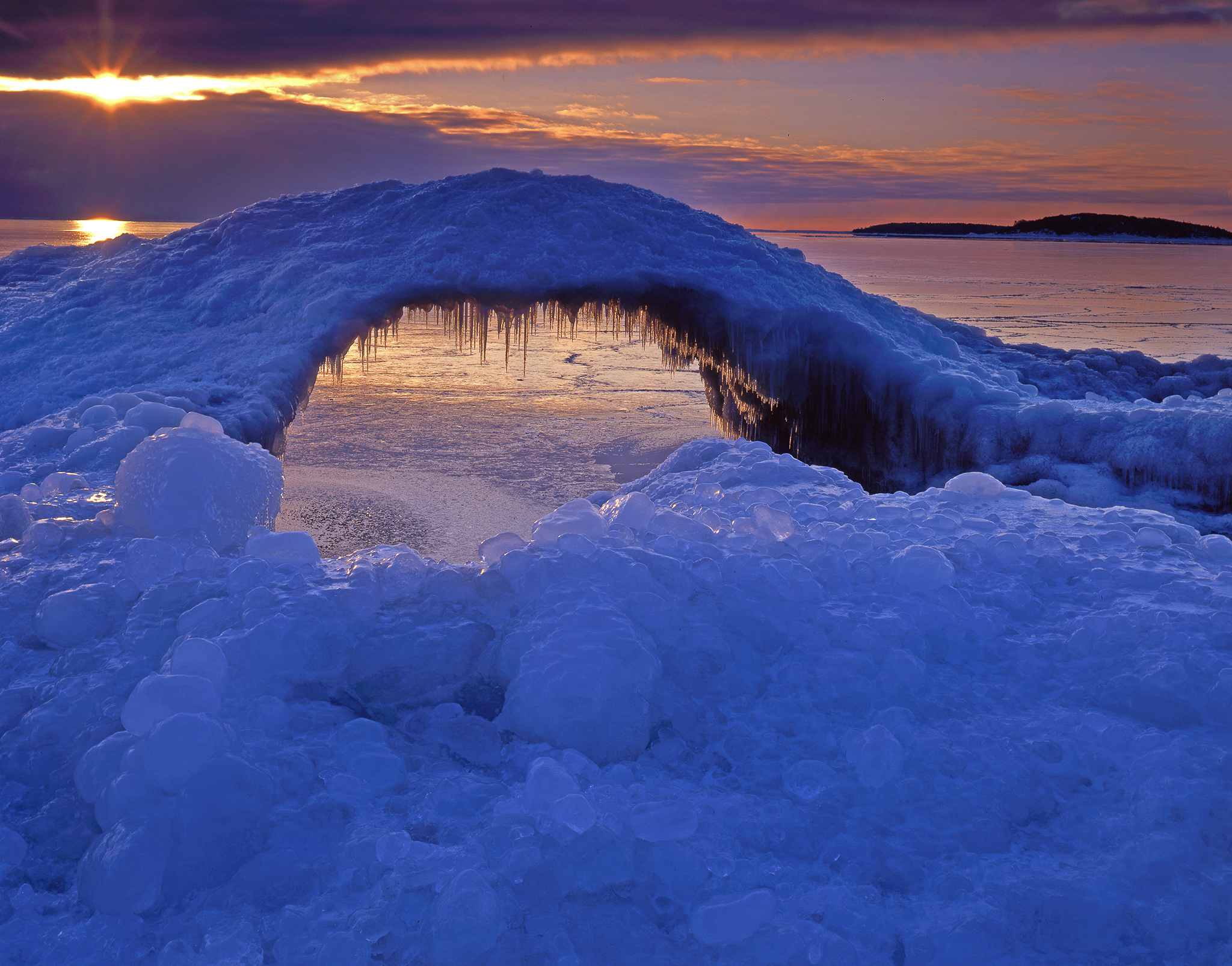
Ice Arch Sunrise
The sun, mostly hidden behind a cloud bank, creates apprehension about when or if it will appear, Presque Isle Unit, Escanaba State Forest, Marquette County, Michigan.
Soft focus and selective focus are some of the most compelling ways of making images with feeling and emotion. Producing such imagery is certainly not as easy as just using a shallow focus or depth of field or randomly picking a point of focus. First, it takes practice, it takes patience, it takes time and subtle adjustments in both focus point and aperture selection. To perfect soft or selective focus, learn to use your depth-of-field preview button on your camera, or if you don’t have such a feature, use the image enlarging feature when viewing the image on your camera’s screen. “Play” with the amount of softness, the focus point, and the aperture.
Use unusual lighting, confuse the sense of what kind of light it is or where it is coming from. Dramatic lighting can create mystery and highlight the less obvious parts of a scene. Backlighting is possibly the most dramatic lighting. It can be challenging to control exposure wise, but very directive for implied motion, and is always eye catching. Pure white or pure black “holes” in an image is one of the supposed taboos. Such things usually are difficult at best to use effectively, but when done creatively, can make incredible imagery.
Create Silhouettes. Silhouettes are a singular style of use of backlighting where the thing being silhouetted has no detail at all or just a minimum hint of detail. Silhouettes work best when the identity of the silhouette is not totally obscured, a hint of what the silhouette is creates mystery but not confusion. Silhouetting a subject can walk a fine line between mystery and ambiguity.
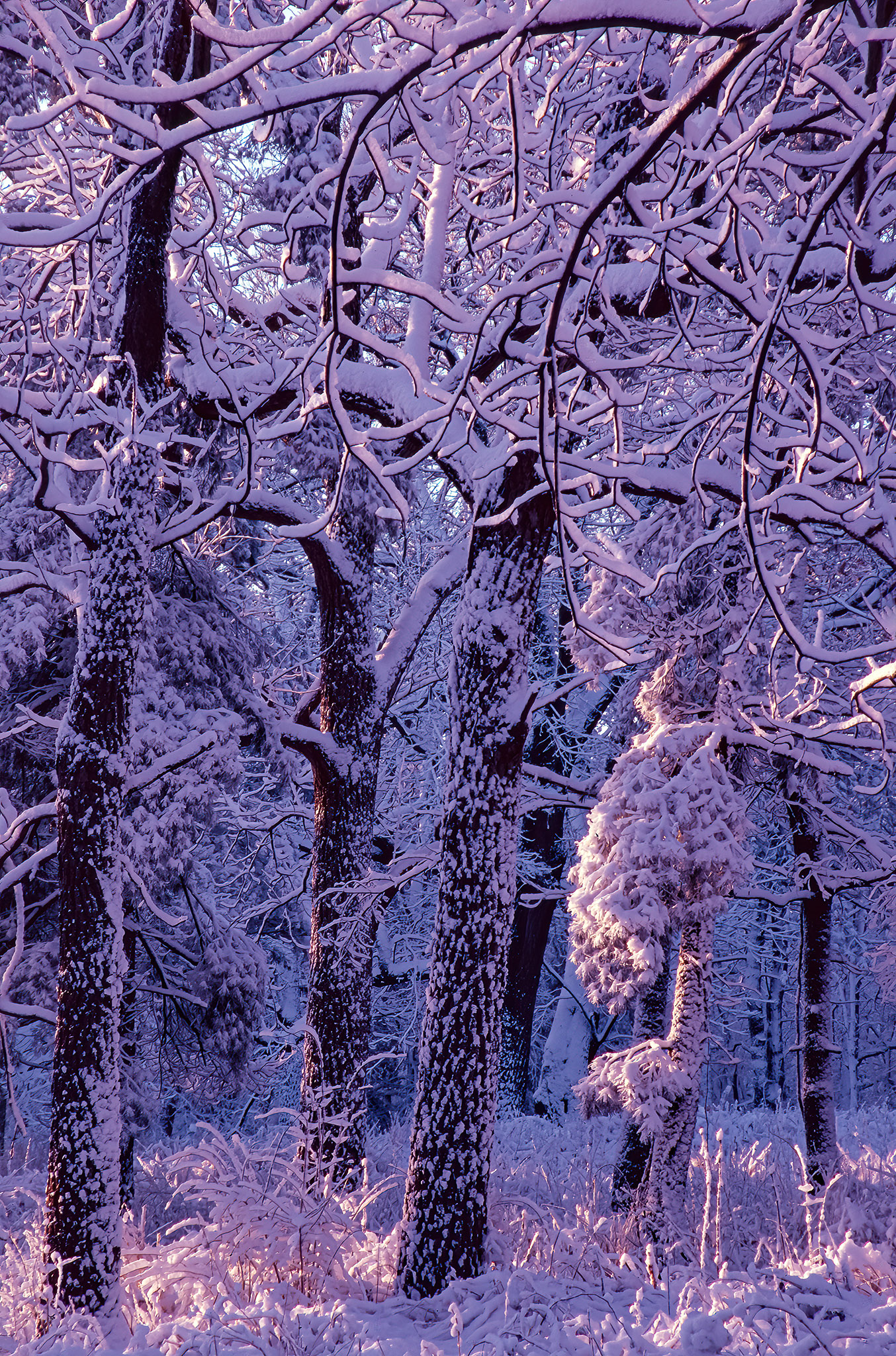
Sunrise Snow Forest
Fresh snow coats a forest that could be just about anywhere with cold enough weather for snow, DuPage County, Illinois.
Make your subject very small in the scene… or very large, i.e.; overfill the frame with subject. Learn and understand the concepts of negative and positive space. Understand the power of negative space. Small subject size in the right frame space can be incredibly creative and mysterious.
Use Spatial Ambiguity. Spatial ambiguity is akin to optical illusion, especially with spatial sensory perception and using optical compression with longer focal lengths. With spatial ambiguity, you create a state where interpretation flips from one thing to another, but your mind can’t hold both images at the same time.
Spatial ambiguity and scale may seem at first glance to be similar concepts, but they are in fact quite different. Scale just hinted at or completely obscured can suggest something other than what you are photographing. You create the impression of something that’s not actually there, like a face in a rock or tree, etc. Eliminating or diluting the sense of scale of the subject or scene will create a sense of mystery. When the scale is not predetermined by the image, the viewer’s imagination is set free.
A landscape view is usually obvious as to understanding of scene or subject. Eliminate the horizon, limit content to just essential elements, and you move to an intimate landscape genre. The intimate landscape by itself usually creates some amount of mystery just by its composition. Move in even closer, to a “close-up” view and mystery usually grows in scale and strength. Move to true macro (1:1 or greater in magnification), and more often than not a huge sense of mystery is created in the image.
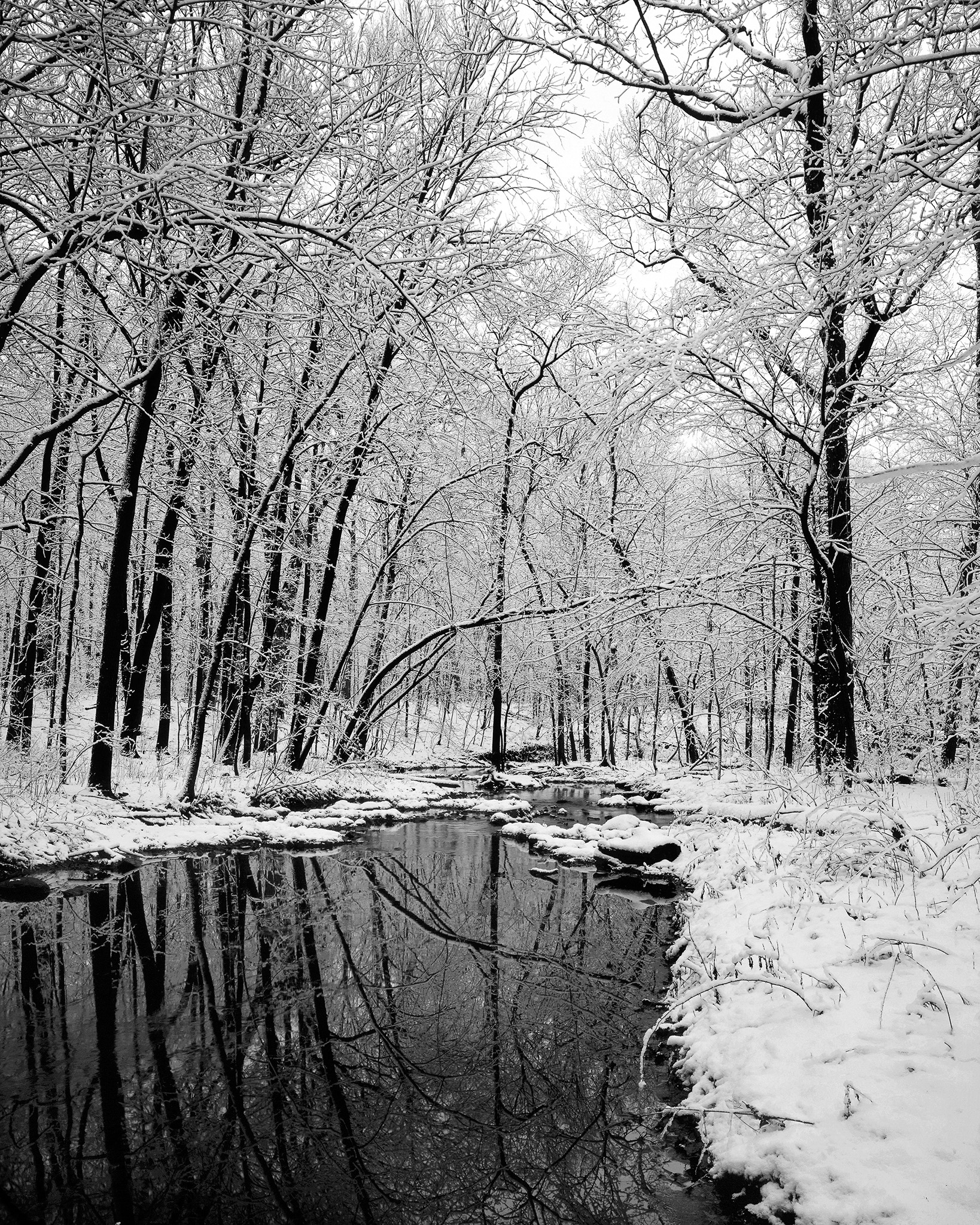
Hammel Creek Winter
Hammel Creek leaves or enters the frame from inside the image versus and edge or corner, creating a “where to or where from” question. Hammel Woods Forest Preserve, Will County, Illinois.
Ambiguous images of the natural scene usually creates a bad image. If ambiguity is so strong, we lose the sense of the subject entirely and possibly the reason for making the image in the first place. Some ambiguity, however, can be used to create mystery. The human mind is quite good at seeing or finding patterns and outlines in a complex or busy scene. That skill comes from aboriginal man seeing dangerous beasts hiding to make an attack or finding the beast hiding from becoming the next meal. Some of this is very subliminal, but experience helps one notice elements in a scene that provide a strong sense that those subtle elements will make a good image. Often, it is not initially nor fully understood how well a subtle element will work until viewed under scrutiny in our digital darkrooms. Digital photography has allowed photographers the wonderful luxury of exploring and experimenting without fear of film costs or film waste filling landfills.
Pose your subject in a mysterious way. Ordinary subjects can become mysterious when rendered in a different manner. Portray subjects in non-standard ways, portray them as something else, or something not quite identifiable. Lose the literal, and viewers will provide their own personal interpretations.
Mysteries lie all around us, even in the most familiar things, waiting only to be perceived. ~Wynn Bullock
Use Incongruity. Incongruity asks the question; “how the hell did that happen”. How did the dog end behind the steering wheel of the car? Why is that tree bright purple? Why is that boat parked on a sand dune?
Use time passage or the suggestion of the same. Add mystery by making or suggesting a coming event or change or the passing of or impending passing of time." Ask visually how long will it be or how long will it last, how long before something happens? Sunrise/Sunset and the placement of the sun with relation to the horizon is such a tactic.
Use weather to create mystery. Weather conditions can hide the subject or scene identity, making it more mysterious. Movement of weather elements, i.e. fog, rain, snow, can soften detail and obscure subject matter creating mystery.
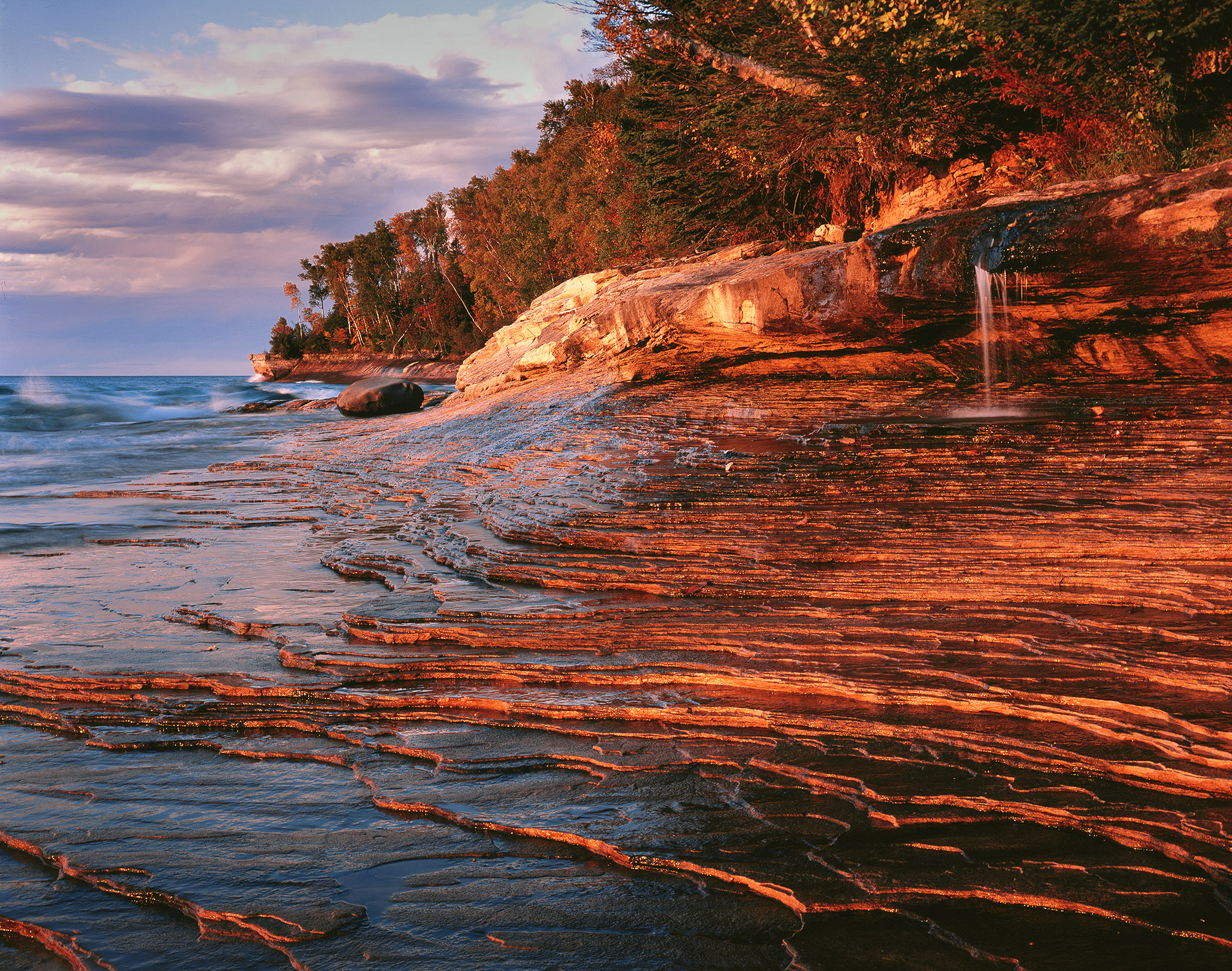
Miner’s Falls
It is a small waterfall on a big sandstone outcrop or a larger waterfall on a shoreline bluff? Lake Superior shore, Pictured Rocks National Lakeshore, Alger County, Michigan.
Abstraction is the ultimate in mystery. Making abstract images that suspend belief or reality can create mystery in varying magnitudes. An abstract can be anywhere from subtlety mysterious to completely mysterious. If we leave a sense of reality in an abstract we change the strength of the question but simplify it with that hint of reality. Like soft and selective focus practice is essential. The more abstract imagery you make the better your success rate. Many of the aforementioned tactics can help make abstract images but intentional “playing” is essential.
Experiment, play, try, guess, and make lots of exposures. In the worst case you expend some time but without expense. In the best case experiments, even when they fail are an education in what works and what doesn’t.
Mystery is the magnet of inquiry ~Edward Counsel
George Carlin, one of the greatest comics of all time, talked and joked a lot about his grade school training as a kid. One of his very funny lines was: when we asked a question of an educator, who could not, or would not answer a difficult or embarrassing question, the answer was always, "it's a mystery, my son". Mystery in that context is not good. Mystery in a great photograph is almost essential!
The above concepts are fine in their singularity, but think also about combining a couple of them, think of a backlit forest with crepuscular rays streaming through, and then abstracting it with soft focus or with camera motion or a zoom motion of the lens. The sky is the limit, imagination the only limitation.
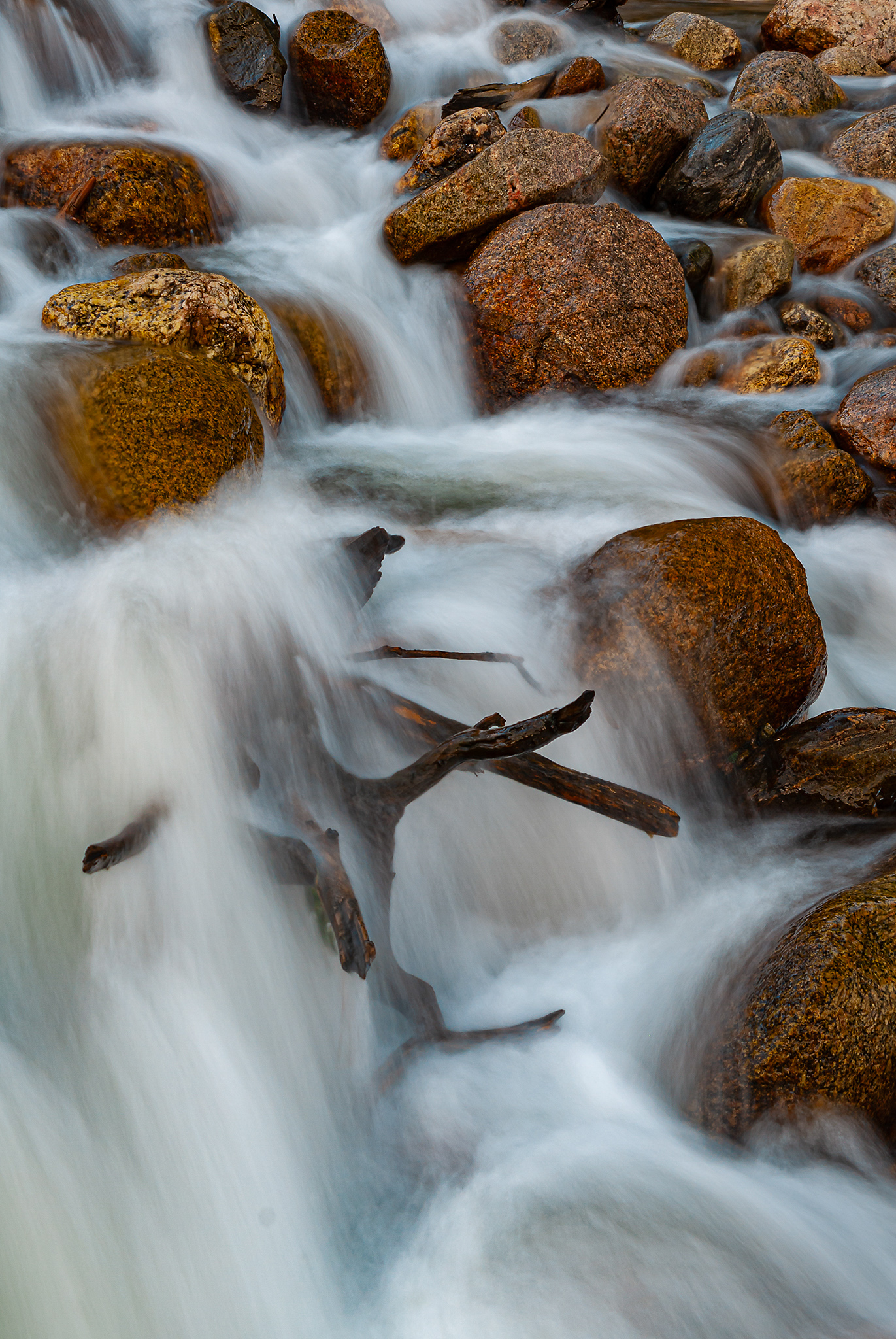
strong> Water Over Wood
Branches stuck in shaded cool colored water contrast wonderfully with warm toned rocks with little clue as to the size of the branches, rocks or waterfall. Alluvial Falls, Rocky Mountain National Park, Larimer County, Colorado.
Go out to photograph, not with a checklist of these techniques, but go out with a mind open to any possibility. There are times one sees something and instantly know it’s a candidate for one technique or composition or another. Most of the time however, just react and make an image with what Mother Nature is providing, allow your artistic instincts to take over. Pay attention and note situations and experiences in creating images so when presented with similar situations, one can react accordingly. Experience is wonderful and valuable but never be afraid to experiment, to try, to “take a shot at it”. The worst that happens is deleting images that didn’t work but one gains experience to make later images that do work. Putting mystery into your images will create more compelling images, will create more interest in your images, and will improve your work.
-

-
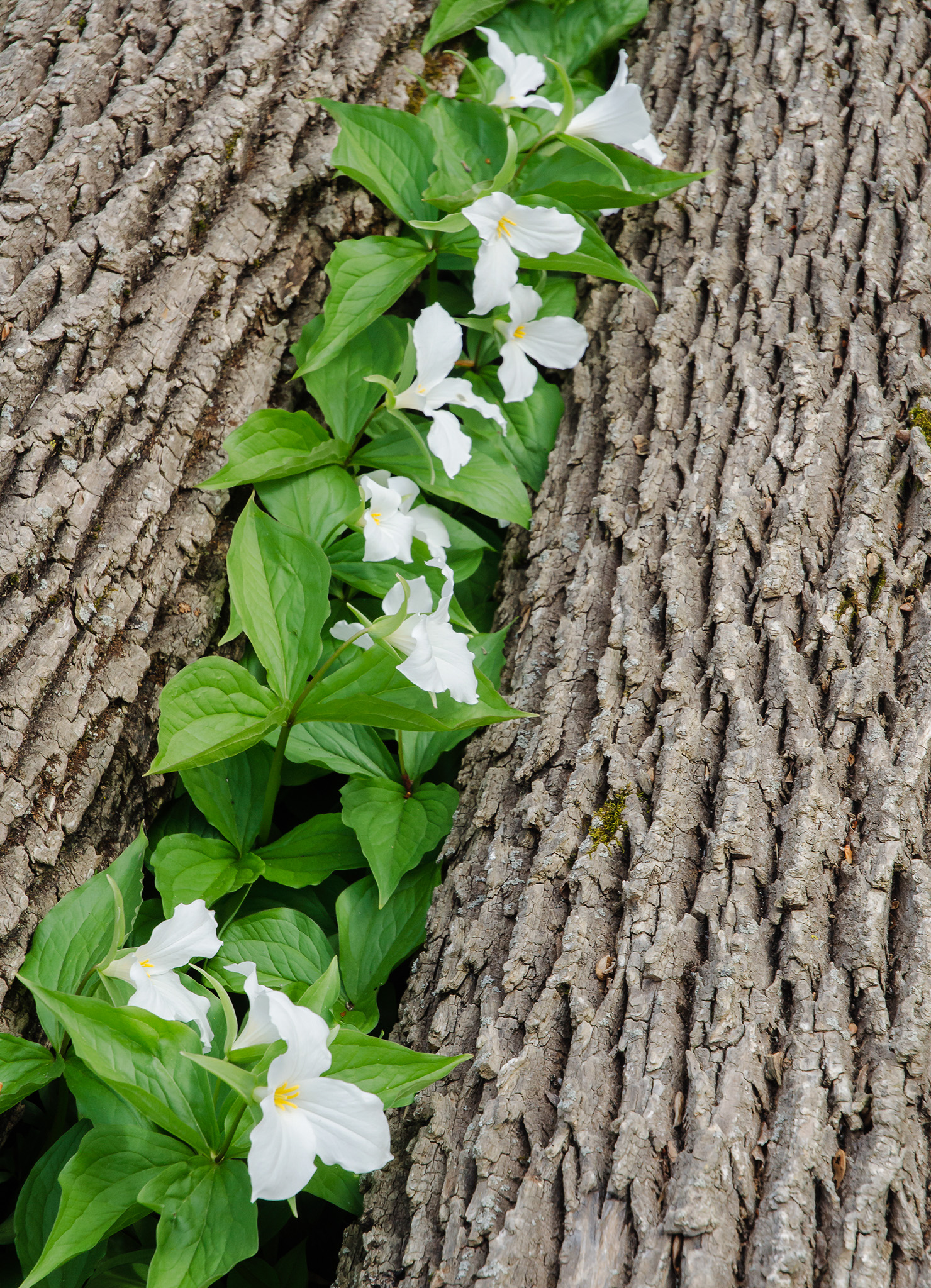
Trillium Bark
Besides being a neat textural study, the question of how the trillium came to grow between two logs on the forest floor and if there are more nearby. Door County, Wisconsin.
-

-
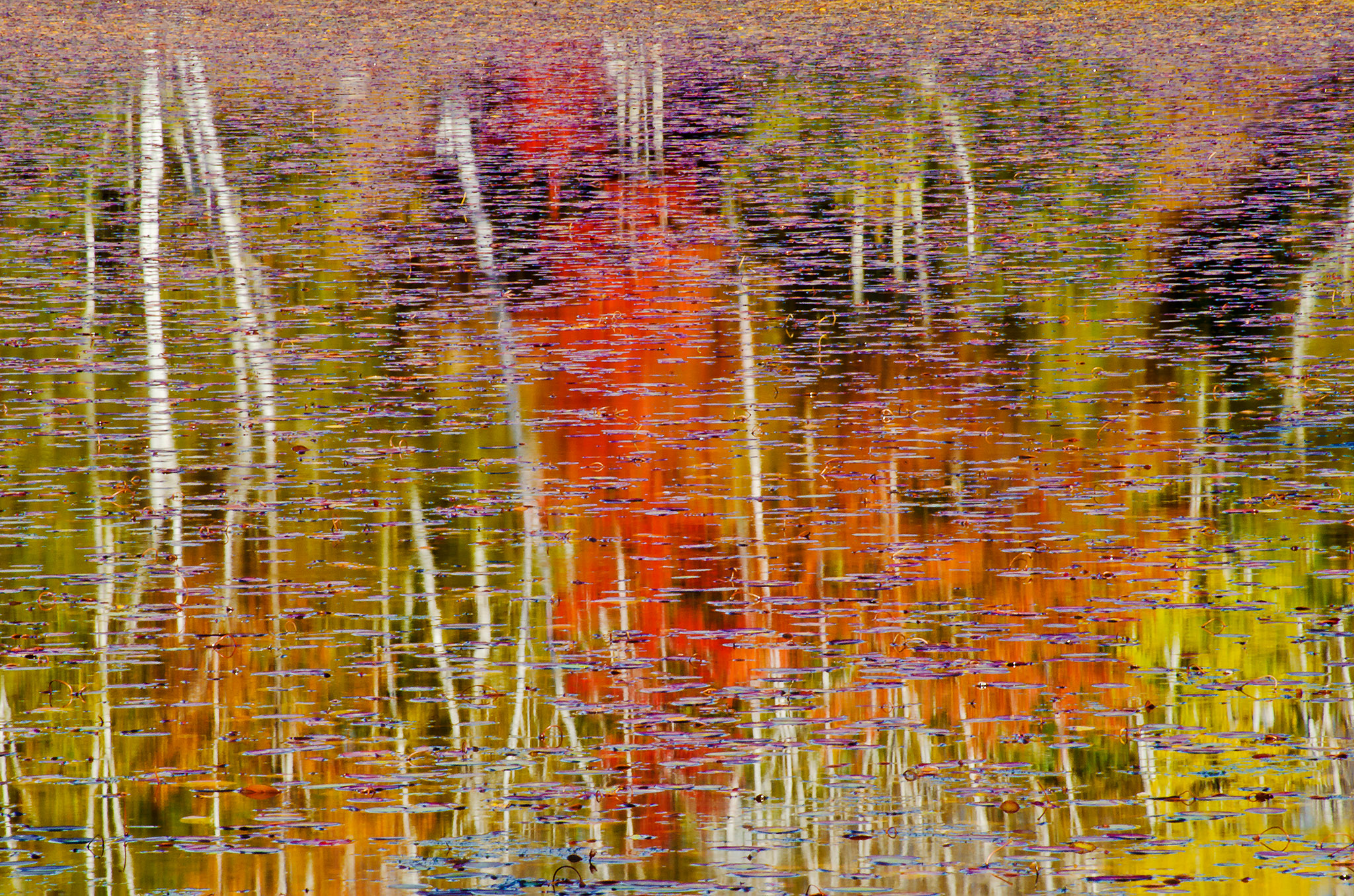
Birch and Shield Reflections
The colors of red maples and white birch trunks with the seeming upside down reflections and the lack of the shoreline in the images creates an abstract image that takes a viewer some time to understand. Mystery can make one study an image for some time! Hiawatha National Forest, Schoolcraft County, Michigan.
-

-
Snow Berries
Cranberry Viburnum berries with fresh snow. Surrounded by hundreds of berry clumps with fresh snow, just one clump had a hanging berry below, making it the clump to photograph and implying a question about that single berry, Door County, Wisconsin.

-

-
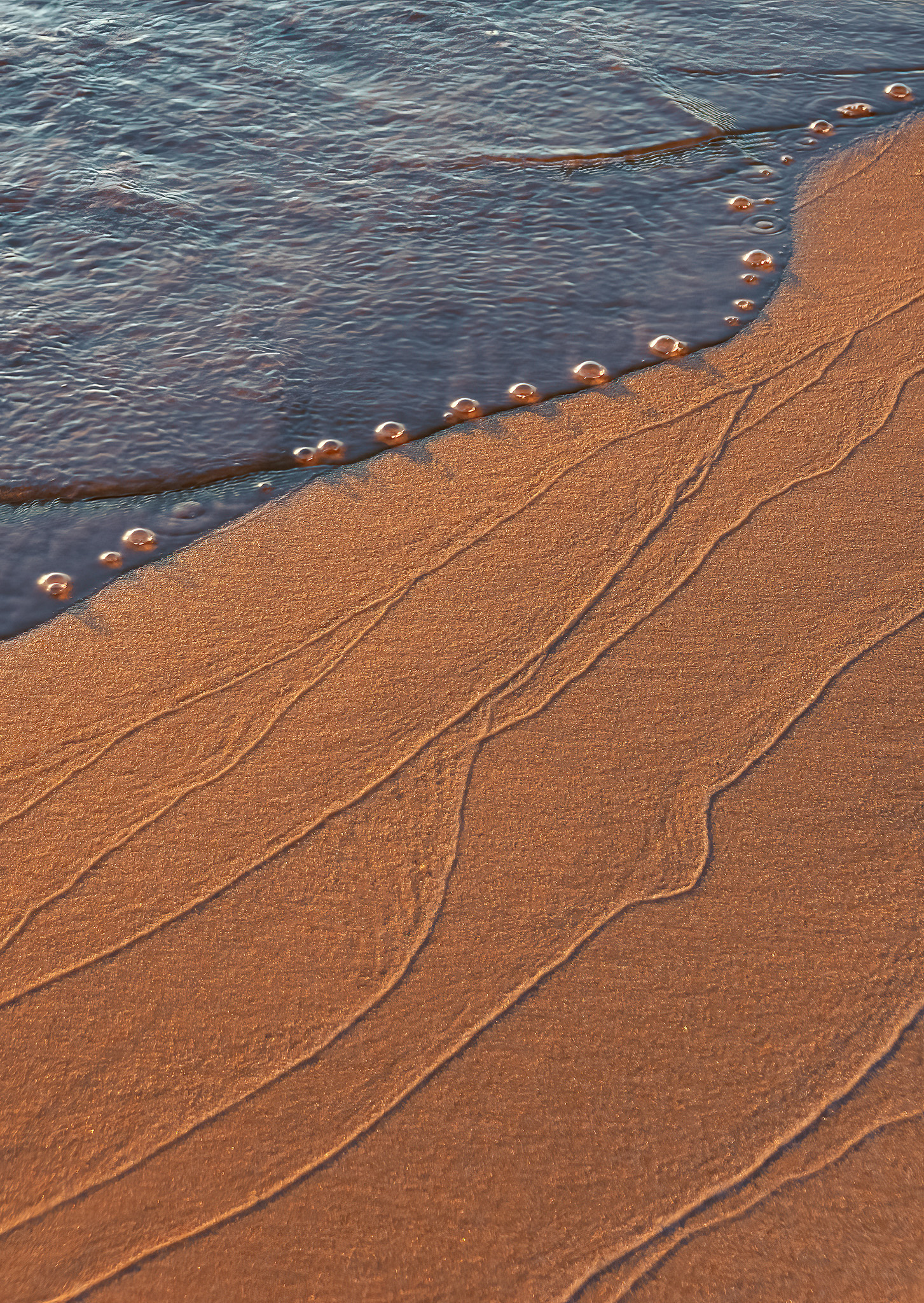
Bubbles on a Wave Edge
Where do the bubbles come from? How long do they last? When do they pop? Lake Superior shore at Miner’s beach, Pictured Rocks National Lakeshore, Alger County, Michigan.
-

-
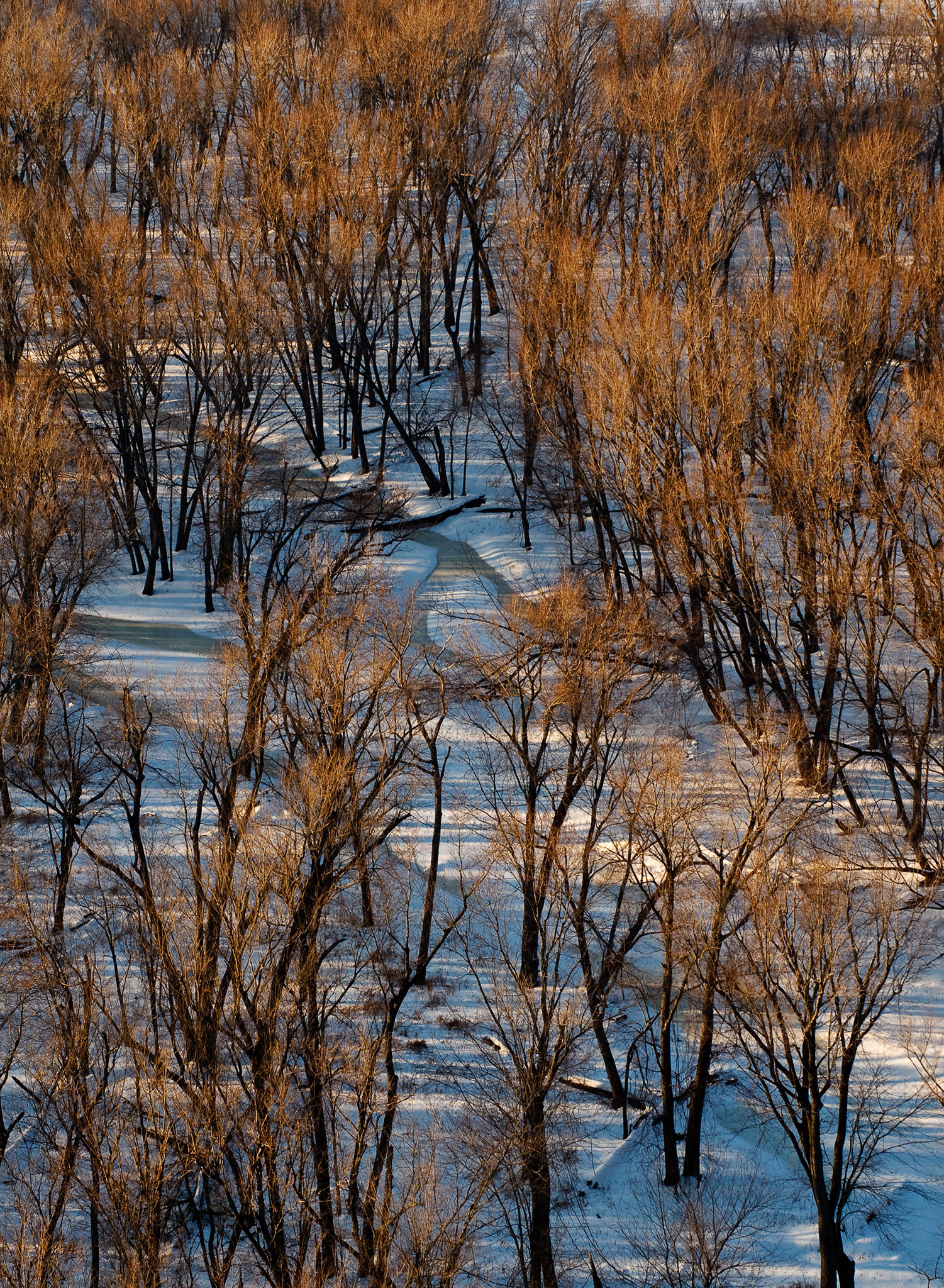
Gold in the Treetops
Sunset light hits the top of the forest, but why only the tops? Wisconsin River Valley, from Wyalusing State Park, Grant County, Wisconsin
-

-
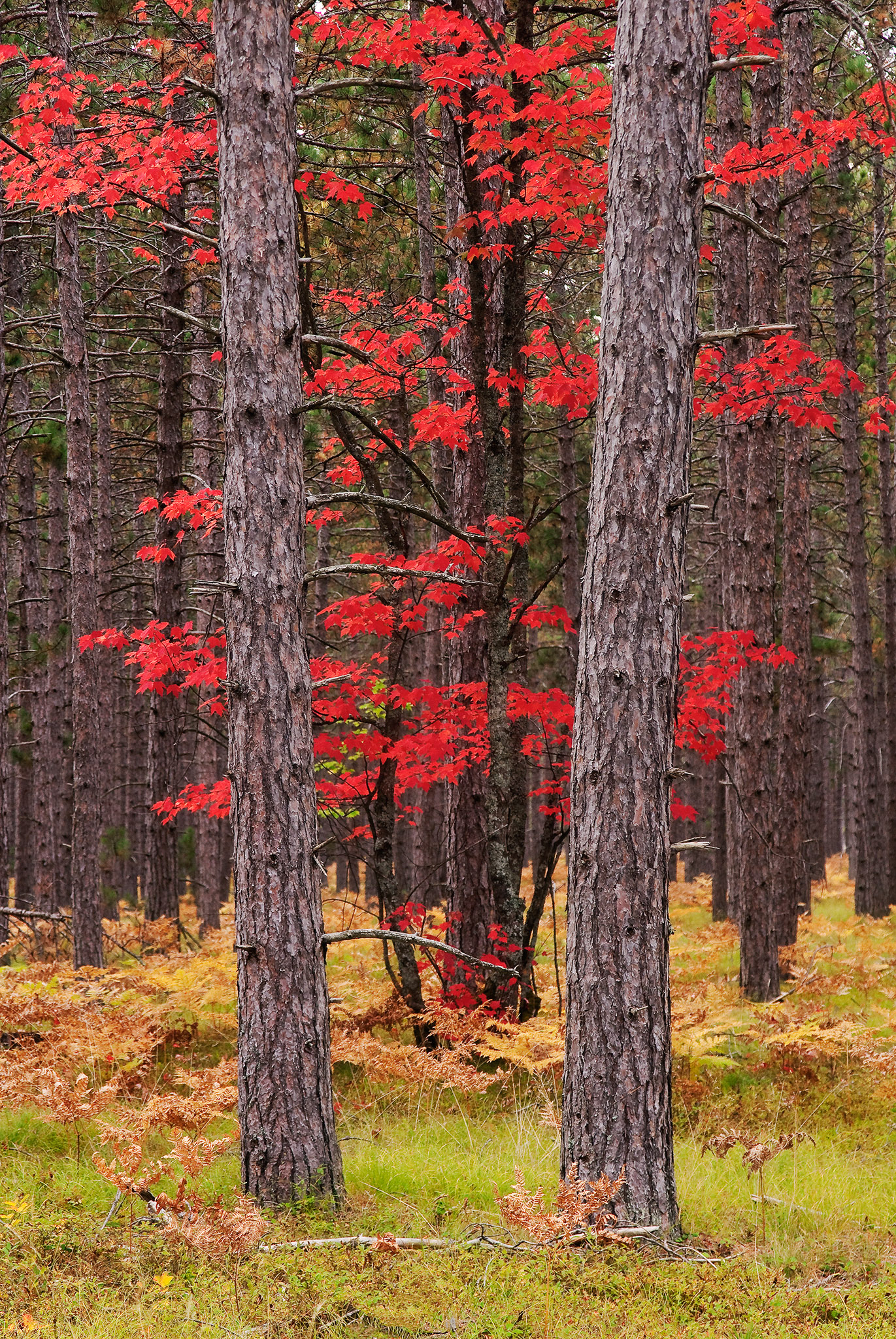
Hiawatha Maple
A single maple sapling is isolated behind two pine trees in a pine plantation…why? Hiawatha National Forest, Alger County, Michigan.
-

-
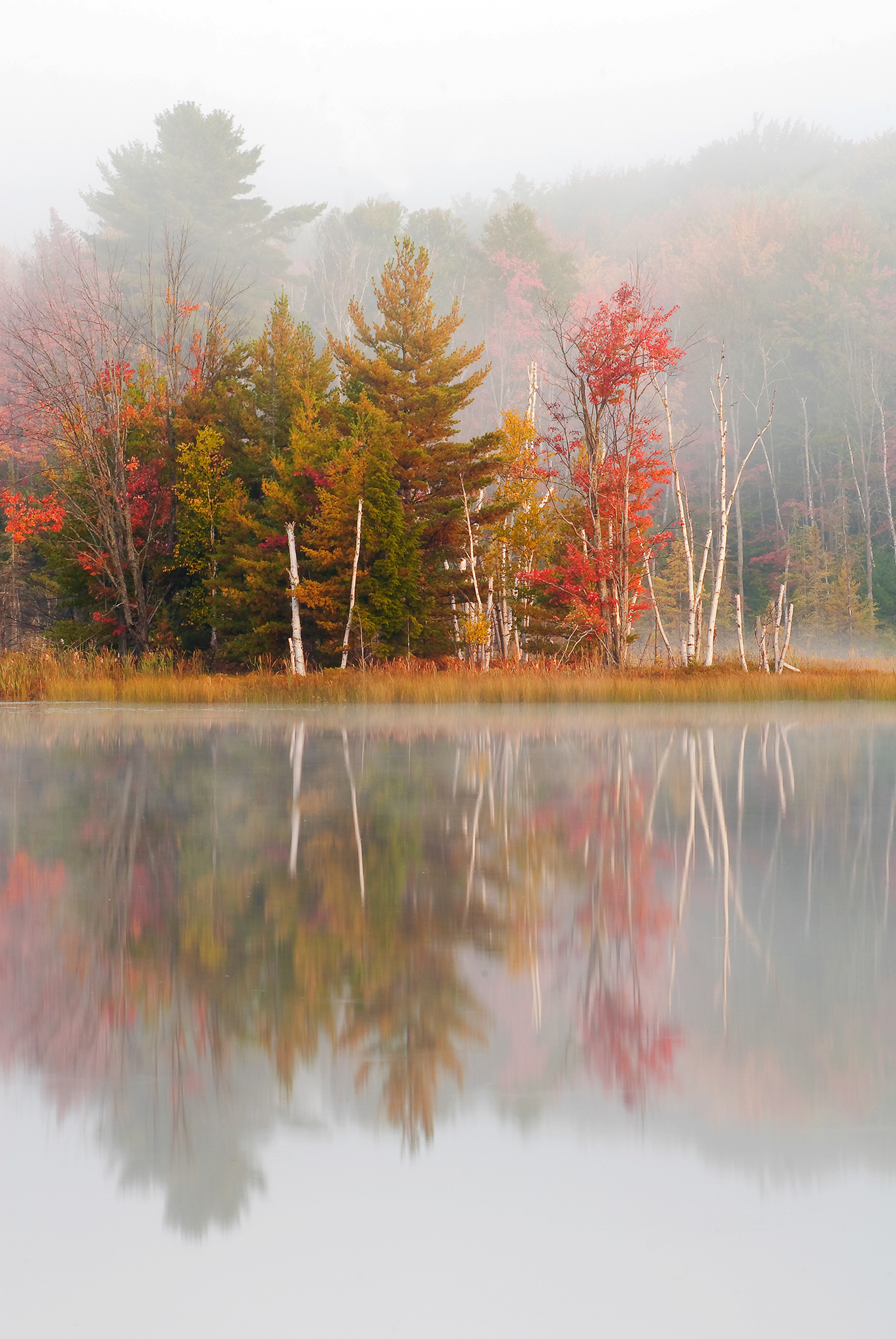
Autumn Fog
Reflections and fog hide whether it’s a point on a far shore or on the edge of an island and remove any firm understanding of size or distance, Hiawatha National Forest, Alger County, Michigan.
-

-
strong> Water Over Wood
Branches stuck in shaded cool colored water contrast wonderfully with warm toned rocks with little clue as to the size of the branches, rocks or waterfall. Alluvial Falls, Rocky Mountain National Park, Larimer County, Colorado.
-

-
Miner’s Falls
It is a small waterfall on a big sandstone outcrop or a larger waterfall on a shoreline bluff? Lake Superior shore, Pictured Rocks National Lakeshore, Alger County, Michigan.
-

-
Hammel Creek Winter
Hammel Creek leaves or enters the frame from inside the image versus and edge or corner, creating a “where to or where from” question. Hammel Woods Forest Preserve, Will County, Illinois.
-

-
Sunrise Snow Forest
Fresh snow coats a forest that could be just about anywhere with cold enough weather for snow, DuPage County, Illinois.
-

-
Ice Arch Sunrise
The sun, mostly hidden behind a cloud bank, creates apprehension about when or if it will appear, Presque Isle Unit, Escanaba State Forest, Marquette County, Michigan.
-

-
Wyalusing Mist
Fog fills the Wisconsin River Valley at sunrise, the mystery is what’s under the mist? Grant County, Wisconsin.
-

-
River Frost
Canada Geese swam into the image I was making of hoar frosted branches. Serendipity! The mystery is where did they come from, where are they going. DuPage River, Will County, Illinois.
-

- Painting with Wildflowers Layered exposures with differing focal points creates this soft and sharp wildflower portrait with no clue as to where it was made, Shrine Pass mountainside, Summit County, Colorado.