

 Join the conversation
 Subcribe to comment rss feed
What’s in the Air?

Morag Paterson
A sense of belonging underpins my photographic work, which varies from the wildly abstract to more literal representations of the natural world. For me, the art of photography is process-based, using the camera as a tool to express my engagement with any given location or subject.
Enjoying many camera-free hours roaming on the hillsides of the southern uplands in Scotland or the wooded slopes around our smallholding in the Alpes-Maritime helps build my mental scrapbook and incubate ideas.
Forestry is rarely discussed quietly.
Where I live, in south-west Scotland, new planting schemes sit alongside established commercial blocks. Conversations about timber, biodiversity, rural economics and landscape character tend to harden quickly. Nationally, it’s the same. We appear stuck in a loop of position and counter-position: plant more trees, plant fewer trees; commercial forestry is essential, commercial forestry is destructive. Each side becomes fluent in its own certainty.
I began Curious Conversations because I wanted to step out of that loop.
Not to resolve it. Not to choose a side. But to see what might happen if I stood inside a working forest for a year and paid attention — not to arguments, but to what was actually there.
Standing in a Working Forest
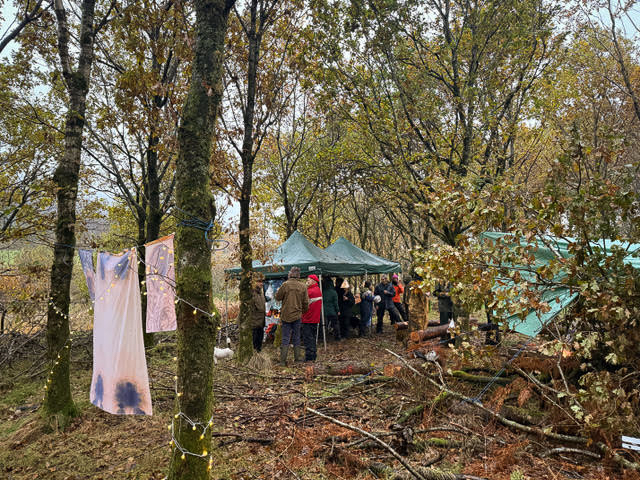
Crofthead, just outside Moffat, is a privately owned commercial forest. Sitka spruce grows alongside aspen. Douglas fir stands beside belts of broadleaf. There are clearfell sites, thinning operations, and deliberate species and management experiments.
Andrew, the forester who manages it, agreed to let me shadow him for a year, after I successfully secured arts residency funding from D&G Woodlands, EcoArt Charity and a private donor.
Initially, the project consisted largely of watching, walking and talking. I watched thinning operations and saw how removing a single tree alters light, airflow and the potential for understory growth. I stood on clear fell sites and felt the exposure. We talked - about policy, pathogens, markets, folklore, species choice, soil conditions – anything and everything.
The project could have remained there, in conversation, observation and questions. But one comment shifted its direction. Andrew mentioned research suggesting that microbes in the air around ash trees may help protect them from pathogens. Invisible presences, potentially contributing to resilience. That idea was fascinating to me, and I wanted to find out how we could explore the forest air.
Catching the Invisible
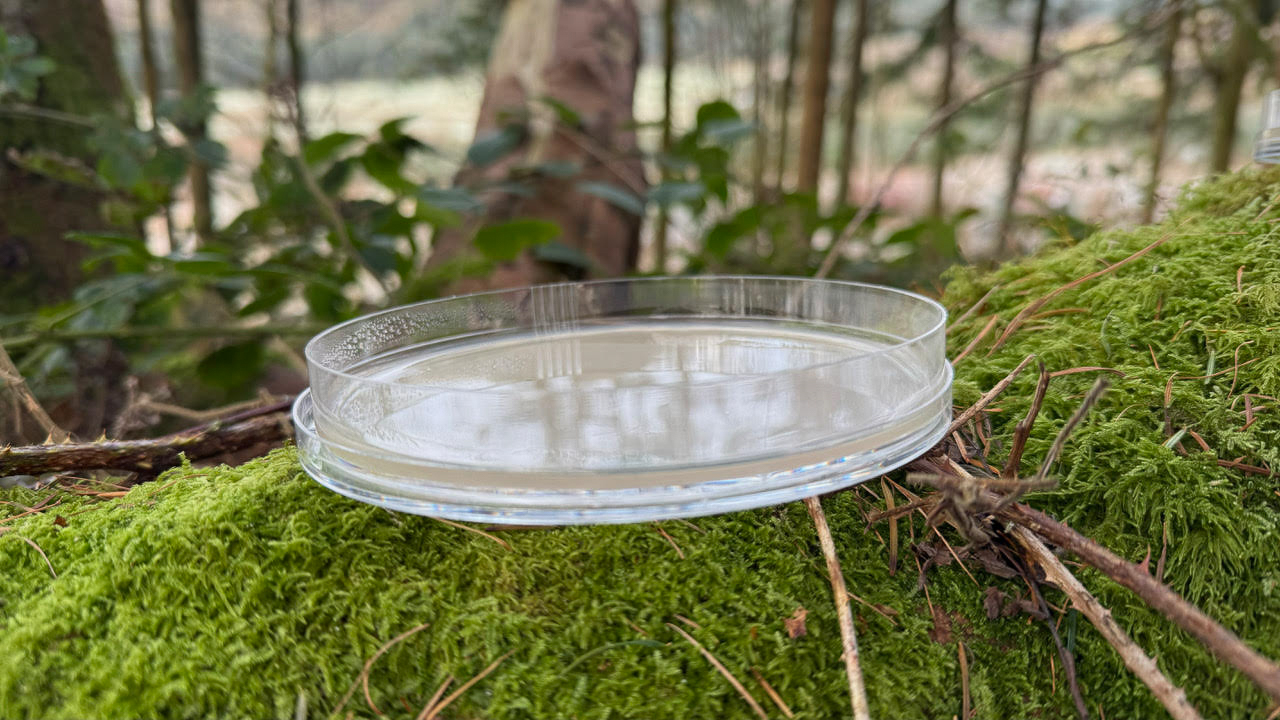
With support from ASCUS Lab in Edinburgh, we began experimenting with settle plates - simple Petri dishes filled with agar, exposed to the forest air for a fixed period, in this case a few hours.
On a cold November day, we distributed the plates across Crofthead: on a windy clearfell site, in a 30-year-old Douglas fir stand, beside a river, near a stump dense with fungal scent. After a day’s exposure, the dishes were sealed and left to grow in a warm environment.
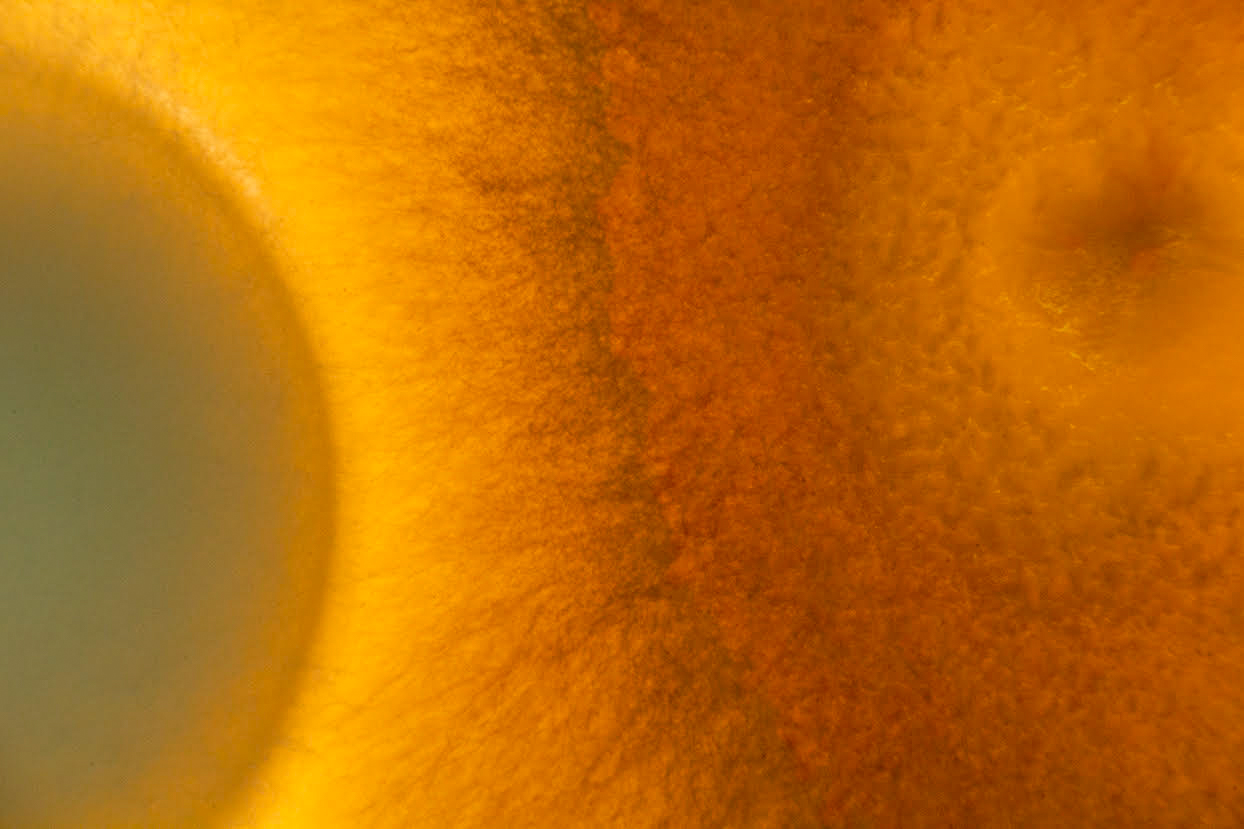
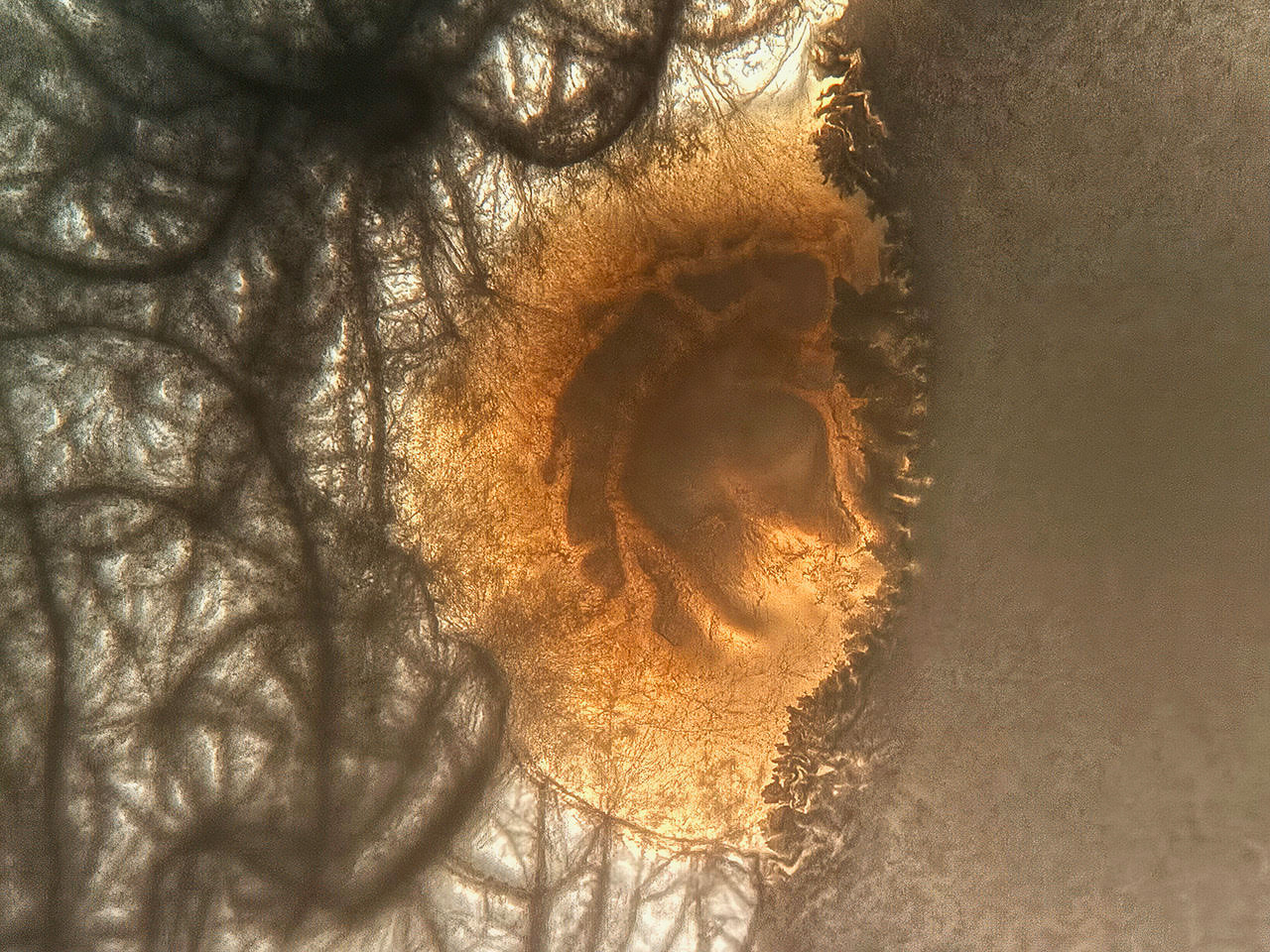
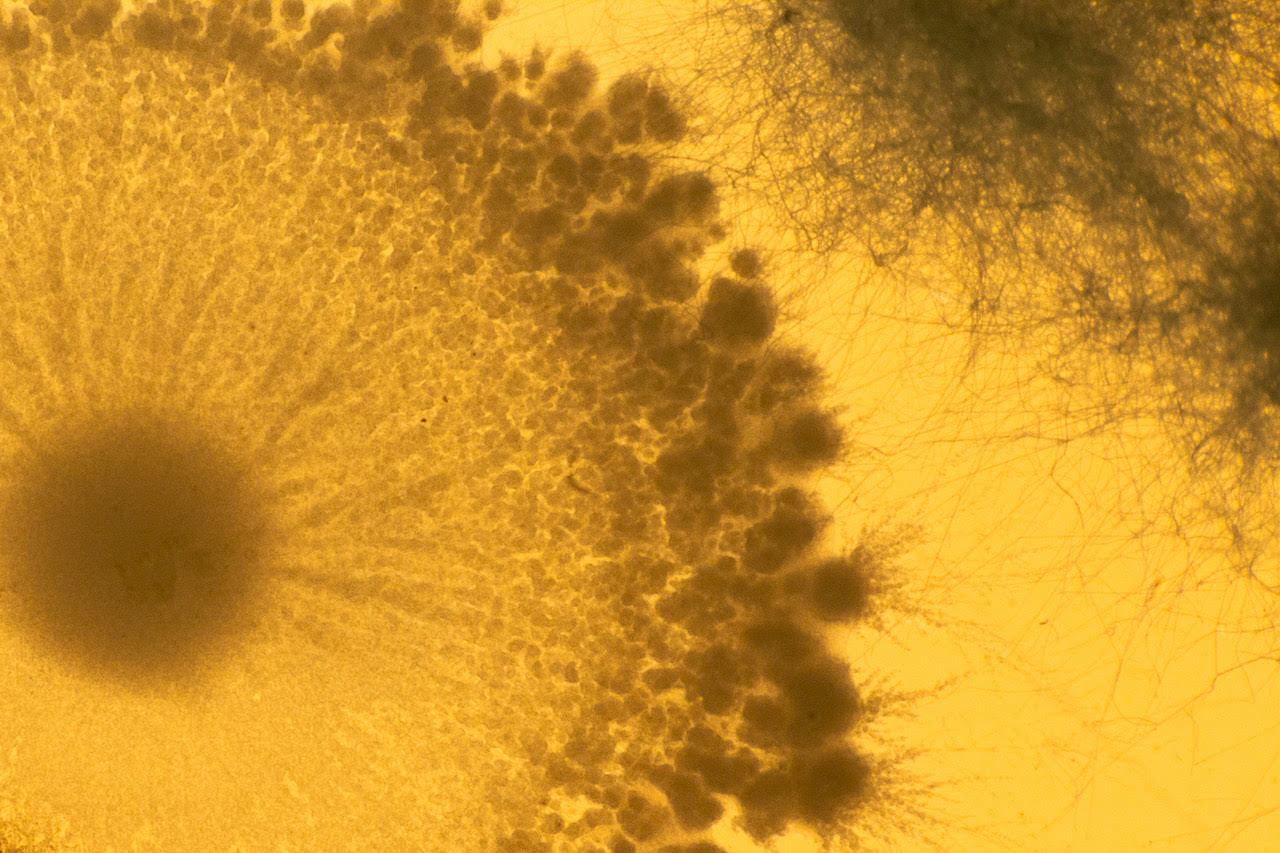
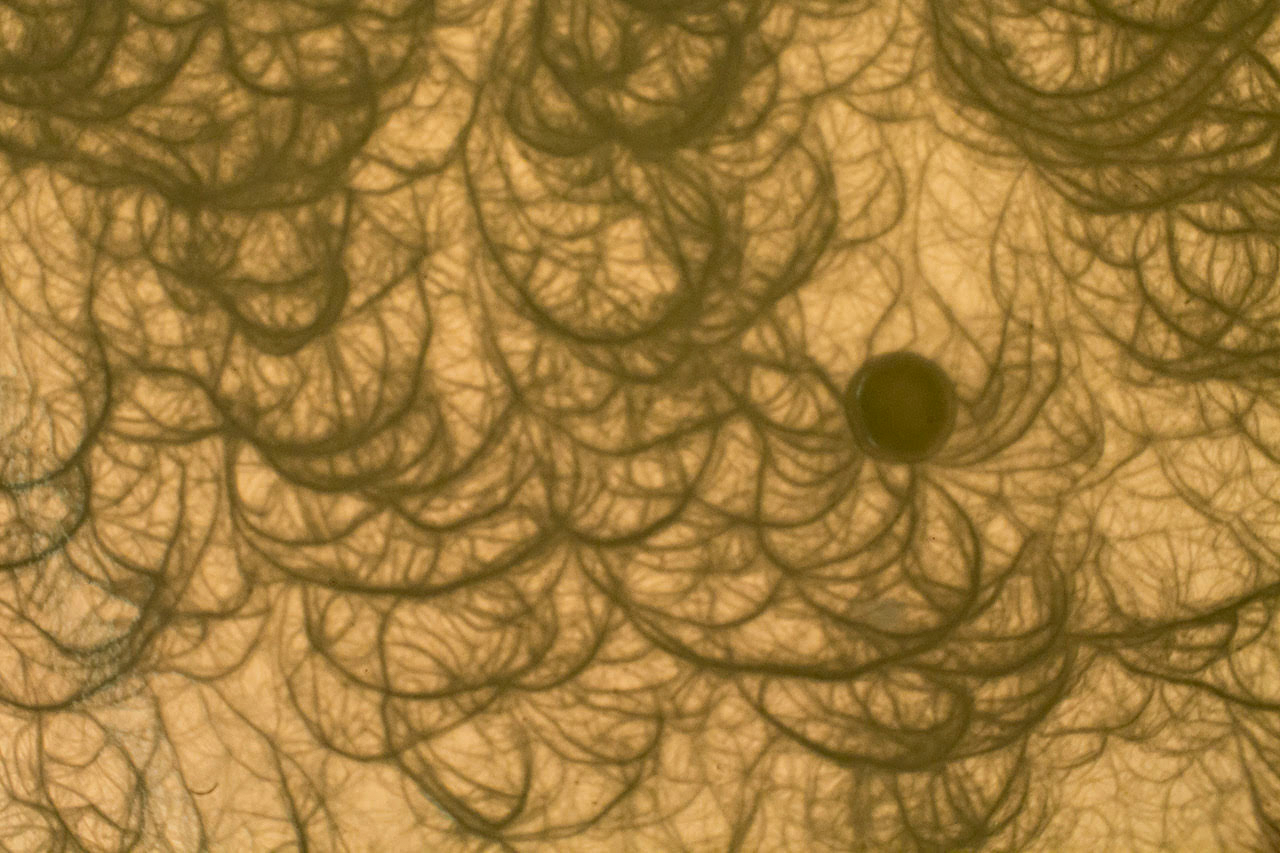
Within days, colonies appeared. Different colours. Different textures. Glossy bacterial forms. Fine mycelial threads radiating outward. Some plates were crowded; others sparse. We made basic counts of colony types and numbers, and more recently have started to try and identify taxa and ecological function. What grew wasn’t anything exotic, but it was revealing. Across different parts of Crofthead we repeatedly found common canopy fungi - likely Cladosporium-, Penicillium-, Aspergillus- and Epicoccum-type species - alongside darker, more heavily pigmented forms and the odd yeast or bacterial colony. These are the quiet workers of woodland systems: leaf-surface dwellers, decomposers, dry-spore dispersers, opportunists waiting for a fallen twig. Nothing rare, nothing dramatic - just a dense, functioning atmospheric community moving between canopy, soil and everything in between. The air, it turns out, is busy.
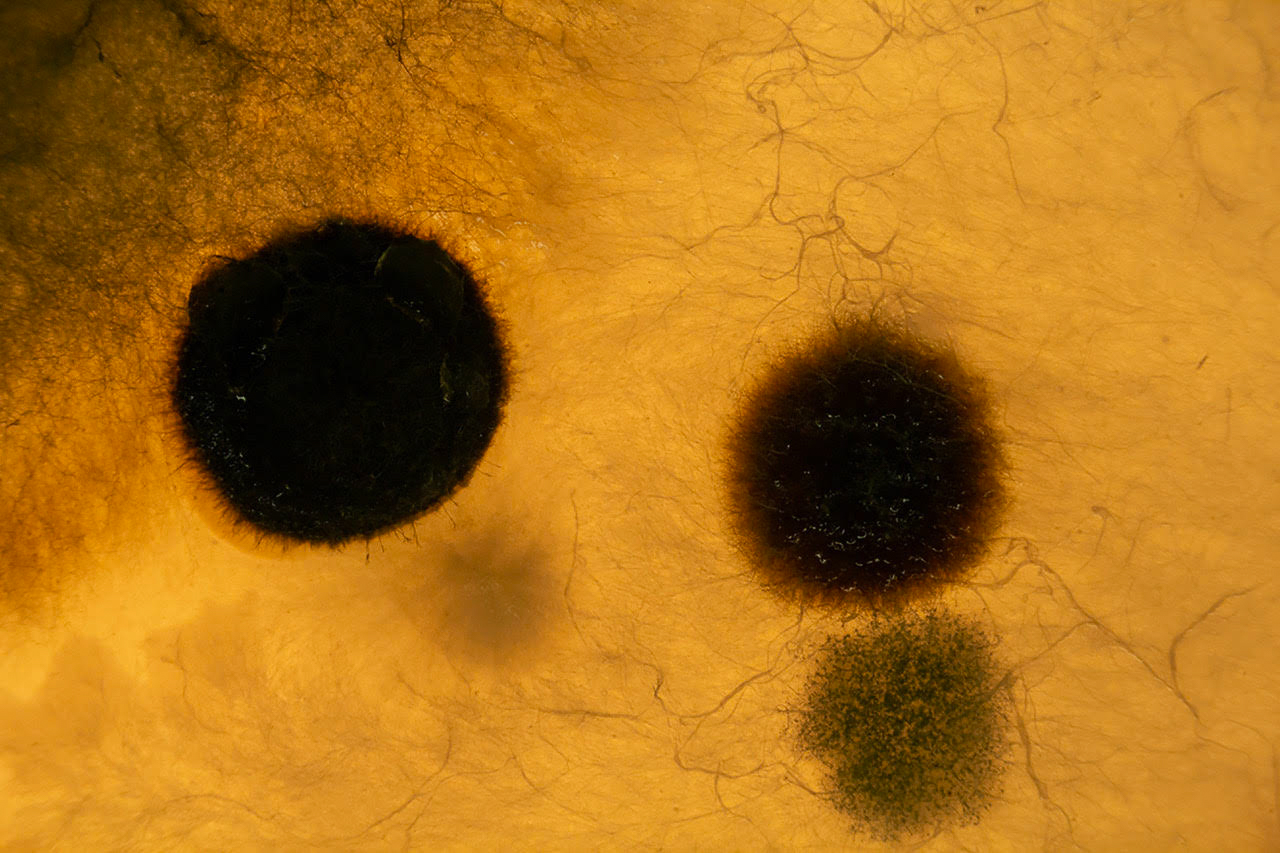
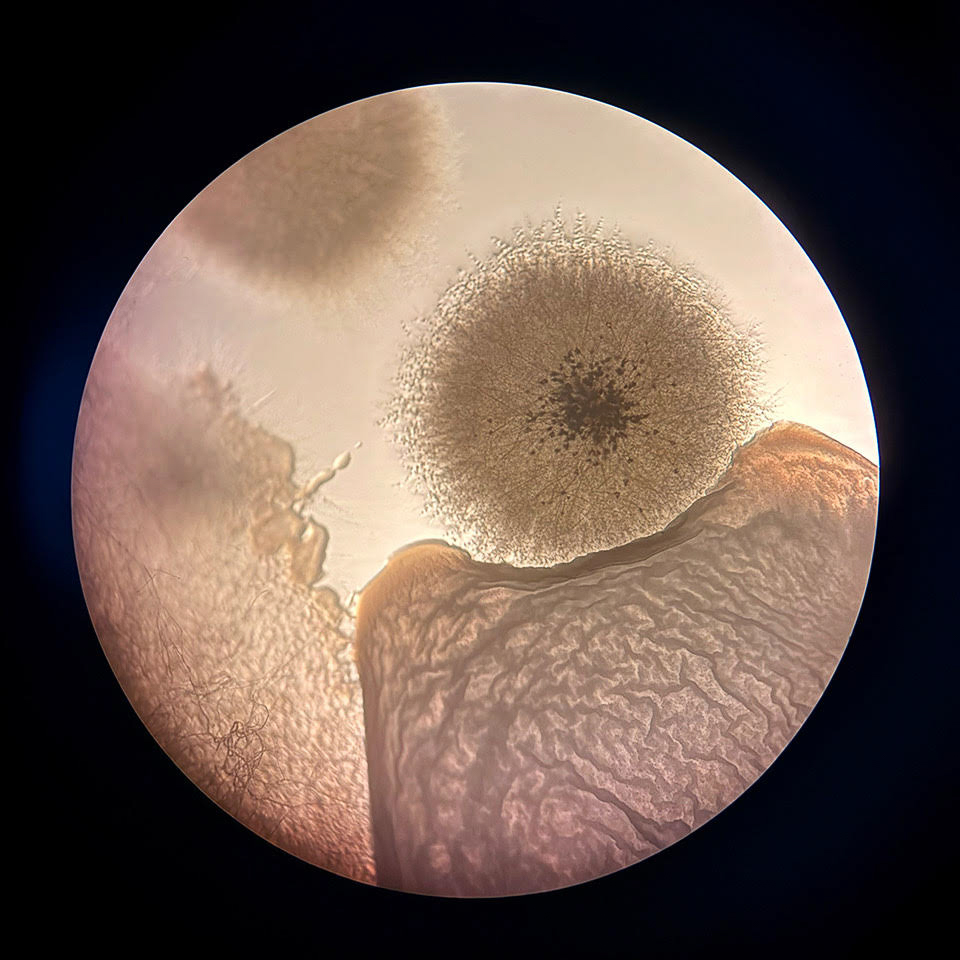
Looking at these colonies under the microscope, my everyday sense of scale radically changed, and I was mesmerised by what we were seeing. A translucent smudge resolved into branching filaments. Zooming in and out, adjusting focus, staining samples to reveal cellular structures — the experience altered how I thought about the forest above ground. What might appear stable at human scale is, at another scale, in constant negotiation.
The photography that emerged from this process was fascinating. These were not images of trees, nor even of soil, but of the atmosphere between them. The photography itself was challenging. I had two options: to hold the phone against the microscope eyepiece, or to use the DSLR mounts on the microscopes in the lab. The latter was tricky – I hadn’t invested in a microscope phone mount at the time – but yielded faster results, more in tune with what I was seeing through the eyepiece. The DSLR images, whilst better quality, were harder to work with; what you see through the eyepiece isn’t what you see on the laptop screen and depth of field is a real challenge. I didn’t want to turn this into a technical photographic challenge with focus stacking etc, and I wanted to retain the sense of wonder I had when I looked down the eyepiece. This was harder to achieve using the DSLR method.
Expanding the Conversation
The project widened through collaboration.
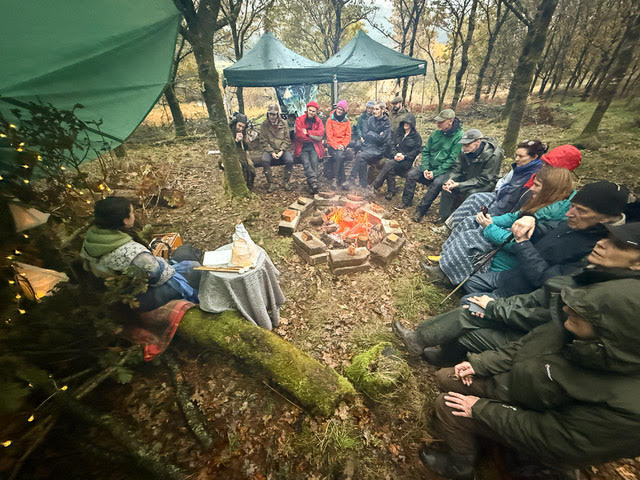
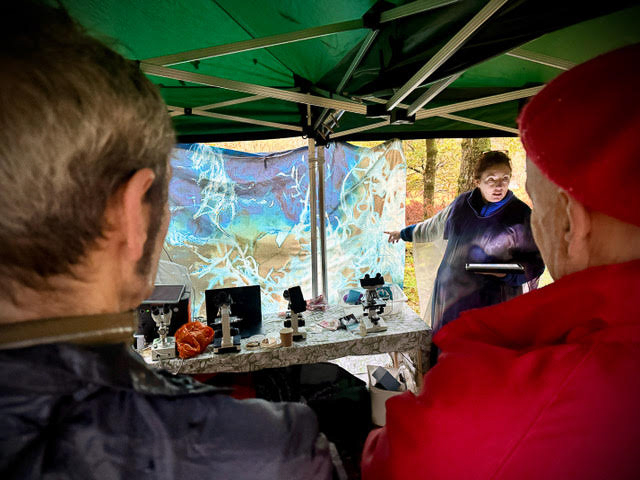
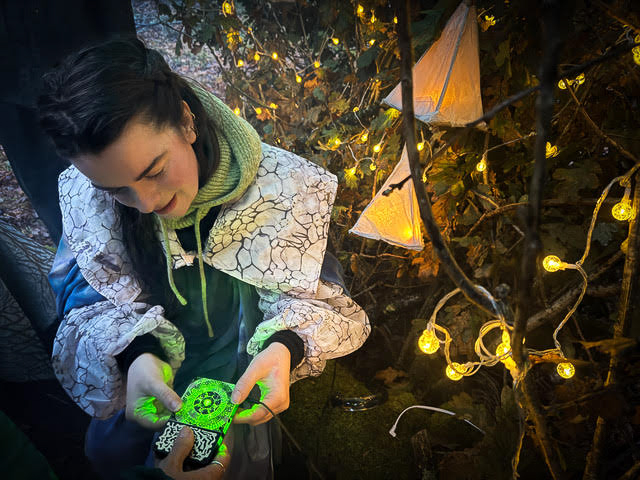
A clinical microbiologist joined us to speak about airborne particles and human exposure. A musician translated fungal electrical signals into sound, performing in the forest itself during a rain-soaked gathering of neighbours and foresters. Microscopes ran under canvas while a fire burned nearby.
These events were not about spectacle. They were about permeability [human/forest and interdisciplinary forestry/photography/musical/microbiological]. Forestry, science and art tend to operate in parallel lanes. Bringing them into the same physical space altered the quality and potential of conversation.
The most generative moments often occurred not during formal presentations, but in between: someone peering down a microscope for the first time; a forester listening to a clinical physician describe microbial exchange; a neighbour asking what might be drifting through the air they breathe daily.
Curiosity is less confrontational than opinion.
What’s next?
Curious Conversations did not begin as a scientific study, and it is not an advocacy campaign disguised as art. It began as an experimentation to see what happens when we embrace curiosity and long-form conversation.
Spending a year inside a working forest shifted my own assumptions.
Most significantly, it altered the tone of conversations I am able to have.
When discussions about forestry return to familiar positions, I find myself thinking about settle plates quietly gathering what is already in the air. About fungal structures embedded invisibly in roots. About processes too small to see yet fundamental to everything above them.
Perhaps changing the forestry debate does not begin with louder advocacy, but with closer observation.
The air is not empty. The soil is not inert.
And if we begin there, with what is actually present, the conversation might shift.
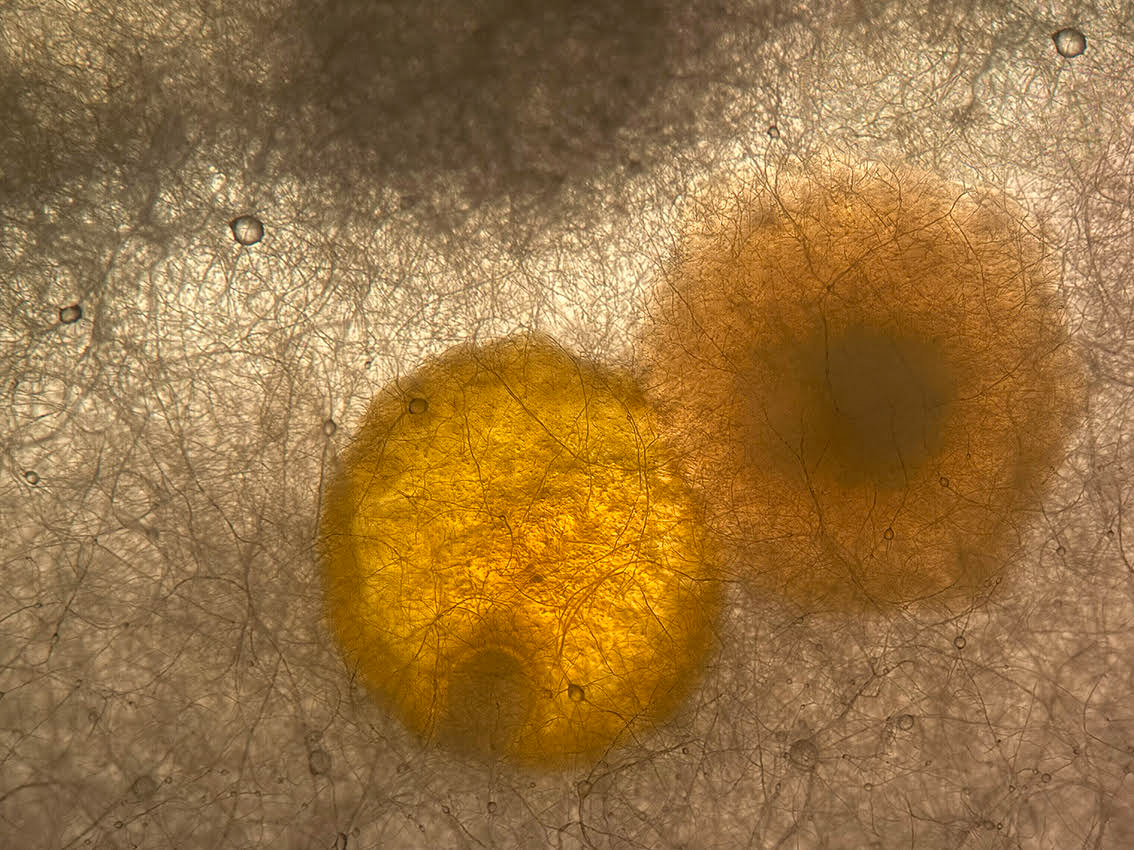
A bit of fun, Space and Spores
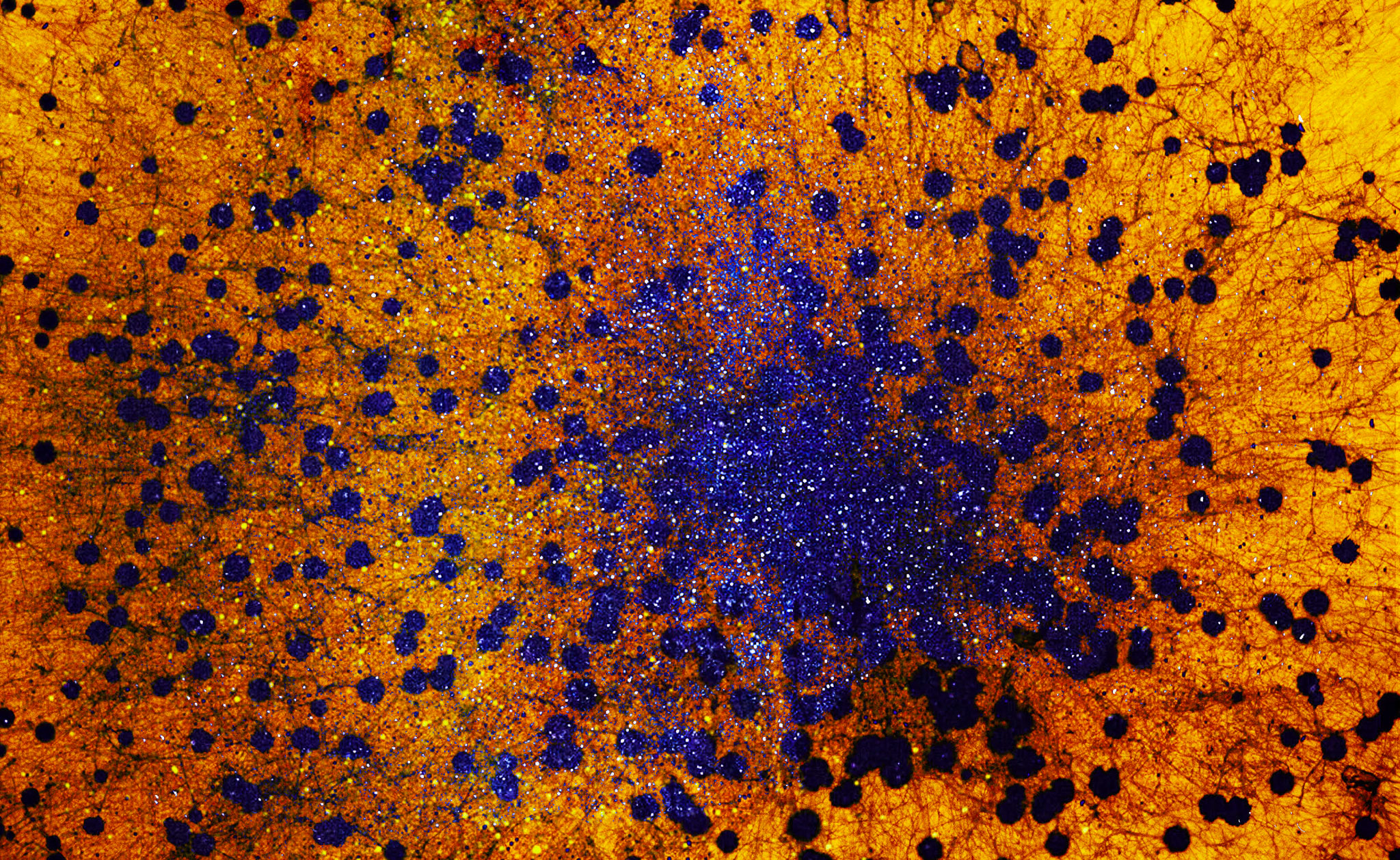
Living in a designated dark sky area, it is impossible not to notice the night. On clear evenings, the Milky Way arches above the same forest where settle plates were exposed. That visual continuity prompted a series of experimental image blends — microscopic textures layered with star fields and with intentional camera movement photographs of trees.
I approach these composites cautiously. They risk romanticism. But there is something structurally resonant between branching mycelial networks and the filamentary structures of galaxies. The connection is not mystical; it is material. The elements that compose microbial life were forged in stars. That is not metaphor, but physics.
Still, I am careful. The project is grounded in fieldwork, in dialogue, in observable systems. If there is poetry here, it must remain accountable to what is actually present.
Image Credits
The event photos are all taken by Ted Leeming.
The spore photos are all taken by Morag Paterson.
The space photos are all taken by Andrew Macqueen.