


 Join the conversation
 Subcribe to comment rss feed
Featured Photographer

Murray Fredericks
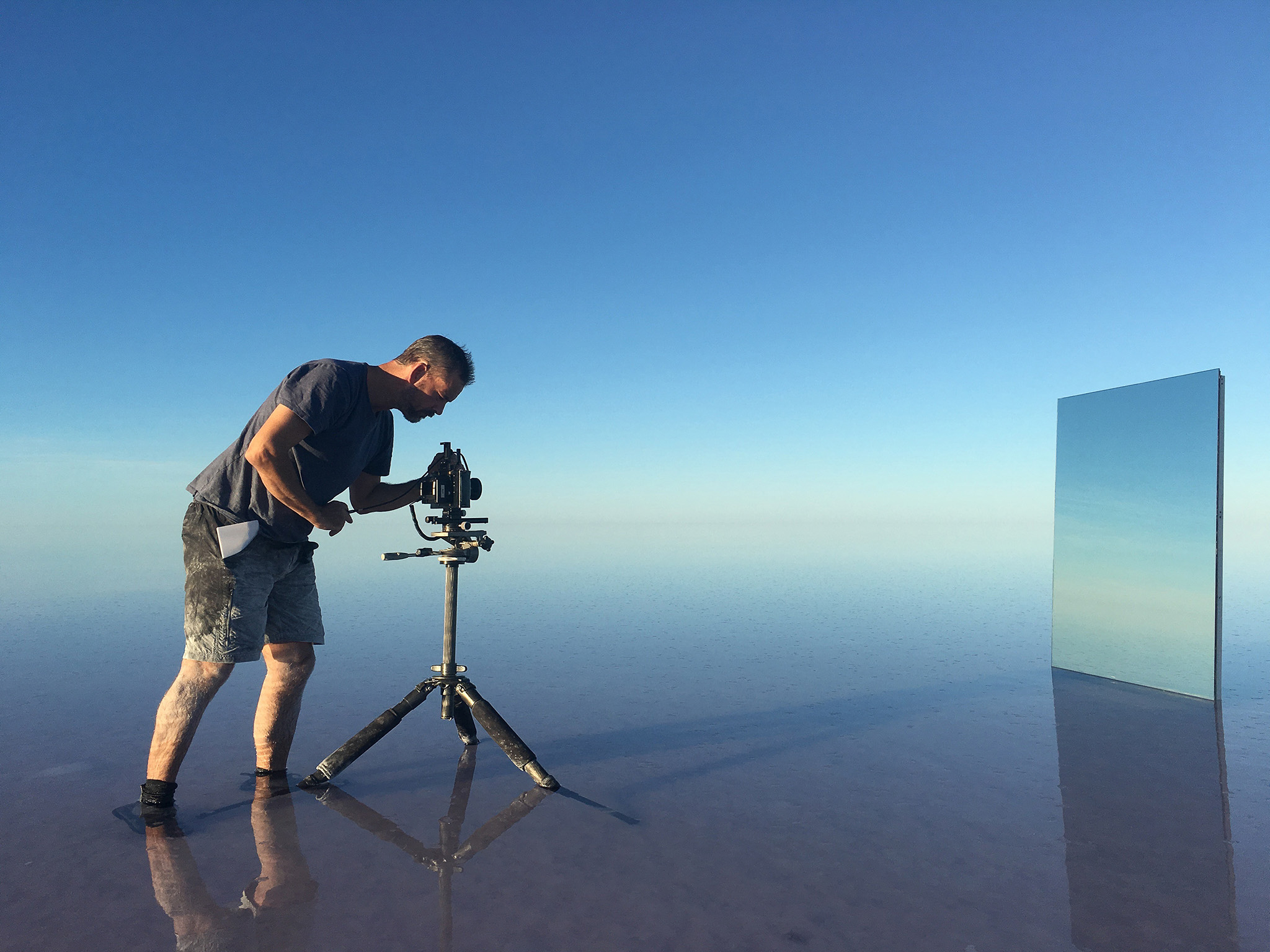
Murray Fredericks is known for his large-scale photographs of remote, seemingly infinite landscapes. In recent years, he has introduced interventions using mirrors, light, and, most recently, fire and flame as central elements within the work.
Based in Sydney, Fredericks has undertaken long-term projects in some of the world’s most extreme environments. His Lake Eyre/Kati Thanda project began in 2003 and has involved more than 30 visits.
Fredericks has exhibited widely and is represented by Hamiltons Gallery, London; Robert Mann Gallery, New York; and ARC ONE Gallery, Melbourne. His work is held in major public and private collections internationally.
Alongside his art practice, he has a substantial commercial career in time-lapse cinematography, architectural photography, and landscape stills.

Michéla Griffith
In 2012 I paused by my local river and everything changed. I’ve moved away from what many expect photographs to be: my images deconstruct the literal and reimagine the subjective, reflecting the curiosity that water has inspired in my practice. Water has been my conduit: it has sharpened my vision, given me permission to experiment and continues to introduce me to new ways of seeing.
In the pursuit of capturing objects, we often overlook the spaces between them.
From the expanse of thought from a university education to extended travel across the Himalayas, Patagonia, and Tasmania, Murray Fredericks realised that the images that resonated were those that conveyed an emotional connection.
Committing time to live within the remote, seemingly infinite landscape of Australia’s Kati Thanda-Lake Eyre transformed his work. Despite the large scale, small changes became significant in a way that they would not in a busier environment.
We live in places of over-stimulation with competing demands for our attention. Everyone, it seems—including many landscape photographers—is in a rush. Yet the key to Murray’s development and success as a photographer has been his extended engagement with subject. The depth of understanding this has fostered has shaped his practice, contributing to a way of working less concerned with individual pictures and more with sustained investigations of space, time, and meaning.
Murray Fredericks’s photography asks us to consider what happens if we stop rushing around and commit to a place.
Would you like to start by telling readers a little about yourself – where you grew up, what your early interests were, and what you went on to study? Did art feature in your formative years?
I grew up in the suburbs of Sydney. Our house backed onto the bush, and I spent a lot of time there, either alone or with friends. It was a very natural place to be, and I always felt at home in that environment.
Art did not feature at all in my formative years. Photography wasn’t something that was ever discussed as a career path in our household. In some ways, that left a certain freedom around anything creative.
I was always fascinated by cameras. I remember taking our small red Instamatic film camera and crawling around the backyard photographing our dog. When the film came back from the chemist, as it did in those days, I remember my parents looking through the prints and asking, with some surprise, “Who took these?” My mother also had a camera with manual controls, and at a very young age, I was fascinated by the workings of it. I didn’t understand how the various settings affected the photograph, but I remember loving the process of placing the exposure needle between the lines, pressing the shutter, and feeling oddly satisfied.
I didn’t take art at school, but in my final years, I chose a science elective called The Physics of Optics. Through that course, I learnt about everything from lens design to the chemistry involved in developing film. While it was intended as a technical subject, I found myself drawn to the photographic side of it. I remember one assignment where I had to demonstrate depth of field using a macro lens. I photographed a backlit drop of water and can still remember how much I enjoyed making the image, even though that wasn’t really the point of the exercise.
My early interests were all outdoors. I loved surfing from a young age, often spending hours in the water by myself. I also joined a school club that organised long treks, rock climbs, canyoning trips, and journeys into the deserts of inland Australia. I often took our family’s little red Instamatic camera on those trips. I always seemed to gravitate towards those environments and, without realising it at the time, probably built a natural confidence in being out in the natural environment.