


 Join the conversation
 Subcribe to comment rss feed
A Dialogue with the Mountains

Rob Henderson
I am a 21-year-old landscape photographer based in Scotland. My photography is primarily inspired by my affinity for mountains, capturing the unique and unpredictable weather of the Scottish Highlands. This is usually achieved through overnight or multi-day trips, battling through any and all conditions.
‘Vignette’
/viːˈnjɛt,vɪˈnjɛt/
Noun
1. a short graceful literary essay or sketch
2. a photograph, drawing, etc,
with edges that are shaded off ~Collins dictionary
The mountains of Torridon have a way of holding you at a distance. Sheer sandstone walls rise from the glen with an authority that resists easy capture. Its mountains are spoken of in reverent tones – Liathach, Beinn Alligin, Beinn Eighe – names that carry the same weight as their ridges and peaks. I was first made aware of these mountains three years ago, when my photographic journey began. Long before setting foot, I spent hours poring over maps and photographs, sketching out routes and viewpoints within this fabled range.
This early fascination made returning inevitable, but as a student, travel required planning and compromise. Scotland’s free bus travel scheme for under 22s offered me both an opportunity and a challenge.
The network stretches far, from comfortable city coaches to old school buses rattling along the Highland roads. But Torridon lies on one of the most restrictive routes: just two buses in and out on Tuesdays and Saturdays, providing a strict time window. For me, reaching it requires three separate connections and around eight hours of travel from the central belt of Scotland. The journey north became a kind of pilgrimage in itself – a reminder that Torridon insists on patience and commitment, before even reaching the trailhead.
The idea of merely revisiting felt incomplete. I wanted to give the journey more purpose, something that would make the effort of reaching this remote range feel intentional. On that long ride I had time to refine my aim. I set myself a challenge: to create a single photograph for each of Torridon’s eight peaks within the Torridonian Forest locality.
Not simply a record shot or a summit view, but a photo that represented each mountain’s presence and character. This demanded a slower pace. Rather than chasing every viewpoint, I had to move with the rhythms of the weather, attentive to its shifts and silences.
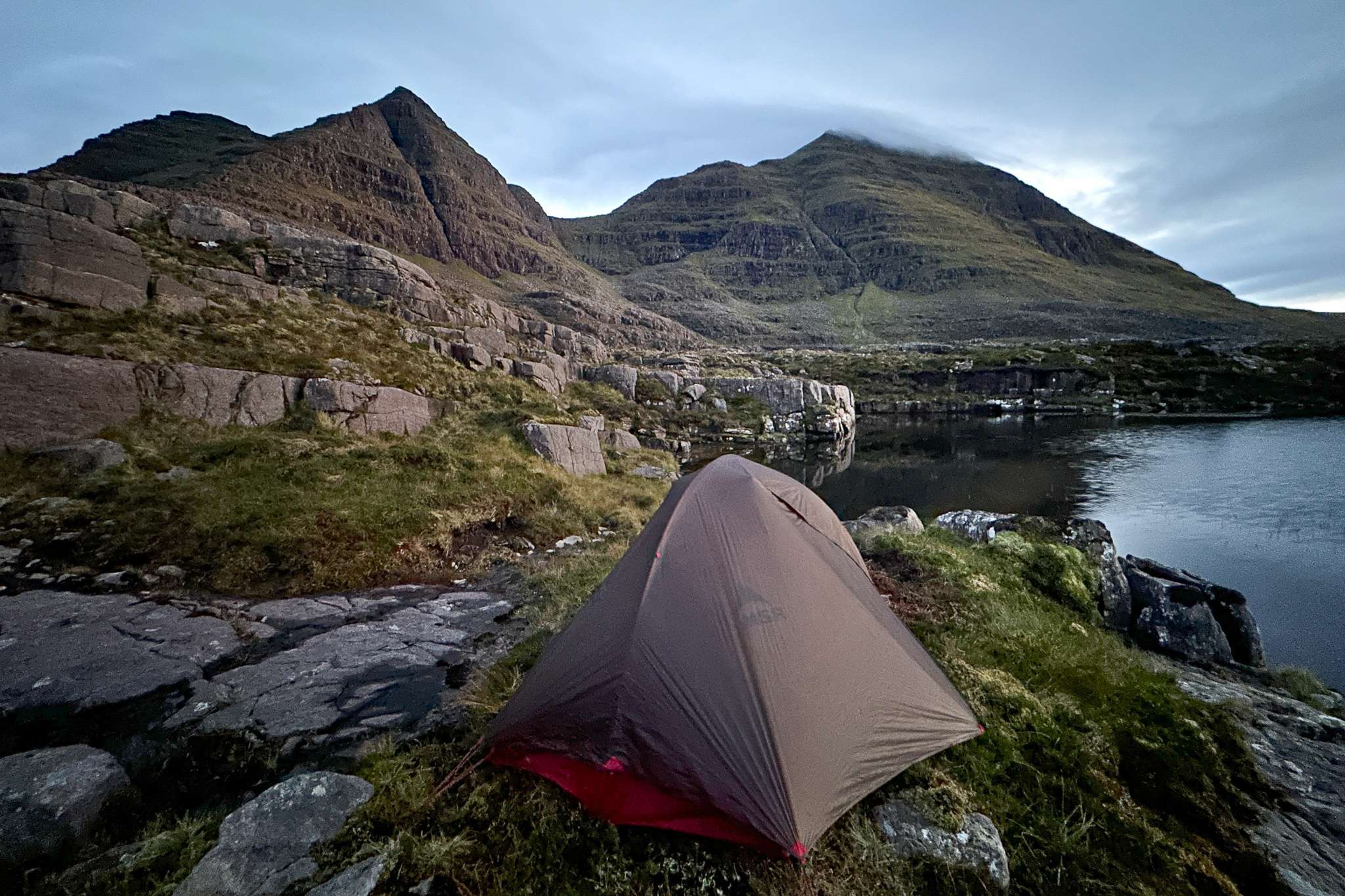
Backpacking gave me this freedom. With four days of food and shelter strapped to my back, I could linger when the conditions aligned, camp where the light lasted, or move on when the moment had passed. The weight of the pack was its own discipline, ensuring every stride was well measured, every stop deliberate, and every frame considered
Each mountain revealed itself differently – sometimes simply through waiting for the sun to be low enough for the right light, more often only after hours of mist or rain broke to let the light shape the landscape. What emerged was not just a record of a route, but a sequence of vignettes: eight mountains, eight photographs, each a fragment of Torridon’s story.
The word vignette feels fitting, suggesting both a short, graceful narrative and a technique for framing a scene. Together, they aim to form a portrait of Torridon – not complete, but true to the fleeting, elusive nature of this mountainous area.
Beinn Dearg – 914m
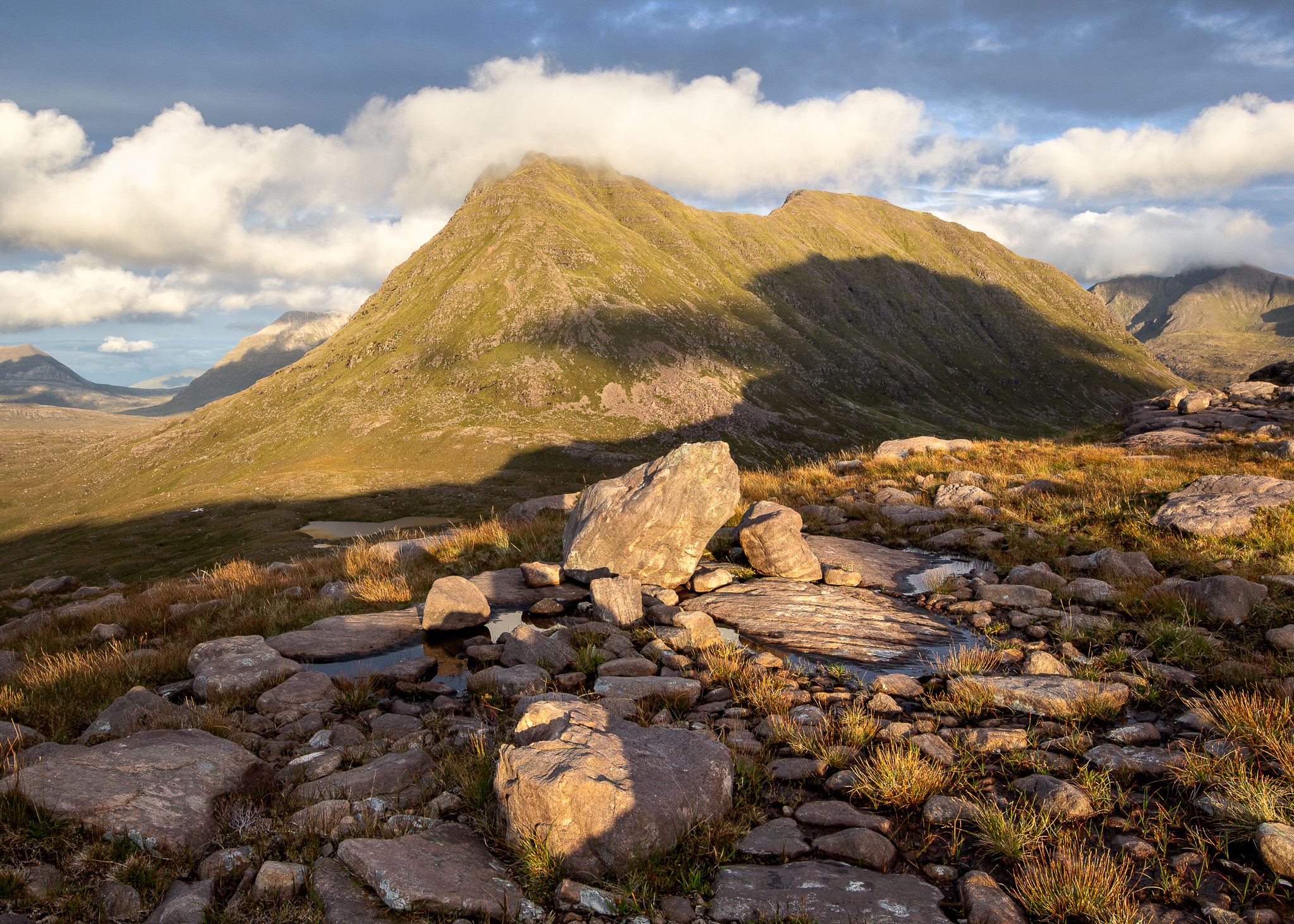
Beginning with Beinn Dearg felt fitting. It is an understated mountain – just 73 centimetres shy of Munro status, yet without the reverence or footfall of Torridon’s more famous peaks.
Sitting in the very heart of the range, it became both the epicentre for photographing this landscape and the original focal point of the trip.
I spent three hours wandering among a minefield of erratics, searching for compositions, hoping to be calm and prepared when the light finally arrived. In reality, it was the opposite. As the sun neared the horizon, the scene shifted into something fleeting and unpredictable: deep blue clouds layered high above, while white, lower clouds swirled around the summits. Panic set in. I raced between my previously scouted locations, watching how the changing light transformed each frame. Nothing sufficed.
At last, I arrived at a spot just as the foreground was descending into shadow. Ideally, I would have placed this rock further to the left of frame so that it pointed inward, but compromise was impossible.
Instead, I leaned into what the moment offered. Shadow and sun worked together, pulling the eye from the corners of the frame towards that solitary stone, now separated from Beinn Dearg by a rising line of shadow. In that brief instant, the layering I had been searching for finally presented itself.
Baosbheinn – 875m
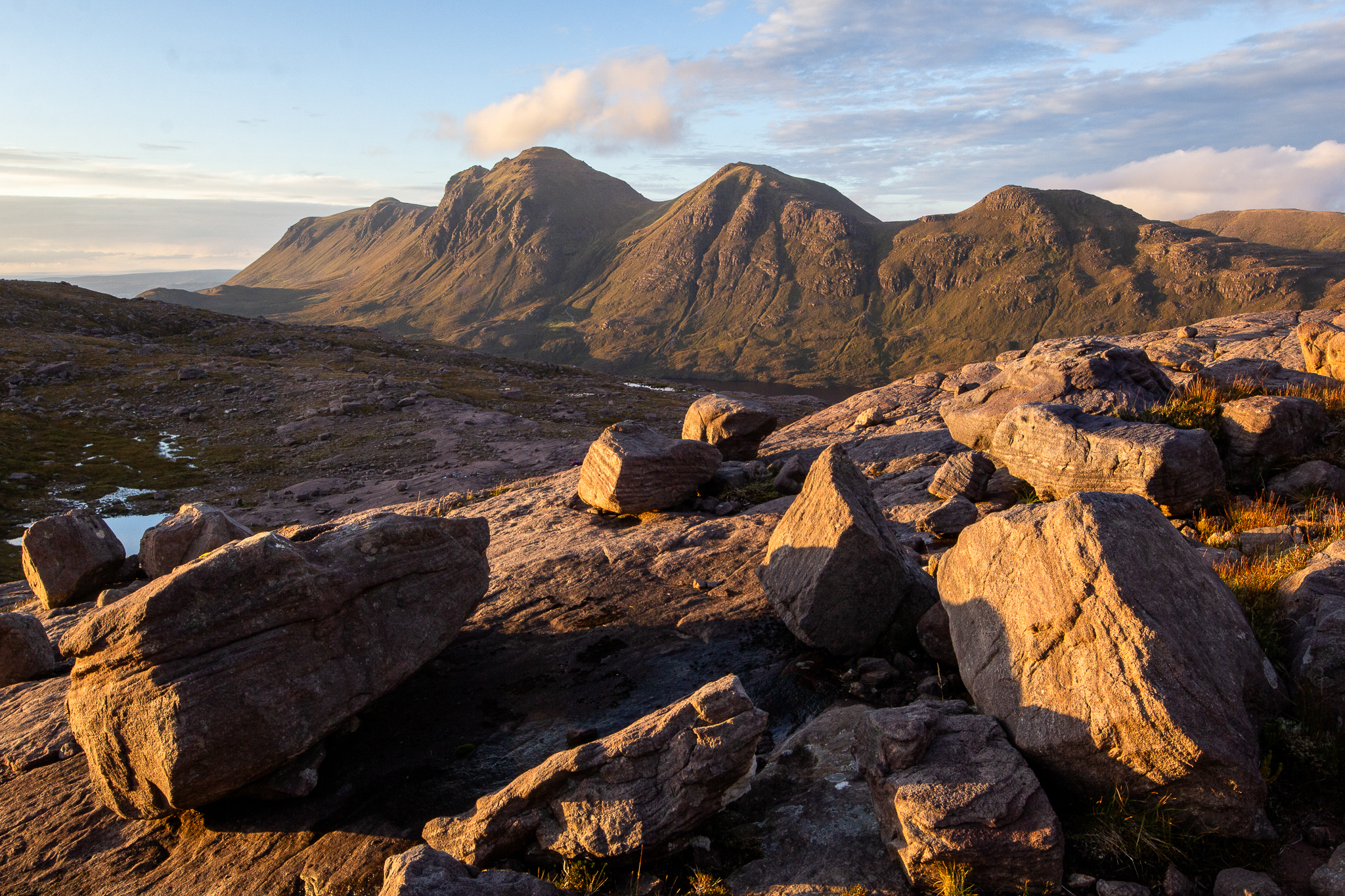
The evening’s photography was far from finished. Having secured a frame of Beinn Dearg that felt strong enough, I turned my attention to Baosbheinn. With its long undulating spine, evoking the shape of a sleeping dragon, a faint wisp of cloud drifted from its summit like smoke.
I had climbed much of its ridge the previous day and carried with me a more personal sense of its place within the range. Baosbheinn is often treated as a lookout – a platform from which to admire the Torridon giants – rather than as a subject in its own right.
When composing the photograph, I let the light take the lead. The boulder field at my feet was chaotic, but within the disorder a group of rocks caught the sun and cast elongated shadows across the ground.
Their rhythm echoed the ridgeline beyond. I was drawn to the possibility of creating a visual echo – foreground stones arranged
like a miniature replica of Baosbheinn’s peaks, pulling the eye from right to left. In that moment, the mountain ceased to be just a viewpoint for Torridon’s giants; instead, it revealed a quiet authority of its own, connected by the rocks that lie beneath it.
Liathach – 1023m
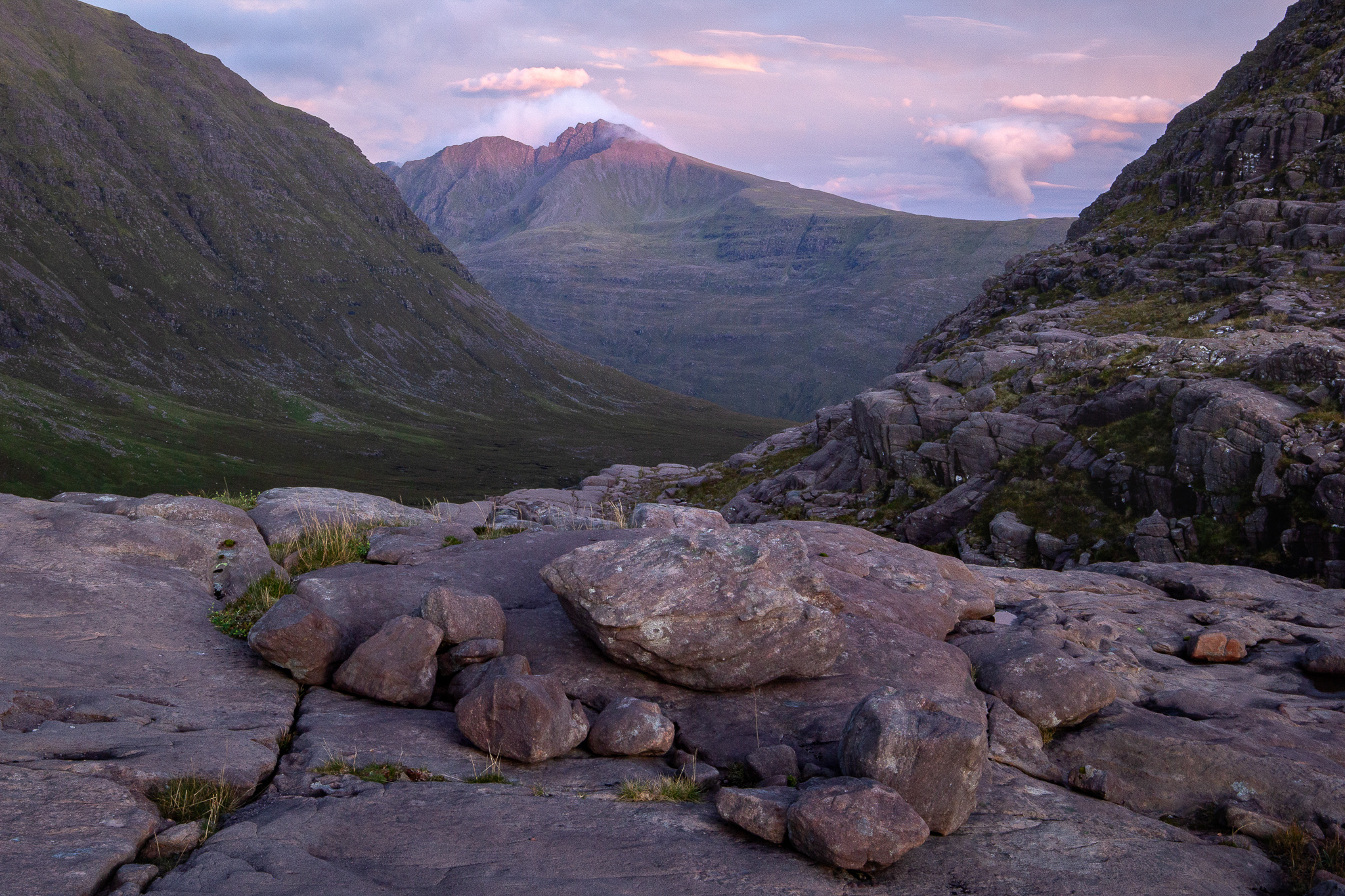
I decided to save the privilege of traversing Liathach’s ridge for another trip, meaning I was only left to admire it from a distance, wishfully imagining the feeling of standing atop its peak. My glimpses of this mountain were handed in small portions.
However, when it did reveal itself, it was with great splendour. The light had drained from the surrounding mountains, leaving only a sharp, crimson glow clinging to the summit of Mullach an Rathain - one of the Munros of the Liathach ridge. Just as I thought the evening could offer nothing more, low cloud crept up behind the peak and began curling around the corner.
I worked quickly, using the converging lines of the surrounding mountains to draw the eye to Liathach, anchoring the composition with a foreground of neatly arranged rocks. Liathach’s grandeur was undeniable, even from afar. It was a mountain that revealed itself on its own terms as I was not to see its peaks for the rest of the trip, shrouded out by thick cloud.
Beinn an Eoin – 855m
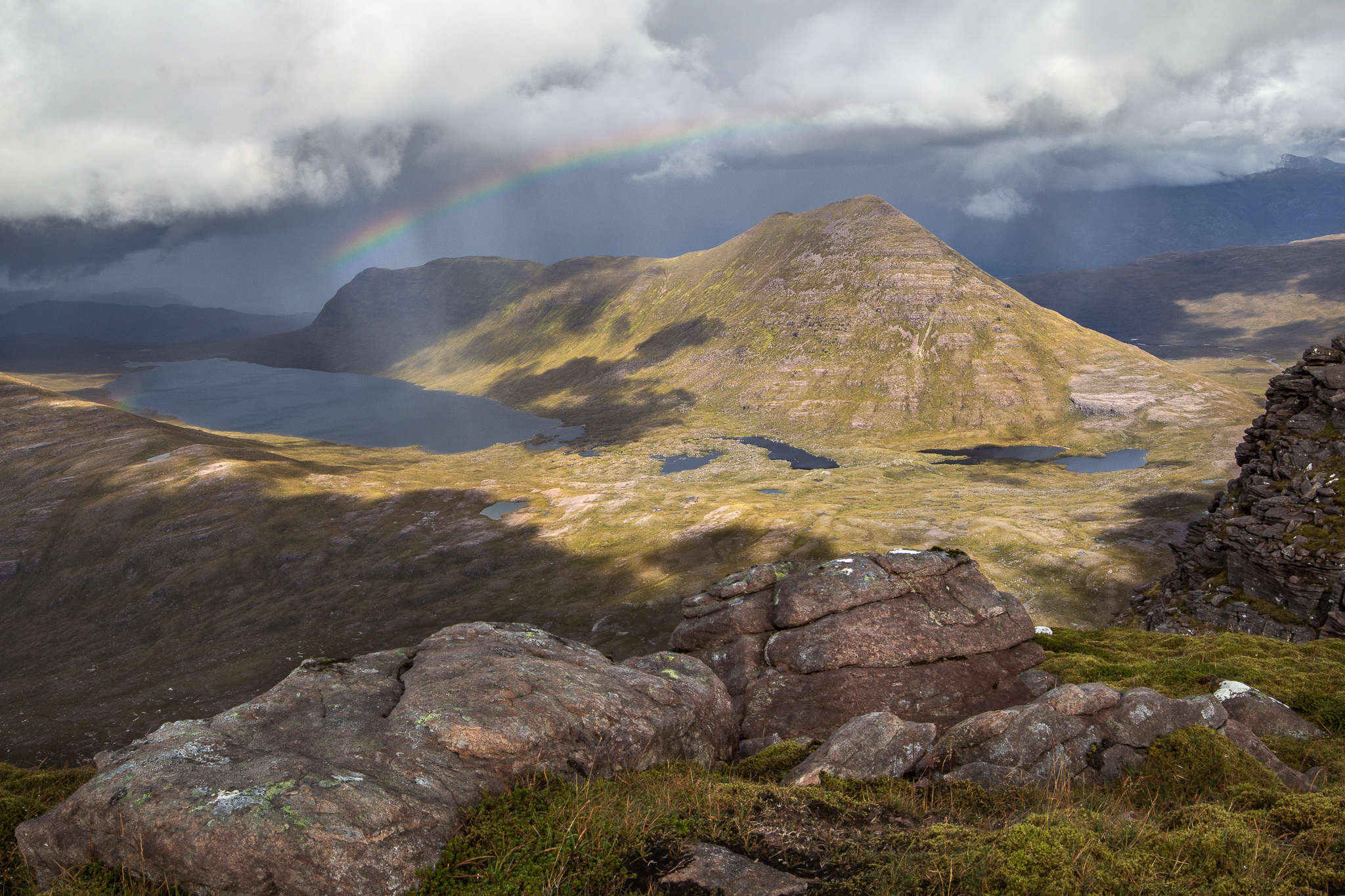
The following morning, the weather that was originally forecast caught up with me. My short stint of good fortune seemed to have ended as I trudged up the steep 440m ascent to Beinn Dearg’s first summit, rain showers sweeping across in relentless succession.
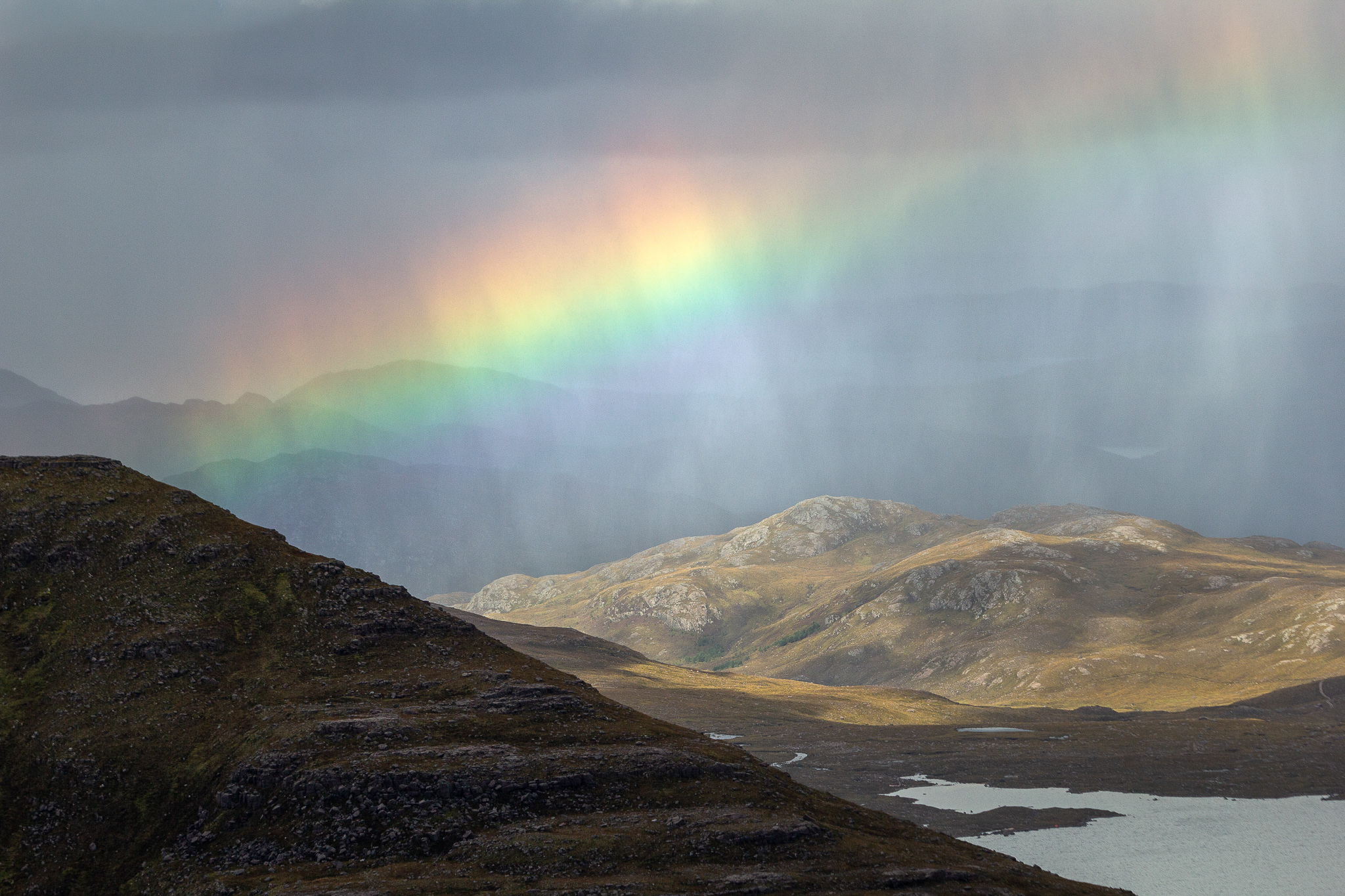
As I reached the first summit, another seemingly targeted squall passed over me and onwards to Beinn an Eoin. A sudden patch of light broke through, illuminating one of the many lochans scattered across the glen, chasing the downpour into the distance. With the sun behind me, I watched with growing intensity as this dynamic scene unfolded. This was the moment I had been waiting for.
Starved for time and with little in the way of foreground interest, I sprinted to a pair of rocks that provided the necessary balance in this scene. Anticipation and exhilaration rose in equal measure as the first arc of colour edged into view. Slowly, the rainbow unfurled from left to right, light fighting against shadow for a foothold on the landscape until the scene resolved in full, fleeting brilliance.
Beinn an Eoin was the stage for this transformation – proof that patience and persistence, even through adversity, can sometimes coax magic form the most reluctant skies.
Meall a’Ghiuthais – 887m
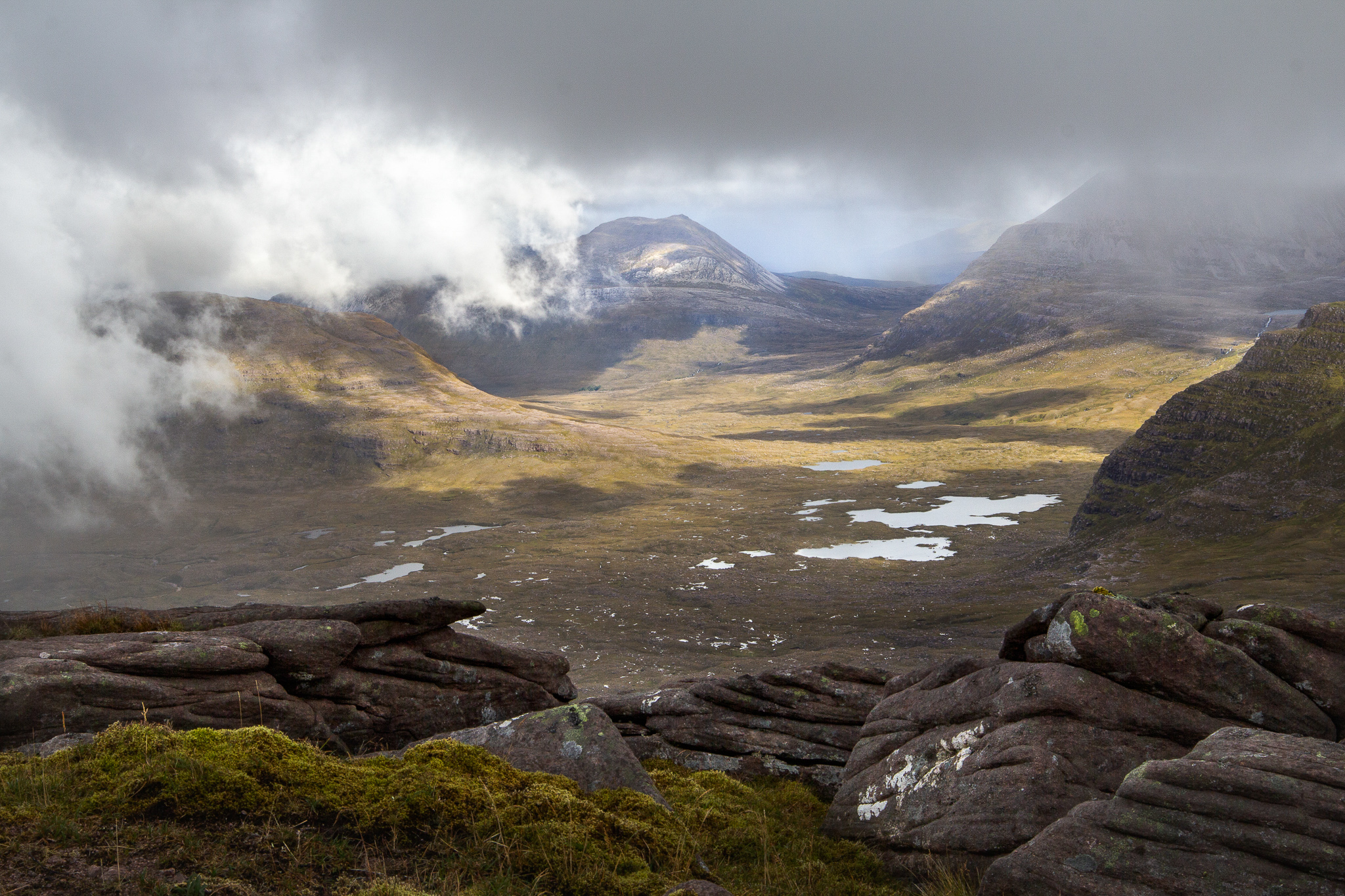
At a loss for words after Beinn an Eoin, I wandered further along the ridge in search of capturing another mountain. I thought nothing I encountered would surpass what I had just witnessed.
Meall a’ Ghiuthais was always going to be one of the ‘make or break’ mountains for the success of this project. A solitary, stubby mountain which doesn’t immediately attract the eye.
This was a fortuitous encounter. Light and shadow once more wrestled above me, the cloud beginning to gain the upper hand as it swirled across the range, closing in on the surrounding mountains. In the distance, the sole-standing mountain was Meall a’ Ghiuthais – seemingly confined despite the vastness around it. I framed this photograph with striated rocks in the foreground, their lines pulling the eye into the centre and lending depth to its otherwise quiet presence.
At first, I dismissed the image. It felt forced, included only for the sake of the project and I questioned whether I would even have paused to take it on a regular trip. But the more I returned to it, the more it grew on me. I believe the reason I was doubting it, is part of the reason this image is just as special. A view and photograph that may be overlooked, but one that wouldn’t have been captured otherwise.
Beinn Alligin – 986m
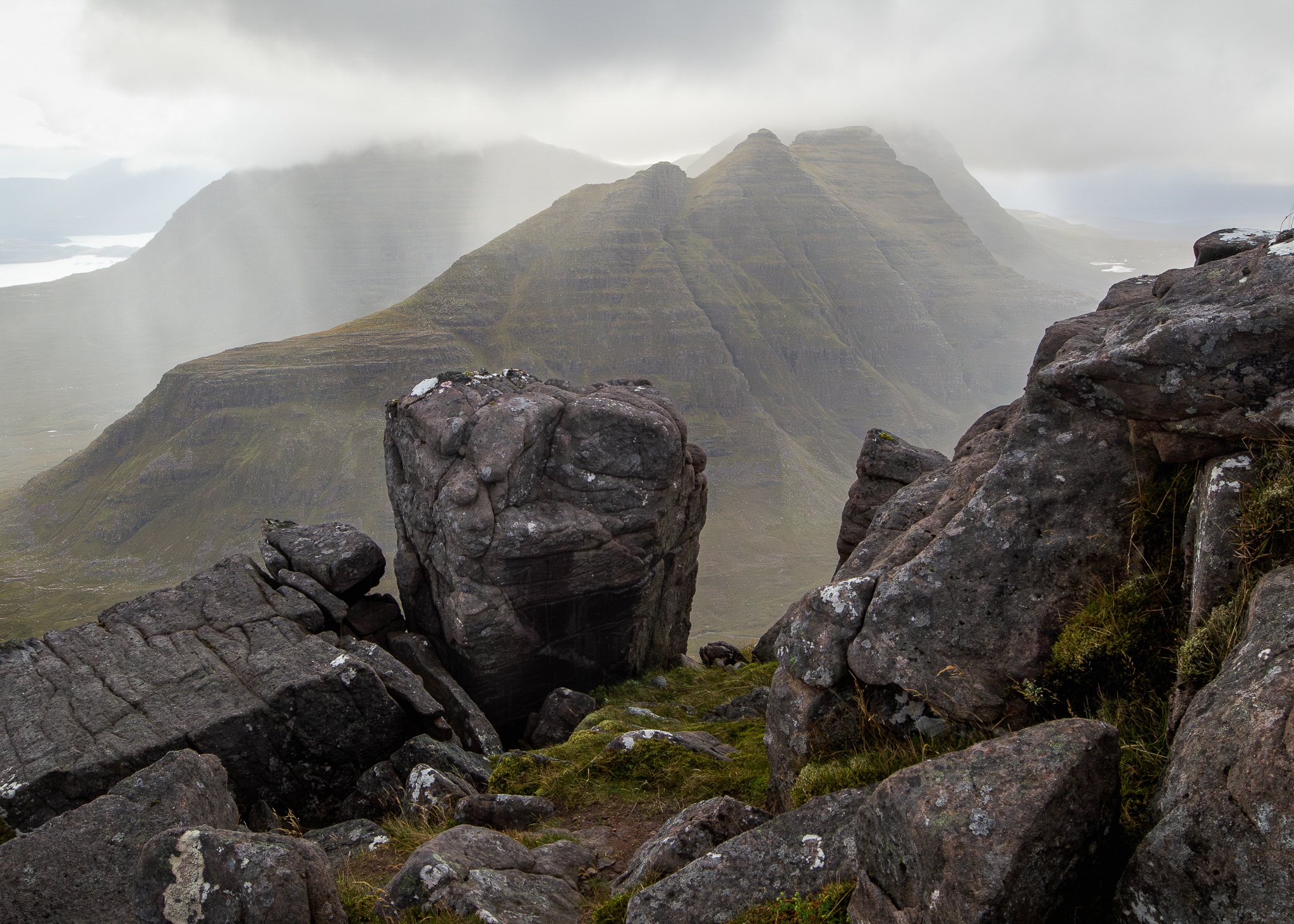
The cloud settled in for good as I made the final push towards the summit of Beinn Dearg. Rain came in swathes across the ridge, turning Torridon’s usually reliable sandstone slick and uncertain. As I scrambled down, I was halted by a formidable boulder – standing defiantly amongst the otherwise obedient line of rocks beneath it.
Space to work was scarce. The ridge narrowed to barely five metres, leaving little margin for error. Each footstep had to be precise as I edged into position, seeking to line up the chain of smaller rocks, circling around the dominant boulder.
Flow has always been central to how I approach composition: how the eye moves through an image, where it rests, what interrupts its journey. While this can be refined in post processing, the core components need to be present with the composition.
As I fought to keep the lens clear with fierce, oncoming rain, I managed to capture just two photos without blemishes of rain. Beinn Alligin offered me no abundance of images. Yet that scarcity gave it weight. It demanded patience, reminding me that these summits are not easily captured, and these types of moments are the memories that will linger longest. The cloud dropped and gripped tightly on the mountains for the majority of the next day.
Beinn Eighe – 976m
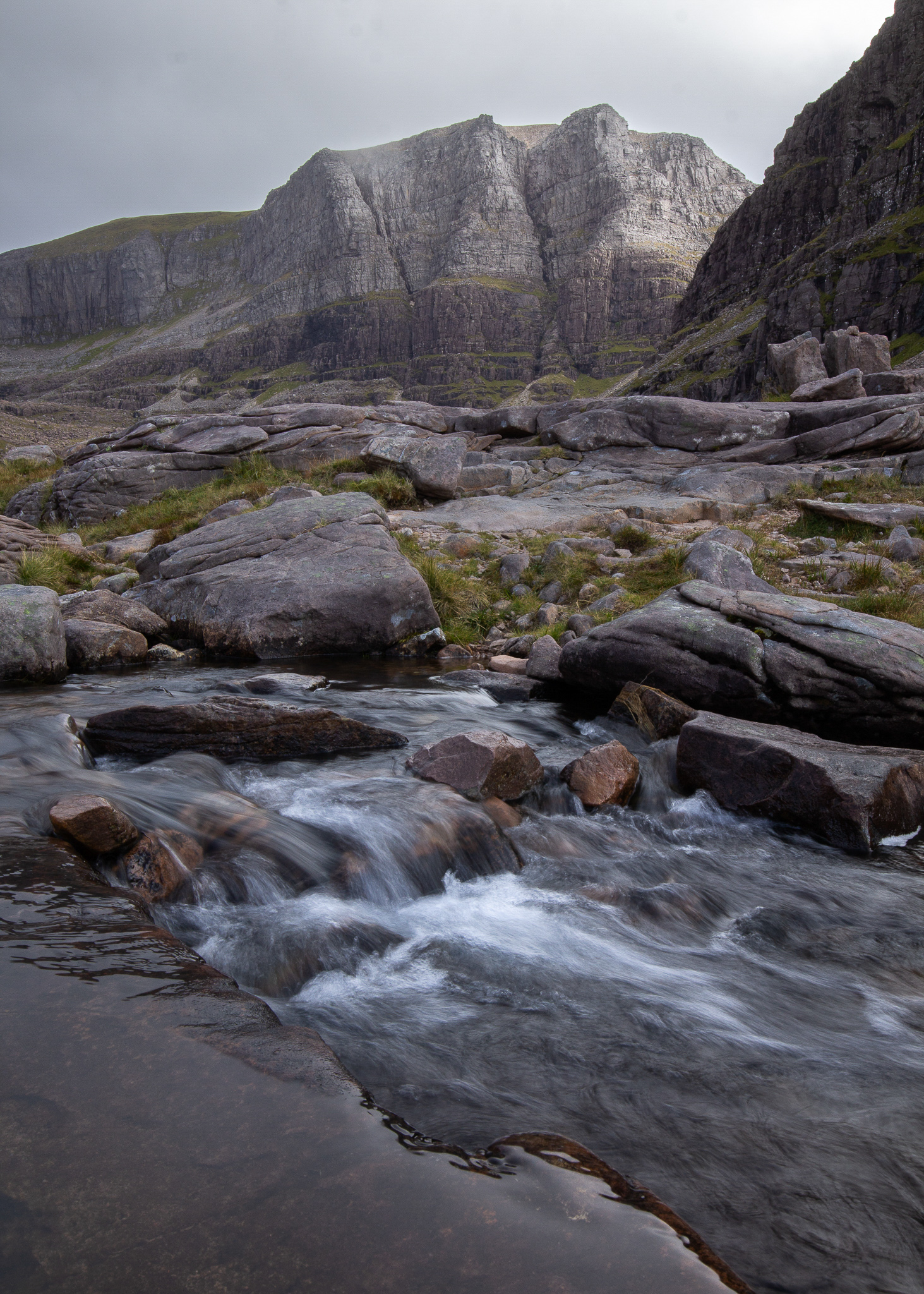
This is the image that ended the stranglehold of cloud and rain. The end of the previous day, and much of the morning and afternoon, had been spent shrouded in low cloud, myself and the mountains both smothered.
Before arriving at this penultimate location, I had a formed a clear vision of what I wanted to capture. Most photographers (rightly so) tend to shoot the vast array of erratics that dominate this landscape, with the loch below acting as the natural progression to the mountain. But while scouring maps and conferring with satellite imagery, I noticed a river running from the loch’s mouth. This detail persisted in my mind. I walked its length, pausing to scout for rapids that would provide the right weight and energy to balance out the imposing cliffs.
I had timed my arrival perfectly. A reluctant shaft of light broke through, falling across the face of the mountain. It was a faint streak, but just enough to outline the ridges, emphasising its dominance. I knew which location I had to get to. This time there was no flustered running about in a panic, just a case of calmly hopping over the river back to this composition and making sure everything was in focus.
This was the most coherent scene on offer: rapids flowing in from the bottom right; complemented by evenly spaced boulders broken up by clumps of grass; all elements gently progressing towards the dominating Triple Buttress, holding the attention. After a day of silence and concealment, Beinn Eighe offered a single moment of clarity – the perseverance paying off.
Beinn a’ Chearcaill – 725m
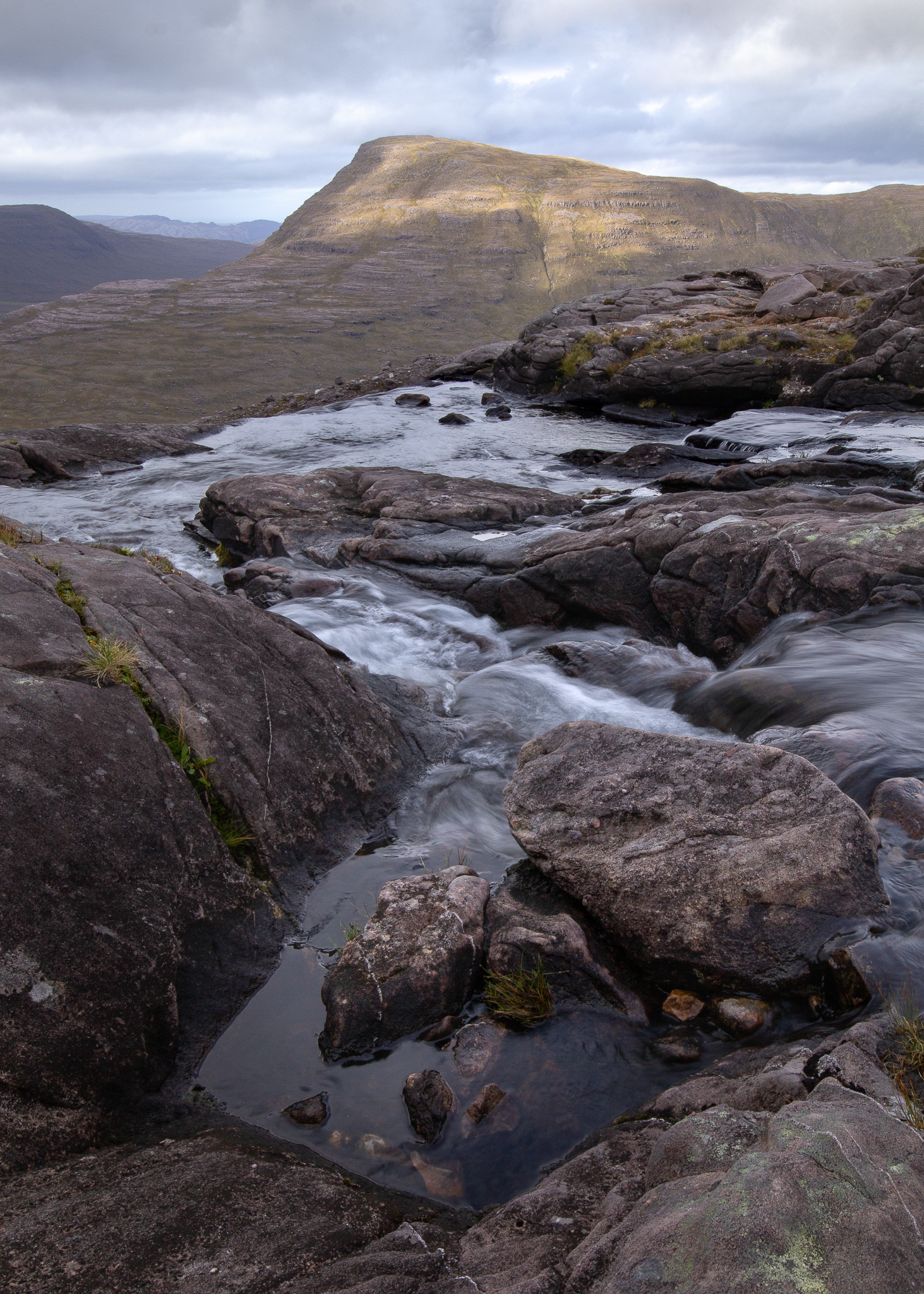
Once the fleeting light on Beinn Eighe had faded, I boiled up a quick pot noodle by the river. It was then, almost absentmindedly, that I noticed a single, narrow strand of light sweeping across the landscape. Just ten metres downstream from the last vantage point – but facing in the opposite direction – Beinn a' Chearcaill was waiting.
I had already made one attempt at photographing this mountain during the frenzy of rainbows the previous day. In my haste, I forced two boulders into the foreground, creating an image with no purpose and no real connection.
It was the only time this mountain had presented itself and I was blinded by the rainbow, not putting any thought into the process. It was simply instinct. Ever since, I’d been quietly disappointed, rehearsing how I might explain the unimaginative result.
This sliver of light felt like a reprieve, a chance to correct my previous falter. By the fourth afternoon, fatigue had set in, yet this was the most alert I had been. Every other mountain was accounted for, but this one remained unresolved.
I worked quickly, centring the composition around a commanding boulder being held in an enclave of the river. All movement in the frame seemed to converge – lines of rock, water, and shadow – pulling the eye inexorably toward the light illuminating Beinn a Chearcaill.
A Dialogue with the Mountains
This photographic challenge shaped the trip, forcing me into a slower, more deliberate rhythm than my usual approach. At first, I found myself in a familiar cycle – racing from one composition to another, as if with tunnel vision. But along the way, that urgency gave way to patience and acceptance of the conditions. Shooting with an end goal in mind meant looking at scenes I might otherwise have ignored, noticing the quieter authority of the smaller peaks, often revealed with passing light.
These may not be the single “best” images I made in Torridon – due to the partial constraints of the challenge – but they feel like the truest representation of these mountains. Eight mountains in four days, each asserting its own character through light, weather, and form. Some demanded effort and persistence, others gave themselves generously, but all carried equal weight in shaping the story.
Presented chronologically, the images not only reflect the range’s often volatile microclimate, but also the shift in my own process – from hurried reaction to a more intentional dialogue with the landscape.


