

 Join the conversation
 Subcribe to comment rss feed
Keeping things going

Tim Parkin
Tim Parkin is a landscape photographer living in Scotland who co-founded On Landscape magazine. Alongside his photography and writing he also co-founded the Natural Landscape Photography Awards, runs a film scanning business and is a judge for other international landscape and nature competitions.
February’s 365 challenge has sometimes needed a bit more effort to get out and about. The weather hasn’t been as ‘interesting’ for most of the month and it was very tempting just to stay inside. I did miss a couple of days and moved a couple of pictures around to fill the gaps. I think it’s important to be self-forgiving when you set yourself a challenge like this. It’s better to do most of it than give it up over a weak moment! It’s been fun getting out in the woods near our house and seeing how the potential for images changes as the weather and light move around. I also (re)discovered that heavy rain can look like mist if you take a one-second exposure! The most important thing I needed to tell myself was that, despite the conditions not being ‘photogenic’, once I get out and start taking photos, I lose myself in the process and start to have fun, even if the results aren’t quite what I wanted.
1st February
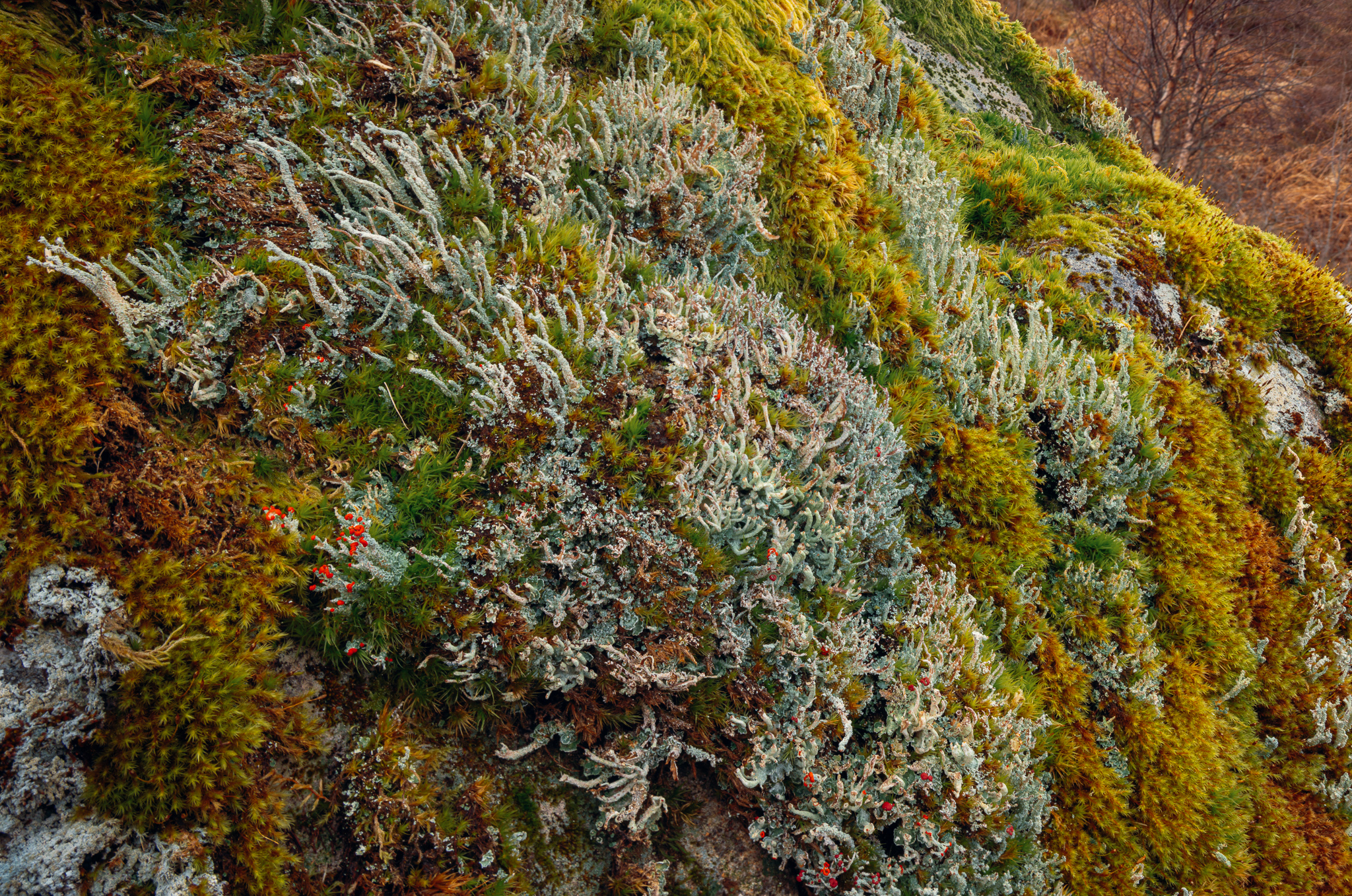
This remarkable carpet of lichen and moss was on the side of an erratic boulder below Sgòrr Dhonuill in Ballachulish. I wanted to capture it in a little context, but also make it look like the side of a hill with bushes and rolling grasses. I used a bit of tilt on my Mirex adapter Sigma 24-35 f/2 lens (quite the chunk of glass), which allowed most of the surface to be captured in focus. I had to play a bit funky with my tripod, as the Mirex tripod foot is locked to the camera's tilt plane. A bit of faff got the job done, though. I loved the British Soldiers cup lichen with its vibrant scarlet fruiting bodies. I’m not a lichen expert, but I think I’ve spotted British soldier cup lichen (Cladonia diversa), red-stemmed feathermoss (Pleurozium schreberi), marsh hair moss (Polytrichum commune), hair cap moss (Polytrichum juniperinum), dusky fork-moss (Dicranum fuscescens). There are too many lichens in the Highlands to be sure, though!