


 Join the conversation
 Subcribe to comment rss feed
Featured Photographer

Kirsi Koivisto
I am a 61-year-old language teacher and nature photographer, specializing in landscapes. I began photography from scratch in 2011, and my work has been featured in exhibitions and recognized in national and international competitions. Through my images, I aim to capture the quiet beauty, solitude, and subtle rhythms of nature, and I hope to continue photographing for many years to come.

Michéla Griffith
In 2012 I paused by my local river and everything changed. I’ve moved away from what many expect photographs to be: my images deconstruct the literal and reimagine the subjective, reflecting the curiosity that water has inspired in my practice. Water has been my conduit: it has sharpened my vision, given me permission to experiment and continues to introduce me to new ways of seeing.
For all the planning we do, sometimes it is the last minute that changes everything. In Kirsi Koivisto’s case, a late booking on a photography trip did just that, and instead of being a fish-out-of-water she found her element and immediately enrolled on a three year vocational photography program. From the minimalist to the surreal, Kirsi is drawn to make expressive landscape photographs in both black and white and in a restrained colour palette that encourages introspection. She writes evocatively about inspiration and process, and you’ll find this interview as rich in words as visual impressions.
Would you like to start by telling readers a little about yourself – where you grew up, what your early interests were, and what you went on to do?
I grew up in an apartment building in Seinäjoki, a small city in Finland. There were many children in the neighborhood, and we spent most of our time playing outdoors. As a child, I was adventurous and athletic, always eager to prove how brave I was by attempting all sorts of risky things. I was happiest skiing alone or staring up at the starry sky or falling snow. I loved climbing onto rooftops or hanging upside down by the backs of my knees from the most dangerous places. I had very little sense of self-preservation.
I especially loved winters with their deep snow—building snow castles, skiing and skating. Experiencing similar moments now through the lens of my camera feels both nostalgic and meaningful. As a child, I constantly set challenges for myself, and the most important one was to ski 20 kilometres every evening after school, no matter the weather. At the same time, I also gave myself tests of courage — for example, whether I dared to ski down a steep hill with my new skis. Well, I did dare, but the wild descent ended in a flight through the air, and the skis shattered into pieces.
In exactly the same way, I have approached my photography trips, and unfortunately, I have certainly not avoided accidents. For me, the happiness that comes from doing—from action itself — is one of the greatest sources of wellbeing. The trait I was most proud of was my courage, even if it often bordered on recklessness.
Some of my most memorable childhood moments in nature were walks on the rocks with my grandfather. I was drawn to the ruggedness of those rocks, and climbing on them became something I absolutely loved. I still visit those very same rocks nearly every year.
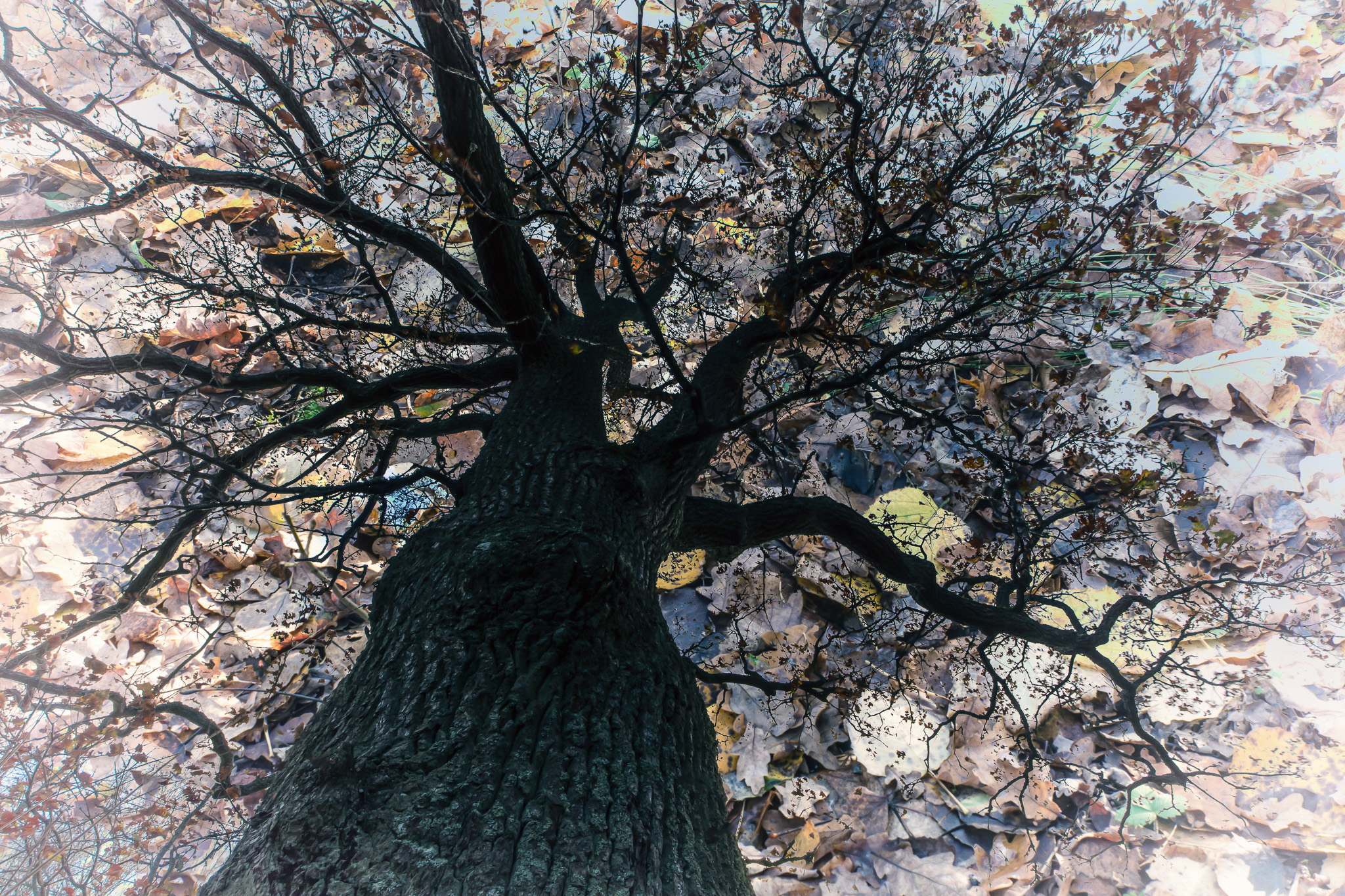
One example of how these early experiences still shape me is a nostalgic October walk I took in Turku a few years ago. I climbed the same rocky hills where my grandfather once showed me the ferns, the twisted pines, the shapes of the cliffs, and the views over Turku’s seven hills. These rocks have always felt like my soul’s landscape. From there, I continued deeper into the forested area, seeing its sturdy oaks through the eyes of my younger self. The ground was scattered with autumn leaves, and as I photographed the scene, I felt a magical sense of being both my present self and the child I once was—wandering through the places that shaped my imagination. I created the double exposure in-camera, scattering the autumn leaves across the sky in that very moment.