


 Join the conversation
 Subcribe to comment rss feed
2009-2014

Morag Paterson
A sense of belonging underpins my photographic work, which varies from the wildly abstract to more literal representations of the natural world. For me, the art of photography is process-based, using the camera as a tool to express my engagement with any given location or subject.
Enjoying many camera-free hours roaming on the hillsides of the southern uplands in Scotland or the wooded slopes around our smallholding in the Alpes-Maritime helps build my mental scrapbook and incubate ideas.

Ted Leeming
Ted’s practice explores land use and the relationships between people, nature, and power. Through long-term, place-based projects combining photography, research, interdisciplinary collaboration and public engagement, he examines how land is shaped and contested over time, while also asking what more regenerative relationships with place might look like.
The Zero Footprint project, explained in a nutshell, is a series of landscape photographs captured from one single location over a period of five years, and counting. The restriction is purely geographical – roughly one square metre of the patio outside our kitchen, we could use any camera and lens combination and had the entire (not insubstantial) vista as a palette. The one other stipulation was that each image should be aesthetically pleasing in it’s own right, as well as forming part of a coherent portfolio of work.
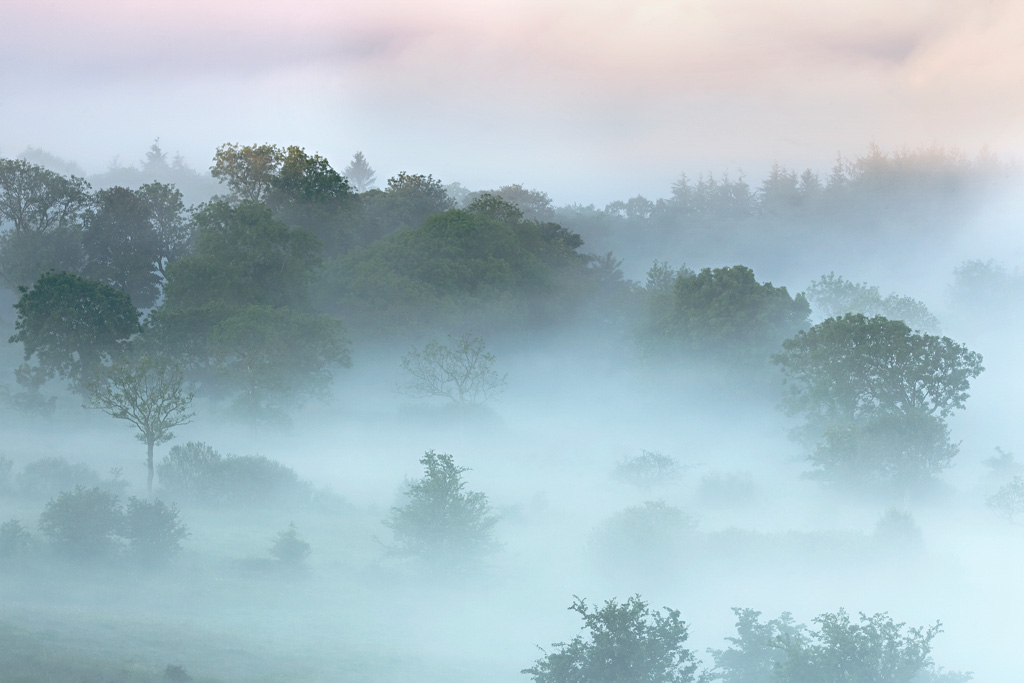
Other photographers have explored ideas that constrain opportunities in one form or other, for various reasons. For us it was the experience of building our own low carbon house that inspired us to attempt a project from one fixed location, thereby minimising the footprint of the work, in a very literal as well as in the environmental sense of the phrase.
While the outlook from the house itself is spectacular, we quickly found the view alone doesn’t easily lend itself to traditionally pleasing photographs, - even in what would normally be considered “good” light, partly due to a lack of foreground, the sheer distance to the horizon also resulting in a tendency towards flat images. Initial explorations and experiments with varying degrees of success led us to the conclusion that we would have to allow the weather and atmospheric conditions to inform compositions by shaping and framing the landscape, often using low cloud and - more frequently – the mists and fogs that form along the river valley and loch system.
Launch events
Joe Cornish Gallery, Northallerton 27th September from 2pm with a talk at 3pm
www.joecornishgallery.co.uk
Country Buildings, Wigtown Book Festival, Wigtown 28th September 4pm
www.wigtownbookfestival.com
Beyond Words, Edinburgh date tbc
www.beyondwords.co.uk
Email or phone for more information:
info@leemingpaterson.com or 01644 430 004