In this series of three articles, my intention is to examine some ideas about the practise of landscape photography in the light of the teachings of Zen Buddhism. The words ‘Zen’ and ‘photography’ used in conjunction inevitably lead to a consideration of the work of Minor White and his ideas about photographic ‘equivalence’, which originated with Alfred Stieglitz. Ansel Adams (who also embraced the concept of equivalence) and Edward Weston (who had different ideas) were also important figures in the development of Minor White’s thinking. All four photographers had met each other at some point in their lives.
Zen teachings can be notoriously difficult to comprehend, often appearing to be self-contradictory (because differing points of view may be expressed) and/or paradoxical (because their intent is to discourage conceptual thinking), so I don’t intend to dive in too deeply. Instead, I’m going to focus on what Stieglitz, Adams and White (and various photography critics) had to say about equivalents and what Weston said about his alternative viewpoint and see where that leads. Stieglitz is the main subject of this first article, but to provide some background, I will begin with a quick diversion to outline how Zen was transplanted from the Orient to America.
Significant migration from China to California occurred during the gold rush from about 1850 onwards.1 Although numerous Chinese temples were subsequently built along the west coast, these were a reflection of popular Chinese religious culture, which was a mixture of Taoism, Confucianism and Buddhism that differed substantially from Zen. Some limited migration from Japan to Hawaii was allowed in the 1860s, but large-scale migration from Japan to mainland USA did not take place until around 1900.1
Significant migration from China to California occurred during the gold rush from about 1850 onwards.1 Although numerous Chinese temples were subsequently built along the west coast, these were a reflection of popular Chinese religious culture, which was a mixture of Taoism, Confucianism and Buddhism that differed substantially from Zen
A pivotal moment in the transmission of Zen to America occurred in 1893 when Soyen Shaku attended the World Parliament of Religions in Chicago, becoming the first Japanese Zen priest to visit the USA.1,2 Soyen did not speak English, and his speech to the Parliament had been translated by a young student of his, D.T. Suzuki, who would become a prolific and widely read writer on Zen. Suzuki himself arrived in the USA in 1897 to work on the translation of Buddhist texts. Soyen revisited the USA in 1905, residing in San Francisco for several months, initially giving public talks to audiences of Japanese immigrants, then, with Suzuki in attendance, travelling to Los Angeles and later by train across America to locations including Washington and New York, speaking to a more American audience. Soyen then returned to Japan, with Suzuki remaining in the USA to translate and edit Soyen’s manuscripts for publication in book form.3
Another of Soyen’s students, Nyogen Senzaki, had travelled with him to San Francisco in 1905. Senzaki remained in California after Soyen’s departure but, under strict instructions not to teach for twenty years, he did not start to give public addresses until 1925.1,2 A second group of Zen Buddhists arrived in San Francisco in 1907; all but one eventually left, but Sokei-an, who remained, walked across the Shasta Mountains to Oregon in 1911, before moving on to Seattle and reached New York in 1916. Sokei-an went back to Japan to complete his studies in 1919, then returned to New York in 1928 to teach and founded the Buddhist Society of America in 1930.1
There is no evidence to suggest that Stieglitz (based in New York) or Weston and Adams (both based in California) had any direct involvement with Zen, but given the circles that they moved in, it is likely that they would have had some awareness of it by the time of the 1920s/30s. (For example, Stieglitz’s circle included Ananda Coomaraswamy, curator of Indian art at Boston Museum of Fine Arts, who published a book on Buddhism, including a chapter on Zen in 1916.4) My intent here is not to argue that they were influenced by Zen but rather to examine to what extent their ideas about photography and the nature of reality were consistent with it.
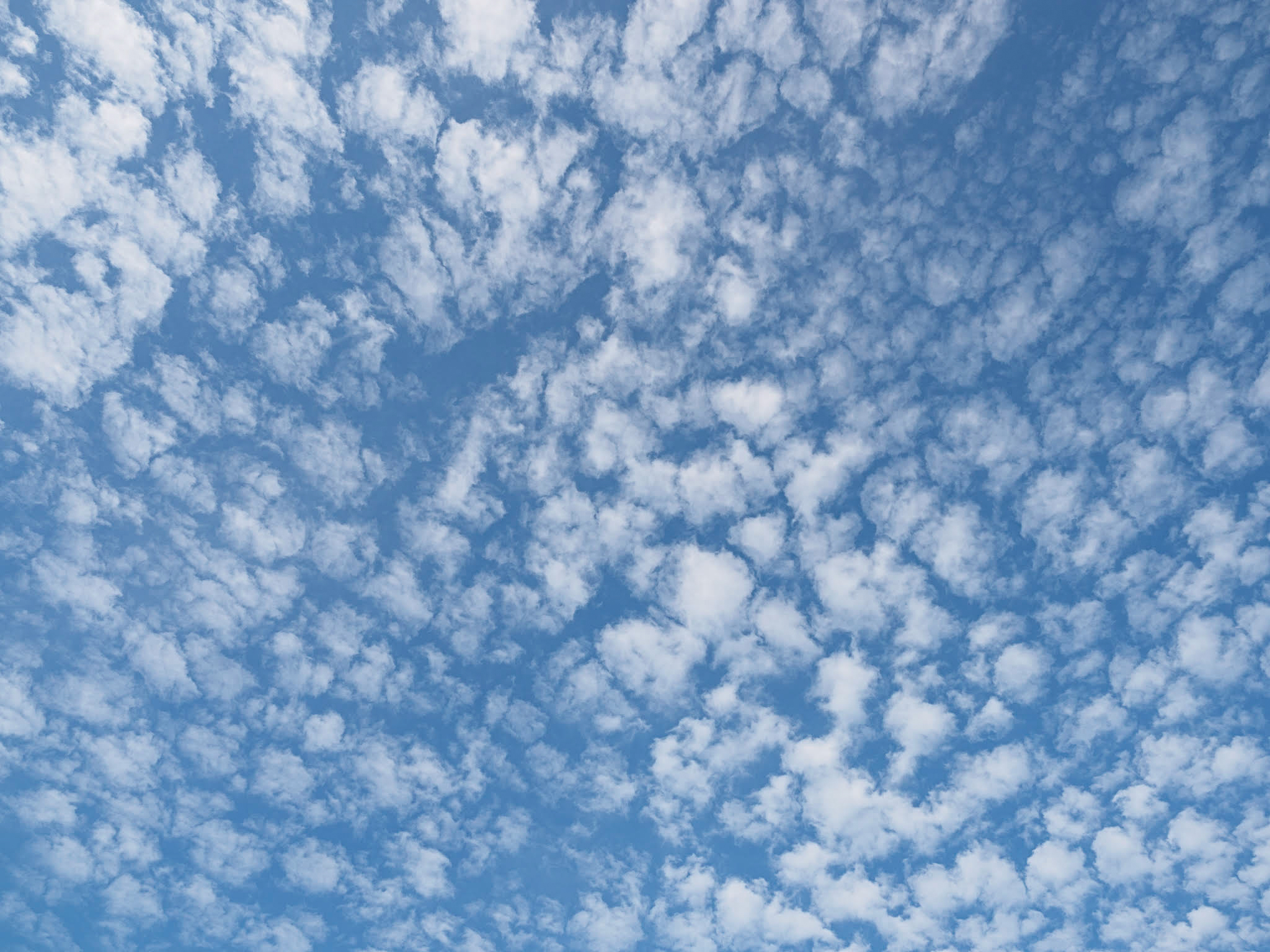
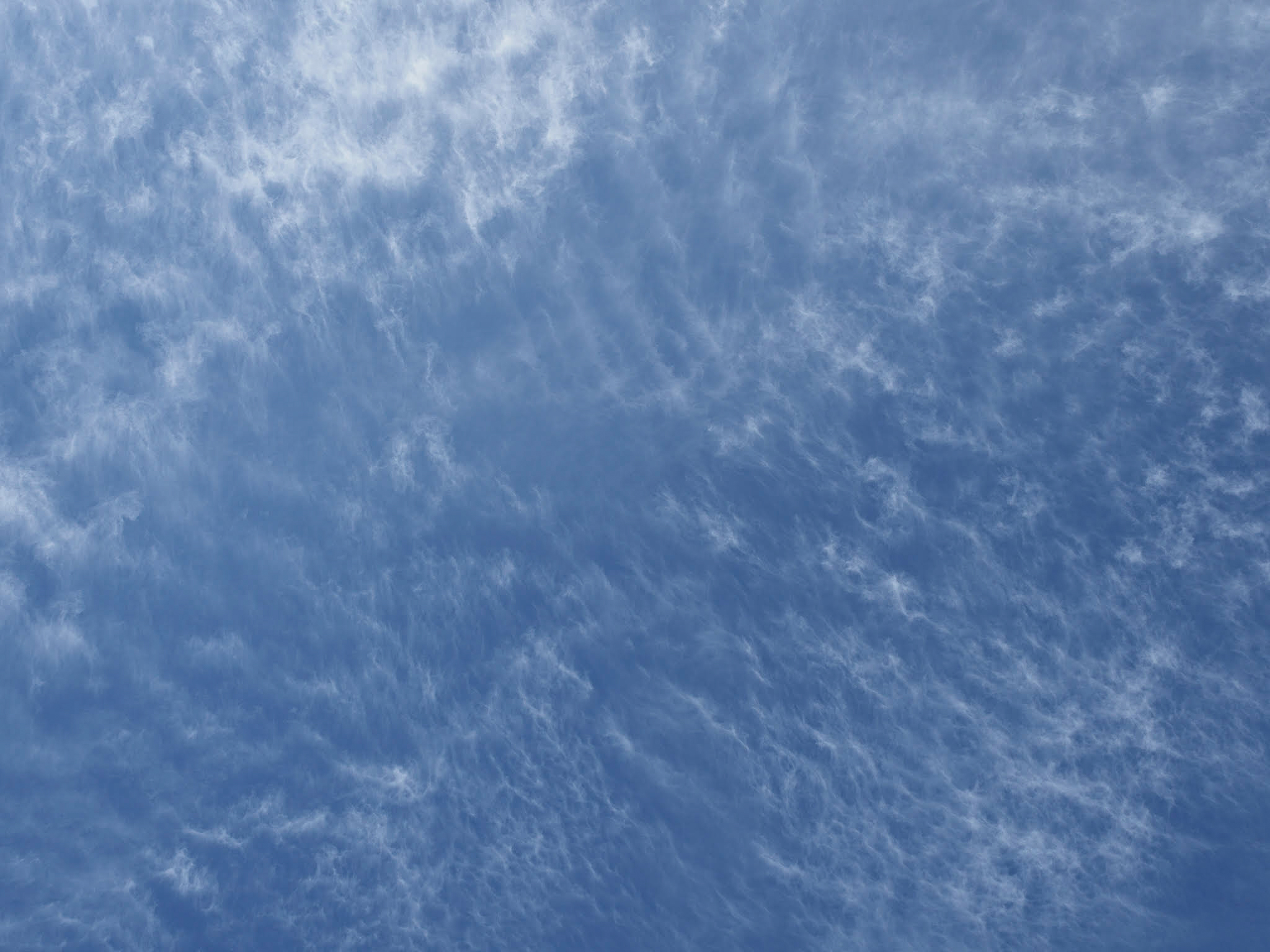
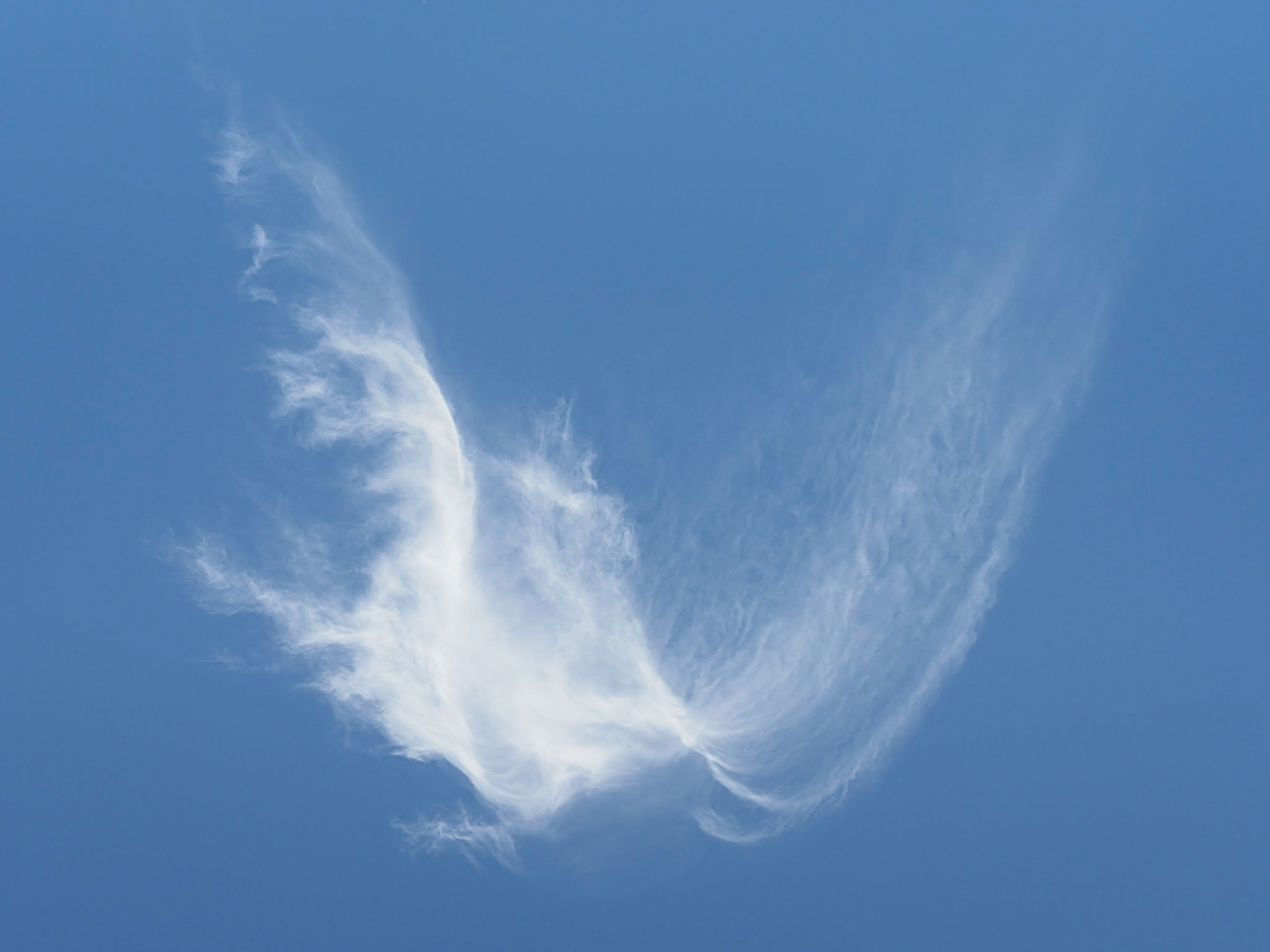
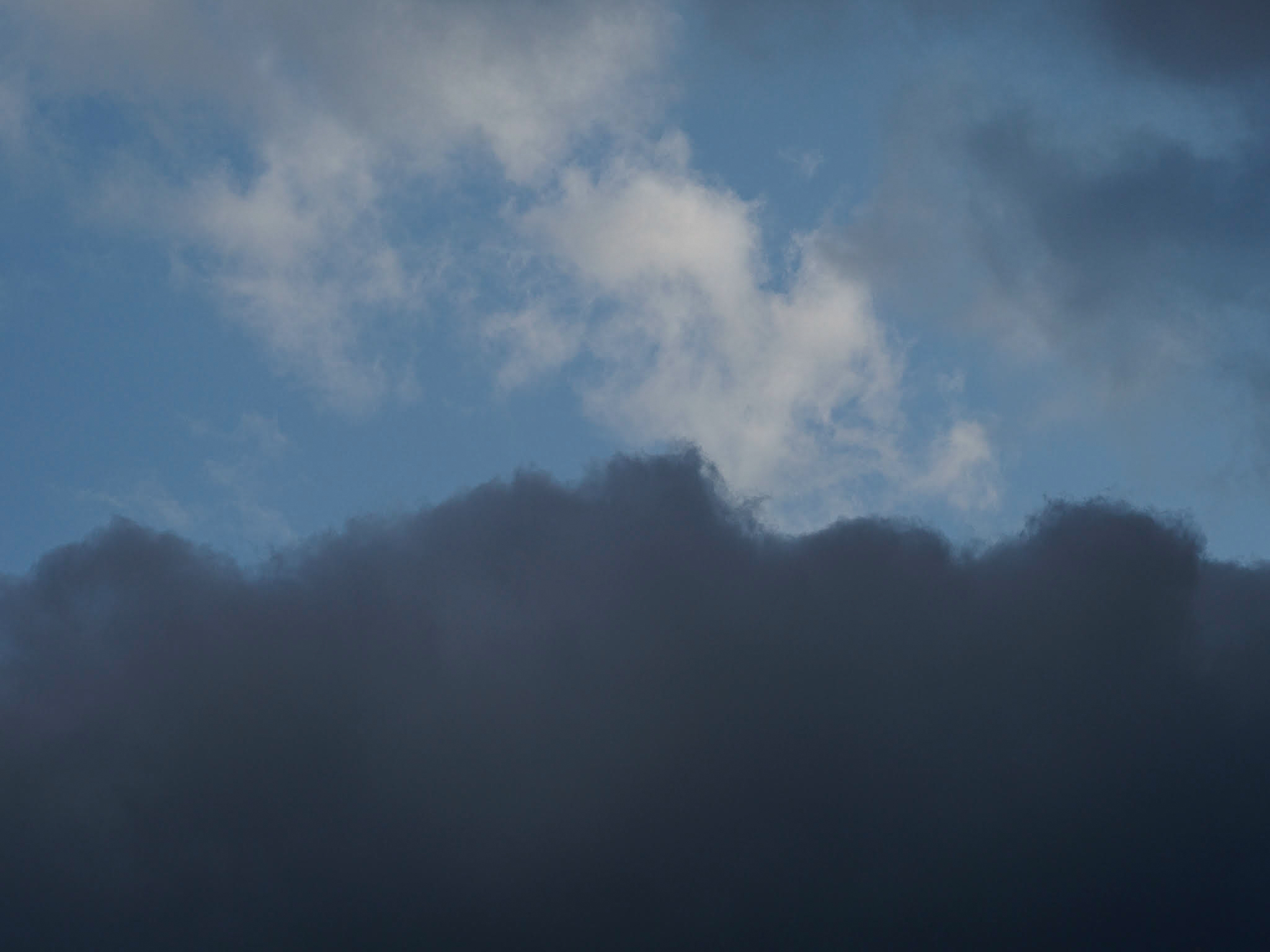
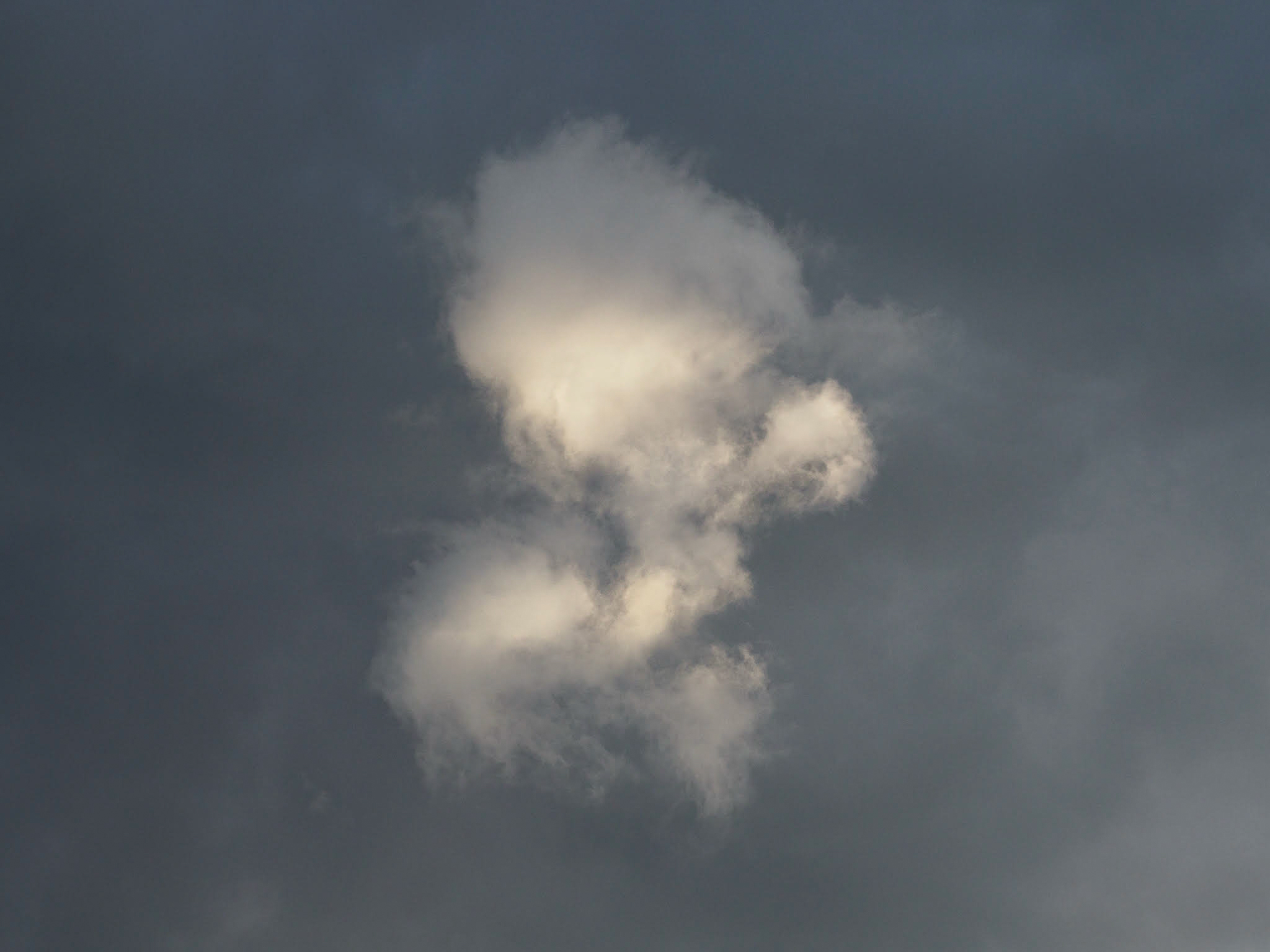
Alfred Stieglitz began to photograph clouds in 1922, by which time he was in his late 50s. The following year, he published an article on How I Came to Photograph Clouds, setting out his motives for doing this. “Clouds and their relationship to the rest of the world, and clouds for themselves, interested me,” he wrote and “I wanted to photograph clouds to find out what I had learned in 40 years about photography. Through clouds to put down my philosophy of life.”5 Stieglitz initially likened his series of cloud images to pieces of music (‘Songs of the Sky’) before settling on the term ‘equivalents’.
What precisely Stieglitz’s equivalents were intended to express remains a matter of conjecture among photography critics and scholars. The prevailing view is that the equivalents are meant to be understood metaphorically — as symbols for something not directly seen, i.e. a divine or spiritual presence or the photographer’s personal thoughts and feelings. In her influential book On Photography, Susan Sontag simply wrote that Stieglitz’s equivalents were “statements of his inner feelings.”6 Kristina Wilson, however, drawing on Stieglitz’s experiences running an art gallery (The Intimate Gallery in New York) during much of the period when the equivalents were made, gave precedence to the spiritual rather than the psychological aspects of his inner life. Although much of Wilson’s argument was based around the work of the artists that Stieglitz represented, she considered that both the gallery and the equivalents were intended to induce a spiritual experience of “oneness with humanity and the universe.”7
Rosalind Krauss stressed the importance of the crop in photography, arguing that the cloud equivalents signified “the absence ... of the world and its objects, supplanted by the presence of the sign.”8 Kate Stanley though argued to the contrary that “as symbolic fragments of the sky, Stieglitz’s equivalents conjure the ‘whole’ from which they are cut ... emphasising the air that enjoins cloud to cloud, cloud to photograph ... photograph to viewer, and viewer to cloud, palpably and infinitely.”9
What precisely Stieglitz’s equivalents were intended to express remains a matter of conjecture among photography critics and scholars. The prevailing view is that the equivalents are meant to be understood metaphorically — as symbols for something not directly seen, i.e. a divine or spiritual presence or the photographer’s personal thoughts and feelings.
John Szarkowski found the notion that the equivalents represented Stieglitz's philosophy of life deeply unsatisfactory because such a claim was unverifiable and also implied that “we are interested in Stieglitz not because he gave us the pictures, but the converse: we are interested in the pictures because they give us Stieglitz.”10 Szarkowski then referred to an observation that John Ruskin had made in 1856 about poets, paraphrasing Ruskin’s words thus: “there are three types of sensibility: to the first a primrose is simply and unambiguously a primrose; to the second it is not a primrose but something else, perhaps a forsaken maiden; to the third it can contain many other meanings without ceasing to be entirely a primrose.” Szarkowski stated that in Ruskin’s view the greatest poets were of the third kind. Ruskin’s meaning though was a little more nuanced. He did state that “in general, these three classes may be rated in comparative order, as the men who are not poets at all, and the poets of the second order, and the poets of the first.” But he added that the two orders of poet that he recognised “must [both] be first-rate in their range, though their range is different; and with poetry second-rate in quality no-one ought to be allowed to trouble mankind.” The second order of poets he called the ‘Reflective or Perceptive’ (which included Wordsworth and Keats, for example) and the first order he termed the ‘Creative’ (including Shakespeare and Dante).11
Remarkably similar sentiments to Ruskin’s three types of sensibility were expressed by Edward Weston in a letter sent to Minor White commenting on a draft of a paper that the latter had written about Weston’s photography.12 (I suspect that this was the unpublished paper, written around the time of Weston’s exhibition in New York in 1946, that White referred to when interviewed by Paul Hill and Thomas Cooper in 1975.13) Weston expressed his feelings on White’s draft by quoting a version of an old Zen saying:
To a man who knows nothing, mountains are mountains, waters are waters, and trees are trees. But when he has studied and knows a little, mountains are no longer mountains, waters are no longer waters, and trees are no longer trees. But when he has thoroughly understood, mountains are once again mountains, waters are waters, and trees are trees.
Detailed explications of the ‘mountains are mountains’ discourse have been given by the Zen scholar Masao Abe14 and the Buddhist monk Thich Nhat Hanh.15 In essence, at the first level of understanding, mountains, waters, and trees are all differentiated, and it is oneself that makes these distinctions; the self too is differentiated, giving rise to the question “Who am I?” and then to query “Who is asking ‘Who am I’?” and so on.
In essence, at the first level of understanding, mountains, waters, and trees are all differentiated, and it is oneself that makes these distinctions; the self too is differentiated, giving rise to the question “Who am I?” and then to query “Who is asking ‘Who am I’?” and so on.
The realisation that the self cannot be grasped — in Buddhist terminology, that the self is ‘empty’ — gives rise to the second stage, where nothing is differentiated. The second stage provides some insight into reality, yet it is not everyday reality as we perceive it. The third view, that ‘mountains really are mountains’, completely subsumes the previous two standpoints — everything in the world exists in itself but is experienced only in relation to everything else. Thich Nhat Hahn used the example of drinking tea: at the moment of drinking, you and the taste of the tea are one experience — this is the “world of Zen ... the world of pure experience without concepts.”
Regarding clouds, Thich Nhat Hanh wrote, “If you are a poet, you will see clearly there is a cloud floating in this sheet of paper. Without a cloud there will be no rain; without rain the trees cannot grow; and without trees we cannot make paper ... Everything [time, space, the earth, the rain, the minerals in the soil, the sunshine, the cloud ...] co-exists with this sheet of paper.”16
Clearly, from a Zen perspective, we can equate Stieglitz’s clouds for themselves with mountains as mountains, clouds representing his philosophy of life to mountains are no longer mountains, and clouds and their relationship to the rest of the world with mountains are again mountains. Although it seems unlikely that Stieglitz would have been aware of it, it is worth noting that the Buddhist term that is rendered in English as ‘emptiness’ is a translation of the Chinese characters for ‘sky-like’2 so cloud images would be a very apt metaphor for expressing the empty nature of all things.
Stieglitz’s own words are perhaps more revealing about his approach to photography than is generally acknowledged in some critical appraisals of his work. In 1925, during the period the cloud equivalents were made, Stieglitz wrote to the artist Arthur Dove, saying, “So far the summer has been unproductive ... I have a print or two ... and I haven’t the slightest idea what they express!” [cited by Szarkowski10].
In Ansel Adams’ autobiography, he recalled that when he first met Stieglitz in 1933, he asked him what he meant by ‘creative photography’18. Stieglitz replied, “I have the desire to photograph. I go out with my camera. I come across something that excites me emotionally, spiritually, aesthetically. I see the photograph in my mind’s eye and I compose and expose the negative. I give you the print as the equivalent of what I saw and felt.”
In a similar vein, Dorothy Norman, a close associate and biographer of Stieglitz, quoted him as saying, “I am interested in putting down an image only of what I have seen, not what it means to me. It is only after I have put down an equivalent of what has moved me that I can even begin to think about its meaning,” and “The moment dictates for me what I must do. I have no theory about what the moment should bring ... I simply react to the moment.”17 As for the meaning when he had thought about it, in response to someone looking at one of his images who asked, “Is this a photograph of water?” Stieglitz replied,“It happens to be a picture of the sky ... Are the sky and water not one, if one truly sees them? ... In fact, I feel that all experiences in life are one, if truly seen.”17
Stieglitz later admitted to an emotional aspect of his photography. In Ansel Adams’ autobiography, he recalled that when he first met Stieglitz in 1933, he asked him what he meant by ‘creative photography’18. Stieglitz replied, “I have the desire to photograph. I go out with my camera. I come across something that excites me emotionally, spiritually, aesthetically. I see the photograph in my mind’s eye and I compose and expose the negative. I give you the print as the equivalent of what I saw and felt.”
Dorothy Norman wrote that Stieglitz “might easily be thought of in terms of existentialism, or Zen Buddhism since what preoccupied him most was the reality of experience itself”, though Stieglitz himself said, “I seem to be claimed by every ist. Yet, no ism in itself has any final meaning for me. All isms contain some measure of truth ... I suppose that if I can be said to subscribe to any ism whatever, it may be that I am simply a fatalist.”17
It is not entirely clear to me whether, in Ruskin’s terminology, Stieglitz would be considered a ‘creative’ or a ‘reflective/perceptive’ photographer (though Szarkowski’s implication was the latter).
It is not entirely clear to me whether, in Ruskin’s terminology, Stieglitz would be considered a ‘creative’ or a ‘reflective/perceptive’ photographer (though Szarkowski’s implication was the latter).
Ruskin did admit that the different classes of poet are “united to each other by imperceptible transitions, and the same mind, according to the influences to which it is subjected, passes at different times into the various states.”11 I would draw a distinction, though, between Ruskin’s primrose that “can contain many other meanings without ceasing to be entirely a primrose” and the Zen realisation that “mountains are once again mountains”. I would argue that the ‘poetic’ primrose is meant to be understood as a symbol for specific things and/or feelings, whereas the Zen mountain is a facet of the undivided, interdependent whole.
I would also add that the insight that ‘mountains are mountains’ is not the sole preserve of Zen. Similar sentiments were expressed, for example, by Nan Shepherd in The Living Mountain: “... the mountain is one and indivisible, and rock, soil, water and air are no more integral to it than what grows from the soil and breathes the air. All are aspects of one entity, the living mountain. The disintegrating rock, the nurturing rain, the quickening sun, the seed, the root, the bird – all are one.”19
Mountains are mountains, primroses are primroses, clouds are clouds, and, as will be discussed in the follow-up article, The Thing Itself, Edward Weston’s rocks are rocks, and his peppers are peppers.
Acknowledgement
I am deeply grateful to Roy Money for providing details of Reference 12 and helpful comments on an earlier draft of this article.
References
Rick Fields, How the Swans Came to the Lake, (Shambala Publications, Boulder, Colorado, 1981).
Helen Tworkov, Zen in America, (Kodansha America Inc., New York, 1984), Introduction, pp.3-20.
Soyen Shaku, Zen for Americans, translated by D.T. Suzuki, (The Open Court Publishing Company, Chicago, 1906).
Ananda Coomaraswamy, Buddha and The Gospel of Buddhism, (G.P. Putnam’s Sons, New York, 1916), pp.252-258.
Alfred Stieglitz, How I Came to Photograph Clouds, The Amateur Photographer & Photography, vol.56, no.1819 (1923), p.255.
Susan Sontag, On Photography, (Penguin Modern Classics, 1977), p.123.
Kristina Wilson, The Intimate Gallery and the Equivalents: Spirituality in the 1920s Work of Stieglitz, Art Bulletin vol.85, no.4 (Dec. 2003), pp.746-768.
Rosalind Krauss, Stieglitz/Equivalents, October, vol. 11 (Winter 1979), pp. 129-140.
Kate Stanley, Unrarified Air: Stieglitz and the Modernism of Equivalence, Modernism/modernity, vol.26, no.1 (Jan 2019), pp.185-212.
John Szarkowski, The Sky Pictures of Alfred Stieglitz, MoMA no.20 (Autumn 1995), pp.15-17.
John Ruskin, Modern Painters, Vol.III (Containing Part IV: Of Many Things), Chapter 12: Of The Pathetic Fallacy.
Edward Weston, carbon copy of letter to Minor White, (Weston Archive, Center for Creative Photography), cited by Amy Conger in Edward Weston: The Spirit of Zen from Lao-tse to Louis Armstrong, unpublished lecture at Huntington Library, San Marino, CA, (Sept. 2002). (Lecture cited by Roy Money, https://theawakenedeye.com/pages/minor-white-and-the-quest-for-spirit/ )
Paul Hill and Thomas Cooper, Dialogue with Photography, (Dewi Lewis Publishing, 2005), pp.267-268.
Masao Abe, Zen and Western Thought, (MacMillan Press, 1985), pp.4-18.
Thich Nhat Hanh, Mountains are Mountains and Rivers are Rivers, in Zen Keys (Anchor Books, 1974), pp.71-88.
Thich Nhat Hanh, The Heart of Understanding, (Parallax Press, 1988), pp.3-5.
Dorothy Norman, The Equivalents, Aperture (Spring 1960).
Ansel Adams and Mary Street Alinder, An Autobiography, (Little, Brown and Company,1985), p.78.
Nan Shepherd, The Living Mountain, (Canongate Books, 2014; first published 1977), Chapter 7: Life: The Plants, p.48.
My ‘End Frame’ would always have to be a picture by Thomas Joshua Cooper. The difficulty is in choosing just one !
My first meeting with Thomas was before the internet, before the digital revolution, and certainly before the arrival of social media and the Metaverse! It came after a 390 mile drive from my home in Cork, in Southern Ireland, to Culzean Castle overlooking the Firth of Clyde on the west coast of Scotland. It was late summer 1982, (over forty years ago !) my mode of transport a ‘tired’ but trusty Renault 4, and after a long drive and ferry crossing I was set to join my new classmates at Culzean for a photographic field trip. I didn’t own a camera or have any idea what lay ahead, and especially how the future and my moving to Scotland to study at the revered Glasgow School of Art would pan out - but it was most certainly exciting and the introduction to a whole new world for me. All quite overwhelming for a 19 year old, young man from Cork.
Since I first met Thomas all those years ago, I have cited him as being my biggest inspiration. It was he who ‘planted the seed’ in my becoming totally absorbed in the world of photography as an art form.
To those of you unfamiliar with Thomas Joshua Cooper and his work - he is today seen as one of the most celebrated and distinctive landscape photographers working anywhere in the world. He was born in California in 1946 but has lived in Scotland since 1982. He was the founding head of photography at Glasgow School of Art but spent much of his life seeking out the edges of the world. Like artists such as Richard Long and Hamish Fulton, Thomas is a traveller and nomadic artist whose extraordinary photographs are made in series at significant points around the globe, most often at its extremities.
Using an 1898 Agfa field camera and specially made photographic plates, Thomas creates extraordinary, meditative landscape photographs printed with selenium-toned silver gelatin. The capturing of any one image can involve days, weeks and months of preparation and arduous travel. The locations are found on a map, tracked down and then photographed, each place the subject of a single negative made with a weighty antique field camera. They are meditative, almost philosophical images, exquisitely printed by the artist in the 19th century manner with layers of silver and gold chloride.
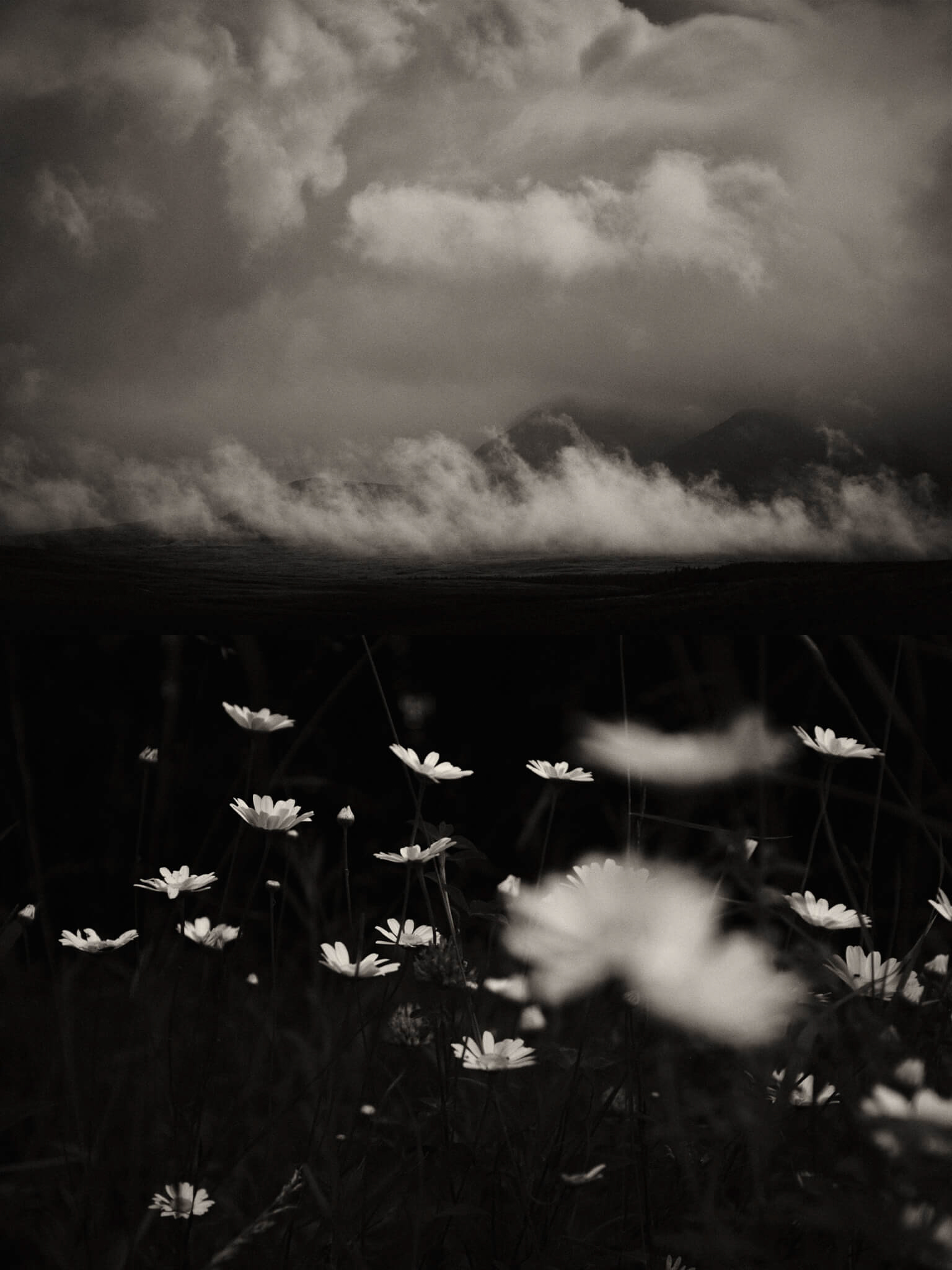
In our Featured Photographer interview with Jaume, we described Jaume’s images as a celebration of nature and of place, with many derived from the area around his home close to the Lake of Banyoles in northeastern Catalonia, Spain. This remains true, but you will find a rather different portfolio these days: strikingly monochromatic, employing inventive pairings of images. It builds on an early love of black and white, using darkness to simplify, and continues to exploit abstraction to give freedom of interpretation.
It illustrates the case that working in one place is not a limitation but a portal to possibility. As you will see, that doorway has led to some unforeseen but exciting opportunities.
What has changed for you, photographically speaking, since we spoke back in 2018, or has given you the most enjoyment during the intervening period?
Very happy to reconnect with you, Michela. I appreciate the invitation!
Indeed, many things have happened during these years. The COVID-19 pandemic has undoubtedly been the most significant event since we last spoke and has partly been responsible for some changes in my photographs during this period.
Right after the lockdown, a friend sold me a compact camera with a 35 mm lens, small and portable. I wasn't sure if I would use it because it took me out of my comfort zone, accustomed to longer focal lengths that worked well for simplifying. This influenced my perspective in the following months; I got used to seeing the world through this new lens.
After the confinement, I almost always carried it with me when I went out. I started exclusively shooting in black and white. It wasn't intentional; it just happened that way; I couldn't bring myself to photograph in colour. The images I captured were dark and highly contrasted, practically devoid of greys, only black and white; all or nothing. Never before had we collectively experienced life and death so closely, and I suppose that was the reason driving me to seek these kinds of photos.
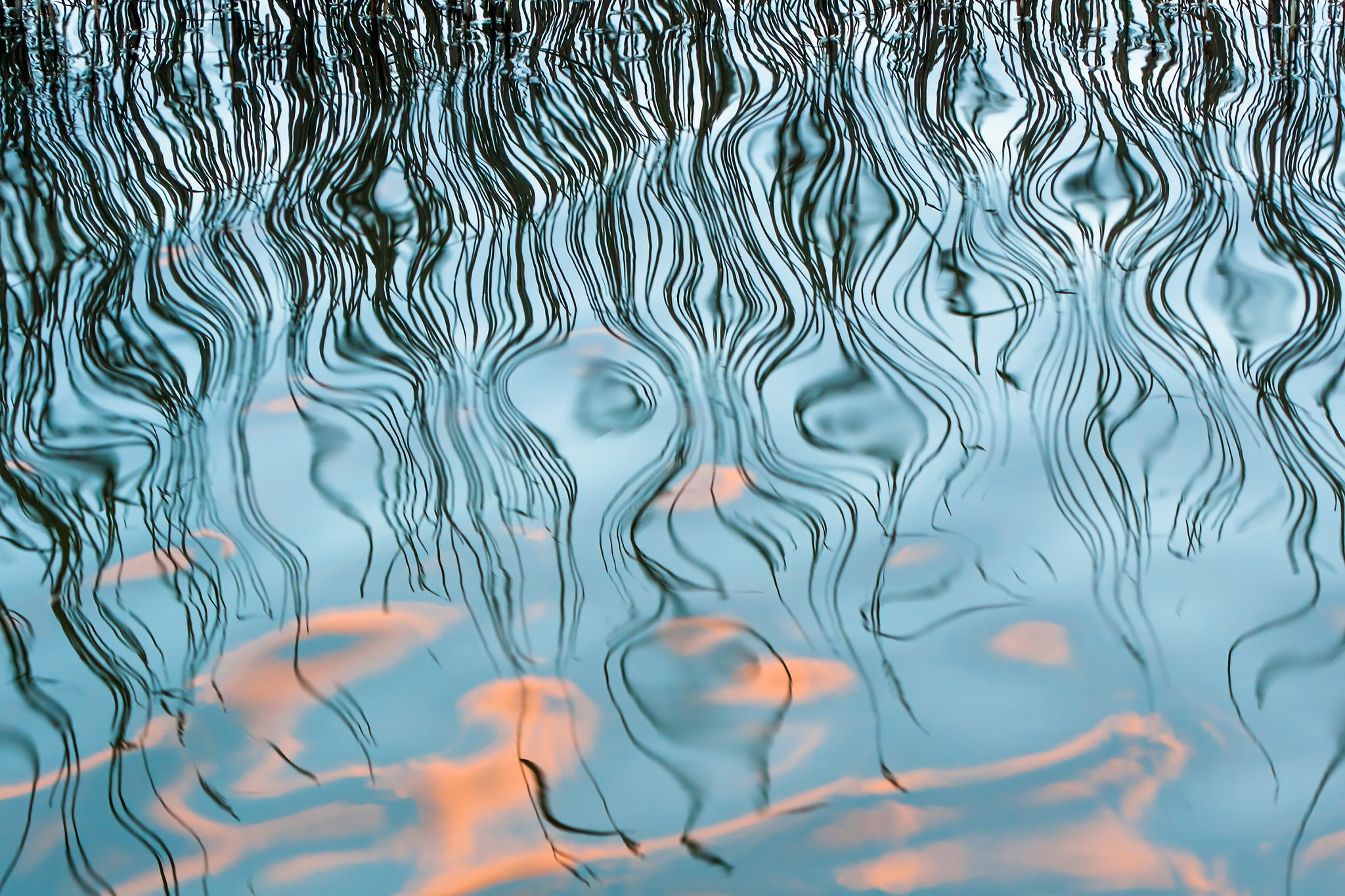
The Scream, the Netherlands, 2006. I must confess that I only noticed the face in the water when seeing the image on my computer screen and not when taking the image.
Introduction
During the fall of last year, I had the privilege of being one of the judges at the Natural Landscape Photography Awards. One of the things that struck me there was, on the one hand, the large number of entries in the Intimate landscapes category and, on the other, the very high quality of many of these images. Of course, this is just a snapshot, but there are numerous other trends and figures that indicate that intimate landscapes have become very popular among landscape photographers. On Google, you already get 60 million (!) hits if you search on the term Intimate landscapes, and there are now countless articles and blogs on how best to create these kinds of images.
We can therefore conclude - 44 years after the publication of Eliot Porter's book that gave the genre its name - that intimate landscapes have become one of the main movements in landscape photography.
When listening to podcasts about landscape photography, such as Matt Payne's famous series F-stop, collaborate and listen, you will regularly hear photographers who have discovered intimate landscapes in recent years and now have a preference for this type of images. If you are still in doubt, take a look at the cover photos of the last 30 editions of OnLandscape magazine, and you will see that many of the chosen images can be categorised as intimate landscapes. It, therefore, seems that intimate landscapes have now become as popular with photographers as grand landscapes, although this observation may still involve a bit of wishful thinking and tunnel vision. In any case, the rise of this type of landscape photography is undeniable, and we can therefore conclude - 44 years after the publication of Eliot Porter's book that gave the genre its name - that intimate landscapes have become one of the main movements in landscape photography. For me, as an early adept and also as one of the advocates of this movement, this is very gratifying to note. At the same time, it also raises some questions, which I will discuss at the end of this article. Before I go any further, it is worth noting that much of what I note here about intimate landscapes can also be said of abstract landscapes, including the abstract aerials that are now widely made with the drone. How exactly the categories should be distinguished from each other, by the way, is a tricky question, as many abstract landscapes could also be referred to as intimate landscapes.
The Areas of Outstanding Natural Beauty and National Parks might be our destinations, and these are managed, georgic places, where much hard work and effort maintains an ecological balance. However, true pastoral is more likely to be found in the edgelands, where our slipstream has created a zone of inattention. Here, even plants and animals meant to live oceans apart are finding their point of balance in the overlooked landscape we flash by in the blink of an eye~'Edgelands, Journeys into England's True Wilderness'. Paul Farley & Michael Symmons Roberts. Jonathan Cape, 2011
Born in Nottingham, Matthew Conduit arrived in Sheffield in 1978 to study fine art at Sheffield City Polytechnic, and this city has remained his creative base and home.
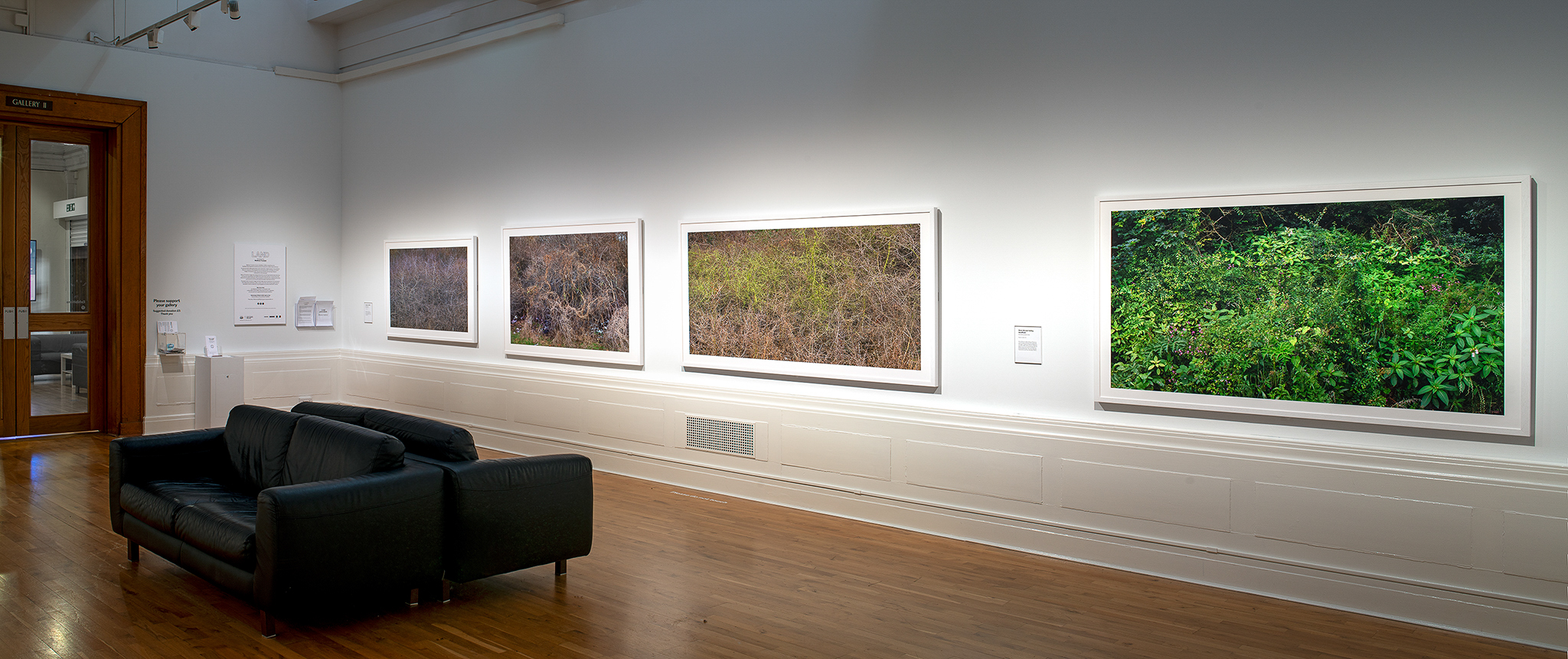
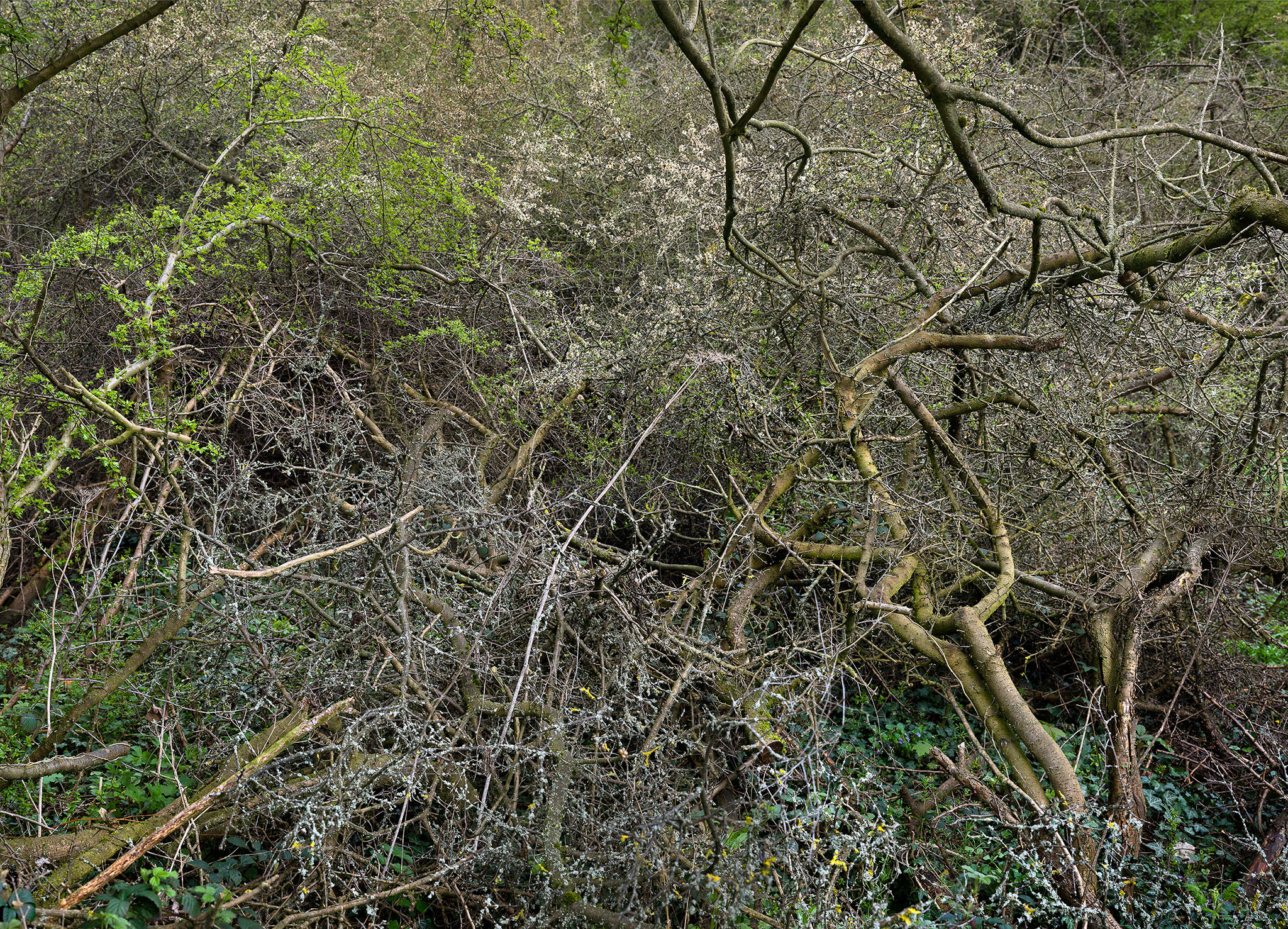
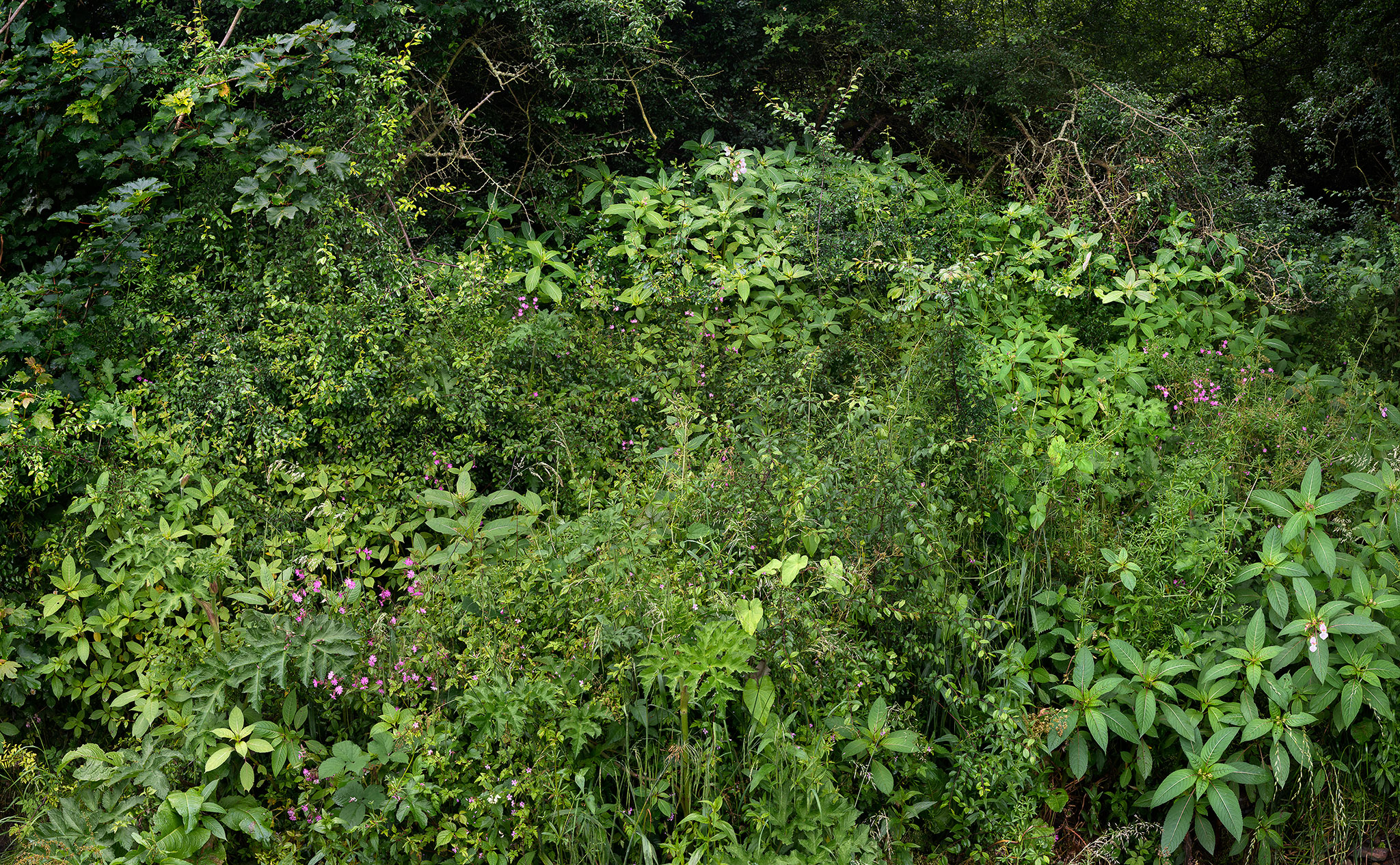
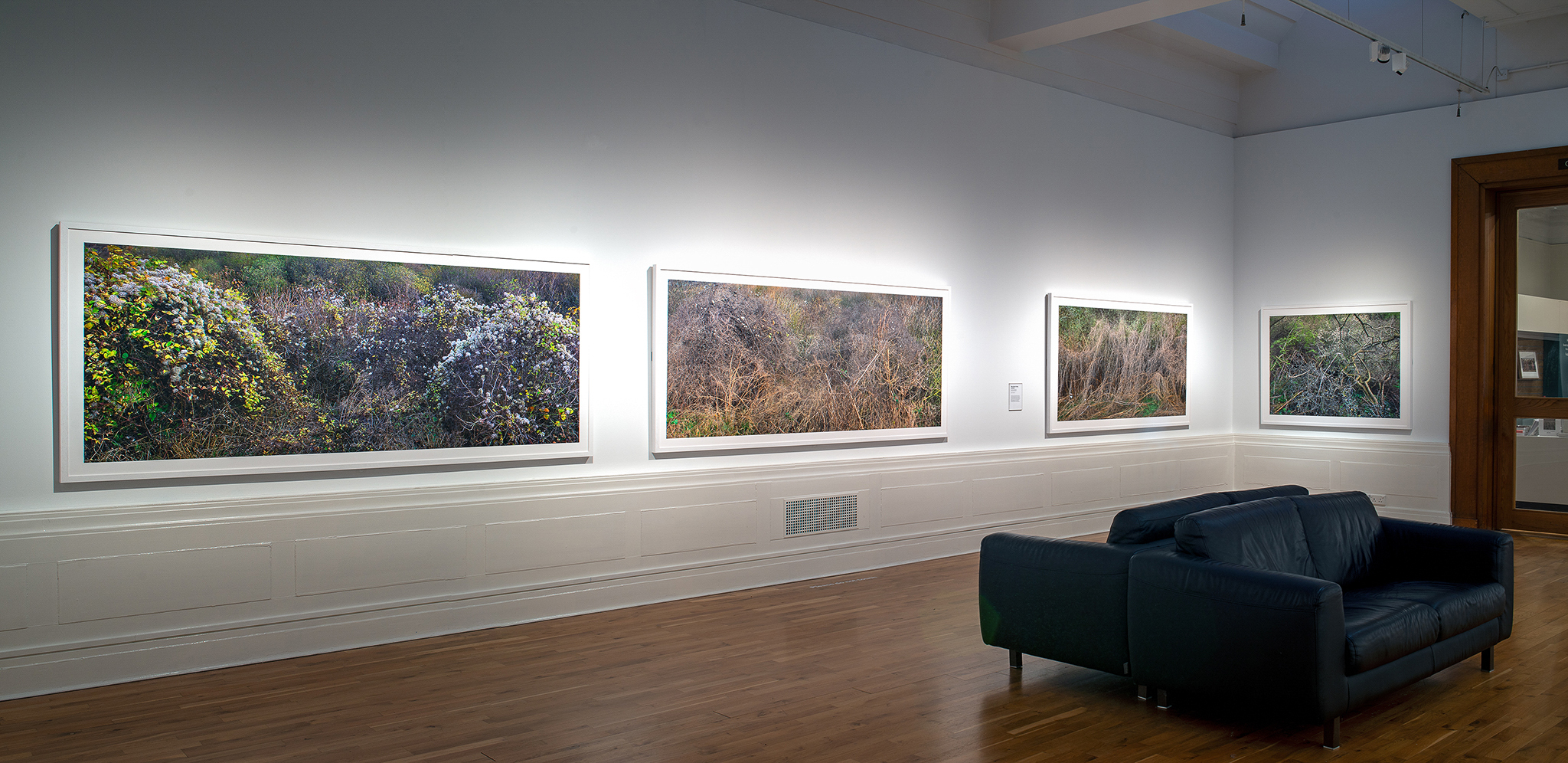
Conduit has had a lifelong fascination with overlooked, marginal places. These are all once thriving industrial sites that have become an overlooked domain of self-seeding invasive plant species and the feral. They are also places of mystery and beauty that are, like his images, in continuous flux, shaped not only by time but by the social and economic environments that have determined their changing function and purpose.
For more than three decades, Conduit has revisited the same sites around Sheffield and continuously worked and reworked his images. In his beautiful large-scale prints, the high resolution and detail are fundamental to the expression of his ideas about aesthetics, place, context, and history, resulting in arresting images that slowly reveal their content.
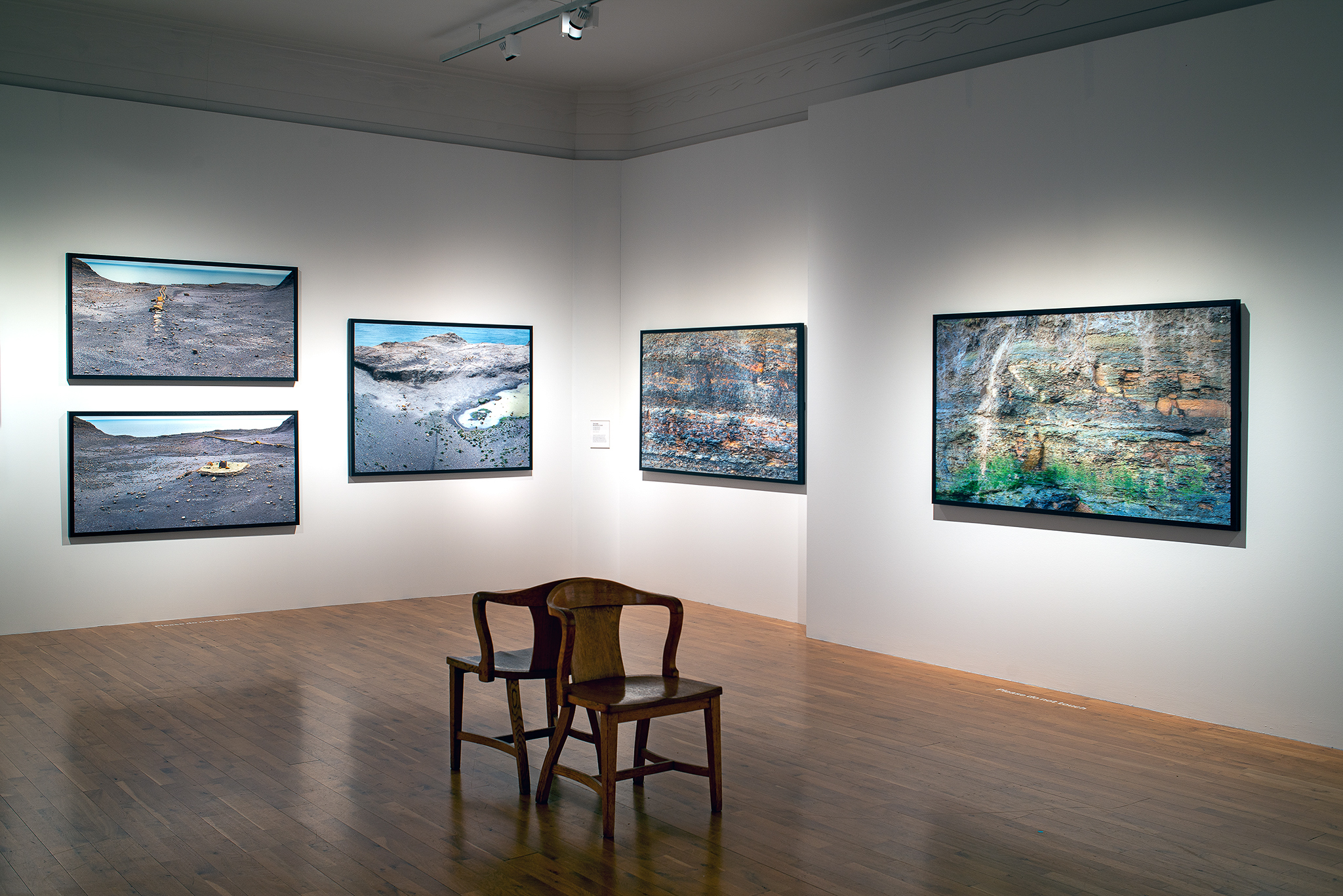
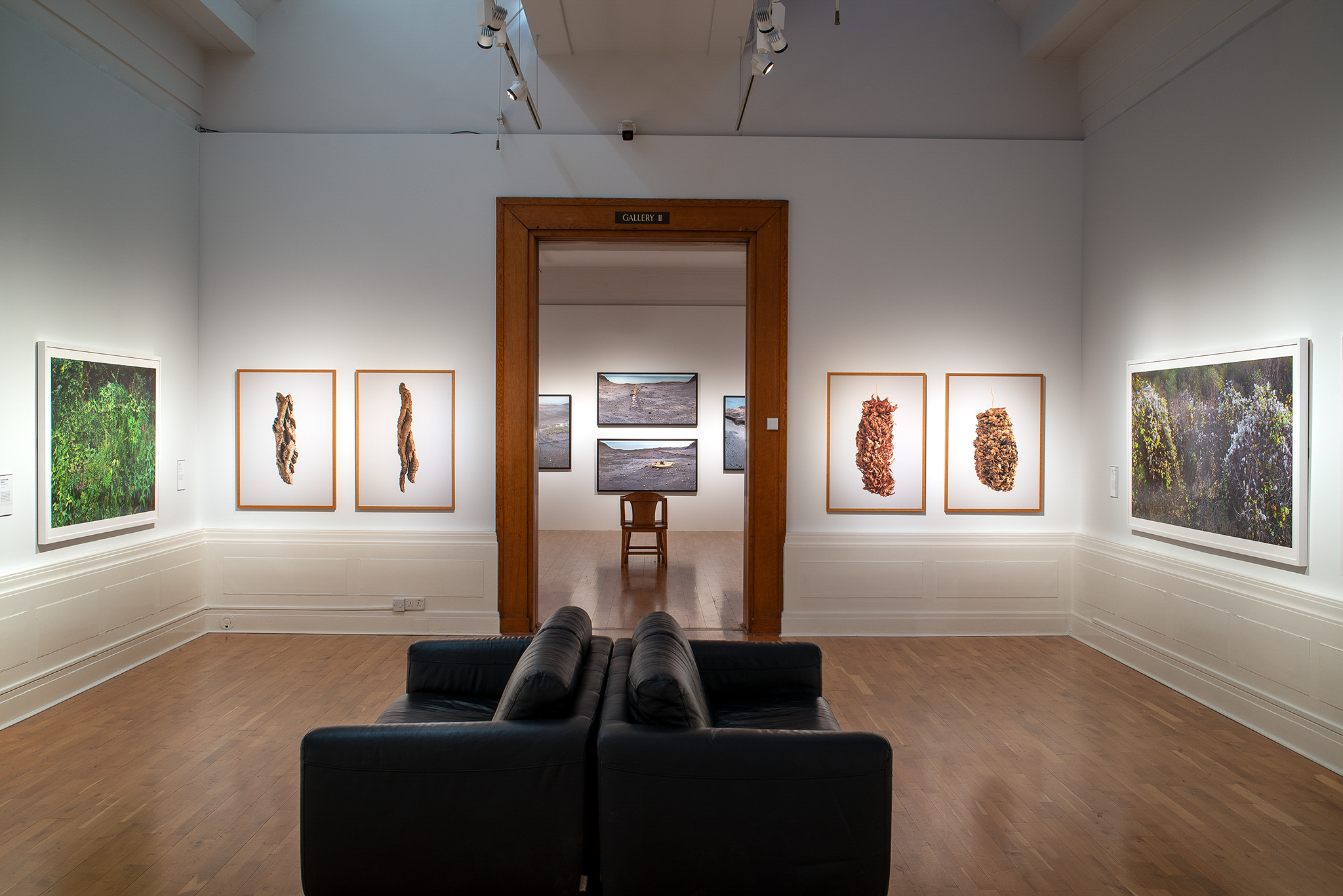
The Land exhibition features a careful selection of photographs made from the last ten years, all never exhibited previously, and includes later work that explores the former Alum mining sites and cliff faces along Yorkshire’s east coast, the first time in many years he has left the city to make work. ‘Treasure’, still-life images that document found objects he has collected over the years whilst exploring the landscape is also featured for the first time.
Each of Conduit’s images serves as a visual narrative, weaving together the threads of his ongoing dialogue with forgotten places, inviting viewers to witness the transformation and rediscovery of these overlooked corners of the world.
Each of Conduit’s images serves as a visual narrative, weaving together the threads of his ongoing dialogue with forgotten places, inviting viewers to witness the transformation and rediscovery of these overlooked corners of the world.
Background
Matthew Conduit was born in Nottingham, and studied Fine Art at Mansfield College of Art and then Sheffield Polytechnic from 1978-1981. Staying in the city, he exhibited widely thereafter, including solo exhibitions at Impressions Gallery, York and at the Axiom Centre for The Arts, Cheltenham. He also featured in various group exhibitions, including the Collins Gallery, Glasgow, with Paul Hill, Keith Arnatt and John Davies, and The Photographers Gallery, London. He took a break from making work in the late 1980’s to concentrate on cultural building projects but resumed his photography in the early 2000’s, which culminated in an exhibition and book publication, ‘Chora’, at the Sheffield Institute of Arts in 2011, his first for 20 years.
Conduit was Director at the Untitled Gallery in Sheffield from the mid-1980s and relocated the gallery to its current location in the city in 1988 (now Site Gallery). He then worked for over 20 years developing the Cultural Industries Quarter and the Workstation/Showroom complex in Sheffield and as a freelance creative industries consultant working across the UK. Conduit has also worked with Heeley Trust since 2009 to develop Sum Studios in Sheffield, where his studio is based and where he continues to develop new work and operate the Untitled Print Studio.
Recently, Conduit curated ‘Regeneration - The Sheffield Project’, a major group exhibition at Weston Park Museum and accompanying publication reviewing the work commissioned and exhibited in the 1980s by the Untitled Gallery when he was Director, concerning the city and its regeneration up to the World Student Games. Artists featured included John Davies, Anna Fox, John Kippin, John Darwell and Bill Stephenson.
Working Process
Matthew Conduit’s images rely on a very high resolution to produce fine detail in his large-scale prints. Earlier work was produced on scanned 5x4 colour sheet film, but in recent years he has worked digitally. He scans a scene and takes many different images - in some cases, up to 80 images, which are then stitched together on a computer in the studio to complete the whole image. He then spends many hours retouching numerous twigs, branches and grasses that are often misaligned between frames. It is a long and difficult process, which can be interrupted by the light changing or a breeze moving the subject matter at any time. As a result, he only makes pictures in even, overcast light and on the stillest of days. The process also means that he never gets to see the completed picture until he is back in the studio.
Earlier work was produced on scanned 5x4 colour sheet film, but in recent years he has worked digitally. He scans a scene and takes many different images - in some cases, up to 80 images, which are then stitched together on a computer in the studio to complete the whole image.
Notes On Locations
Brightside
Brightside Recreation Ground and the site of Limpsfield School was formerly the site of Unwin and Shaw's coal pit, generally known as the Brightside Colliery, where nine miners lost their lives in separate accidents from 1865 to 1873. The coal seam was worked out, and the mine was completely closed by 1886.
Blackburn Meadows
Blackburn Meadows Nature Reserve is on the site of Sheffield’s main sewage treatment works, which opened in 1884. The nature reserve was developed in 1993 out of the redundant sludge beds that remained following the modernisation of the sewage works between 1956 and 1969 and was expanded further in 2005.
In 1942, Olympia Oil and Cake Company, based in Blackburn Meadows, was outsourced to produce 5,273,400 cakes by the Porton Down biology department. These were used in Operation Vegetarian, a British biowarfare military plan to disseminate linseed cakes infected with anthrax spores onto the fields of Germany.
Shire Brook Valley
Shire Brook Valley Nature Reserve was formerly the site of Coisley Hill Sewage Treatment Works, Rainbow and Carr Mills, Birley East and Birley West Coal Mines, and the Beighton Road Landfill site, under which the Shire Brook is now culverted. The area was also heavily farmed from the late 1700’s.
The Shire Brook was the historical boundary between Northumbria and Mercia and was the border of Yorkshire and Derbyshire up until boundary changes in 1967, when Sheffield expanded its boundary to include Hackenthorpe and Beighton.
Catcliffe Flash
A ‘flash’ is a body of water that forms where the land below it has subsided. Whilst these are mostly found in areas where mining has taken place, some can occur naturally. Collectively, they are known as Flashes. Catcliffe Flash was likely formed as the elevation of the land beside the River Rother dropped due to coal mining subsidence from neighbouring Orgreave Colliery, which was actively extracting coal for 170 years up to 2005.
Alum
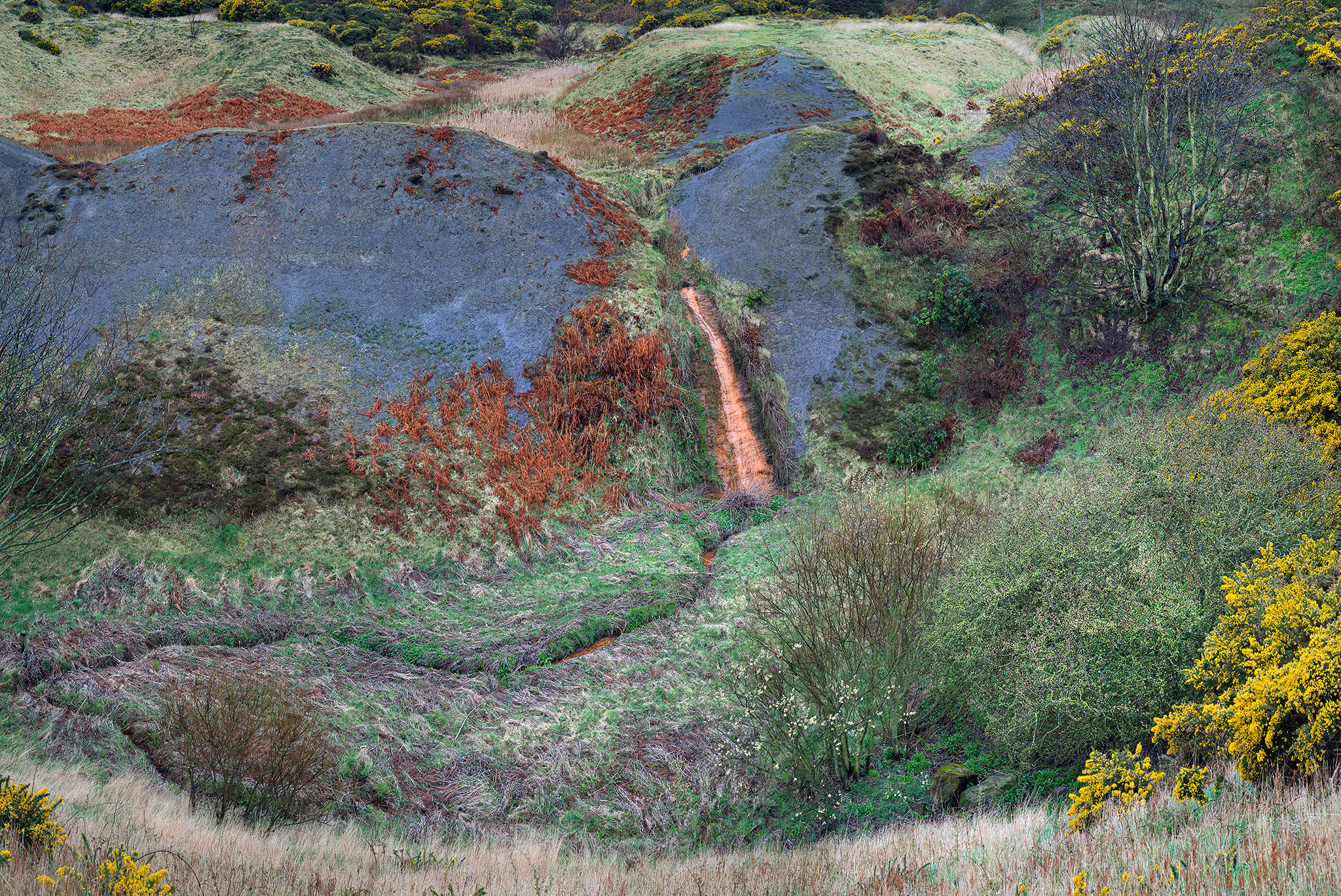
Dating back centuries, alum was essential in the textile industry as a fixative for dyes. In the 15th century, Europe’s Alum production was controlled by the Catholic Church and ultimately by the Pope, and the vast sums of money from Alum exports in Europe went to the Vatican. Alum was discovered on the Yorkshire coast by landowner Thomas Chaloner and has been mined for up to 300 years.
Alum was extracted from quarried shale stone and then burnt in huge piles for nine months before being transferred to leaching pits to extract the aluminium sulphate liquor. Human urine was then added to turn the sulphate into ammonia aluminium sulphate. At its peak, alum production required 200 tonnes of urine every year and was imported from London, Sunderland and Newcastle.
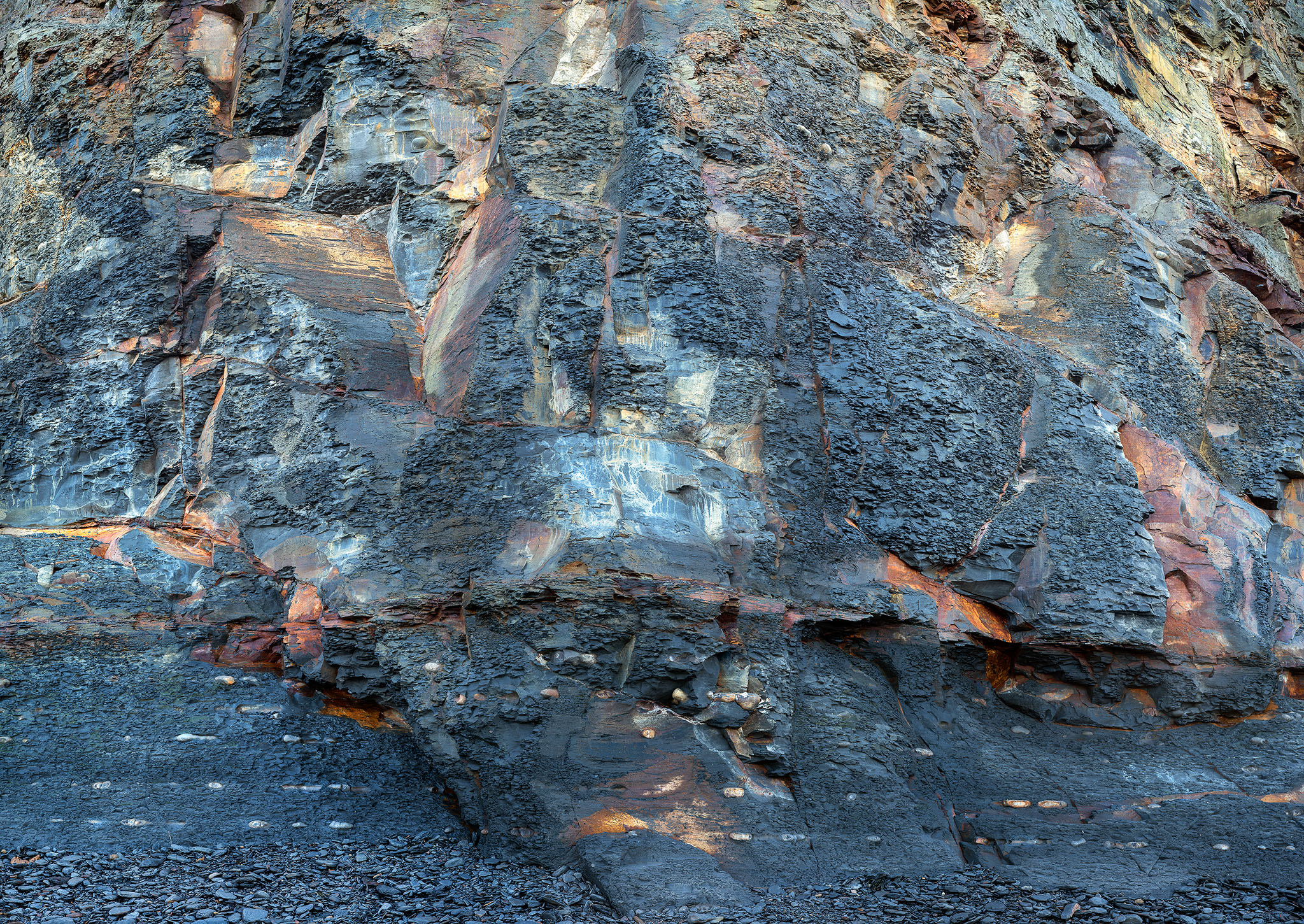
The last Alum works on the Yorkshire Coast closed in Sandsend in 1871. Conduit is fascinated by this alien landscape, still scarred centuries later by the toxic process.
The last Alum works on the Yorkshire Coast closed in Sandsend in 1871. Conduit is fascinated by this alien landscape, still scarred centuries later by the toxic process.
The Edge
Conduit became fascinated by the varying cliff faces along the East Coast many years ago but only started to photograph them around 2012. This was initially a largely aesthetic exercise, but he grew to consider them in terms of representing the very ‘edge’ of the landscape, where millennia of history unfolded. More recently, the signs of the impact of coastal erosion have taken on an additional significance. This work also led to the Alum series, which Conduit discovered while photographing The Edge.
Treasure
Treasure is an ongoing series of images made of objects collected while traipsing the landscape. The earliest object in the series dates from 1980. The images shown in the exhibition include two from the ‘Bark’ series, where Matthew collected large pieces of fallen bark from a dead English Oak tree, and ‘Leaf Stack’, where collected leaves have been threaded together and then hung in the studio, where they have dried out and coalesced. Matthew started photographing these objects from 2015 onwards.
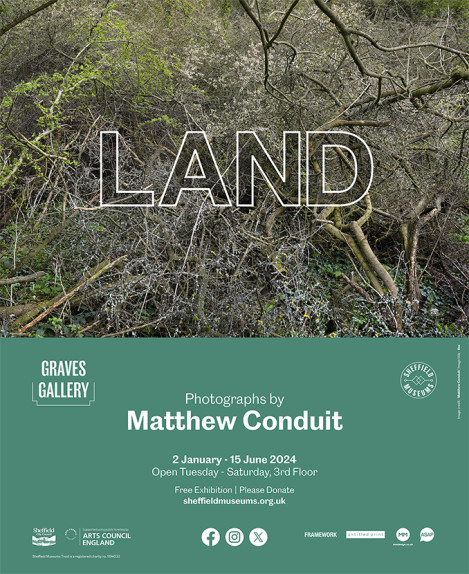
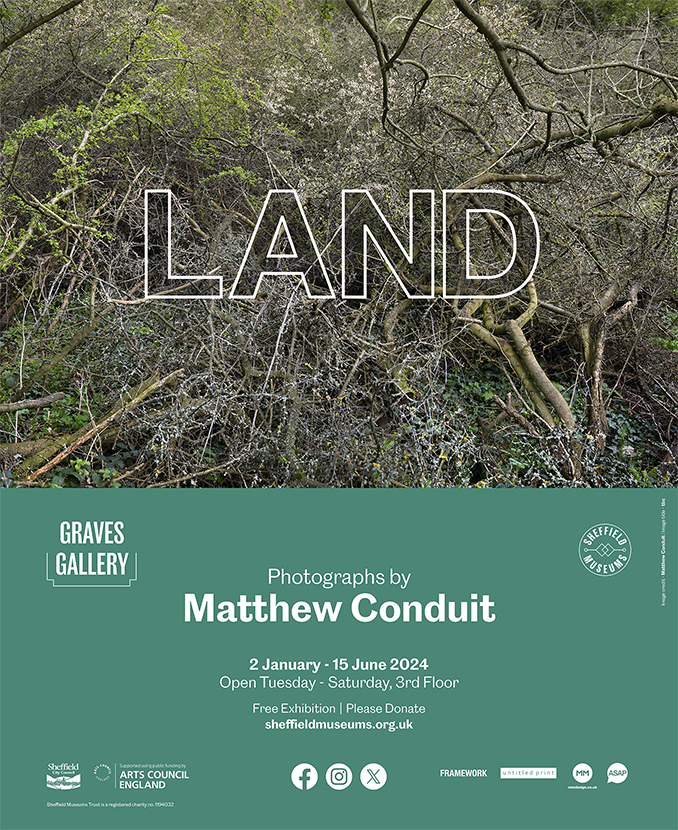
Graves Gallery, Sheffield, January 2024
Exhibition Details
Sheffield Museum, Graves Gallery, (Above the Central Library), Surrey Street, Sheffield, S1 1XZ
The premise of our podcast is based loosely around Radio Four's "Any Questions", Joe Cornish and I (Tim Parkin) invite a special guest onto each show and solicit questions from our subscribers.
Our first podcast featured Alex Nail where we discussed his mountain photography, colour management and much more. You can see the first podcast here but we're also making the podcasts publicly available on most streaming platforms. You can find out more at this public link.
Our next guest will be Mark Littlejohn so if you want to get any questions to us in advance by 12th March. Please send them to submissions@onlandscape.co.uk.
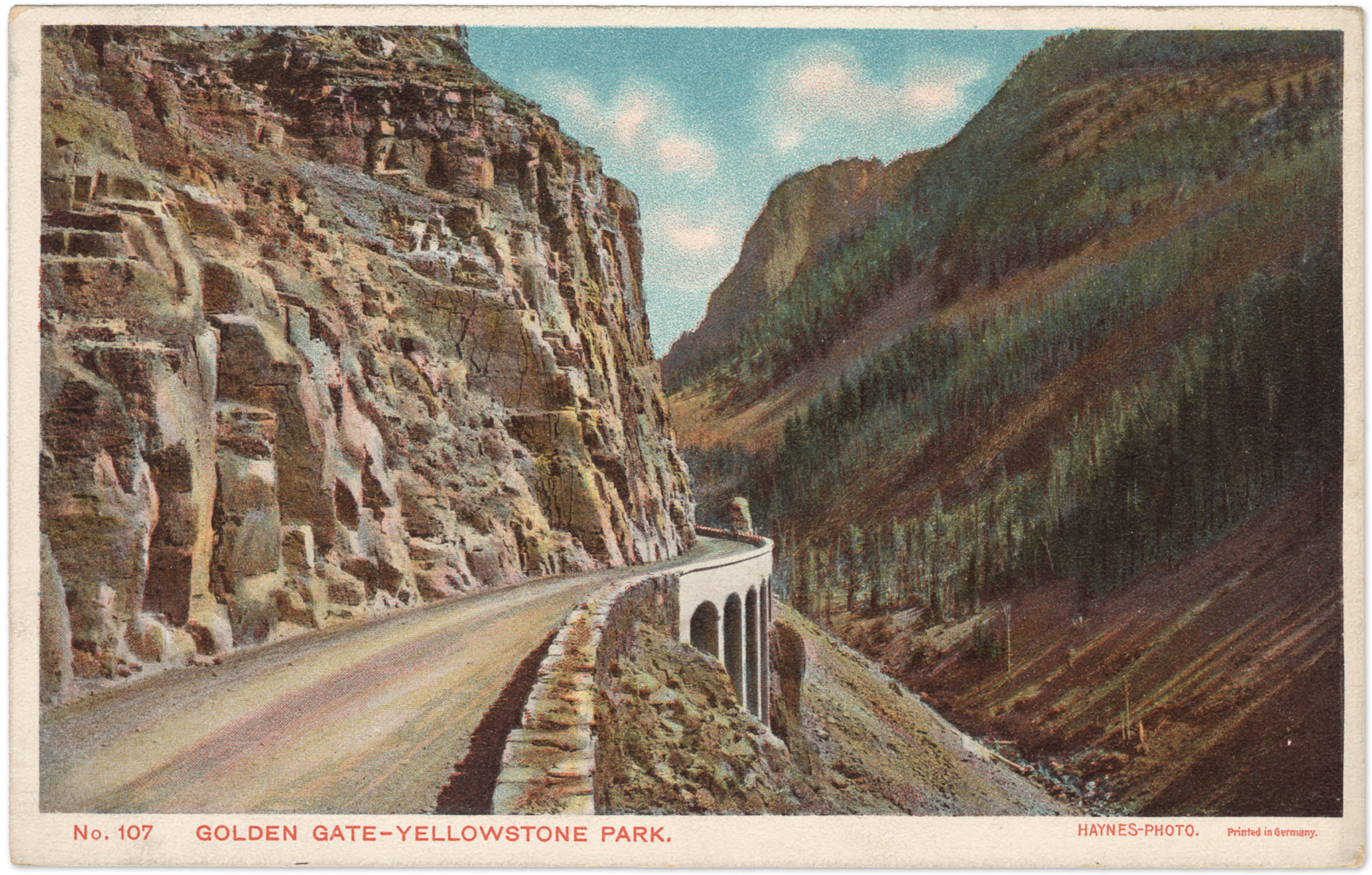
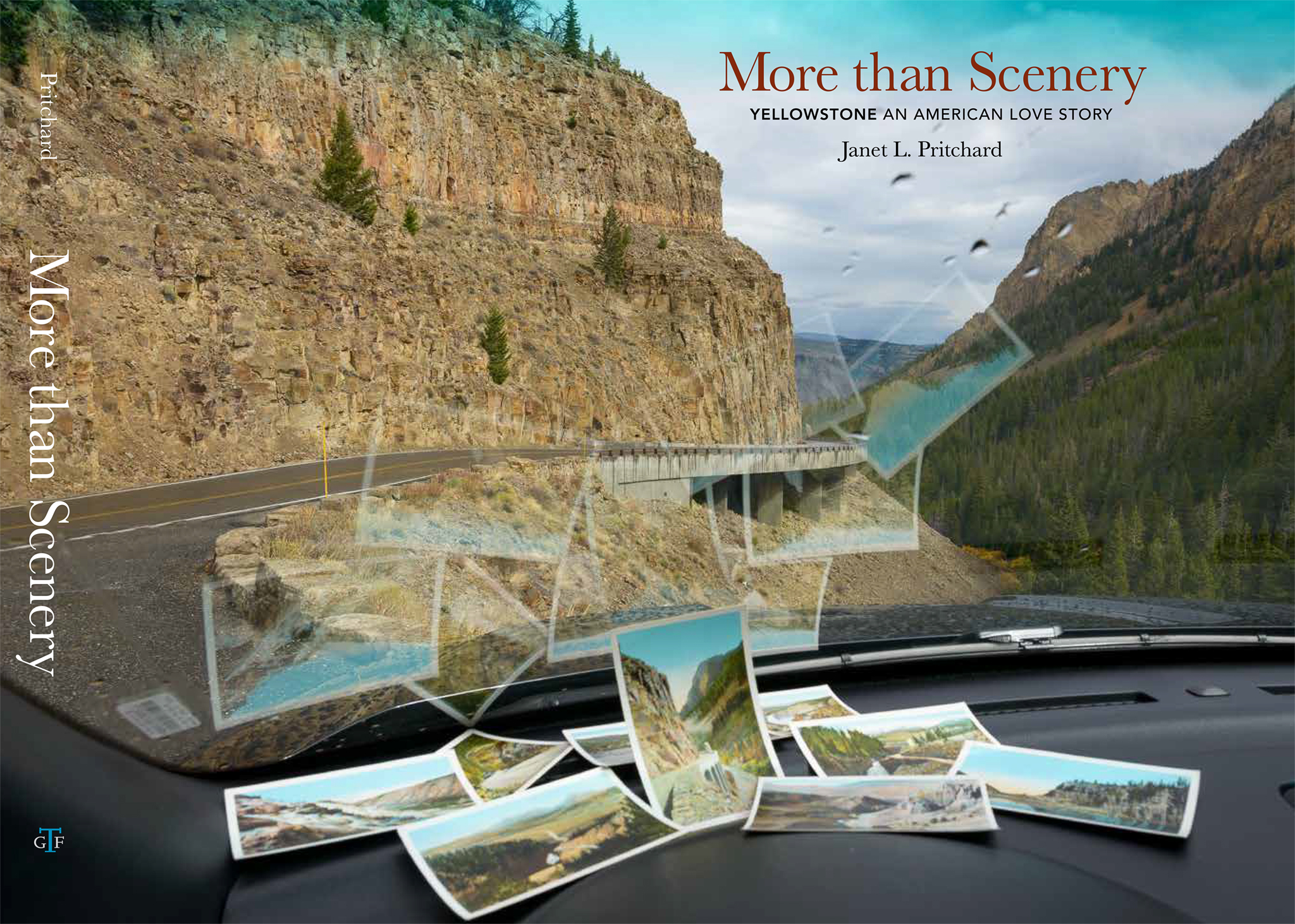
An old Haynes’ picture postcard of Golden Gate Canyon found at a paper antiques show first caught Janet's eye. It transported her back to a place from her childhood. The significant regional and socioeconomic differences in the US, compared to that experienced as a child, had a direct impact on her work as a photographer. Janet uses a methodology called "historical empathy, which relies on archival materials to guide depictions of the complex landscapes found at the intersection of nature and culture." Eager to delve deeper into her latest project, I reached out to Janet for an in-depth conversation about her latest project.
Would you like to start by telling readers a little about yourself – where you grew up, what your early interests were, and what you went on to do?
My origin story as a photographer begins with adolescent summers in NW Wyoming, an introduction to a 35mm rangefinder and the darkroom in junior high, and later working as an outdoor education instructor. These experiences influenced much of what followed. Wyoming expanded my sense of place; a manual camera and the darkroom shaped my earliest perception of self as a photographer, and outdoor education confirmed my fondness for teaching. I discuss this story further in my essay “Education of a Photographer” in More than Scenery.
At what point did photography become more than a hobby? Did anything in particular prompt this? You worked as an outdoor education instructor. How did you transition to a photographer?
Once in the darkroom, photography was never a hobby; it was a passion. Early on, I sensed it would shape my life. On a most fundamental level, photography is my way of being in the world. Working in outdoor education was also a good fit for many parts of me.
If I hadn’t already dipped into photography, I might have remained in outdoor education rather than settling in academia. I have a range of interests, and I’ll never know what might have been….
I love to be outdoors. Making my way through a wilder world using my body, knowledge, and skills satisfies my soul, and I love to teach. If I hadn’t already dipped into photography, I might have remained in outdoor education rather than settling in academia. I have a range of interests, and I’ll never know what might have been…
Tell me about the photographers or artists that inspire you most. What books stimulated your interest in photography, and who drove you forward, directly or indirectly, as you developed?
I read widely and variously. I look deeply at work in many modes, but photography and painting hold my attention the longest. Walker Evans, Lee Friedlander, Emmet Gowin, and Andre Kertesz are a few photographers I studied in my youth and still enjoy. A little later, Linda Connor’s work held my gaze. Looking at and thinking about work by other women became a strong focus as I wrestled with where I fit in the medium's traditions and feminist theory. Critical theory encouraged my inclination to lean on other intellectual disciplines. There is a lot of great photography being made these days, and it’s a joy to follow the work of many younger artists.
On your website, you write about being “geographically bilingual and having early experiences leading to an awareness of significant regional differences within the United States.” Tell us more about how this experience informed your view of the different landscapes in the regions and how that impacted your creativity.
People often talk about the importance of travel and being a global citizen. While I believe that to be true, I also worry that too few people in the U.S. have experienced the sharp regional differences at home. If we were more aware, we might also be more empathetic. Spending summers in a very different part of the country at a young age opened my eyes to significant regional and socioeconomic differences in a way that drives my work. My photographs frequently tap into an awareness that even when a place looks familiar, a life there may differ significantly from my experiences. I work to remember this and use research to understand such differences.
As Barry Lopez suggests, I understand landscapes as the intersection of nature and culture. Historical empathy as a method grew out of this belief, but historian Robert Gross coined the phrase to describe my methodology some years ago when writing a letter to support my work; it stuck
You mention a methodology you call ‘historical empathy, which relies on archival materials to guide depictions of the complex landscapes found at the intersection of nature and culture.” Can you tell us more about this methodology, how you devised it and how you use this process in your creativity?
As Barry Lopez suggests, I understand landscapes as the intersection of nature and culture. Historical empathy as a method grew out of this belief, but historian Robert Gross coined the phrase to describe my methodology some years ago when writing a letter to support my work; it stuck. I had the benefit of a vital “classical” education growing up. Still, I railed against the holdover beliefs from New Critical Theory that a work must be interpreted solely using intrinsic information and excluding historical, social, economic, and biographical influences from “reading” a work. This view of art felt limiting, so I began digging in other places to expand my understanding. Now, I lean heavily on different ways of knowing to understand the landscapes I photograph more deeply.
Your current position is a Professor of Art, Area Coordinator, and Graduate Advisor at the University of Connecticut. Has teaching influenced your style and approach to photography?
How can teaching photography not influence my photographic work? I had a student who opened my eyes to the obvious. He was a golfer who competed in college. Afterwards, he taught as a golf pro, and his game improved.
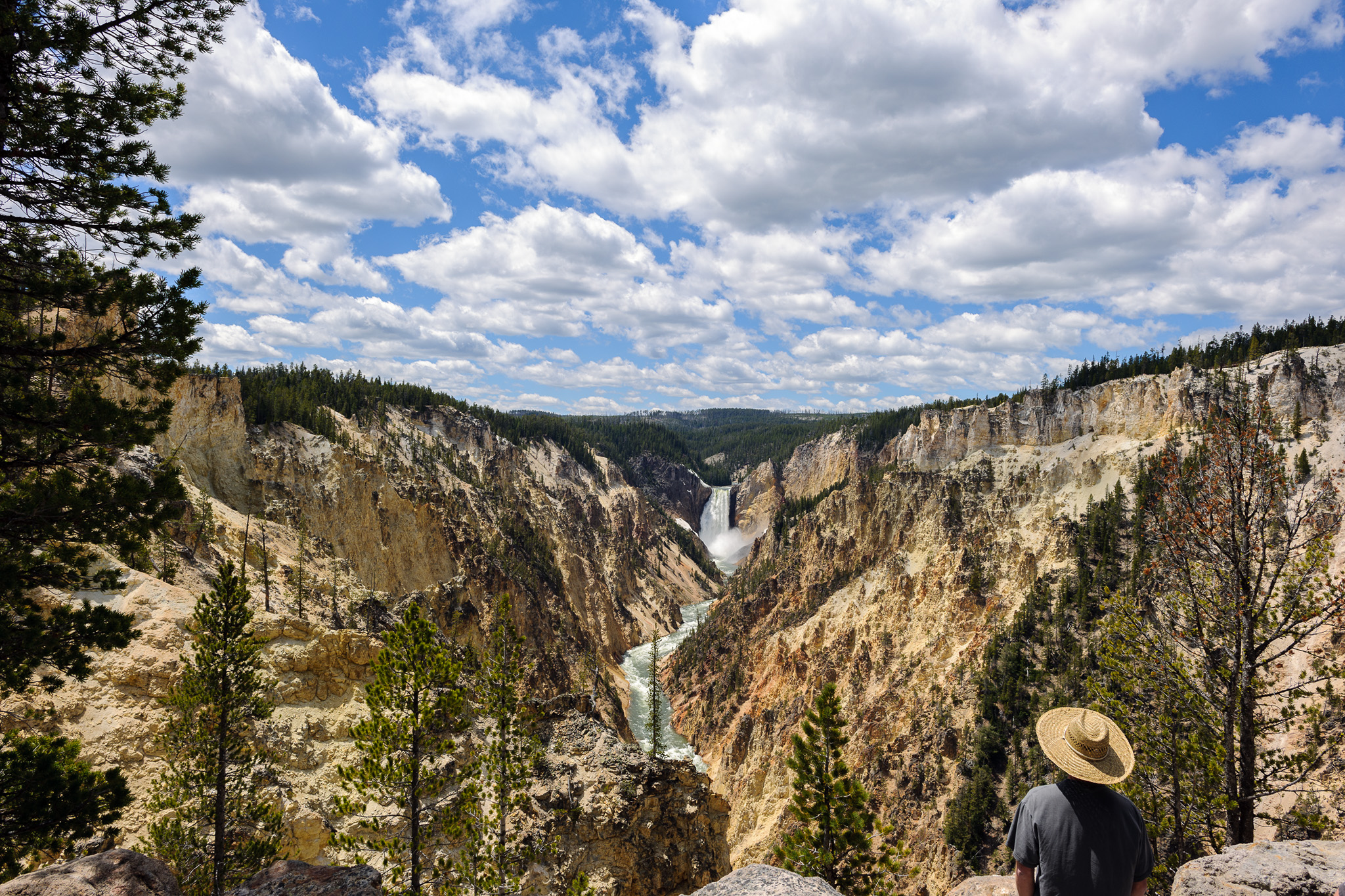
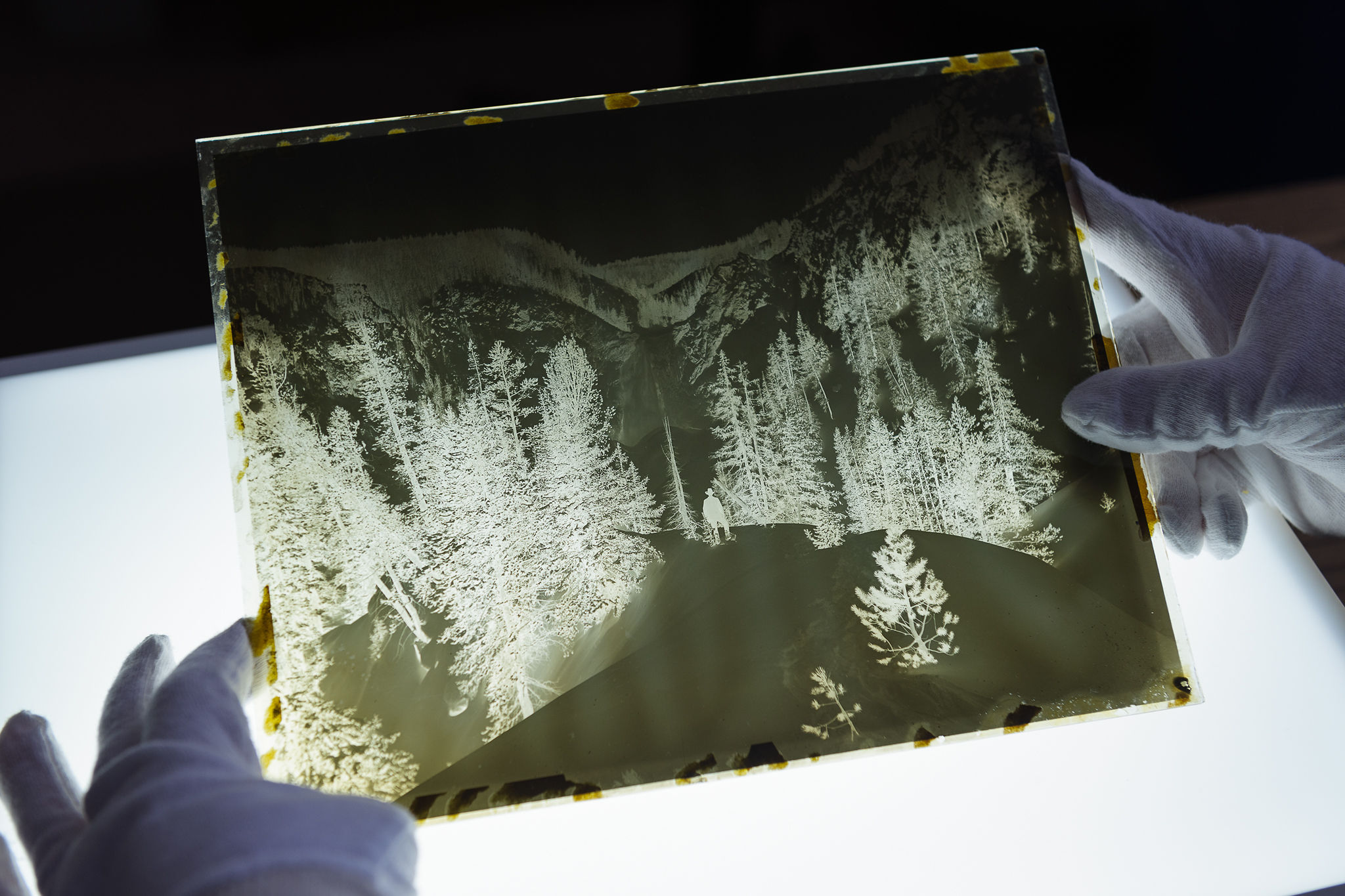
The view of Golden Gate Canyon caught my attention after looking through the Wyoming cards at a paper antiques show. It’s a classic 19th-century proscenium picture space borrowed from painting by Western exploration survey photographers of the 1870s and ’80s.
He believed that focusing on the fundamentals made the difference. I, too, have found truth in his belief. I work hard not to stifle my intuitions but recognise some choices are more carefully considered when I hear my teacher’s voice saying don’t be lazy, don’t forget, do it now before it becomes a problem, are you sure there isn’t a better vantage point, if you look a little longer? I hope my students also will hear my voice in their heads in years to come. It’s sometimes hard to separate teaching and photography; I’ve been doing both for so long.
More than Scenery - Yellowstone, An American Love Story was inspired by a vintage picture postcard of Golden Gate Canyon by Frank Jay Haynes. Can you tell us more about how this sparked the idea of the project and how it evolved?
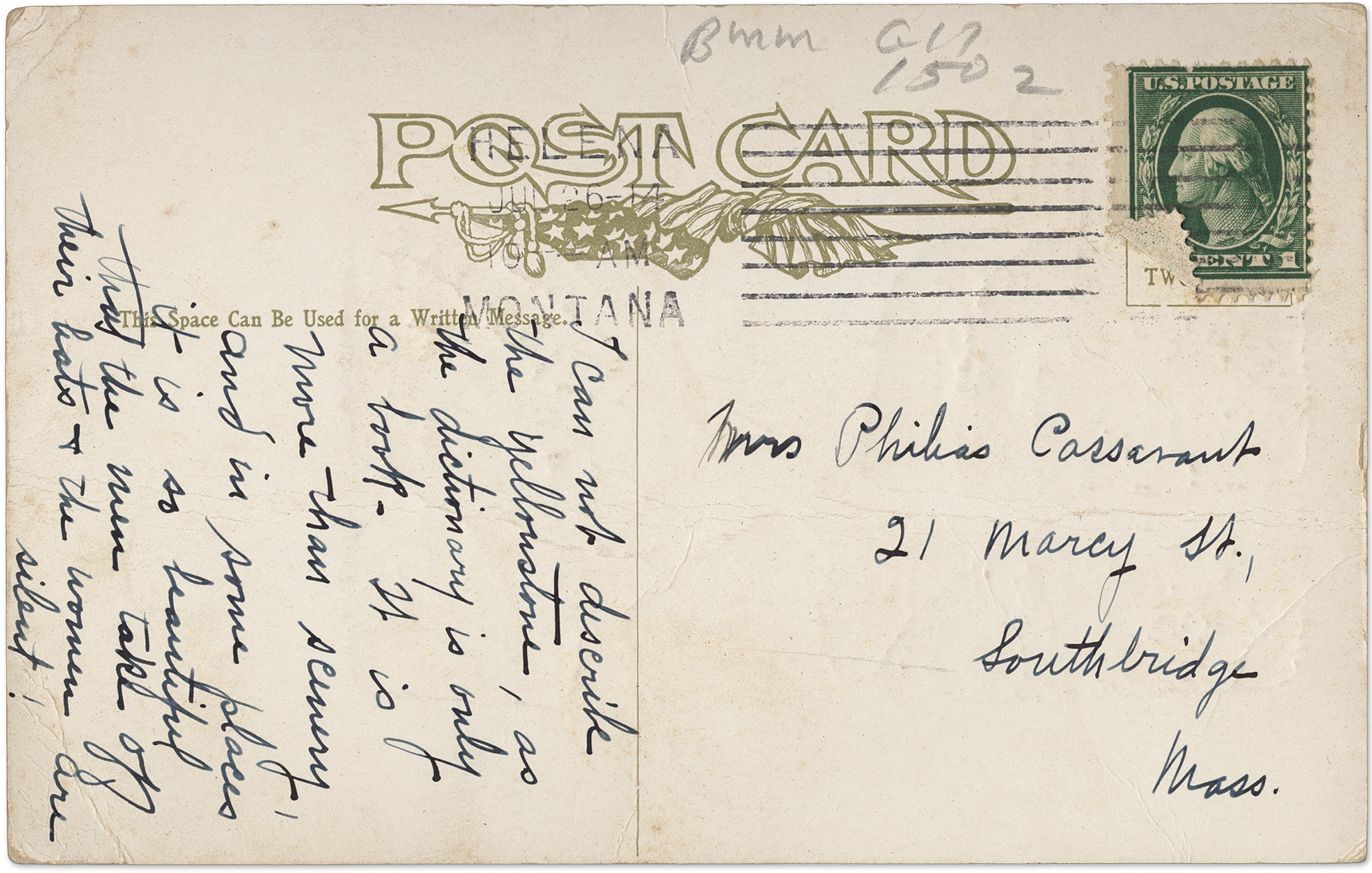
The view of Golden Gate Canyon caught my attention after looking through the Wyoming cards at a paper antiques show. It’s a classic 19th-century proscenium picture space borrowed from painting by Western exploration survey photographers of the 1870s and ’80s. I noticed multiple copies of this view and thought it strange since it is not known today as one of Yellowstone’s “greatest hits.” When I turned it over, the message took me back to that childhood place of wonder tempered by a lifetime of work in landscape photography and raising a family: “I can not describe the Yellowstone, as the dictionary is only a book. It is more than scenery, and in some places, it is so beautiful that the men take off their hats & the women are Silent!”
Lucy Lipard wrote the introduction to your book. What’s your connection to Lucy, and how did this collaboration come about?
When I returned to finish my undergraduate degree at the University of Colorado, an influential professor suggested I read a recent book by Lucy Lippard, From the Center, a 1976 collection of feminist essays. This book validated much of my resistance to New Critical Theory. I was surprised later to learn the extent of her interest in landscape. Later, books, Overlay, 1983, Mixed Blessings, 1990,. Lure of the Local, 1998, and On the Beaten Track, 1999 all informed my work. Over the years, our paths crossed in various informal ways, and we had mutual colleagues and acquaintances. She had previously worked with George Thompson, my publisher, and I was honoured and pleased when she accepted our offer to write.
In the introduction, Romancing the West, Lucy writes, “The subject of this book is not another fruitless attempt to describe or simulate the effect of Yellowstone’s magnificent “scenery” so much as it explores human responses and human presence, including the artist/author’s.” (page 13) How did you approach capturing these human elements?
This project was grounded in the visitor’s experience of the park from my first reading of the vintage postcard quote. Trying to imagine visiting Yellowstone as a once-in-a-lifetime opportunity shaped my perspective. From there, my curiosity led the way. However, it took time for the book’s unique structure of the three portfolios, “Views from Wonderland,” “Collecting Yellowstone,” and “Stories from the Greater Yellowstone Ecosystem,” to unfold. As I worked, my appreciation for the complexity of the park increased; what I paid attention to changed, and where I pointed my lens reflected those changes. I came to think of the portfolios as triangulating the park’s heart from distinct vantage points.
This project was grounded in the visitor’s experience of the park from my first reading of the vintage postcard quote. Trying to imagine visiting Yellowstone as a once-in-a-lifetime opportunity shaped my perspective. From there, my curiosity led the way. However, it took time for the book’s unique structure of the three portfolios, “Views from Wonderland,” “Collecting Yellowstone,” and “Stories from the Greater Yellowstone Ecosystem,” to unfold.
“We are accustomed to calendar photographs of our stunning national parks, and, more recently, we are also exposed to the critical landscape photographers who inform us about the downsides of human impacts on the scenery. Pritchard’s rejection of grandiosity is suggested by a deceptively casual approach to photography (bolstered by extensive thought and historical research) that contradicts the expected coffee-table/calendar mode and testifies to the artist’s vision, acumen and commitment.” (page 14) Was this an intended style of photography, or did it evolve from your trips into Yellowstone? Do you think that ‘grandiosity’ can get in the way of communication?
The “style” of this work, described as a “rejection of grandiosity” by Lippard, is intentional. It is the outgrowth of questions I have asked since my undergraduate years in Boulder, photographing the foothills along the Front Range of the Colorado Rockies. There, poised with my view camera along the dividing line of the eastern plains and western mountains, I first questioned my place in the photography. Pushing against the male-dominated genre of landscape, I depicted the “grand view” through a scrim of cottonwood leaves, forcing the viewer to focus on the ordinary rather than the extraordinary. My strategy in More than Scenery is “a deceptively casual approach,” which rejects the “coffee-table/calendar mode.” My “style” in More than Scenery lies at the intersection of the calendar and the critical photograph. While my “style” is neither, I’ve learned lessons from both.
“The heavy hand of humankind is depicted innocently: a hand holding a chunk of obsidian taken from the cliff in the background" (page 108), "a fleeced arm holding a picture of a waterfall in front of the real place" (page 10)—nature at home and decontextualised.” (page 14). When you were making the images, did you think about the messages that you wanted to communicate to the viewer? How did you go about achieving this? Did you think about the messages that you wanted to convey and then made the images or vice versa? Or was there a different process, perhaps through curation?
A photographer/artist makes many choices along the course of a project. One’s sense of a project shifts and changes in response to work, research, reviewing results, moving this image next to that one, and learning back from one’s work, always working to understand what one has done rather than what one thinks they have done. New choices are made, hypotheses are tested, adaptations are adjusted often on the fly, and so on. In the beginning, I had curiosity. That identified a place to start.
I refined the concept as I worked, and the process became more directed, but I always left room for chance. This project, spanning thousands of photographs, required frequent reassessment, checking in with what was and wasn’t working, and always keeping the strong outliers in my mind because as an emphasis shifted here or there, gaps might open up, making room for pictures that hadn’t fit before. Final edits left some stunning photographs out of the book for the good of the whole.
“Hiding behind the scenes of Pritchard’s photographs are the invaluable and still unknown ecosystems ignored by most visitors, cherished by scientists worried about climate change and the disappearance of species. They are finally becoming a focus of beleaguered park management, whose budgets were constantly being raided by an unsympathetic federal administration.” Was climate change something that you were actively thinking about when you were working on the project? Was there a clear message that you wanted to leave with the viewer? (page 15)
An awareness of the impacts of climate change is unavoidable for anyone paying attention.
More than Scenery weaves a picture of a complicated landscape that appears one thing to visitors, another to those steeped in its histories, and yet again another when seen through the lens of recourse and management issues.
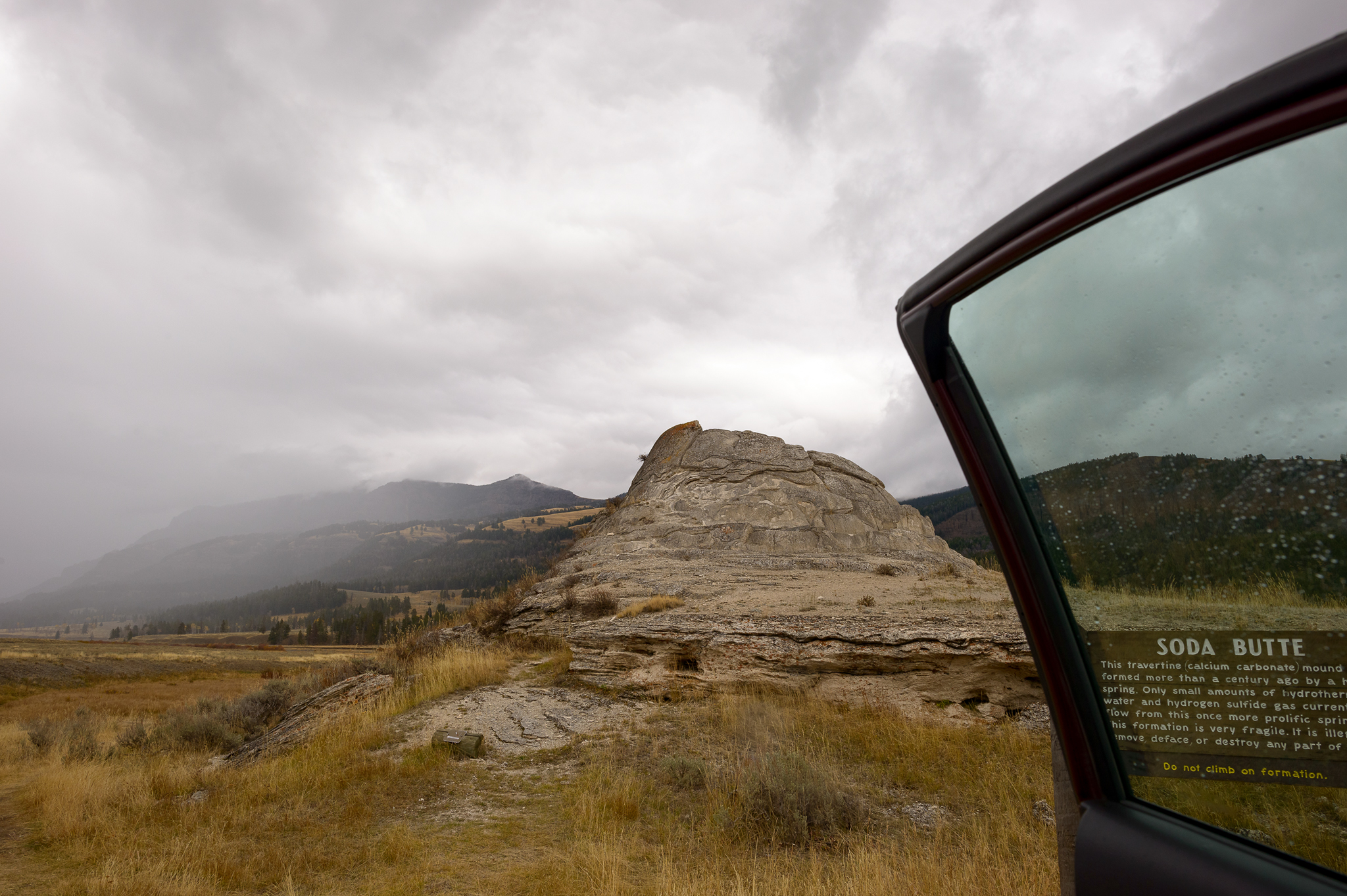
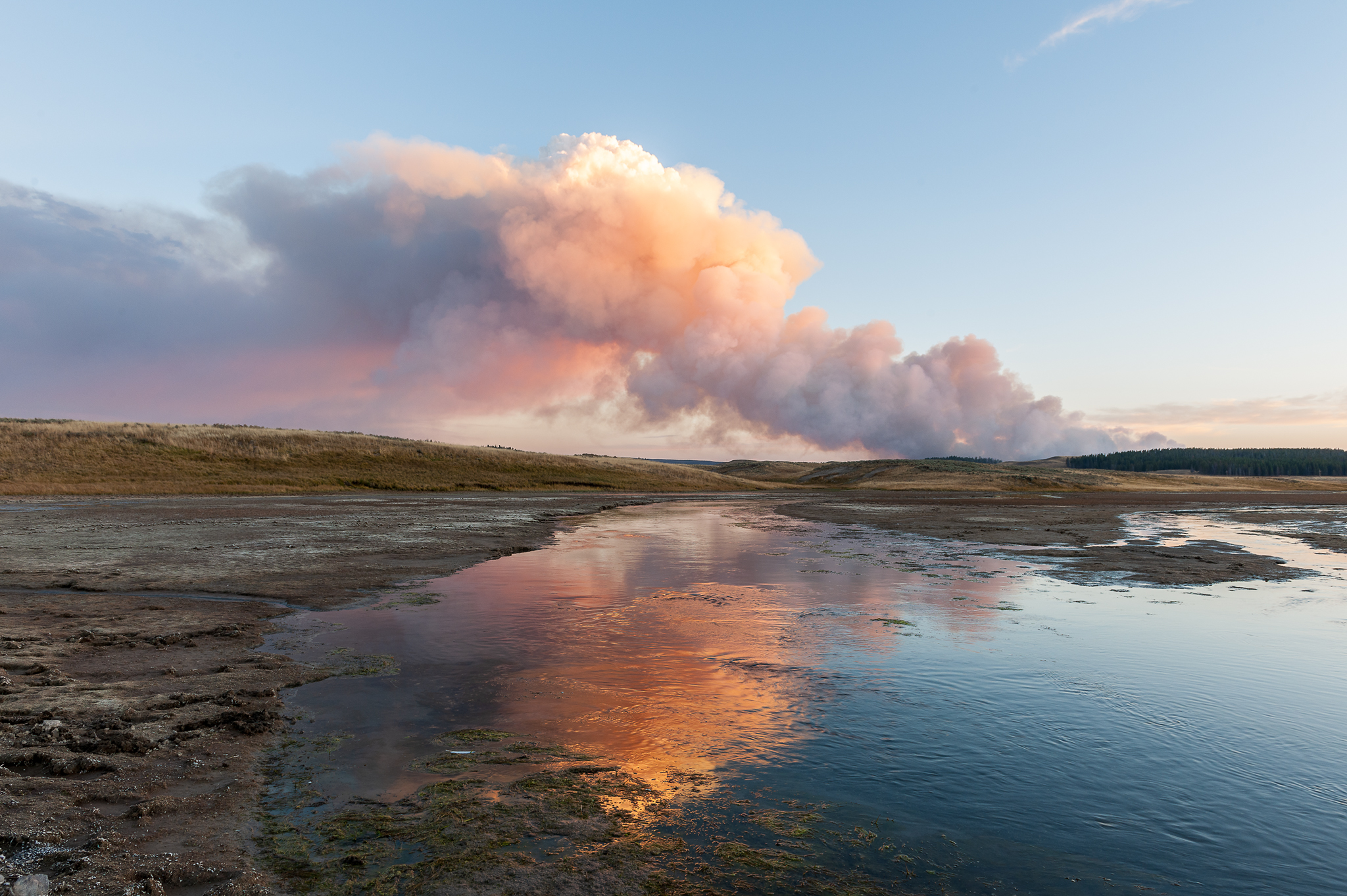
Weather patterns shift, water resources are diminished, food sources follow these changes, and animals follow the food. Yellowstone is all about the menu.I worked on this project long enough to see change. Wildfire patterns are shifting, and flood markers such as a hundred-years or five-hundred-years have lost meaning. This work shows the human hand everywhere on the land, even when we don’t see people.
The clear message of this book is simple if complex: Yellowstone is not one thing. As Lippard says, this is not a coffee table book. More than Scenery weaves a picture of a complicated landscape that appears one thing to visitors, another to those steeped in its histories, and yet again another when seen through the lens of recourse and management issues.
“The photographs I have made of Yellowstone National Park and the Greater Yellowstone Ecosystem surrounding it are not a tale of paradise lost but are sparked by the memories of my life in Wyoming when a dream turned real. That landscape of childhood and adolescent wonder set the stage for my life as a photographer, allowing me to connect nature with family, love, belonging, and separation. A lifetime of longing for the place where I was not living.“ Do you think completing this project has helped you heal the sense of separation and the longing you had?
You ask if this project healed my sense of separation and longing. The longing is a comforting presence, an understanding that my life plays out over a more extensive terrain than any one place. I’ve often thought my work was about paths not taken in my life. There are any number of other doors I could have walked through when I was younger. I chose photography, which has allowed me to explore a number of those paths, albeit differently than if I had made a career of X, Y, or Z. With a camera as my guide, I can dip into history, literature, writing, environmental studies, and science, etc. Although it’s true, I must sometimes remind myself I am not a historian or any of those other things and prioritise the needs of my chosen path.
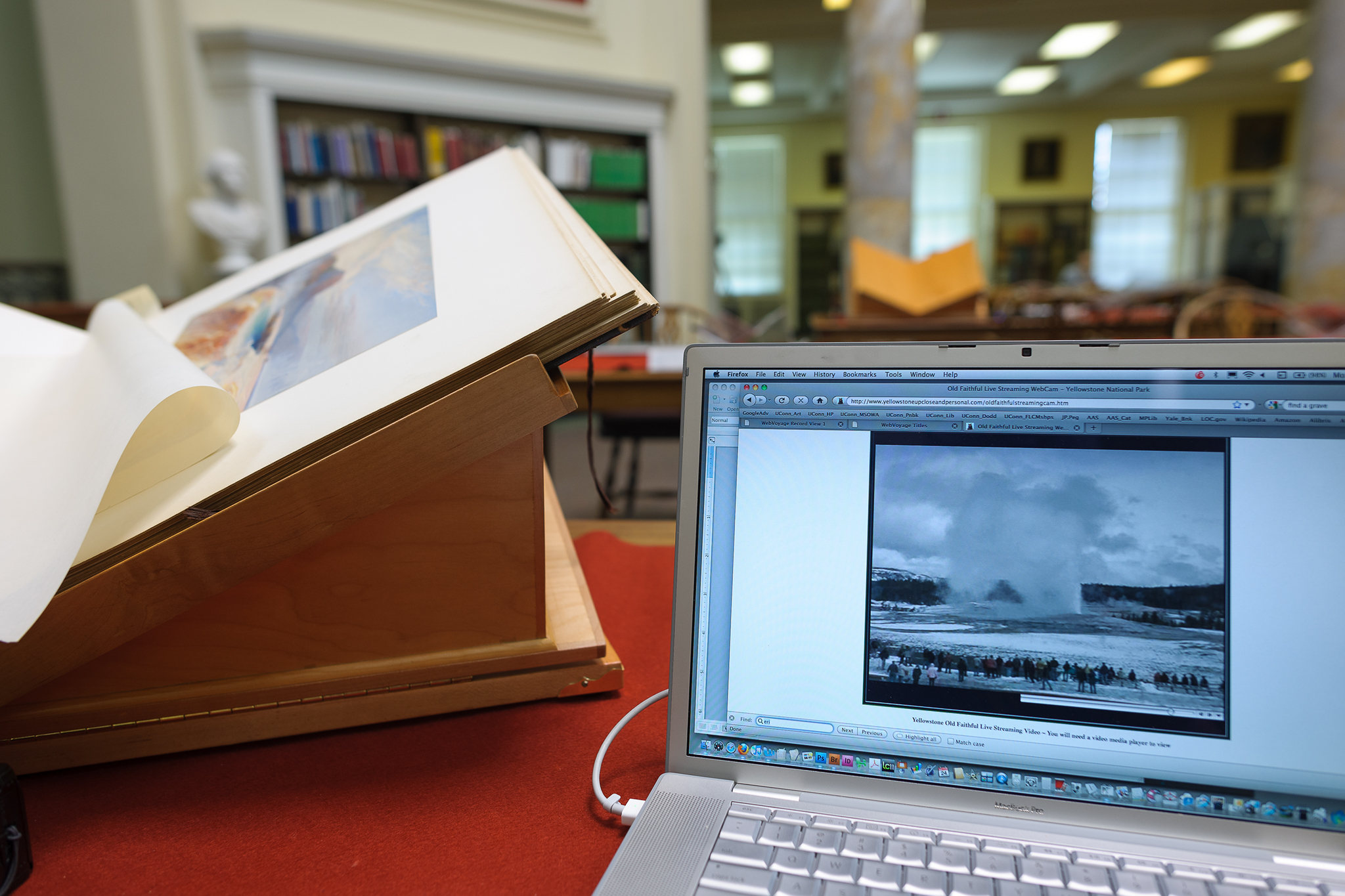
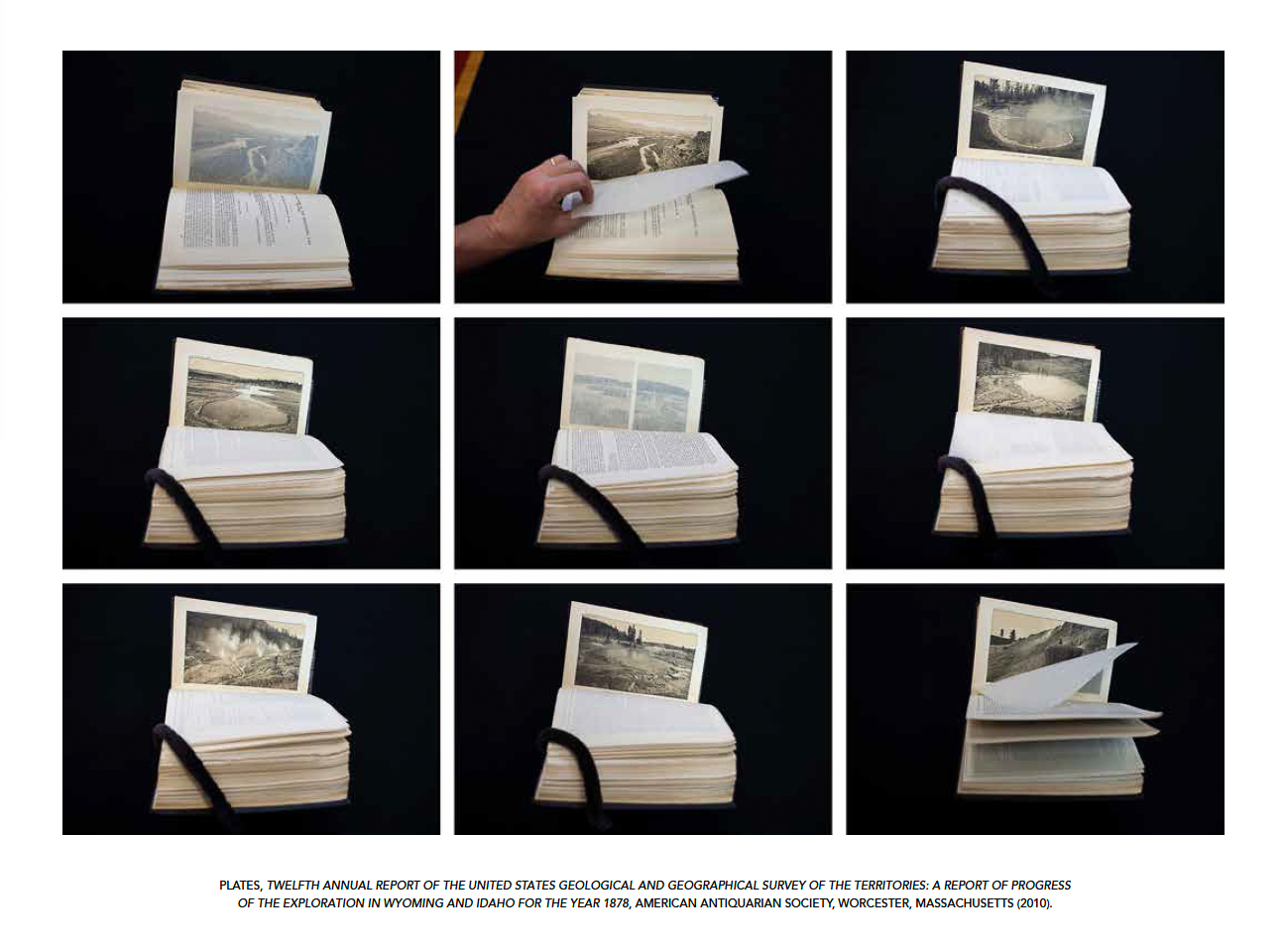
“Research for the book began beneath the generous dome of the American Antiquarian Society’s reading room in Worcester, Massachusetts, where I was a Jay and Deborah Last Fellow in June 2008. Sitting in the library for forty hours a week for four weeks was not my natural habitat. And yet, the strength of my belief in the value of learning more about Yellowstone’s history and origin story compelled me.” Tell us more about the research that you did into Yellowstone. Why was it so important to you to understand more about the history and origin?
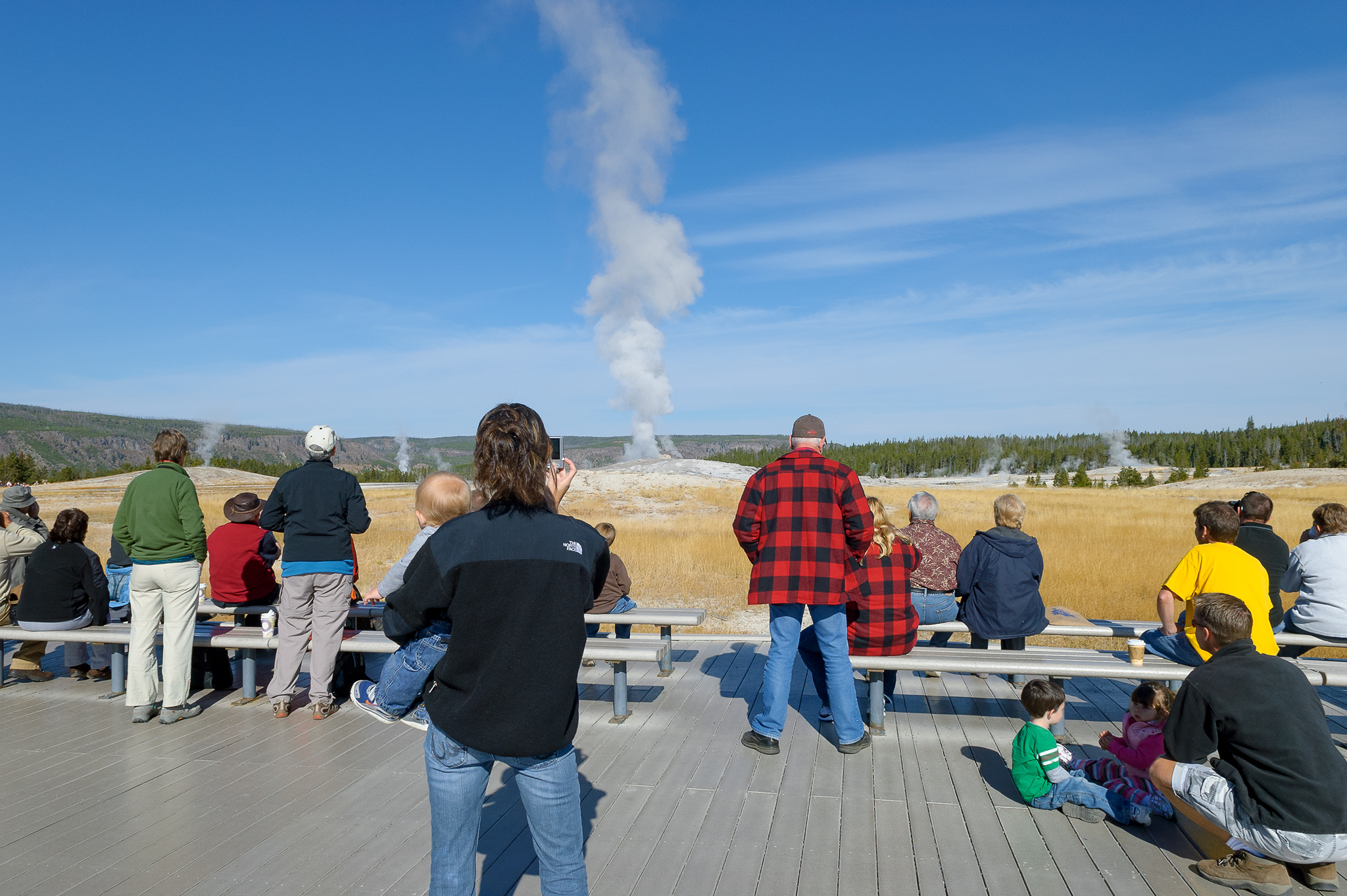
When I was younger, I visited Yellowstone for less than a day on my great American road trip the summer before University. My friend and I drove in the west entrance, watched Old Faithful erupt, and left through the south gate because it was crowded, and we were impatient. Later in life, I appreciated the once-in-a-lifetime experience for a visitor in a way I could not when I was young.
The research helped me see beyond myself. I learned to read details in the land through history; an unnatural flat along the west side of the Yellowstone River in Yankee Jim Canyon is an old railroad grade that brought early visitors to the park, a spit of land that seems a natural causeway in Yellowstone Lake is an old carriage road, and so on.
The research helped me see beyond myself. I learned to read details in the land through history; an unnatural flat along the west side of the Yellowstone River in Yankee Jim Canyon is an old railroad grade that brought early visitors to the park, a spit of land that seems a natural causeway in Yellowstone Lake is an old carriage road, and so on. I saw first-hand how changes in technology mediate one’s experience of place. The picture postcard that sparked this project was purchased from a Haynes Picture Shop and mailed in 1916.
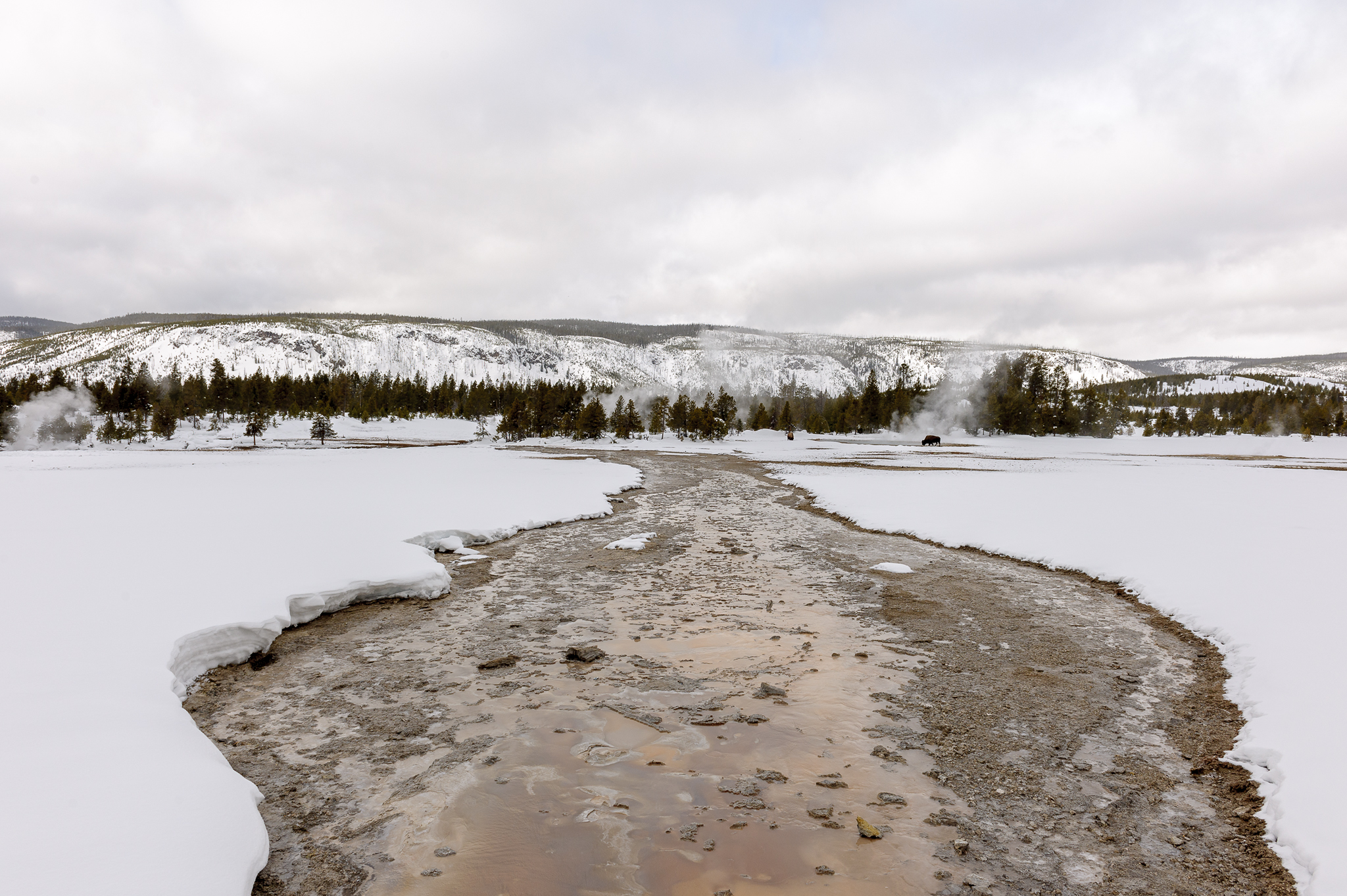
In contrast, today, visitors use personal devices to capture their memories, changing from film to digital point-and-shoot cameras to cell phones and even illegal drones throughout this project. Selfie sticks are now everywhere, and photo frenzies happen. Through the eyes of science, the large boulders scattered in the Lamar Valley were named glacial erratic, telling a story of ice sheets long ago. The trees sheltered in their lee speak of dominant weather patterns, yielding the expressive term nurse rocks. These few examples highlight how enlarging my knowledge changes my understanding, which guides my camera.
“Six weeks of fieldwork in Yellowstone began to shape the project. I saw common threads of shared experiences in the Yellowstone landscape by photographing people visiting the park. Through numerous visits over the years and countless hours in libraries, museums, and any place else where I could find a reference to the park, More than Scenery evolved.” Could you expand on how the project evolved and comment on how it changed from your initial ideas? (page 25)
Initially, the quote called to me. I had faith in my process to follow that call, but More than Scenery evolved as I worked in the field and various archives. The portfolio structure traces that process. When I first went to Yellowstone in the fall of 2008, I could not escape the visitors, and “Views from Wonderland” was conceived. Although I spent time in the American Antiquarian Society reading room before my first visit to the park, those photographs of books were intended to be notes. It was not until the end of my fellowship that I realised these images had the potential for more, and “Collecting Yellowstone” took flight. “Stories from the Greater Yellowstone Ecosystem” about the natural history wonders and resource and management issues took longer. Not because I wasn’t making these images early on but because I wanted this project to be more than pretty pictures or another condemnation of Manifest Destiny and our wrecking ball approach to settlement. Finding my place in that took time.
“Three thematic portfolios comprise the heart of this book. Inspired by the Haynes postcard, which served as my benchmark, I photographed early twenty-first-century visitors to the park. Visiting Yellowstone is a heavily mediated experience for most. Visitors drive through “Wonderland” (page 26). Tell us about the three thematic portfolios and how you built the narrative around them.
Although I touched on this above, I will add a bit. The three-part structure of More than Scenery is unusual and only emerged slowly. At first, I believed I needed to weave the pictures together to present a more cohesive narrative. However, I found myself resisting and so delayed.
I couldn’t figure out how to justify the three portfolios for a long time until I realised it is a form of triangulation bounding my primary intellectual and visual concerns, a way to point to the more considerable complexities of Yellowstone as a place, as an idea, and as bureaucratic reality without being didactic.
I couldn’t figure out how to justify the three portfolios for a long time until I realised it is a form of triangulation bounding my primary intellectual and visual concerns, a way to point to the more considerable complexities of Yellowstone as a place, as an idea, and as bureaucratic reality without being didactic.
“Stories from the Greater Ecosystem (Portfolio III) took shape when I more carefully considered our role as stewards coming to appreciate the wonders of the Yellowstone landscape fully.” (page 26) The challenges of popularity and protection, ownership and wilderness are difficult to distil. What conclusions did you draw from your work on this topic?
What did I conclude? My appreciation for the messiness that is Yellowstone evolved. I grew more empathetic to the sincerity of a one-time visitor’s wonder but cautious of their ignorance, which can lead to danger. I began with a sense that the origin story of the park was complex, pitting centuries of indigenous habitation against the brutality of Manifest Destiny. My increased knowledge about the economic incentives for establishing the park fuelled this fire. I also learned more about the management issues driven by the diversity of stakeholders across the Greater Yellowstone ecosystem. The short answer is yes; my most concrete conclusion is that there is nothing simple about the park. Yellowstone is one of our most iconic landscapes and a microcosm for the enormous challenges we face in the twenty-first century as we struggle to know how to steward the land, right the wrongs of the past, and leverage science to develop plans for a changing future.
Tell me what your favourite two or three photographs from the book are and a little bit about them (please include these images in the ones you send over)
Haynes’ picture postcards of Golden Gate Canyon
Wow, I can only choose three favourites: that’s tough, but I can tell you about the five that summarise the project. Haynes’ picture postcards of Golden Gate Canyon first caught my eye, but one held the provocative quotation that started me on this path [p. 2–3].
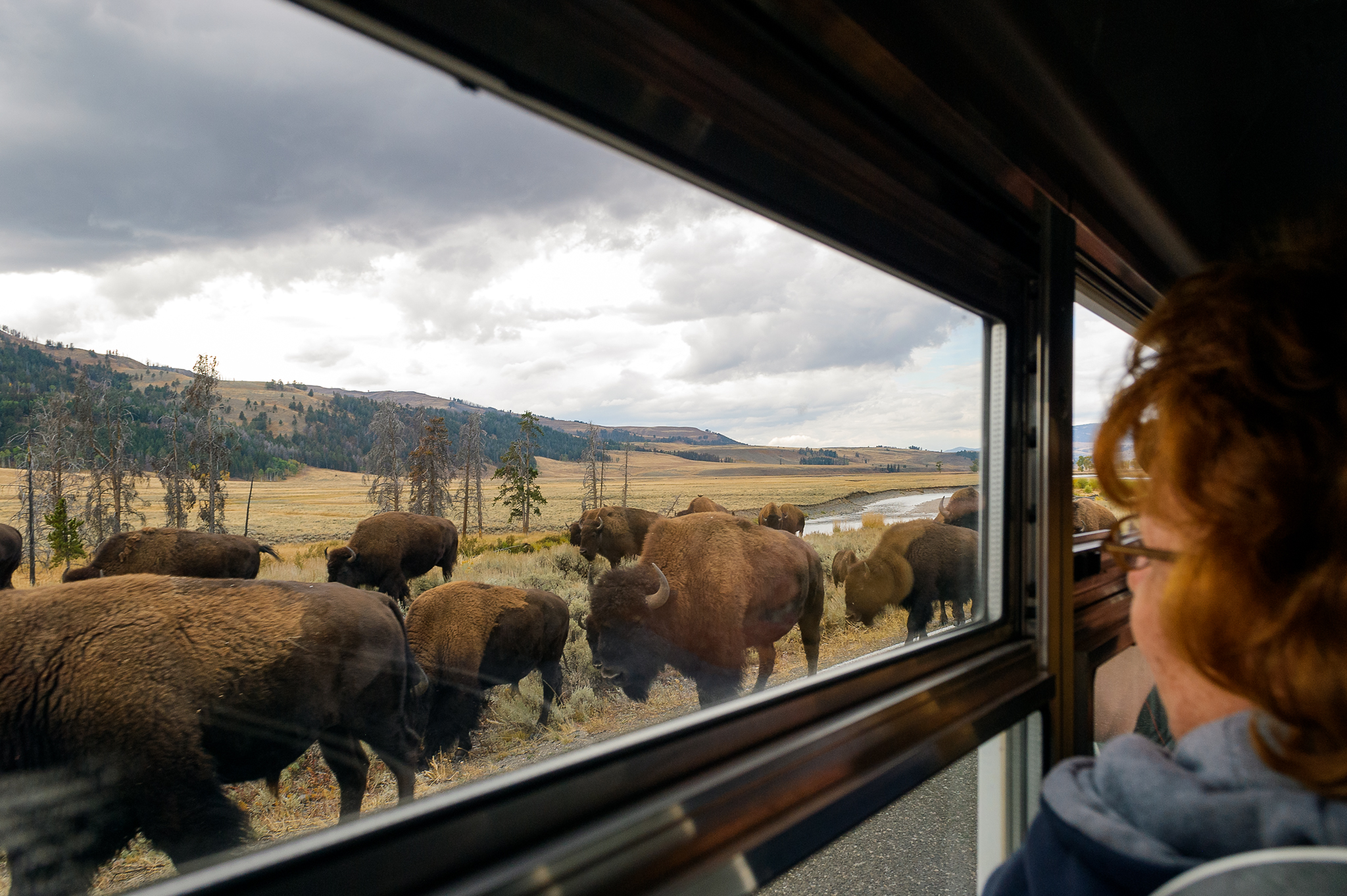
Bison (Bison, Bison) Along the Lamar River
Next, “Bison (Bison, Bison) Along the Lamar River” [p. 33] shows a woman viewing Bison through the window of a Yellowstone Association tour bus. The woman is safely seated behind glass, ironically protecting the animals and herself.
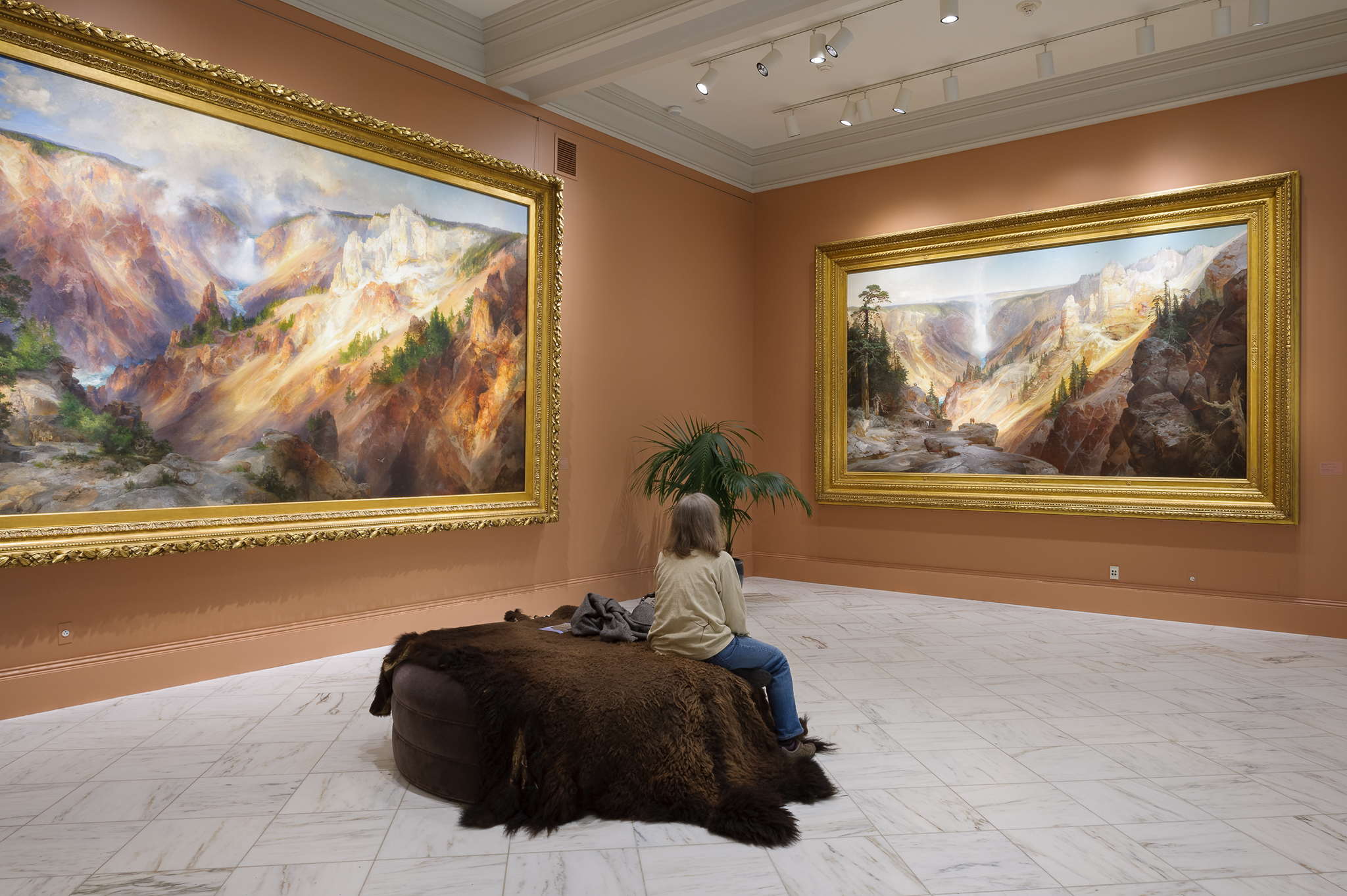
The Grand Canyon of the Yellowstone by Thomas Moran
“The Grand Canyon of the Yellowstone by Thomas Moran,” which hangs in Lobby 2N at the Smithsonian American Art Museum in Washington D.C., is Moran’s most famous painting. Marketed in the 19th century as a wonder, viewers paid a sum to see the big reveal when curtains were drawn aside [p. 32]. Museums like parks preserve heritage, and what could be more symbolic of our idea, the good and the bad of it, than a famous painting of an even more renowned view hanging in a preeminent museum?
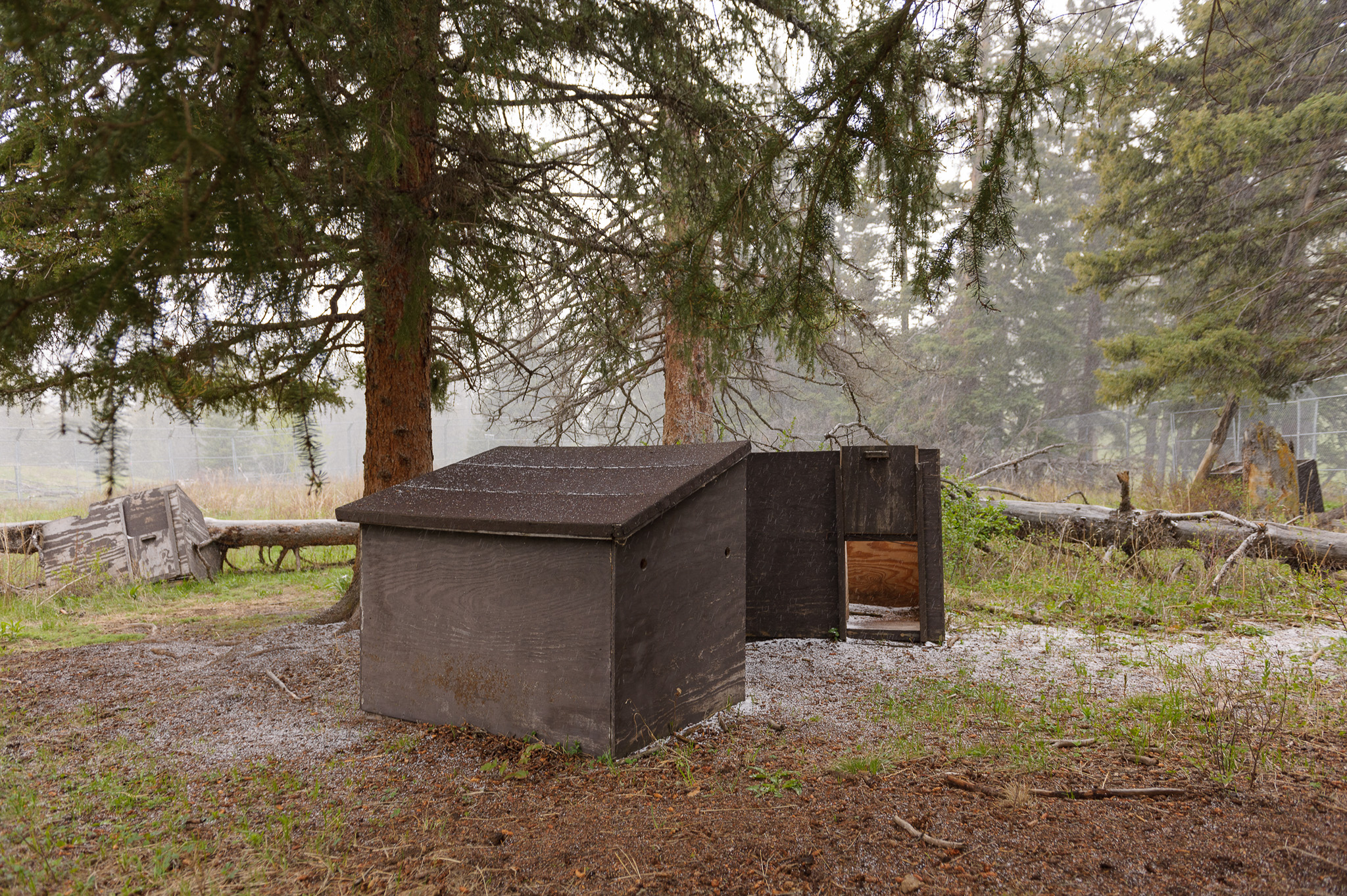
Rose Creek Acclimation Pens
“Rose Creek Acclimation Pens” were used in 1995 and 1996 to house Gray wolves brought down from Canada for reintroduction [p. 154]. Extirpated in 1926, by the mid-1940s, the perception of National Park Service rangers was that a mistake had been made; the ecosystem needed its apex predator to thrive.
Emerald Pool
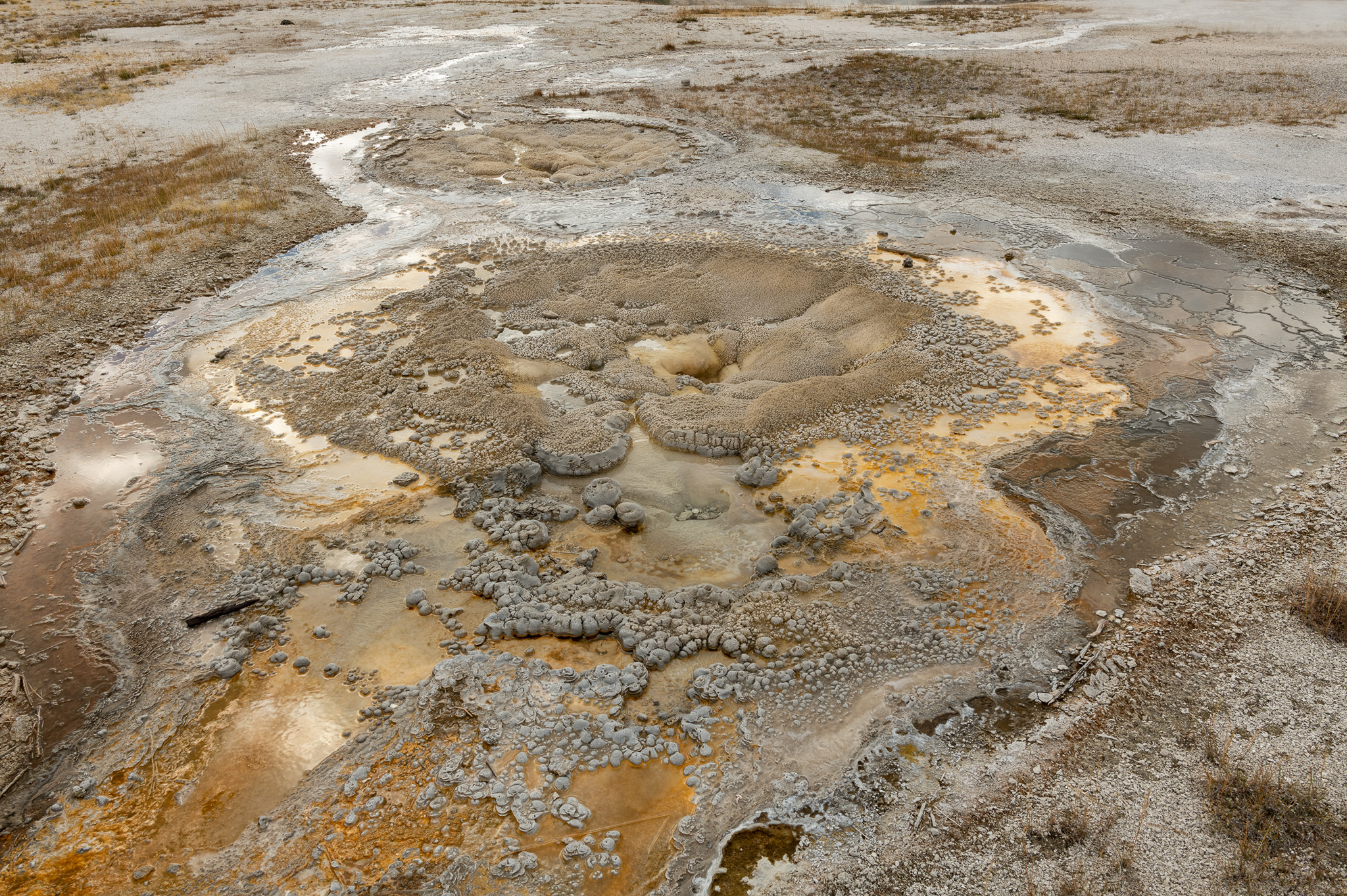
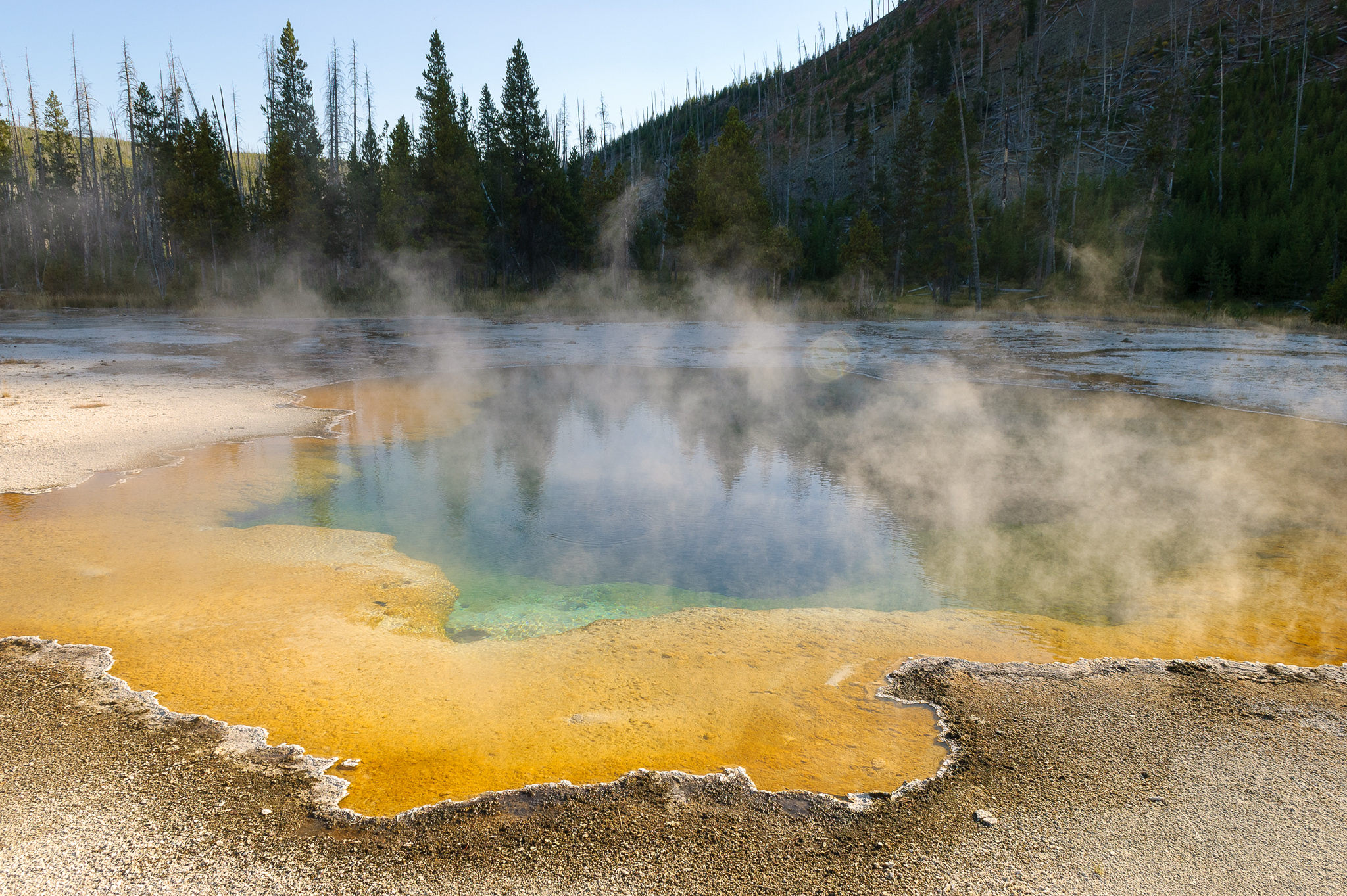
“Emerald Pool” is an example of the natural history wonders that draw over four million visitors from around the world to visit Yellowstone each season [p. 179].
My first glimpse of this was in a woodblock print of a Hayden Survey photograph by William Henry Jackson published in the Twelfth Annual Report of the Hayden Survey, a U.S. government document published in 1878. The reproduction captured my attention, and I have visited the pool numerous times (see plate 3, p. 78).
Were there many key photographs that you knew would succeed when you took them? Conversely, did some of your pre-planned images fail in execution?
Some photographs stood apart early on, and I felt some were gifts while pushing the shutter release—others required multiple visits to a site. Some days, I arrived at sites and knew the stars were aligned, the weather was what I hoped for, the time of year would yield this information versus that, etc. If the photograph involves people, luck plays a more significant role. But no matter what kind of photograph I hoped to make, perseverance played a role in achieving my desired results.
Sequencing is obviously important - how do you manage the flow of the images and visual narrative when you're working on a book?
Funny you should ask this. I have understood the role of sequencing in a book of photographs ever since encountering the work of Duane Michal’s and Robert Frank’s The Americans when young, but I found with this book, I wasn’t particularly good at it. I knew which photographs belonged in which portfolio and recognized critical pictures to include. It was also clear to me which sequences did not work and when images needed to be sacrificed for the greater good, or empty pages functioned well as breathers. However, the subtleties of movement from this page to that eluded me at times, and for this, I leaned heavily on advice from George Thompson. I am grateful for his support.
The subtleties of movement from this page to that eluded me at times, and for this, I leaned heavily on advice from George Thompson. I am grateful for his support.
What have been the biggest lessons you’ve learned about the process of printing (and preparing to print) a book?
The biggest lesson I learned is that I will go on press next time. Trying to communicate about colour through the designer David Skolkin to the printer in another country was challenging. David went to great lengths, but it took extra effort and patience on the part of the team; everyone was great to work with, but being there would have made things more accessible. Could the results have been better? We’ll never know.
Although the equipment choice is secondary to your own processes, it inevitably affects the way we work to some extent. What equipment do you currently use, and why did you choose it?
All equipment, cameras and tripods, computers and hard drives, and all the endless bits and pieces serve a purpose; I let function drive my choices. I used many cameras during this project. Most of the pictures in the book were made with DSLR cameras, which changed with availability. A few were made with mirrorless cameras, and a few scans are also included. I used digital point-and-shoot cameras for notes and, later, my iPhone. A medium-format digital camera accompanied me on a few early trips but never fit my needs. I finished the project with a Nikon D850 and would love to have had that camera for the entire project. However, now that I have returned to Hasselblad, I can’t imagine a camera more suited to my working methods. I have used Macs since 1986 and Epson printers since 1995. I see no reason to change. But cameras don’t make pictures; people do, so I included the essay “Education of a Photographer” to address the larger question of how I became the photographer I am.
What is next for you? Where do you see your photography going in terms of subject and style?
I am currently in the midst of another long project. Photographs in Abiding River: Connecticut River Views & Stories expressively document the land and riverscape of the Connecticut River and its watershed.
am currently in the midst of another long project. Photographs in Abiding River: Connecticut River Views & Stories expressively document the land and riverscape of the Connecticut River and its watershed.
Much like my Yellowstone work, these photographs provide depictions of place, expressing a subjective vantage point through conversation with the language and history of photography. Much like More than Scenery, the river book will coax a more extensive story from context, sequence, and stories, this time pointing to that which is not named, human lives lived alongside the dynamic, shifting force of a steady presence played out across time in a landscape that stretches back long before humans that most see only in its current iteration. This book will follow the course of the river’s main stem, north to south, weaving multiple threads into a larger whole rather than searching for the heart of its story through triangulation.
Lastly, I’d like to offer you a soapbox for something related to the natural world, the benefits of photography, or just living a good life... What would you like to say to readers or encourage them to do?
Photography is my way of being in the world. It allows me to travel paths not otherwise taken, to spend time outdoors, which nourishes my soul, and to add something to the world. In short, it helps keep me sane in a world where I might otherwise feel powerless. My family keeps me tethered to and enriches my day-to-day life, while photography provides a place to dream; the balance feeds me emotionally and intellectually. I am fortunate and wish life could be so rewarding for everyone. The opening sentence of my Acknowledgments section says it all: “I have the good fortune of a guiding passion and the security of a supportive family without whom none of this would have happened.”
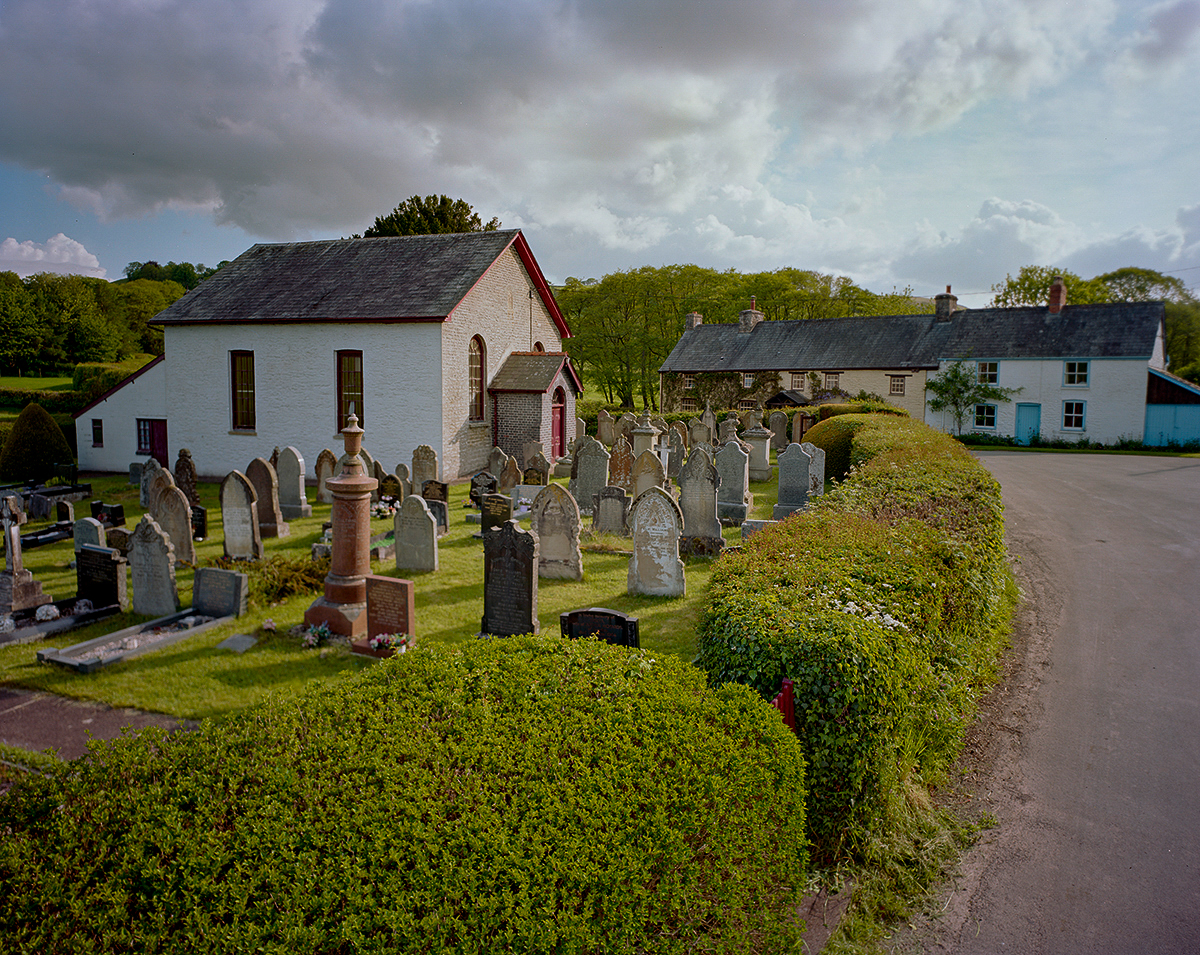
With over 6000 chapel/capel sites dotted across the country, it is clear that the religious landscape of Wales was once deeply dependent on a place to worship. The early places of worship were meeting houses on farms or held in upper rooms of a public house; you would even find them being held in cow sheds. As the congregation grew, local builders were then commissioned to build a chapel, which would then be able to house the growing fellowship; at times, these would be knocked down and rebuilt again or enlarged to seat up to 1500 people as congregations grew so fast.
With over 6000 chapel/capel sites dotted across the country, it is clear that the religious landscape of Wales was once deeply dependent on a place to worship
During the period of 1860 Welsh chapels/capels had enough pews to seat three quarters of the population, this number then grew again substantially following the 1904 revival which was lead by Evan Roberts who is now berried at his family grave in Moria Capel, Gorenizion.
Until the 1689 Toleration Act, it was not legal for dissenters to meet for worship, so the buildings did not have a real identity. This changed by the 1700s, and there was a more distinctive trend to buildings with long wall facades, normally with a large central window allowing the light to flood in onto the pulpit so the speaker could be seen clearly. From 1840 onwards, the long-walled model was looked at as outdated, and the far more common square-planned gable chapels/capels would become the norm. These modern day chapels had more of a worship characteristic, unlike those of the earlier days, which looked far more domestic.
Firstly, it’s an honour to be asked to write the End frame article for On Landscape magazine, so thank you very much Tim and Charlotte for that. When I initially read the email from On Landscape, I had no hesitation whatsoever in my first choice of photograph. I was quite busy at the time with workshops, however, so I didn’t get a chance to look at the image again, with this article in mind for maybe another week or so. In that time, I began to think more about my choice. I think Some favourite photographs can be compared to favourite tracks or albums of the past. You might very well have played the CD to destruction back in the day, but listen to it now (and especially with your kids present). Well, lets just say time moves on! Thankfully, once I had the chance to grapple my copy of Joe Cornish’s First Light out of our cramped and creaking bookshelf, a wave of comfortable reassurance swept over me as I looked at this image once again. Even though I’ve probably not looked through the book in over ten years, I was highly relieved to think that this image, in my opinion anyway, can be compared to one of those timeless classics that you can come back and listen to again and again, and still get the same thoughts and feelings you did the very first time you heard it.
While looking through First Light, it also dawned on me that many of the images in the book, especially Shell Pocket Twilight, are much more than just a photograph. They are a point in time when all those natural forces and processes that shape and change the landscape around us suddenly stand still. Having visited Mewslade Bay and other locations along the Gower Peninsula more than once myself (after seeing First Light), I was inspired to have a go at creating my own set of images from here. What is immediately apparent is that this location is ridiculously difficult, not to mention downright dangerous to reach. If there’s a polar opposite to those famous round Dolerite boulders at Dunstanburgh in Northumberland, then I think this must be it! The Limestone cliffs here are made up of a series of sharp edges and jagged, dagger like protrusions, and any slip while attempting to climb over the cliff, and into the cove, would almost certainly result in serious injury. As far as I know, unless there’s a spring tide, the sea hardly clears the entrance to the cove, even at low tide, making it treacherous to get in and out that way before your exit is cut off. Needless to say, I never got to actually see this part of the bay!
It’s important to remember that landscape is a construct. ‘Landscape photography’ tends to major on the ‘natural’ though our interpretation of this is effectively a construct too. We may carefully ignore the parts that we find less aesthetic or overlook the fact that nearly all of what we see has been shaped by man’s activities, some visible, some over time and in ignorance of what ‘went before’ less so. We continue to change our planet: land, sea and atmosphere, not just directly but by our reliance on trade from afar and the way that consumerism has shifted our understanding of resources and seasonality. And even in our attempts to archive the Earth’s resources, we may be tripped up by what has already been set in motion.
I was drawn to Janet’s images by their fluid beauty but they may challenge you to think about your own definition of photographic genre, for all that we do is interconnected and our path into revelation may be our own life experiences.
Would you like to start by telling readers a little about yourself – where you grew up, what your early interests were, and what you went on to do?
I grew up as the middle child of a working-class family living in Marrickville, a suburb of Sydney; we moved to Maroubra in the 1970s. Marrickville was, back in the 1960s, a working-class suburb with a high immigrant population. It was known as ‘Little Athens’.
I don’t remember when I started my interest in art, and I’m not sure where it came from. I grew up in a household where sport was the centre of the universe and creativity was far from encouraged. After I finished school, I enrolled in the local TAFE college to study art.
I can remember being jealous of the Greek kids at school because their jacks were actual bones, and I only had the coloured plastic ones.
I don’t remember when I started my interest in art, and I’m not sure where it came from. I grew up in a household where sport was the centre of the universe and creativity was far from encouraged. After I finished school, I enrolled in the local TAFE college to study art. This started a lifelong love of making, teaching and studying art.
How did photography come into your life, and what were your early images of or about?
Photography was one of the subjects in my Fine Art course at the TAFE college. I really enjoyed the medium but gave it up after seeing a Diane Arbus publication. I thought that it was the most amazing photography that I had ever seen. I felt that if I couldn’t take photographs like Diane Arbus I should not even try. It was a couple of years later, whilst doing my BA in Visual Arts, that I returned to photography. I found myself drawn in by the medium and settled into documentary style portraiture.
The major shift in my photographic practice happened after I had my three daughters. I called this period my ‘Pink Pause’, where teaching and motherhood dominated my life. During this time, two of my three children were diagnosed with Coeliac Disease and food allergies. This may not seem significant, but it started my obsession to understand our food chain, sustainability and the environment.
Lately, I have become acutely aware of the work of some excellent Japanese landscape photographers, including the focus of this week’s article, Yuki Kamishima. I’ve been trying to articulate what has drawn me to their work, forcing me to spend a great deal of time studying the work and engaging in thoughtful conversations with folks noticing the same work. Having not spent much time studying Japanese landscape photography, I feel that the “newness” of these Japanese landscape scenes is undoubtedly one factor in my newfound appreciation of these photographers; however, I think there’s much more going on here.
I believe that significant cultural strengths may serve as a foundation for Japanese landscape photographers, and that is why I have found a deep appreciation for their images.
A proper analysis helps reveal fundamental differences between some Japanese photographers and their photographs compared to their Western counterparts. I believe that significant cultural strengths may serve as a foundation for Japanese landscape photographers, and that is why I have found a deep appreciation for their images.
As a nature photographer, my primary goal is to help those who view my work to appreciate the value of pure, unspoiled wilderness. To that end, creating captivating images that seize and sustain the viewer’s attention is key. The longer you can get someone to look at a photograph, the greater the odds are that they will connect with its subject matter. Still, in this fast-paced world where people can consume hundreds of images and videos in a matter of minutes, the big question is, “Why should they stop scrolling just for your image?” While the answer is multi-faceted, practising the art of mystery can be very effective for creating more captivating and engaging images.
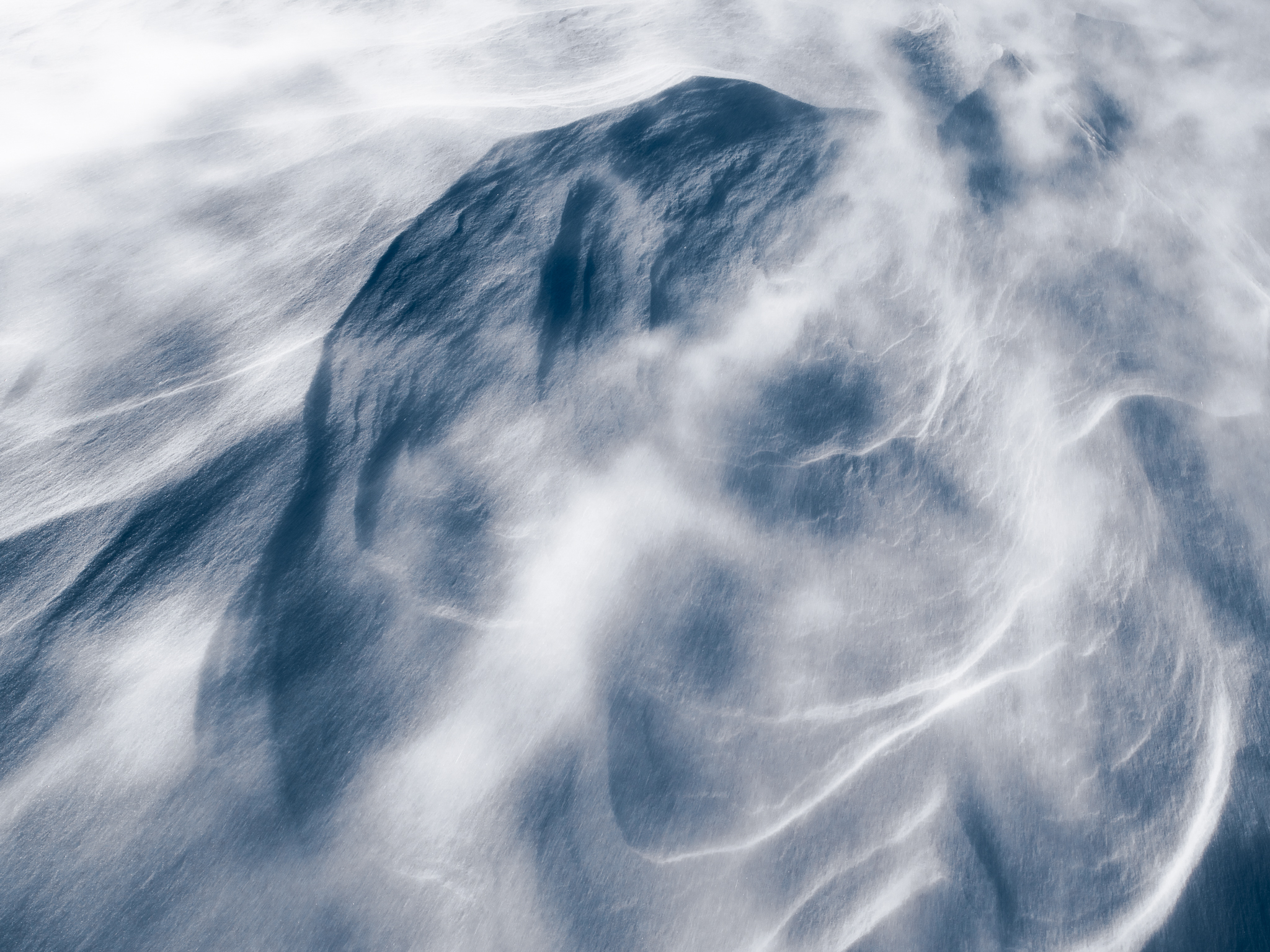
I photographed this scene almost an hour after sunset. There was only a faint, ambient light softly illuminating the landscape, and the lack of direct light washed out its colour, making it appear more white. Since I excluded the light source, I was able to overexpose it and raise the luminosity extensively in post-processing in order to bring out the soft highlights and shadows and give it this serene, ethereal, pure feeling.
In September 2012, when I was in a photographic stage, which I called “practice & portfolio”, I made a two-week trip to the Greek island of Santorini. During my “practice & portfolio” period, as the name suggests, I made regular trips to various locations offering different kinds of landscapes and cityscapes in order to build up a travel and landscape portfolio. These trips were part of a series of trips that I financed with the money I saved during my previous career, which lasted a decade, in another visual art.
One evening, I decided to photograph a viewpoint from a series of steps I walked by earlier that morning and reckon that it would yield a higher potential if photographed sometime before sunset, when the sun would light the landscape sideways, enveloping the scene with much softer and warmer hues. This long series of steps followed a broad curved shape at first, which then turned into a gentle "s" shaped path, a perfect line leading the eyes towards Oia's windmills in the background.
This path of steps was built right on the edge of an elevated and steep ridge. When looking towards the village of Oia, the descending steps overlooked the sea on the left, while on the right, the scene was characterised by a seemingly endless perspective of typical white Greek houses. It was an idyllic location, infused with a classic summer flavour and illuminated by uninterrupted side lighting, which filled the atmosphere with a gentle warmth coming from the seaside.
One evening, I decided to photograph a viewpoint from a series of steps I walked by earlier that morning and reckon that it would yield a higher potential if photographed sometime before sunset, when the sun would light the landscape sideways, enveloping the scene with much softer and warmer hues.
Away from the tourist noise, I carefully choose the exact step to unfold my tripod before waiting for sunset. Suddenly, a man came up and set up his tripod and camera right next to me, on the same narrow step where I, too, was standing. Despite there being many other steps before and after me, that precise step must have appeared to be the best one for him, too. Without moving my tripod, I took a step back and let him place his gear.
Since I had a few more days to spend in Santorini, I said to him that I could leave the spot to him and come back the following day to photograph that view. He declined, saying that we could both be there, share the small space, and shoot the sunset together. After a while, we started talking and he humbly explained he was a well-known American photographer, he hosted a TV series about photography and authored many books. Impressed, I asked for his name and business card.
After the shoot, I checked his website and saw his work. It impressed me, but I couldn’t yet grasp how famous he was. As I was eager to meet him again, I searched for him the following day. I found him eventually and I explained I was dedicated to becoming a professional photographer. He mentioned it was already great for me to be out there, doing what he was doing: making images. He explained that he had been a travel and wildlife photographer for 40 years, and it was a great lifestyle, but loving such a lifestyle is as important as having a strong passion for photography itself.
These words were spoken to me by Art Wolfe. I didn’t know who he really was back then, and only once I got back home, I did do further research on him and buy some of his books. After that conversation, he and his colleague, Gavriel Jecan, allowed me to tag along as they kept exploring Oia until dusk when we split our ways.
These words were spoken to me by Art Wolfe. I didn’t know who he really was back then, and only once I got back home, I did do further research on him and buy some of his books. After that conversation, he and his colleague, Gavriel Jecan, allowed me to tag along as they kept exploring Oia until dusk when we split our ways. They left for Thailand to lead a workshop, and I stayed there, still unable to fully comprehend what had happened in the past two days: Art Wolfe placing his tripod 3 inches next to mine, letting me photograph alongside him as if we were colleagues, and discussing his photography and lifestyle with me. At that time, I was 27 years old, and only 13 months before that day, I held my first camera in my hands. It was all very abstract to me.
While on the first evening, we were photographing a classic vista across a Greek island from late evening to dusk. On the second day, I saw him moving around much more and photographing all sorts of things, especially architectural details and cats near beautiful doorsteps. The part that intrigued me the most was when I saw him curl up on the ground to photograph the ruined planks of an old wooden door. I admit my naivete made me wonder what he saw in that and why was he photographing with such eagerness and passion, what, to me, appeared to be just an old door.
Abstract workshops
A few years later, he started to offer specific workshops on abstract photography either along a coastline or in rural settings in old villages with abandoned vehicles or trains.
Attracted by the idea of training my eyes and creativity on finding and framing small patterns and pleasing arrangements of details on rusted surfaces, I began searching for abandoned trains near my home.
Recalling him photographing those details in Santorini and the curiosity to learn more from him while spending a proper amount of time photographing with him made me think of joining him.
Attracted by the idea of training my eyes and creativity on finding and framing small patterns and pleasing arrangements of details on rusted surfaces, I began searching for abandoned trains near my home. But as I gave priority to my trips to improve my travel portfolio, I couldn't justify to myself the need to do a workshop on abstract photography and moved on.
Since then, throughout the years, whenever I would find appealing details to photograph, I would do so, but I never met a single piece of surface to inspire me to make a series of photographs from it.
Every time I went to my wife's grandmother's home, 200km south of our home, in a small village in Bourgogne called Tannerre-en-Puisaye, I would see in the garden this old door and felt a certain attraction to it. As we rarely went there, at times I never took the time to study and eventually photograph it, while other times I didn't have my photographic gear with me.
Eleven years apart
Only on my last visit there for a family reunion, as everyone was about to go to an event nearby, I decided to stay in the garden to photograph that door. As we joined the family reunion on our way towards the south of France for a long photographic trip, I had my gear with me and was finally able to photograph it.
At first gaze, I could only see a couple of interesting motifs on the old wood, but as I kept looking, I began to recognise a series of unexpected designs. Some of them had shapes resembling human figures bearing a torch or holding something upwards.
This made me open my backpack, unfold the tripod and start photographing.
The necessary calm to perform an attentive observation of the old wood’s surface led to contemplative moments of interpretation upon new appealing findings. This tranquil exploration, mostly done through gazing while standing still, was contrasted by an eagerness to photograph various compositions born of immediate intuitions.
The making of nine photographs of this small wooden door, which illustrates these words, took about one hour. While framing some of the compositions, I had a feeling as if I had already begun to work on those images way before that moment. The connection I had always felt for those wooden planks materialised that afternoon.
When the family returned, they were surprised to find me curled up on the ground to photograph the intricate design of the old door and even more so to learn I have been doing that since they left. For them, it was just an old door, but for me was the perfect “location” for my own personal abstract workshop.
The making of nine photographs of this small wooden door, which illustrates these words, took about one hour. While framing some of the compositions, I had a feeling as if I had already begun to work on those images way before that moment.
I asked some questions about the door and learned that it was placed there by my wife’s grandfather over 40 years ago. It used to be brand new, with the wooden planks perfectly aligned and smooth, but now it had a run-down look, full of bumps and holes, and nothing was straight anymore.
Some people asked me what I saw in that door and why it took my interest so intensely to invest much time and focus. As I said above, that was also what I wondered about Art Wolfe in Santorini and so after explaining my reasons for photographing the old door, I shared with them my Santorini story, even if they didn’t know who Art Wolfe is, just like I didn’t.
I felt like Art Wolfe involuntarily taught me something that day in Santorini, which stayed with me ever since and took eleven years to fully resurface in my consciousness to come full circle. Eleven years apart, Art Wolfe’s passion still inspired me. He was able to stimulate in me the desire to be immersed in the same creative process I saw him disappearing into in Santorini as he photographed an old door.
Unconsciously, that lucky meeting with Art Wolfe stimulated in me my interest in that door from the first moment I saw it. The appreciation of such an old object and the realisation that all those faults on its surface were holding photographic opportunities came from him and that encounter.
Unless Art Wolfe reads this text, he will never know about his impact on my photographic journey. Like him, we too, by simply practising our passions and sharing our stories, may never know who we may inspire and how we may flare up someone else’s creativity. This has the power to set in motion a chain of events that would lead a person to follow his passions, discover new horizons, produce personal work and potentially inspire someone else. Just like Art Wolfe did while being curled up on the ground to photograph an old door.
When I first started landscape photography, much of my work was inspired by subjects and locations. In more recent years, my approach to photographing landscapes has evolved to become more expressional and emotional. The lure of iconic destinations no longer has the appeal it once did. And in the same vein, the lure of new locations has also diminished.
My attitude changed when I came to the realisation that to understand a landscape, it’s crucial to spend time immersed in it before I can begin to convey aspects of it through my photography and create more personal bodies of work.
During the last ten years, I have done very little photography-related travel. Most of my photography has taken place where I live, in New Zealand. I have a set of locations that I love and keep returning to again and again. I’ve got to know these places well and also use them for my workshops. You’d think perhaps that familiarity would lead me to plan the types of images that I hope to create—or that my approach to photographing there might become quite fixed—but the opposite has been true. By really getting to know a place, I’ve heightened my sense of exploration.
I revisit these revered landscapes with a completely open mind, which enables each visit to present new opportunities for experimentation - to play around with the story I want my photographs to tell.
I revisit these revered landscapes with a completely open mind, which enables each visit to present new opportunities for experimentation - to play around with the story I want my photographs to tell. The constraints of having to find new paths that lead to expression have enhanced my creativity, and I’ve done some of my best work within these familiar places. Not since 2012, when I travelled across Africa for a couple of months on a photography trip, have I travelled overseas specifically to take photographs. This insight might seem surprising for a full-time landscape photographer. My travels abroad since then have mostly been without my camera. I’ve chosen to treat these trips as holidays or travel experiences, not as a time to work on my photography. I don’t feel the need to photograph every landscape I visit. I prefer to be more engaged with the landscapes I photograph, taking the time to explore and form a connection, a relationship with the place.
So, when contemplating working on an expedition in Antarctica, the location appealed to me greatly. I had always wanted to visit and photograph this unique landscape. But, at the same time, I also felt a sense of hesitation and uncertainty as I didn’t quite know the direction I wanted to take with my photography whilst there. I also could not imagine how the images I would create could fit within existing bodies of work. However, I was excited by the potential to explore an expressive approach in a fresh landscape.
Whilst considering the interesting challenge that lay before me, I thought about my New Zealand-based work and what unites it. It is not the New Zealand landscape—the location as a subject—that is the defining factor for my work. For me, it’s much more about exploring my relationship with the landscape which leads to my style. There is freedom that comes with the fact that my work is not about the landscape itself. It was an interesting challenge, considering how to shoot images of a very different landscape in a way that expressed their individual stories and meaning while offering continuity of style.
It felt impossible to envisage until I’d spent time in the vast, icy expanse and been able to process the vistas, their energy, and the associated thoughts and feelings that would ignite ideas that would form an approach to creative expression.
While considering the expedition to Antarctica, I decided I’d also like to create a fresh body of work that conveyed context about Antarctica and included my personal experience of being there—but the exact nature was difficult to define before visiting. It felt impossible to envisage until I’d spent time in the vast, icy expanse and been able to process the vistas, their energy, and the associated thoughts and feelings that would ignite ideas that would form an approach to creative expression.
The 28-day voyage would depart from New Zealand and sail south to the Ross Sea via the Sub-Antarctic Islands. Going to the Antarctic for the first time, I knew that during the first 12 days we’d have in the Antarctic Circle it would be extremely challenging to be able to see, experience and process all the elements of this completely new environment. I knew that creating and refining a narrative that could inform the basis for a new collection of work—expressing meaning, context and depth—would be a challenge within the limited timeframe. It was unlikely I would be able to return to build a stronger relationship and connection with the place and allow my thoughts to percolate and evolve.
I find it isn’t possible to tell a story from a first impression. A story needs to unfold in layers, requiring a continuous cycle of reflection. An additional element to the challenge would be having no constraints or boundaries initially. These would need to be defined once I had a level of familiarity with the place. With previous collections, the creative process has been refined via multiple visits and opportunities to reflect and recalibrate the messages I want to express and how I think I can achieve that. The question continually resonated in my mind, ‘How much could I achieve on just one trip to the ice?’
As we traversed the wild Southern Ocean, I could feel the anticipation building, and as we crossed the Antarctic Circle, I felt quite overwhelmed. There were photographs to be made everywhere! Grand, icy vistas, icebergs, ice patterns and, of course, wildlife. I found myself creating lots of images - it’s something we all often find ourselves doing when experiencing exciting new places. I was conscious they weren’t all going to be photographs that would represent me as a photographer; I was simply enjoying recording the landscape and my memories.
I photographed with two different purposes, one capturing the journey, the other a considered approach to create images that encapsulated personal meaning that incorporated elements of my unique style.
I photographed with two different purposes, one capturing the journey, the other a considered approach to create images that encapsulated personal meaning that incorporated elements of my unique style.
After returning to New Zealand, I reflected on the trip. Photographically, had it been a success? Did I come away with images that I’m happy with? I feel that ‘success’ in photography is very difficult to define. I can easily create an image of a magnificent landscape that would receive attention on social media - but I know this type of image is unlikely to hold any deep personal meaning for me, and that I would use it to convey my style. So the answer to my question is, sure, I did come away from Antarctica with several images that were successful, including some of the wildlife—something I have chosen not to focus my photography on in recent years.
Some of the images I took illustrate elements of my personal style, but, at the same time, similar images were created by other photographers on the expedition, and I did not feel these offered a unique perspective. But there were also photographs I made that could sit within and complement existing bodies of work created throughout different environments here in New Zealand. Thinking about this, it was simple to envisage how these photographs would work within existing collections as I have a deep understanding of the messages I intend to convey. I didn’t have a preconceived approach, but I did have defined constraints around the subject, compositional elements and lighting within individual portfolios. So, when opportunities arose, I saw images that would add depth to my previous collections, rather than offering an alternative expression in a different environment.
This may be a landscape I never return to, and if I did may not offer the same lure of visiting an unknown destination—seeing things for the first time—and maybe a little bit of that magic will be lost.
After being back home for about a month. I hadn’t looked through the images I’d made in Antarctica in any detail as I knew I needed some distance from these. Having shot so many images, I’d felt quite overwhelmed going through them, but I was incredibly excited about the prospect of developing a new and very different collection. One of my first photographs of Antarctica provided the inspiration to form the basis of a new collection that I had wanted to evolve. During the rest of the trip, I made subsequent photographs in this style to be able to collate and refine the beginnings of a new series.
This may be a landscape I never return to, and if I did may not offer the same lure of visiting an unknown destination—seeing things for the first time—and maybe a little bit of that magic will be lost. But, I feel that I now understand this environment and how I wish to photograph it—and hopefully, I can make more images to build a portfolio of work from Antarctica. If I do ever return, perhaps I’ll see the landscape in a very different way or just start working on a completely new set of images, and the idea I have of extending this body of work will go out the window as I start again from scratch. But this is the thing I love about returning again and again to the same location: it’s the chance to be able to explore it more expressively, to see things you wouldn't and couldn’t have seen the first time, and move away from just representing it to understanding it and being able to express your relationship with the landscape.