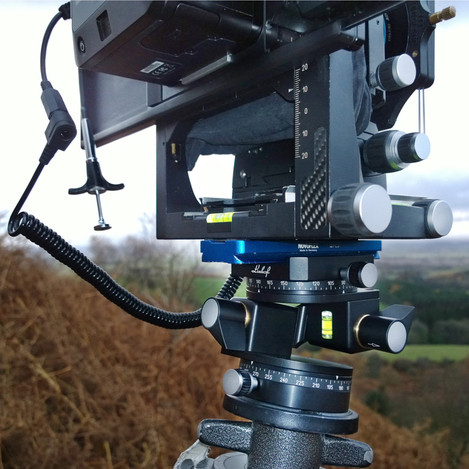
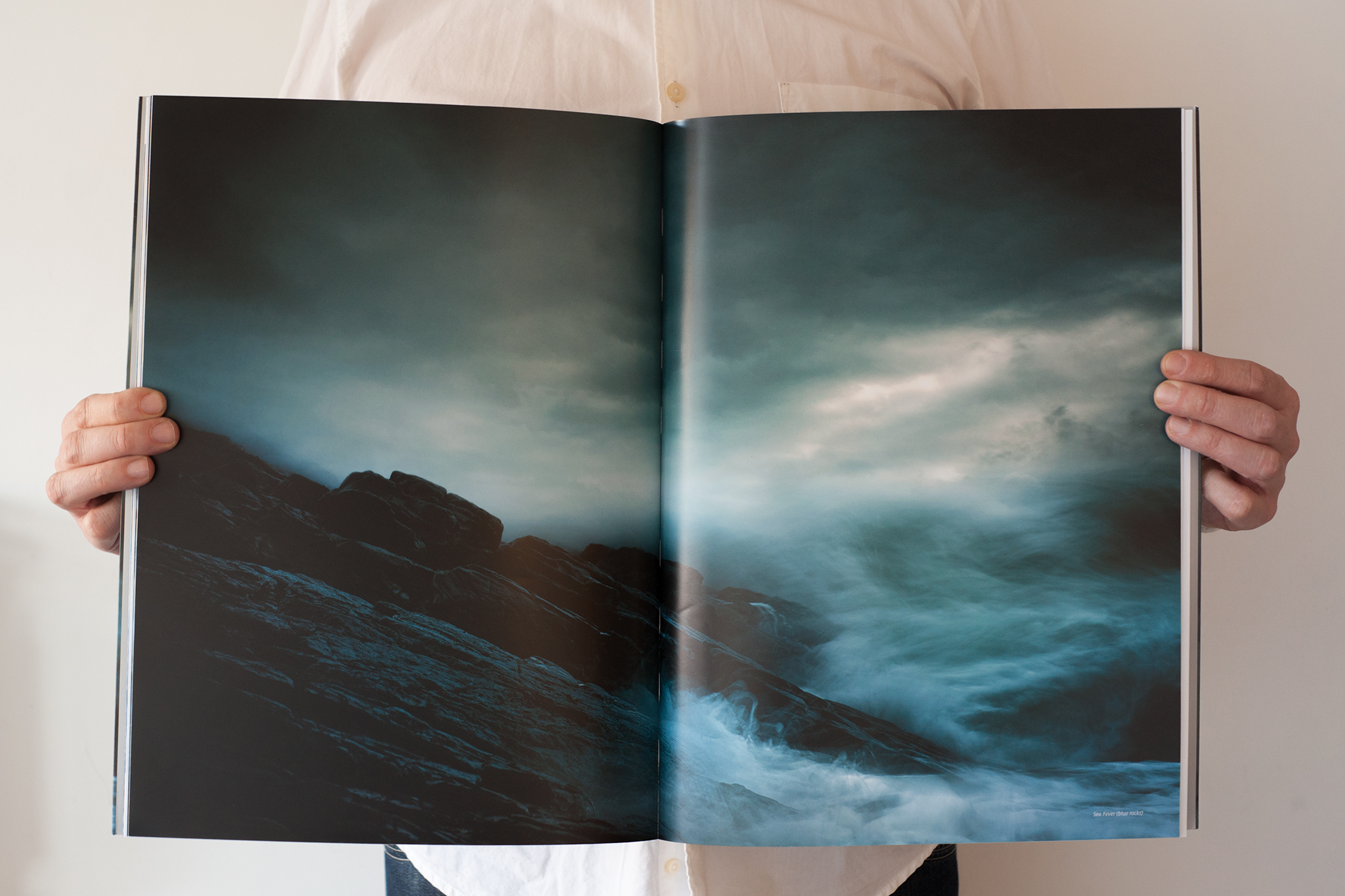
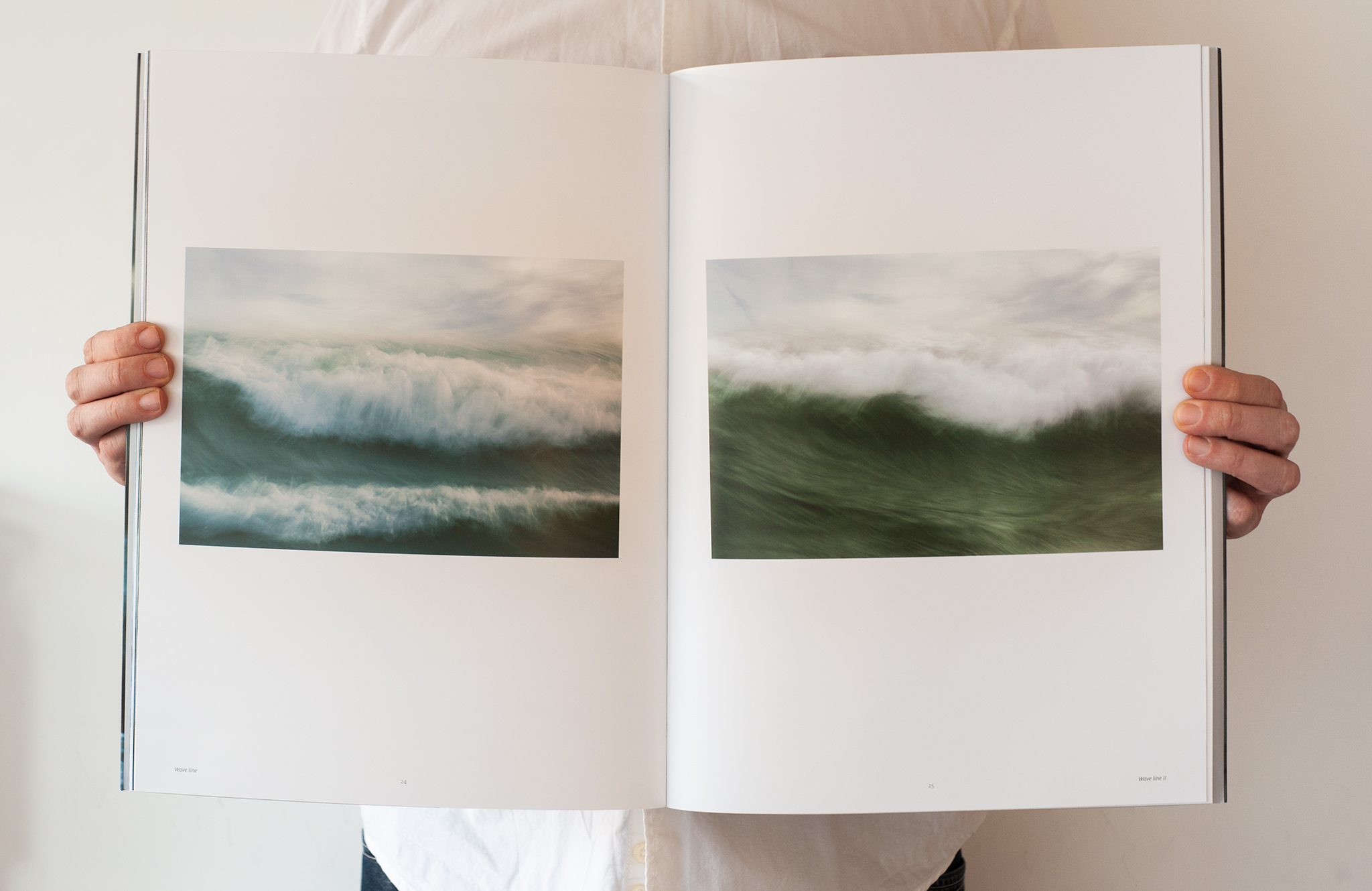
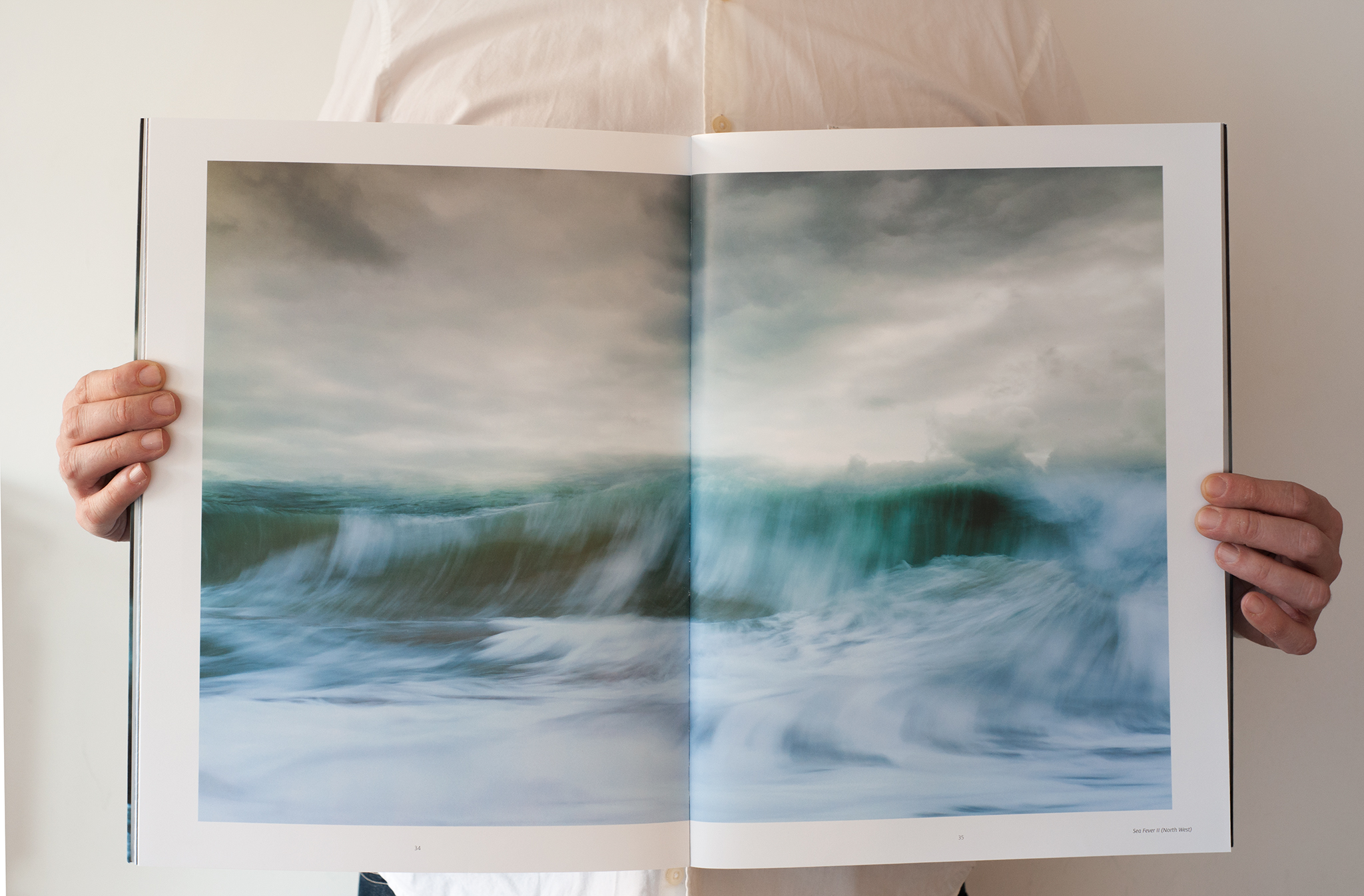
It has long been photography's cross to bear that of all the crafts and communication media it is the one whose image is most tainted by associations mechanical (as I suspect David Ward once wrote); that, and its apparent easy-ness. It seems that the vast majority of camera advances involve automation of one sort of another. Make photography easy and cheap enough and everyone can and will take pictures. And that is literally what has happened. George Eastman of Kodak fame who promised, “You press the button, we will do the rest”, would not have been surprised by this turn of events (although he might have been dismayed by the lack of print sales.) The emancipation of photography is, like reading and writing, a good and educational thing. But pressing a shutter button is only one small part of a process which is primarily about understanding and seeing light, and composition, and visual story-telling.
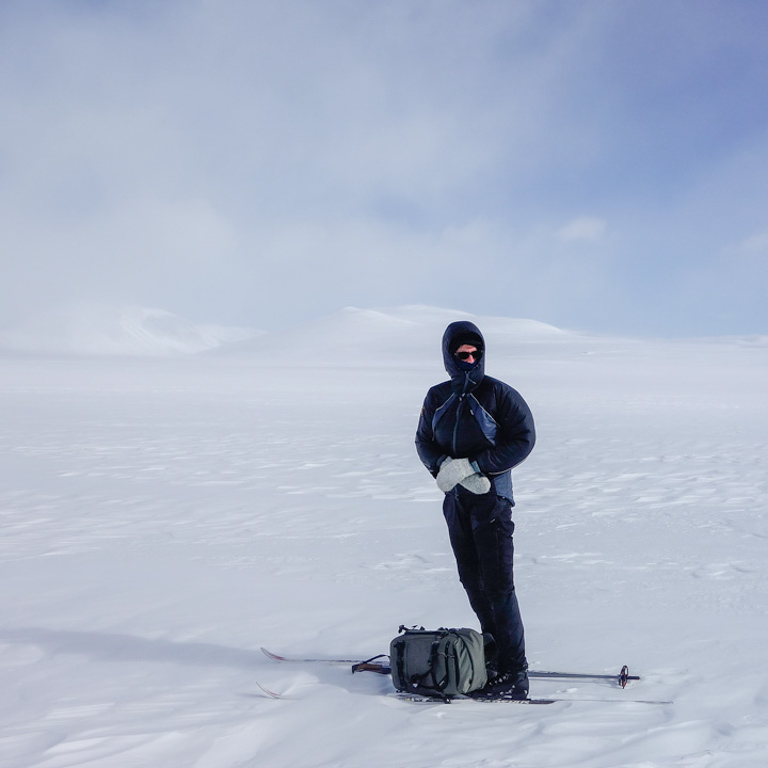
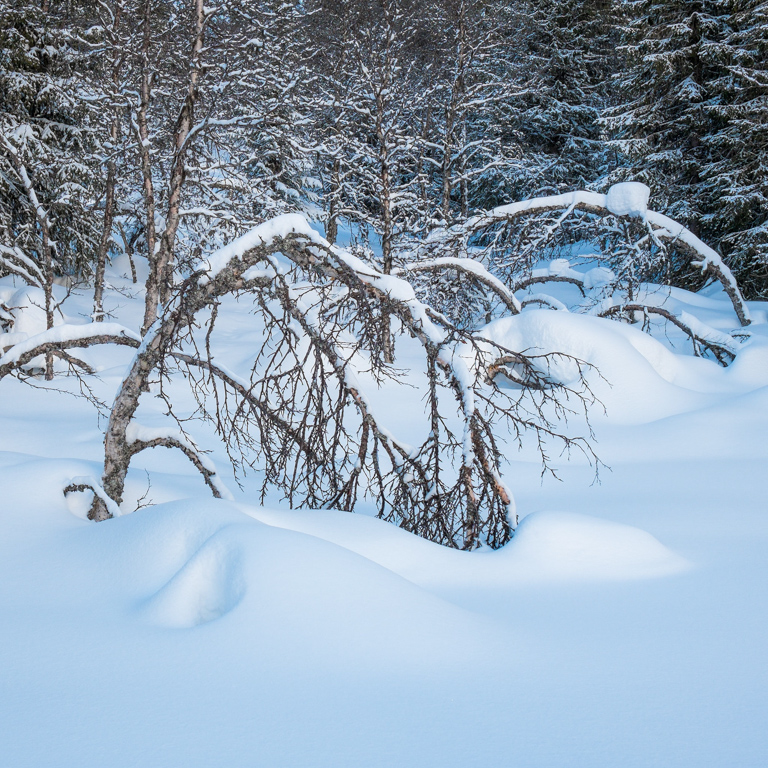
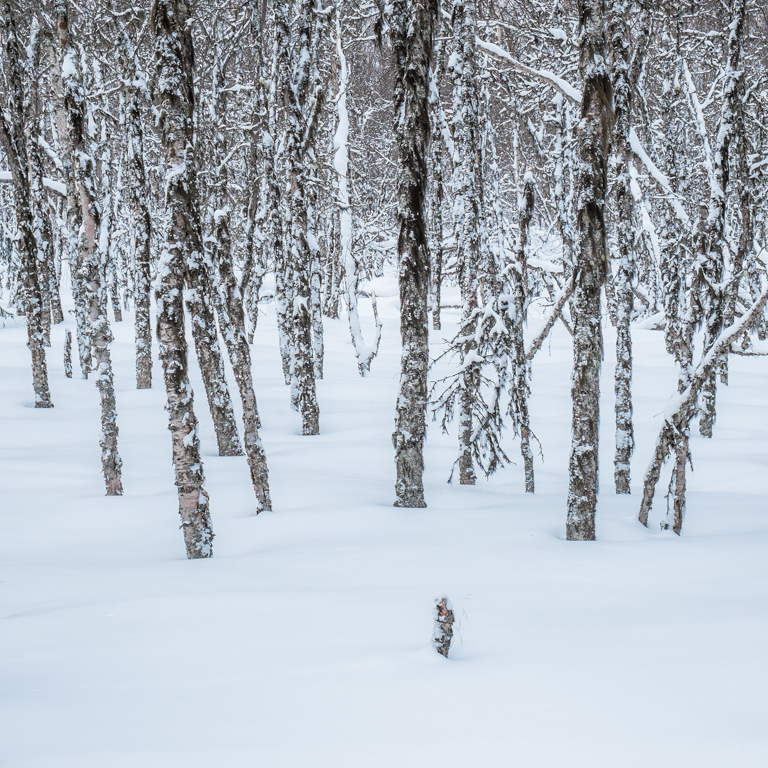
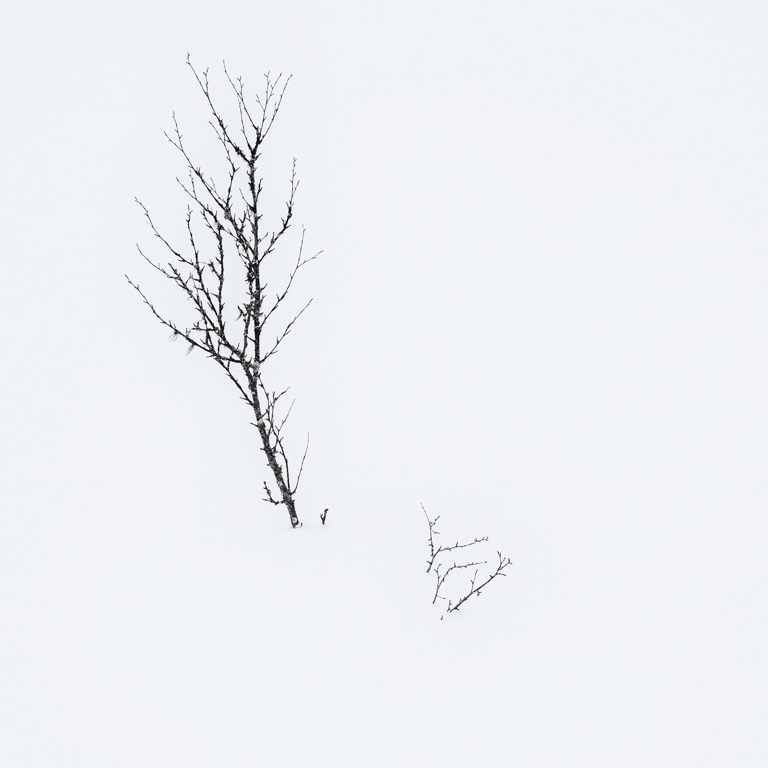
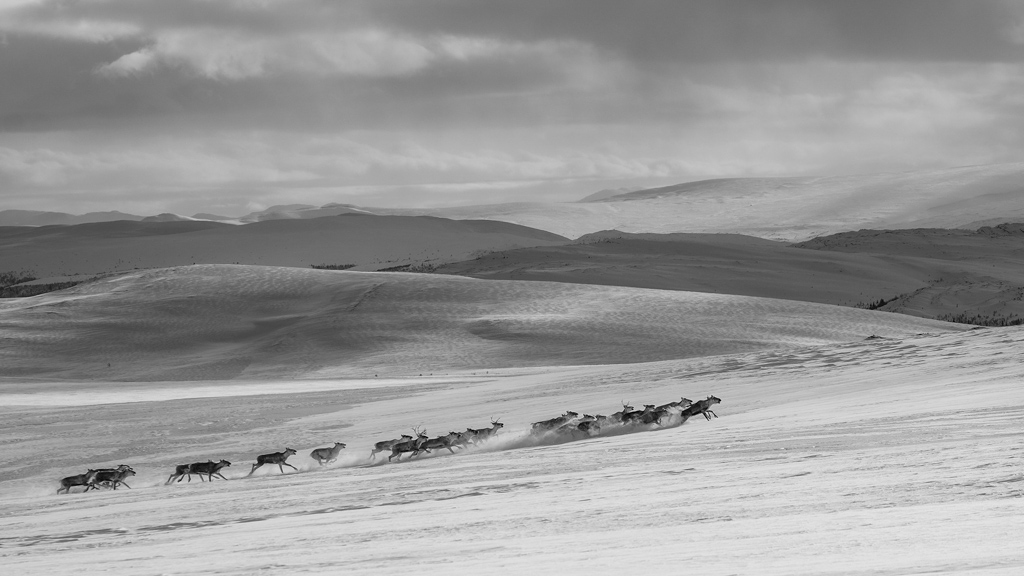
Welcome to our featured photographer section where in this issue we'll be talking to Timo Lieber, a German photographer living in London and who has recently been shortlisted at the Sony and Wildlife Photographer awards.
Can you tell us a little about your education, childhood passions, early exposure to photography and vocation?
My degree and day job are in finance and hold little relevance to photography. I did, however, enjoy helping my dad putting together films from family hikes, so picking up a camera felt very natural.
I bought my first DSLR a few years ago and things have progressed from there.
When I was asked to contribute to ‘End Frame’ I readily accepted, thinking what could be easier than writing about a favourite photograph? Then I started to think about which photographer to pick, and exactly which image, and the problems suddenly seemed to multiply. Who do I consider my favourite photographers? How can I possibly pick a favourite image from so many? I can easily reel off the names of a good couple of dozen photographers whose imagery I particularly enjoy and who have had an influence on the evolution of my own photography. Taking away some people about whom much has already been written still left a pretty long shortlist. Who to pick….? The American photographer Joel Meyerowitz might seem a strange choice to write about in a magazine devoted to landscape photography - having made his name in the 60s and 70s shooting fast on the streets of his native New York.
You can download the PDF by following the link below. The PDF can be viewed using Adobe Acrobat or by using an application such as Goodreader for the iPad.
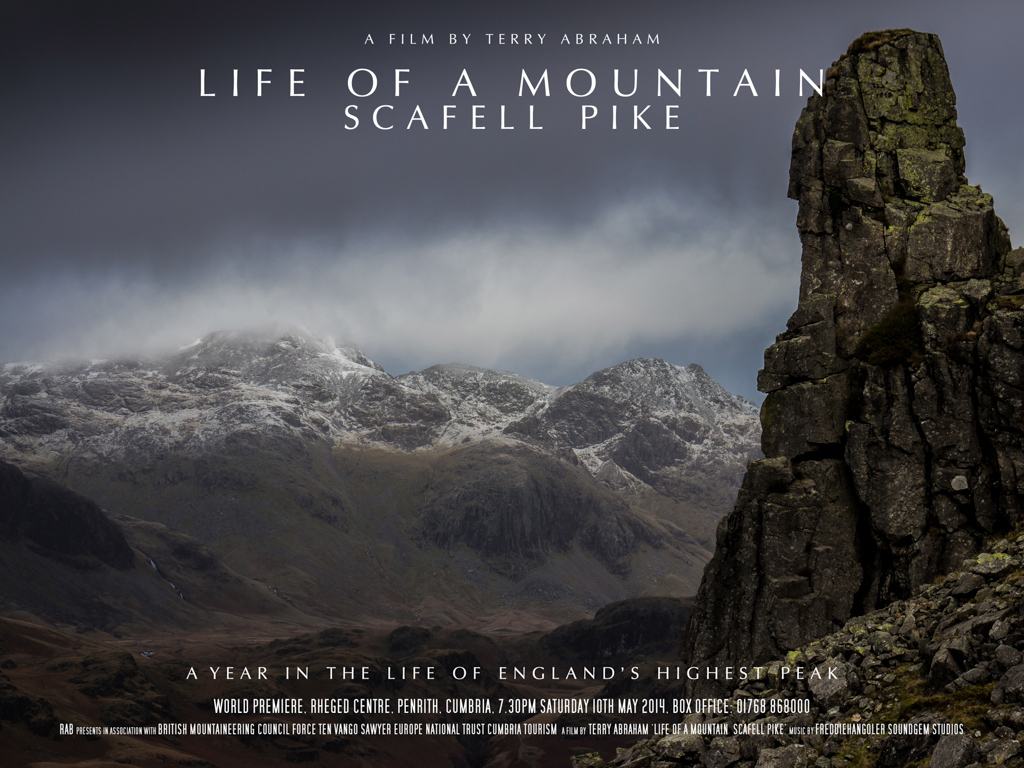
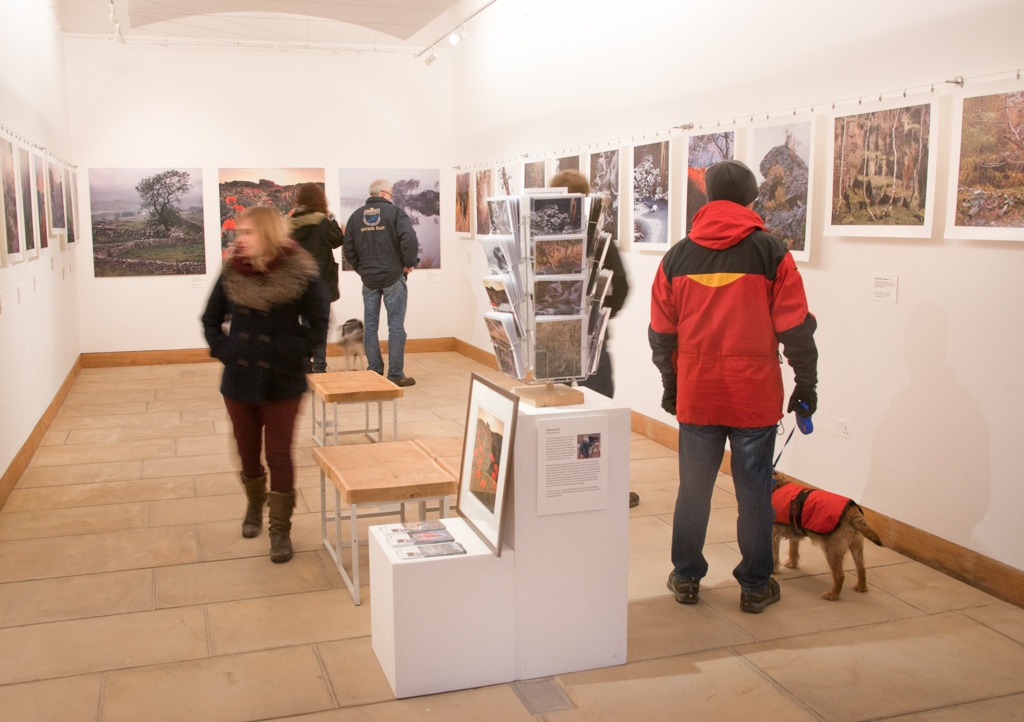
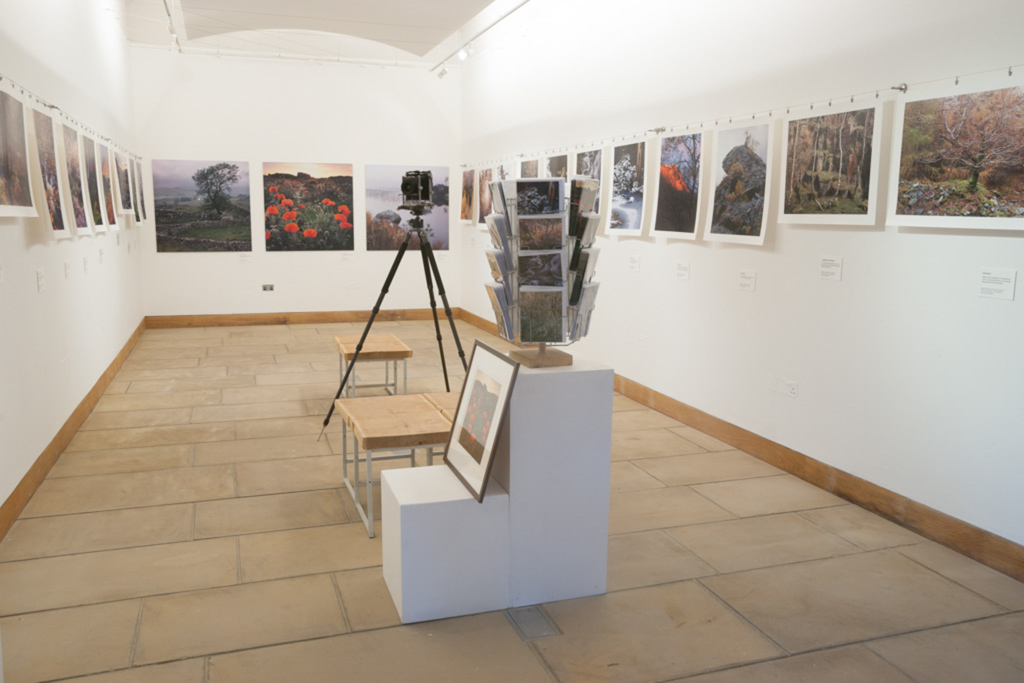
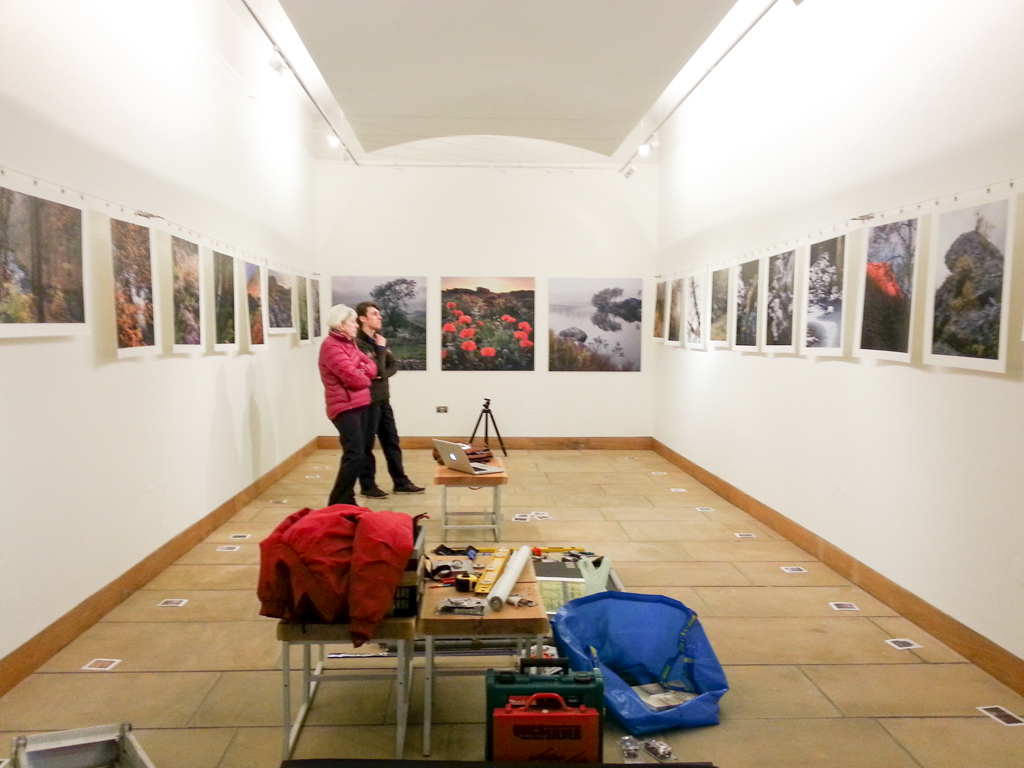
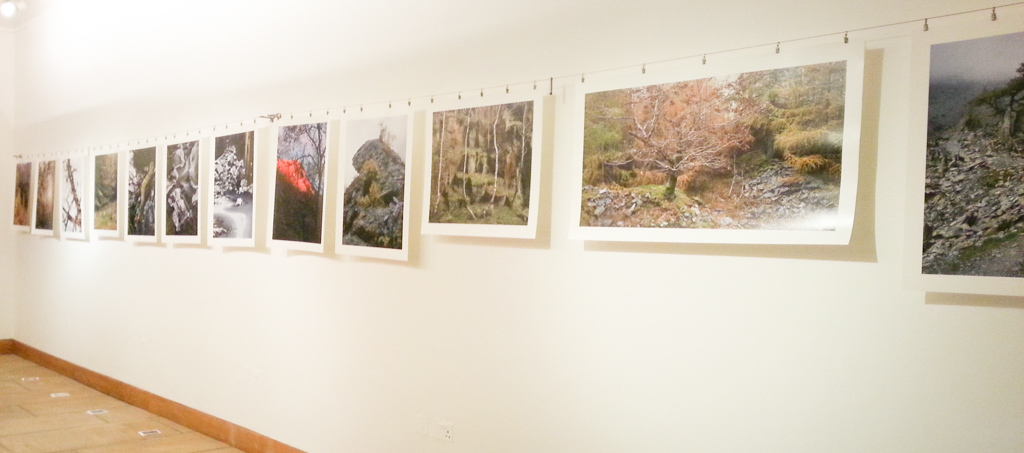
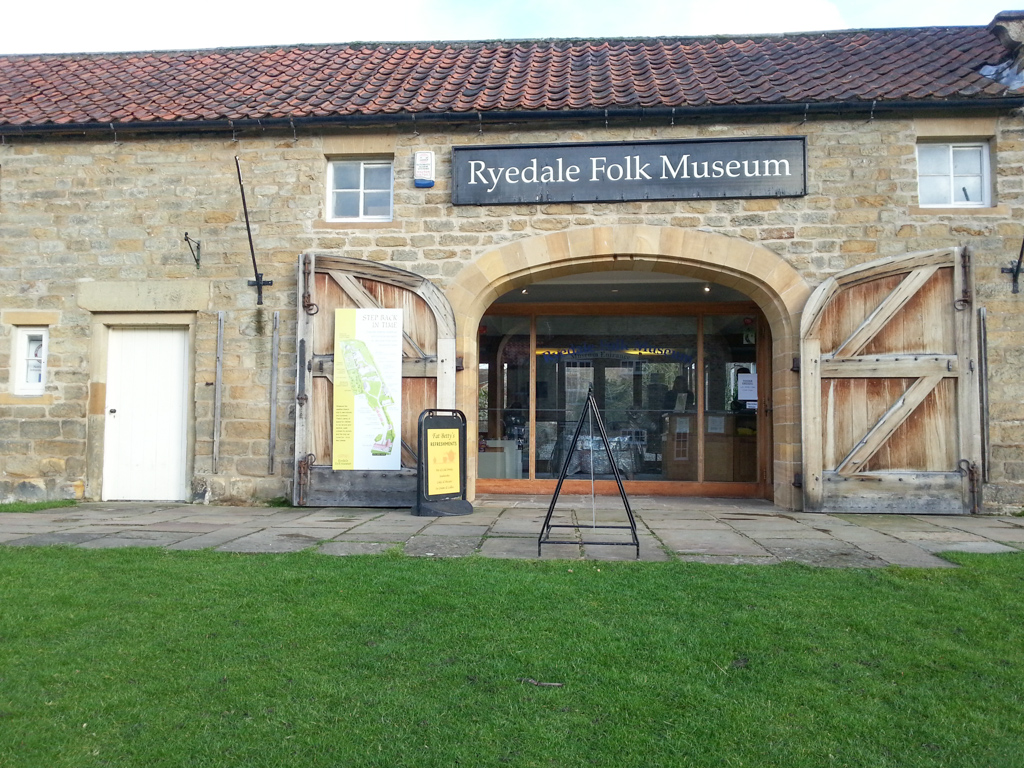
On Landscape have helped the Rheged to put on an exhibition of Lake District photographers and also a talk by David and Angie Unsworth and a workshop by Mark Littlejohn to coincide with the launch of Terry Abraham's movie "Life of a Mountain", a full feature about Scafell. We talked to Terry about his project and asked him how he the whole thing started.
Tim: We’ll start off asking you a bit about your background as a photographer film maker. What came first for you? I’m presuming it was the outdoors before filming and photography.
Terry: I’ve always had an interest in film and video. As a young man, I always daydreamed of producing my own films one day but such is life and it never really came to fruition but that interest was always there. I’ve always had a love and passion for the outdoors. A few years ago, I bought a cheap camcorder, started taking it out on my camps up the hills, built up quite a large following on the likes of You Tube and it’s really thanks to modern technology and the Internet that my career’s been born from there in terms of getting the interest. I won a couple of amateur film competitions. I started the video making side of my trips and capturing the hills but more seriously and then I got made redundant in a job I was doing in IT. At that point, I was moonlighting at weekends producing short videos of the Peak District for various tourism bodies and I thought, I’m going to go for it as a full time living. Invested in better and more professional equipment in terms of the craft of making videos and it was very hard, it was a struggle but I got through the first year. They always say the first year in business if you’re still going, you’re onto something. If you keep going after two years, you’re definitely onto something and also it’s going to grow and that’s exactly what happened. It’s all led to me producing this film about the Scafell, it’s a long held ambition of mine where I could produce something I wanted to see not somebody else wanted to see, like some clients I work with. The photography came out a year or two ago, I’ve only started taking the photography seriously. Some friends I speak to on Twitter are saying, “You’re taking some fantastic shots on video, why are you not taking photos?” and I’m going, “I don’t have a DSLR or anything like that,” so I’ve invested in a DSLR and now, about a quarter of my income comes from the photography. I don’t put the images out online on the likes of Alamy or anything like that. I’m quite fortunate in that I get approached by companies and then commissioned to do photos. Anything I put out online gets picked up my magazines and they get in touch and so on.
Tim: That’s where the money comes from, commissions, with the landscape photography.
Terry: Yeah, that’s something I learned. A lot of what I’ve just talked about has been a very steep learning curve for me. I’m not formally trained with anything like this at all. I’ve taught myself. I have to say I was considered a talented artist as a young man and I was an illustrator till my mid-twenties and I suppose I’ve got a natural eye for seeing a picture. In a roundabout way that’s what shows through the work I do, particularly with videos, it’s always about that composition, getting that picture. But whereas I could create something as an illustrator or change things or arguably some people do with Photoshopping images, with video it’s all about being in the right place at the right time. I can’t do anything with the image afterwards.
Tim: No, very difficult, not like what you can do with Photoshop, video hasn’t quite got to that stage yet, fortunately I would say. But you’re not from a mountainous area; Nottinghamshire is not exactly full of the peaks.
Terry: No, it’s quite flat round here.
Tim: And your background if you’d been out travelling, you’d have been interested in going round Sherwood Forest I presume, like it says on your ‘About’ pages on your favourite locations.
Terry: Yeah, that’s absolutely correct. It was my grandfather’s love for the outdoors. He was a farmer and gamekeeper and he’d often take me out on hikes and we’d camp out in the woods overnight watching badgers and foxes. My grandmother had a big interest in culture and history so they both had a profound influence on me in that respect, in shaping my view of the world we live in. They were immigrants as well, they weren’t born here. They came here after the War. Not long before I got made redundant, I had a health scare, a suspected heart attack and that reignited my passion to the fore for the outdoors and particularly here in Britain. I felt like there are lots of places I want to see and visit and camp out and make the most of it because life’s just too short. While some would say it became an obsession of mine in truth, it doesn’t feel that way for me and just that obsession, that passion for the outdoors, the likes of Twitter, the You Tube stuff, it’s all come together all at the same time to put me where I am now so I do feel very fortunate and very grateful for the followers I have that have put me where I am today. It’s encouraging for me as well how they enjoy the sights I see and share.
Tim: Had you travelled before to the Lake District and Scotland?
Terry: Yeah, I did go out but not as often as I’ve done in recent years. Forget what I do now in my work but as a hobby, it’d be as often as possible. I’d work extra shifts at work so I could earn the hours which would then give me more free time off.
Tim: Was that mostly in the Lakes?
Terry: Yeah, mostly in the Lakes. I spent a lot of time in the Peak District and Snowdonia. There are lots of other places I’ve not been to. I’d like to. I’m recently spending a lot of time in Scotland but my heart really lies in Cumbria. I don’t want to say the Lake District because it’s a cliché but it’s the whole county, I love all the aspects of the county because you’ve got the Howgill Fells as well and the Northern Fells, the coastline, the Southern Lakes with the limestone country and the forests. It’s just something there. I often joke I was probably born a shepherd in a previous life because of the time I spend out on the Fells but it’s just there in me. As much as I love other places and they’re just as spectacular or arguably more spectacular, there’s just something about Cumbria that really pushes the buttons for me. That was one reason why I wanted to do this film about Scafell.
Tim: How do you go from having a health scare and then deciding to do something full time, to deciding it’s going to be about Scafell?
Terry: They were all like regular corporate and tourism videos that I was doing initially, bread and butter, I was just getting my foot on the ladder on this new career I was on. But where the idea of the Scafell film comes from, it’s really with a frustration that we never see much of the British countryside looking spectacular on the television or on DVDs you get in shops. It’s like the crews had turned up because they’re on a daily or hourly rate, they get the shot done and then they go home and that’s the Lake District. Don’t get me wrong, it does look beautiful whatever the weather and it can look nice but as a backpacker, as a wild camper, I know it can look a million times better. I see these sights from my tent on the Fells. Born out of that frustration is what led me to do this Scafell film, I wanted to show the Scafell through the seasons looking at its best and worst. But with my interest in history and culture as well and people, I wanted it to be as much about the people that live and work around the mountain as well and play on there because people have arguably shaped the mountains that we see today in the Lake District, sheep farming for example. So it’s something I always wanted to see because it’s just not out there. Recently I’ve been working extremely hard doing lots of night time laps of the area. You see that two a penny on these videos on You Tube or in California, the lucky beggars have got a lovely dry eyed desert to go out and see billions of stars. We don’t really see that here but we do get some nice dark skies. I can’t think of any particular productions where we’ve seen lots of night shots of places like the Lake District and that again I’m keen to get into the film and why I worked hard producing those night time lap sequences is because it’s another aspect of the area that’s stunning. It’s not just beautiful in the day; it’s beautiful at night as well when you see the Milky Way coming over. Again I suppose I’m revealing that passion and love for the area because I want to inspire and share this with people so it enlightens them, makes them wish to care and protect the area and more importantly, visit the area and look at it in a different way. If they’ve not been there before, they may want to go after seeing this.
Tim: Here’s a question for you. Scafell is notoriously difficult to photograph and you see very few photographs that get a good representation of what it’s like. I can think of a handful I’ve seen and I’ve seen a lot of people trying. If you’re going to choose somewhere for a video, why Scafell over other possibly more attractive options?
Terry: I disagree with that. I think the Scafell are photogenic. It depends where you go. A lot of people don’t wander far from the beaten path. There’s Yeastyrigg Crag which is on Esk Pike that gives you this formidable full on view of the Scafell on the Upper Eskdale side. It looks brutal. I often compare the Scafell as the ugly prince with the Queen that is Snowdon and the King that is Ben Nevis. The obvious ones from Hardknott and so on but you get this amazing view of the Scafell where it does look like a wild large mountain. High Gate Crags which in Upper Eskdale, there’s a real sense of isolation and being remote there and again it affords a fantastic view of the Scafell, a much more intimate view. However, when you go to the Wasdale side, it does look like large grassy hills with some craggy knobs on the top, totally different character and it’s often that side where you see all the photos of the Scafell and not so much the wild side. And that’s because it’s easily accessible from the road and people think the usual shot with water there in the same scene to frame the shot. But also you have to bear in mind that the weather plays a large part in the view of the area, the whole massif but also where the sun sets. Generally through the summer months, the warm dry months, spring and summer to early autumn, the sun sets along the line of the Wasdale Valley. It lights up that side of the Scafell and it can look very lovely and pretty, particularly the Screes nearby which all light up red in the late autumn because the sun’s setting in perfect alignment with the valley. That’s really rather exciting, there’s not many valleys you get like that in mountainous areas. When you get to late autumn and through the winter and early spring, the sun sets on the other side of the Scafell where it lights up Eskdale and lights up all the crags and knolls of the Scafell on that side, the wild side as I like to call it. Again, that’s completely different and it’s just as spectacular. If you’re on the other side, you’re dark. Unfortunately, it’s hard to get dawn shots. It tends to be early winter where the Scafell can look best at dawn because the sun tends to rise in alignment with the Crinkle Crags and as it creeps over the gap, the cull between Bowfell and Crinkle Crags where three tarns is, that cull thankfully gives enough dawn light to light up the majority of the Scafell on that side, that facet of it. I suppose in a roundabout way if you want it nice and easy, it is hard to photograph but if you persist and think outside the box, it’s easily achievable.
Tim: Do you think this is one of the downsides of the Lake District representation in landscape photography, the fact that all the photographs are taken from places within a mile at the most from a car park?
Terry: Yeah, absolutely. I can only think of a couple of photographers I know well in Cumbria base that actually get away. Most don’t walk more than a mile from the car. These guys camp out like I do. It’s their love and passion for the area and they get some amazing photos of the Scafell and the Lake District at large. They’re doing much the same as me but sadly, we’re a minority. I go out in all seasons. I’ve camped on Bowfell summit. It’s a rocky place, you can’t always put a tent there but in the height of winter, there’s lots of deep snow so you can get a tent up there. Sub-zero temperatures, I’ve encountered –18 and –19 wind chill up there, absolutely freezing but it was well worth it for some of the shots I got. I’m a crazy minority breed in that respect to most people but it’s just normal to me.
Tim: Have you been wild camping before you were doing the video?
Terry: Yeah, that was my hobby, backpacking in general so the interest came from that with video and everything else.
Tim: When you’re going out with your video, I’ve wild camped with my large format gear and it ends up quite a hefty collection of equipment by the time you’ve finished getting everything in a pack. How do you travel? Do you typically go out with a tarp in the summer or are you still a tent...?
Terry: I switch about. A tarp in the summer or a bivvy but when it comes to winter, it’s a tent every time. You get a bit more shelter. Arguably a bivvy will be just as good because it’s a bit more bomb proof wherever you can lie down and feel you can sleep the night, a bivvy will go there. With tents, you have to think carefully where you’re going to pitch it, is it quite sheltered.
Tim: It’s a long night in a bivvy though.
Terry: I get a thrill from that sense of exposure to the outdoors; it makes me feel much more in tune with the area, the sight and the sounds. I don’t particularly enjoy being cooped up in a tent because you’re cut off from it all. But a tent’s handy as well; I may sometimes base camp so I’ll make a camp and then go from there to save a bit of weight on my back. At the moment, this winter my pack was in excess of 30 kilos and that’s made me think very carefully on the kit I take and why. With regards to photography, I’m a big fan of these mirrorless cameras now.
Tim: Are you using things like the Panasonics?
Terry: No, the one I’m using at the moment, I chop and change my mind quite a bit, but the one that’s done me fine and I really enjoy using but I’d prefer a few more features on it is the Canon EOS M. It’s the only mirrorless camera they do but it’s tiny, it’s the size of a compact but spec hardware wise, it’s essentially the same as their mid-range DSLRs.
Tim: Incredibly cheap at the moment, I saw someone get one for £200 at a photography show.
Terry: Exactly. I still have a DSLR as well because with the mirrorless camera, you don’t have the viewfinder which is a bit of a pain sometimes because you have to rely on the light view screen. You can use Canon lenses with it but it defeats the object of using a mirrorless camera because it becomes a lot bulkier. Their own specific mirrorless camera lenses are not ideal really for photography when it comes to focus. You can’t see your focus numbers on the lens, I’m mimicking it already, you have to look through a viewfinder but you can’t do that on the Canon EOS M which is annoying so I do flip between the two. It depends how much kit I’m taking and why I’m on the trip so if I’m taking not as much video kit as normal, then the DSLR comes with me. If I’m taking a lot of kit with me, then the EOS M comes with me.
Tim: So you use a 5D for the video?
Terry: I did have one and I got rid of that, I’m using a 600D at the moment. I’ve been using the 600D primarily for time lapse, not really for the photography although if it’s all I have with me, then I will use it if there’s a shot I’d like to take a photo off. The priority is the video.
Tim: Do you take out sliders and things like that as well?
Terry: I used to take filters but I don’t bother now.
Tim: Sorry, sliders.
Terry: Yes, I do, it’s a professional 3 sensor video camera you use. Sadly DSLR video’s not very good. I know it’s all the rage at the moment and it’s great for online use but when it comes to DVD and TV or even where the Scafell film’s being shown on the IMAX screen, that’s where the shortcomings reveal themselves. You get a lot of codec fizz noise in the image.
Tim: Which camera is that?
Terry: If you use a DSLR for video, I don’t, you have more codec issues. It surprises lots of people when I mention it to them but 90% of DSLR don’t actually record true 1080 HD video, it’s a few lines less and of course it’s compressed and then you get a codec fizz in there. So I use a dedicated three chip professional video camera which is not a Canon, it’s a Panasonic. And it’s bulky and heavy but ensures I get the images I’m after and it has a very good wide dynamic range on it for a video camera.
Tim: That’s what you need for some of the shots I’ve seen you getting.
Terry: Yeah! I’d love it to be much better. A DSLR does afford a better wide dynamic range; it’s just all the shortcomings you get with that in terms of video. They’re not quite there yet. I’d love them to be because they’re smaller and lighter to carry but there are other things I have to consider as well. Sound, for example, is equally if not more important quite often than the actual images you’re capturing. DSLRs you’ve got your shortcomings there on the sound. You need dedicated audio recorders and it all adds more bulk and expense, where my dedicated video camera it’s all there built in.
Tim: I just do a bit of amateur video now and then and I ended up spending about £2500 on my audio gear and about £200 on the camera. You can save money on the video gear if you can compromise slightly but you can’t save money on the audio stuff.
Terry: But for online use, there’s nothing wrong with DSLRs and a relatively cheap microphone, it does the job but that’s been a steep learning curve for me in the last couple of years. I can’t do that for when stuff’s going on DVD or in cinemas, it’s got to be much better.
Tim: Out of interest on the sound side, the one thing most people get when they go out and do a video on the side of a mountain is wind noise, regardless of what they use. What’s your recommendation for trying to get some decent recording when you’re in the inevitable Lake District gale?
Terry: Again, this adds more bulk but not so much the weight, I have to add, I use a large Blimp. It’s just a large case; the microphone sits inside that on a suspension system so there’s a filter over the microphone that should cut out a bit of noise but not too much. The Blimp itself should cut out quite a bit of wind noise and on top of that, I put a furry dead cat, as they call them. That keeps the wind out and it surprises you how good the sound is. The wind just sounds like a deep breeze.
Tim: Do you know the Unsworths, David and Angie? They do recording now and they introduced me to the Blimps and they were very impressed with the sound quality.
Terry: I use it all the time now, unless it’s a nice day and then it’s fine. When I’ve interviewed people out on the Fells, normally I would wire them up with a tie clip mike but that has limitations if it’s going to be windy. If it’s going to be windy, the Blimp comes out instead, or I’ll use both just as backup and then I can work with both when I get back home.
Tim: You can mix some ambient sound in because the tie clips are quite tight sometimes.
Terry: Yeah, that does make a difference. If I’ve not used the Blimp, I’ll use the internal microphone, the video camera, but that’s not always ideal anyway. The quality on there is not particularly great but it’s good enough for ambient stuff if somebody’s talking through a tie clip mike, you won’t really notice.
Tim: Getting away from the technical side of it and back on the hill again, what do you compromise on when you’re out because of the weight? Do you compromise on your camping gear or do you always make sure you’re fairly comfortable?
Terry: That’s a tricky one. My base weight for my camping gear is not even four or five kilos. It’s a lightweight tent, it’s all top end gear, I’m quite fortunate that I bought some of this stuff myself the last few years but also the sponsors that are involved with the film produce good kit so they donate kit to me enabling me to carry on doing the film. So I’m quite lucky in that respect. With the tent, the sleeping bag, a decent mattress to keep me warm and comfortable ... I need a decent mattress because I’m going to be out for nights and nights, days on end, I need my sleep. I need to get a good night’s sleep to rest and recover or whatever the terrain and the weather’s throwing at me, so I don’t compromise too much on that front but I probably do with food. I don’t really take nice tasty warm meals with me, I’ll take things like dried fruit and nuts, chocolate drinks so I’m getting my nutrition, all my vitamins and minerals and my calories but it’s not exactly something I look forward to at the end of a hard day’s slog when I want my steak and chips or anything really that would be nice and warm inside me! But instead, I’m munching on dried fruit and nuts. So I probably just compromise there more than anything else.
Tim: How many days do you reckon you’ve spent on that mountain to try and get the footage you needed?
Terry: I’ve not been counting, let’s put it that way! I often get joked that they should do a Council tax ban for wild campers now with the amount of time I’ve spent out on the Fells in a tent! I’ve spent more time out on the hills than I have in my own bed at home so it’s a lot and it’s not all good either. There’s been many periods where I’m cooped up in a tent all day or on and off, mostly in a tent for two or three days because of the weather. I’ve got to take the rough with the smooth. I’m not a stubborn minded person but I’m bloody minded when I want to get a certain shot of the Scafell so I’ll often wait and wait for two or three days before thinking of giving up and moving on. Or I repeatedly go back to the same place chasing that special view that I want to capture. Eight times out of ten, I get it but eight times out of ten most of the video I capture is not planned anyway; it’s just what I see as I’m out walking and camping.
Tim: That was going to be one of my questions. A lot of photographers like to try and plan their shots in advance and my experience has been that some of the best moments just happen and you need to be ready for them. Has that been your experience?
Terry: Yeah, absolutely which is why I say 80% of what I’ve captured has not been planned at all. The simple reason for that is we can’t control the weather or the light or the air clarity we’re going to see. We can’t control the colour of the land in terms of the seasons. You’ve got to go with the flow and that’s how I am when I’ve been filming people out on the Fell, that go with the flow. There’s not too much of a script. There’s a rough outline of what I want them to talk about but I go with the flow and it’s much the same with capturing the images of the Scafell because I go with the flow. I have a little list of what I’d like and I’ll be mindful of that and keep aiming for it. If I don’t get it or I’m not happy with the shot I’ve got I might try to capture it again but it’s all about being out there in that moment.
Tim: The premiere is at the Rheged and I presume you’re getting pretty close to finishing the editing. Have you started thinking about what to do afterwards or are you just going to take a bit of a break to recoup?
Terry: I can’t afford to have a break, to be honest, I’m on a very low budget for this film and I’ve invested a lot of time. It’s taken over my life and taken quite a bit of my money as well. I didnt want to start working again straight away but the projects I’ve got lined up for this year are nowhere near on the scale of what I’ve been doing with the Scafell or as ambitious. Deliberately so because it’s easier work and I need a rest. That’ll be my break, just easier work, still working hard but working on this Scafell film has really knocked me for six. Physically, my body’s going to be thankful when it’s all over but in my heart, I admit I think I’m going to be really rather sad because of all the friends I’ve made there, getting to know the area much more intimately than I could possibly have ever imagined before starting on this project. The stuff I’ve got lined up, I’m doing a backpacking DVD with Chris Townsend in the Lake District, another Lake District based DVD with Mark Richards who’s the author of the Lakeland Fellranger series books and friend of Alfred Wainwright. And I’ve got some other jobs as well, just regular bread and butter work but nothing lined up now that’s on the scale of what I’ve been working on with the Scafell.
Tim: So theoretically if you were to do another one or a couple if it were a series, what other Fells would you choose?
Terry: Originally I wanted to call this ‘Portrait of a Mountain Scafell Pike’ but if I remember rightly, there’s a copyright on that so I changed it to ‘Life of a Mountain.’ I originally envisaged a series, the series being Scafell Pike, Snowdon, Ben Nevis but I didn’t want to run away with myself because I’m not sure how people are going to react to the film. It’s all subjective but if it proves popular, then great and I’ll seriously think about doing another one. Whether it would be Snowdon or Ben Nevis, I don’t know. My heart says Helvellyn; I’d like to do Helvellyn.
Tim: There’s a lot of life there.
Terry: But my brain is saying maybe go for Snowdon and leave Ben Nevis till last but I’m torn. I’d like to do one about Helvellyn personally and if I was, I would start on that late this year in the winter and carry on with that. We’ll see, it all depends on how well the film’s received. Thankfully, I’ve done some test audience stuff and they’re thrilled, it’s exceeding a lot of people’s expectations and I’m pleased with that because even though I do these little PR shorts for social networks, I’m deliberately holding back the true scale and depth to the film. There’s a lot going on but it’s not as in-depth as I’d like it to be because it’s only two hours. I could’ve done it as a series.
Tim: Director’s cut coming?
Terry: No, the two hour cut is the director’s cut. I really struggle to get everything in that without spoiling it with its emotive power. I want to strike the balance between it being a spectacle of the mountain through the seasons but equally about people, stories and their experiences. I was a little conscious about getting that balance right but thankfully with the test audience stuff, they’ve given the thumbs up. I don’t want to sound like I’m boasting about it but I’ve been absolutely over the moon with the feedback, it’s been such a thrill that it’s touched people deeply. Some people even said they shed tears and that astonishes me, stuff like that because I’ve become immune. I’ve seen the footage over and over again. Anything involving people might be quite emotionally moving, I’m not seeing that, I’m immune or whether a particular shot of the landscape or sequence I’ve put together is moving for people, it’s all lost on me.
Tim: It must be quite sad because I get this with my photography at times. You never have the effect that you would like your audience to have on yourself, you never see the picture as a stranger would see it.
Terry: No, and I get a thrill from that. I recently showed a selection of people on Twitter a ten minute clip from the winter chapter in the film and I don’t think it’s a particular highlight of the film but they loved it. They went mental. Part of the film I think is a highlight; I’m wondering if people will think that’s a highlight but it just shows you how subjective it is.
Tim: It is. If it’s anything like the audience we have for the magazine, some people say they love it and some people say they don’t like it but they say they love it and don’t like it about completely different things. There’s no consistency at all. Its life at the end of the day, we can’t all like the same music, we can’t all like the same art so as long as the overall content as a whole satisfies most people and they can find something within it that makes them sit up, and I think that’s a win.
Terry: Absolutely, you took the words right out of my mouth, I couldn’t agree with you more. I do feel what’s gone in my favour with this project is that there are lots of characters and stories in the film so there’s something for everybody. If you have no interest in backpacking, that’s all right because there’s another part of the film that’s not featuring backpacking, it’s featuring a shepherdess or a climber or mountain rescue. I’ve got so much in there; it boggles my mind thinking about it now, how I’m going to get it all in. But it’s good stuff.
Tim: We could talk forever about this stuff but don’t want to take up more of your time. Looking forward to following what you do next and how the video is received. Many thanks
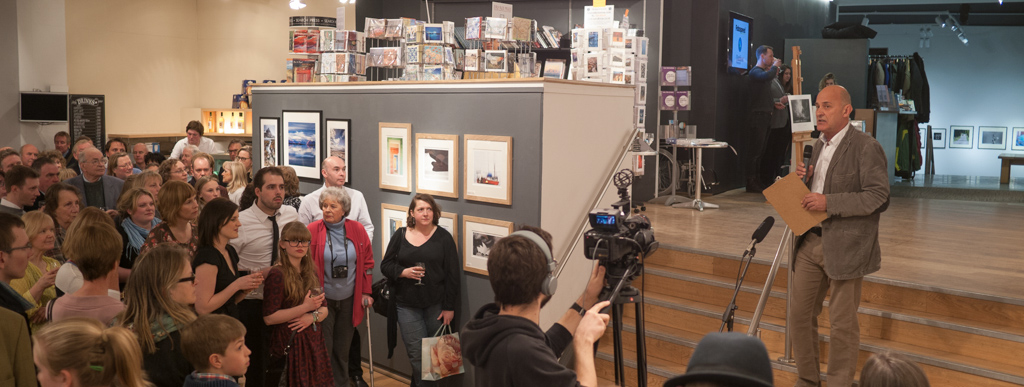
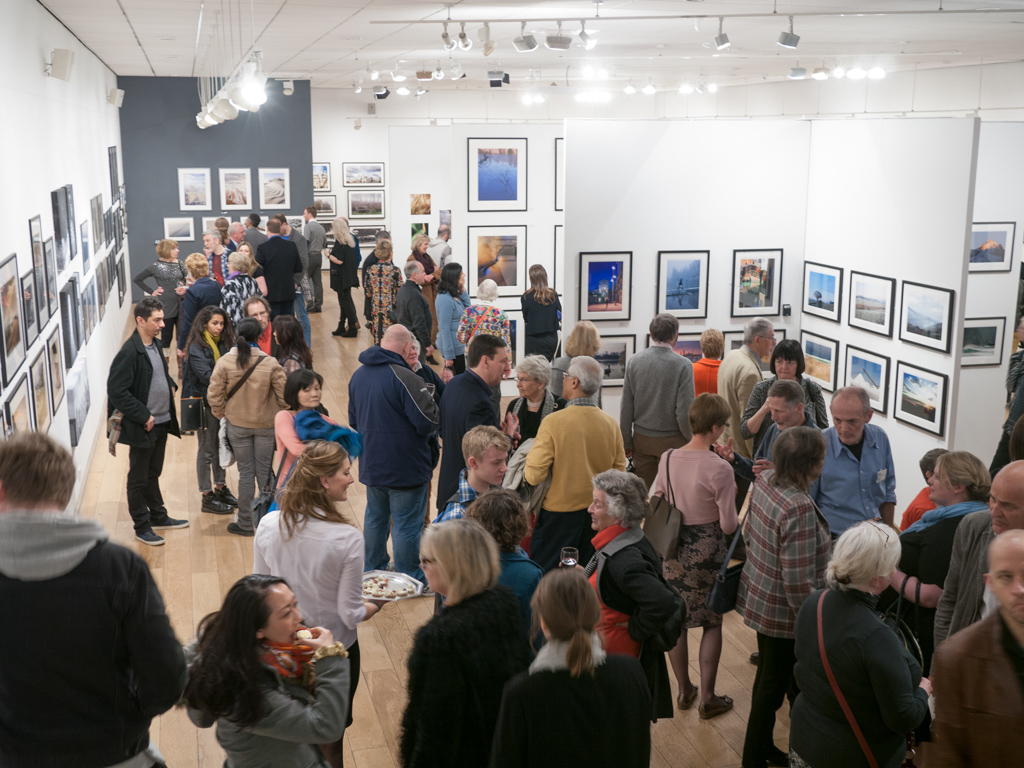
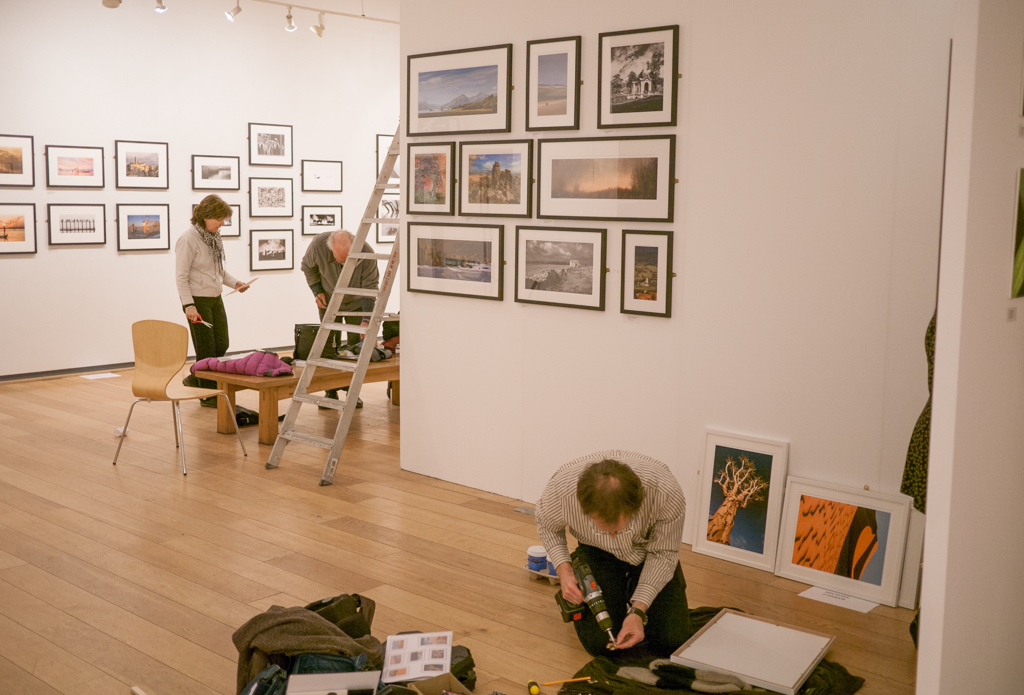
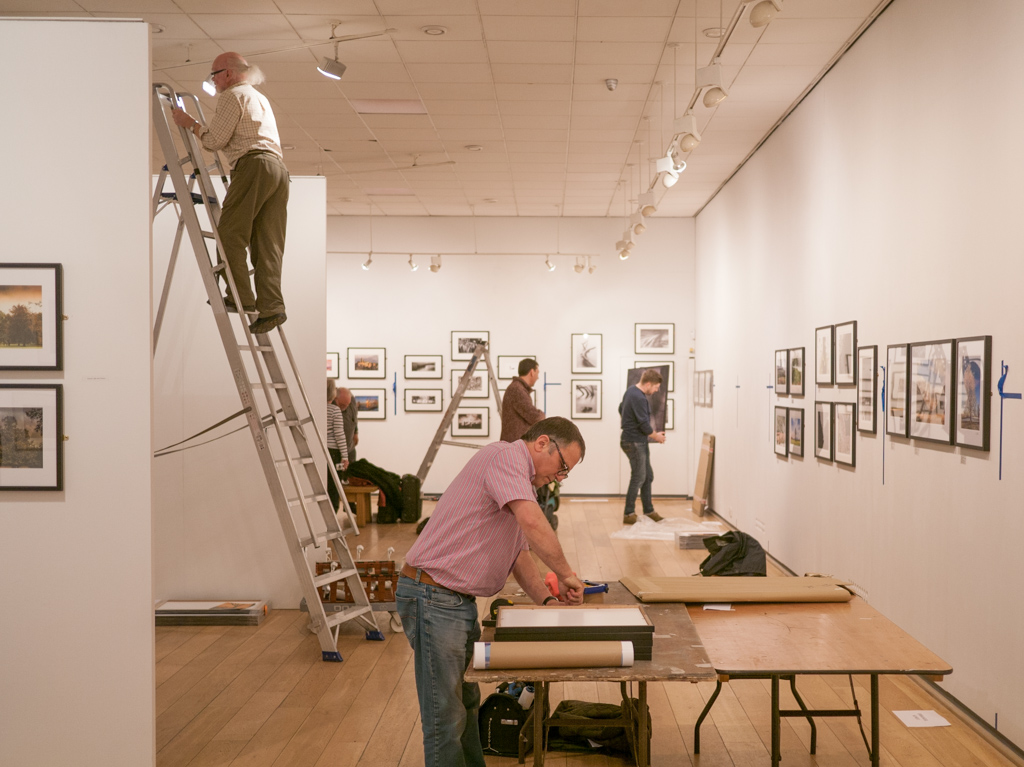
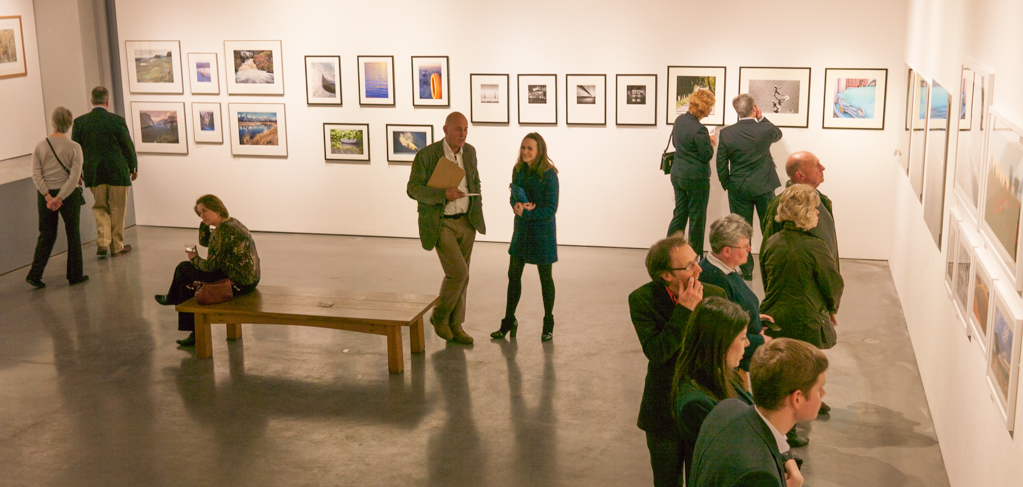
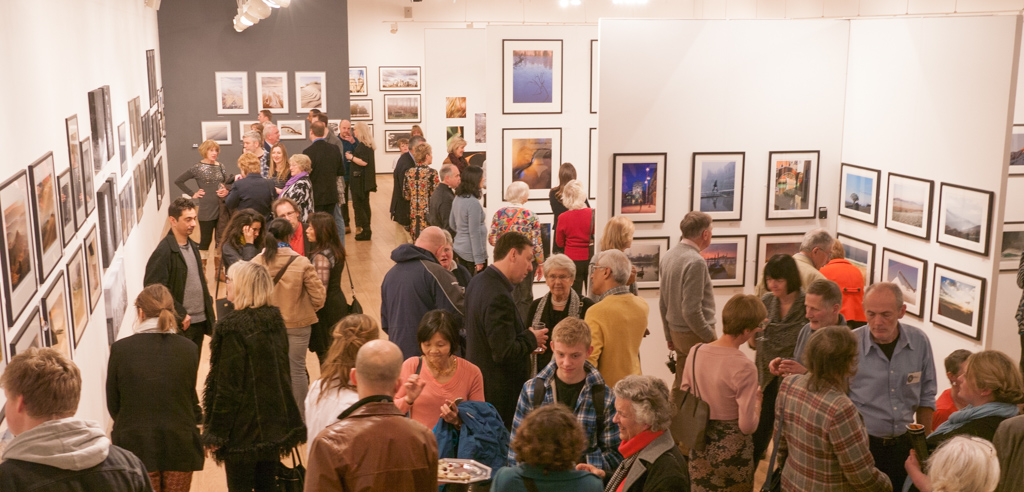
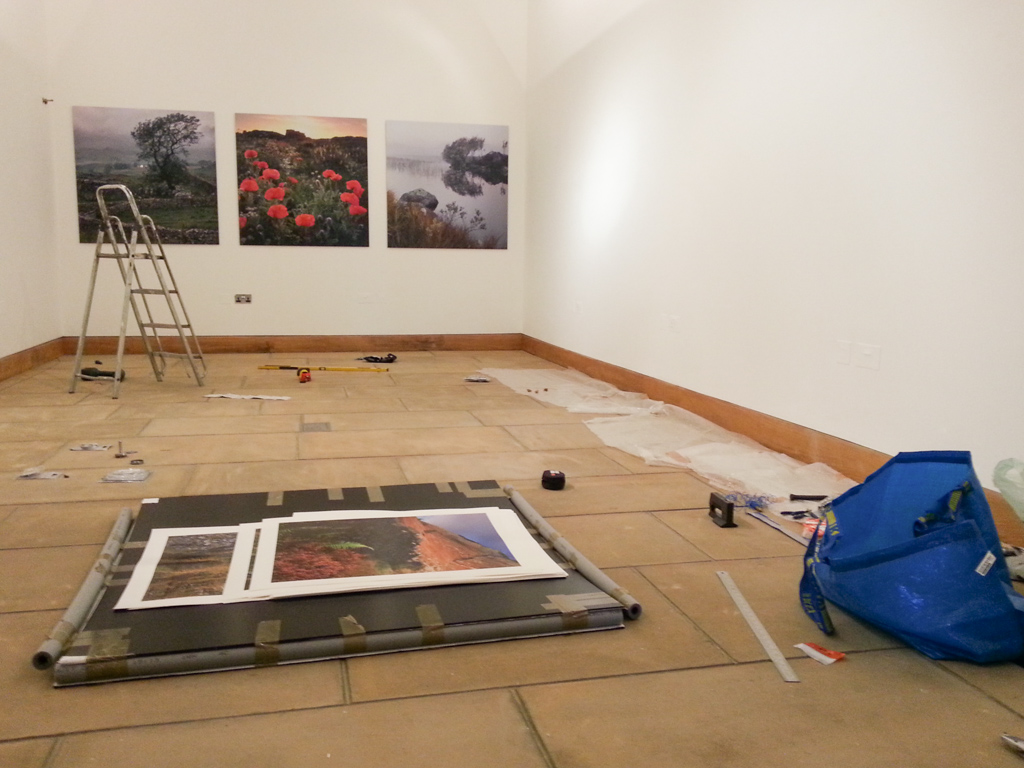
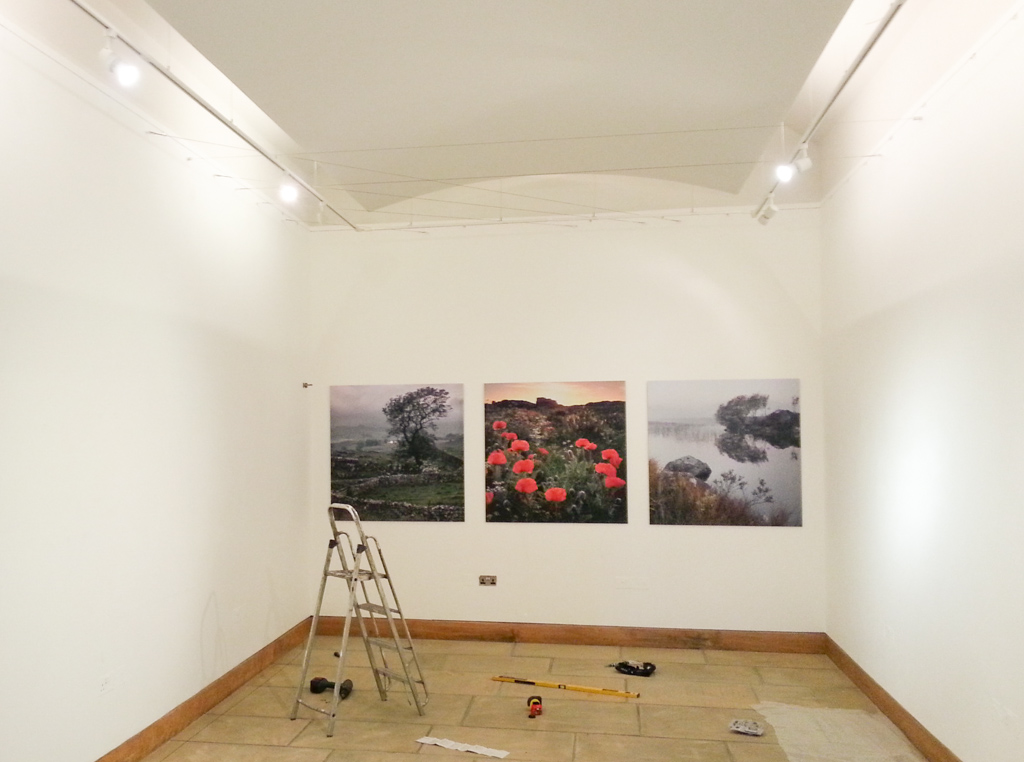
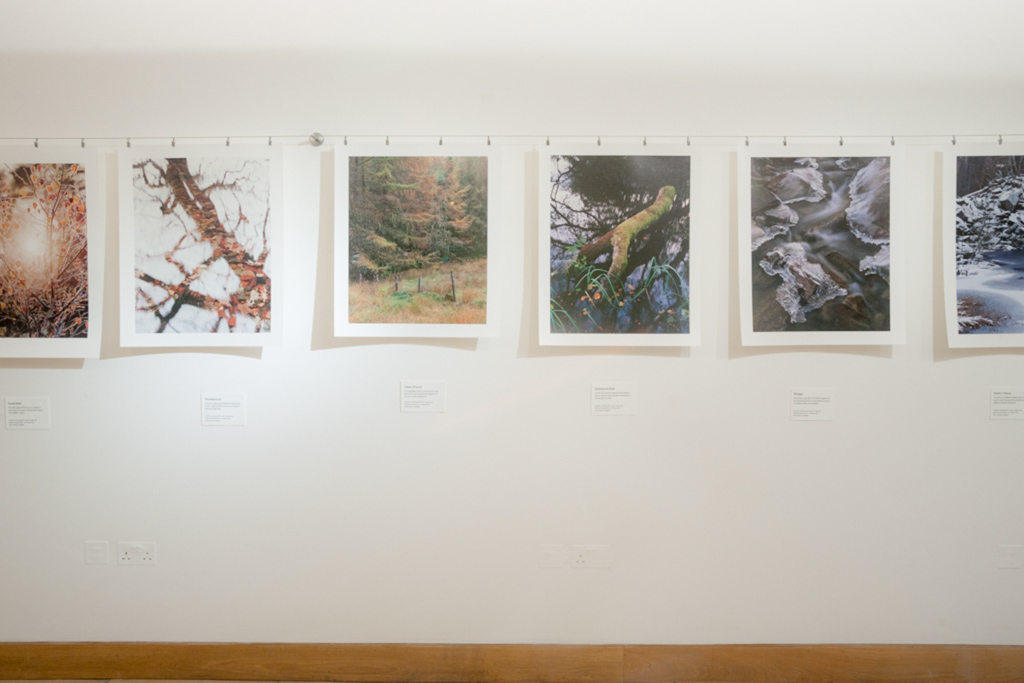
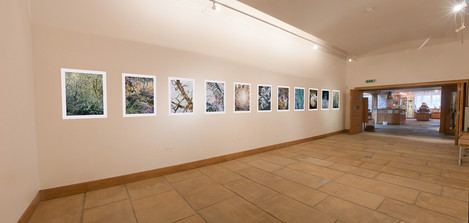
On Landscape are also helping the Rheged in Penrith to put on a show of a few images, a talk and a workshop to support the premiere of a film about Scafell Pike. It’s called “Life of a Mountain” and we’ve interviewed it’s creator Terry Abraham in this issue. You can find out more about the event at the Rheged website including the workshop on Ullswater Steamers with Mark Littlejohn, a talk by David and Angie Unsworth and a small exhibition of landscape photography including photographs by Colin Bell, Mark Littlejohn, David and Angie Unsworth, Tony Simpkins, Roy Fleming and Terry Abraham. The Rheged are also offering the opportunity for people to exhibit their own work for which a booking form is available.
Last week we ran a webinar with David Ward and Joe Cornish where each photographer chose three of their colleagues images to discuss. The video is now available on You Tube but we've transcribed the content and included the images at higher resolution here.
"I know what you're thinking: 'Did he use two sheets of film or only one?' Well, to tell you the truth, in all this excitement I've kinda lost track myself. But being as this is a Deardorff 8x10, the most powerful camera in the world, and would blow your D800E clean away, you've got to ask yourself one question: 'Do I feel lucky?' Well, do you, punk?"
- filed under "Things Harry Callahan might not have said"
So I guess you know I'm not talking about *that* Harry Callahan here but to most people and many photographers, you mention the name and this is what comes to mind. Which is sad in a way as Harry Callahan was undoubtedly one of the most important photographers of the post war period. To put things in a little context, the start of the century saw Weston, Adams and the like eschew the 'creativity' of pictorialist style in order to use the camera to record untainted reality. The difference in Harry Callahan's approach to photography was that he used the camera as a tool to investigate his own ideas and environment. He found a small set of subjects, ideas and techniques and worked them repeatedly to find out where they took him. This introspective approach to photography produced some very novel, modernist work.
editor - Obviously we love Land|Sea but we wanted to put it in the hands of our prospective audience and ask them to give an honest opinion. Paul Arthur fit the bill for a colleague who is always brutally honest (thanks for all those occasions Paul - I think)
In the middle months of 2013 I heard rumour of a new book about to break onto the scene, written by a friend I had made very early on in my landscape photography career. Many of you will have read the review of Dav Thomas’ book, With Trees, and you may even be lucky enough to own a copy. The content of the book was simply wonderful, but the presentation and production of the book was something that was interesting in itself; the book represented the first publication by a publisher that styles itself as a producer of “Quality Landscape Photography Books”, and in the months since then, TripleKite Publishing has announced a number of exciting book projects, and I know that more are in the pipeline.
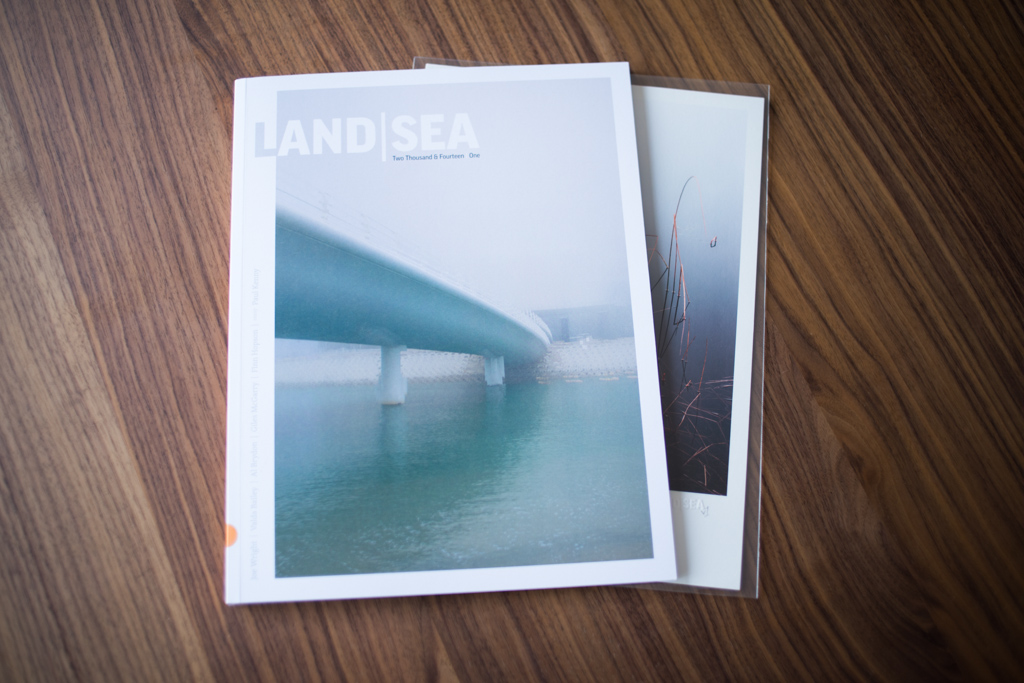
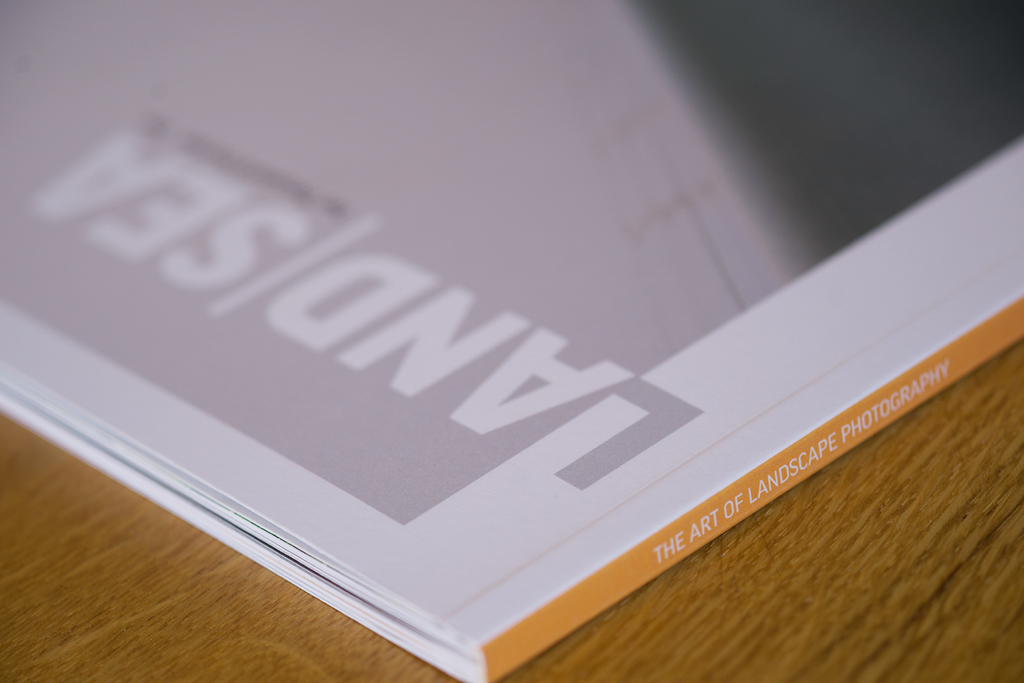
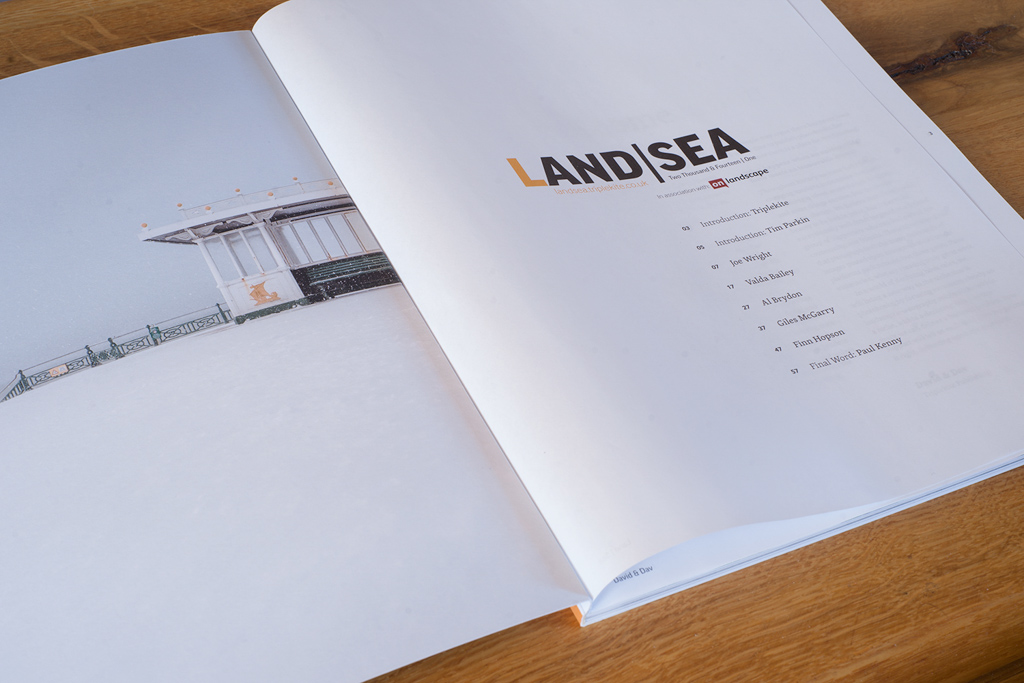
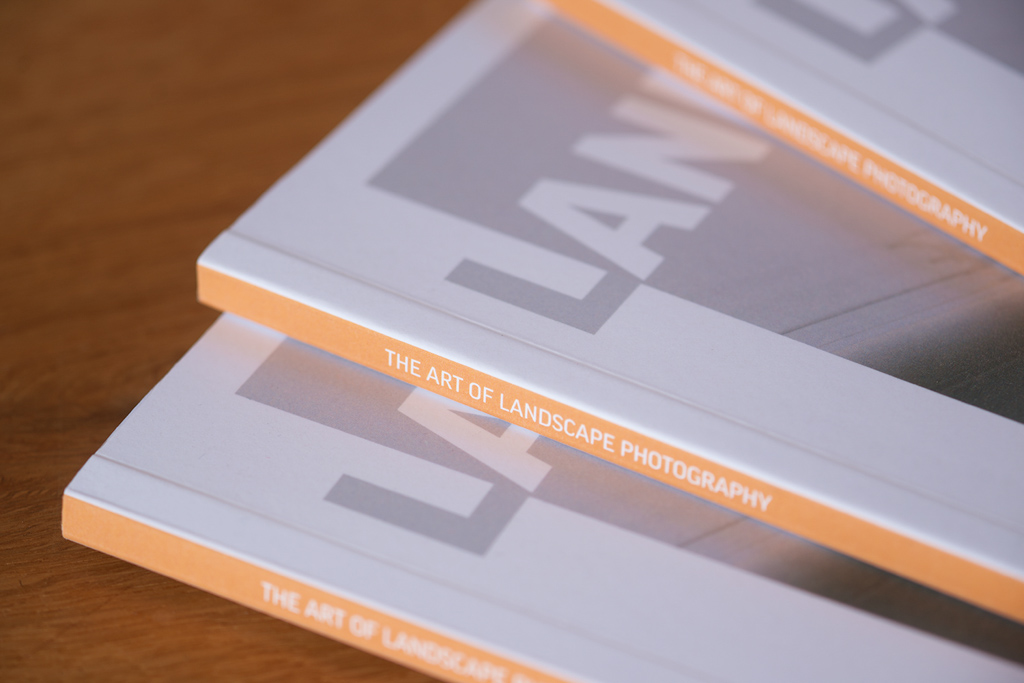
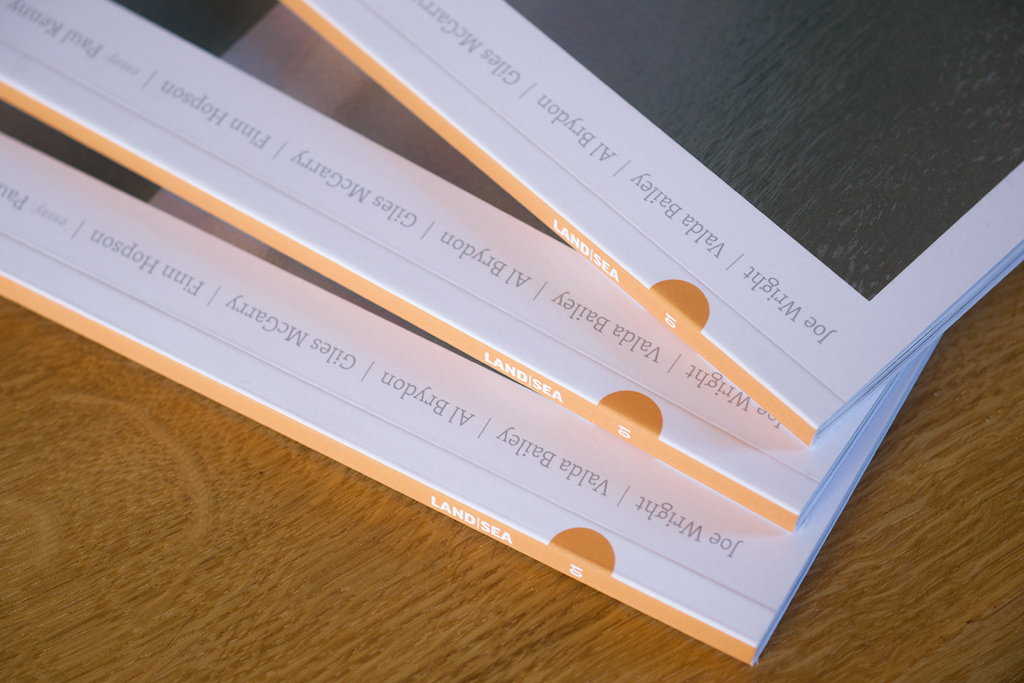
One of the book projects that TripleKite has announced and now produced is the Land|Sea book in collaboration with On Landscape. TripleKite were kind enough to provide me with a copy of the book so that I could review it. So when I arrived back home last week I was delighted to see a discreet packet waiting for me on my doormat. Inside the carefully thought out packaging was the book and also a beautiful print to accompany it, available for a very reasonable extra supplement.
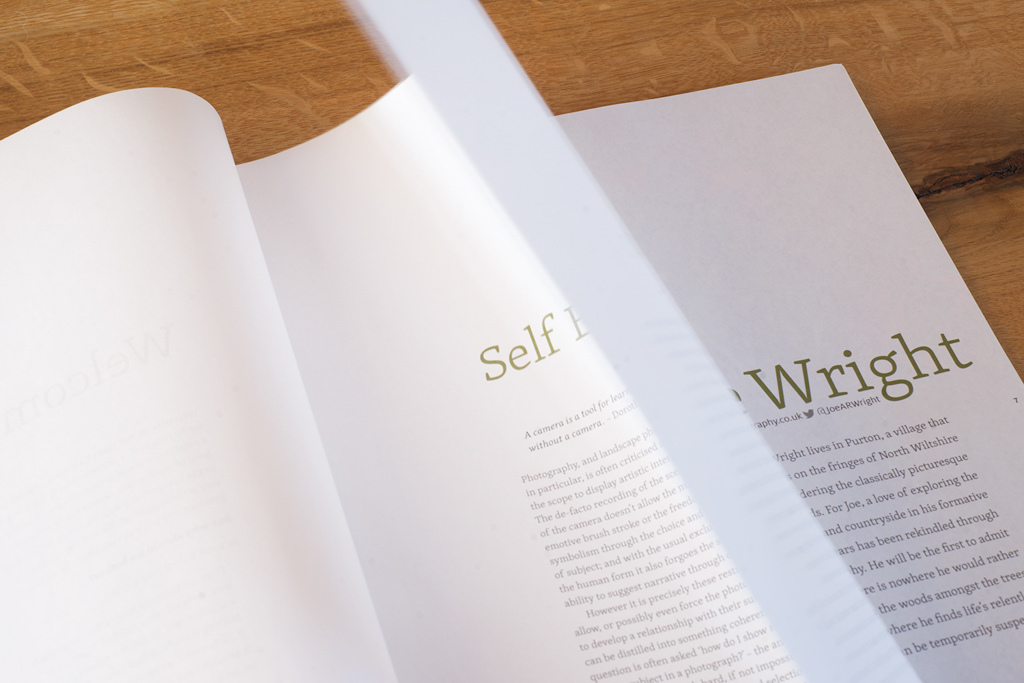
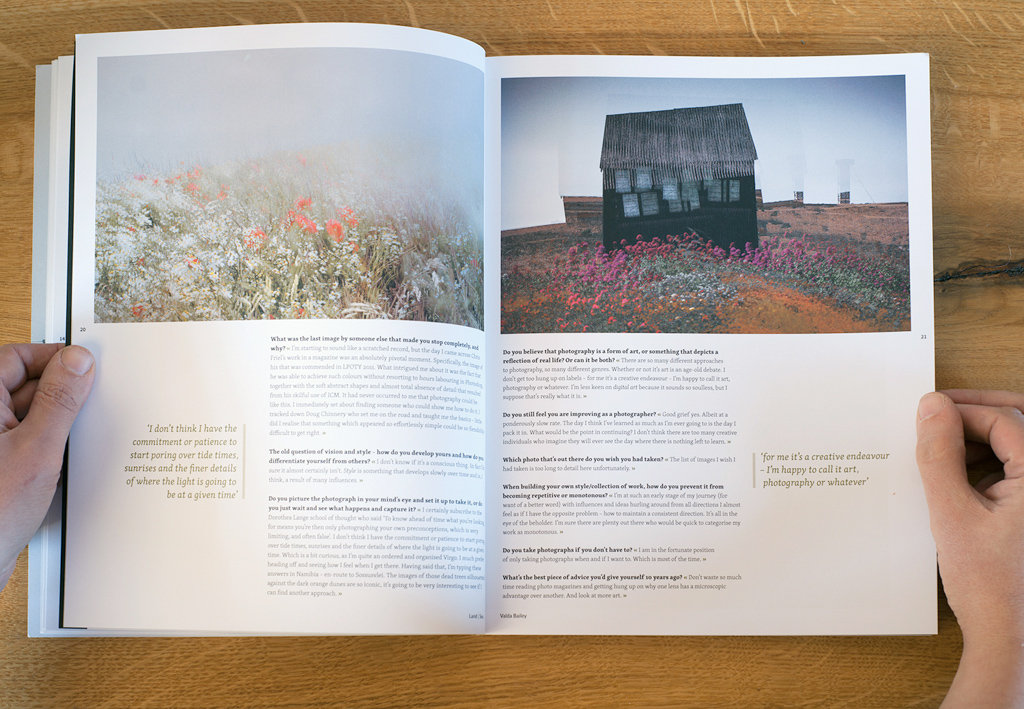
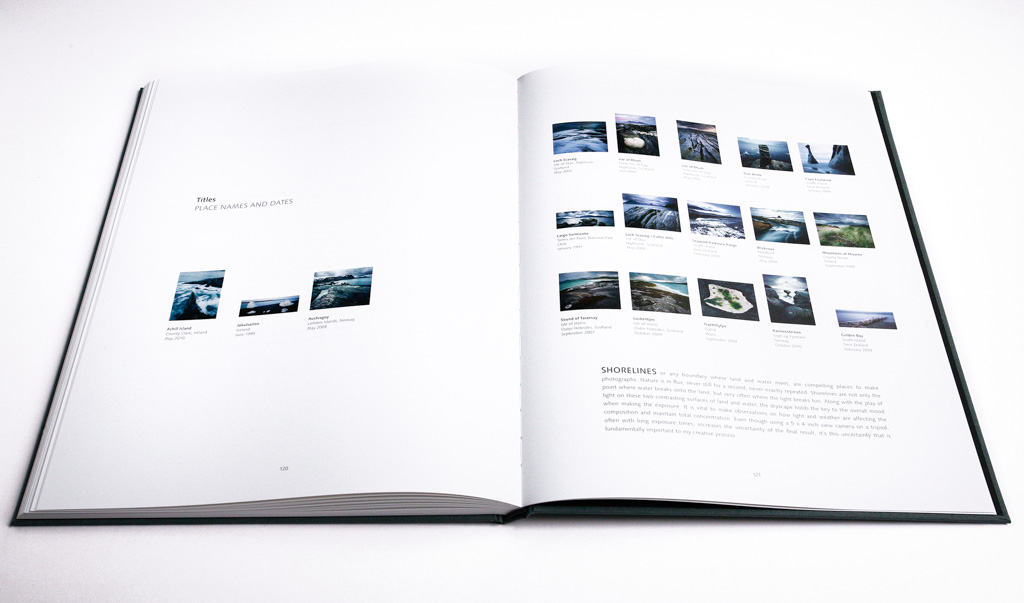
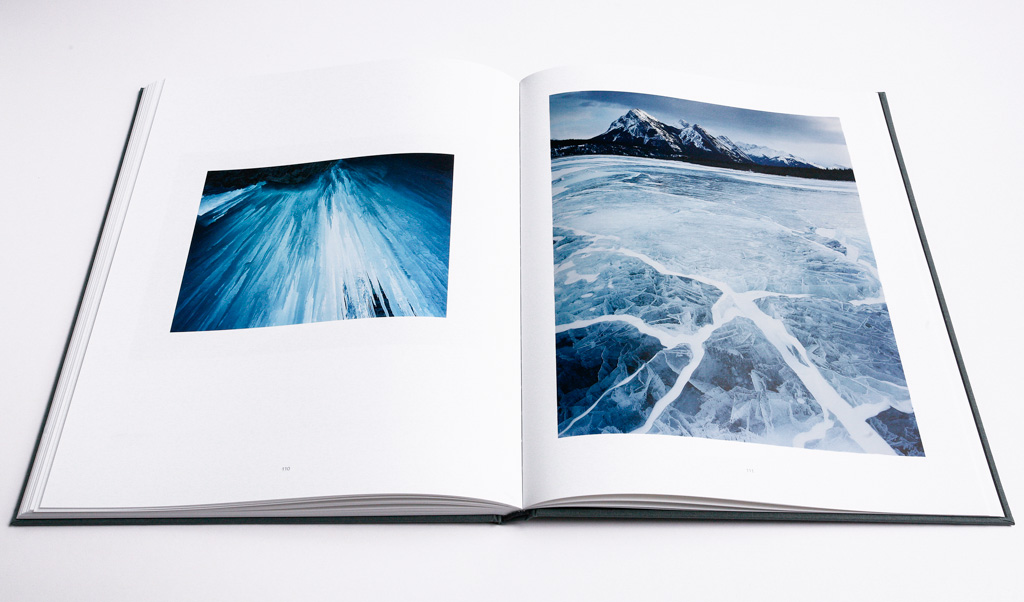
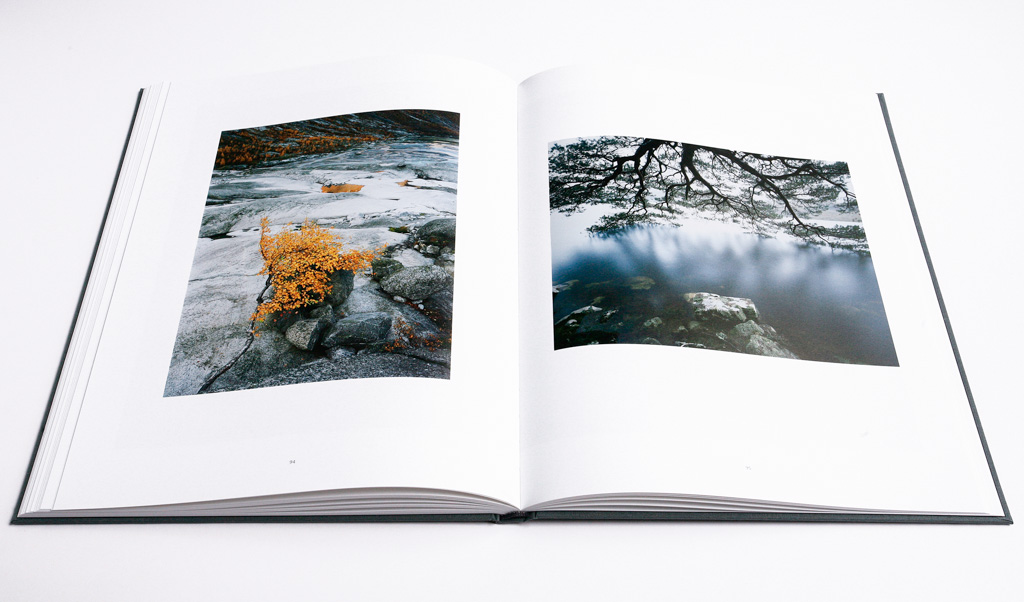
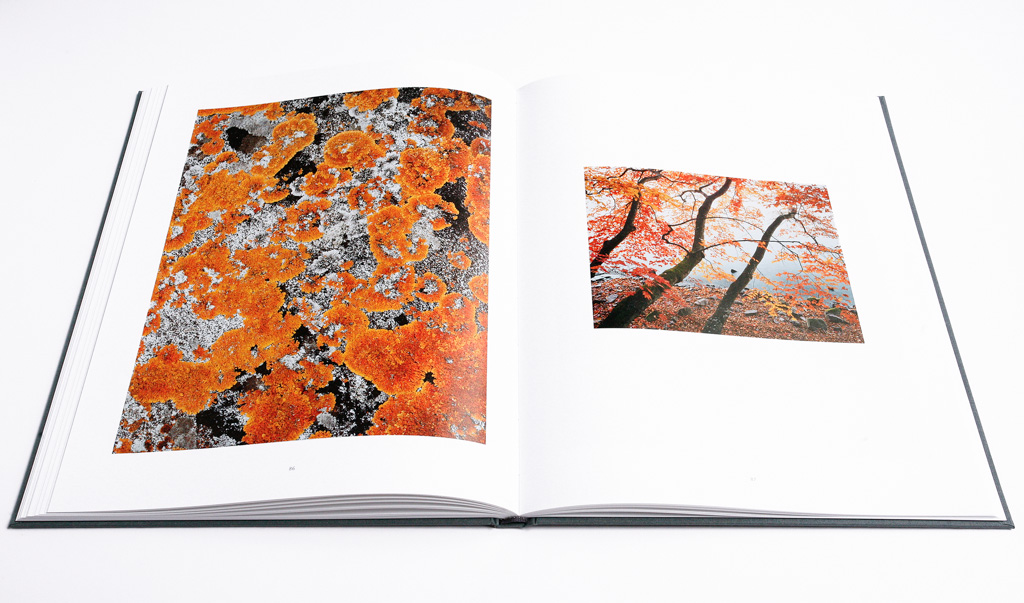
This book is an unusual prospect for the reviewer as firstly it contains work by a number of different photographers, and secondly because it is clearly designed to be the first volume in a series, so I feel it is better to discuss the work and the production separately as the production is likely to remain constant for future volumes. The book is very nicely printed, and the variety of papers and printing methods provides a very tactile experience. The inside is a combination of very thin paper for text sections and sumptuous matt paper for the images, and combined with the silky matt cover, it gives a feeling of being a high-quality publication. The dimensions and bulk of the book remind me of publications like the British Journal of Photography and in some ways I think that this should be viewed as an overachieving magazine, rather than a book.
Land|Sea is something of a compilation album, but I don’t want you to think of it as a Greatest Hits type of affair; they’re trying to do more than that. The collaboration with On Landscape has enabled the publisher to select a small group of photographers that are very different from each other, and that are able to demonstrate high levels of skill and creativity in their own area of the landscape photography spectrum. So perhaps this book is more of an anthology designed to give a flavour of the variety that is out there, rather than something designed to illicit a “Wow!” response.
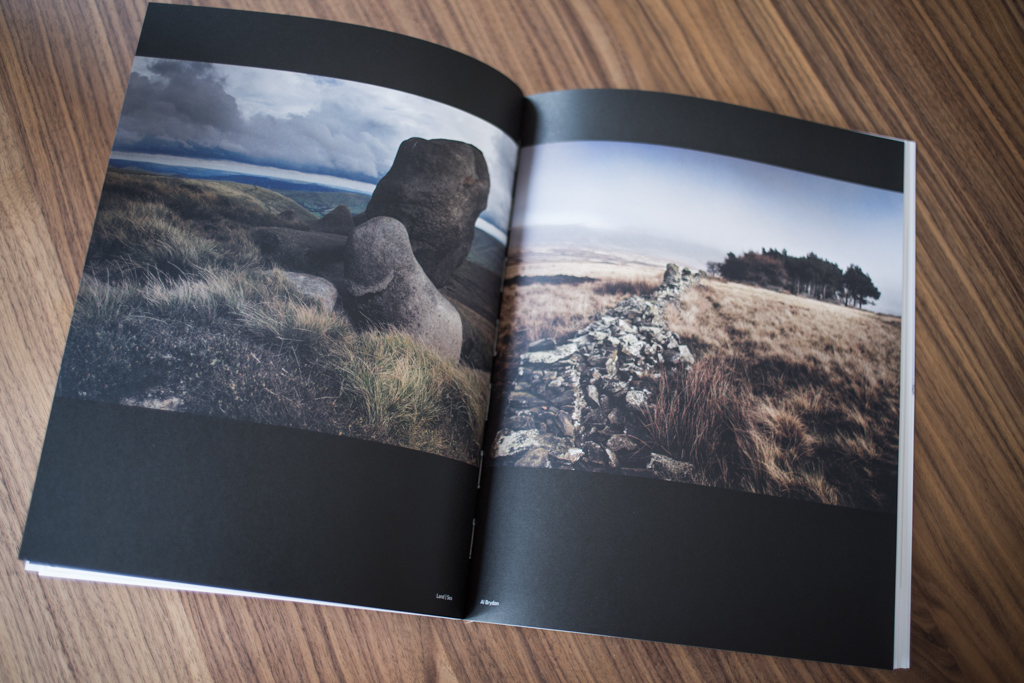
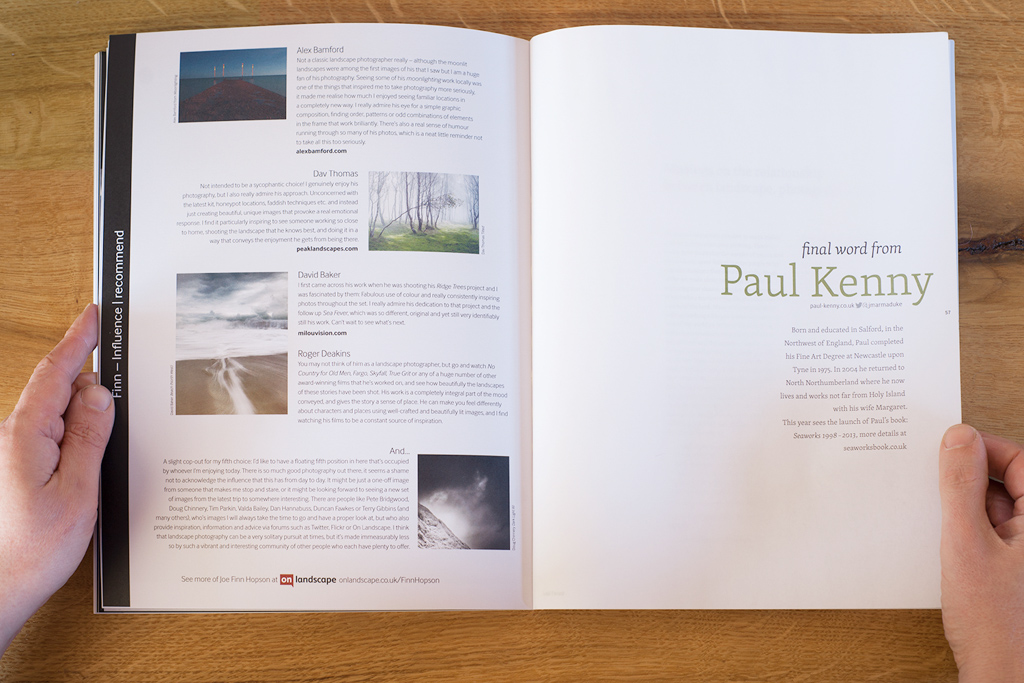
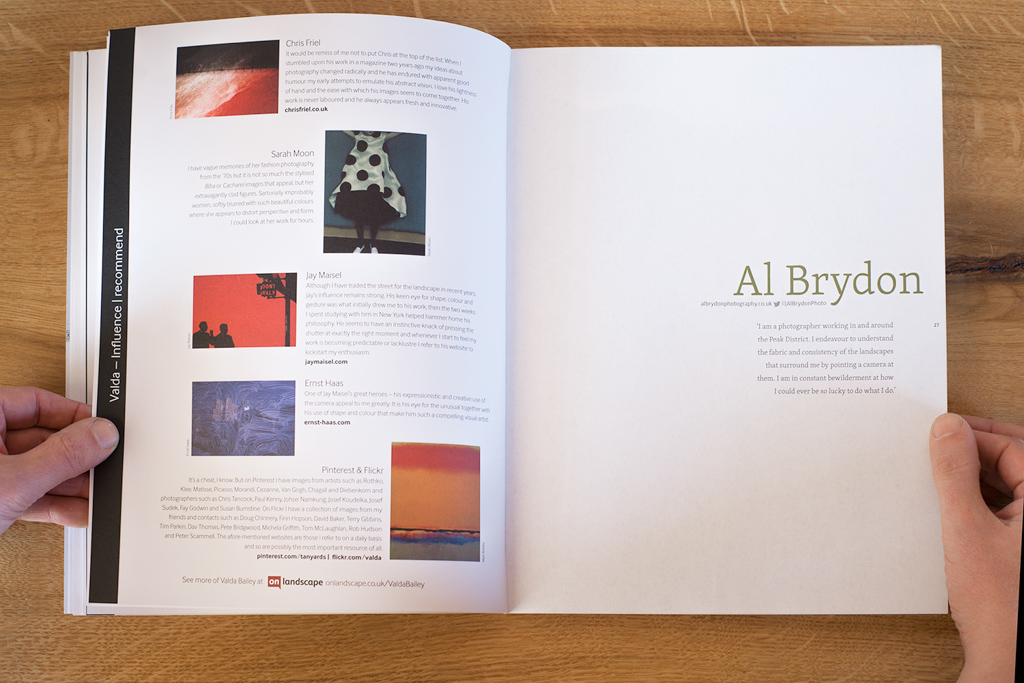
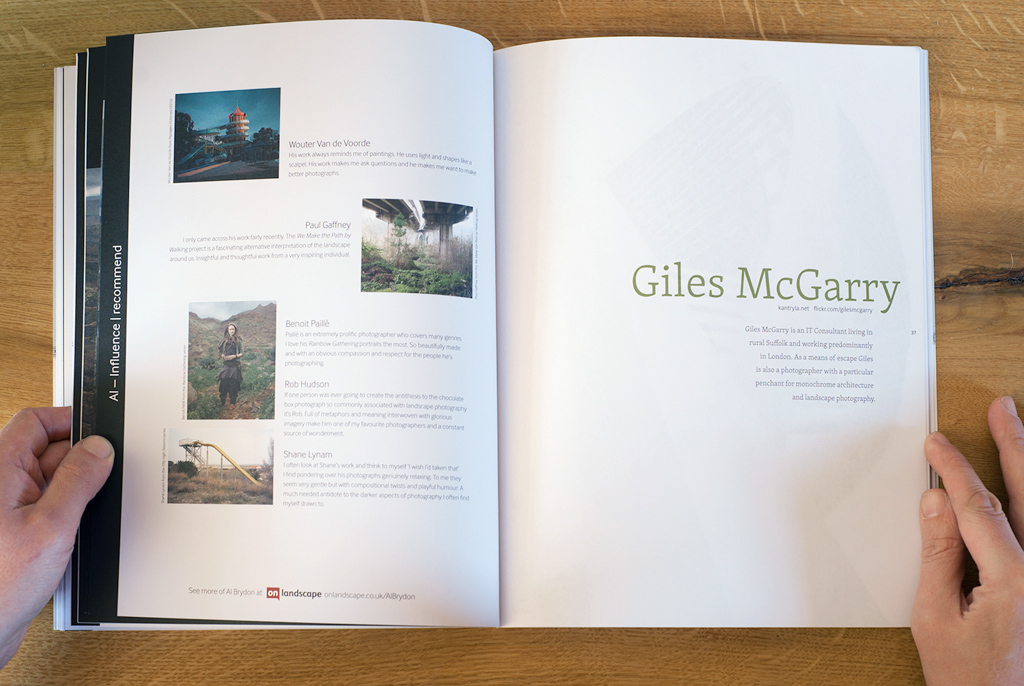
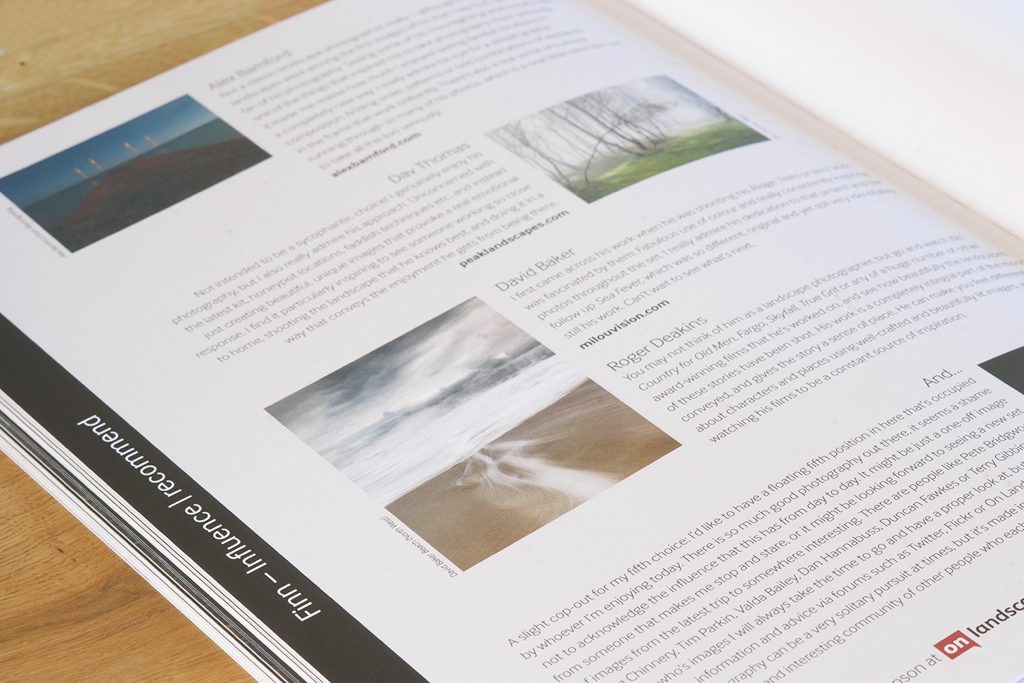
Each of the photographers featured in the book (Joe Wright, Valda Bailey, Al Brydon, Giles McGarry and Finn Hopson) get eight pages in which to show their work, and with each is either a short essay about their method and philosophy or a question and answer session, very reminiscent of On Landscape’s Featured Photographer articles. There’s also a very good essay by Paul Kenny at the end of the book: a discussion piece about the relationship between Landscape, Photography and Art. Whilst an enlightening read that helps us to understand how Paul came to produce the work in the way that he does, I would have perhaps preferred him to write a piece about his views on the work represented in this book.
Joe Wright
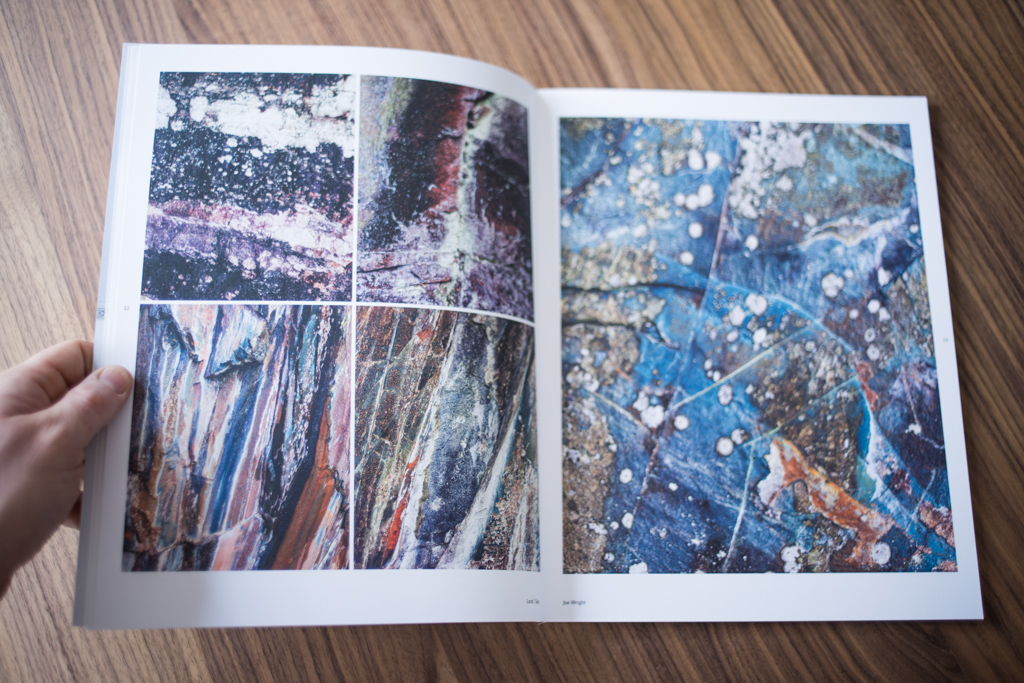
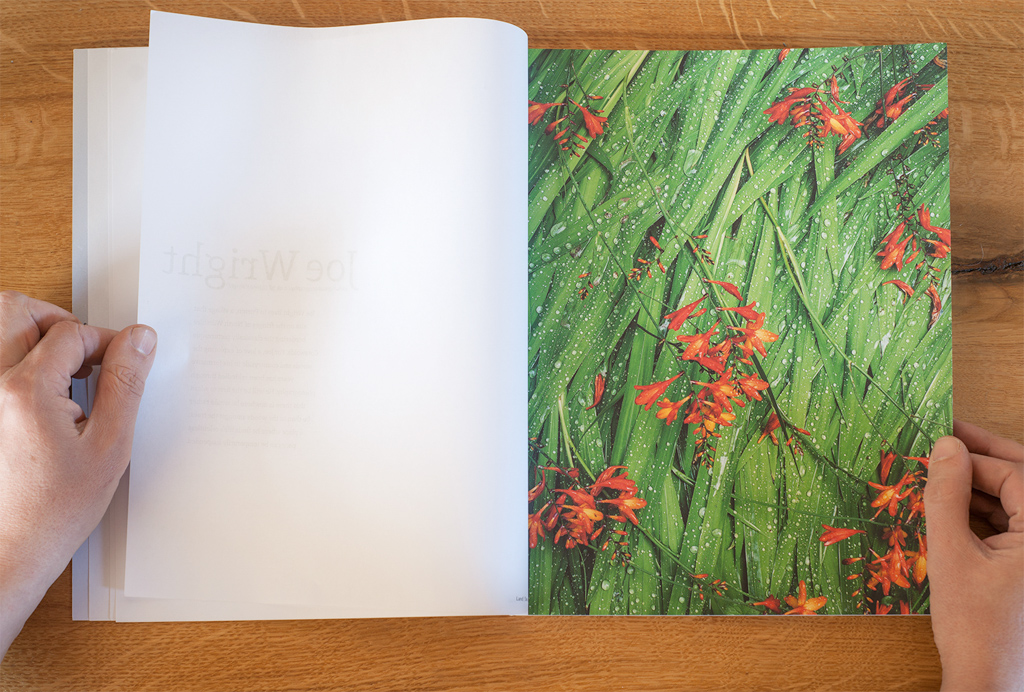
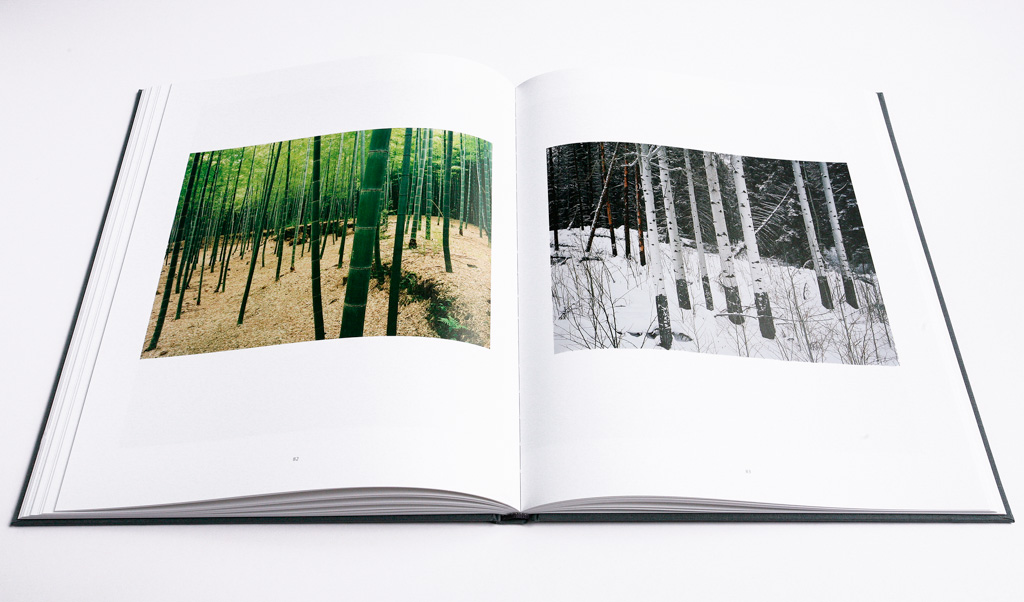
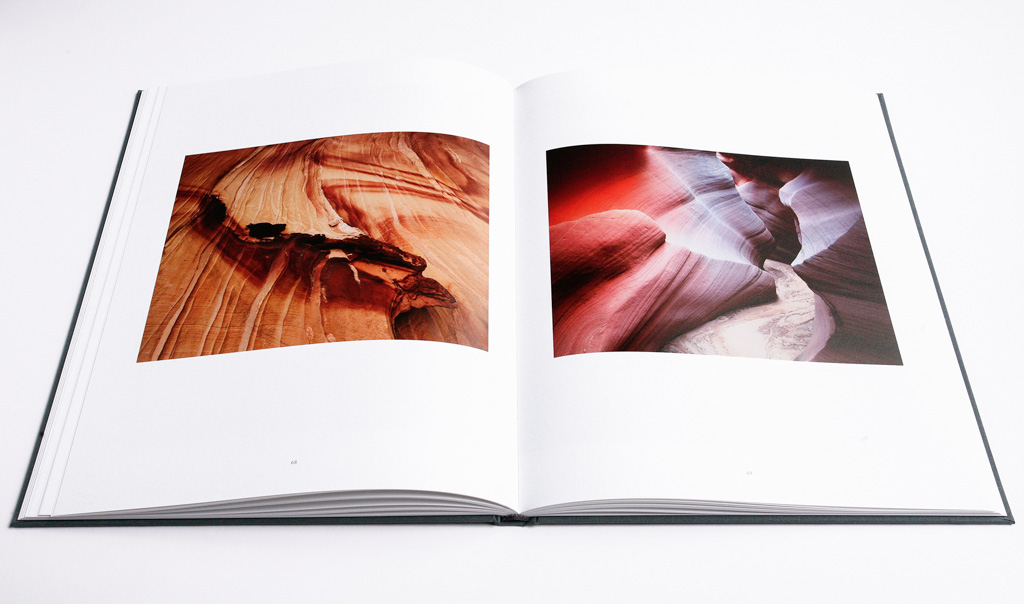
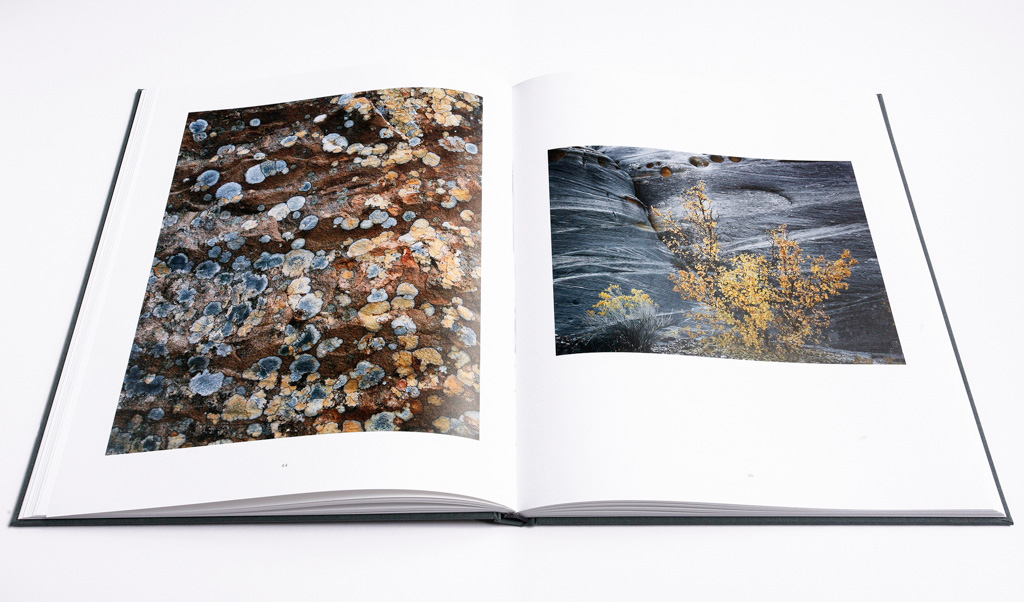
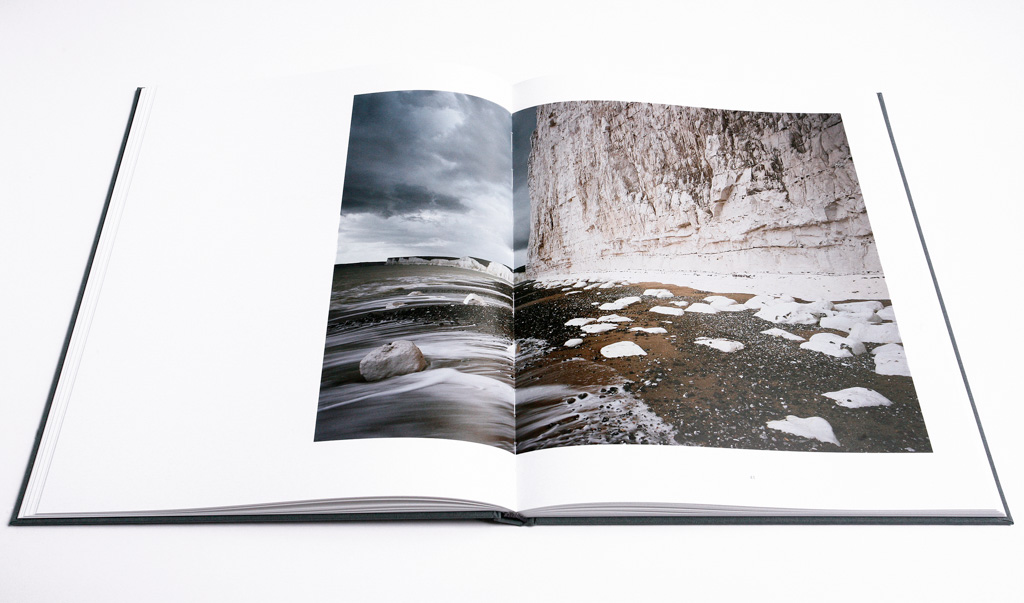
I have spent time photographing with Joe in the past, and I have always marvelled that such quiet and gentle work can come from such a giant of a man. The first image in the main body of the book is a simply stunning image of a pile of rain-soaked Crocosmia, with glistening water droplets and rich, juicy colours. I was so pleased to find this image at the front of the book, welcoming me, warming me and encouraging me to sit down and read the rest of the book in one sitting – not something I’m prone to do. Alongside Joe’s thoughtful prose on the virtues of the British landscape is a pair of literally reflective images that sit well opposite a peaceful, almost monochrome winter woodland scene, before an explosion of colour in the rock studies over the page. Describing these images as simply rock studies doesn’t do them justice however, as the rich colour relationship between the five is both pleasing and jarring and demonstrates the pre-visualisation of the set as a whole.
Joe’s final pages are devoted to a pair of images (my favourites) that show his ability to spot images where others might not, and how he can combine still and dynamic elements to create images that confuse and titillate the senses. I’m looking forward to seeing more of Joe’s work in print in the years to come.
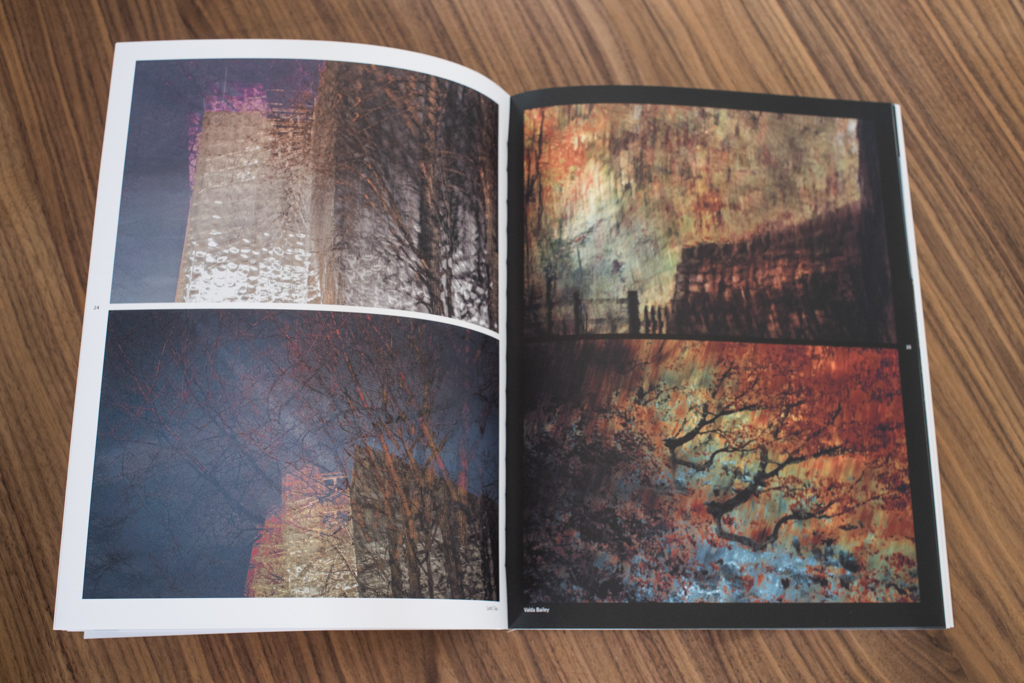
I have often felt that amongst arty types, photography is viewed as a poor cousin, a runt of the litter, and not particularly artistically valid. Indeed, on reading a book titled “101 Things to Learn in Art School” recently, I saw an illustration depicting a camera with the title “Always document your work” – the implication being that photography is only for documenting art, and cannot be art in itself. Paul Kenny’s article in this book discusses that photography can be art, and that the subject isn’t important, but other less tangible things are. Valda’s work for me perfectly illustrates how it is possible to use the medium of photography to create “Art”, and I can’t see how it could ever be accused of being merely descriptive and illustrative in the way that photography often is.
I find it difficult to describe adequately the images that Valda creates. She makes, in camera, images that in my view aren’t photographs: they are individual artworks created with a camera. I think that photographs in the traditional sense can become art if they are viewed as part of a portfolio that has something to say more than just “this is a pretty picture”. This simply isn’t the case for Valda – each one of these images deserves in my view to be considered as art on it’s own, let alone as part of a portfolio. Her images are rich in colour, lush in tone and are long-lasting because of their confusing nature. I can look at most traditional photographs and know pretty much how they were made, but with Valda’s I mutter with child-like wonder “How on Earth did she do that?” I would be doing her a disservice to try to describe these images to you, so I won’t. But you should definitely check her out.
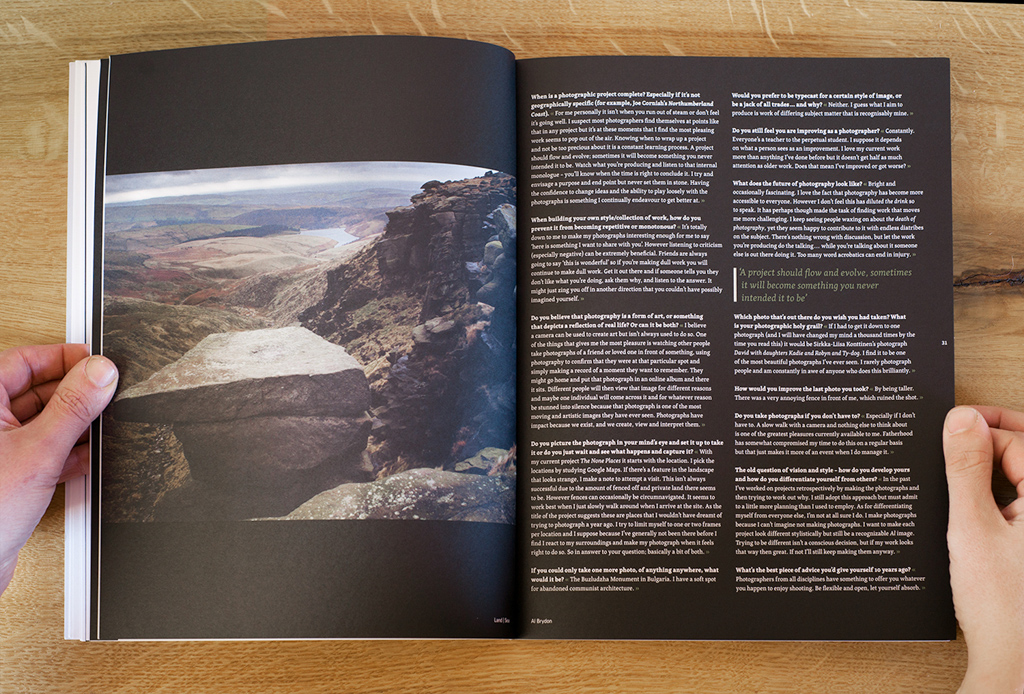
The last ten years in landscape photography has mostly been about big vistas and bright colours, and the mainstream photography press has perpetuated this because it looks superficially appealing on the page. It’s always a relief to me then when I am allowed to look at work that is less colourful, less contrasty and that has less obvious compositional structures. Those images permit me to have more than a “Oooh” reaction; they let me stroke my imaginary beard instead and ponder them. Al’s images are predominantly dark and brooding, they demonstrate careful and well thought out solutions to compositional problems, and there are strong lines of energy movement though largely static structures.
The pair of full-page images in the middle of Al’s chapter of the book are particular favourites and complement each other well. I find them inviting and they make me want to explore those places and find my own images too, but not because I want to take the same, but because his images make me believe that there are so many possibilities in those places. The set hangs together well in tone and style, although I’m not convinced all of the images work well with the printing method employed in creating the book. The matt paper on which the images are printed is actually quite reflective and I found that I had to move to the window to get the best out of Al’s darker images. It’s a minor thing indeed though, and I found the imagery and the humour in the accompanying interview particularly enjoyable.
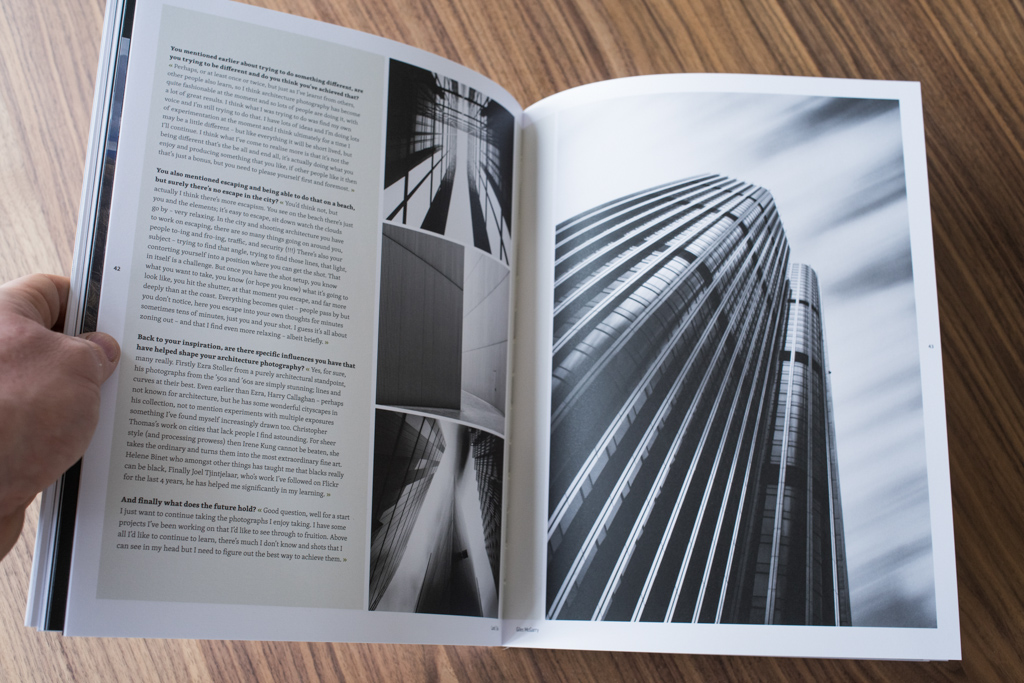
Giles is another photographer with whom I have been lucky enough to spend a day over the last couple of years. We went out in the rain around central London and came back with pretty much no images at all, but we spoke about our mutual love and respect for architecture. Architectural photography is my game, and so I take real pleasure in not only the subject matter of Giles’ photography but also the way in which he approaches it – a way completely different to mine.
Some may question why a portfolio of architectural photographs is appearing in a book of landscape photography, and they may have a point, but a prospective client of mine hit the nail on the head a few years ago when he said of architectural and landscape photography: “They’re the same thing, right? You’re looking for the same things in the photographs.” In this respect, the artier side of architectural photography should feel right at home alongside images of the landscape.
Giles’ love affair with line and texture is evident in this portfolio of images. The techniques he employs in making his images may be quite common these days since the rise of the Big Stopper, but this level of attainment is not at all common. His employment of both high and low key, angular and rounded shapes, smooth and jagged textures give a nicely balanced set that leaves me wanting more.
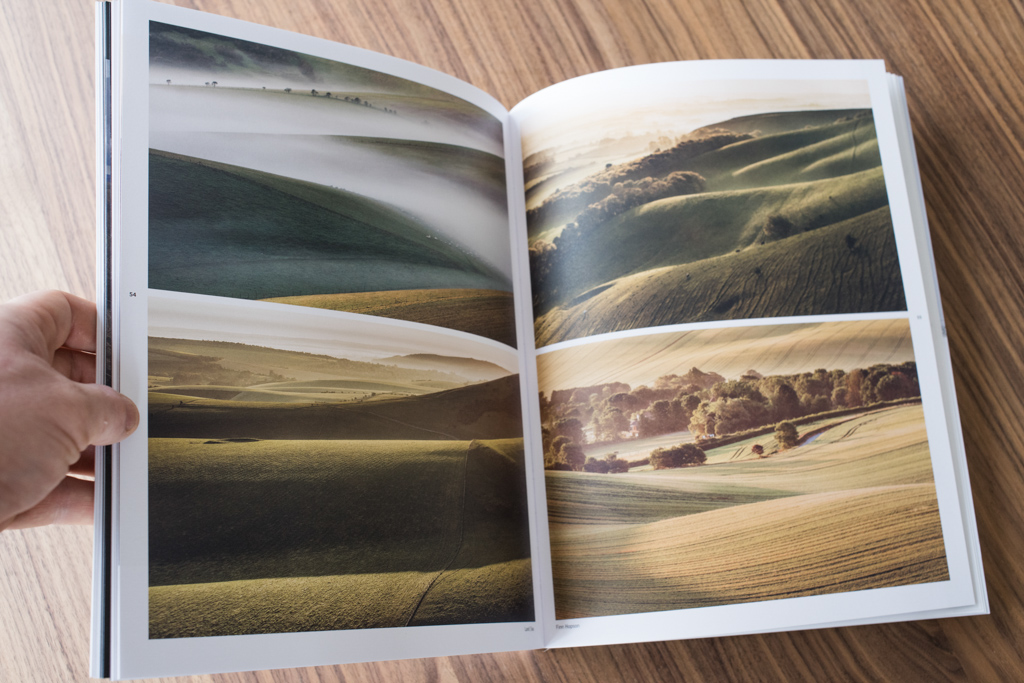
I hope Finn will forgive me for revealing that out of all the photographers featured in this book, he is the only one I hadn’t heard of before. This is I think one of the strengths of the book as a whole: it introduces you to a selection of photographers, different in style, and you probably won’t have heard of them all.
One of the difficulties I have with my landscape work is finding the time to get out and make images, and I have noticed that the better landscape photography output usually comes from photographers who make images close to home. This is no accident, as I think real success comes from repeated visits and getting to know an area intimately. Finn is another to add to the list of image-makers who show that regular visits to the same area yield stunning results. His peaceful images of the South Downs stir emotions in me, and certainly make me wish I lived nearby so I could go for long walks in those places. In my view, a successful image is one that conveys the feelings of the photographer or that makes you imagine what it is like to be in that place. The final spread of Finn’s chapter feels like it should be a montage of images to accompany a great piece of Elgar, a combination designed to make you fall in love with England and its landscape.
I feel that all the photographers featured should be proud to be involved in the first volume of hopefully a long series. The premise itself is a sound one: create a high quality showcase of skilled landscape photographers, and I hope that the series gets the attention and sales it deserves so that there are more editions to put beside this one on the shelf.
Route 66, The Mother Road. Taking in eight states, the route once epitomised the American dream. In the forties and fifties it’s travellers would journey from Chicago in the east to Los Angles in the west. The reason for the journey was the journey itself. The image of Route 66 was its cars, hotels, diners, gas stations and the people that made the experience remarkable.
Roll forward more than half a century and things are now very different. In the seventies and eighties the US interstate roads by passed the towns and cities along route 66, which together with the road itself, fell into decline. Today Route 66 exists only in sections, but those sections are really worth visiting. Much of the route has become the interstates i-55 and i-40, roads which are also worth travelling. Many of the towns and cities from the heyday are still there. Some are in better condition than others but all are worthy of a look. And whilst much may now be faded it is still the cars, hotels, diners, and gas stations, not forgetting the people that continue to make the experience of today fascinating. Perhaps in a different way to how it was all those years ago, but a journey along route 66 is still unforgettable.
This issue we're featuring Canadian photographer Kyle McDougall who has some beautiful imagery of Ontario and it's surroundings (and more!).
If you could also tell us where you live and what you do for a living that would be great.
I am a landscape photographer based out of the Muskoka region in Ontario, Canada. For a living I run my own business, which includes work as a cinematographer and editor for television/commercial projects and also landscape photography focused on writing, prints and teaching private workshops (soon to be group workshops).
Can you tell me a little about your education, childhood passions, early exposure to photography and vocation?
I grew up in a larger city in Ontario, Canada, but as a child was exposed to nature on a regular basis with trips to the family cottage further north. I spent my summers exploring the forests around the area as any child would, fishing, swimming, hiking… in search of the next great adventure. I guess I would say that I always had a special connection with nature although it was never exposed, or I never understood it until later in life. After finishing high school I moved out to the Western Canada to spend some time in the Rocky Mountains, which is where I bought my first DSLR. I always had somewhat of an interest in photography, but living in the mountains is where my passion really started to develop. I started creating images whenever I had the chance, and was always excited regardless of the results. It was only natural that with my love for the outdoors, almost all of my photography was focused on my surroundings. I enjoyed the personal approach to creating images and the fact that the results were a reflection of my dedication and commitment. Out of this grew an interest in cinematography, which lead me to move back home and attend school for Film Production. I spent the next two years training in still photography and motion picture film, specifically super 16mm. After graduating I started work as a cinematographer and editor for a couple of television shows, and also found my direction with photography. This is when my images started to focus solely on the land and my passion for nature started to strengthen.
What are you most proud of in your photography?
I would say what I’m most proud of is the journey I’ve created through photography and my growth as an artist. Any creative person knows that no matter how passionate you are about your craft, there are always low points, and what matters most is staying passionate, persistent and curious. It’s the journey that has the biggest impact on your images, therefore it’s extremely important to stay true to yourself and not try to follow someone else’s path. Because of this, photography has evolved into something so much bigger then I ever thought it would be. It has taught me an immense amount about both the land and myself and has grown my appreciation for the simple things in life immensely. I know I still have a huge road ahead, but am excited for the challenges and excitement that the future holds.
In most photographers lives there are 'epiphanic’ moments where things become clear, or new directions are formed. What were your two main moments and how did they change your photography?
I think the biggest moment was when I realised the importance of creating images for myself, not simply trying to please others. I think in the beginning, we all reach a point where we become proficient enough to create images that are technically sound, and we are left searching for other ways to improve our photography. For me, this is where I started to realise the importance of personal vision. The closer I looked the more I started to see and as a result my images started to possess more personality as my appreciation for the land grew stronger. It was this realisation that an image doesn’t have to have bold colours or a dramatic sky to be “successful” that had a profound affect on how I work. I think it’s only natural that starting out we all try to create images to please others in hopes of gaining acceptance. Unfortunately the only thing this does is leaves us creating work that lacks uniqueness and self-reflection. When we strip ourselves of pre-conceived outlines and rules, our images grow stronger. The other moment would be the realisation of how important the experience is. I think we all get to a point where we are so set on creating a great image that we try and force things, forgetting why we are out in nature in the first place. Because of this, the experience becomes un-enjoyable and any images we do create are certain to be affected by it. Now, if I’m at an area and something isn’t working, I simply take a break, and enjoy my surroundings. I will find an image when the time is right, and usually that’s only when I have a clear mind. Both of these things have taught me to take a slower, more detailed approach to creating images, and in the end have shaped the direction I’ve gone with my photography.
Tell me about why you love landscape photography? A little background on what your first passions were, what you studied and what job you ended up doing.
I love landscape photography because it has influenced me to explore places that I may not have otherwise ventured. It has been a big reason why my passion for the outdoors is as strong as it today. It has pushed me out of my comfort zone on many occasions and has taught me many lessons. There is nothing more exciting then going out with my camera to explore for the day, either at a new dramatic location, or somewhere close to home that I’ve visited many times before. It’s the curiosity of what I’ll find that drives me. Like I said before, my passion for nature was always there, but I believe photography was the tool that exploited it and grew it into what it is today. I’m fortunate to do what I love for a living, that being photography and cinematography. Most of my cinematography is lifestyle/action sports based for television and has me working outside and traveling throughout North America. While not directly related to landscape photography, I’m constantly learning as I’m behind the lens, composing and using light in similar ways. I feel that it’s played a large role in developing my vision.
Could you tell us a little about the cameras and lenses you typically take on a trip and how they affect your photography.
The kit I use is pretty simple and consists of a Canon 5D MKII, Zeiss Distagon T* 21mm f/2.8 , Zeiss Planar T* 50mm f/1.4 and Canon 70-200mm f/4 L. I switched to the Zeiss primes after not being completely satisfied with Canon’s wide-angle zoom lenses. The Zeiss 21mm seems to be the lens that is on my camera the most, although I never approach an image from a focal length standpoint, I always visualize first and then select a lens based on what I want to show. I like the Zeiss ZE series lenses because I know I can rely on them to resolve the most detail and produce the cleanest results. The 21mm in particular is the most impressive wide lens I’ve used and captures stunning detail from edge to edge. I’ve enjoyed working with prime lenses as they match my slower approach. They also work great for shooting video with their smooth focus throw. In the future I’d like to keep building my collection of primes starting with the Zeiss 35mm f/2 ZE. When Canon eventually releases a body with more resolution I’ll likely make the upgrade, but for now the MKII serves me well.
What sort of post processing do you undertake on your pictures? Give me an idea of your workflow.
Like everyone else in the digital age, processing plays a large role in my work, but in varying amounts depending on the image. I strictly use Photoshop for all of my images. My process starts off in Camera Raw where I optimise my “digital negative”, sticking to minor exposure adjustments like black levels, shadows and minor highlight recovery. From there I will apply capture sharpening and remove any lens aberrations if need be. After this, all of my adjustments are done in Photoshop through a series of layers and layer masks. Again, the amount is very much dependant on the image and can be very simple or very complicated. Post processing for me is a way to overcome limitations of the camera and also shape my personal vision. I often use manual blending for exposure issues or focus stacking to avoid lens diffraction. Luminosity masks also play a large role in my processing workflow as a way to target specific tones throughout my image. Every time I process an image I refine my techniques in small increments, even if I notice it or not. All of my images are saved as TIFF master files and then duplicated for printing, web etc. I often find myself revisiting old images as my skill and techniques become more refined.
Do you get many of your pictures printed and, if at all, where/how do you get them printed?
I print all of my images myself up to 17” wide on an Epson 3880. For images any larger I outsource to a local landscape photographer who I have a good relationship with. The printing process is something that holds a lot of value. In my opinion, the image truly becomes complete once it’s printed. I use a range of papers depending on the image but recently have been using Red River’s San Gabriel Semi Gloss Fibre. I also use Ilford Prestige Smooth Pearl. Matte papers are something that I haven’t yet experimented much with but may in the future depending on the image. It’s an exciting process as I always find myself making small refinements every time I print an image.
Tell me about the photographers that inspire you most. What books stimulated your interest in photography and who drove you forward, directly or indirectly, as you developed?
In our day and age with the Internet we have access to so much inspiring work, it’s almost overwhelming. There are so many talented photographers out there, some with whom I’ve had the privilege of getting to know. Someone who has had a big influence on my work has been Guy Tal. Not only for his images, but also his writings. I admire his passion, mindset and approach towards creating. There have been a number of books that have had large influences on how I work. David Noton’s “Waiting For The Light” was one of the first books I owned that really introduced me to the intricate process of creating an image. I’ve also enjoyed Alain Briot’s collection of books published under Rocky Nook. And of course Galen Rowell’s classic Mountain Light. It’s books like these where photographers really express themselves and their approach that have had the biggest influence on my photography.
What is the landscape photography community/scene like in Canada compared with your perceptions of the US or Europe?
This is a tough one but I would say that the landscape community in Canada seems a lot smaller and because of this possibly tighter knit. Obviously, with Canada’s population being lower than both the US and UK there are less of us landscape photographers around and therefore it becomes easier to get to know everyone who is involved in the scene. I could be wrong on this, but that’s what I would assume. Lately, I’ve noticed more people start to take an interest in landscape photography, which is exciting. You don’t have to go far in Canada to be surrounded by nature, which is a big benefit for us. The amount of inspiration around is endless! That all being said, social media has really changed the way we interact and has opened up the door for us to meet other photographers from all over the world.
Tell me what your favourite two or three photographs are and a little bit about them.
What I consider my favourites are constantly changing the more I create. At the moment, if I had to pick three, these would be them. They are all similar in subject matter, which I think shows the direction my photography is headed.
“The Stand Off” : This was one of the first images I created from a “visualisation” stand point a number of years ago and it really changed the way that I approach my work. I had passed by this area many times and eventually decided to stop and scout out possible images. I was attracted to the lone tree on the riverbank and knew that with where it was located there was the potential to work with dramatic light to create a strong mood. I returned one morning at the start of winter with frost covering the land and mist slowly rising from the water. I waited for the right moment when the tree was backlit and a select portion of the warm morning light had spilled on the foreground. It’s this layering of light and shadows that I feel give images a strong sense of depth.
“The Tree Of Life” : I created this image last autumn at a location close to my home. By far, my favourite time of year to shoot is in autumn when the mix of varying temperatures creates thick fog and mist that blankets the landscape. I’m always attracted to busy scenes and the way that mist can simplify them. I explored this particular area for over an hour searching for the right image. I’ve found that a lot of my images focus on trees. I think they have a lot of qualities that attract me, one of them being lines. I really liked the way that the foreground trees act as a frame and seem to “guard” the centre tree. The bird’s nest in the centre tree was what ultimately completed the image for me.
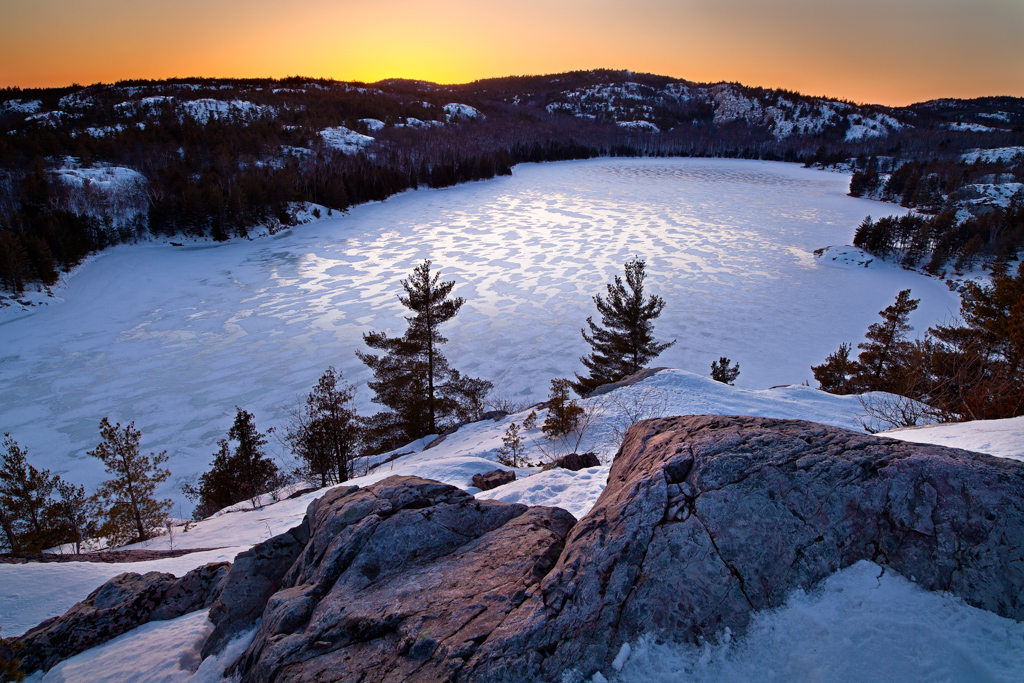
“Winter Warmth” : I spent three days camping at this location, exploring and photographing throughout the days. This particular evening I climbed to the top of a ridge to capture the fleeting light and a vista of the surrounding lake. The first image I created was a wider view, which shows off the surrounding land, but in the end it was this more intimate composition that resonated with me the strongest. I’m always attracted to mixing warm and cool light and the effect it can have on the final image.
If you were told you couldn’t do anything photography related for a week, what would you end up doing (i.e. Do you have a hobby other than photography..)
I would most likely go camping, canoeing or hiking, just without my camera. Or work on one of my personal projects related to Filmmaking (Does that still count?). I’m passionate about telling stories and have a short documentary project in the works focusing on another artist. I think that everyone has a story to tell or at the very least a meaningful message. I really enjoy exploring the possibilities of impacting others through filmmaking. Cinematography really interests me… mainly the power and complexity of it.
What sorts of things do you think might challenge you in the future or do you have any photographs or styles that you want to investigate? Where do you see your photography going in terms of subject and style?
My plan for the future is to follow whichever path my photography takes me. I haven’t ever had a specific style that I’ve tried to follow; rather, I’ve just let my photography take me in specific directions and embraced them. I really see my work exploring the finer details and more intimate scenes in nature. This is something that over the past couple of years I’ve noticed myself trending closer towards. I really enjoy exposing the amazing scenes in nature that many others miss. I think for all of us, as our eyes and minds become more refined, it’s these details that interest us more rather than what’s most obvious.
How do you work with both moving and still image together and is it possible to do both at the same time?
My photography and video work are very separate endeavours. Landscape photography for me is a very slow and personal process. Most of the time when I head out to shoot I only end up creating one image. Also, there’s the fact that the results are based solely on my own input and effort. When I’m shooting video, it’s usually under very different circumstances. All though I approach this type of work from a cinematic standpoint and spend as much time composing and creating shots as I can, I have to work fast as each shot is just one piece of a scene, which in the end is made up of a large number of shots. With moving images you are almost always working with a number of people in the production, and all of these people play a big role in how the final product turns out.
How does telling a story differ when using stills or moving images?
Telling a story is very different between both mediums. Obviously, moving images are used in groups and are usually accompanied by dialogue, sound and music to tell a story. Whereas a still image has to stand on its own and really comes down to how deep a viewer looks into the image and how they interpret it. That being said, it’s still important to create moving images with as much meaning as possible so they match/suit the overall mood and story you are trying to tell. Both have their challenges but in a way I would say it’s almost more difficult to tell a story with a still image as opposed to a moving image. I enjoy the fact that both have their own unique challenges. Who do you think we should feature as our next photographer?
If I had to suggest someone I’d say my good friend Greg Russell as his images and writing posses a lot of depth and are always a source of inspiration.
I must say, sitting at my desk at work completely absorbed in some unmemorable task, it was a welcome diversion to hear my mobile go ping and then see a message from Tim pop up on the screen. With the message saying ‘favourite image’, my concentration was immediately broken and interest piqued sufficiently to want to see what little morsel of information he was about to divulge. On this occasion though, not information about a great little book he had discovered or someone’s work but, an ask; ‘we’re starting a new feature in On Landscape..... pick a photograph to talk about… could be from a book or website or from a colleague’. Should not be a problem I thought to myself, duly agreed and turned my attention back to said unmemorable task.
You can download the PDF by following the link below. The PDF can be viewed using Adobe Acrobat or by using an application such as Goodreader for the iPad.
In part one of this article I looked at the psychological processes that underlie creativity and introduced the notion of flow. I tried to make it clear that creativity is an everyday part of human existence and not exclusively the domain of ‘gifted’ individuals. I don’t pretend to be an expert but it seems plain to me that humans have developed creativity because it has an evolutionary benefit. As history has repeatedly shown, creative leaps of the imagination can lead us to solve what had previously seemed ‘insoluble’. These solutions can lead to better living conditions for individual humans and the species as a whole – though, sadly, not always for the benefit of our neighbours on Earth. Creativity is not limited to artists, it’s a fundamental aspect of human psychology and appears in all walks of life. Scientists and artists – who appear on the surface to have very little in common – share the common tool of creative thought, though they differ in intent. There isn’t a single aspect of human existence that hasn’t at some stage benefited from a little creative thought. The scientists and inventors use it to gain practical advantages but artists use it to enrich our lives in less palpable but nevertheless equally positive ways.
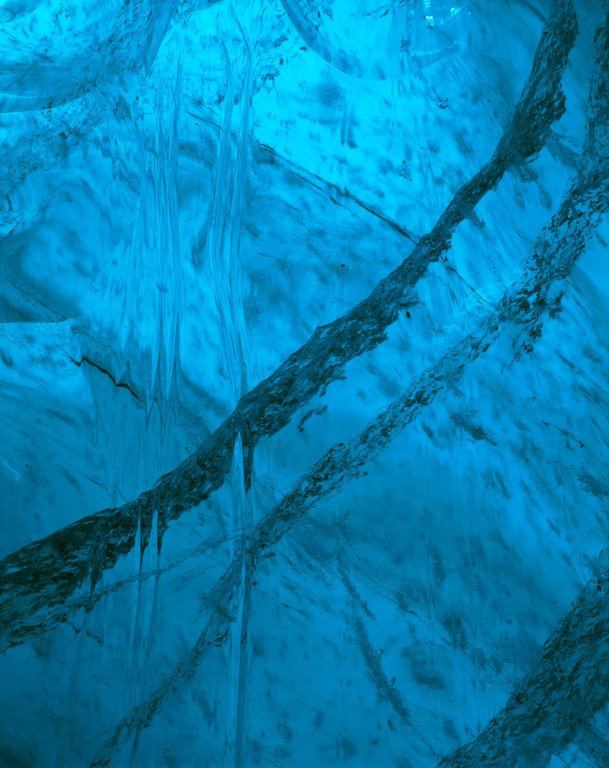
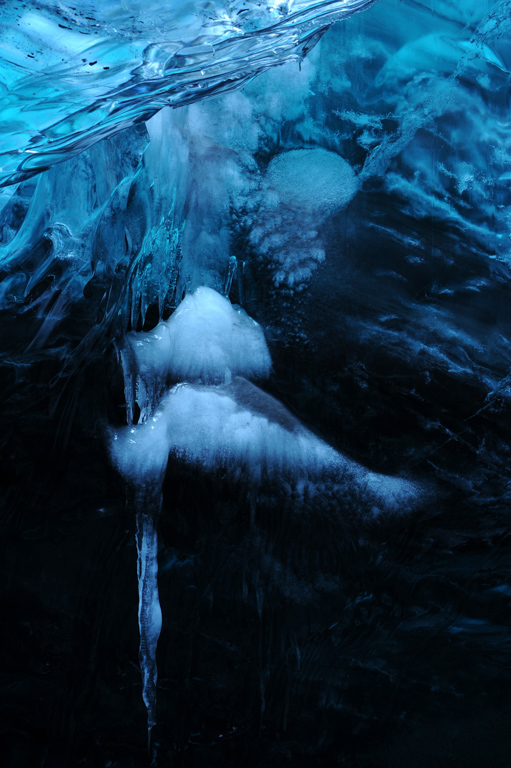
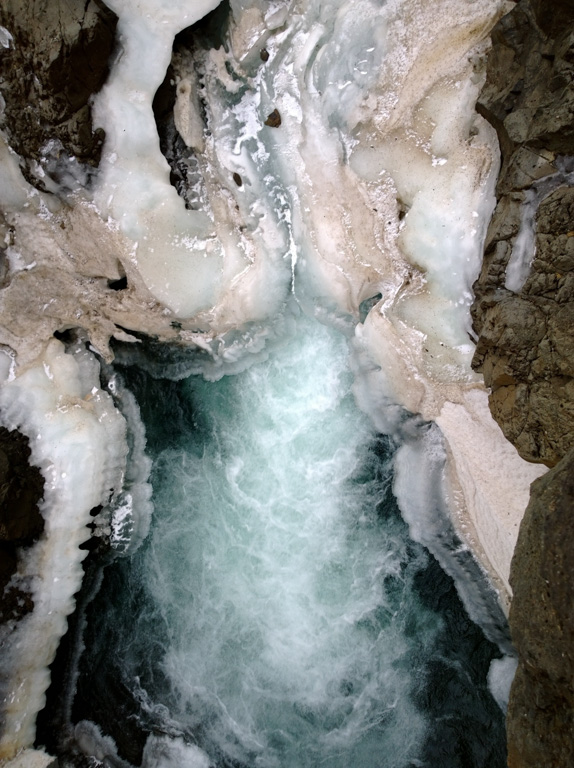
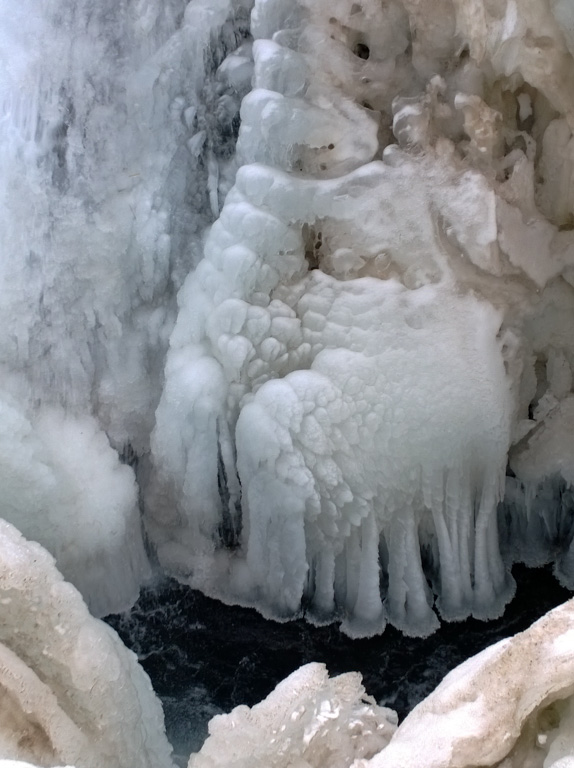
Ice Cave
In this article I want to explore how we might more easily access the heightened state of creativity that comes through flow. Flow is something that we are all capable of through concentrated application. By concentrated I do not mean the kind of furrowed brow, pained expression that might have the caption ‘Thinking!’ appended to it, but rather a calm exclusion of irrelevances - a state oddly more akin to peaceful daydreaming.
Many photographers, as well as other artists, have described this heightened state of awareness. The American photographer, Minor White, equated the preferable state of mind to that of an unexposed piece of film, static and seemingly inert yet pregnant with possibilities, ‘so sensitive that a fraction of a second’s exposure conceives a life in it.’ In an unconscious nod to notions of divergent thought, he suggested that any image might feasibly be formed upon the film (or sensor) and we should be ready to equally accept what passes in front of our eyes, not blinkered by convention or expectation.
Before I describe how we might achieve this I want to write a little about the importance of practice.
Just taking photographs is one way to get into the flow. Over many years I have witnessed Joe Cornish do just that. When arriving at a location new to him, he will spend some time studying his surroundings then start making images. This is a process I call sketching. Each image forms a part of directed play - and may also be a stepping-stone to flow. But I think it’s important to point out that Joe is a master craftsman. For him, the camera is no longer something that stands between his mind and an image, it has simply become the conduit for the image he imagines. Whereas, for less practiced individuals, operating the camera can interrupt the acquisition of flow. This is because self-reflective thinking ("What aperture do I need?", "Where am I focused?", "I need to stop down!", or any one of a hundred other questions…) can inhibit us from entering flow. Once in the flow these questions become part of the focused task.
But we need to enter it first.
I think that there’s a universal problem here. Let me explain it by contrasting Joe’s ease with a DSLR with my unease. When I use rigid bodied DSLR cameras I find it much harder to enter flow. For me, there are two obvious reasons:
Because I’m not as familiar with DSLRs as with a view camera; manipulating them involves tasks I’m not used to such as navigating a menu tree – I have to consciously think how to do things!
And because the ritual I’m familiar with is absent (more about this in a moment).
Both are different aspects of my unfamiliarity with the camera. They are only difficulties because I almost exclusively use a view camera. Joe can enter the flow through making images with a DSLR because he is practiced. And practice is the key!
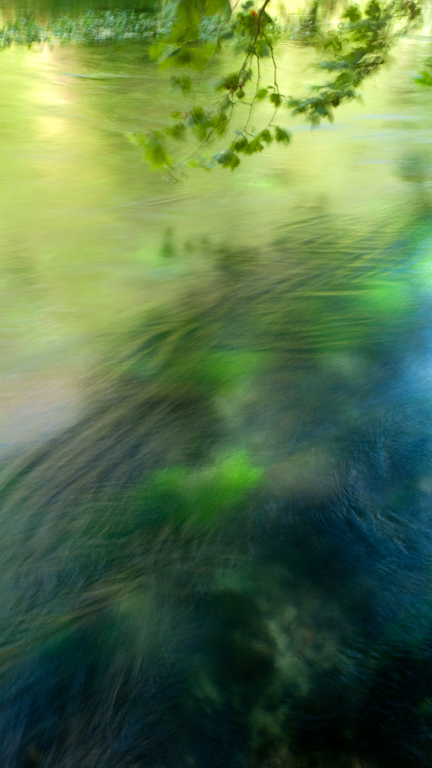
Fontaine de Vaucluse
He uses his cameras (of whatever format) many times a week and sometimes many times a day for weeks on end. Most of us don’t practice that much. If you wanted to play a violin concerto wouldn’t you expect to have to practice every day? Yet we get frustrated when we can’t make good images on the day we pick up a camera for the first time in weeks. If you want to enter flow easily the camera must not be something that you have to puzzle over, you need to be completely familiar and at ease with it. And that takes practice. Rather than thinking of photography as something you do on a special occasion, think of it as something that is an everyday part of your life. Once a day, pick up the camera and play with it. Think of this as practicing your scales. You’re not trying to produce a virtuoso performance, you’re trying to hone your skills and make the camera an extension of your mind’s eye. You don’t have to be in a special photographic place, a hallowed location, to do this. You can do this anywhere, even in your kitchen.
Dos and don’ts…
As I mentioned earlier, it’s hard to exclude everyday irrelevances from our minds when we make photographs. I know that they often crowd in and disrupt my ability to enter the flow state. After many years of trying to find an easier way into flow, I have come up with three guiding principles, one prescription and two proscriptions. Let’s start with the ‘do’.
Develop a ritual…
Flow and meditation are closely allied states - indeed, being in creative flow has the same psychological benefit as meditation with the added bonus that you’re doing something creative. In Zen, and other meditative practices, rituals are often prescribed as a means to enter a meditation. So, it’s perhaps no surprise that rituals also work for entering the flow. Don’t worry, I’m not suggesting that you sit cross-legged and chant before making a photograph. The ritual can be something very simple, informal and undemonstrative. And it needn’t be long. The ritual bouncing of the ball by a tennis player before they serve is a good example. Sometimes they do it twice, then serve. But sometimes you see them hesitate and start the ritual again. It’s not because the ball bounced badly – that’s got nothing to do with the serve - they’re simply waiting until they’re mentally and physically settled.
Some photographers already have unconscious rituals that they go through when making a photograph. This might be something as straightforward as going for a walk in the landscape, or plugging in their headphones and listening to music on an iPod (although I confess that music makes it impossible for me to concentrate on making an image), or just sitting and staring. It’s not a fail-safe approach, but associating some simple task with making photographs can help you to enter the flow. You might try viewing your surroundings through a framing device such as a 35mm slide mount or piece of card cut in the appropriate proportions.
I consider myself lucky that working with a view camera involves working through a prescribed, ordered set of tasks; unfolding the camera, setting it on the tripod, donning the darkcloth, using the focusing loupe, opening the aperture and shutter, applying movements and working through the iterative process of focusing. These amount to a formal ritual. As I step through the process I can feel my visual perceptiveness increase as I relax into a ‘photographic’ frame of mind. I think that the darkcloth is a particularly important part of the ritual as it excludes irrelevant visual information. Under the hood, I am only aware of the image on the ground glass, the surrounding visual context is lost to me. I operate the camera by touch, as musicians do with their instruments. I feel the positions of the camera. There are no distracting menus to scroll through to pick settings, no text to read and process with my conscious mind. I find that I can let my subconscious dominate.
Don’t rush…
Many people seem to feel that they have to make a photo NOW! But placing a time pressure on yourself is almost guaranteed to keep you out of the flow. On photo tours and workshops, the pressure sometimes comes because this might be the only opportunity someone gets to make an image at a particular place. I sympathise with this desire to come back from the hunt with a prize but know that rushing isn’t the way to get first prize.
Of course, the light and the landscape also exert a time pressure: we look out and notice that a cloud will be in just the right position in a few moments and rush to capture it; we see that the sun will soon set and rush to make an image; we see the light flowing across a mountainside and - realising that rain will soon be upon us – rush to pick up the camera… As a wise Yorkshire woman recently said to me, "Dear me, we’re all of a gallop!" It’s very hard not to react to these external pressures but experience has taught me that my images are better if I can resist the temptation.
One participant’s tongue in cheek feedback from my webinar in February was, "I now know that wandering randomly around is a key technique I need to master." That’s frequently what I do, so he’s actually perfectly correct! People sometimes ask me if I feel that I’m missing out on images, by only making a handful a day on the 5x4 as opposed to their tens or even hundreds of frames? The answer is no, I don’t. I decided long ago that I’d rather make fewer images but try to make them count.
Once I’ve found a subject that excites me, I often walk around it for ten or fifteen minutes before I pick up a camera. In that period I’m tuning out of any irrelevances and tuning in to the subject. Minor White suggested that, ‘If you could stop the shouting of your own thoughts in your ears, you might be able to hear the small voice of . . . a pine cone in the sun.’
If you’re struggling to see images, I recommend that you just sit and "be" for a while. Quietly contemplating your surroundings gives you time to really look at your environment, time to lose yourself and connect with its ambience. I strongly believe that time spent just sitting in these circumstances isn’t wasted; in fact it’s often the most productive thing you can do and will pay huge dividends.
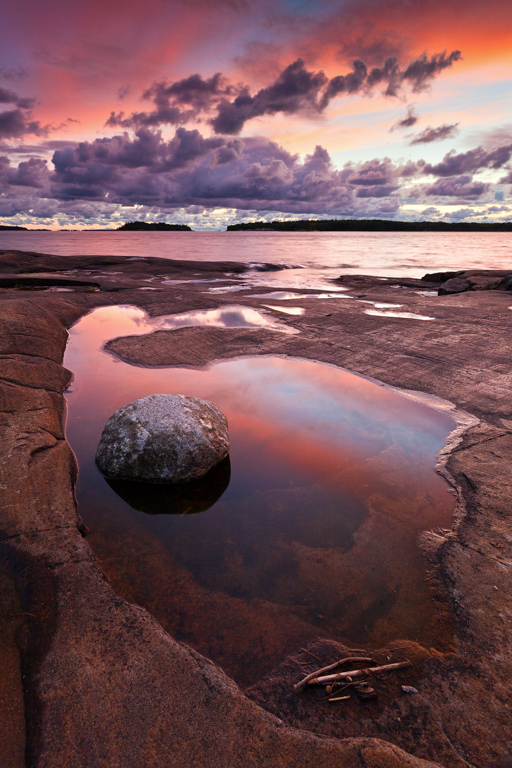
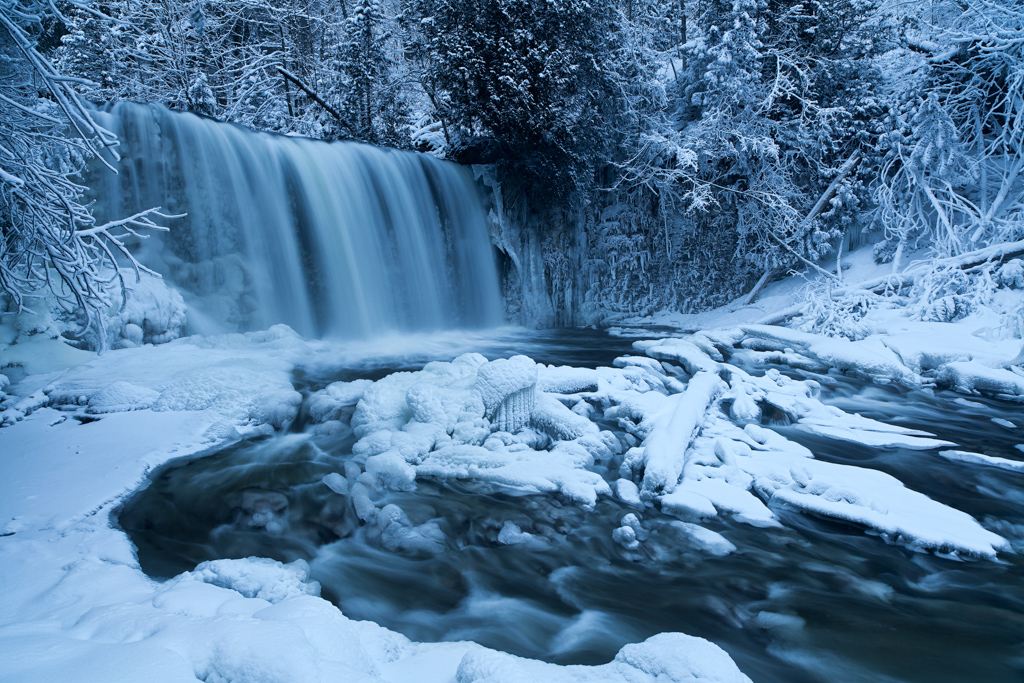
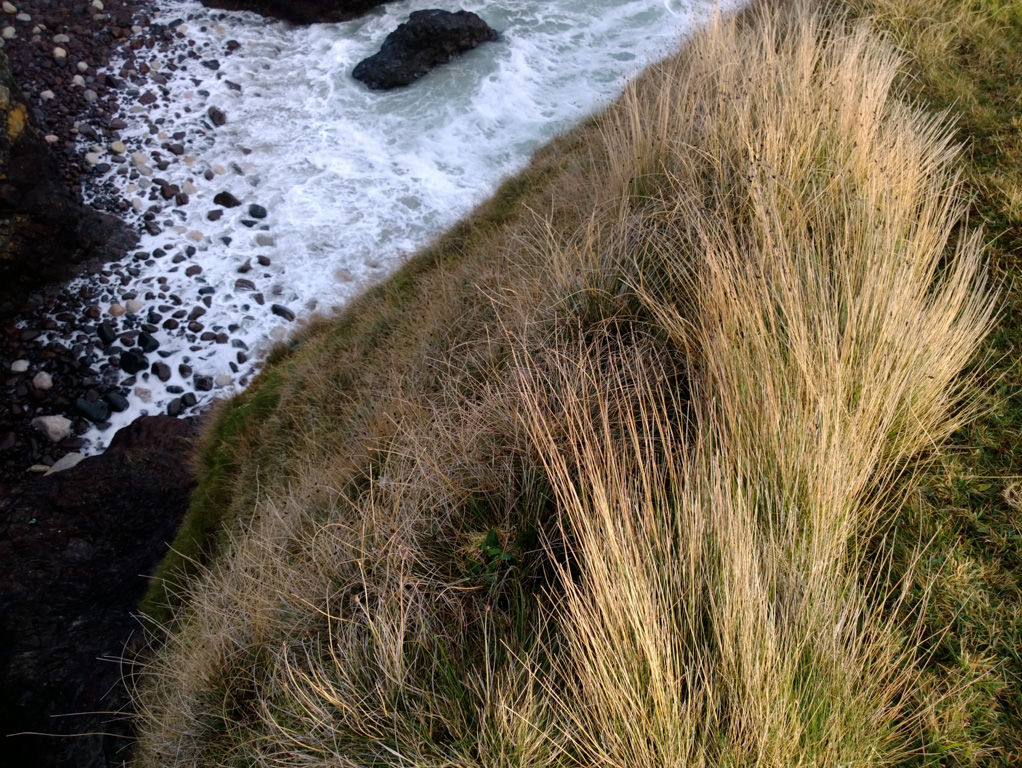
Budle Bay
Stay calm…
Don’t expect too much of yourself. This might seem like an odd thing to suggest; surely we’re constantly striving to make the best image that we can? Yes, but that doesn’t mean that we should expect to make a masterpiece on any one day or even once a month or once a year. Performance anxiety, setting your sights too high, is bound to exclude you from the flow. Your best work will almost certainly come unexpectedly. Always try and enjoy making a photograph for the simple pleasure it brings.
Another kind of anxiety arises from simply being in an amazing location, well known for its photographic potential. I’ve sometimes noticed participants on workshops being disappointed in the most incredible landscapes. This disappointment can blind them to possibilities and exclude them from the flow. Yosemite Valley, in California, is a perfect example. We all know Ansel Adams’ famous image, "Clearing Winter Storm’. It’s an incredible photograph of an epic moment. We should remember, however, that Adams lived and worked in Yosemite for seven decades and only made one image with such spectacular conditions. It’s completely unreasonable to think that we will find anything like that during a ten day visit. OK, it’s the Gates of the Valley at Yosemite – the landscape photographer’s Mecca! But it’s really just another place to find an image. We should treat all locations equally. Each is a place where we might make a good image. But there’s never any guarantee that we will. If we’re too in awe of a famous place we won’t be able to enter flow.
On any one day, your ambition should simply be to make an image to the best of your abilities. And it really doesn’t matter if you don’t make an image. Just being out and looking is part of the ongoing process of developing your aesthetic sense.
Anxiety can also arise from comparing ourselves to our peers or the photographic greats. It’s pointless even to think in terms of a league table. Art has no absolute points of comparison, only subjective ones. Comparing your work on a particular day to someone else’s - or even to earlier work of your own - is only going to make you feel anxious and unproductive. Both these feelings are enemies of the flow. Just try and be calm. Forget the past and ignore the future. Focus on now. In a sense, we are never more completely in the here and now than when we are in the flow. By ignoring irrelevances we allow ourselves to concentrate all our attention on the present.
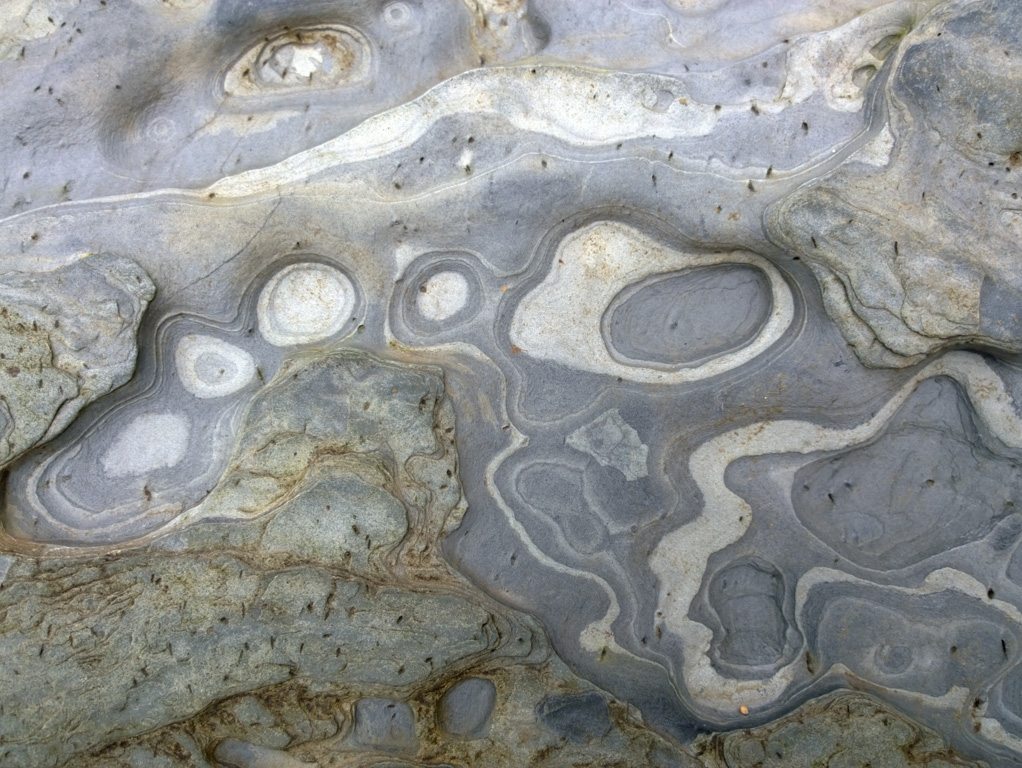
Ocean Beach Pattern
In conclusion…
Flow was something that happened in my creative life long before I comprehended its significance. Twenty years ago I thought that it was just an odd state that happened from time to time. I couldn’t predict when it would happen but I knew that afterwards I would feel energised and fulfilled. Talking to other photographers, I realised that they too had experienced it. Like me, they found that flow often accompanied periods when they made what they considered to be their best work.
Of course, I’m not successful all the time. It’s not often acknowledged but our mental state is more important than anything else when we’re trying to find photographs. Mental barriers of one kind or another often make it hard to see images and impossible to get in the flow. Apathy, for instance, is quite a common barrier for me.
As noted in part one, we need to feel that a task presents a challenge in order to enter flow. So unless I can sense a degree of difficulty (such as some small promise of a novel solution to the eternal problem of composition) the camera is likely to stay firmly in the bag. But, perhaps the need to balance challenge and skill in order to achieve flow makes me more pernickety about what I shoot, and less likely to shoot the obvious. And being discriminating is, of course, also a vital part of the creative process.
Having studied Mihály Csíkszentmihályi’s research, I now have some deeper understanding of how commonplace flow is and how beneficial it can be. So, my advice would be forget about buying the latest bit of kit: change your mental state instead of your gear and it might just make you a better photographer.
Travelling lighter? I’m guessing a number of photographers will identify with that - particularly given the ever increasingly popularity of mirror-less CSCs. I think it would be fair to say that not many of us actually enjoy carrying heavy loads up and down hills, or wherever else our photography takes us.
But working faster?! That doesn’t sound like something any self-respecting landscape photographer should aspire to, does it? Surely it’s all about working more slowly - losing ourselves in the landscape and working very deliberately to produce photography as near to perfection as we can get it. In an ideal world yes but, in my view, there has to be room for both ways of working. I love nothing more than spending a few hours in one spot, working with what’s in front of me, with no time constraints. However, time is not always in plentiful supply and I firmly believed in adapting my approach to what’s in front of me, making the most of what time and circumstances allow.
This may not suit everyone but it’s the only option available to me when my husband and I go cross country skiing. One of the main reasons we both love this kind of skiing (rather than downhill) is that it gives you the ability to access some staggeringly beautiful and unspoilt scenery. And so, last month, we found ourselves visiting Norway’s oldest national park - Rondane - for the second time. I was thrilled to be going back, having fallen in love with its shapely array of mountains on our previous visit, five years earlier. I also hoped it was going to compensate for the lack of a proper winter here in the UK this year.
Last time we had stayed in Hovringen - which gives you quick access to much of the skiing area up on the plateau. This time we opted for the little hamlet of Mysuseter, renting a small hut for the week. From a photographic point of view, this proved to be a superb choice. We were surrounded by a network of magical, snowy forests and, higher up, even better mountain scenery than we’d enjoyed previously.
I’d decided in advance that I’d just ski with my lightweight Fuji cameras, knowing that they were capable of producing great results but expecting to get a little frustrated by some of their shortcomings in terms of usability. So, each day, I went out with an F-Stop Kenti backpack with some spare clothing and provisions, an XE-1 with a 55-200mm lens attached and an XM-1 with an 18-55mm lens attached. This made for a very comfortable carrying weight and meant I had an excellent range of focal lengths available to me without having to change lenses.
I knew already the challenges of combining cross country skiing with photography. In an ideal world, to ski well you want to build up a good, comfortable rhythm, looking straight ahead to assess the terrain. Constantly looking around you and stopping to assess photographic potential is not entirely compatible with this! Of course I ‘make do’ and try my best to keep my balance and not keep my very patient husband, Rob, waiting too, too long! Being able to assess a potential composition reasonably quickly is vital - and all of this with the camera hand held, balancing on a pair of long, skinny skis!
I’ll talk a little about the practicalities of using the Fuji cameras at the end of this article. But first, I wanted to share a little of what we experienced each day and, I hope, give you a taste of why it can be such an incredibly rewarding experience on many levels. Yes, I had to make a few photographic compromises but the alternative doesn’t bear contemplating. I can’t witness scenes like these and turn my back on photographing them - it’s not within my psyche to do so. It’s also not just about the photography - it’s about the complete experience and about enjoying and capturing it to the best of my ability.
By the time we’d got ourselves sorted on our first day, we only had a few hours of daylight left, so opted for what looked a relatively straight forward 15km circuit, taking in the Glitterdalen (Glitter Valley). I think this might just have been my suggestion, having heard about all the wonderful birch trees that line much of this route! Other than an initial climb up onto the lower part of the plateau, most of our journey was through forest and, with light snow falling, conditions were perfect for photography! Rather lovely for skiing too I should add…
The scenery was even lovelier than I could have imagined and the soft, falling snow a dream. I stopped several times to enjoy and capture the lichen covered birch trees, dripping with an irresistible combination of snow and moss. We also passed some wonderfully characterful old barns, which just cried out to be photographed..
The forecast suggested days two and three would be our only days with good visibility and so we decided to head for the mountains on both of these. The forecast also correctly predicted strong winds for day two and the 9km climb up to the Peer Gynt hut, into a strong headwind, was brutal. Again though, conditions were wonderful for photography: swirling spindrift, occasional bursts of fast-moving low cloud, mountain peaks coming and going and the odd tough little tree somehow finding a way to survive in this inhospitable climate. It was bitterly cold at times and, even with my thick dachstein mitts, my fingers were suffering - all a bit challenging for photography. Of course you find a way to make things work and it was an incredibly exhilarating, if exhausting, day.
Day three dawned as the forecasters promised and so off we went again, with another long climb up into the mountains. Thankfully the wind had died down and conditions were really very pleasant for skiing. We had been told the route up to the tourist hut at Rondvassbu was well worth the trek and proved excellent advice. The views were quite breathtaking and just the tonic I needed to help me forget my badly blistered heels and generally weary body. We spent a little while taking in the beauty of this idyllic location, even spotting a little dipper exploring the crystal clear blue water in the partially frozen stream.
However, the best was yet to come and I’m happy to say that, without my constant stopping for photography, we’d have missed one of our most exciting wildlife sightings to date. Whilst I was concentrating on capturing yet another ethereal mountain/cloudscape, Rob noticed a group of small specks on a distant hillside. A look through the binoculars confirmed these were reindeer. We knew that Rondane is home to the odd herd of wild reindeer and so were absolutely thrilled to see these magnificent animals in their natural environment.
We spent a good twenty minutes watching them as they came down the hillside, eventually spotting us and then speeding across our path some 100 metres away, before making a beeline for the spectacular mountain scenery the other side. What a backdrop in which to see and photograph your first herd of wild reindeer! The XE-1 is no action camera but, in the circumstances, I was pretty pleased with some of the results. By the time we reached Mysuseter, sunset was approaching and I caught some beautifully soft, low light on the elegant distant peaks, before we returned to our hut. An amazing day and one we both felt very privileged to enjoy.
Day four and the forecasted snow duly arrived - perfect for another ski through the woods. Thick, fresh snow can be hard work on the legs but there’s a beautifully eerie sense of still and calm when skiing through woodland in falling snow - just magical! As we neared the tiny hamlet of Raphamn, the clouds started to lift and the delicate shadows cast by the slim birch trunks enforced a stop half way up a steep hill. A good opportunity for a rest but a rather precarious position in which to get out the camera!
The second half of our route saw us climbing high amongst some bizarrely shaped hills with the visibility now very good. Just as well, given the fact that many of the small sticks that mark the route were semi-submerged in the deep, fresh snow. We felt very fortunate to be enjoying another exhausting but spectacular day, with yet more incredible views across towards the mountains we’d skied through the previous two days. The late afternoon light was wonderful and I was again able to make the most of some stunning woodland scenes with snow laden, anthropomorphic trees casting soft shadows on the virgin snow underneath.
So much snow had fallen that day, that the trees still had a good covering on our last full day of skiing so once again, we again explored some of the forest paths. At one point I could have sworn I was skiing through Nania - childhood memories conjured up by the weird and wonderful patterns of the moss draped trees. Lunch was rather a treat and we shared our sandwiches with a number of very friendly and extremely cheeky willow tits. The afternoon was a bit of a challenge with temperatures increasing to just above freezing. If you use wax based skis, as we do, trying to achieve a good combination of grip and glide at this temperature is a nightmare and one we have yet to master!
There was only time for a quick morning ski on our last day. It was perhaps just as well that conditions were not nearly as good for photography, with largely cloudless skies. In fact my camera came out just once! And so the week ended - no serious injuries and both of us incredibly happy with the way things had turned out. Also, despite the inevitable compromises, I was really pleased with some of the images I’d captured.
So how did the Fuji gear fare? I’d say about how I expected. I love the results these little cameras can produce - the sensor seems to produce photographs with a lovely feel to them and the optics of the lenses are really very good. The dynamic range of the sensor is also very good - not quite up there with my Nikon but more than good enough for most situations. Overall they are very enjoyable to use.
The only downsides were really the ones I had anticipated. The XE-1’s electronic viewfinder is very good in unchallenging light but, as a glasses wearer, I’d like it to be a little larger. I also find it has enough lag to be annoying on those occasions where you need to react quickly. I believe the XT-1 would almost certainly eradicate both of these frustrations - but it’s not an upgrade I can afford or justify at this time.
I’d be interested to find out to what extent the bigger and brighter EVFs of the latest cameras would help in terms of trying to compose whilst wearing prescription sunglasses. I found I had to take them off when composing through the viewfinder - not an ideal solution because whilst I can then see what’s in the viewfinder I can’t see the wider view with my bare eyes. I’m not sure what the answer is - perhaps a dual mode option where you can press a button to brighten the EVF temporarily?
The XM-1 has no viewfinder - only an LCD. Being a newer camera, it suffers less from lag than the XE-1 and is generally more responsive. In overcast light, I found composing with the LCD screen worked well, even with sunglasses. In brighter light I had to take off my prescription sunglasses and peer at the screen. I wouldn’t be happy using this camera handheld with a longer lens, finding it too hard to compose accurately and to keep it stable. With the 18-55 it worked very well though, my only real gripe being the lack of an inbuilt spirit level.
Some of the XM-1 controls are less accessible than on the XE-1 but it does have one major advantage in that the exposure compensation dial seems content to say where you leave it. Every time I took the XE-1 out of my bag, the dial had gone to +2 EV. I also found the tilting screen of the XM-1 came in useful at times - on one occasion allowing me to hold the camera above eye level to get a clean composition of a moss-draped birch.
So, despite what you may read on twitter, these little Fuji cameras are not perfect! However, they are very accomplished performers in most respects and, a few gripes aside, are a pleasure to use. Most of the controls you will want to access regularly are accessed with buttons and dials, rather than having to delve through a menu. I particularly like being able to set both EVF and LCD to show a square crop - it’s my default option, and quick and easy to change if you assign the function button to file size/crop. I’m certainly not ready to ditch my DSLR but there’s very few situations in which I would not be comfortable using these camera and, equally important, I know they can produce some cracking prints!
Our recent article on the Mirex adapters from Germany sparked a lot of interest with the opportunity to mount medium format lenses on Nikon or Canon SLR cameras. In a little advertised move (you wont find it on the Mirex website) they have produced a tilt/shift adapter from the same stable for mounting EOS mount lenses to Sony ‘E’ mount. This becomes of particular interest to A7/A7R owners who now have access to some very interesting possibilities.
The mount comes with the usual uni directional tilt and perpendicular axis shift from the bigger brother and a bracket for accepting a tripod plate. A plate was promised but as yet is not available (simply add a lens plate mounted as afar forward as possible). It rotates through 180degrees with 2 push locks but always with perpendicular shift to axis tilt arrangement. Tilt is locked with a rotating knob. The adapter gives 10degrees of tilt in one direction only and 15mm of shift in each direction. The shift is operated by a push lock and will lock at any setting but has indents that click each 5mm and at the '0' position. All movements are 'finger' powered and not geared.
The mount is only available in EOS fitting and no others are currently planned from what I understand from my conversation with Mirex via email. EOS is a good choice for 35mm as it has the widest throat of any current SLR manufacturer so adapters can be easily fitted from just about anything.
I have been using the Canon FD 35mm Tilt/Shift lens on the A7R with good results so why my interest ? I was fortunate to find a Contax 35mm PC Distagon Shift lens at a very low price and looked for ways to add tilt capability to the lens. I used to run a Contax 35mm film system and love the look and rendition of the old Contax glass and also had a 100mm macro lens from those days. The PC Distagon is widely regarded as one of the finest lenses available for 35mm systems.
The Mirex adapter with the PC lens is proving to be far more flexible than I first envisaged. Some interesting observations with respect to using a large format camera:
Mounting the lens on its tripod foot gives rear tilt and rear shift as an option. All tilt/shift lens that I am aware of only give you front tilt & shift. You also have access to front shift on the lens in addition to the rear movement options.
Mounting the camera (as opposed to using the lens mount) on a tripod gives access to front tilt & shift - note that shift is now available on both lens and adapter and can be in perpendicular axis.
Why is this relevant ? If you come from a large format background then the option to use either front or rear movements depending on how you want the verticals to look of whether you want to ‘loom’ is baked into your thinking. It is what gives the flexibility that a large format camera is valued for and has been almost impossible to totally replicate in smaller formats. The exciting thing will be to mount a tilt /shift lens on the Mirex adapter and at which point you have got a pocket monorail with a 36mp back attached in the form of the A7R ! Front and rear tilt & shift would be available with the ability to configure the adapter and lens in different axis to give swing also.
For me the most common uses for the ‘lens tripod mounted’ option with a PC lens will be:
Front rise or fall using the shift on the lens in the vertical configuration to maintain vertical lines whilst still giving access to tilt and panoramic stitching on the Mirex adapter
Re-centre-ing of the image circle after tilting for focus using the Mirex to maintain the highest quality.
In macro usage the image circle grows substantially as magnification increases so using a lens designed for 35mm will allow full tilt once in the macro territory. I tried the 100mm Contax macro lens and had no vignetting on full tilt at approximately 1m or less.
Before getting carried away… PC shift lenses from Contax, Nikon, Olympus, Pentax and Canon will give most of the functionality. Lenses that need electronic stop-down will not work on the Mirex adapter. Lenses will only work in stop down mode but I personally don't have any problem with that workflow.
There are practical limitations to the size of the image circle even on PC lenses available today. Looking at the Contax PC Distagon as an example the following images show the extent of the movements available. I purchased a Fotodiox Contax to EOS adapter to do the conversion. The image is for illustrative purposes.
Maximum fall on the PC distagon (more than needed to hold the verticals but I wanted to show the maximum situation)
Full side to side shift for a panoramic on the Mirex.
Here is the full frame stitch showing the vignetting:
There is a little unevenness in the vignette surprisingly which I haven't been able to explain yet.
Here is the cropped version:
Finally here is a picture taken with the 28mm Contax Distagon showing the un corrected interpretation:
Other observations:
I find the ergonomics of using the adapter on its tripod mount quite hard to get used to. Tilt is achieved by moving the camera upwards in an arc and is just not intuitive for me. YMMV
The adapter with lens is very tight to the grip on the A7/R so the tripod foot needs to be forward from the foot (see picture 2) otherwise full rotation cannot be achieved.
In conclusion:
I am excited by the possibilities of using the adapter with tilt/shift or PC lenses, OK there are some limitations to coverage and what you can do but the movement available with the combination will exceed majority of requirements before it becomes an issue.
This feels like a hugely undersold concept for the landscape photographer giving access to movements only available (to a lesser extent) on the technical cameras with medium format digital backs costing tens of thousands of pounds or by doing it the old fashioned way with film and a monorail style camera. Something like the Linhof Techno doesn't offer rear movements because of the need for absolute precision in the plane of focus.
To buy, contact Mirex via email and a quote will be sent with payment only available by bank transfer which may cause some alarm but I know many people who have dealt with Mirex this way without issues. I have bought from many companies in Germany by bank transfer without issue.
This is a beautifully engineered and European made item and is expensive compared to some of the Far Eastern clones appearing on the market. However I feel its worth the money, the difference is small once taxes and shipping are included. The medium format adapters that Joe, Andrew and Tim use give good reliable service.
Here is a small gallery of images taken with the Mirex and PC Distagon and Contax 100mm F2.8 Macro lens on a recent trip to Cornwall:
Whilst attending the Year of the Print we were also able to interview Charlie Waite and also Diana Leppard, Charlie's assistant, about the exhibition and the ideas behind it.
The idea of a group exhibition where the exhibitors are selected by who has the incentive to put their hand in their pockets and the pictures selected by the same people initially struck me as a recipe for disaster. Without a curatorial control over such an exhibition the end result could have been a mashing together of holidays snaps and works of art; literal representations among ICM madness. So it was with some surprise that I entered the Mall Galleries on the day of the hanging that things seemed to be coming together well. It is a testament to the amateur photographer that nearly every exhibitor had something of interest on show and images that could be classed as 'snapshots' were in a small minority. One of the things that seems to have helped with this is that most people used the services of Fotospeed to print and frame their work. Even though Fotospeed offered a few options, the recommended black frames seem to have created a consistency when viewing the exhibition as a whole.
Fotospeed’s quality eye was also on the printing and between them and the clients who printed their own work (either on their own printers or through third parties) the results were almost universally good. After a preview of the preview we took a short wander around London to take in the sights (soon retreating to a local pub to escape the touron* hordes).
When I first started looking at photos and photo books I vividly remember that visceral thrill of finding a new body of work sparked the imagination and thrilled with the sheer brilliance of seeing and execution. Over time I’ve been encountering this feeling less and less - I still get a thrill from seeing great photography but only a few times a year do I encounter something that reminds me of that original feeling. Jane Fulton Alt’s “The Burn” is one such encounter.
Dav Thomas showed me Jane’s Vimeo video a few months back and I think I was so impressed I managed to order the book before the video had ended.
A bit of background on “The Burn” project. In 2007 whilst Jane
had an artist’s residency at the Ragdale Foundation she encountered a controlled burn. The burns are carried out both to limit the dangerous effect of uncontrolled fires but they are also essential to renew life in the undergrowth. Spotting the creative potential of the burn, Jane asked to come along to future burns in order to photograph them. At the same her sister was diagnosed with cancer and she had a new grandchild. All of these themes were to become fixed within the work she went on to create.
For me the images are in many ways like Stieglitz’s equivalents - the subject matter can be taken literally or metaphorically or perhaps as a muse to express the artist’s temperament. The result is often beautiful and at times literally sublime. They range from glimpses smoke as backdrop and move through to thick, blinding plumes of smoke, distortions of the heat of the flames and finally the flames themselves charring the landscape.
“The Burn” is a 9” by 9” hardback book containing 96 pages and 38 colour plates.
Some of the work has been put together into a handmade fine art book which has an encaustic print at its center. the encaustic is a layering of beeswax over a photograph, adding another veiling layer to what is already an ephemeral work.
Please take the time to look at a video about her work on Vimeo. There is also an interview with Jane at Lens Scratch. You can see more of Jane's work at her website.
Jane’s sister, Peggy Fulton Heller, sadly died in 2012.
Can you tell me a little about your education, childhood passions, early exposure to photography and vocation?
As a child I was always into painting and drawing, along with Lego and later programming my ZX81. I did Art at A Level (along with Maths and Physics) and at one point thought of going on to do an Art Foundation Course, but ended up studying for an engineering degree and then a computing PhD at the University of Bristol.
Other than the family 110 format film camera for holiday snaps, my first real camera was a Praktica 35mm SLR given to me as a birthday present shortly after I started at university (25 years ago now). Initially it was mainly used to document my hill walking trips to the Lake District and Scotland, then gradually became an outlet for creative urges. Photography being a more immediate and practical medium compared to painting and drawing: not having the space in a student house that I was used to having in the art rooms at school.
Apart from in the sixth form when I learnt the basics of B&W developing and printing (to record source material and produce studies for proper art pieces) my film experience is purely of 35mm colour negative developed and printed by Boots or Jessops. I have never shot a single frame of transparency film in my life. I shot my last roll of film in 2007 and have been using DSLRs for nearly 10 years now.
I gradually learnt the technical side of photography by trial and error, with hints from various books (this being before photography resources on the Web became widely available). On the composition side, I’ve always found this to be instinctive, guided by my interests in the arts and design in general.
What are you most proud of in your photography?
When I take an image I like. I don’t generally worry about what other people may think of my images, but don’t deny it’s nice to receive praise if offered.
Being a bit different. When I manage to take/make (never sure what the correct terminology is supposed to be) images of a location which are not like anyone else's I've seen. Perhaps partly helped by only relatively recently in my photographic journey realising that as a landscape photographer I’m supposed to be obsessed with taking coastal sunrise/sunset pictures :-)
In most photographers lives there are 'epiphanic' moments where things become clear, or new directions are formed. What were your two main moments and how did they change your photography?
Gordon Stainforth's book Eyes to the Hills (although revisiting it, the photographs perhaps don't stand up in their own right quite as well as I originally remember, but definitely a step on from the record shots of hills and mountains I was taking at the time). First time I remember recognising a particular type of image I wanted to be making. It gave an initial direction to my photography, although a direction I have since diverged from. Also coming across Colin Prior's first book Highland Wilderness made me aware of the heights that could be achieved in genre of mountain photography.
Secondly and far more recently, buying a Lumix LX5 which has a physical switch for different aspect ratios (rather than it being an option hidden deep in menus) which encouraged experimentation with square and panoramic formats, away from the 3:2 aspect ratio I was used to. Plus the LX5's close focus ability is something that equally led to experimentation and has become a key element of my photography. (Why do people bother anymore with macro lenses for DSLRs?) While the LX5 has encouraged me to play, digital in general was also a major player in the development of my photography. Specifically buying my first DSLR (a Nikon D50) with the immediate feedback it gave and the freedom to take far more pictures than I would have ever on film. And the complete end-to-end control that is possible with digital.
Tell me about why you love landscape photography? A little background on what your first passions were, what you studied and what job you ended up doing.
Photography for me has combined interests in art and design, the outdoors and being in wild landscapes, along with technology. Have always enjoyed the outdoors and walking. Guess my interest in technology could be said to have started with Lego and progressed ultimately via my degree education to a job as a computer systems/software engineer currently working in the area of DAB digital radio receiver technology.
So photography combines art and technology; with landscape photography combining photography, the enjoyment of the outdoors and wanting to somehow record my love of being in wild and/or remote locations in the mountains or by the sea. To these ends I’m lucky to find myself living at the bottom of the Wye Valley on the edge of an Area of Outstanding Natural Beauty.
Could you tell us a little about the cameras and lenses you typically take on a trip and how they affect your photography?
I have too many cameras and lenses!
My main camera is a Nikon D700, along with my trusty Lumix LX5 and my newest camera is a Micro Four Thirds Lumix GX7.
The D700 gets used when I know I might need the high ISO performance (i.e. for aurora) or fast AF (i.e. for wildlife) or if expecting bad or cold weather (I know I can manipulate the controls easily wearing gloves). While I have a large collection of manual and autofocus lenses (from an 8mm circular fisheye through to a 600mm mirror lens), I mostly seem to end up with my old Nikkor 28-105mm zoom on the D700. Recently I’ve been liking the look I get with my Voigtländer 90mm prime and I need to play more with the Hartblei 45mm Super-Rotator tilt/shift lens I own.
The Micro Four Thirds gear gets used when I don't what to carry so much bulk/weight, most often using the original Panasonic 14-45mm (28-90mm equivalent) zoom or the Olympus 45mm (90mm equivalent) prime. I also have an old Micro Four Thirds body which I’ve had converted for IR photography, where having an electronic rather than optical viewfinder comes into its own in visualising the IR effect.
Then there's my LX5 which tends to get taken everywhere and shines in its macro capabilities.
Sometimes locally I will deliberately go out for a walk with just the one camera and one lens, as a semi-challenge to see what I can do with the combination. If I'm going on dedicated photography trips I will take a wider selection of lenses, etc., but not owning a car such trips usually involve having to carry all my gear and other luggage at some point in the journey, which limits what I take (which I think is actually a good discipline).
What sort of post processing do you undertake on your pictures? Give me an idea of your workflow.
I have a confession to make: I don't do any post processing!
On all my cameras I shoot RAW + Fine JPEG and the RAW files then just sit there on my hard drives. I have Lightroom on my PC, but with a day job of sitting in front of a computer, I never really feel like sitting in front of a computer again in the evenings. At weekends and during holidays I would rather be out taking more images than processing the ones I've already taken.
So images on my website are currently the in-camera JPEGs resized with some one-size fits all auto-tone/curve adjustments applied by scripts I've written to drive the image processing utility ImageMagick. Although I'm certain many of my images could be improved upon once I find the time to get up the Lightroom learning curve.
Do you get many of your pictures printed and, if at all, where/how do you get them printed?
I own an A3 Epson inkjet (although a couple of generations old now) and print occasionally. When I do it reminds me firstly, that images look good printed and I should print more, secondly, that I need to learn how to get the best from it. Various friends and family have some of my prints on their walls, myself I don't currently have any. Have also make a couple of blurb books which I keep meaning to do more of. I think book form is one of the best ways to present/view photography.
Tell me about the photographers that inspire you most. What books stimulated your interest in photography and who drove you forward, directly or indirectly, as you developed?
Well, to start with Ansel Adams obviously, specifically his Yosemite and the Range of Light book. Books of mountain photography by Gordon Stainforth and Colin Prior I've already mentioned and then Joe Cornish's First Light. Relatively recently I discovered and admire Eliot Porter's work and I’m slowly building a library of secondhand books of his. Also an early general stimulation of interest in all different styles and genres of photography was a series of Time-Life Photography Year books from the 1970s in the art rooms in the sixth form (which I've acquired my own secondhand copies of since).
Of current photographers I believe my approach and images are perhaps most akin to David Ward's (although not saying I’m as good a photographer and definitely have no plans to move over to the Dark Slide). Not sure to what extent my style is partly due to his influence and partly that I admire his work since it has parallels with what I already found myself doing. I definitely share David's unplanned approach to finding images.
Using tools such as The Photographer’s Ephemeris to plan specific images is not something that really occurs to me to do. (I do admit though to keeping an eye on predicted extreme high and low tides which may be worth a stroll from home down to the river Wye, with the promise of seeing familiar territory in unfamiliar conditions). However, I often revisit locations, albeit sometimes years apart, when having prior knowledge of the possibilities at a location on return trips works for me. Not so much in planning in advance what images I want to take, but rather in knowing in advance places I want to explore further.
Tell me what your favourite two or three photographs are and a little bit about them.
Avich Falls, Argyll, Scotland. Nikon D700 with Nikkor 28-105mm.
This was taken in the rain with a plastic bag over the camera. It was a fairly quick photo to take: walking along I saw the old tree arcing over the river and recognised there was an image there, set the camera up with very limited playing around with the positioning from where I originally placed the tripod and took the shot. I like the chaos of it, but it also seems to work in having some structure and balance. The small glimpse of the river in the corner is I think essential to the image working.
Penterry Lane, Wye Valley. IR converted Lumix G1 with Sigma 30mm (60mm equivalent).
I was out for a local walk on an overcast day with just my IR camera and noted the tunnel effect of the lane through the trees. I took two other shots: one further back of a wider view down the road and one tighter in. When reviewing the images at the time I initially preferred the others, but this framing grew on me since. The somewhat dull look is the in-camera B&W conversion as is, which I actually like. I also like the fact that it's not immediately, obviously an IR image, but just that there is something slightly odd about the rendering. Like the Argyll image, I like the controlled/anchored chaos/complexity of it.
Now for something completely different. Snow Birch, Kvaløya, Norway. Lumix LX5.
This I think is perhaps more representative of more of the images I make. Taken on an island off Tromsø in Arctic Norway. The location is a stretch of birch woodland I'd previously visited in the summer and have since visited in the autumn. Taken handheld where I shot a sequence of similar compositions as square in-camera. This image had the best balance of the set. The look I was after was inspired by wood block prints I’d seen by Laura Boswell.
Just noticed there seems to be a bit of a tree theme going on here…
If you were told you couldn't do anything photography related for a week, what would you end up doing? (i.e. Do you have a hobby other than photography?)
Go for walks up the Wye Valley. Or if the weather was really that bad, reacquaint myself with all the music in my LP/CD/MP3 collection that I've forgotten I own. And the washing-up always seems to need doing...
What sorts of things do you think might challenge you in the future or do you have any photographs or styles that you want to investigate? Where do you see your photography going in terms of subject and style?
Hope this doesn't sound too arrogant, but think I have the beginnings of my own distinctive style.
Currently I’m trying to find a balance between taking time over an image and being spontaneous. The latter is my more usual way of working, but I sometimes kick myself that some aspects of an image are not as perfect as they could be, due to issues that were under my control at the time the photo was taken and I could have avoided if I had slowed down and taken more care over the shot. However, conversely when I deliberately try slowing down and working a scene I usually find that what I end up with is nothing special. Often the initial image, if I take several variations of a subject or scene, will be my favourite.
Some other goals: pay more attention to the quality of light, continue my ongoing local Wye Valley project (if that's not too grand a word to use).
And maybe use a tripod more often.
Some thoughts about vistas versus details?
A friend has described me as a photographer of artistic rocks (although she did then ask me to take photos at her wedding), but I also want to somehow take pictures that are recognisably of a place, rather than travelling to destinations such as Iceland and Norway and returning with yet more rock abstracts...
Taking successful vistas is something I struggle with. With my approach being self-taught over the years, the normal landscape conventions of golden hour light, tripod and ND grads passed me by until recently. I have tended to solve the problem of excessive contrast between land and sky by coming up with compositions that avoid including the sky. So my focus on producing more detail/abstract style images has partly been forced on me for technical reasons. It was never a conscious decision to head in this direction. So my style in a nutshell: landscapes without any sky!
Also an element of laziness in that wider views don't always lend themselves to my more spontaneous approach, as you often need to faff about with filters etc. and that can imply using a tripod, but every now and again I will take an image of a wider view which I'm really happy with and so I persevere.
While the artistic rocks have turned out to be a gateway drug leading to rust and decay :-)
Who do you think we should feature as our next photographer?
Andy Tibbetts who photographs the landscapes and wildlife of Knoydart and the Small Isles of northwest Scotland.
You can download the PDF by following the link below. The PDF can be viewed using Adobe Acrobat or by using an application such as Goodreader for the iPad.
The older I am getting ( now 58 ) the more I tend to love less spectacular and quiet imagery. When I was young, mountains where the hot stuff on the menu and I made long hikes in the Swedish national parks in the High North. My strategies were all in the direction of catching the mountains in the most dramatic light as possible. I still like images of grand landscapes, but more so when they are interpreted in a more subtle way. In this short article I will try to encourage you to find inspiration in the unspectacular landscape and pieces of nature. Images who are very personal and an important ingredients in my own photography.
Although On Landscape was always intended as a ‘virtual’ magazine for various reasons - cost being an important one but print quality and the possible advantages of video and interactive content being others – the idea of seeing great photography printed well is still one which we think is incredibly important. Seeing photography on a screen is something that is working better and better, especially when people are using tablets such as the Ipad with retina display, but there is something different and uniquely satisfying to seeing images in print, either in a gallery or in a book.
To this end we were very happy when Dav Thomas and David Breen from Triplekite approached us about collaborating on a series of books about landscape photographers. The idea of a compilation book of landscape photographers has been kicking around in both mine and Dav’s heads for a while and we even went as far as to mock up a compilation of large format photographers but real life got in the way as usual and the idea was put to one side. Since then Dav Thomas and David Breen have kickstarted a publishing business with a new model that will hopefully reignite the passion for printed works.
We talked to Dav about where the idea for the Land|Sea book started.
Dav Thomas: I was always a fan of AG Magazine, I enjoyed the fact that it featured photographers who were out there doing stuff a little bit different to the norm and it was varied and interesting every time. So for me there was certainly a gap in the market representing landscape photographers who were not doing the usual stuff, who were doing projects and more personal work and who didn’t really have a voice or channel to show their work in print. There is also a big movement at the moment for publications that are beatiful objects to own – lovely typesetting, beautiful feel publications. There are a couple of these like Another Escape (http://anotherescape.com/) and Kinfolk (http://www.kinfolk.com/) who have this very textural feel - they’re more general subject matter, not necessarily photography.
Tim Parkin: Treating publications like works of art in themselves is done quite a lot in the graphic design industry as well, there’s a very strong craft element with letterpress typesetting etc
Dav Thomas: Well I’m certainly a fan of that as well - the beauty of doing the Triplekite work for me is that as someone with a love and passion for graphic design, it gives me the chance to mess around with type and to produce things that I think are beautiful in their own right – you you don’t generally get to do that with your general graphic design jobs. And also, as I’m a photographer as well, I hopefully know how to treat photographs in a publication and give them the space and the flow they need which I think a lot of non-photographer graphic designers wouldn’t have.
With Land|Sea I didn’t particularly want it to be a magazine but I don’t think it’s really a book either, we can’t actually decide what it is – we haven’t got a word for it – after trying all sorts of stupid descriptions for it, in the end it’s not a book, it’s not a magazine, it’s just “Land|Sea”
TP: So what did David Breen say about this when you raised the idea with him?
DT: He said “How much is this going to cost me!?”
TP: Pragmatic to the last!
DT: He liked the idea of it – he loves quality printed books and the magazines I’ve mentioned. But we needed it to be something that was as close to perfect as we could imagine – it’s definitely not a budget book and with the production costs we’re not going to make millions out of it. If it breaks even we’ll kind of be happy.
TP: And then you came to On Landscape and suggested a collaboration
DT: Yes - We came up with the general concept of what it would be – it would feature 4-6 photographers in each edition and we looked at the sorts of photographers we might like to feature, obviously we were looking at On Landscape which I’ve had an involvement with in the past and it seemed that there was a big crossover between the sorts of photographers On Landscape were featuring and the ones that we wanted to feature. It seemed silly to do something that is sort of like On Landscape but in print but separate from it and so it made sense to see what we could do to work together on it, creating something that crosses over.
TP: And the choice of photographers is very much in the vein of how we work in On Landscape but the obvious difference is we haven’t featured architectural work. Possibly because I don’t feel knowledgeable enough to find appropriate photographers. Giles’ work is very strong and graphic though and works very well in print.
DT: Giles is one of David Breen’s favourite photographers so we really wanted to feature him. Overall though we wanted each issue to be quite varied so it’s unlikely that any one reader will like everything we put in Land|Sea but even if you’re not entirely sure whether you like someones work, hopefully you’ll be able to read about them and get an idea of what they’re about. There are magazines out there that already cater to the mainstream audience - we wanted it to be a bit more cutting edge.
TP: Myself and a few colleagues were chatting about this in Scotland in terms of photography and taste and the photographers featured in On Landscape because we often get emails from people about some photographers that say “I can’t believe you’re including this rubbish” alongside others saying “I’m so glad you’ve included XXX” and they’re both writing about the same article.
But I was arguing that if you had a book or a magazine about music you would be very unlikely to fill every issue with music that satisfied all of your audiences tastes. And most buyers of music magazines accept this but are still interested in buying Q even if they feature an interview with the latest Country and Western artists alongside a Slipknot feature. And people still talk about music with their colleagues even if they disagree about certain artists (which is inevitable if you have a level of passion about things)
The same should go for any subject magazine – it should be something that challenges people and hopefully even if you don’t like the featured artist you have enough trust in the magazine to know that the work is quality and some of the best of that genre.
DT: We certainly want whoever is in the magazine to be someone at the top of their game or someone doing something a little different. Every person we feature is doing work they are passionate about and that is important. Just like there are a lot of bands that I hear and appreciate but might not want to listen to. Hopefully that same sense comes across in Land|Sea. The biggest thing is that these photographers have personally decided that this is the sort of work they want to do and that they love – it isn’t something they have done to be part of a scene or just to get acclaim. They’re either passionate about the landscape they live in like Finn’s work – you can tell from his interview that he absolutely loves that area - and that comes across in the photographs. Giles is the same – he has a strong passion for his subject. That’s what I think it’s all about.
TP: I notice the photographs featured by the artists are definitely not a ‘greatest hits’ which is what we’ve come to accept from many online galleries – it’s definitely a set of photographs related to an area or style or subject.
DT: We wanted to some extent to leave it up to the photographer about what they featured in their section. With some of the people in the next volume which is coming out in the summer, there were particular projects that we wanted to feature and asked them if we could feature those, other people we asked to just provide a set of images and we’ll ask some questions around them - in a similar way that the featured photographer section works in On Landscape – but I didn’t want it to be formulaic, either project or portfolio, it should be different across the magazine .. or book.. or whatever it is … (Land|Sea : ed)
So particularly in this first one we have Joe Wright who is talking about a certain type of photography, Valda Bailey which is more of a portfolio of a style, Al Brydon has a strong visual look but it’s about his philosophy of photography, Finn Hopson is about the place and style he works In the second book we’ve got more project based work along with a couple of portfolio pieces.
TP: When we’re choosing the photographers for the issue, we have a spreadsheet of artists we’d like to feature and out of those the next selection has been published so for those who haven’t seen it yet can you tell us who we have?
DT: I can but it will require me remembering! We’ve got Pete Hyde, great classical landscape photographer, David duChemin who produces the Craft and Vision ebooks and who has submitted some quite surprising work – very different than we expected - but it’s good to feature recognised photographers doing different work; We’ve got Nigel Halliwell who has some stunning newer work from the Peak District which we’re excited about; we’ve got Simon Butterworth who you’ve featured a couple of times in On Landscape – we’re featuring his Scottish Island photography and finally we’ve got Michael Jackson featuring his non-Poppit Sands work. A good second album I think!
TP: And we’ve got a big list of potential photographers to be working with in future volumes too.
DT: Yes - every time we see someone interesting they get added.
TP: And we’re producing three books a year - that’s a hard schedule for book publishing but I think it’s needed in order to cover the huge number of great photographers we keep seeing.
Now in terms of design there are a couple of fairly unique things about it. Firstly it’s printed on a matt, uncoated stock which is uncommon for photography books but which works very well. But also it has proper duotone black and white prints interleaved with CMYK.
DT: Printing black and white images is a little tricking on a litho press, if they are printed with standard CMYK inks like the rest of the book is, you tend to get an unpleasant colour cast – print them with just a black ink and they end up rather flat and washed out. So, because we want the images of those photographers who are working in black and white to be reproduced to the same sort of high quality of the colour contributors, we decided to print that section of images using an extra ink. Although it adds more costs to the production costs, we think it's worth it – we're really pleased with the way Giles's images turned out; the tones and wonderful and the extra spot colour means that the dark areas really are dark!
As for the paper stock, we wanted the whole thing to be a tactile experience really - we’ve a soft laminate on the cover - I’m sitting here now stroking it and it feels really nice. I haven’t sniffed it yet which I normally do!
TP: Steady on!
DT: I specced the stock which is a really good quality uncoated stock and we found a printer that uses a waterless press and that meant we can print beautifully on uncoated without ink splurges, desaturated colours and blocked up blacks. These printers have very little dot gain. Al Brydon’s photographs were a good test for this but his images have a great extension in the blacks.
TP: And you’ve separated these with some very lightweight almost japanese papers
DT: My idea was to have the intro section on this very light stock, it’s 60gsm bible paper, and I wanted it to be a little bit transparent to hint through to the following pages and each artist has a single title page in the same stock. I think it just paces the whole book nicely.
Then at the back we repeat the 60gsm stock with an essay about photography, in this issue a beautifully written essay by Paul Kenny about his influences.
TP: It is definitely going to be a challenge for the next essay writer.
DT: Yes, when we got it through we read it and thought “Wow that’s fantastic”.
TP: The logic behind the essay is just about people’s approach to landscape photography?
DT: Yes, it harks back again to making the book more than just a collection of portfolios. Having the essay is a chance to make people think a little more.
TP: Anybody confirmed for the next one?
DT: Nobody planned yet.. If anybody can write as eloquently as Paul about their landscape photography then feel free to send in your application!
TP: It’s definitely more than your usual magazine or book in terms of feel and that is something it’s difficult to get over in jpegs. It’s definitely something to value and collect hopefully. When this builds up into a collection it should be a good statement of the state of photography at that point
DT: Yes I would hope it’s a good chronicle of the current state of landscape photography. I always look back at ‘The World’s Top Photographers’ book and I think it’s a great milestone of it’s time – it defined what was happening at that point. I’d hope Land|Sea can do that as well.
TP: One of the other nice touches I think is that there is a single page at the end of each photographers’ sections listing a few influences with links to follow to find out more
DT: We left it to people to suggest influences or recommendations and I was really pleased at the wide variety of suggestions that people have come up with. It ended up working extremely well – Valda suggested photographers and painters, we even got Flickr and Pinterest as influences and it ended up so varied it’s become a good stepping off point to looking at other work and you can see in the list that Al Brydon includes and you can see the context in which he’s working. Not sure about Finn Hopson’s recommendation of some bloke called Dav…
TP: The book’s available now at £20 but there are also a few prints you can buy alongside it
DT: Yes we didn’t do a ‘special edition’ but we have got a print from each of the photographers and you can buy them individually at £20 or together at a discount. Photographer’s don’t generally buy prints so we wanted to offer the chance to get an A4 print at a reasonable price and a print that is outside of limited editions for instance.
TP: Getting away from Land|Sea for a moment - You’ve got a few book projects running at the moment including a Paul Kenny book I believe?
DT: Yes, we’re producing Paul’s retrospective of his ‘Seaworks’ images from 1998-2013. It’s looking very nice and we’re hopefully going to have that ready for June too. While we’re plugging we’re also producing s book of Iain Sargeant’s work on his “The Pool” project which will be a smaller, square book. We’ve got two more Land|Sea’s this year too and in total we’ve got about seven books left to produce this year. Hopefully people won’t be sick of us by then!
TP: People should save their pennies up because you’ve be on a stand at the On Landscape Conference at the Rheged in November.
DT: We will yes and by November we’ll have all of the new books out to buy. We’ve looked at this and thought that’s a lot of books to produce in one year, but when we look at each project they are all of a great standard and hopefully will sll be beautiful books.
TP: It is the unique position you have that you can make short run books on direct sale.
DT: We certainly don’t want to be a bulk publisher and we’ll only ever do short runs from a few hundred to a couple of thousand at the very most. We want each one to be great, something that we would buy oursleves – I think that is what differentiates us from the larger publishers
TP: Thank you very much
DT: It’s a pleasure.
Dav and I spent a couple of hours putting together a short promotional video for the book which you can see below or follow the link to You Tube to view it.
We're both very proud of the final product and hope people who start to purchase the series are too and we'd love to hear feedback from you about it. In the meantime you can order the book from http://www.triplekite.co.uk/landsea.
In the days before digital photography, I knew a passionate, avid and talented amateur photographer who, despite spending most of his free time out in the landscape photographing, rarely processed his film or printed his images.
Why would this have been we might ask? Was the photographer like the host or hostess who pre‐visualises and then prepares a delicious supper party menu for the delight of their guests but who themselves eats little of their own feast? Was it in the preparation of the meal that true satisfaction was found?
Namibia by Sally Fisher
To my mind, it seems perverse to make a photograph and then not wish to see, in physical form, whether it has parity with oneʹs own pre‐visualisation. But as with that photographer, might one feel disinclined to process and subsequently look at an image that, for whatever reason, had caused feelings of insecurity?
I have many recollections of making a quick instant print with the Polaroid back on my Hasselblad both for the purpose of recording the location and equally so that, when remote from the camera and the business of photography, I could stand back and assess whether my composition had ʹworkedʹ. Now photographers are in the enviable position of being able to enjoy an instant review of their image at a size that approximates to my old Polaroids.
But why would we not wish to print the images that we have made and in which we really do have confidence? Might it be that we are seduced into getting a quick rush of affirmation that the image ‘worked’ from the monitor with the sexy vibrancy and saturation of transmitted light? Surely we should not settle for such a transitory visual experience of our precious work. Might it also be that dispatching our images around the world via any number of social networks is enough for us? Could this not be seen as rather a sad conclusion for an image that has had all the investment and nurturing that we could bring to its creation? Is that it?
To my mind and I would guess to the minds of my distinguished landscape photographer friends, to leave images languishing on hard drives or flitting from one social network to another is not an appropriate end. Surely the investment made by the landscape photographer is only fully realised when that very special exchange between photographer and subject is made manifest in the tangible form of a print. Only then may the photographer fully enjoy the repeated evocation of their experience, with other viewers able to share and relish some of that emotional experience.
Let the ʹprintʹ be the grand finale to all the craft and likely tenacity that has been devoted to the entire image making process.
I have been privileged to have visited a fair number of galleries exhibiting photography and am thankful for their existence for it is only there that I may, at my leisure, delve into and quietly examine the images that hang before me.
-- Charlie Waite
The Exhibition
Given the context of the essay above, Charlie and his tour company Light and Land have put together an exhibition of work at the Mall Galleries in London.
The exhibition runs for six days and opens to the public on 24th March. The work of many fine landscape photographers will be on display, with the passion and skill that makes a successful photograph much in evidence. Locations from around the world will be represented and pictures are available for sale.
A series of talks will run throughout the exhibition and there will be individual critique sessions on offer from leading photographers, photography magazine editors and other industry experts.
The exhibition runs from Monday, 24th until Saturday, 29th March and general admission is free. For more information, please visit
We’ve written about using masks in Photoshop before now (see links) and we’re still of the opinion that, combined with curves and hue/saturation adjustments, masks are the key building blocks of post production. Quite often it’s difficult to make the right mask selection though and we’d like to introduce a technique that allows a more fine grained control combining different masks together; and also over the way colour, tone and saturation can be adjusted together.
First of all, a quick recap of the way masks can be used.
I think it would be safe to say that the vast majority of us have taken photographs of water flowing over rocks in a river at some point or other. The way water dances over stones, the way the bubbles dart back and forth and surface foam lazily traces paths through our waterways is enough to keep a photographer in action for most of a decent sized compact flash card.
While UK’s coastline draws photographers from far and wide, the chances are that The Wirral may not be uppermost in your mind when contemplating your next excursion. It is home to Marianthi Lainas, whose deceptively simple and often peaceful images suggest that we may be overlooking something in our search for high drama.
Certainly they are a good reminder that photography does not have to involve lots of travel. I have come to know Marianthi through the Landscapes by Women community, but it’s possible that you may previously have seen her work in “Practical Photography” and “Digital Photo” magazines – her image “Abandoned Boat” was selected as overall winner of their 2012 “Photographer of the Year” competition.
Can you tell me a little about your education, childhood passions, early exposure to photography and vocation?
As I child I loved art and up until the age of eleven or twelve I always seemed to be drawing or painting something. I went to a very academic secondary school, where art wasn't really encouraged and so ended up studying more traditional subjects. My interest in, and appreciation of visual art fell very much by the wayside, as studying and then work took over. I'm very much a latecomer to photography, having only really 'caught the bug' six years ago.
Growing up I only had a pocket camera and photography was just a way of recording snapshots of holidays or social occasions. Without any early exposure to photography via family or friends, it just never occurred to me that a camera could be used creatively.
What are you most proud of in your photography?
If someone had told me ten years ago that I would be not only passionate about photography but that I would also be making some income from something I love, I would never have believed them. Proud may not be the right word, but I do feel incredibly fortunate to be doing something I love and it does feel special when somebody is prepared to spend money on one of my prints.
In most photographers lives there are 'epiphanic’ moments where things become clear, or new directions are formed. What were your two main moments and how did they change your photography?
The first significant moment was probably when I started to realise that I didn't need to travel to lots of well-known photographic locations in order to develop as a photographer. Working part-time at that point, finances were somewhat stretched and I just couldn't justify the fuel costs involved in travelling to lots of different parts of the country. I live in a lovely place to which I have a strong emotional attachment and I've found there are endless photographic opportunities to explore right here on my doorstep. That doesn't mean I have lost the desire to travel and experience new landscapes, far from it, it's just that I'm more content to explore locally these days.
The second came a few years after I started taking photographs and was becoming unhappy with my images, not realising quite why they weren't working for me. I would start processing an image and just not be satisfied although I felt that there was something in there somewhere! I started to really experiment with cropping images, sometimes very dramatically, and discovered that the resulting images worked much better. It’s something I initially was only able to see once that rectangular image was on my computer back at home, having completely missed it whilst out on location, surrounded by lots of other visual distractions. The cropping was sometimes so dramatic as to make the edited image unusable but the process itself really helped to train my eye.
Tell me about why you love landscape photography? A little background on what your first passions were, what you studied and what job you ended up doing.
Like the majority of landscape photographers I love being outdoors. I grew up on the Wirral peninsula and remember spending a lot of time outside , playing on the beach and making dens. My father was a teacher and for six weeks each summer we would head off in our old split-screen VW camper van for camping holidays in North Wales or the Lake District.
Being out in the landscape fills me with a sense of freedom. It's when I'm out with my camera that I feel most alive and at the same time the most at peace. I find landscape photography completely absorbing, a total distraction from daily worries.
I studied languages at university, lived in France for a year and ended up working as a systems analyst for a large multinational company throughout my twenties. I did a lot of travelling around Europe before realising that long-term the job was not for me. I ended up having a complete change of career direction, moved back up to the Wirral and spent the next decade and a half working in community and voluntary sector development which I loved.
At various points over the years, usually when I felt my work-life balance was out of sync, I had tried to rekindle my early love of art by dabbling with painting, both in watercolours and oils. But I never felt either of these mediums were for me and it wasn't until around 2008 that I had a real 'eureka' moment and realised that photography could be a creative art form.
After taking voluntary redundancy from my job, I experienced a short illness and really needed some kind of creative sabbatical. My brother was about to upgrade his digital camera and gave me his old Olympus bridge camera to use. Within a few weeks I was completely hooked and realised that I had finally found the perfect creative outlet for me!
Could you tell us a little about the cameras and lenses you typically take on a trip and how they affect your photography?
I use predominantly digital equipment. I have a Canon 5D MKii and a variety of Canon lenses although I now find that I rarely use anything other than the 24-70mm f2.8 and the 70-200mm f4 lenses. I went through a phase of using the 17-40mm but now find it too wide for my taste. I also have a set of Lee filters which I use all the time.
My back has recently started to complain a bit about the weight of my camera bag and so if I am out photographing locally I will usually just take out one lens, which I find has also helped my photography. Rather than switching lenses all the time, all my attention is on the subject and the framing. A year ago I bought a medium format Mamiya 7ii film camera with 50mm lens. On the occasions I have used it I have loved some of the resulting images. It's a whole lot lighter to carry than the digital equipment and really forces me to think very carefully before I take a shot.
However, I'm not sure I've got to grips with scanning transparencies properly yet (I use anEpson v700) which can frustrate me. Also because I use my digital equipment for all my commercial work, I find that I still automatically reach for the Canon when going out.
What sort of post processing do you undertake on your pictures? Give me an idea of your workflow.
I use Capture One for RAW processing where I'll make some basic adjustments like straightening, exposure tweaks, white balance and some colour corrections. Deciding if any adjustments are needed to the white balance settings is a critical part of my workflow as it can completely alter the whole mood of the image and what I am trying to convey. I'll then export as a 16-bit tiff file to Photoshop for further processing, which is usually a series of curves adjustment layers with some possible further colour correction. Sometimes I'll work in Lab mode to make adjustments and then switch back to RGB mode to make further changes.I'll end up with several versions of a particular file:
1) A 16 bit tiff file with all my adjustments so I can go back and change if needed.
2) For images that will go on to be printed, I'll save additional 'print ready' versions to which I will have made further adjustments during the soft-proofing process.
Do you get many of your pictures printed and, if at all, where/how do you get them printed?
I print quite a few of my images as I exhibit/sell at art fairs and other events throughout the year. For me, printing is the final stage in the creative process and I get a great deal of satisfaction from seeing one of my images that has worked well in print.
Initially I used a professional print lab but realised fairly early on that I preferred to have complete control over the printing process. So I now produce all prints myself. As a result, I have discovered that printing is a whole art form in itself! Neil Barstow from colourmanagement.net was a great source of information, helping me to get started on the process and I now feel that I've got a reasonable understanding of colour profiling and colour management.
For a while I used an Epson R2400 A3+ printer but la st year inherited an old Epson 4000 17" machine from a friend who is a fine art printer here on the Wirral. For the moment, it still works brilliantly, I'm really happy with the prints it is producing and also that my overall ink costs are now much lower.
As well as prints I also produce greetings cards and calendars which I supply in reasonably high volume to local retailers. For these commercial products, it's much more practical and cost effective to use an external print house and I use Advantage Digital Print in Dorchester to produce these for me.
Tell me about the photographers that inspire you most. What books stimulated your interest in photography and who drove you forward, directly or indirectly, as you developed?
The photographers whose work first had an impact on me were Bill Brandt and not unsurprisingly, Ansel Adams. Michael Kenna is another inspiration. I recently visited his retrospective at The Brindley Arts Centre in Warrington and was able to hear him talk about the philosophy behind his work. His prints in the flesh are exquisite.
Seeing David Ward's work for the first time really inspired me to start looking at the world in a different way and I find his writing particularly insightful. Bruce Percy is also a real favourite - I find his work very emotive and beautiful and love his approach to photography. Although my photographic book collection is small, I also own a couple of his monographs. I find that I am also increasingly inspired by artists who are not photographers. There's a vibrant network of artists across the Merseyside area, I go to a lot of art exhibitions and also help to organise the annual Wirral Open Studio Tour. Being part of this group for the past couple of years has, indirectly and quite unexpectedly, really helped my photography to progress. I've learnt so much about light, colour and composition from artists working in other media.
Tell me what your favourite two or three photographs are and a little bit about them.
My favourites change a lot as I tend to go off my images fairly quickly! If an image makes it onto my wall at home, then it becomes a favourite for a while and usually these will also have a special personal memory attached to them.
1. Stokksnes Dunes
The memories of my trip to Iceland last September are still fresh in my mind and this abstract image of the black dunes and grass detail at Stokksnes b each is currently a favourite from that portfolio. I spent an hour or so here while my partner was playing golf nearby (amazing how he is always able to find a golf course, wherever we are in the world!). There are dramatic views of Vestrahorn mountain from the beach and although I made a few images of the wider view, I got a much greater sense of creative satisfaction from this more abstract view.
2. Winter Tree
This image of a little tree in the snow was the first photograph I took using my Mamiya film camera. Having never used a film camera properly before, I was pleased I had at least exposed the film correctly! Although the subject matter of 'lone tree in snow' is not exactly original, when printed there is some very subtle and beautiful, bluish toning from the film that I just love. I had taken my digital camera out with me and took the same shot with my Canon 5D MKii but was unable to achieve the same subtle toning through post-processing.
3. Posts in Snow
Another image from a snowy day which was made out in North Wales last March. It was the end of a long day spent wading through deep snow drifts. Living on a low-lying peninsula, we don't get to see much snow and so the prospect of being able to photograph the landscape in these conditions is always hugely exciting. I remember feeling exhausted walking up a steep hillside in thick snow in search of a composition that really appealed to me, and then experiencing that wonderful flood of energy that you get when you finally look through the viewfinder and love how all the elements of your image have come together.
If you were told you couldn’t do anything photography related for a week, what would you end up doing (i.e. Do you have a hobby other than photography.)
I love being out in the landscape. Before I developed an interest in photography I would spend most weekends walking with friends. So I guess I'd spend a lot of time walking on our local beaches or getting out into the hills of North Wales.
For any longer period of time, however, I'd need to find another creative outlet. I have no idea what that might be, but I'd probably end up enrolling on an art workshop or two to try something different.
What sorts of things do you think might challenge you in the future or do you have any photographs or styles that you want to investigate? Where do you see your photography going in terms of subject and style?
At the moment I am making a reasonable income from photography but this comes from many varied sources and I would say that it is certainly a challenge to keep finding and sustaining new sources of revenue. Although I do a certain amount of business planning, there’s no overall grand plan. I think I have definitely reached the age (half century milestone looming this year!) where I am much more philosophical about my working life, and as a result I’m kind of open to where my photographic journey may take me. Obviously bills need to be paid, but if there comes a point when I find that the joy is disappearing from making photographs, then I’ll have no hesitation in finding another way of making an income and go back to photography as purely an outlet for personal creativity.
Excitingly, I have just been offered space for a solo exhibition of my Icelandic images at Liverpool’s Nordic Church which will take place between 5th-24th September this year as part of the Liverpool Independents Biennial International Arts Festival. It’s a venue that often hosts art exhibitions with a Nordic theme. It’s a beautiful building with some interesting spaces and so I’m really looking forward to the challenge of preparing for this. I’ll also be running a few more workshops in the North West and further afield this year with my colleague, Eli Pascall-Willis.
My personal work is definitely becoming more abstract in style and it would be good to work on creating a cohesive series of work. I've learned, particularly in the last year, that I really need to set aside time for personal projects and that developing new ideas, allowing myself thinking space and working creatively really does take quite a bit of time. So, that's part of the plan for this year - more hours in the day please!
Much of your work is close to your home. How important is a sense of place and a connection with the land to you?
I grew up in this area of the country and moved away for 15 years to study and work before then returning. The Wirral peninsula is a relatively small area of around 60 square miles but the majority of my images are made within an even smaller area, probably just a few miles from my home at the tip of the peninsula. I can't imagine living anywhere else and I have that very strong emotional attachment which comes from living in a place for a long period of time . As a result, I think my local work generally holds much greater meaning for me. I live a stone's throw from the sea, am lucky enough to see the beach from my house and I spend a lot time walking out on the open sands of the Dee Estuary. Getting to know an area really well also has some obvious advantages from a photographic point of view - I feel very in tune with tides, and understand weather patterns and differences in light depending on the time of year.
There is a quietness to your work, and simplicity in your placement of elements which are often sparingly used. Is this a conscious style ?.
It's certainly true that I prefer a minimalist look when it comes to composition and I'm very drawn to simple, strong and graphical forms in the landscape. I don't have any formal training in graphic design but when I worked in the voluntary sector, I often found myself designing leaflets, newsletters and the occasional website for various projects which I always really enjoyed. As my photography has developed I have found that I also prefer a more muted colour palette in my images. I've become much more aware of the subtleties of colours found in nature and how to combine colours to capture the mood of a scene without automatically cranking up the saturation and vibrance sliders. I think all my most recent images don't 'shout out' so much in that respect. A few other people have commented on the quietness of my images - it's not something that I am consciously trying to achieve, but I do feel very at peace when I am out photographing the landscape (regardless of the weather conditions!) so maybe that's what being reflected in my images.
You’ve mentioned that you enjoy talking to potential customers. Does this feed back into your image making?
Well, I do love a good chat, that's for sure! Landscape photography is generally a solitary activity and although I feel very comfortable in my own company and love the freedom of being self-employed, I also really look forward to events where I can meet other artists and talk to visitors.
I find that my more classic landscape images far outsell any of my abstract work and local scenes are consistently popular. So, I suppose that I am mindful of this when I am out making images. However, if people tell me they are looking for a particular view, I can’t say that I then rush out to make images as a result! I did once accept a commission from a customer who wanted a print of a favourite view for a Christmas gift but I admit that I really didn't enjoy the experience.
As I’m trying to make an income from photography, I do need to consider what might sell and for the moment there seems to be a market for my photographic style. As my photography develops, that may or may not continue, but whatever happens, it’s really important to keep getting personal satisfaction from making images as this is what truly motivates me.
Your images from Iceland go beyond the usual floes and aurora. What was your experience of the country and did you gain any new insights from your trip?
I completely fell in love with the Icelandic landscape when we visited last September – it’s no exaggeration to say that it really touched my soul and it is no wonder that it is such a popular place for photographers to visit. We hired a small camper van for our 12 day trip and that really helped to make the experience so much more intense. When we returned a lot of people wanted to know whether we had seen and photographed the aurora! I must admit neither of us had been particularly bothered whether we experienced the northern lights or not - if we had, then of course I would have photographed them, but as more of a documentary record. Although I'm not a fan of bright green skies in an image, my impressions of Iceland were all to do with colour - blacks and golds, blues and whites, I just loved the combination of colours that we saw in the landscape. That colour palette, combined with dramatic shapes and forms really struck a chord with me, the possibilities for image-making were endless and I would love to go back to and explore in more detail. I found that my ability to see not just the ‘wider view’ but to visually isolate more graphic and abstract shapes really developed while I was there and this has helped reinvigorate my photography now that I’m back on home soil.
Who do you think we should feature as our next photographer?
Either Ian Bramham, another North West photographer, whose black and white images I admire very much. Or Glyn Davies, from Anglesey, whose portfolio includes some evocative images of the North Wales/Snowdonia area. Glyn is also one of the handful of UK landscape photographers who runs his own gallery and he produces some fantastic prints which are really worth a look if you are in the area.
Thank you Marianthi for the insights you have provided us with. You can see more of Marianthi’s photography and find details of her forthcoming exhibitions and shows on her website.
You can download the PDF by following the link below. The PDF can be viewed using Adobe Acrobat or by using an application such as Goodreader for the iPad.
During my recent webinar for On Landscape I was struck by the fact that one question kept coming up in a number of different guises: how do I go about finding an image? It was apparent that most people felt I had some trick that I employed when searching for an image. In this article, the first of two parts, I’m going to endeavour to explain how I feel the creative process works for all of us. This recaps some of the ideas that I discussed in Landscape Beyond but expands them to include what I consider to be perhaps the most important single aspect of being in a creative frame of mind.
Painted Coigach
The capacity for creative thought, and the ability to subsequently act upon on it, is inherent in all of us - though often neglected or suppressed. Over the years I have met many people who have told me that they’re not “at all” creative. I fundamentally disagree with this point of view. It seems to me that this opinion arises from a narrow and often mistaken idea of what creativity is. The mystique that surrounds the notion of an “Artist” in Western society is undoubtedly partly to blame. Creativity has traditionally been seen as the domain of gifted, intuitive, often eccentric individuals with turbulent lives – Vincent Van Gogh is perhaps the archetypal artist. These individuals are mythologised and set apart from ordinary folk. It may be a cynical thought but it does the sale price of their work no harm for them to be considered slightly deranged demigods. Whilst it is true that some artists fit this otherworldly stereotype the majority do not. Psychologists have long characterised creativity as originating in the right hemisphere of our brains. The two hemispheres are thought to be responsible for opposing forms of perception and behaviour:
Left Brain Right Brain
Analytical Synthesizing
Logical Random
Rational Holistic
Sequential Intuitive
Objective Subjective
Concerned with detail Concerned with wholes
Recent studies using functional MRI scans have shown that this notion of a strict split between hemispheres isn’t correct. The actual picture of activity is more subtle and complicated than the right-brain/left-brain paradigm suggests. Putting that inconvenient truth on one side, it will be obvious from a quick glance down this list that the traits we associate with creativity are all right-brain and that the traits thought necessary for operating a camera are left-brain. But ultimately, it doesn’t help us very much to say where traits might originate because, unfortunately, we seem to lack a convenient switch to turn on the appropriate behaviours.
So, let’s look a little more closely at how the creative process works. Psychologists have suggested that we can split this into four stages; preparation, incubation, illumination and verification. Let’s take them in turn.
Bannack interior
PREPARATION
The stage when we identify an opportunity (a problem to be solved) - in our case, finding something to photograph - and collect ideas about how we might utilise the opportunity (solve the problem). The problems artists of all kinds face are said to require a divergent rather than convergent approach. Convergent thought processes are used to solve problems that have single solutions, like mathematical formulae, where we home in on the solution. In contrast, divergent thought is needed to find a solution to a problem that has many possible solutions - whenever we make a photograph there are a host of alternative ways of photographing the same subject. We need to come up with as many different ways of solving the problem as we possibly can in order to guarantee an original solution. It is therefore vital that we don’t deny ourselves opportunities by blindly following a plan to make a predetermined image. We should remember that whilst experience teaches us what does not work it doesn’t teach us what will work until we’ve tried it. This requires us to have confidence in our own abilities, something we gain through practise and experimentation. Every time we press the shutter we need to make a leap of faith as well as a leap of the imagination.
Typically for landscape photographers, the preparation stage would be spent in the field – though not necessarily so as we may already have thought of a subject but be struggling with how to tackle it. At this stage we need to be fluent and flexible in our generation of ideas and resist the temptation for closure – we need to keep our fingers off the shutter release as long as possible. Artists from different media have described this frame of mind as a strange mixture of insight and naiveté – a need always to look at our surroundings, no matter how familiar they may be, as if for the first time. The British photographer Bill Brandt said that:
Most of us look at a thing and believe we have seen it, yet what we see is often only what our prejudices tell us to expect to see, or what our past experience tells us should be seen, or what our desire wants to see. Very rarely are we able to free our minds of thoughts and emotions, and just see for the simple pleasure of seeing. And so long as we fail to do this, so long will the essence of things be hidden from us.
And Vincent Van Gogh wrote that 'A feeling for things in themselves is much more important than a sense of the pictorial.' But sadly, most “How to Make Great Photographs” discussions concentrate on the pictorial. It’s the easiest topic to write about but it’s also, in many ways, the least important.
How might we achieve this insightful state of mind? As I’ve already noted, we need to be receptive and open to possibilities, but this alone is not enough. We also need to shut out the everyday babble of thoughts unrelated to the task at hand; we need, in short, to become detached from anything not directly linked to making the image.
I wonder if any of you share this common scenario from my experiences as a landscape photographer? I find myself returning to full awareness, one knee sodden from immersion in a cold and muddy puddle, having crouched atop a hill in the wind and rain for an hour and a half making a single image. I become so lost in making a photograph that I’m almost in a trance like state, oblivious to everything but the task in hand for extended periods of time. In this intensely focused state, physical discomforts are irrelevant to me; my mind is lost in a place where the physical no longer matters. In this dream space, I’m unaware of the passage of clock time - that mechanical manifestation of universal time - because I’ve become totally immersed in subjective time. This is a plastic realm where seconds can stretch into hours and, conversely, hours can be compressed into an invisibly small interval. It’s also a realm where we care nothing for the discomforts or needs of those around us. Little wonder, then, that our loved ones are often reluctant to accompany us on photographic sorties.
This meditative state is not a mystical condition but a behaviour, widely recognised by psychologists, known as flow state. The Hungarian born psychologist Mihály Csíkszentmihályi (Read Guy Tal's article Art and Flow in Photography for more on this) was the first to identify and name the condition. The name refers to the feeling of being “lost in the flow”, carried along by the task in hand - as if caught in a powerful current on a river. The vector of your journey is seemingly determined by the demands of the undertaking and not by self-reflective thought. The phenomenon has been widely known for a long time; “in the groove”, “in the zone”, “on a roll”, “on fire”, and “in tune” are common phrases from a variety of different fields that refer to the state of consciousness ascribed to flow. No one had ever rigorously studied the phenomenon before Mihály began working on it in the late 1950’s.
Allt Dearg
Csikszentmihalyi arrived at the concept of “flow” after first noting the behaviour of some artists. He realised that if something they were working on was going well they became intensely preoccupied - sometimes to the total exclusion of bodily needs such as hunger, fatigue or physical discomfort. It is said that when Michelangelo was painting the ceiling of the Sistene Chapel he would sometimes work for several days at a time without rest. Eventually, complete exhaustion would overcome him and he would collapse. But upon waking he would return to his work as soon as possible. Essentially, he and other artists were completely lost in their work. In fact the phenomenon is not limited to artists but is experienced by athletes, surgeons and musicians as well as in many other walks of life. Anybody engaged in what Mihály referred to as “an intrinsically rewarding experience” may experience flow.
Csikszentmihalyi wanted to understand the conditions of this state and how it arose. He and his collaborators began a very widespread research program, interviewing people from all over the globe and from many different professions to try and find the roots of “flow”. Eventually, he proposed six factors that characterise this heightened state. I have listed them here with some examples of how they might relate to making a photograph.
An intense and focused concentration on the present moment, e.g. bringing all our skills to bear at maximum intensity on making an image.
A merging of action and awareness, e.g. a feeling of brilliant clarity in which the craft associated with making a photo becomes seamlessly blended with one’s compositional choices.
A loss of reflective self-consciousness, e.g. we become unaware of ourselves and our surroundings; everything extraneous to the making of the image becomes completely irrelevant – this includes “loved” ones!
A sense that one is in control of the situation or activity, e.g. a sense of quiet assurance that we’re making the right technical and artistic decisions.
A distortion of temporal experience, e.g. an hour’s effort might be compressed into a subjective span of a few minutes or might even seem to have taken no time at all.
The experience of the activity as intrinsically rewarding (also referred to as autotelic experience), e.g. the “buzz” we feel when an image has matched or exceeded our expectations.
Being in the flow isn’t, however, akin to being a mindless automaton. Flow is an innately positive experience; it is known to "produce intense feelings of enjoyment", sometimes even “rapture”.To a spectator, one might appear to be lost from the present and unheeding but that’s not how it is experienced. Indeed, it can be argued that we are never more intensely “here” than when we are in the flow. Mihály Csikszentmihalyi has shown that the time spent in flow makes our lives more happy and successful. He and his fellow researchers believe that flow experiences lead to positive feelings about ourselves, in the same way as meditation. Perhaps more importantly for us, as photographers, flow also results in better performance. The joy that we experience in the flow means that we crave further experiences. But pursuing something that invokes flow is not just searching for a temporary “high”. Research has shown that repeated flow experiences permanently increase our overall levels of happiness.
There are three conditions for achieving flow:
The activity must have a clear goal, e.g. solving the puzzle of composition and making a personally satisfying photograph.
The task must have clear and immediate feedback, e.g. success or failure is readily apparent and we have the sense that technical (or aesthetic puzzles) are being satisfactorily resolved.
There must be a balance between one’s perceived skills and the difficulty of the task, e.g. one doesn’t feel totally out of one’s depth!
The last condition means that novices - whose skill levels are necessarily low - are unlikely to achieve flow. There is always a balancing act between the challenge level and the skill level. If the challenge is too tricky it is improbable that we will achieve flow. And similarly, if our skill level far exceeds the challenge flow won’t happen.
I mentioned earlier that flow leads to better performance. This is one of its long-term benefits. Because we need to match the challenge of any task to our skill level in order to enter flow we develop a habit of looking for new challenges. Hand in hand with this goes the further development our skills. So meeting a challenge gives birth to higher skills which in turn encourages us to look for bigger challenges… and so on. Flow, therefore, fosters our personal development and Csikszentmihalyi has stated that happiness is derived from continued personal development.
In my experience, the greatest difficulty is getting oneself into the flow. I’ll look at how I do this in the next issue. But first, let’s look at the other three stages of the creative process.
Ballachulish Quarry
INCUBATION
When problems arise in our everyday lives we often follow the age-old advice of ‘putting it on the backburner for a while or even ‘sleeping on it’ until the solution occurs to us. This is a way of letting our subconscious work at a synthesis of the different elements of the problem and so arrive at a conclusion. We’ve probably all had the experience of going out to make images but being unable to find any satisfactory compositions, yet we might return to the same location in similar light and see pictures all around us. In the intervening time, we will have incubated ideas about how to approach the subject from our original visit. This is why we often find it difficult to make images in a new environment; we have to spend time assimilating many different complex factors and ideas before we are ready to progress to making images. If you are stuck for a solution leave the problem to stew rather than worrying at it like a terrier with a bone. When you return to it ideas will flow more freely.
ILLUMINATION
This is the sudden realisation of a solution to the problem, how to make the photograph in our case. History is littered with anecdotes about such moments from other arenas of creative thought: from Archimedes jumping out of his bath and crying ‘Eureka!’; to the moment when Isaac Newton watched an apple fall and understood the notion of gravity; to Darwin extrapolating the theory of evolution from his study of finches in the Galapagos Islands. It is this seemingly unexpected insight that bolsters the myth of a kind of divine genius granted to only a few individuals. But this is just part of a process; neither Archimedes nor Newton nor Darwin arrived at their particular moment of insight out of the blue. They all worked on the problems for a considerable length of time, from months to decades. In fact, in the case of the last two revelations, there is strong evidence to suggest that these particular moments are retrospectively applied myths that never actually happened. We all have little eureka moments every day; we use this process when doing mundane tasks like trying to remember somebody’s name or solve a crossword. “Aha!” we say to ourselves, often not realising that we have emulated such august individuals indeed, if not in scale.
When making a photograph we’re trying to solve a multi-dimensional puzzle. We obviously have to work out how best to flatten a three dimensional space into two dimensions. We also have to work out how best to incorporate time in the image; do we freeze motion or allow it to become blurred (and if so, to what degree). Perhaps less obviously we are also trying to work out how to balance the colour dimension. This is a complex task in itself. Put all of these five dimensions together and you have an incredibly complicated puzzle to solve. We might not shout “Eureka!” but I think we should recognize more often how commonplace but amazing this creative problem solving capability is.
VERIFICATION
The final stage is when we reality test our solution by implementing it and making an image. Obviously, the solutions won’t all be masterpieces but the longer we can delay closure the better the chance. If a particular photograph, a single verification, fails to meet our criteria then we must simply start again from square one. One great advantage of digital photography is that the verification is instantly available for the photographer to assess without the traditionalists agonised wait of hours or days. The first four images below were all made on a single afternoon in Death Valley, California. The first three were made on a compact digital camera. The series represents the development process that I have described here, leading to my particular answer to the divergent problem that these subjects posed. As can be seen, I made of images that offered solutions to the particular compositional conundrum posed by this abandoned car.
Tie Canyon cars
The final image of the rear window of a wrecked car that was taken on a 5X4 camera using Velvia and is the one I feel best answers the question posed by the subject… on that day.
Buick
But on a different day, two years later I reached a different solution.
Bonnet
The hardest part of the process is the delaying of closure because evolution has programmed us to quickly seek the simplest solution to perceptual problems. The overriding visual assumption we make when we look around us is that our environment is not inherently deceptive. To get past this we have to trick ourselves in to seeing things in a literally ‘new light’. One way of doing this is simply to study your subject for a long time until it no longer seems familiar so that new relationships and patterns arise in the subject (try staring at any word for long enough and you will see that it suddenly becomes disconnected from its meaning, the ordering of the letters becomes strange and unfamiliar). The photographer Duane Michaels declared that "I do not believe in the visible. I do not believe in the ultimate reality of automobiles or elevators or the other transient phenomena that constitute the things of our lives... Most photographers believe and accept what their eyes tell them, and the eyes know nothing. The problem is to stop believing what we all believe." Our perception is programmed to look for patterns and to switch off when a plausible solution has been found. For photographers to see something afresh and for this to excite the viewer, the trick is to go beyond the obvious and to embrace the ambiguous. Look hard, think long and only then press the shutter release.
The obvious conclusion to be reached from analyzing the creative process is that there is no single correct approach to making an outstanding photograph. In fact, by definition, an outstanding image will have arrived at a unique and personal solution to the divergent problem that the subject had posed the photographer. For this reason, Edward Weston wrote that “…to consult the rules of composition before making a picture is a little like consulting the law of gravitation before going for a walk. Such rules and laws are deduced from the accomplished fact; they are the products of reflection”
Next time… In the next issue I will look at how I prepare to make an image and explore some ways in which you can get in the flow.
I (Michela) first came across Valda on social media last year and was struck by her refreshing approach to landscape photography. She has a good eye for composition and is quickly establishing herself as a leading practitioner of I.C.M. (Intentional Camera Movement) and M.E. (Multiple Exposure) photography. I wanted to ask her to expand on the artistic journey touched on in Doug Chinnery’s article Creativity in Camera last September. When I contacted Valda she was in Namibia but kindly applied herself to the questions while seeking respite from the midday sun (not something we’ve had to worry about in the UK recently).
Can you tell me a little about your education, childhood passions, early exposure to photography and vocation?
I can remember from a very early age having a very strong need to be creative. I spent all my time drawing, painting and making things. I think it’s fair to say that my schooldays were not the happiest and I couldn’t wait to escape. I went off to art college for a brief time but looking back, I now realise I wasn’t emotionally ready to leave the safe surroundings of my home in Jersey for the substance-smoking, cheesecloth-wearing, crystal-carrying mindset that was the art school scene in London in the mid-1970’s. In retrospect it would have been a lot better had I waited a year.
I first became properly involved in photography when I was about 16 or 17. My dad and I signed up for evening classes and learnt the basics with a Canon AE-1. We set up the obligatory darkroom in the downstairs loo and I had a lot of fun producing some truly unremarkable images.
What are you most proud of in your photography?
I don’t enter many competitions so I was quite chuffed to get a 2nd and a 3rd prize in the International Garden Photographer of the Year (Greening the City category) in 2013. I’ve just found out I’ve been given an award in the same category this year although I haven’t yet been advised what it is. However I don’t know if proud is the right word. To me, being proud suggests something that has been hard won or involved great effort - getting recognition in competitions is really only a case of what a certain judge likes on a certain day so clearly there is a huge element of luck and subjectivity involved. I think I need to clock up my 10,000 hours (at least) before I can even start to consider being proud of anything I’ve done. The afore-mentioned awards were for images made in the more conventional way - maybe if I ever get a multiple exposure image into the final rounds of any of the big ‘OTY’ competitions I might temporarily allow myself a brief glow.
In most photographers lives there are 'epiphanic’ moments where things become clear, or new directions are formed. What were your two main moments and how did they change your photography?
My first epiphanic moment was the week I spent in New York with street photographer, Jay Maisel five years ago. I had been bobbing around in the unchallenging shallows of Flickr for a few years and having long been an admirer of Jay’s use of colour and shape decided to treat myself when I turned 50.
It does me no favours to admit that I set off for New York without fear or trepidation fondly assuming I could hold my own and happily mingle with a group of like-minded people. And so I turned up 10 days before Xmas to find I was the only woman amongst a group of 8 highly accomplished Alpha Male types - CNN camera men fresh from the Iraq war, professional photographers, movers and shakers and of course Jay himself, a super-confident New Yorker who takes no prisoners. Never did my status as middle-aged housewife from Sussex seem more painfully apparent! I must add that the problems were all in my head - the guys were lovely, but having never been called upon to offer up an intelligent critique of an image, the daily sessions around the huge boardroom table in the bank building where the workshops were held, saw me cowering at the back of the room. Needless to say ‘nice colours’ and ‘awesome image’ were not going to cut it here! By the second day I realised how out of my depth I was and came perilously close to throwing in the towel and running back home.
I finished the week and learned a great deal - it boosted my confidence and opened my eyes to a different world. To be in such a creative environment and to have people such as Peter Turnley and Duane Michals come and speak is a memory I cherish to this day. I went back a couple of years ago for an Alumni week - this time the group dynamic was more diverse. It made me realise how much I had gained from the first week and bolstered my commitment. It was hellishly hard work - 12-14 hour days - but Jay is a wonderful teacher, raconteur and motivator and we all sat there soaking up information like sponges.
The second light bulb moment was the day I came across Chris Friel’s work. At the time Jay’s influence was still strong and I was involved mainly in street photography. I felt it gave me more opportunity to capture a ‘moment’; something unique that I had assumed (incorrectly) wasn’t possible with landscape photography. Possibly because of my lacklustre travails at the easel, the images I saw of Chris’s with their abstract shapes and lack of extraneous detail just knocked me sideways. It didn’t take long to track down Doug Chinnery who was - and still is - running ICM workshops. I booked up a one to one with him - I think it was 2 1/2 years ago - and everything changed for me that day. I was lucky enough to meet Chris as well and both he and Doug have been so hugely kind and supportive of my efforts during the past couple of years.
You’ve mentioned previously that landscape photography did not initially appeal to you. How is the relationship developing?
I’d have to say pretty well - I’m totally committed to developing ideas and honing my vision. It’s very easy to rely on familiar techniques, views, compositions etc - although I don’t think change for its own sake is necessarily a good thing either. Hopefully any progress is more of an evolutionary process. I’m thinking a lot more about why I’m pressing the shutter and what I’m trying to say with my images. I’m also enjoying the challenge of working with projects rather than the single image although how viable that is when travelling I don’t know. I remain intrigued by portraiture and street photography however - the emotional impact that can be captured in a moment is something very difficult - if not impossible - to achieve in a landscape image. For me, anyway!
Tell me about why you (now) love landscape photography? A little background on what your first passions were, what you studied and what job you ended up doing.
Although I pressed on with street photography for many years, my personality is really not cut out for it. For me, the biggest problem is the issue of stealing an image with a long lens from across the street. As much as the ethics of this approach trouble me, I would still rather get root canal work done than bowl up to a complete stranger and ask if I can take their portrait. Even if I could get round this not-inconsiderable social stumbling block, I don't really have the knack or confidence to start directing people how to pose.
Landscape photography gives me the chance to be out and about on my own with nobody to answer to. It can be a quiet and solitary place and offers up the opportunity for thought and contemplation. My life is not really geared up to chasing the light or the tides and I’m too lazy to lug a tripod around but fortunately my multiple exposure imaging seems to be quite compatible with such an undisciplined approach.
When I was younger I spent some time in banking, went off to live in the U.S. for a few years, then finally ended up back in Jersey where I opened a shop selling clothes and handbags. I loved the creative side of it and learned a lot about shop and window display which seems to have many parallels with the rules of composition I refer to in my photography today. The commerce side of it was a bit more problematic - I struggled with the idea of taking large sums of cash from customers who had become friends and ended up giving away far too much discount to really make it a viable proposition.
I closed the shop then moved to the UK about 20 years ago when I met my husband. I found myself in the fortunate position of not having to go out to work, so I resumed my painting for a while but it quickly became apparent that I didn't have the commitment/flair/talent - call it what you will - to produce anything I found even vaguely pleasing. Photography came back into my life about 8 years ago but it is only in the past 3 or 4 years that I have become totally committed to it.
Your portfolio covers a wide range of locations in the UK and overseas. Do you prefer to photograph new places or those you are familiar with?
I feel fortunate that my husband and I get to travel quite a bit so I am constantly experiencing new and unseen landscapes. Of course when you visit a foreign country you don’t have the same connection with an area you know intimately but I do enjoy seeing unfamiliar places - you just have to let instinct and spontaneity lead the eye rather than deep meditative introspection. I enjoy both approaches equally although the one big advantage of taking images while on holiday is that the demands on my time are few, so I can completely switch off and concentrate for longer periods of time.
I do find myself having to explain myself quite a bit when traveling - other photographers hear the furious succession of shutter clicks and amble up to ask me about the strange bracketing technique I’m using. Mostly my explanations are met with blank incomprehension but a surprising number of people ask for my website address because they want to know more.
To what extent are you able to envision the end result?
One of the aspects of multiple exposure that I enjoy is the frequent surprises one sees. I’ve only been doing it for about 14 months but am gradually starting to be able to predict what a certain combination of variables might produce. When I’m out shooting (and indeed mostly when I’m not) like most landscape photographers I find myself looking for shapes and patterns; patterns interrupted, that sort of thing. I choose the settings I think will best convey what it is about a scene that has intrigued me. It might be a shape, a colour, an emotion, a message or a combination. On a good day I will come back with exactly what I was hoping for - or a close approximation. Most frustrating are the times when one gets really excited by what is on the back of the camera, only to get home and be desperately disappointed when the images are uploaded to the computer.
Could you tell us a little about the cameras and lenses you typically take on a trip and how they affect your photography?
I use my Canon 5d3 for 80% of my work because it offers me the option to combine up to 9 multiple exposures in camera with a variety of different blend modes. There are so many variables one can employ - blend mode, shutter speed, white balance to name but three - that I really am only just scratching the surface of the potential of my camera. I use fewer lenses these day and most of my images are taken with my 24-105mm. When travelling I usually take along a 70-300mm zoom as well. The tilt shift lenses I used to use to create blur with ICM seem less successful with multiple exposure for reasons that remain unclear at the moment. The blur is not attractively rendered in any of the blend modes that I am using, but it’s possibly the case that I haven’t given it enough practice. I have just bought the new Sony A7r because it has a multiple exposure app. It will only combine two exposures but it has a host of other options not offered by the 5D3 that I am currently having fun with.
What sort of post processing do you undertake on your pictures? Give me an idea of your workflow.
I do take an awful lot of images when I’m out and I find whittling the results down in Lightroom perhaps the most difficult part of the process. Even when I have narrowed down small selection of ‘keepers’ I spend quite a lot of time at my desk gazing vacantly into the middle distance wondering why the image in front of me is not working quite as I’d hoped. I have created a handful of presets that give me a springboard and I try a few out, see which if any work, then do a little fine tuning. The processing is pretty much limited to contrast, clarity and colour adjustments although most of the tweaking is done with the colour sliders - I enjoy seeing how the dynamic of an image can change by pushing the hue, saturation and luminance. I don’t have too many sleepless nights about cloning out an errant twig, but if anything major needs removing to improve the composition, I would rather consign the image to the trash and look elsewhere. I do use Photoshop but only very occasionally for things like afore-mentioned cloning.
Some of your images have a certain darkness to them? Ha! I’d like to say it’s because I’m a deep thinker and the darkness comes about as a result of hours of navel-gazing and listening to Leonard Cohen. Actually I do listen to Leonard Cohen but I don’t think he’s the reason for any perceived darkness. When I used to paint I favoured strong contrasts, big colours and lots of black - I think it’s just the way I am, which is curious because it’s totally at odds with my personality. I really admire the measured restraint of the images made by Chris Friel and Doug Chinnery - I just can’t seem to do it myself.
Do you get many of your pictures printed and, if at all, where/how do you get them printed?
I print them at home on my Epson 4900. It’s a big old beast of a printer and I enjoy experimenting with different papers. Printing and profiling is a wide ranging endeavour however and my limited knowledge barely scratches the surface. I have reached the stage where I can reproduce with reasonable accuracy what I see on my screen, but I would dearly love to find the time to learn about the myriad alternative printing processes. I know there are plenty of workshops available and it’s fairly high up on my list of to-do projects.
Tell me about the photographers that inspire you most. What books stimulated your interest in photography and who drove you forward, directly or indirectly, as you developed?
I am very lucky that I have so much time at my disposal to dedicate to my image making. Although I do have commitments I know for sure if I had a 9-5 job as many of my online friends do, I would not have progressed much beyond second rate images of dogs and sunsets. The quality of the work out there produced by people who only have a few hours here and there to dedicate to their photography never ceases to amaze me.
I really believe there is a valid place for every approach. Many people get great pleasure from visiting a location and bagging 'the shot' (and if my local framing shop is anything to go by, the chocolate box image is exactly what most people want to look at). At the other end of the spectrum are the thinkers whose images are laced with concept and metaphor. I try to look at a diverse selection of imagery with an open mind. With the possible exception of HDR - we all need a bit of time on the artistic moral high ground don’t we?
Chris Friel is an obvious inspiration. He has a wonderful resource on his website where he lists photographers who have inspired him. I think it runs to about three or four pages now and it is a fascinating place to browse. Others, in no particular order include Jay Maisel, Rob Hudson, Doug Chinnery, Sarah Moon, Fay Godwin, Susan Burnstine, Peter Scammell, Alexey Titarenko, Klavdij Sluban, Chris Tancock, André Kertész, Paul Kenny, Michael Jackson, Arnold Newman, Ernst Haas, Saul Leiter. I think I’d better stop there.
I have many books on my shelves that I refer to often. The famous image of Stravinsky at the piano by Arnold Newman is one I love to look at for its purity of shape and line and perfect composition. It reminds me of the importance of these elements which I try to keep in mind when I’m out with my camera. I refer as much to painters as photographers - Cézanne, Matisse, Diebenkorn, Morandi, Chagall, Kandinsky, Rothko, Van Gogh, Klee…..sigh. Is it any wonder I’m confused? The odd thing is I am mainly driven by shape and colour, yet virtually all the images I have on my wall from photographers I admire are black and white so I don’t know what that’s all about. I’ve certainly tried to render my images in B&W but hitherto have failed miserably for reasons that remain shrouded in mystery.
Tell me what your favourite two or three photographs are and a little bit about them.
Such a hard question. I am usually drawn to images I have recently taken, then a week later they hold no appeal. I find I can only really be objective about images I have taken several months previously - probably because the emotional connection to the place has faded somewhat.
The first image is one I took in Jersey - I still go over to visit my mother whenever I can. She lives high up in the wilds of St Ouen - a wonderfully remote and weather-beaten part of the island. When there’s a spring tide the Atlantic breakers come crashing over the wall and there’s no place like it. The Five Mile Road runs alongside this stretch of beach and the trees there bear all the scars of the ravages of time and tide. I have been trying for some time to make images of these trees that I am happy with and this is the first one I have produced that I find pleasing. Usually when I’m photographing trees, I use the dark blend mode on my camera but I decided to try to emphasise the bleached silver bark by using the bright mode. I find this mode fiendishly difficult with trees as small branches are often rendered in a messy and unappealing way. There’s certainly a chaotic tangle of twigs here, but I think it’s just about held together by the strong trunks.
This image was taken on a trip to Avignon last September. I like the interaction between the fractured buildings and the spreading branches together with the harmonious colours. I used the dark blend mode with three or four exposures and moved the camera fairly dramatically during the sequence.
A view of Tuscany in the autumn. As much as I would have liked to include an image from my recent trip to Namibia here, there hasn’t been enough of a time lapse to enable me to form an objective view about which - if any - are viable. I was in Tuscany last autumn and this image is still one of my favourites. The sky had that wonderful light you get just before a storm and I like the scratchy textures and the rich colours. I didn’t do much to this - a slight white balance shift and a square crop. I think it was three exposures combined in camera using the bright blend mode.
If you were told you couldn’t do anything photography-related for a week, what would you end up doing (i.e. Do you have a hobby other than photography.)
I wouldn’t have any trouble filling my time. My kitchen garden is a sad and neglected place; I just about manage to produce the basics but all dreams I once had of creating a beautiful box-edged potager to waft around in eating peas straight from the pod on a June morning have long since evaporated now that photography consumes my life. I also used to be a very keen cook and producer of all manner of exotic sourdoughs - that creative endeavour has also been massively scaled down. I have a pile of books that I would like to read, poetry I would like to familiarise myself with and a desire to learn about bookbinding too.
What sorts of things do you think might challenge you in the future or do you have any photographs or styles that you want to investigate? Where do you see your photography going in terms of subject and style?
I would like to learn more about alternative printing. This probably goes hand-in-hand with the mastery of film photography. Realistically I don’t know if I will ever find the time. I often feel quite overwhelmed when I realise how little I know. I still enjoy street photography but I would really like to become more proficient at what I am currently doing - specifically honing my compositional skills and reducing the number of images I need to take in order to get one worth keeping. I think that’s going to keep me occupied for a good few years at least.
Your images speak as paintings as much as photographs and you mention that you enjoy trying to push the boundaries of photography? I do, but I also sometimes wonder if trying to make photography something it’s not supposed to be is a pointless endeavour. The one issue that there’s no getting around with digital imaging is the absence of the hand of the artist and that frustrates me somewhat. As much as I enjoy printing my work, I find the end result is often slightly sterile. It’s the reason why I would like to investigate some alternative printing methods.
How are you finding that your work is received given the dominance of conventional landscape photography and the UK’s slowness in recognising it as art?
I don’t how one measures such things. If gaining recognition with multiple exposure images through competitions is the defining factor then my progress has been lamentably slow. However my website hits have increased measurably in the past 6 months and On Landscape has been very kind to me recently. The good people at TripleKite have invited me to contribute to their latest publication and I’m exhibiting with Light & Land in London in March. I also get some wonderful support from the friends I have online. I’m pretty sure I couldn’t have envisioned such exposure 12 months ago. Doug Chinnery has finally badgered me into doing a multiple exposure workshop with him next month and I think it sold out in a week, so I guess there must be a certain amount of interest in experimental techniques. I’m afraid I’m hard-wired to struggle with the promotional aspect of what I do - my whole family have the same issues in their chosen fields so I don’t imagine that’s going to change anytime soon. I have a major crisis of confidence even putting images on Flickr much of the time and I have yet to submit anything to a photography magazine.
Who do you think we should feature as our next photographer?
Many names that spring to mind have already appeared. I would suggest Terry Gibbins. His work has a quiet, considered thoughtful quality about it which I find appealing and I’m also enjoying his recent multiple exposure and ICM work.
Many thanks to Valda for agreeing to be my first interviewee for On Landscape and for the thought she has put into her answers. I’d certainly recommend her website http://www.valdabailey.co.uk - the number and range of images in her portfolio definitely bears a closer look. You’ll also find her on social media flickr and @tanyards.
Around ten years ago, when (from my point of view) shooting 5x4 inch film was the only show in town, I was one of a number of photographers asked to participate in a BBC series about digital photography. The presenter, Tom Ang, asked me to use a phone, to see how I got on with it and how I could apply it in daily use.
It was embarrassing in retrospect; I shamed myself by completely failing to adapt to the challenge of the new-fangled 2-megapixel white wonder (I don't recollect the make or model). A 4-second delay to the press of its 'shutter' was especially frustrating, and on its small screen the colour and general quality hardly inspired the imagination. I tried everything I could think of, including shooting from the roof of my camper van, using a tripod designed for a 10x8, and in the hunt for novel viewpoints I also managed to drop it off the side of the pier at Whitby harbour, after which, to my astonishment (and regret) it continued to work normally. I was reminded of this incident by anyone who had caught the series for years afterwards. Admittedly at this point I was still wrestling with Photoshop, and then only with 300+mb files, so my antipathy for this daft digital phone camera gimmick was almost limitless. How could anything this small be any good, and besides, why put a camera on a device designed for spoken conversation…? Obviously, it'll never catch on, I thought.
So there, I will never make a living foretelling the future, and furthermore it is no secret that I am neither scientist, engineer or technocrat. I remain somewhat dependent on my dear friends with brains and phds (the Geekeratti?) to help me out as each wave of technical revolution unfolds. It was with huge reluctance that a couple of years ago I acquired my first smart phone (mainly because a client asked me to photograph with one as part of a commission). This was an HTC Desire S, and while it had a hopeless camera, the myriad benefits of smart phonery penetrated even my dense skull. When the time came for an upgrade last year there was a new option, one that had the laughable theoretical resolution of 40 megapixels. Part of me was thinking, be sensible and swim with the iPhone tide. But some rebellious streak still wants to be different, and having established that no-one I know (in the photo community) used either Nokia or Windows based phones I took the plunge and ordered one. The what? The Nokia 1020.
Before proceeding further, a little background diversion may be helpful… As the years have gone by and digital photography has come of age, many different work-flows have evolved. My own is now built on the use of smaller cameras for 'sketching' a way into seeing an idea, and always working hand-held to allow things to unfold without the inhibiting presence of the tripod. Once I am reasonably sure I have something I want to try “seriously”, then the tripod and technical camera take over. This remains parallel with my previous 5x4 film method of using a hand-held Linhof zoom finder. I particularly like LCD live view for visualisation, so smaller enthusiast models (like the Panasonic LX or Canon G series) are ideal. The latest Canon G-16 plays this role to perfection, with a well-balanced size/direct controls/lens range compromise. Of course, that really is a matter of personal choice. Sometimes I prefer my hand-held small camera images to the “finished” high res work, as they often retain the freshness of the idea and the quality of light which was just right in that moment. And so a certain obvious pressure began to build… if the sketch is occasionally the best photograph, should the sketching camera not also be capable of giving at least reasonable quality prints (print remains my preferred way of sharing a picture)?
The small cameras do, to be fair, produce good prints up to a point, but I have also toyed with something a bit bigger, namely MFT (Panasonic), and also APS-c in the shape of the Fuji XE-1. I rate the latter very highly, but no one could claim this is a pocket camera, even if it does happen to be more compact than its DSLR rivals.
All of this in the light of discussion with friends – something every photographer accepts – that the best camera is the one you have with you. Most of us invariably carry a phone, which is why photography, if there is such a word, is such a thriving field. The HTC had never inspired me photographically. It was certainly my hope that the Nokia 1020 could do so.
Immediately after its arrival, I ordered one of the battery grips that Nokia has designed specifically for this model. In black, this gives the unit the rather charming appearance of a mini polaroid back. It also extends the battery life a lot and makes the phone easier and more secure to handle and shoot with. It even has a tripod threaded base, although as yet I have avoided the temptation to use it this way.
There is a bundled app called Pro Cam which, incredibly, does offer a handy degree of manual control. I can't honestly say that this is a piece of design genius, especially as the whole thing is touch screen operated and therefore not that well suited to dark or damp conditions, and is also designed with graphics the size of which will challenge all males of 45+ who have lost their glasses (again). Nevertheless, with a bit of jiggery-pokery, these controls do allow the user genuine input.
Now I am no expert in smartphones, but to me, the screen is simply phenomenal. I believe other independent reviewers say that Sony's are better, which may well be true, but I just love the size and brightness of the Nokia's screen. The response provoked when others see the pictures on screen is almost invariably 'Wow!' and I am not kidding myself that's because the photos are great, its a case of the technology impressing almost all comers. It is a big phone and some might find it bulky to use, but this does make it easier to hold. And isn't making a phone call with a polaroid back almost so daft that it's cool? The shutter button built into the battery grip also works very well.
In standard set-up, the camera saves two versions of every picture (the two are only evident when they are uploaded to the computer) called pro and high res jpeg. The former is in fact down-sampled versions of 2592x1936 pixels, storing at anything from 1.4 to 4.5 megabytes. The high res files are 7136x5360 pixels, an astonishing figure. And if you have managed to keep your hands steady, and the auto iso has selected 100 (this can also be selected manually) the images can be really quite clean and packed with detail. By no means is it time to throw away the Nikon D800E (and equivalent) for all sorts of other reasons, but, for what it does well image quality is, in my humble opinion, very good. Certainly good enough to print.
Due to its inherent quality, Nokia has now provided a raw file capture app. So far I have failed to figure out how to download it (I had no such problem finding the Nokia photo transfer app, essential for importing stuff from your phone or exporting portfolio jpegs onto it). While dng files from 1020 have an obvious appeal, there is also a danger for me that this will take away the fun part of the exercise. That is partly why I have resisted the temptation, so far, to mount the phone on a tripod, as I did all those years ago. It certainly didn't work for me then, and that was at least partly because I was probably taking it all far too seriously.
So, since I am accepting the jpeg model for shooting, for now anyway, it is obvious that clipped highlights, the jpeg curse, is a major challenge if an image deserves printing. DR is pretty poor compared to my other cameras, and clearly, you would expect this to be its Achilles heel. In spite of this the quality of the files, if highlights are preserved, is highly respectable, albeit on the contrasty side. That punchiness though is the default setting of most consumer digital devices for the simple reason that it is immediately appealing. The auto white balance is good. Mostly I love the results I get from it.
I have played with some of the files in Photoshop and they respond quite well to the normal inputs, although this is still not like using a contemporary pro camera in the post production stakes (and I didn't expect that). As someone who still harbours some resentment for the lost time and freedom of film days when all we did was done in camera, shooting jpegs on the Nokia is all about getting it there and then in the moment. I'd prefer to do no post processing unless I had to. So all the examples included in this article are the low res (“Pro”) files, un-retouched, straight from the camera.
The great Harry Callahan, one of my favourite historic photographers, described his Hasselblad SWC (38mm Biogon) photography as “Monkeying around with space”, and it is that playful attitude that the Nokia has really encouraged in me. It is also the default family snapshot camera, preserving memories of friends and family which I might previously not have bothered with.
Its wide angle (28mm equivalent lens) is clearly not ideal for everything, but it does encourage getting close (including to just under life size on the phone screen), often resulting in images that are surprising and striking. Depth of field is huge, although focus effects are evident at closer distances. The Zeiss lens is a prime, so zooming is digital-only. Effectively, it is cropping in the camera. This means that, at the pixel level, the quality of the files remains the same in theory, but the files get smaller. The high res version of the file simply has fewer pixels in it. This obviously gives an incentive to use the prime lens setting whenever possible. Nevertheless, on those occasions when some cropping makes the picture better then it works fine, accepting the fact that you are effectively diminishing the image size in camera.
While it is the functional carry everywhere device I had hoped for, it is really much better than that. So much so that I have been reminded of the pleasures of non-landscape photography, especially staircases, once a long-standing obsession.
This article may be a bit thin on detail about the actual image quality of the Nokia 1020. I make no apology for that because there are specialist sites that will explain its particular strengths and weaknesses already, here for instance…
The main thing for me is the fun factor, the wonderful screen quality, and the lack of inhibition engendered in using a phone.
Oh yes, and it texts a decent message (the predictive text is brilliant) and makes quite a handy telephone as well. Who'd have thought it?
That is how it happened. Where will it all end? If you can foretell the future better than yours truly, then answer on the back of a postcard please to Tim Parkin. We'll put them in his film freezer (if he has room), unwrap them in another ten years and see which of you came closest. And the winner's prize? How about a partially used HTC Desire S… Or if you prefer, ten sheets of Velvia 10”x8”?
This is the latest book by British photographer Paul Wakefield. A long awaited monograph that includes photographs of both epic proportions and intimate detail. Natural landscape is presented through the five different sections : Shorelines, Rockscapes, Drylands, Woodlands, and Snowscapes. Paul’s work combines a classic landscape tradition with a contemporary sensibility and reflects his life long passion for the natural world. Paul Wakefield was born and grew up in Hong Kong and has worked continuously on his own landscape projects while using his vision of landscape on advertising commissions. He has published four books previously, three of which were with Jan Morris, reknowned author of travel literature.
Publisher: Envisage books
Size: 290 x 365 mm
128 pages, 80 full-colour images
Available in limited edition or as a standard book from 'Beyond Words' and other fine book stores.
I am sitting here at a table in a house in the North West of Scotland. For company, I’ve been sharing a glass of wine with Paul Wakefield and I’ve been working out how to review a book I’ve been waiting to see before I even knew of its existence. You see, Paul Wakefield was one of the first photographers that made me think about what landscape photography meant. Alongside Joe Cornish, Charlie Waite and David Ward whose work was well known either through their books, writing or workshops, Paul was an unknown. He had a tantalising range of images available in the National Trusts “Coast” and “Countryside” books and had a range of books “Scotland”, “Ireland”, “Wales” and “Britain” which were appallingly printed but whose images just couldn’t be ignored. Beyond this Paul was just a mythical commercial photographer from whom the occasional trickle of images would appear via his occasionally updated, minimal website.
But the images themselves were something different. At first, they can appear brusque or unbalanced but they exert a magnetic pull that brings you toward and engages you with the subject matter. Take for instance the lichen, twigs, rock and pine cones taken in the Grampian forests. At first, it seems to lack form but the composition isn’t shouting at you to look, it’s inviting you to see for yourself. The pictures suggest that the viewer plays an important part in the visual transaction and once the view becomes engaged the picture really gives it’s all. There are small compositions within compositions; line shadows line, shape echos shape, colour balances tone. Everything in these pictures has been considered but it’s very rare that this consideration is given top billing.
This isn’t to say there aren’t pictures to take your breath away from the first. The cover image tipped into the grey cloth of the hardcover is beautifully seen. An explosion of scale like rocks and brachial lines of the Skye coast point towards a cloud capped Rhum in late angled light. The sea stack at Dun Briste in County Mayo floats away from an apparent docking point in the cliff edge in an impossible juxtaposition; The white limestone of the Sahara Al Beyda in the Egyptian desert is at once alien and inhospitable but is lit by the most divine soft lighting.
To be sitting opposite the creator of these images and to pass judgement on the results of his collaboration with Eddie Ephraums is a little humbling. To spend some time over the last few days listening to the stories and experiences of a photographer who has dedicated his love of photography to the landscape is fascinating and it’s difficult not to connect the personality of the man to the personality of the photos. Paul is a very private person and does not suffer fools (I’m hoping that the pouring of a glass of wine means I’ve passed at least one test) but this comes from a person who has been in control of his own destiny from an early age. He’s never been an assistant, never worked for a studio, always been at the sharp edge of a machine that creates imagery for the professional work (read the interview just before Christmas for some back story) and so is it no surprise that his personal work strikes such a strong and personal line. If there are any influences playing a part in Paul’s work they are derived from fine art - Caspar David Friedrich, Frederick Sommer, Francis Towne, etc.
But what of the book? Well, high standards are the order of the day. This is an oversize, cloth bound, hardback book printed on beautiful thick satin/matt Tatami fine art paper with just a hint of tooth (texture). The prints themselves are extremely well done with very little to complain about.
The book itself starts with two essays - one by Robert Macfarlane (who writes about landscape with the same eloquence that Paul photographs it with) and by Andrew Wilton (specialist in the Sublime and curator of the Tate Gallery and the British Museum) but leaves the bulk of the book to the 80 full colour plates.
At the back of the book is a short essay by portrait painter Anthony Connolly and a short description of the location and year of each image of creation.
A special edition of the book includes a small print of one of a range of three images and also comes in a slipcase wrapped as per the hard case.
If you want to know more about the book, visit the dedicated website
I’ve now spent four days with Paul and I’ve got to know him a little better and his pictures as well. Each has great depth, strong character and an incisive connection with the landscape.
His work is the first and still some of the best colour landscape photography that Britain has produced and as such deserves a place on every photographer's bookshelf.
This is the third and final instalment of my “journey into world of exhibitions” article. If you’d like to catch up with the previous two articles you can find at the following links -
We left you in part two having just hung the exhibition and finished arranging the card spinners and sample of a framed print etc. At this point in time the only thing left was to wait for 24 hours until the preview evening. I hadn’t invited many people* but a few friends live nearby and so I arrived at the exhibition early to make a few final tweaks and waited for the surge of attendees. We forgot the crash barriers at the entrance but fortunately not too many people turned up.
The disadvantage of not having many people was that I didn’t sell out all of my print editions** on the first night - the major advantage was that the free wine didn’t have to stretch as far :-)
As it was I had a couple of friends from the Lakes (thanks to David & Angie), colleague David Ward popped over from his nearby residence, Paul Moon and his wife arrived and Dav Thomas came over from the Peak District.
My role was to talk over the prints with the occasional visitors and let them know a little about my background and the reasons behind the type of photography I was doing. A lot of people were very interested in where the images were taken and it started off with quite a few conversations about their own personal experiences in the areas in question.
It was very interesting observing people’s behaviour around the prints - the photographers spent quite a while moving backwards and forward, engaging with the images on a global and local level - looking at fine details and absorbing overall composition - whereas the general public would nearly always place themselves at a distance away to absorb the whole picture at once and only really observed more closely when the picture wasn’t immediately clear.
Promoting Your Exhibition
There is little point in putting together an exhibition if you don’t do some promotional activities to get people to visit. In my case, the museum has just had a new director and they have been great at getting press opportunities but we also decided to appoint a PR person to help stretch the effect a bit further. They managed to get a couple of interviews with local newspapers but missed out on some obvious opportunities - I think the major thing a PR person can bring to a job (apart from offloading some tasks) is having the appropriate contacts in the press to get interviews/news but also to plan a campaign that keeps a level of public attention. But to get the most value for money out of PR you need to work with your representative so that they do the things that you can’t do at all and allow you to help with the general work.
Making the Most of Your PR Opportunities
The thing to keep in mind with journalists is that they are naturally lazy and anything you can do to supply them ‘material’ will increase your chance of good coverage. The one thing most journalists will tell you is that the exhibition itself and your pictures aren’t enough for a good article and will only really get an event listing and perhaps a small news item. What journalists really want is the back story, the ‘human interest’. My own story about recovery from a back injury and the movement from digital to film was something they found quite intriguing but the more human interest you can supply (and the more ‘local’ it is if you’re dealing with the regional press) the better.
Lessons Learned
1. Print Brightness
One of the big mistakes I made was in the assessment of print brightness. I assessed the brightness of the prints I was making on a Just Normlicht daylight print proofing booth. This provided good quality daylight light and the prints looked very good. However, upon hanging the images on the wall I was surprised to find out that they looked quite dark. It took me about a day to figure out why. The first, and most obvious, reason is that the lights in the museum were not as bright as I had first realised. This meant that there was a general reduction in ambient light level but this shouldn’t have caused the dark effect I was seeing.
After a while, I realised that the prints looked absolutely fine when you walked up to them but when you looked at them from further away they looked too dark. Then it clicked - white walls! When I was looking from further away there was a lot of white surrounding the picture and my pupils were closing down causing the image to look darker. You can see the effect in Photoshop or Lightroom by viewing a photo that only fills the centre of the screen and then change the background colour from white to black. You’ll see that the picture looks brighter on a black background and darker on a white background.
The same problem was seen with the larger prints but in this case was my fault as I didn’t ask for some form of proof. The prints are not too dark but are darker than I expected and combined with the white walls they looks odd from a distance. However when you get closer to them they look pretty good - the ‘surround’ effect or in perceptual terms “Simultaneous Contrast” .
2. Gallery Lighting
As mentioned above, the lighting in the gallery wasn’t quite as good as I had expected. This was a case of not spending enough time looking and preparing. Given the time constraints perhaps it might not have been possible but if I had the opportunity again I would make a few test prints at various brightness levels and hang them at various positions around the gallery. If I had done this I would have noticed that some parts of the gallery were not really illuminated at all and perhaps would have printed images brighter for them. This presupposes that I had planned all of the prints and their respective positions in advance though.
It’s a tough trade off as prints that look too bright can definitely look a lot worse than prints that are too dark. If you can do so, make some test prints and check!
3. Plan A Post Preview Dinner Party!
I didn’t arrange anything for after the exhibition but my colleagues all agreed to go to the local village pub for a meal and a few drinks. I didn’t quite realise how stressful the whole exhibition planning and producing was and hence hadn’t quite realised how much I needed an evening of relaxation in good company. I’d recommend making this something a little more organised and try to make your preview night an enjoyable evening for yourself and not a stressful one.
Conclusions
Overall the experience of putting on an exhibition was one that I enjoyed on the whole. There were moments of sheer panic and desperation, some late nights and some missed work deadlines (sorry to my work colleagues!) but it worked and I think it has allowed me to take a look at my work properly for the first time and draw a line in the sand to say “This is where I am now” and ask myself if it’s where I want to be? I’m now working out what next - where will my journey take me.
I think this is possibly the most important aspect of exhibiting - the opportunity to look backwards as well as forward and to make space to move onward with your photography.
For me this means less of an emphasis on just taking pictures and more of an emphasis on the reasons surrounding picture taking; the connection between a series of images and the potential to convey a message or feeling. I don’t suppose this will change my photography in the short term but from little acorns…
* OK! I invited the whole of you lot but it was possibly a little short notice to get to the edge of the Yorkshire Moors at 4pm on a weekday - at least I hope that was the reason
** OK again! I don’t do print editions! It’s embarrassing to have a wall full of 1 of 1s!
Here is a gallery of the images I used in the exhibition for those of you who couldn't get along in person.
You can download the PDF by following the link below. The PDF can be viewed using Adobe Acrobat or by using an application such as Goodreader for the iPad.
Hello and welcome to On Landscape webinar, a question and answer session with David Ward.
Tim: Welcome David
David: Good evening, how are you doing Tim ?
T: I’m not bad, de-stressed after launching the exhibition yesterday. Whoever said exhibitions are a relaxing affair, they were lying! It’s completely stressful, but quite satisfying in a way as well.
D: It’s really nice to see your work up isn’t? I think it’s fantastic. A really important part of the creative process is to share, otherwise what are we doing?
T: Absolutely. If no-one has looked at the format for this evening, we’ve got a series of questions, via email, Twitter, Facebook and the webinar. We’ll be going through them, but if you have any questions you’d like to ask. You can use the interface on the right hand side of the screen and our able assistant Charlotte will be compiling those together and passing them on through. We’ve already got around 20 questions which will get us going! So shall we start from the top David ?
D: Yeah, go for it, ask away !
T: Right, our first question is from John Dunne via Facebook: Any insights David can share about his unique compositional approach of seeing the landscape in terms of 'graphical' elements would be wonderful. Oh and any news on either a reprint of "Landscape Within" or the ebook version would be nice too ?
D: It’s kind of interesting when people talk about my photography as I don’t know I recognise people’s descriptions of my photography. I don’t think of myself as someone, I suppose, who necessarily looks for graphical elements when I’m making a picture. I’m just trying to find what I consider to be the salient parts of a scene when I’m making a photograph. Something will attract my attention and I will try and work out exactly what part of the scene is the most relevant. Then try and work out how to frame that. I don’t set out to think ‘Oh, that’s really graphical, what do I do with that?’, I just find out what is in the scene that interests me I suppose.
Merced Evening
T: How do you actually learn composition in the first place? Is it something that came naturally to you or is it something that you had to work at?
D: I think it’s something that we all have to work at. I think most people start from the position that the magazine encourages us to start from which is with a set of guidelines or rules. That’s, as I’ve said many times before, like stabilisers on a pushbike; it stops you from falling over and hurting yourself or making an idiot of yourself (or however you want to put it). I think that I very quickly decided that I should ignore that and find what I consider to be my own voice, my own way of interpreting the landscape. That’s what most people would describe as a style I suppose. I consider composition to be solving of a multi dimensional puzzle. There are the three physical dimensions, and there is the fourth dimension which is time. We have other dimensions - colour and (if you’re shooting in black and white) tonality. All of these things need to be balanced with each other within the frame. By balanced I don’t mean that they need to be in harmony necessarily. You can make an image that has tension, that is perhaps uncomfortable to look at. But there still needs to be an internal logic. There needs to be something that makes it a whole, so you’re not looking outside the frame for answers. That’s not quite right... I wouldn’t say that exactly as I like to make pictures that actually allow room for the viewer. That’s a slightly different thing, and is slightly different from composition, but I don’t want to actually provide a complete picture for people. I like the viewer to bring something to the viewing of the photograph.
T: Is that the element of intrigue and surprise that you’ve mentioned in the past?
D: Yes, intrigue, mystery or however you want to put it. I suppose, images that are illustrative just provide the viewer with everything that they need in order for them to understand the scene that before them.
Whereas an image that moves beyond illustration, that is provocative in some way, actually allows room for the viewer. This is something that’s incredibly well known and understood within art in general - the other visual arts, literature and plays. It is understood that you don’t spell everything out. As someone said to me not so long ago, the scenery on a radio plays was actually much better! It’s that. It’s allowing room for people to interpret and for the image to have a life within their own creative minds. Not actually telling them everything.
T: Next question we got from Joe Rainbow via email: I wanted to ask David how he views the link between the photographers state of mind and the images he makes. Really about receptiveness to ideas, and techniques to become receptive when in the field.
D: I actually made a comment on the piece that you wrote about opportunity cost and photography, that I think that for me the most important thing when I go out to make a photograph is to be receptive. To be in a state of mind where I can be open to all the possibilities that are around me.
Minor White talked about being in a state of mind akin to an unexposed piece of film “upon which any image might be conceived” and that’s what I try and do. Frequently that means that when I go away for the first day or two, I don’t actually make very many images, because I need time to shed the cares of my everyday life and settle into a state of mind that allows me to make pictures. For instance, if I went out for an afternoon to make pictures, it would be very unlikely that I would make any pictures. I need to be in a meditative state or flow state and that’s something that takes time to achieve.
You can’t flick a switch and I’m there, so that takes some time. It’s about starting to connect to the place where I am, just really visually studying the environment that I’m in. Also, for a lot of the time, one of my major concerns is to look at the world around me and try to look at the differences between how the camera sees and how the human eye sees. Which is really about how the mind works. I don’t go somewhere with the notion that I’ll illustrate what that place looks like.
I’ll go somewhere and explore vision, my vision. I can’t explore how you see or how my viewers do, all I can do is try and see how I see it and try and make images that are questioning how that works. So the receptiveness is really important. And the techniques about coming receptive? Well, that’s really about being quiet, opening myself to what’s happening around me and really looking.
Most of the time we are using our eyes we take a visual shortcut, like visual shorthand. So, we use our vision so we don’t bump into things like lamp posts or trip on a kerb. We don’t actually really look at our surroundings because there is a huge overhead, an enormous cognitive overhead to actually looking all the time; it’s tiring.
You probably notice on workshops that people are tired. It’s not the physicality of walking up a hill or whatever it is. But they are tired because they are using their minds - not just to work through the puzzles of technique. They are using their minds because they are really trying to look the whole time. For most people really looking happens when they are in some form of crisis. People talk about the experience of being in a car accident and how everything slows down and how afterwards they can remember everything that happened to them in really tiny detail. That’s the state of mind that we try and get into when we make a picture, as it’s about seeing every detail around us and really trying to work out how things sit in relation to each other. Most of the time we don’t really understand the perspective of things, we just make shortcuts.
T: Next question is from John Lamont via email: When you’re at a planned location to shoot, and you’re just not seeing frames despite scouting/google earth/planning and the cost of time and money being there, what do you do? Give up and try later - drink lots of espresso - try harder and work with what you see - or buy a new camera - Joen King :)
D: Certainly not the last ;)
T: He’s joking
D: I see that he’s put a smiley on that !
Try harder? No, that becomes self defeating, if anything you have to relax. It’s more like meditation. If you try too hard, you end up in a state where you can’t see anything. It’s a bad thing to do. I’ve had that with participants, where they put themselves under a lot of pressure to make pictures as they’ve come on a trip to wherever they are. They’ve spent a lot of money to get there, and they have got to make pictures. Sometimes for the first day or two that means that they can’t actually make anything worthwhile, because they are putting themselves under too much pressure.
I know the same thing would happen to me if I did that, so I try and be sanguine about it. ‘I haven’t seen anything yet’ and I need to spend some time and look, tune in and just be quiet and see what’s going on around me.
T: I know you’ve said to a colleague of mine, Paul Arthur, that with the same problem, “Just sit down.”
D: Yeah, I think he thought, he thought I was telling him to go away, but I wasn’t! I said go and sit down for twenty minutes. That’s what I do on occasions if I can’t see anything, I’ll stand or I’ll sit, or I’ll look around me and just see what’s happening. I’ll take it in and absorb it and sometimes, you do that and you make a frame and you see what happens when you place a frame around reality. Most of the time I don’t actually bother to do that, I’m doing a frame inside my head. I know that does work for some people - to take a film out or cardboard with the right aspect ratio cut out from it. I think that works better than putting the camera to the eye as sometimes that causes performance anxiety again. ‘I’ve got the camera here, so I best take a picture now’... you need to just see it first. You need to see the picture before you get the camera out I think.
T: Somebody said to me (I can’t remember who it was), that it’s unlikely that the location around you is going to change, so you have to wait for your attitude towards it to change. You have to do something for that to happen and is the idea of sitting down or doing something else to get your mind in a different state for a bit before you look back at the location.
D: I think a lot of us have had the experience of going to a location and not being able to see a picture and “Why can’t I see a picture?!” Especially when you go back a few days later and you can see pictures everywhere and you think, “This is mad! Suddenly I can see pictures everywhere!” It’s about your conscious state - in fact mostly about your subconscious state, as I think most of the visual processing is done in the subconscious. But of course, it’s the consciousness that we’re aware of all the whole time. We’re having this dialogue with ourselves ‘I can’t see a picture’.
Sometimes you’re using your conscious state to control the technology and the camera and sometimes that’s what fails you. Sometimes you get frustrated because you can’t actually make the camera to do what you want it to do or rendering the way you want it to do or maybe even physically you can’t get the shutter speed you want, or whatever of those kind of things.
The most important thing in making a picture, I think, is your subconscious and as a rule of thumb - given that most statistics are made up! - is that it should be 90% subconscious and 10% conscious. It’s much more about being in the right state of mind, which is allowing your subconscious to dominate in a way. If you actively hunt for pictures in a conscious way then you’re likely to reach for solutions that have already been shown to you, in terms of a template or a set of rules. If you let your subconscious dominate, that’s where the notion of a meditative state comes from, you are just being receptive to what’s around you. You are not trying to impose yourself upon it. That sounds really hippy-dippy doesn’t it? It is really “out there”, but there are actually strong proofs, through cognitive behaviour study and through psychology studies, I have seen that this is how the creative mind works and that is the way to do it. If you are too conscious and mindful that stops you from seeing things in a novel or interesting way.
T: Nigel Williams asks a couple of technology/film questions: With 4x5 Velvia 50 almost gone, what would be your next 4x5 film of choice and why?
D: Well 4x5 is still being made in Japan. It is still available via the various websites in Japan. And still available via people who have stockpiled it and then decided that they don’t want to use it. I don’t kind of feel that for another year or two that I’m going to run out of Velvia. When I finally do run out of Velvia I guess I’m going to go with Portra, a colour neg film. That’s bit of a learning curve, but I’m hoping Tim that you’ll be able to help me with that, as you’ve already done it !
T: I’ll try! Certainly not as straightforward but it’s interesting
D: Yeah, from what you’ve told me in the past, I don’t think that the colours are actually going to be exactly the same. But I think for me it’s the use of the camera that’s really important. It’s the way that the 5x4 works, it’s not the film, it’s not the medium. It’s what the 5x4 allows me to do and the workflow that goes with the 5x4 camera, that’s the thing that I want to hold on to as long as I possibly can.
T: Nigel also asked about would be your choice of current Black & White 4x5 film if you were to shoot with it and why ?
D: I am ignorant of black and white these days, I used to use FP4 and HP5 a very long time ago. I really don’t know anything about current black and white emulsions. I used to like using black and white but I would want to have a darkroom if I was going to shoot black and white again. It’s a huge part of the process, being able to do that interpretation. Whereas with colour, it’s about getting it right in camera and I do certain tweaks at the scanning stage. What I’m trying to do most of the time is make the scanned image look like the 5x4 original did. I think with black and white, the interpretation at the printing stage - and to an extent how you process it - is really important. If I don’t have access to my own darkroom, then black and white isn’t something I’m going to do.
T: Simon Bedwell via email asked: In many landscape scenes in which I 'sensed' potential I struggle to express feelings or connection with the landscape. Is there any process, checklist or approach you use that can help the photographer distil the essence of the landscape?
D: It sounds to me from his question that he has the notion that he can express feelings as if they were prose, through a photograph and it’s not like that at all. It’s much more ephemeral, it’s much more difficult to put your finger on it. You have to feel something but I don’t think that you can say a photo is ‘what I feel about this is this, this and this’. It really is just that the place that you are, almost compels you to make a photograph. Ernst Hass said “Beauty pains and when it pains most, I shot.” I think that it’s that kind of poetic connection, I suppose. I think that’s the really important thing to have. If you try to be too literal, ‘this place makes me feel happy’, I want to make a photograph that will make the viewers feel happy, it doesn’t work like that at all.
T: Do you think that comes from more that one picture or a series of pictures. Or your work as a whole in many ways? This emotive connection?
D: I think it is certainly much easier with a series to direct the viewer's interpretation of the images. I think with a single picture it’s almost impossible because the viewers set of emotional connections with a particular subject or colour are going to have as much force as the photographers, it’s easier for the viewer's interpretation to be wildly different than the photographers intention. So, I think a body of work is much more powerful in directing the viewers’ interpretation of the image.
It’s not even like visual poetry, as in poetry we have a set of definitions of words, a cloud of meaning shall we say for every word. You put two words next to each other and the cloud of meaning expands, through ephemeral links - things that you can’t quite grab hold of between the words.
In a photograph, you don’t have that at all, there are no fixed meanings. So what people get from a photograph, what you get from looking at one of my photographs, and what I get from looking at my photographs, are unlikely to be the same thing. Through a body of work, people start to interpret this work within a particular space. You can’t even say ‘yeah that’s what I understand by so and so’s work’. I can’t look at Ansel Adams or Edward Western’s work and say I understand exactly what he was trying to say in a particular picture. It’s just not possible.
Do I have a checklist or an approach that I can use?
I don’t’ have a checklist. In Landscape Beyond I talked about beauty, mystery and simplicity but I don’t actually, at the point that I make a photograph, feel that I have to tick these boxes. It’s whether it moves me or not. How it moves me, varies hugely from place to place. In a way, photos a reflection of how I feel at the time. So something that moves me one day, will not necessarily move me another day. So I mean, something that makes me want to make a photograph one day, won’t make me another day. That I suppose relates back to Stieglitz’s notion of equivalence. I think that’s a common part of the artistic process and I think painters and other visual artists have the same reaction to stimuli.
T: Peter O’Neil asks: In some of your writings and posts you refer to our perception and the way the eye sees in relation to your photos. Do you study our cognitive and neuroscience in relation to your photos. Do you study our cognitive and neuroscience abilities? If so which areas in particular?
D: I’m a dilettante rather than an expert! So, I’m interested in these things. I read articles when I come across them and I’ve read a few books. Stephen Pinker’s, “How the Mind Works” is one that springs to mind. He’s got quite an interesting chapter on vision. I’ve read about the subject and I understand some of the issues - but I’m not an expert. I’m fascinated by the gap between how we see and how we think we see. Vision appears to be clear and straightforward and nothing to it - we just see! But actually, there are very interesting things going on and I suppose most of the time we don’t understand what’s going on. The assumptions that we make about vision when we look at visual puzzles such as optical illusions are an obvious example. I suppose that in some of my photographs I’m edging around that notion.
It’s hard to make a true optical illusion with a photograph of the outdoors because there are too many clues that give it away, that make you understand the perspective. That is something that I’m fascinated about. Certain aspects more than others - such as colour. That really fascinates me because the gap between how a camera sees colour and how we see colour is huge.
In fact, the gap between how I see colour and how you see colour is huge as well. We all assume that we’re talking from the same point of view, but we’re not.
T: Would you say out of the theories Gestalt theories are quite useful in photography, in terms of understanding lines and shape ?
D: I think they are, again it’s a bit like Simon’s thing about a checklist; do I think about all these things when I make a picture? No I don’t! The more widely we read about things - whether that is our subjective environmental concerns about the landscape or geology or weather or whatever it is - the more widely we try to understand the things that we’re photographing, the more the nuances creep into the ways we make photographs. So they become embedded with the image in an unspoken way.
T: So they are not conscious thoughts but subconscious recognitions that you’ve looked at things and studied things ?
D: I think that’s very much the way it works for me, I don’t set out to think ‘I’m going to make a set of photographs that explore this’. I know there are artists who do that... I can’t remember the name of the artist - Eames I think he was called - who made sculptures, which were sort of disassociated objects, to do with perspective. So, he made a sculpture of a chair and from a particular point of view it looked like a chair and you moved three foot to the right and realised it was all these separate elements. There are people who very deliberately set out to explore things to do with perception in that way. But I don’t do that. I’m interested in it as an underlying facet of photography, it’s something that’s taken for granted and I like to play with the fact that you can slightly disrupt it and you can show people that we don’t see how we think we see and that’s something I get feedback from people a lot of the time. They look at my photographs and they go ‘I don’t understand what that is’. I find it fascinating that I can make an image of something that is in a sense incredibly straightforward, it’s just written by the light from the subject. But when people look at it, they don’t understand it, as it doesn’t fit with how they perceive reality. A lot of that is to do with framing, that’s a really important thing.
T: Sarah Slade has asked two questions that are connected :
In my awareness that much of my landscape photography seems derivative/cliche'd/done before, and reading much in "On Landscape" about images that are said to show emotional attachment or empathy to the subject, this is something that I have difficulty in understanding, especially the "how to". Feeling a connection is the reason that I am drawn to the subject in the first place, but knowing how to put that across in my images, is harder. Any comments? Advice?
This is about how to express a connection in an image, which is what we just talked about.
D: It is and I don’t think there’s a formula for that. I think that I’ve expressed this notion in the past, there’s a sort of alchemy that takes place in the visual arts. When somebody is really fascinated with a subject, what happens after a while as they really study the subject. They internalise the subject in a way, whatever it is that they photograph becomes a real part of the way that they look at the world around them.
I think what happens is that is that those people highlight subtle connections between things, which perhaps the rest of the general public don’t note or notice. However, you want to put that. So, they then make images - whether they are painted or photographed - they make images that make people go “Oh, I never thought of that before” or “noticed that before”.
So that’s how I think that we express our connection with a subject to people. Because of our fascination, we are then able to show other people that we have an emotional attachment to the subject via the revelatory nature of the photographs that we make. She talks about images being clichéd / done before, whatever, that’s when people follow stylistic cues or follow trends or however you want to put it. They have seen an image, which is really successful, and they think, ‘Oh, I’ll make another image like that. A big thing in the last few years has been using the big stopper, using a 10 stop ND and photographing some seaside architecture with endless variations of groynes, and buoys, with blurry skies and blurry waves. It’s graphically interesting... But what does it say? I’m not sure it says anything really, perhaps that’s the problem?
How to show an emotional attachment? To show an emotional attachment by being emotionally attached, and making a series of images that show you’re fascinated by it. How you do it in a single image? I’m not sure you can do it in a single image. You have to do it through a series. That is photographic style; it’s a visual expression of what interests them, what their concerns are in the visual realm. Most of the time photographic style people have inherited, they found, they look at how someone else has made pictures and they say ‘I want to make pictures like that’ and they ape them, or - as I’ve said in the past - there’s an awful lot of ‘Cornish-pastishes’ out there. There are an awful lot of people who take pictures like Joe’s but they don’t’ understand that Joe has a very strong philosophical reasons for the way he makes his pictures. They are looking at the graphical elements in Joe’s pictures and trying to make pictures that are “like” Joe’s but they are not understanding what lies behind, the reason why he makes those pictures.
I was talking to David Unsworth when I was with you last nigt at the opening [of Tim’s Exhibition at Ryedale Folk Museum], and he was saying a lot of people think, “Well I make good pictures, I’ll go and get another lens.” And he said, “Don’t get another lens, get a philosophy!” Understand why you want to make a picture, what is it that you are trying to say and that really it has to be a heartfelt thing.
It has to be some subject that fascinates you, whether it’s mushrooms, trees, or architecture or man in the landscape or whatever it is. It has to be something that really speaks to your soul. If it really speaks to your soul, then you will through this alchemy of photography and be able to show that to other people.
T: So it’s an emergent property in many ways, it’s not something that you can find for yourself or manufacture. In fact, it’s quite difficult to see yourself I would have thought?
D: People tell me that I’ve got a particular style, but I can’t see my photographic style. I’m surprised at the way people that people describe my photographs a lot of the time. As to me, I’m just seeing: that’s the way I see.
T: It can’t be a photographic style as it’s naturally what you do, that’s why it’s a photographic style?
D: If it’s a true style, and it’s not something that you’ve interpreted from somebody else or inherited, then it should be clear as water. It’s just the way you see.
T: There are some things like the use of a film stock, such as Velvia or the use of a certain post processing style. But it can look like it is a style, but that’s a stylistic feature in many ways. Style can become how you choose to see things, and what you choose to include/exclude, and take photographs of.
D: Using Velvia has been very strongly described as being a photographic style, that in itself it’s a style. But I don’t think it is a style, it’s an attribute. It’s like using a particular pigment for painting. If a painter using a particular blue, does that make it a style? No it doesn’t, it’s a tool he uses, it’s a way that he uses the armoury of things that he has to express his visual concerns. It’s not in itself, a style. There’s been a lot of nonsense talked about the Velvia school of photography, but I don’t think it means anything.
Emergent is the right thing, it’s something that comes with experience. Your style isn’t something that you develop straight away. I’ve been a photographer for 35 years or however long it is now. It’s something that I’ve developed over a long time and I don’t think, personally, I would have what I would describe as a recognisable style until I’d been making photographs for probably 15 -20 years. Even now it’s hard for me to say what my style is, I know the kind of images that I like to make. I don’t make just one kind of image, I make a range of images. Do they all fit within a style ? I don’t know ? That’s just the way I see.
T: Almost the way people see Micheal Kenna at times? People say he has a style and then you pick up one of his books and you realise that half his pictures don’t fit his style.
D: Yes, some people criticise him for that, they say this isn’t very good, it’s not like the other stuff. This is isn’t the real thing? It’s all ways that he makes images! They are all part of the aspect of how he sees reality. They are all mediated through his vision, they are aspects of the way he sees.
People like to characterise photographers and other visual artists. They like to pigeonhole, so I’m the guy who does details and Joe is the guy who does vistas. It’s not how it is. We both do each. I do a lot of what you’d call detail photographs, which I suppose I feel most fascinating when I’m trying to bridge that gap between how the camera sees and how I see. It’s a very important part of the creative process for me.
I also love making pictures of vistas. I started off as a photographer just loving being in the outdoors - that was a really big motivation when I started out, just to be outside. Just to walk around and look at the landscape and try and make images that record it, how I felt about the landscape. It’s just that as time has gone on, the agenda for me has changed. The agenda for me now is much more about exploring photography as a medium and much less about trying to illustrate what I see.
T: Question from Roger Voller. Do you always get good photos or are there times in which you return back home with empty hands? In these last cases, do you get frustrated?
D: Lots of times I don’t get a photograph at all, but I’m perfectly happy not to get a photograph. Well, I wouldn’t say I was happy but it’s something that I realise, that I won’t always get a picture. That’s just the way it is and some days you don’t.
T: Question from Ken Nolan. When I changed from B&W large format to colour, my first images tended to be along the same lines. This made me think would it be the same going the other way as in essence B&W is only two colours of varying tones. With my background of B&W, and looking at your printed work I often think to myself, I wish he would do a B&W version of that.
D: I suppose for me a dominant thing in what I do is trying to simplify things. So I think my trend in both directions, whether it was black and white or colour, it would be to simplify that. I think that there’s a lot of complexity, just because of the subjects that I shoot. But I try and make them as essential as I can. I don’t know of any relationship between a black and white work and my colour work.
T: Do you ever think that when you’ve ever done a colour photograph, “That might good in black and white ?” Or are you always committed to the colour version of it?
D: Very occasionally. I use to see well in black and white, I started off as a black and white photographer. Certainly, a piece of advice that I give to workshop participants is “The light as it today and the kind of subject matter that we’re shooting, you should make that black and white and not a colour image” It’s something that I understand. For me colour is hugely important in my own personal work and I would always rather not make an image than not make a colour image. I’d rather walk away a lot of the time.
T: Questions from Alex Winser: Many of your shots seem to have originated abroad, do still find shooting in the UK as interesting?
D: Yes I do! At your exhibition opening last night, Paul Moon said ‘You never photograph here!’ I do photograph here in the UK! But I think there’s a psychological thing, which is I like the edges. I like to find things, which are novel experiences because I find it easier to make distillations in those situations within themselves are novel, I suppose. I still love photographing here, I love photographing Scotland and all over the UK.
T: The other part to that question was: Do you hunt out derelict/abandoned places specifically?
D: Yes.
T: The final part to that question was: As you mainly use large format, much like many contributors to On Landscape, do you think the same results can be achieved with DSLRs?
D: Yes they can be done on digital! This time last year I went off to Iceland with a Canon 1DX and certainly for the first week or so I was using that camera, I was making digital versions of 5x4 images. The second week, as I got used to the camera, I started to make images which were more to do with the possibilities the equipment opened up. I think that using different cameras changes the way that you make pictures. Definitely, it changes the way you make pictures. I strongly believe that an important part of the photographic process is the restrictions you have imposed upon yourself by the medium you use. It’s about pushing against those restrictions, which really helps you to make images which are more interesting. When everything is up for grabs, when you can do anything, you actually end up making nothing of any use.
T: So in many ways easy is bad? Hard is good ?
D: Yeah, I really do believe that. The harder you make it, the more likely to make something interesting.
T: Question from Andrew Tobin: When arriving at a location, how do you go about finding a composition. Do you have some sort of process or do you just wander about until you are struck by something?
D: The latter, I’ll walk around somewhere 15 -20 minutes to an hour to two hours if I think it’ll likely yield something and wait till I see something. I have no set way of working when I arrive somewhere. I just try to be receptive to what the possibilities are.
T: A great question from Rich Rooney here: Given that workshops such as yours are a great way to learn/improve, how does one maximize the experience?
D: I think that the most important thing for a workshop participant is to be open. Not to set off with an agenda of what they want to do. To be open to the experience and not actually to think its about making lots of great photographs either. It’s about the seeds which are sown on a workshop. It’s about how they will blossom over time. Sorry germinate over time I should say, I’m mixing my metaphors horribly here!
I think one of the ambitions Joe and I have with workshop participants is that the old adage ‘Give a man a fish, you feed him for a day. If you teach him how to fish you feed him for life’. What we’re trying to do is to provide people with strategies rather than just give them the fish / this is what you do. So people need to take those notions on board and they need to interpret them in a way which is appropriate to the photography they are trying to do. This is not a quick fix thing, it’s about being as open minded as you possibly can be when you go on a workshop/tour and trying to take away from that experience that is relevant to you.
T: Paul Chambers asks: If out on a Landscape shoot how far would you walk?
T: That’s pretty arbitrary – so say you were going out for a landscape shoot from 8 in the morning to midday. How far would you end up getting ?
D: I used to walk a very long way, I’m getting old now. I’m 53, almost 54! I’m reminded of Edward Weston when he said ‘anything more than 500 yards from a car ceases to be photogenic’.
T: Phil King asks: Hello this question is to David and Tim, as most of my questions have already been answered. I will just ask what would be the best way to take up large format photography (5x4) and how many sheets of film did you waste (if any) when you first started? :)
D: Do you mean waste as I didn’t expose them right or waste as in god that was a pointless photograph?
T: Bit of both?
D: Second question… probably thousands. Looking at the first question probably not that many. When I was learning photography I started off as an assistant with photographers who were shooting 5x4 all the time, so I understood the technicalities before I ever actually tried with any of my own film. I had very few failures from that technical perspective. From an artistic perspective, a lot! I was using it as my main tool to learn photography. The great thing about digital is that you complete that circle much faster these days. You get feedback much quicker and you can progress artistically faster than was previously possible.
How much film did you waste ?
T: It’s a funny one, out of the first three photographs that I took, two of them are my favourites. I wasted more pictures after about a year, I think that what it was I was very selective and I was talking about an hour to take one picture because I was being really anal about getting the exposure right and as I thought it was very difficult. It turns out it isn’t that difficult it’s more forgiving that you think it is. What happened in the second year, I thought right, ok I’m going to take more chances on things to discover what works and what doesn’t. That’s when I wasted a bit of film but the biggest thing for me is that I shoot on film and digital alongside each other. That helps me as if I’m playing around with a subject I’d shoot digital just to see what’s possible. And then when something got me excited I’d get the large format out, so I was learning to see a bit with digital and learnt to hone and select with large format at the same time.
D: I think that digital is fantastic for taking your photography forward much faster. It took me a long time to develop as a photographer because completing the feedback loop through 5x4 is a slow and expensive way of doing it.
T: I would have found it hard if I was just using large format from the start, definitely.
D: Stupid way to do it if I think about it!
T: Question from Andrew Tobin: How do you get over "location saturation" when you've run out of ideas for the places near you and feel you have to travel further & further away at more & more expense to get photographic satisfaction. You go to quite a few iconic locations ?
D: I have been fortunate to travel to a lot of iconic locations. I don’t know I experience location saturation, I think it’s a state of mind thing. I can return to places where I’ve made pictures before and think there’s nothing else to find. I suppose it’s about leaving time and not going back to somewhere too often. If I go back a year, or 18 months after I last went I’ll find different things to photograph as I’ll have moved on in what I’m interested in photographing. That’s the most important thing for me, not to go to somewhere every day, every week, month, twice a year or three times as year… I return to places infrequently. There are lots of photographers who would say the absolute opposite of that. Actually, Joe might be counted in this, that the “point of return” - as he wrote about in First Light - that returning to somewhere and getting to know somewhere was an important thing for him. We’re all different in that. I like going back to places infrequently, and I find that I’ve moved on and I find different things.
T: From Phil King: The current theme of making a living with landscape photography seems to be taking out other photographers on workshops. Where do you see photographers making a living in the future?
D: I’m tempted to say that I don’t see photographers making a living in the future! I’m not sure that there is a living to be made beyond education. There will be a few individuals who’ll make a living from selling their work as art. Photography, as the profession it was when I left college, isn’t there anymore and I think that’s a very sad thing. It may be that we don’t call ourselves photographers anymore, we’re just artists. Maybe that’s the way forward?
T: Question from me: Do you think if you had to make your living from selling your photography directly it would negatively effect your photographic output? Or you’d have to separate your professional from your passion?
D: I think that’s what I used to do, as I had two very distinct strands in my photography. There was the stuff I did commercially and the stuff I produced for myself. There came a point around 1999 that I felt that the commercial work I did - which I didn’t really want to do - was dominating my life and that was having a negative effect on my photography. I was starting to lose interest in photography as a medium, it was becoming just a job. That’s a danger.
That’s why I became a workshop leader. I led a couple and I found that it really invigorated my interest in photography. Actually explaining to people and having conversations with people about photography actually made it alive for me again. It also freed me to make just the pictures I wanted to make.
T: Stephen McGill asks: What was the last piece of work that David has seen that made him go “Wow I love that”
D: Mine or somebody else’s ?
T: I presume somebody else’s.
D: I don’t know, that’s really hard for me to say. There have been pictures that I’ve looked at recently and thought fantastic… but can I recall an individual picture and give it a name? I’m not sure that I can. That’s quite sad really and I feel really guilty that I can’t actually pick out a picture and say “Yeah! God this guys pictures are fantastic.”
T: Or books?
D: Books? Chris Bell’s work, Tarkine, I think his photography is fantastic.
T: He’s a Tasmanian photographer ?
D: Yeah, but Hans Strand, almost anything that Hans does, I look at it and think WOW! I’m always mindful of something Ansel Adams said, “If I really love photographs that someone else did, then I’d be doing it.” There is an element of that, I think. I’m not trying to be snobbish and I do love lots of different kinds of photography, but I think I’m most interested in (and I know this sounds self centred!) the images that I make, which somehow seem to fulfil what I’m trying to do with my photography. So the last image that made me go WOW, honestly, was one of my own.
T: Is that in your 2013 collection in the magazine ?
D: Probably stuff I’ve just got back from Yosemite. I’ll have to get them scanned by you and put them up on the web.
Editors note: here are some of David's images from his Yosemite trip with Joe Cornish
T: Definitely! I think we’ve run out of time. I’ve to think we’ve got through many of the questions. We’ve got room for one more which is the last one!
How does one get over shyness about displaying or sharing one's work? From Rich Rooney.
D: Yeah! I had a long, interesting conversation with a participant on a workshop recently. I think there are two kinds of confidence that we have. There’s the confidence that we have succeeded within our own terms, that we have made images that we think work. Then there’s the confidence about whether we think other people will care a damn. I think most of us suffer a lack of confidence with the second one. I know I do and I’m constantly surprised when people say they like pictures that I’ve made.
That might seem like a completely stupid thing to say. But I am! It amazes me that people like what I do. I think a lot of people have that same thing. They think David Ward’s not going to be like that or Joe Cornish isn’t going to be like that or David Clapp… They all know that they do good photos ! It doesn’t work like that.
The creative process is about self-criticism, the creative process is about doubting yourself. Fundamentally, that’s at the root of what we do and if you don’t have that self-doubt, then actually you’re not going to make anything that’s worthwhile.
How does one get over the shyness? Just do it! If people don’t get it, they don’t get it. David Unsworth, last night when I was chatting to him, said when he was at college he was taught that if just 2% of the population liked what he does, then he’s doing really well. You can’t please all the people all of the time. If you get even remotely along the way of pleasing a majority of people that look at your pictures, then I think that you’re not doing very well. It’s actually fewer people that like your pictures the better you do. Personal view!
T: Thank you very much David. That’s wonderful. Thank you everybody for the questions.
D: There’s a fair number left, so maybe we should do this again sometime.
T: I’m sure people would be very happy about that. Till next time !
D: Thank you all for sending the questions in. Really interesting. Thank you.
Like many landscape photographers coming from a film background the use of graduated ND filters was second nature and the only way to shoot transparency film. To squash a dynamic range involving foreground and sky into 3.4 stops you get of Velvia 50 was a challenge that needed a certain amount of skill in positioning and selection of ‘grads’.
For me, since the introduction of the D700 in particular and its huge usable dynamic range my filter use on digital has diminished to the point where I don’t often use them at all making do with highlight/shadow recovery or blending of exposures to achieve the desired results. This isn’t an uncommon story amongst my friends and regular photo trip partners.
Perhaps I have got sloppy or lazy but my tolerance to the old adage of getting it right in camera has significantly relaxed since I have shot more and more digital. I was very familiar with the Lee 100mm filter kit on 5x4 and for Nikon digital equipment where a number of the lenses required 77mm and bigger filters but with the move to mirrorless as my main digital system this has some key disadvantages, namely that the transition is rather soft even on the hardest grads and the size isn’t really in keeping with the downsizing philosophy. A typical kit in the 100 series might be a set of 0.3/0.6/0.9 ND grad in hard & soft, polariser & ring, lens hood and adapter rings. Crucially for digital work, the solid ND filters were available as glass variants avoiding some of the redshifts seen when stacking the polyester filters. The original RF75 system didn’t have a lens hood and a maximum size of 67mm and was originally designed with the film rangefinder in mind. The Lee RF75 system has been re-launched as the Seven5 system with a revised filter holder and the ability to take a lens hood plus now some glass ND filters including a ‘big stopper’. It now is similarly specified to the old ‘100’ system that I know and love and can now accommodate 72mm filter threads.
Before doing more with the bare bones system I have I needed to revisit my usage pattern – do I need it at all?
A look back at filter usage in the film days and what issues it was trying to solve is relevant: As already briefly discussed the filter system was essential for working with slide film and was principally used for tonal control ensuring that the highlights could be held whilst maintaining some semblance of shadow detail. The most popular film for landscape work was Fuji Velvia 50 and this had a usable range of plus/minus 1.7 stops. It went black at minus 2 stops on anything other than the brightest lightbox and plus 2 was essentially clear film. I would reckon on 80% of subjects would fit in 7-8 stops so it was mostly manageable with some alternate film stock in the bag for the 20% (negative film or something like Provia which is a bit more forgiving).
In the digital world today it is relatively common to have up to 10-14 stops available at the lower ISO range so holding highlights is just a question of underexposing until they just don’t clip and recovering shadows in post at a small noise penalty even without recourse to HDR or exposure blending. Much of the discussion around ND Graduated filters is still about tonal control.
Where I and others have been having issues is with the management of shutter speed, not so much tonal range. We are all familiar with the use of a ‘big stopper’ or 10 stop ND filter to smooth out the movement of water and clouds but its hitting the sweet spot of around ¼ second for water subjects that proves most challenging. Again, this wasn’t really an issue with V50 on 5x4 or 10x8 because stopping the lens down, and reciprocity it was more an issue with getting faster shutter speeds not slower! With digital and the speedy onset of diffraction means that getting a slow shutter speed is a real problem in anything other than very low light. I had the opportunity, courtesy of Paula at Linhofstudio, to borrow the missing bits from my RF75 kit (lens hood, pro 0.9ND filter) for a trip to Scotland last week with the Sony A7R.
I had a favourite shot in mind that I have been back to with 5x4 on and off for the last 10 years. This was shot on Pro 160S negative film because it was one of the 20% where I stood no chance of holding the snowy mountains and the deep shadows. I had previously tried using grads with both Velvia 50 and Provia 100 and wasn't 100% happy with the results. Shot with an Schneider 80mm XL and Ebony 45S.
Ebony 45S, Schneider 80mm XL, PRO 160S film
I revisited this popular location in Glen Etive the first week of February 2014 with sadly no ice! All pictures were taken with the Zeiss 35mm lens on the A7R at 100ISO.
The first image is taken unfiltered with the exposure dialled down to not clip the highlights in the snow. Fortunately not sunlit on this day which would have added another 2 stops to the problem.
This image is as the Raw file in Lightroom and you can see its not too bad. 1/60th of a second fully holds the highlights if shooting JPEG but 1/25th was OK with RAW albeit with some highlight compression (seen from the shape of the curve). The 1/25th sec shot had some clipping on the back of the screen. This 1/60th second is the reference point for the rest of the shots as it holds the highlights and has the optimum shaped curve.
The second image is applying some basic PP to the RAW file with a grad across the sky and some highlight recovery after raising the overall exposure (as opposed to just pulling the shadows). The principle problem with this image despite it being perfectly satisfactory is the quality of the water. This is less satisfactory (would have been 1/125th) if the digital camera has a base ISO of 200 before compression which many APS-C, in particular, do.
There is a noise penalty which is mainly chroma and is easily dealt with in LR. Here is a comparison of what can be expected in the increase in chroma noise with pulling the shadows in this way by 1.6 stops (first image) vs an image exposed better for the shadows at 1/25th sec. The penalty is inconsequential.
In the third image, I have added a 0.6 (2 stop) ND grad to the sky section only. Shooting at 1/25th of a second at the same aperture holds the highlights in the sky bringing definition back into the snowy mountain and sky without further manipulation. It critically enables the water to start to flow and get the life into the image I was looking for. Note that even using a very hard 2 stop grad only gives a 1 stop improvement over such a small area due to gradation.
Fourth image shows post processing which has been much simpler with the use of highlight/shadow and exposure. This is pretty close to what I wanted and I could have just used a 2 stop ND grad to control my shutter speed even though I didn’t really need it for dynamic range control because it reduces the level at which clipping occurs.
The fifth image shows the RAW file after adding a 0.9 ND Pro glass filter to get the shutter speed down to 1/5th which now has the flow that I wanted through the image. This image could have usefully had a little more exposure to take advantage of the full 3 stops of ND added which if I had been slightly more awake would have given at the time!
The sixth image with some PP and is the final image of the set.
This analysis is a precursor to what I wanted to do at the location which was a stitched panorama with the 35mm Canon FD Tilt/Shift lens with a sweep from left to right and a flow down the canyon. The final shot is:
In conclusion, testing the hypothesis really illustrated to me that I need to re-think my grad usage on digital. I can now see images I have taken that would have benefitted from more thought into how the shutter speed should be used, anything with flowing water benefits from a positive selection of shutter speed. I have had that nagging feeling that I should re-think my approach for some time. I was with Jon Brock who, whilst mainly shooting with a Linhof on 5x4 film also shot some work with an APS-C sensor Sony and could be heard across the Glen cursing the fact that he could not slow the shutter speed down enough to make his composition work.
This final image is something I would not have added an ND grad to or even a straight ND but gave me a lot more control and that lovely flow of water in the stream.
Last words on how the RF75 system worked. On the whole positive:
The lens hood is excellent and is something I will use a lot. It vignettes from about 24mm (full frame) when fully extended or on full shift on the 35mm Tilt/Shift lens. You can use the polariser with it too.
The 72mm adapter is a good edition but it vignettes on a 20mm lens so again I would say 24mm is about the widest. Lee doesn’t do wide-angle adapters for the Seven5/RF75 system unlike the 100mm system so it is not a good answer for ultra-wide work.
Not a fault of the system but exacerbated by the design is that old lenses with rotating front rings are a PITA to set up and use. The RF75 holder and adapters are metal and quite a snug fit. Metal to metal is not the best for usage as it isn’t very smooth and tends to ‘grip’ so everytime you change the filter angle it moves the focus and vice versa. It is not great under normal circumstances but the amount of fiddling about is much less.
To answer the question posed at the beginning, no not dead but I suspect more for shutter speed control than tonal balance – at least for me.
It really is difficult to elicit any sympathy or argue that life is hard when part of one's portfolio of tasks, labours and responsibilities involves travelling to California to lead a photographic workshop in Yosemite valley. David Ward and I have co-led tours, mainly for Light and Land, for many years and when Charlie Waite suggested “in the footsteps of Ansel Adams”, negotiation was unnecessary. We politely accepted. All photos were taken with the Phase IQ280 or Fuji X-E1
My previous visits to Yosemite had always felt slightly incomplete, unfinished. They had been in the summer, in mostly fine weather. I had never seen rain there, still less snow, and considering the shadow cast on my imagination by Ansel Adams' luminous, “Gates of the Valley, clearing winter storm” it seemed logical to me, to suggest winter. With considerably more experience of Yosemite than I, David was also in favour of the plan. Although we both know that, whatever the season, the weather is impossible to predict in the mountains, even in California.
Our small group of eight proved excellent companions. Tough too, as they had to be on the first day… having travelled eleven hours by plane to San Francisco they were then subjected to a rather elongated drive to Yosemite thanks to appalling Friday evening traffic, and subsequently a bit of navigational 'creativity' on our part. When we finally arrived at our Lodge near Yosemite Falls after 1am, never had the sight of staff at the desk still willing to check us in been so welcome.
All landscape photographers tend to have a love-hate relationship with the weather, however philosophical we know we should be; and an equally mixed relationship with the weather's forecasters too. We all knew about California's drought long before we arrived in San Francisco, and we also knew about the extraordinary depth of cold and wintery precipitation that was covering the eastern half of the United States just a short-ish flight away. Could the jet-stream shift west a bit please, and provide us with the cold and the snow in Yosemite, a landscape photographer's royal banquet, to feast on? To make things even more peculiar, we were all escaping from the UK's warmest, wettest, windiest winter of modern times, so surely, anything should be better than that?
The first day dawned cool and dry with light winds, but by the afternoon a powerful northerly airstream was drawing in dark clouds and snow started to settle on the giant trees that… stop!!!! wait a second. Sadly, that was my dream of what happened! In fact, the day continued cloudless, and by the afternoon was pleasantly warm. And if the UK forecasters have been almost apologising to us for the mayhem that has passed (in southern England and Wales especially) the last three months, they had the opposite problem in California; almost throughout our visit, to put it colloquially, it was weather-free.
Fuji X-E1
The days were beautiful. We could travel where we wished, up to a point (although the high roads such as Glacier Point and Tioga Pass were simply closed for the season), and the most exceptional occurrence was the appearance of a few high clouds during the day. On some days these were enough to provide beautifully soft light, perfect for the forests. For anyone other than photographers it was as close to paradise as can be imagined if you are inspired by my mighty granite cliffs, magnificent trees and wonderful vistas. But somehow it was not quite what we had hoped for. In our hearts probably every one of our excellent group nurtured the small possibility that we too might witness a snowstorm clearing over the valley, or deep snow simplifying the marvels of the mighty sequoias in the Mariposa Grove. It never happened. The sun continued to smile down on us, as did the waning moon at night.
There were still wintery details to enjoy. The rain-starved Merced river was moving low within its course, and slowly too, allowing decayed snowbanks from the early winter to remain in situ and encourage the formation of adjacent ice overnight. The huge walls of the valley cast deep shadows through the winter, even at midday, and these shadows proved a salvation photographically. Vernal Falls, a usually sun-bleached tumult of water that is the reward for a committed walk, had been reduced to a frayed white ribbon; but revealed around it was the superb rock face normally hidden by the Vernal cataract. And that rock was in itself a wonder to behold.
On the day we chose to drive to Mariposa, where Yosemite's largest grove of giant sequoias can be found, our sharp-eyed leading driver (not me!) spotted a brilliant cluster of ice formations surrounding river boulders in the Merced's Southern Fork. This provided an unexpected session, and one of our most productive.
For anyone who has not been to Yosemite, it is worth describing a little more of what the experience is like. The majority of the park is mountainous, much of it covered in trees, especially on the lower western slopes. This is granite country, indeed it is the textbook example of a granite region and the valley is simply the most intense expression of its geology. Most of the park away from the roads and the valley remains wild, very wild, and enjoys the highest level of protection that American law can give. For the most part, its animals still do well here and although they are more abundant in the summer months we were fortunate to see a bear, several coyotes, a lynx and a large number of deer. But for all the Park's wildness, the valley itself is dominated by people. Among the trees is Yosemite village with thriving shops, cafes and a deli (as well as the Ansel Adams gallery), one hotel, one motel and a huge mix of camping and chalet style-accommodation at Curry Village. Many thousands of people can be accommodated, and even on a weekday in the middle of January, the valley can feel almost urban in human numbers, albeit an urban place of huge trees and amazing vistas in all directions!
To experience anything approaching the feeling of wilderness that the Park does in fact contain it is necessary to walk, to walk a long way, far from the well-known viewpoints and waterfalls. One of our first goals was Mirror Lake which is a couple of miles east of where the road ends. On that first day, we never got far; it became a standing joke, “Today, we are going to Mirror Lake!” as we kept postponing the endeavour. Then on the last day, we actually did it, and partly because we wandered some way away from where we should have been, we found ourselves under a gigantic landslide, almost immediately below (the now seriously foreshortened perspective of) Half Dome. Although still on a track, and being a group of ten, we had the place to ourselves for an hour or so and it was magically quiet. When we did finally return to Mirror Lake, which we had overshot, not recognising the dry flats where it should have been, many others had now gathered, including families with young children, and the atmosphere was… well, like a city park.
Another special highlight was the Merced Grove of giant sequoias. Although not a long hike, the grove's sheltered valley provided a sense of adventure to actually get there (would we see a bear?), and (the slightly oxygen-thin) climb back out after a number of happy hours with our cameras reminded us that we were not in fact at sea level. The peacefulness of it all, and the atmosphere of the place, hugely enhanced (literally) by the giant redwoods themselves was really memorable. Awe-inspiring is indeed an over-used phrase; but in the case of the sequoias, even these words can scarcely do them justice.
Parts of the valley, and the surrounding high country, show evidence of the fires that swept through here last summer. Fire is a mixed blessing in Yosemite, a necessity for sequoia who depend on it to launch the growth cycle of their seedlings. But when it rages too hot and long it also damages soil structure and condemns whole zones of the forest to long, difficult periods of recovery. One area we passed en route to Crane Flat we named the Desolation of Smaug. Yet I personally found the forested areas in the valley where recent fires had scorched many trees without killing them, and cleared the understorey – and promoted vigorous new growth – to have both visual beauty and symbolic meaning.
Fuji X-E1
If our dreams of Yosemite in winter did not actually turn out as we expected, that should hardly be surprising. It is worth remembering that Ansel Adams himself lived and worked here (as a ranger as well as a photographer) for eight years, in addition to the hundreds of individual additional visits that he made. His work reflects a lifetime of devotion to the valley. Yosemite itself might be termed the ultimate Muse in landscape photography. Its grandeur can barely be explained in a photograph, even great ones like “Gates of the Valley”, and for us to have enjoyed conditions such as Ansel witnessed on that occasion would, on reflection, have been phenomenally lucky. As it is, we should really focus on the drought now afflicting California (and the wildfires that have raged out of control, even during the winter period). It is after all part of the same strange weather pattern that gave icy winter storms to the warm states of the American southeast, unseasonably mild weather in the high Arctic, and hurricane force winds and flooding in the UK. These events give serious pause for thought.
Yosemite remains a landscape conjured up in the imagination of artists, the darling territory of a nation, almost overexposed by its own celebrity. Yet for all its crowds, and unrealised dreams, it remains able to surprise and delight. It is aloof from the politics of climate change, above the short term concerns of individual human lives. And although geologically all landscapes are temporary, few places have its power to evoke an eternity, to help put ourselves in perspective. It still it draws us back. It always will.
So I left you in the last article (part 1)just as I was starting to print the photographs for the exhibition but hadn’t quite decided which images were going to be printed. I’d made some rough choices but was still not completely convinced I had anything more than a group of favourites.
Final Choices
Before I made my final choices, myself and my wife Charlotte visited David and Angie Unsworth in the Lake District to get kitted out for a winter mountain walking workshop. David and Angie took a look at the images and after a couple of conversations they helped me realise that despite my photographs being ‘just’ pictures taken on my various travels, they did have a theme of sorts. They described many of my images as having a sense of ‘other’ as if they had come from some form of fairy tale. Now I didn’t think this was strong enough or probably appropriate enough to push down people’s throats but I thought I could possibly hint at this through image choice and naming and let people ‘join the dots’.
So I went through the images again looking for images that supported the theme. I also have been thinking for a while about the way in which my images show the way nature reclaims landscapes and recovers from mans influence. After a good look through a copy of Brewers Dictionary of Phrase and Fable (borrowed off David and Angie) I decided to call the exhibition “Elemental” which could be interpreted as the components of the landscape - earth, water, wind and fire - but it could also refer to the spirits called elementals.
This helped in at least tying the images together into some form of coherence (however intangible). So it was out with some of the images that just didn’t fit in - this meant no black and white, no big sunny vistas, no obvious locations. Although I quite liked some of the swirly lens images I had taken - only one worked particularly well (the heather and birch).
In all I rejigged the selection and ended up with 26 possible pictures but I knew I would only have space for between 22 and 24. I decided to print all 26 which would give me a little leeway to chop and change once I got to the gallery (and possibly a couple of emergency substitutions for myself or the gallery to use should any prints get damaged
Printing
Oh dear - what a world of potential pitfalls and problems. Printing is one of those areas that cause all sorts of problems for all sorts of reasons. As I don’t have a 17” printer and I was already due to go around to Dav Thomas’ to help calibrate his monitor and 24” printer I asked if it was OK to do the printing at his too.
Now I’m no expert in colour management but I have spent some time looking at the theory and practice (which I’m hoping to write about in a future article) and I hoped we might get Dav’s system set up so that we could at least get close to a match between monitor and printer.
The first step was to calibrate Dav’d NEC Spectraview monitors using my Gretag Macbeth i1 Pro. To cut a long story short, a good hour later and we had converted Dav’s beautiful monitor to some sort of psychedelic lilac monstrosity. Disappointed doesn’t quite cover the emotions.
Fortunately on the second run around where we did a little manual intervention on the brightness, contrast and black levels we managed to get something that looked pretty good.
Now for printer calibration - I know why people use these automated chart readers as manually measuring over 2000 patches of colours quickly becomes quite boring.
However, what happened next wasn’t expected in the slightest. We made a test print of one of my images and put it up on Dav’s daylight print booth (a Just Normlicht print booth off eBay for less than a £100) and the match was just about perfect. Possibly the print was slightly cooler but that could be down to a slight difference between the colour temperatures set.
After a little bit of astonished smugness we got into a printing workflow and over the space of a day managed to print all 26 images. The results on the Crane Museo Silver Rag were quite beautiful, to say the least - rich, deep blacks and a very large colour gamut that was only exceeded by one of the digital photographs that were converted into a ProPhoto colour space (thereby convincing me finally that ProPhoto is a “bad idea”).
Out of the 26 images, we lost two prints to tears in the Crane Museo Silver Rag paper. Other than this, all of the prints came out almost identical to the screen versions. If there was time available I would have liked to have made a few test prints but I am reassured that it is possible to proof on screen if you have the right calibration.
Finally, after having finished printing, I realised just how heavy 26 times 24” wide prints can be!! Fortunately I had two print sleeves that I had borrowed off a good friend which were invaluable to transport the prints. I shudder to think at the problems of moving such a large amount of prints without suitable support!
Hanging the Prints
This is where the rubber hits the road. As mentioned previously we had ordered three extra large prints from Digitalab in Newcastle Upon Tyne and I saw these for the first time when I got to the gallery on the day before the exhibition preview. The images looked wonderful as matt C-Type prints mounted on Dibond with a deep crystal laminate coating. The prints were supplied with an aluminium batten hanging system that only took a few minutes to hang (after measuring a two or three times in a fit of paranoia).
For the remaining images I worked out that getting 22 prints framed professionally would have cost £170 per print for a grand total of approx. £3,500. I could probably get this down to a couple of thousand if I did it myself (and a huge amount of time). Because of this, I had decided to use the same hanging system that I had seen David Ward and Anna Booth use in their OXO Gallery exhibitions in London. The cost saving over framing my prints was substantial with individual prints now costing approx. £15 and the whole framing system costing £90.
Fortunately the gallery were happy for me to use any mounting system I liked and the walls were thick plasterboard that took drywall screws beautifully. The Ikea Dignitat curtain hanging system was an elegant and simple design to attach to the walls and within about 15-20mins we had the first run finished and a half hour later the remaining were done. This system comes supplied with strong and nicely designed chrome bulldog clips and we used four per print and five or six on the few panoramic prints.
One of the elegant aspects of hanging images on wires such as this is the ease of repositioning images. It was a simple matter to slide images along the wire or transfer images from one side of the room to another. It would have taken more pre-planning if we had to mount individual prints to the walls as we would have had to get the exact sizes, gaps and positioning right from the start. I can only think that the best way to have achieve this would have been to mock everything up in Photoshop with accurate sizes measured from the frames.
Additional Material
We decided to make short captions for each image which would include a title, a sentence (or two) about the image and the pricing. These were printed on Museo Silver Rag as well for consistency. It may have been better to have mounted these to a backing card for extra stiffness but we didn’t have anything suitable and hence we attached these directly to the wall using self adhesive velcro tabs. The use of velcro was justified when I realised I had made the pricing quite confusing with framed/unframed options and had to reprint all of the labels and spray mount the new ones over the old ones (which helped with the card thickness at least!).
As for the content of the captions, I spent a little time with Brewers Dictionary of Phrase and Fable and the odd Google search in order to come up with a little connection from the picture to the mythology around the subject matter. For instance the image of the fallen leaves in the water is titled “Thunderstruck” as the oak tree had been felled by lightning and folklore tells that the tree is sacred to Zeus and Thor and offers protection from lightning (probably because the Oak tree is supposedly more often hit - hence not hitting nearby houses or people). The caption to this picture reads “A shallow lake edge filled with oak leaves under a fallen branch turns to a stroke of arboreal lightning”. Pretentious? A little. Bothered? No :-)
Merchandise
My next door neighbour (well - next village neighbour) Paul Moon said I should get some cards printed and he helped me produce a range of A5 blank greetings cards from 10 of the images on display. These were produced on a digital press and I was pleasantly surprised at both the cost and the quality of the final product. The only downside of digital images is that it can produce some patterning in areas of light, continuous tone. Not something your average greeting card purchaser would notice though.
The images for the greetings care were lightened a bit from the print masters and also given a little more saturation - the equivalent of a “radio edit” in musical terms.
The gallery didn’t have big enough card stands to display all of the selection and so Dav Thomas came to the rescue with the loan of his card spinner.
Pricing
The pricing of the exhibition was extremely difficult to work out. How much should you value your artwork at? Is it worth charging more if people won’t pay for it. If you charge too little you may have a lot of work fulfilling. I decided to charge at middle to higher end for the prints. I got a quote for framing for about £80 per print and I decided I would like to make about £80 per print sold for the smaller prints and about £150 for the larger ones. This ended up as a retail price of £100 for the unframed 12” wide prints and £200 for the unframed 20” wide prints (on 17” wide and 24” wide paper respectively). I added a £40 for the big panoramas which were nearly twice as large as the squares that had been included.
So the final pricing was
£100 for small unframed
£190 for small framed
£200 for large unframed
£320 for large framed
Dav Thomas framed an example of a smaller print that I put on display on a stand at the gallery. As you can tell Dav has been an enormous help in getting this exhibition up and running.
Information
As the exhibition is about me as well as the pictures it seems I have to provide some form of biography. For some reason the accepted way of doing this is to be someone else writing about you. I imagine you can hire a ghost writer to do this sleight of hand but I’ve become used to writing in the third person for other people over time so it came quite naturally.
What to write about though? It’s not a diary or a job CV. I’ve been told a little bit of back story helps people to engage with work though so I included a little bit about what I got into photography (at my doctors behest to me to “go out and do some walking” in order to get my back in shape) and a bit about why I use a large format camera (cuz it makes me speshal!! ermm - no!) and finally a bit about the work itself and a bit about the magazine and scanning business (you never know where you’re going to drum up some work - might not be effective if you are a taxidermist).
Here’s the bio in full as it appears on a podium at the gallery.
“There are few places in the UK that can be thought of as truly wild but it doesn’t take much walking to find places that have a feeling of isolation and stillness. Although Tim Parkin started photography as a pastime to accompany his recovery from an accident, this peace as well as the occasional moment of sublime beauty, is what compels him to continue.
Although he started working with digital cameras, an introduction to the process of working with large format film cameras, and the stunning results that they are capable of, brought a different direction to his work. Instead of a hundred or more photographs in a day, satisfaction could be had from finding one or two compositions. There is also a meditative state that comes from photography; a way of seeing and engaging with the landscape that comes from acute observation and mindfulness. The resulting works show a landscape in flux, often the touch of mans hand can be seen but ultimately there is recovery; the subtle power of elemental nature to re-possess.
Tim Parkin now runs a magazine dedicated to the art of landscape photography, “On Landscape”, and also specialises in scanning film for museums, artists and publishing houses.”
Please forgive me for more pretentiousness - I tried to buck the accepted wisdom but it looked even worse..
David and Angie Unsworth also reminded me that a guest book would be a nice thing to include.
The Problems
It was bound to happen. Things had been going so well that I think we tempted fate. I was slightly concerned about print curl because we had no backing to the images and I had read that Museo Silver Rag did like to bend a bit. I chatted with David and Anna about their exhibition and they said that things did curl a little but settled down quite quickly. Unfortunately I didn’t have every picture printed at the same size, the same aspect ratio and the same orientation and so I couldn’t use a bottom wire as well as a top wire.
I thought I could use a ‘deroller’ to fix the issues and borrowed one from Dav Thomas. Unfortunately my prints decided to curl in the opposite direction to the way that they came off the printer and so the deroller was too small (it’s designed for 24” wide but my prints were up to 48” long).
After a modicum of panic I remember buying a long roll of black studio backing paper. This was also a larger radius than the deroller (and considerably cheaper!). I was able to unroll a section of the paper, insert the print opposite to it’s curl, roll everything up and wait for a while (in my case I started off with 10 seconds and ended up at 2 minutes per print). The results were excellent and the prints looked flat again….. for about 20 minutes.
After that they were back to the same old. I ‘derolled’ again and although it was helping it wasn’t going to cut the mustard.
There was nothing I could do at the gallery so a bit of a brainstorming which involved the possibility of a second wire and elastic bands, some fishing wire, mounting the whole pictures onto foam core, fishing weights on clips and a few stupid ideas as well and I settled on the idea of velcro’ing a few ‘correx’ battens behind the picture opposite to the curl (Correx being laminated thin polypropylene sheets with ribbing between them for rigidity - think light and fairly strong). You can see how they were mounted on the picture below.
Amazingly this worked a treat and I was finally ready for the preview.
The act of finding and constructing a composition is one that struggles to be pinned down. The way each photographer manages this is often quite different and to generalise about the ‘best’ way is a pointless task. However, a single photographer can describe how they go about approaching a particular area and then possibly document the way that a potential composition reveals itself. There are then all of the framing decisions about edges, corners and flow that can be discussed and finally a discussion of how to emphasise some of these featured in post processing. And then, perhaps if a few different photographers were to do this, we might find a few commonalities - even if not I hope that the experience of reading about such a process might provide a few areas for experimentation.
To this end, whilst I was in Borrowdale in the Lake District last year, I decided to document the area I was hoping to take a picture for just such an article. Those photographs have stayed on my hard drive for 12 months until the final picture was included in my recent exhibition. I hope you’ll find the exercise interesting and please let us know if you’d like to see more of these from myself or other photographers.
The Approach
Borrowdale in the North West Lake District has to be one of the most beautiful square miles of countryside in the United Kingdom. It combines a beautiful lake and meandering river with craggy outcrops and ridges plus some stunning old growth forest. On top of this, it has some added interest from the leftovers of a lead and slate mine, arguably the source of the pencils that Wordsworth may have penned his poems with.
Whilst on a trip to the Lakes with Dav Thomas, Anna Booth, Joe Wright, Alastair Ross, David Unsworth and Paul Arthur we decided that a sleety day would be best spent around and about Dalt Quarry, a small slate(?) quarry on the path from Grange to Castle Crag. The most famous feature of this disused quarry is the mineral staining on the slate around the edges, particularly a bold yellow stripe behind a young birch tree.
As many photographers have already produced great work using this stripe I was keen to produce something that included it but was different enough to hold its own in good company. It’s always interesting when you visit a location that you’ve seen in so many photographs as you’re sure you have an idea what it will look like but you’re inevitably wrong in many ways - usually because of changes in photographic perspective, seasonal variations or the repeated exclusion of parts of the landscape that weren’t “photogenic”.
In this particular case, I was surprised to find a sodding great pond filling the whole bottom of the quarry - partially frozen and snowed over in this case. This meant that angles from which to take pictures of the quarry were quite limited. As you can see by this first photograph, Alastair Ross has found the first, slightly precarious, viewpoint and I’m taking his picture from the second, backed up against the start of the rise of the quarry. I took a couple of panoramas of the quarry to give you an idea of first impressions.
This first panorama shows the general shape of the quarry. If you were to stand in the middle it would encompass 270 degrees of your view. I’m standing on the start of the quarry face to the right of the fence that Alastair was standing on.
Finding the Shot
You can see the ‘famous’ yellow staining just to the right of the middle of the picture. It would appear that many of the ‘usual’ images are using a long lens to pick out details. My first impressions were that things were a little too ‘messy’ to do anything with the edges of the quarry itself and instead I become a little fixated on the arched branches in the snow in the foreground. I moved around from viewpoint to viewpoint to see how I could line up the arched branches - I was trying to include both sets of branches but struggled to create something coherent.
In order to try to make the most of the location, I decided it might be good to walk around the perimeter of the quarry. A few of us made this precarious trip, trying our best not to make obvious footprints as we travelled. Nothing really stood out along the way apart from a possible shot using the fallen tree in the above shot.
But it wasn’t working. The area to the left of the tree was too featureless and the grasses above the tree were messy. It did start me thinking about using the shape of the snow layer on the pond as a feature though. I returned back to the start again and took a test shot of the arched branches from lower down, trying to include the yellow stripe in the background.
It wasn’t worth trying too hard with though and so I returned back to my two primary viewpoints and started working on potential crops. I was limited by the tree just below my viewpoint at the bottom of the frame and by the edge of the quarry at the right of the frame. I could include some of the trees at the top of the frame but I was thinking about using the snowy pond as the main feature and the trees would probably just detract. On the left hand side of the frame, it was more open but things got a bit messy by the time you reach the fallen trees. Here’s a diagram showing my new area of interest.
Composing the Shot
Looking closer at this area, I loved the small branch just stuck in and out of the snow in the pond and I also really like the curves that the snow makes. At the moment there is way too much snow at the bottom of the picture though so I moved the bottom line up a bit. Here’s my new area of interest but converted to a line drawing of dark a light.
Now it seems fairly obvious to me that there is too much dark area at the top to provide balance - especially if the ‘subject’ is the white curves of of the snow on the pond below. We can darken the snow a bit and lighten the slate but there are limits to these changes in order to keep things believable.
Also, the trees on the right aren’t adding anything and the darker area in the bottom right is unbalancing the picture.
Finally, I’d like the snowing shape in the foreground to act as a leading feature into the picture and hence be a little more central. I can do this by cropping a little off the bottom of the image as well as the previously mentioned cropping from the right.
Given the constraints of the 5x4 crop, this leaves me with…
Taking the picture on my Sony A900 DSLR then gives me this.
Hopefully, the snowy shape at the bottom of the picture merges into the snow pile on the top left and then back down below the yellow stripe. Obviously, things are still a bit dark around the slate and the yellow stripe could do with a little “enhancement”. However, my next task was to take a picture of this with my 5x4 using Fuji Velvia 50. The focusing wasn’t too hard. Knowing that you need to be more accurate in the foreground because you have less depth of field, I placed the focal plane from just before the branch stuck in the snow and then in the background I made it pass through the yellow strip about a third of the way up. Stopping down to f/32 gave me enough depth of field (it’s the equivalent to f/8 on a full frame camera) and avoided diffraction. I used a one stop hard graduated neutral density filter to hold back the brightness of the snow at the bottom of the picture (not needed on the digital shot).
If I recall correctly, I took this shot with a 200mm f/8 Nikkor M lens which would imply my digital shot was taken at around 50-60mm (there is an approximate 4x factor when converting from LF to Full Frame 35mm).
Post Processing
For my own work, I consider post processing as part of the picture taking process. I will consider whether the image will need some work as I am composing the photograph. This includes adding a little perspective correction to either fix verticals or to nudge undesirable parts of an image out of the shot, cloning out annoying items I couldn’t or didn’t want to remove in the field, balancing, subduing or enhancing tones, etc.
This particular image looked pretty good straight out of the camera but without the yellow stripe to contrast with the cool blues, it just looked a little dull. I’ll show the post processing of the Sony A900 shot first. Here are the before and after shots next to each other
I work with daylight colour balance on my camera which can often end up with images looking a bit cold and occasionally a little cyan/green so the first thing I do is to warm the image up a little and dial in a little magenta as this seems to make the whites stand out.
I’ve also learned over time that most of my favourite films tend to cool off the shadows and warm up the highlights. This is obviously something that Kodak and Fuji’s R&D departments have decided is aesthetically pleasing and I must say that I agree with them, especially for shots like this where I want a feeling of cool to the shadows without the whole picture going blue.
So I use “Colour Balance” to shift the shadows slightly blue and also slightly cyan. I then shift the highlights by adding quite a bit of yellow and a little bit of red. Sometimes the magenta/green balance needs tweaking a little when you do this to get things looking ‘normal’.
I also brightened some of the snow areas that were a bit murky (below the strip, towards the bottom of the rock pile) and lightened the slate wall using a curve adjustment which also pulled out a little extra colour.
Finally, I used the Hue/Saturation tool to select the yellows in the strip and add saturation and also lighten them a little.
The Final Shot
If we look at my Velvia 50 large format shot before and after you’ll see that my starting point is a lot better but it still has a little green tinge and the whites need pulling up.
There was one peculiarity of the photograph that I had to deal with when printing this for the exhibition. The trees in front of the rock pile on the left have lots of fine branches and it looks at first like I have a lost contrast in that area because of a light leak or water on the lens. In fact it’s just the fine branches making the dark areas of the slate pile behind not look quite as dark. In the final picture I’ve just a curves layer to selectively add contrast to these areas. I also darkened the bottom of the picture very slightly to move attention into the picture a bit.
Post Rationalisation
You may be asking “Did he really think about all of this whilst standing in the snow with his camera?”. The answer is “Yes and no…”. Some of the things I talked about - particularly the choice of places to crop the image - were done instinctively. Yes I thought About some things such as avoiding the trees on the right and above the quarry, but I was always using a bit of instinct about ‘balance’ in the image. I’d try things using a ‘cropping mask’ (a 4x5 square in an A4 sheet of black plastic) and as I moved the crop around I’d be constantly thinking “Hmmm - works? doesn’t work?” and I would reject crops that weren’t balanced. Now and again a crop would look more natural and I’d hone in on what I thought was making that work.
The first two articles looked at the A7R and some wide angle options available to the landscape photographer. I had the opportunity to take the camera and lenses to Scotland in the first week of February for some Winter landscape work. Jon Brock and I have been going to the Kings House on Rannoch Moor for more than 10years for a week sometime in January. We have had some great trips in true Winter conditions but the last 2 years ironically have been mild, windy and wet. This year was no exception and proved quite challenging at times keeping kit dry and not having any U.I.C.M (UnIntended Camera Movement or camera shake as it is perhaps better known).
How did the camera perform in the wild? Over the week I took about 400 frames with a significant amount of panoramic stitching either to get a wider view or to really see how the camera compared to my Arca 5x4 that was also in the bag. No issues is the headline summary. I photographed in the wind, heavy drizzle and at times driving sleet/hail and the camera and its electronics performed without issue. The camera was used either with the larger sized arca ‘L’ bracket or the novoflex tripod ring and canon adapter and I didn’t lose a shot to UICM from either set up. I was using my usual spiked Series 3 Gitzo systematic with Arca D4 head so the platform was very solid but nevertheless, several people have raised concerns about the light weight and poor weather performance which I haven’t experienced on this trip.
The only area I remain unhappy about is the battery life. I never changed a battery within a day but I got down to 17% on one day after less than 100 shots. It is by some margin the worst digital camera I have used for battery consumption in the last 10 years. It will be interesting to hear how Joe gets on with his A7R in Iceland later this month in some serious cold. Take 2 spares and charge every day is the best advice I can give.
On image quality, I was generally pleased with the output. The files, especially from the Canon legacy glass were rich in tone & colour and quite a film like in look and feel. They have some character. White Balance was accurate and confirmed my initial impressions that I can safely use Auto as a default and it gets it closer to what I would call ‘daylight’ in that it doesn’t wipe out the colour hues in the scene at dawn & dusk but tones them down to closer to what the eye sees.
Sharpness and detail is very good and I saw nothing to change my original view that it is as good as you need and it will challenge your technique to get the best from it. Depth Of Field is the biggest obstacle to getting front to back sharpness mainly because it shows the focus fall off brutally.
Glen Orchy
The first image is from Glen Orchy. Jon & I got here early enough to stop and spend some time stretching our legs. It was wet and pretty wild and had been a whiteout over the higher ground coming out of Tyndrum. We were surprised to see a warm sunset glow down the end of the Glen despite the fact it was still drizzly and miserable at the Bridge of Orchy end where we were. The trees here glowed in the soft warm light and I managed to get off frames with both 5x4 Velvia and the 35mm FE lens on the Sony.
Glen Orchy, A7R, 35mm lens
Glen Orchy, 110mm Xl, Velvia 50
It is interesting to make comparisons between the images but it is clear that the richness and colour for which Velvia 50 is rightly prized comes through in a way that I cant easily replicate on digital.
Glen Coe
The second image is a stitch from the Canon FD 35mm T/S and was taken on the small stream at the bottom of the Devil’s Staircase in atrocious conditions. It was near impossible to stand up and the sleet periodically howled in as it only can in the mountains. A brief break and the beautiful ‘U’ shaped valley between Glen Coe and Glen Etive glowed in the light. Filtered with a 3 stop Pro glass ND to get the shutter speed down a bit and a 2 stop grad across the hills at the snow line. Cropped to square.
Glen Coe
Kinlochleven Pipes
The good thing about the Glencoe & Rannoch Moor area is that whatever the weather you can always find a valley that is sheltered depending on the wind direction. A combination of Orchy, Etive and Leven guarantees at least one sheltered option. Here it was almost still compared to the Moor which was atrocious.
This is one of the few landscape images I took with the 35mm lens as I generally found the T/S more useful. This is the only focus stitch that I did balanced with tripod on the middle of the pipes on the West Highland Way out of Kinlochleven. One foreground and one infinity focussed simply blended in Photoshop CC.
Kinlochleven Pipes
The Study
An early morning trek to the Study while light and conditions were good (not for long !) for this classic shot looking down the glen. I placed the boulder to hide the road and buildings on the top of the pass, it makes a very different picture having them in shot. Taken with a 20mm Canon FD lens and ND grad composition to emphasise the space around the boulder and make it deliberately central. This is an image I would normally have expected to shift the WB to ‘daylight’ as AWB would normally take the blue out but I though the Sony handled this rather well and kept the blue
The Study
A few minutes later at the rescue hut, the weather had closed in and the valley was being filled with a snow shower. This is taken with the Canon 20mm FD lens with some burning in added to emphasise the refuge.
Loch Leven
A still calm day on Loch Leven again with some late afternoon light on the Nevis range. A 5 frame stitch with the Canon 35mm T/S lens. The richness of the images from the A7R comes through with the colours in the foreground. Only the tiniest amount of clarity (+5) and saturation has been applied in Lightroom to these images.
Glen Etive – Skyfall
This is one of Jon and my favourite vistas on the Glen Etive road now made more famous by the Skyfall movie with Bond /’M’ and the Aston ! It is the best late afternoon in January, a bit of height gets the bright line down the river from a bit of colour in the sky. This afternoon we were blessed with the light, a snow shower and some wonderful colour from blue sky just out of shot to the South. Conditions weren’t good for taking pictures dues to the precipitation straight into the lens on a brisk Scottish breeze (ahem..) but an umbrella and lens wipes meant that I could keep filters and camera relatively dry. A 2 stop grad was used and also an ND to slow the river down to give me a sense of flow. I did need to adjust the WB a bit with this image and switched to ‘cloudy’ to just get the warmth back into the grasses without losing the blue from the sky. If there was a day when the camera wasn’t going to perform in the wet then this would have been it, it got quite a lot of rain and snow on it during this afternoon.
Loch Etive
The afternoon light at the bottom of Glen Etive on a still day is quite magical. The end of January is almost as late as you can wait for the light to be low enough to glow before disappearing behind the high mountains of ‘The Slab’ much too early in the day. We waited and waited for the sun to peep out from behind the mountains of the Southern flank of Etive to get the trees illuminated while the mountain shadow provided a good backdrop. A stitch again with the 35mm Canon T/S lens with a 2 stop ND grad across the snow line.
Rannoch Moor Mosses
Taken with the Sony and 35mm T/S lens when it was too windy and wet for the 5x4. Works surprisingly well with quite a lot of tilt needed to get front to back sharpness and it focuses quite close.
Glen Etive Waterfall
One of the better sections of waterfalls in Glen Etive is found just as the first deer enclosure is encountered. I have visited this spot many times over the years seeing it in conditions like this to completely frozen. It needs about 20mm to get it all in and has a very big dynamic range between the deep gorge shadows and the snowy mountains. Normally I visit here in the morning when the light is softer on the hills and the rock gorge is in shadow. I have been wanting to do a big panorama here for years and get the sweep of water from almost behind you before plunging through the gorge and out. The A7R with the Canon 20mm lens gave me a shout at achieving what I wanted. I had recently invested in a levelling plate for the systematic tripod so I could stitch by rotating the camera platform more easily so is a good opportunity to try that out too. This is an 8 frame strict with the 20mm FD lens merged in Photoshop CC. No grads or ND filters and exposed for the sky and shutter speed of 1/125th to render the boiling cauldron quite sharply. I would have tried a version with filters but the 20mm lens vignettes with the holder and the rain would have made it impossible to keep dry. I lost very little in the pan when stitching together and the A7R dynamic range enabled me to pull the shadows up with very little loss in quality. Very pleased with this as both a technical and visual exercise despite the slight flare from the raindrops.
A7R Summary - Last words
I think the images speak for themselves, I find the camera easy to use, doesn’t get in the way and the IQ from tripod based use is superb. If anything perhaps the images feels a little ‘pumped up’ even as RAW files and are lacking in subtlety or refinement. The biggest problem remains lenses and how quickly the gaps get filled, the 35mm TS lens from Canon has been the making of the camera for me, without it I would struggle to get the best out of the camera. Sony or someone probably needs to fill the tilt/shift gap fairly quickly for the camera to become the darling of the landscape photography community. Nikon T/S lens (except for the old 85mm PC) have electronic diaphragms and I am not aware of an adapter that will close them down. The latest Canon lenses are good and adapters can now transfer some of the electronics so may be an option. I am trying out a Mirex adapter in Canon EOS to Nex with the ability to mount a wide variety of lenses through mount to EOS and then Mirex. The lens situation, although partially filled with old glass exposes you to the bear pit that is the secondhand market where it can take a few purchases to get a lens in good condition and that works well. Not for the faint hearted or impatient.
The unanswered concerns regarding shutter shock and lossy compression of RAW files remain and have quite damning evidence on the internet. These 2 issues prevent this from being viewed as an out and out professional system in my opinion. I don't have equivocal examples that I can point at and say - look here it is but I have suspicions in some pictures that there is the tiniest lack of sharpness when I know there shouldn't have been. These issues shouldn't be something I have to worry about - all the other pro spec cameras allow lossless RAW and its my decision then on the price I pay in buffer clearance times. Mirror lock up or its equivalent should be standard if electronic first curtain shutter closure isn't. For now when I know I need absolute quality then I can still shoot 5x4 (or even 10x8) and I hope that Sony fix some of these niggly worries quickly and not with a new camera !!
I will finish off with a couple of Velvia 50 slides of some bog dwellers on Rannoch Moor. It is hard to beat it in conditions where it glows and despite 1 stop of bellows factor and 1 stop of reciprocity (shot at 28seconds at F32) it produces magical results.
Arca Swiss Field, 210mm G-Claron
Mosses, Arca Swiss Field, 210mm G-Claron
The final word is that the beauty of the A7R is that I could have it in the bag too….
Can you tell me a little about your education, childhood passions, early exposure to photography and vocation ?
My early interest in photography was the usual, my uncle gave me a camera when I was 12, it was a twin lens reflex Ensign and I took mainly family and domestic photographs.
However, I became completely absorbed in photography during my time as an Art student in the 60’s studying Fine Art Painting at Brighton. As part of our curriculum we were given tuition in sculpture, printmaking and photography and I found myself gravitating towards those processes. I developed many ways of using photography in subjects such as screen printing, etching and relief printing. I was taught photography, including dark room work, by Lawrence Cutting, a part time lecturer at the time and he became a good friend and I used to drive him to his assignments and be his assistant.
What are you most proud of in your photography ?
When strangers see my photographs in exhibitions and enjoy them and hopefully buy them.
In most photographers lives there are 'epiphanic’ moments where things become clear, or new directions are formed. What were your two main moments and how did they change your photography?
There have been many moments, but the two that come to mind are, firstly, My partner and I were on one of our expeditions and we were on the Isle of Harris having just arrived by ferry and driving, early evening, to our rented croft. It was a single track road, very twisty and we came up and over a rise and the evening, light was reflecting strongly off a small lock that was covered in reeds. I knew then how differently I would approach taking pictures on Harris, I would abandon the idea of the “view” or the “scene” and instead concentrate on the close up, almost abstract qualities of the place, this is now my main approach when visiting a new location.
The second memorable moment was more recent and was when I realised I had a good reason to use colour. Most of my work in photography and on other media is monochrome and stems from my early interest in etching and drawing, I do not “see” in colour I see the graphic qualities, the tones, the forms and textures. But now I have found colour is essential to develop my very abstract work, see my three favourite images.
Tell me about why you love landscape photography? A little background on what your first passions were, what you studied and what job you ended up doing.
I love travel and landscape photography is the perfect reason to visit wild and challenging places. Having studied Fine Art at Brighton with a concentration in the graphic arts and Photography, my first job was teaching photography part time to art students, film of course and monochrome. They would then incorporate photography in their work or use it as an end in itself.
I also earned money photographing buildings for architects as records of their construction. At the time photography, for me was my main obsession.
After two years teaching, I was given the opportunity to teach printmaking 4 days a week.
I stayed with this career until 2006 when I retired from teaching. During those years my interest in photography developed, I always pursued my own work and exhibited at least once a year throughout my teaching years. In 1998 I was invited to exhibit my Printmaking and Photography in the U.S. at the two galleries owned by Wisconsin University, I was also invited to give two seminars on my work, a great experience during which I had two pocket film cameras which I used to document the experience.
Could you tell us a little about the cameras and lenses you typically take on a trip and how they affect your photography?
Until the start of this year I had always used slr cameras with various lenses and the usual array of filters, triggers, tripod etc, all the things I thought I needed to take the photographs that interested me. The history of my gear started with Zenit E to Pentax to Nikon F with Hasselblad then Bronica, finishing my film days with Canon which led me to Canon digital, and finally Canon 7D with various lenses.
Then I had an epiphany when I picked up a Fuji X-E1. It is, without doubt, one of the best cameras I have ever used, IQ quality is a given but more importantly, it simply does not get in the way. For me it enables me to concentrate on being creative, having very good manual controls that take me back to my Nikon days. Plus, when yomping round the Western Isles, I do not need a heavy backpack, I just have two lenses at the moment 18-55mm and 55-200mm, both perfect for my needs.
What sort of post processing do you undertake on your pictures? Give me an idea of your workflow.
When taking photographs I have the camera set to RAW+Jpeg then I can compose in monochrome and choose the best images for RAW conversion. Since the early days of Lightroom, it has been my preferred programme, occasionally dipping into Nik FX pro2. Now, because of the type of sensor in the Fuji camera, I use Iridient to perform the initial raw conversion, sharpening and tonal adjustments. I then transfer the images to Lightroom 5 and use adjustments like vertical correction and fine tune the image, turning off noise reduction of course.
Do you get many of your pictures printed and, if at all, where/how do you get them printed?
Being a bit old school, I feel that the images do not really exist properly until they are printed. I print my own using a reliable Epson 2400, great for monochrome. I also cut my own mounts and have them framed professionally if they are to be exhibited.
Tell me about the photographers that inspire you most. What books stimulated your interest in photography and who drove you forward, directly or indirectly, as you developed?
The book that changed my life was one I spotted in the college library when I was a student, it was Mirrors, Messages and Manifestations by Minor White 1969 edition. I always regretted not buying one, but as luck would have it three years ago I found one on the internet in a small bookshop in the U.S. I now look at it often. It is not just the images but his philosophy and use of sequence that I have absorbed into my own work.
Other photographers that stand out for me and whose work has influenced me are:-
Josef Koudelka, a Magnum Photographer.
Lewis Baltz, particularly his Nevada Portfolio.
Francesca Woodman, incredible self exploration “portraits” produced during a tragically short life.
Rene Burra, especially his iconic image of “Men on a rooftop, Sao Paulo”
Fay Godwin particularly her book on Forbidden Landscapes.
Eugene Atget. Street scenes of Paris
Edward Steichen, the father of fine art photography
Tell me what your favourite two or three photographs are and a little bit about them.
My favourite photographs are the latest ones hovering on the hard drive, not yet selected or processed, but as I cannot show those yet, that is not very helpful. So I would say they are the latest that I have processed, and they are the three colour abstracts. They were images I “found” by recognising the possibilities one day while cooking. There was a lot of steam on the windows, there was evening sun outside and I used manual focussing and extreme post processing to create these images.
They are such a new departure for me and I can see how this way of “seeing” will be my direction for now.
If you were told you couldn’t do anything photography related for a week, what would you end up doing (i.e. Do you have a hobby other than photography..)
I have self imposed weeks like that, usually, after a travel session, I use the filter of time to sort out in my mind which images are worth pursuing, plus if I have not looked at them for a while surprise results can pop up for recognition.
If however, as you suggest, the break is imposed then I would either draw, research ideas, tend my crop of chilli’s or spend time cooking which I find creative and relaxing at the same time.
What sorts of things do you think might challenge you in the future or do you have any photographs or styles that you want to investigate? Where do you see your photography going in terms of subject and style?
Well in terms of subject and style the answer would be the same as in the answer to my “three favourite photographs”, colour abstracts.
I would add that I have always liked the possibilities in urban photography and it is an area I have not yet explored. This is where the influence of Eugene Atget and Rene Burri comes in.
Who do you think we should feature as our next photographer?
Lewis Baltz. Urban, suburban based work is very bleak, brilliant. You might need to ask some different questions or just write an article.
You can download the PDF by following the link below. The PDF can be viewed using Adobe Acrobat or by using an application such as Goodreader for the iPad.
It is a well-known code among artists and photographers (of a certain age) that striving for perfection is a pretty pointless, hopeless and ultimately futile exercise. Indeed it is cautioned against in many cultures, for perfection is 'the exclusive domain of the gods'.
However, that doesn't stop us looking for it in our photographic equipment. And there is no harm aspiring to find those bits of gear that get closest to perfection. For these are the tools that work so well they allow us to forget about them (as we work).
The nature of photography, as with anything, poses incompatible requirements. The bigger and heavier a camera is, by and large, the better its quality is (or could theoretically be). The smaller and lighter a camera is, the further the photographer can walk safely, and the greater the energy left for photography. The same principles apply to tripods. Lightweight and portability impose compromise. Cameras compensate in the digital world through super smart technologies (the Sony A7r being the latest example). But in almost every other aspect of the imaging chain, the laws of physics are harder to overcome.
It is true that carbon fibre has brought about a quiet revolution of lighter and more portable (and much more expensive!) tripods. But it is a material unsuited to the requirements of a tripod head. And as all experienced photographers know, the tripod head is at least as important as the legs themselves. It is also the part of the tripod that we handle the most, the unsung agent of precise positioning. At least, it should be precise. In reality, many fall rather short of this aim.
Landscape photographers are the most demanding of tripod users, and the search for perfection has led me to a rather eclectic collection of options that includes conventional pan and tilt designs, geared heads, and conventional ball heads. All have their own merits and drawbacks. There is a bewildering range of possibilities, and Arca Swiss, Novoflex, FLM and Really Right Stuff are just the most prominent of the manufacturers competing in this market.
Linhof, a small German company renowned for its high precision large and medium format field and technical cameras, also produce tripods and tripod heads. Over a year ago I bought and have been using the Linhof 3D Micro levelling head Q, and more recently have had the opportunity to test the Linhof 3D levelling head Q. In this article, I want to focus on the latter.
The Linhof 3DlhQ (forgive the abbreviation, but the full name is a bit of a mouthful) is a very simple design in concept, with numerous antecedents by other manufacturers. In essence, it comprises a panoramic base, two right angle tilt units, and a full panoramic top. To me that gives the head 4 independent movements so I think they could legitimately have named it the 4-D leveller! As we will see, the panoramic top is actually a stroke of genius.
There is a choice of quick release fittings, either Linhof's own, or the more universally applicable (Arca-Swiss originating) dovetail track. Having used dovetail fitting Q/R components for many years, this was my choice. While not quite as quick to use as Linhof's 'click-clack' Q/R, it has the advantage of being open-ended, so allowing longer Q/R plates, such as the Novoflex unit attached to my Techno, to become an improvised rail. This gives scope to move the camera forward and backwards within the QR clamp, a surprising advantage in numerous situations, especially when working close-up. The tightening control on the Q/R gate is not a fancy quick release lever but in the form of a screw-down knob. Certainly slower, probably more robust and reliable.
This is a good moment to return to the introductory theme of compromise. To maintain the most compact overall dimensions, Linhof has kept all the control knobs reasonably small, including the tilt locks which, while beautifully designed with a chisel-shaped profile that typifies Linhof's modernist form-follows-function design ethos, might not be quite long enough for the leverage required. In cold conditions and with cameras like the Technikardan which will often end up with a large overhang, say, when shooting 4-500mm lenses, this could prove problematic. Although I never encountered any problems with 'drifting' due to the locks not being tight enough, I have heard from other users this is an issue. It could easily be solved with a longer lever design, or even a (removable) supplementary extension lever to provide more accessible extra tension. And since longer levers might well get snagged on cameras and/or filter systems it would make sense if they were indeed supplementary.
Pan and tilt heads are not always the easiest when making tiny tiny adjustments. This one is no exception, although with a hefty beast like the Techno mounted the actions and adjustments are pretty good, With an ultra light camera like the Sony A7r, I found myself having to slacken the levers right off for positioning, as some mass (in the camera) is needed to provide smooth adjustments if there is still any tension in the locks.
It would be wrong to focus on the negatives though. Personally, I have found no problems at all. The mechanisms all work with the super smooth precision one expects of Linhof - the damping of the panning action is exemplary - and the head is reasonably light and very easy to use. One of the best features is the panoramic top. Obviously, this makes easy work of doing panoramas with a horizontal composition (or vertical with L brackets and view cameras). But the aspect I found most pleasing was that if you are not fortunate enough to use a view camera (or have an 'L' bracket for your DSLR or CSC) then the camera must inevitably be positioned vertically using the tilt angle controls, so it hangs 'off the side' of the tripod. With many pan and tilt heads, this can then lead to a wrestling match with the tripod figuring out how to angle the camera for and aft. There are no such problems with the 3DlhQ whose panoramic top makes precise 'angling' (once the camera is side to side level) an absolute breeze. This is when the benefit of 4 movements really comes into its own. Pointing the camera straight down or straight up becomes elementary.
The simplicity of the design does mean that there are no geared movements; this is the domain of the Linhof 3D micro (to follow in a later article), so perfect camera positioning can be tricky, as with any similar head. However, there is no creep or wobbliness associated with lesser heads. Once locked down the rig has a carved-from-solid feel to it that inspires confidence.
The quoted retail price of the 3DlhQ is £555 ex VAT, so this is not a purchase for everyone. But for those who respect top quality engineering and have a suitably robust tripod/s on which to mount it, this is a purchase that makes sense. It should take a hammering and last a very long time. And then it will seem good value.
Photography exhibitions are fairly rare in this country. The venues that could typically host such exhibitions are usually dedicated to painted works and if you've tried to find an appropriate space yourself you've probably discovered that they get booked up for at least a year in advance.
So I was very surprised when I got a phone call on the second day of 2014 asking me if I would like to have an exhibition at the Ryedale Folk Museum - an exhibition space that has played host to Tate exhibitions including works by Henry Moore and Barbara Hepworth.
I was obviously not going to look a gift horse in the mouth and said yes immediately - I thought I’d figure out everything else later. A few minutes later I was told I’d be hanging the exhibition on the 9th of February and the room was 10m by 4m and I had it all to myself !! OK, time for some planning methinks.
Now I know a lot of people reading this will already have had an exhibition of some sort but as I know I'm going to have to put a fair bit of work into the preparation and planning of this I thought it would be good to share my experiences and talk to a few other photographers who have had exhibitions and ask for their advice.
For now, this is the first of a mini diary of the exhibition planning and execution and hopefully, I’ll share some of the things I learn from experience or other people along the way.
Planning a photography exhibition
To begin the process I made a list of things I would need to think about and here are the main points.
1) Have a good look at the space
2) Meet the gallery staff/exhibition organiser
2) Work out how many pictures
3) Work out how to present them
4) Choose the pictures
5) Work out the ordering/grouping
6) Print the images
7) Finalise the hanging system plans
8) Work out any supporting materials (cards, posters, etc)
9) Figure out how cheap you can buy the wine for the launch event to offset print costs…
OK, number nine wasn’t a worry yet but we’ll start at the first item in the list and work down.
Have a Good Look at the Space
The great news here is that the space is wonderful - it’s a professionally built exhibition space with full climate control if needed; Off white walls and a stone floor with a gallery hanging system and permission to fix things to the wall if needed. The lights provide high angle floodlighting across the walls with very few hotspots. Whilst there I got the measurements of the room and we do indeed have 10m by 4m to play with.
I took along my Sony DSLR with a nodal slide to allow me to make panoramas. The following pictures were stitched in PTGUI. I also made a simple plan of the room and mocked up the wall space (you’ll see what I mean from the pictures below).
Meet the Gallery Staff / Exhibition Organiser
You may not have carte blanche to do what you like with the exhibition and so a good chat with the people organising it will help get expectations managed. In my case, I spoke to Jennifer Smith who has taken over running the Ryedale Folk Museum and asked if she had any particular theme in mind - possibly a Yorkshire Moors theme? Fortunately, the opposite was true and there was an expectation that the exhibition would demonstrate that the space is more diverse than just regional art. This helped as it meant I did have a lot of leeway in what I could exhibit.
We talked about ideas for the show and I broached the problem that I was going to struggle to get enough prints framed for the exhibition and asked if ‘alternative’ hanging was OK - I had in mind using wire and clips as I had seen this done to great effect at David Ward’s and Anna Booth’s show at the OXO Gallery in London and also at a show at Somerset House.
The other aspect mentioned was having a showcase image at the end of the room to draw people into the area. I’ll come back to that later.
Work out how many pictures
Well, it’s a big room that is for sure and I’ll want some large(ish) images to make sure they don’t get lost in the space. I have a 17” printer at home which would probably be just about OK if I was printing edge-to-edge and then adding a matt and frame. However, if I’m just hanging the prints as paper on a rail system the paper has to have a border around it and so a 17” print would need to have about a 14.5” image on it which doesn’t really make a very big print.
I realised I would have to go up to a 24” printer to get a decent size for the room which would give me 20” x 24” image sizes with a 2” paper border.
In order to work out how many images I could fit in with this, I printed out all of my images using the contact sheet option in Lightroom so that the width of the image was consistently 5” wide (which is the 20” wide we talk about above at ¼ scale although for a couple of panoramic shots this created images that were a bit too big so I set an arbitrary upper limit). I then cut all of these to size so that they had ½” borders (2” borders at ¼ scale). In other words, I was making a mock up of the space at 1/4 scale and seeing what happened.
I could then find a nice 2.5m space on the floor and mark the ends with strips of some sort to mark the end of the walls - offcuts of paper from the contact sheets worked a treat. A quick check showed that I would have to produce approximately 22 images on 24” paper.
You can see a photo of these further down this article where I talk about working on the order of the images. I also then mocked up the space using Photoshop as you can see below.
As for the end wall, the goal was to create as big an impact as possible with a showcase image to draw attention in the middle. I decided to use the Bamburgh poppies and lupins image which has some wonderful rich reds to catch the eye and I also decided to book it with a couple of other shots that would look very nice at size - a 10x8 shot of Winskill and a 4x5 shot of Rannoch Moor.
Work out how to present them
I looked around at the types of frame or mounting solutions available and decided that my ‘rolls royce’ solution would be acrylic faced dibond but that it was too expensive to get very large prints and I would only really be able to manage 30” prints and even then they would still cost a lot. Fortunately, I contacted Jeff Heads at Digitalab after seeing Joe’s prints and also David and Angie Unsworth’s prints from them and Jeff was able to help with a package price for the exhibition in return for promoting Digitalab alongside the prints. In return, he would “see what he could do” for print size. I’m hoping we can hit 40” square - fingers crossed.
As far as the bare paper images were concerned I was originally going to print them at Joe Cornish’s and use Fotospeed Smooth Cotton 300 but timetables meant that this would be tough to organise. Fortunately, I had to visit Dav Thomas to work on some colour profiling for monitors and printers for his Triplekite Publishing business and he was amenable to me using his printer to produce the 24” prints.
The difficulty here is that the printer is set up with photo black ink and hence normal rag papers were out. Dav recommended Ilford Galerie Gold Fibre Silk or Crane Museo Silver Rag.
My main worry about printing was the potential curl of the paper once hung. It would be ideal if you could get hold of 24” wide paper in cut sheet form but the only supplier that does this is Crane Museo and nobody has it in stock. David Ward and Anna Booth had hung their exhibition using roll paper and the tension from having a wire top and bottom seemed to be enough to keep things from getting too much of a curl. At the moment I’m tending to the Crane Museo Silver Rag on Dav’s recommendation.
Choose the pictures
Well that sounds easy doesn’t it - just choose some pictures; how hard can it be… Well as it turns out picking the images you like isn’t the hard part, it’s picking the images you aren’t going to show that is the issue. 22 images out of 400 I’ve taken over the last four years. That’s quite a lot of images to be left out!
One of the obvious things to do was to ask other people which images they thought I should include. Asking them to look through all 400 would be a little too much and also the choice of images is a personal thing - if I let other people choose then they don’t represent my personal choices.
The compromise was that I would choose about 60 images that I felt worked and that represented what I thought of as ‘my work’ (i.e. they weren’t off the wall or shots taken just because I was somewhere beautiful - e.g. I have beautiful vista images from various locations taken because the combination of light and location worked so well that it was a pleasure to use the camera. They weren’t images that I really saw as part of the type of photography I produce normally (that could just be a result of the terrible weather I normally get though!).
I then I would ask a range of people for their choices. I prepared a lightroom gallery of my 60 images and uploaded them to the web and solicited the opinions of a range of people from family members to contributors to the magazine. This ended up with a good 11 or 12 images that were consistently chosen by everyone and then four or five that got a good approval. Out of the remaining, there were a couple that I really wanted to include as they were personal favourites. That gave me 18 images from a potential 22 with a shortlist of about 10 left that got a fair few ‘votes’.
Work Out ordering and Grouping
For this stage I went back to the small prints I had made whilst working out how many prints and just left them arranged on the floor (much to Charlotte’s dismay!) and kept rearranging them until I was happy. If I struggled, I had the shortlist from which I could swap some images.
At this point, I asked visitors to the house if they thought images didn’t work in the display or they could be reordered and whether they’d include some I’d left out or vice-versa.
I’ll talk through my choices in the next issue when I’ve actually finalised them.
So at the moment, we’re almost at the point where the photos are going to be printed and starting to get the promotional activities going. More about all that in the next issue!
If you have any questions about exhibition planning or execution feel free to ask them below and I'll try to address them in the future instalments of this series.
As you might have noticed in our email newsletter or in the editors comments at the start of last issues PDF, we have been planning a landscape photography conference for November of this year and we started selling tickets to subscribers a couple of weeks ago. A few people have mentioned that they had missed this news and others had asked for more information about the event and what we hoped to get out of it. To this end we thought an short description of our own goals for the event and what we expect to be able to include wouldn’t go amiss.
The idea of a landscape photography conference has been in the back of our minds for a while now. Every time any of us ends up at a ‘physical world’ event we all comment about how nice it is to catch up with old friends, meet new ones and talk about landscape photography. But it was a couple of events last year that made us realise how a properly organised event could make a great catalyst to bring together landscape photographers of all sorts.
Event Location
Working out a location for the event wasn’t easy. There are many conference facilities throughout the country but quite often they are either a long way from the centre of the country or they are in large (dull) urban conurbations.
In the end the Rheged Centre was suggested by a few people and it ticked nearly all of our boxes. Location wise it was a little bit further North than we had wanted but it is next to one of the main motorways (the M6) it has good train access (3hr direct train journey from London, 4 hours from Bristol with one change, 2 hours from Edinburgh) and more importantly it sits on the doorstep of some of the most beautiful landscapes in the country (we were hoping people could combine the conference with a 'last days of autumn with snow peaked mountains' photography trip).
Rheged also has brilliant facilities - an IMAX Digital screen with great audio presentation facilities, space for sit down dinner, an open area in which we can include an exhibition of prints and space for retail exhibitors to show their offerings and for individuals to give presentations and potentially to run critique sessions.
What will be Happening?
Well, we’re still working out some of the details but the main events will be the talks on the Saturday and Sunday. Unlike many conferences that pack talks back to back, we have separated each talk by half an hour to ensure everyone has a chance to chat and to spend some time looking around the exhibitors booths and the exhibition of prints. We will also be starting the conference a little later than is probably usual so that we can give you a chance to go out and get a sunrise session and still be back in time for the start - or if you’re not the sunrise sort then you can sleep in a bit :-)
We’ll have nine talks in total, five on the Saturday and four on the Sunday. This allows us to start the first talk at 9:30am and have the day finished at 5pm with each talk taking an hour. This gives us a half an hour between each talk and an hour for lunch.
The Exhibitors
These are to be confirmed but we’re expecting a mix of retailer, workshops and tours, publishers and others.
The Friday Night
We don’t have any organised events for the Friday evening but we will have an informal gathering at the Rheged for people to take a first look at the exhibition and say hello. This will kick off around 6pm. We’ll have more details in a few more weeks, and will ask you to confirm whether you can make it or not (so we know for numbers!).
The Exhibition
With such a great space outside the auditorium we couldn't ignore the chance for an exhibition. We decided to include some of the best landscape photography from contributors to the magazine over the last few years (permission allowing) and they will be on display just outside the auditorium and just below the cafe and exhibitor stands - a great place to mingle and chat.
Saturday Evening Meal
On the Saturday we are putting on a three course sit down meal in one of the large rooms at the Rheged Centre. This will be a chance to socialise properly and we’ll also be including a photography pub quiz after the meal is over (we have another couple of ideas we’re working on too). We are limited to 130 tickets for this so please do book early!
The Talks
We’re currently working out topics for the talks with our speakers and want to make sure we cover a range of topics that includes some inspirational imagery. There will be time for a short question and answer session after each talk. There’s list of who we’ve got lined up on the conference information page. Let us know if there are specific topics are areas you’d like to see covered.
Informal Sunrise Photography Opportunities
We’re not organising any formal trips out with delegates and the speakers but we’re sure that there will be some informal trips out for a sunrise or sunset on some of the days! We’ll keep you posted as we get closer to the dates
Summary
The conference isn't just an excuse to get a bunch of people to give some talks - one of our main goals was to create a focal point for landscape photographers to discuss their passions and be inspired by great photography and presentations.
We really hope you can join us and please let us know if there is anything you would like to see that we haven't mentioned.
The introduction of the A7R introduced the tempting concept of a specialist small high MP camera for landscape enthusiasts. As we discussed in the initial review it delivers on quality and portability but with a paucity of lenses to make it a totally compelling purchase. The Zeiss 35mm and 55m lens introduced with the camera certainly get the best that the sensor can deliver. Both Andrew and I have the 35mm lens, Andrew has the 55mm lens and both are almost clinically sharp across the frame.
There are typically 2 ways to get increased wideangle options – buy a native wideangle lens (doh !) or put in place a workflow to stitch multiple images either via a shift lens or a panoramic adapter.
The big problem remains for the landscaper that there are no native non adapted solutions for the ‘E’ mount currently available.
Along with many others searching for usable wideangle options for the camera I have found that it is fraught with compromises especially looking at short focus designs from Leica, Voigtlander and Zeiss. With vignetting, purple corners and smearing I have not found or seen a viable lens wider than 35mm for colour landscape use from this stable. Zeiss have announced they are redesigning the biogon based wideangle lenses for use on modern short focus mirrorless cameras. How much has been achieved with the ZE 35mm in software in camera remains to be seen.
Lens designed for SLRs don’t suffer the same inherent problems but nevertheless were designed in an era where the exit angle for light from the back of the lens did not need to be parallel and perpendicular to the film plane. What this means is that you get increased problems – especially vignetting, corner purple fringing around highlights (not the same as Chromatic Abherration) and smearing of detail the wider you go because the light angle of incidence on the sensor lens increases. The thicker the sensor lens (or deeper the well) and filter pack on the sensor the more light diffraction you get and the problems described. All the main manufacturers have redesigned there lens ranges over the last 10 years for DSLRs to take account of this. For a more technical discussion look here:
Of the legacy brands that don’t have current digital bodies with the same mount (Nikon, Pentax, Minolta AF ) some interesting options are available at relatively bargain costs. Of the large scale manufacturers Canon FD glass stands out as being good value and widely available. Olympus OM is good but less readily available and commands a premium as does Leica R. Contax/Yashica has always been good but now quite difficult to buy and also getting to be in Leica R price territory. For example, a good Canon FD 28mm lens will cost around £30.00 secondhand whereas the equivalent Leica R or Contax will be 10x that. Nikon, Olympus, Pentax in between.
Of all the problems facing the landscape photographer management of depth of field is one of the inherent challenges. Even with the use of hyperfocal distance the modern high density sensors really show the transition to OOF quite brutally. Many turn to tilt/shift lenses to provide some of the flexibility to manage it in camera. Others use focus stacking extensively (see the David Clapp article on Focus Stacking).
To date there are no native Tilt/shift lenses available for mirrorless so adapted solutions are required (a 24mm Samyang is scheduled for release this year in ‘e’ mount). For APS-C and smaller the tilt/shift adapters (look at Kipon) are a good solution and lenses designed for 35mm full frame provide enough coverage to have some tilt and shift available. Full frame effectively needs a lens with medium format coverage and the adapted solutions are not available for the ‘e’ mount for any of the medium format mounts (let alone those that might make sense).
Modern Tilt shift lenses are available from Canon, Nikon, Schneider and Samyang but tend to be quite large and very expensive even before you add the adapter. Shift only legacy lenses are available from Pentax (28mm behemoth with built-in filters), Olympus (24mm & 35mm, very nice) and Nikon (28mm and 35mm). Pricing wise, the lenses with the exception of the Olympus 24mm have recently sold in the £300-£450 range, the Olympus 24mm significantly more. Compared to the cheapest modern lens will be £650+. As such they represent good value. As today they represented the premium end of the manufacturers lens range and have high quality build and optics.
We will cover a wider range of Canon FD glass in a future article but in this article I will concentrate on the 20mm and 35mm TS lenses in Canon FD mount. Why these two ? One of the reasons for moving to the A7R is portability... a combination of a 20mm and 35mm TS lens is quite a flexible combination. The 35mm lens fully shifted in the landscape mode gives a panorama (2:1) very close to 20mm. Shifted fully in the portrait orientation likewise is very close 28mm but approximating to 4:3.
Both lenses were originally introduced in 1973. Details can be found here :
Things of note - the 35mm TS is very compact even with the adapter on the A7R. It takes 58mm filters so an RF75 / Sev5n system from Lee fits it. The vernier scale for shift has a red area... for good reason – quality can fall off quite quickly and although a theoretical 11755 pixels is available from stitching panoramically I have found circa 10000 is usable.
Canon 35mm TS on a Novoflex Adapter
Canon FD 20mm F2.8 on a Novoflex adapter
How do the results compare?
A7R, 35mm Zeiss cropped to square. F11 focus mid ground
Almost inevitably without being able to alter the focal plane the infinity can be seen to be a bit OOF.
The use of a bit of tilt brings foreground and background into focus with the 35mm T & S.
Canon FD 35mm T & S
And the central detail:
Foreground Seaweed:
What it shows from these 2 images is the level of detail you can get from the A7R but above all how good some premium lenses are from the early 70s.
I talked about the need to defringe some images at the extremes of shift or tilt, here is an example of a 5 frame stitch panoramically with before and after correction. This is full frames 11755 pixels and should be cropped to circa 10000 to be critically usable.
5 frame stitch panoramically with 35mm TS showing maximum file size
Cut out from trees mid far LHS. You can see the dramatic quality fall off in the last 500pixels. Before correction for green and magenta fringing in Lightroom:-
Uncorrected
Corrected:
Corrected
The power of stitch using portrait mode, the files from the legacy glass have a richness compared to the clinical finish of the modern Zeiss glass :
Stoupe and Ravenscar with 35mm TS 5 frame portrait stitch in Photoshop CC
In these examples you can see the difference between a 20mm lens and a panoramic stitch with the 35mm TS :
Witterings Dunes - Canon 20mm F2.8 FD
Witterings - post sunrise - 35mm TS stitch
Lastly some differences between the Canon 35mm TS in 'normal' mode and the 35mm Zeiss.
Zeiss 35mm FE at F11
Canon FD 35mm with tilt
And finally a straight image with the 20mm lens:
The mouth of the Hamble in Warsash, pre dawn
We will be looking at other Canon FD lens options in future articles but for now, can heartily recommend both 20mm and 35mm TS FD lenses for the A7R
I’d like to introduce an idea that comes from business planning but I think has a great deal of relevance to photography. The situation is as follows - you’re out on location and see something that interests you and the temptation is to say “well, digital photographs are free, film is cheap (ish). Why not have a go?” I’m hoping to highlight some of the reasons why this isn’t necessarily the best choice to make or why it’s worth thinking about in a slightly different way.
In business planning, when you make a proposal of any sort you are nearly always asked “How much is this going to cost us?” (even if you only ask it of yourself). The key thing to bear in mind when asking this is that it isn’t only direct monetary cost that is important - the financial cost is certainly a big factor but there is also something called “opportunity cost”.
Opportunity Cost
Opportunity Cost is all of the other things that you could have been doing instead of the thing you have chosen to. For instance, in the supermarket industry, you have a ‘new store development’ team that typically only has the capacity to roll out a certain number of new stores a year. When you decide to open a store in one location it is important to keep in mind that you are losing the opportunity to open stores in other locations. For example, choosing to develop another supermarket in Milton Keynes means you can’t open one in Paris - what a bummer (except for those from Milton Keynes who are crying out for new supermarkets) .
In terms of photography “Opportunity Cost” is either the other photograph you could have taken or more time spent looking for that photograph or waiting for the light when you’ve found something better. OK perhaps I’m channelling my own experiences here but you know that situation you sometimes get in where you’ve got a wonderful sunset in front of you with unicorns and the dancing fairy cakes - you know it’ll get some great comments on Flickr but you already have some unicorn/fairy cake pictures and everybody else has been posting them recently. Do you take the picture? Let’s assess the opportunity cost.
The options are to just get another photograph of these particular fairy cakes, you never know they might be special in some way, or do you carry on looking for something else?
The tension mounts though as, even if you decide to take a picture of the unicorn eating the dancing fairy cake you hesitate and think that the light might get better and you never know you might get a rainbow in as well, or you can get your single unicorn/fairy cake bonanza fix and then move on to see what else you can find.
Each choice is made at the cost of all other choices.
Examples
I had a classic example of this when photographing in Ardnamurchan a couple of years ago. We arrived a little late for the sunrise because we'd seen a wonderful mist hanging over the loch shown below.
And to my dismay, when we arrived at Aruindle there was a stunning hoar frost and just the view of it, with a layer of hanging mist above, would have been enough to get a handful of Flickr favourites and comments.
However, my mind went, “But what would it be like if you could get something interesting compositionally to raise it above a record shot of a stunning morning?” - well I made the choice to sacrifice the immediate shot and go looking frantically for something a bit more. Sadly what happened was I wasted a stressful fifteen minutes of my life searching frantically to no avail.
Should I have made the obvious choice? In my mind no - but that doesn’t mean someone else in the same situation should have done the same thing. As long as you are aware of the opportunity cost then any choice is valid.
It isn’t just a hunt for composition - walking that bit further is a risk but it can often pay dividends. In Kinlochleven, my wife and I found a wonderful confluence of rivers that seemed to have enough photographic potential to last a whole day. I took a selection of shots on digital and film over the next hour as you can see below.
I may have stayed longer, captivated as I was by the conditions and location but as it was mostly a walking holiday we continued and I’m very glad we did; I found one of my favourite shots of the holiday which you can see below.
Sometimes you need to know when to move on too...
Is it just about ignoring the good stuff then?
It sounds that way from what I’ve written doesn’t it but, no, that isn’t the case. It’s about being consciously in control of the choices you are making and not being driven by auto-pilot. It’s about being aware of the trade offs and knowing what it is you want to take photographs of. If you want to get the best vista in almost perfect conditions then there is no point taking pictures of the vista in average or even just above average light. It’s better to move on, search for other opportunities elsewhere and then come back when the conditions look better. If you’re working on a project based on mountain birches, that beautiful, golden oak tree hanging over the river isn’t going to move things forward. In many ways, it’s about choosing what not to do.
Ultimately though, it’s about knowing what you want out of your photography and making the best use of one of the most valuable resources a photographer has to get it - time!
I hope you've had time to drop in on one of our blind critique sessions over the last couple of months. Dav Thomas and David Breen, the two directors of Triplekite Publishing, took part in one at the end of January and it was most enjoyable to take part in (although Dav teasing us with his malt whisky was almost too much to bear - next time send some over Dav!)
The webinars are open to anyone and we upload recordings of the results to You Tube for people to look at should they miss the webinar or wish to have another look through.
We'll be continuing these critiques into 2014 on a regular basis and so please don't stop sending pictures in as we all learn from people's opinions on every picture.
It's my pleasure to introduce our first Belgian featured photographer, Bart Heirweg. You may recognise a couple of Bart's images from various places but his image of Cat Bells in the Lake District won the Visit Britain award in last year's Landscape Photographer of the Year.
As long as I can remember I have been interested in nature. I grew up on the country side and was always to be found outdoors, buildings camps in the woods behind our house or collecting bugs and insects. At the age of 15 I started bird watching with a friend of mine. I did this very passionately for several years. We drove around the country to observe rare species and during spring and autumn we searched for rare migrants in the bushes and fields along the Belgian coast. In summer, when birds are more quiet, I observed butterflies and dragonflies. At the age of 18 I bought my first camera: an analog Nikon F80 with kit lenses, I think. It enabled me to capture the insects that I encountered in nature. Two years later my first real digital camera followed, a Nikon Coolpix 995. I used that camera mainly for digiscoping, when mounting it on my Leica telescope. A few years later I purchased a Canon D300 and a Sigma 150mm macro lens and from then on I got hooked on photography. I consider the winter of 2005-2006 as the point where I shifted from bird watching to photography. At that time my camera had become my most important tool and no longer my binoculars and telescope. I soon developed an interest in landscape photography and this has become my main focus since then. I still do some macro photography too, mainly in summer and I also still love to watch birds now and then.
What are you most proud of in your photography ?
I have been doing rather well in photo contests recently. Winning the Visit Britain award in the Take a view Landscape Photographer of the Year last year was a big thing for me.
Publishing my first book 'Silent Fields - Memorial sites of the Great War' has been another great achievement.
But probably the most important thing is that I have always dreamt of a career as a landscape/nature photographer. Making this dream come true has changed my life completely.
In most photographers lives there are 'epiphanic’ moments where things become clear, or new directions are formed. What were your two main moments and how did they change your photography ?
It might sound weird but the death of my father in 2008 made me realise that life is too short to do things you don't like. From that moment on I decided to follow my dreams: I quit my job and and started working hard towards becoming a professional landscape photographer.
I have been thinking a lot about my photography the past few months and I am trying to find new angles and trying to get to the next level (whatever that may be), so I think this year may well become one of those important moments in my career.
Tell me about why you love landscape photography ? A little background on what your first passions were, what you studied and what job you ended up doing
At the age of 19 I tried a master in Biology, but I didn't even finish my first year. At the age of 21 I think I had grown up a bit and started studying multimedia and communication technologies. In 2004 I started working as a web developer for about 7 years. In 2009 I switched to doing this part time, so I could further develop my photography career. In 2011 I finally quit my IT job and started out as a full-time photographer.
The most important part for me is still being outside, spending time in nature. I love watching the landscape being transformed by light and atmosphere. I love visiting new places, especially up in the north. My real passion is nature and something that I will love and be interested in for the rest of my life.
Could you tell us a little about the cameras and lenses you typically take on a trip and how they affect your photography.
I work with a Nikon D800E and a D600 as a backup camera. If I want to travel light I take both camera's, my Nikon 14-24mm f/2.8 or 16-35 f/4.0, 24-70mm f/2.8 and 70-200mm. If I go on a 'bigger' trip I usually add my 300mm f/4.0, 1,4 convertor and my 24mm PCE. I would like to start working more with the shift & tilt, but I haven't used it a lot and am still stuck in the learning process.
I love taking wide shots with lots of foreground, so the 14-24mm is definitely my most used lens and often at the widest end.
What sort of post processing do you undertake on your pictures? Give me an idea of your workflow..
I use Lightroom for RAW editing. My images get imported into a catalogue, are then keyword tagged and then edited in the develop module. General editing includes contrast, clarity and vibrance. Some images need some highlights, shadows, whites or blacks adjustments too. I rarely use the saturation slider. These are my 'basic adjustments' and most images don't need much more processing then this. I always try to keep it natural.
I use Photoshop for things that are impossible or difficult in Lightroom. Removing dust spots, stitching a panorama, manual blending or removing an annoying electricity wire or an airplane is something I usually do in Photoshop.
The final image is then exported to a tiff file which becomes my master file. The tiff file is then resized to different formats for website, image library, Facebook, etc.
The keywords that were entered during import in Lightroom are also used in the search engine on my website.
Do you get many of your pictures printed and, if at all, where/how do you get them printed ?
I don't print much. I would love to do my own printing but I can't justify the investment of a decent large format printer for now. If I need to print an image I send them to a professional print lab near where I live.
Tell me about the photographers that inspire you most. What books stimulated your interest in photography and who drove you forward, directly or indirectly, as you developed ?
I think it was Outdoor Photography magazine which first sparked my interest in landscapes.
There have also been many photographers who I admire a lot and who have been an immense source of inspiration and motivation. One of the first books I bought was 'First Light' by Joe Cornish (I think you know him ;-) ). I think Joe is one of the finest and technically skilled landscape photographers out there. I also love the work of Charlie Waite a lot. His book 'The Story of 50 favourite photographs' was also one of my first books. 'Waiting For the Light' by David Noton sparked my interest in preparing and waiting for the light and in 2009 I did a workshop in Skye with Ian Cameron, he has been an influence too since then.
I also love the work of Vincent Munier, Sebastião Salgado, David Ward, etc.
I must say that I have bought about every book of the photographers mentioned above and there are many other photographers who I really like.
Tell me what your favourite two or three photographs are and a little bit about them.
I find it difficult to choose favourite photographs, because this can change quickly. I'd probably go for my most personal work and 'non'-iconic landscapes.
1. This image was made in a small and relatively unknown nature reserve near where I live. I organised a workshop there and had been preparing it in the days before. It had been rainy and cloudy for most of the days, but that particular morning everything came together. Good light, a few clouds and a little bit of fog. It was a lovely morning and I managed to get quite a lot of decent images. Although I prefer to use graduated neutral density filters this is an exposure blend. Although I would love to say that I had been waiting for this particular shot for hours, I actually came past it accidentally and the shot didn't take much longer than 20 minutes.
2. This location on the High Fens in Belgium was not easy to reach. The wooden path had been burnt during a big fire in summer and I had to walk through the moors covered in a thick layer of snow for quite a distance. The location itself is very surrealistic, it's a burnt pine forest (it has actually been burnt twice by now) in the middle of a wide open space on the moors. The black burnt trees and the thick snow work very well for a B&W conversion.
3. This is a recent image from the Lofoten. It's a small pond near Fredvang in thick mist. I really like it because I think it's something different, not a classical landscape, rather simplistic and a bit high-key.
If you were told you couldn’t do anything photography related for a week, what would you end up doing (i.e. Do you have a hobby other than photography..)
I'd probably go bird watching, spent time outside or book a trip. It would be difficult though to leave the camera at home. If it where raining I'd probably spend some time with my wife, family and friends.
What sorts of things do you think might challenge you in the future or do you have any photographs or styles that you want to investigate? Where do you see your photography going in terms of subject and style?
I think the biggest challenge is to stay creative and to keep getting better in what you do, so that will probably be the most challenging thing for the rest of my career. I would also like to publish another book solely dedicated to landscapes.
I like 'pure' photography, so if things gets to experimental I kind of lose it. I can see that photography is changing and is getting more experimental, I honestly hope that there will still be room for a simple landscape in good light and atmosphere.
Who do you think we should feature as our next photographer?
Maybe Ian Cameron or Adam Burton. I really love their work.
Thanks for Bart for the interview and if you want to see more work by Bart you can visit his website at bartheirweg.com or on social media at Facebook or Twitter @bartheirweg.
Books by British landscape photographers are fairly thin on the ground. We have a handful from the end of last year that we're going to review but there is one book from one of our featured photographers that we thought you'd like to know about.
You can see our interview with David Baker as our featured photographer here and also an interview with him after he had started his Sea Fever project for the Masters of Vision exhibition here.
Shortly after the Masters of Vision exhibition, Dav Thomas and David Breen approached him about a book of the Sea Fever work for their Triplekite book publishing business. The result is something quite special and a book the like of which just doesn't get published anymore.
You see in the 1960s there was a passion for oversize photography books, probably started by the Sierra Club books documenting the American wilderness. These books were about the size of an A3+ page and a double page spread worked out as about a 16"x20" print.
The results made for stunning browsing. For the Sea Fever book, they have done the same thing but with the advantages of modern press technology the quality of reproduction is stupendous.
Just to give you an idea, the size of the image needed to provide a double page spread is over 10,000px!
The Book
The result is an immersive book that really shows off the power of the images in David Baker's collection. Showing the collection to some of our guests at On Landscape it has been the almost universal reaction that they haven't seen the energy of the sea captured in quite this way before.
Here are a few spreads from the book to show you the size and impact of the images.
A lot of people will probably say they don't like double page spreads but in the context of conveying the emotional power of the images that David has taken I think they work exceptionally well. There can be few better ways to become immersed in a scene than to hold a 16x20 print in front of you!
We've talked about Triplekite before so you know they're doing good work and the printing in this is impeccable again and have reproduced every nuance of David's images. I'm very pleased that they've started this "Discover" series of oversize books and look forward to the next instalment.
As for David's work - I can definitely recommend it and it's inspiration for anyone considering project work.
You can buy "Sea Fever" from the seafeverbook.co.uk dedicated website for £25 or you can pay an extra £60 for a limited edition version with a signed and numbered A3 print.
Apologies for the delay in posting this video (it's been on YouTube for a little while but we forgot to post an article telling you about it). This is the last part of Doug Chinnery's three part series on Intentional Camera Movement and Multiple Exposure techniques for Creative Landscape Photography.
If you'd like to see any other subjects covered in our webinar series, either from one of our regulars or somebody new, please let us know.
Articles on Multiple Exposure and ICM in Landscape Photography
We had to run a second Blind Critique Webinar with David Clapp because of the volume of submissions. We might have gone a bit quick through these but we hope you got some good feedback.
The webinars are open to anyone and we upload recordings of the results to You Tube for people to look at should they miss the webinar or wish to have another look through.
We'll be continuing these critiques into 2014 on a regular basis and so please don't stop sending pictures in as we all learn from people's opinions on every picture.
We are just planning our next Blind Critique so please send us your pictures - don't forget we would like them at 2048px on the long edge without any copyright or watermarks and also if you want to include a little information about the picture for background (technical or general) we may use the image critiques in the magazine if you give us permission. Send your images to blindcritique@onlandscape.co.uk.
You can download the PDF by following the link below. The PDF can be viewed using Adobe Acrobat or by using an application such as Goodreader for the iPad.
Ever since I started photography in the early eighties I have been strongly attached to the forest. The tranquillity, the scents and the feeling comfort being embraced by trees, stimulates my senses. By stepping into a forest I transcend into a meditative stage, where I forget the stressful dayly struggle and become a photographing indian, looking for camera compositions. I really like this friendly “hunt“ for new perspectives. I often return to the same forests over and over again. Almost everytime to discover changes from the previous visit: a tree has fallen and some new ones have popped up. It feels like somebody had rearranged the furniture in my living room. Sometimes to the better and sometimes to the worse. The pace of the forest is slow, but it has a pace. It is amazing how much a forest can change over a period of 20 years.
A forest is the most “relaxed” environment I can think of. I therefore seldom look for sensation. I normally take my time just looking for complexity and naked reality. A natural chaos can be given order by finding the structures which holds it together. To find “the back bone” is always a challenge and it takes time. It is a combination of seeing and being meticulous with choice of lens, camera position and framing.
American landscape photographer Galen Rowell said that light is everything. I don´t agree. Enhancing light is, as I have expressed earlier, of less importance to me. My favourite forest light is overcast conditions. This kind of light gives me the time I need to find my subjects and to give them a good framing. Galen´s statement works for mountain photography, but in the forest, composition is far more important than enhancing light. An image can work very well without “great light” , but it certainly does not work without a good composition. A combination of both is of course to prefer. A misty sunrise is fantastic, but it seldom gives me time enough to make intellectual photographs. If I decide to chase the light, there is always a shortage of time and I have to rush and more or less shoot what ever is possible, before the light is gone. The vast majority of viewers of though, tend to love the romanitic sunrises, shot in a rush, in front of the more quiet and complex ones. To survive in the photography business I have to adapt to what the market wants. I therefore many times have to take pictures with two personalities. In two diverging styles, one quiet and sometimes introvert and one of the sweeter and easier to digest kind, more adapted for potential buyers and clients. An artist shall idealistically be free in his creative processes, but reality is often different and this may not be worse a problem than having two jobs. I think it is possible to develop both styles if you just allow them to.
Here I will show you some examples of these two ways of seeing:
“Winter Chaos”, Lill-Jansskogen, Stockholm, January 2009.
This photograph was taken inside the city limit, just north of Stockholm, after a heavy snowfall. I was walking on the road on the edge of a swamp forest and stopped when I found this chaos of interacting tree branches and trunks. The complexity of the winter forest appealed to me almost like a spiders web. Although the majority of the viewers won´t see anything in this almost black&white colour photograph, I still think I found a functioning composition, with the backbone and the framework which holds the image together.
“Autumn Oaks”, Norrmalma, Uppland, Sweden, October 2013.
About 120km north of Stockholm there is a very nice grove of oaks. I use to go there in early May when the forest floor is covered with anemones and in late October for the autumn colours. This shot was taken last autumn during pretty harsh light conditions. To soften the light I let the sunshine through the canopy of the tree. I stopped down the lens to f16 to get a nice sun star and to get everything in focus. These kinds of forest shots are easy to digest. It is both colourful and powerful and has more commercial potential than the first one.
“Decaying Oak”, Trystorp, Närke, Sweden, December 2013.
I took this image during the Christmas holidays last December. It was the mildest Christmas ever recorded in Sweden. Therefore there was no snow or frost on the ground. Green moss had given the branches of a decaying oak a soft and attractive velvety colour. There was no direction of light. In my opinion a perfect light for forest photography. There was plenty of time to find the composition I wanted. I tried to fill the entire frame with interesting components interacting with each other. The way I found it, the ideal composition was accomplished only in a square. I was using a total of 6 exposures to make the photograph. I decided to use two horizontal images stitched together into a square format. Each horizontal image was first to focus stacked from 3 different files with different focusings. When the focus stacking was completed I did the final stitching. The reason for all this extra hustle was to make an image with very high technical quality and maximum depth of field. It took a lot of work to make the image and thanks to the grey weather light situation there was a hurry either to find the composition or to do the exposures.
“Fallen Beech”, Söderåsen National Park, Skåne, Sweden, October 2011.
I found this fallen oak very attractive with its moss grown branches. The combination of life and death has always touched me and I have taken many images of dead trees over the years. In this image, the misty mood and the autumn colours were giving the photograph an extra lift. What would have been a rough and difficult photograph to take in in a different light situation is due to the mist suddenly quite compelling.
“Beech Forest”, Kullaberg, Skåne, Sweden, May 2013.
On the peninsula of Kullaberg, there is a very nice beech forest. Some of the trees are catching the last sunlight of the day. Here I was chasing both the light and of course something to put in the frame. I ran like a rabbit up and down the hill without really finding anything clever. Due to lack of time I was more or less forced to take a straight shot of some trees before the “beautiful light” was gone.
“Beech Trees in Autumn Mist”, Söderåsen National Park, Skåne, Sweden, October 2011.
Mist is a blessing condition for forest photography. It softens the background and adds depth to the images. Here the influence of the mist is fading the background and gives it a slightly blue cast. The composition idea was to make a very clean and attractive image. I, therefore, excluded the ground and made the image only from trunks and branches. The image is quite easy to take in and represents the sweeter side of my photography.
“Ferns”, Hälsingland, Sweden, June 2012.
I find close ups of forest details quite interesting to work with. It is like entering a secret realm when looking at mother nature through a macro lens. By using a large f-stop (here f2,5) I got an image with a nice bokeh, which totally resolves the background. Only by looking through the camera and moving it up and down and in and out, you can decide how an image shall be composed and focused. Here I cropped the original image into a square. This is to give the photograph more attitude and to tighten the composition.
“Spruce Needles”, Hälsingland, Sweden, August 2013.
A similar strategy as in the previous image, but here with a more showy result. It was shot very close to my summer house, right after a short but intense summer rain shower. I saw the water drops still sticking to the needles of spruce and stuck the camera, with a macro lens, into one of the wet branches. Again I saw something which my eyes could not see without the camera. Lots of out of focus water drops filled the image with bright shining circular spots. In the background, there was also some warmth of the setting sun. The difference in colour temperature between the foreground and the blurred background contributed to an almost 3D effect. I handheld the camera to speed up the shooting, since the water drops were disappearing quickly and used f 2,8 to get a short depth of field and a nice bokeh.
“Windy Forest”, Burgundy, France, October 2013.
Close to some of the best vineyards in the world, in Gevrey-Chambertin, there is a very nice forest reserve named Combe de Lavaux. This image was for a certain shot in neither ideal light or wind conditions. It was very very windy and strong sunlight was seeping through the forest. At this location of the forest, the sunlight was suddenly moderated by a passing cloud and at the same time the wind really picked up. I realized that this was an opportunity to try something different than the standard sharp stuff. To really get as much motion blur as possible I stopped the lens down to f16 and the ISO setting down to ISO50. This combination gave me a shutter speed of 0,6 seconds. Enough to allow the branches and the leaves to move around quite a bit. The result came out on the impressionistic side with intense colours and a complex chaos of trees.
“Fairy Tale Forest”, Burgundy, France, October 2012.
This image was made the year before the previous one. At home, I was playing around with a new software ( Color Efex) and started to try all kinds of different options. Of which about 95% were just different ways of destroying my images. All of a sudden I had this result which I liked. It gave the image a “fairy tale” look. The only problem is that I never recorded what the heck I was doing to the image. I have tried to come to the same result with other images and even with this the same image, but I have never ever come close to this expression. It is not a representative image of the way I present my work, but still an image I like.
“Douglas Fir & Sequoia”, Sequoia National Park, California, June 1996.
In this image, I found the composition the day before, just when the light faded before I was able to take the picture. I, therefore, returned to the same spot the next day. Rigged my camera and waited for the last light of the day. I wanted to have this tight composition with some lichen grown Douglas Firs framing an old giant Sequoia. I used the swing function on my Linhof Technicardan 6x9 cm to create an optimal focal plane, to bring most of the trees into focus and stopped down to f45. I am happy with both the composition and the influence of enhancing light in this image.
“Taiga Forest”, Northern Finland, February 1994.
Twenty years ago I went to the northern part of Finland to photograph the winter in the Taiga forest. I realized at once that the best images were made in the classic enhancing light, just after sunrise and right before sunset. The winter forest did just not work in overcast conditions. This made the shootings very stressful. I just needed to find a composition that really worked during these few colourful minutes. In this case I was taken up on a hill by a snowmobile by my Finnish friend and photographer Hannu Hautala. The snow was a meter deep and moving around was almost impossible. On a slope facing towards the sunset, I eventually found this setting of nice looking trees. I placed my Linhof in the soft snow and worked out a composition I liked and waited for the sun to shine through the branches. The light only lasted for a couple of exposures, before the sun was blocked. This remains one of the sweetest winter images I have ever taken. It is close to eating bananas and ice cream, but I still like it.
When Eadweard Muybridge – he of the random extra vowels in his name and inventor of the camera shutter and remote release – made his images of Yosemite in the late 1860’s, landscape photography was an altogether more physically challenging experience than it is today. We may think that we’ve got it hard walking a mile or two from our cars and waiting for an hour or two in the cold in our modern wind and waterproof clothing but we really have no idea how hard it can be. People moan about the weight of a modern DSLR and a couple of lenses but Muybridge and his contemporaries worked on cumbersome wooden cameras weighing up to 20kg. Despite the vast differences in technology, there are many connections between their images and how we make landscape photographs today - especially in terms of what we choose to photograph. Actually, the photographers working in the Western U.S. in the late 19th and early 20th century are largely responsible for creating the photographic landscape aesthetic that we still adhere to today. Even before Muybridge, the vista was king, a position inherited from western traditions in painting, stretching back to the landscape works of great seventeenth century artists such as Claude Lorraine and Nicholas Poussin. In fact, the representations of the vista we commonly see in photography are still largely bound to the landscape traditions that arose in painting in the seventeenth and eighteenth centuries.
So what kind of men were the early pioneer photographers? Muybridge and contemporaries like William Henry Jackson, Timothy O'Sullivan and others working in the "Wild West" were a colourful crowd, ranging from murderers (Muybridge) to Civil War photographers (O’Sullivan). It would be fair to say that they were as far away from being wimpish aesthetes as it's possible to imagine. Indeed, apart perhaps from Muybridge, none even regarded themselves as artists. They were hard men, skilled in survival and willing to endure terrible hardship in order to photograph an untamed land. The wet-collodion process they used was known as instant photography, but it wasn’t anything like modern Polaroid. They produced enormous glass plate negatives (sometimes 20"X24"), often in extremely difficult conditions. Photographers in the 19th century American West had to carry all the paraphernalia of the darkroom, including the chemistry and delicate glass plates, with them whilst travelling by mule or boat across hundreds of miles of trackless wilderness. Not for them the convenience of popping a fresh 16Gb memory card into the camera. Because the latent image was chemically and physically unstable, each plate had to be developed within minutes of being exposed, and you couldn’t just nip down to the nearest street corner lab. Making an image involved not only setting up your large camera in an appropriate position – perhaps atop a 3,000ft cliff as Muybridge did to photograph Yosemite Falls – but also erecting the light-tight developing tent nearby. Having made an exposure, you had to process it there and then. And if that wasn’t hard enough there was always the possibility of unfriendly natives, appalling weather and deadly wild animals to cope with. All of which makes climbing a Scottish mountain to make a few images on a digital camera seem very tame indeed.
Let’s look for a moment at where our desire to make landscape images comes from. Prior to the early 19th century, landscapes in paintings were merely backdrops for mythical or religious subjects. Landscape only achieved the status of the subject in its own right as Europeans began to tame Nature. But crucially, the early landscape paintings didn’t exclude man or his work from the frame. Nature was depicted in relation to man's dominance over it. With the coming of the Industrial Revolution, Nature became harnessed for Man’s benefit and hence less frightening. This new accord with Nature – or, some would say, its subjugation - made the landscape a fitting subject for artistic interpretation in the European mind.
Landscape in western art graduated from backdrop to subject around the beginning of the seventeenth century. The word entered the English language in this period as ‘landskip’ from the Dutch word ‘landschap’. The northern European tradition of landscape painting, epitomised by the Dutch, was naturalistic and celebratory in a secular, even nationalistic manner (Holland having just gained independence from Spain). In contrast the landscapes of Poussin and Lorraine, from southern Europe, were grand, idealised and dramatic arrangements that were still employed as backgrounds for mythological or religious figures. Whatever the stylistic approach taken, both Dutch and Italian artists concentrated on the wide view, the vista. It was not until late in the nineteenth century that smaller scale views became commonplace.
In the eighteenth century, numerous well-to-do English men and women took the grand tour of Europe to broaden their social, cultural and artistic horizons. Inspired by the imaginary, allegorically constructed landscapes by Poussin and Lorraine that they encountered on their travels, they sought equally dramatic viewpoints on their return to Britain. What they thought of as dramatic we would be much more likely to describe as picturesque; a word that is, more often than not, thought synonymous with pretty or pleasing but simply means worthy of capture as a picture.
Our current positive attitudes toward wild, windswept and craggy mountains arose with the Romantic movement in art, beginning in the late eighteenth and continuing throughout the nineteenth century. Romanticism emphasised an artist’s emotional sensibility above intellectual reasoning – though ironically there was no shortage of theorising as to what constituted good Romantic art. The artist’s task was seen as conveying feeling for the subject - as portraying beauty and the sublime, and their offspring the picturesque. To a Romantic artist the word picturesque had a much deeper resonance than it has today. The defining characteristic of the picturesque was a concentration on ruggedness in form and texture, something which still fascinates photographers. The influential art critic and theorist Revd William Gilpin wrote, ‘Roughness forms the essential point of difference between the beautiful and the picturesque’. A study of the beauty of the natural world was central to Romanticism, but importantly beauty was seen as dependent upon certain compositional criteria being fulfilled: nature was only truly beautiful when you could fit its elements neatly in a frame. And they weren’t above subtle manipulation of perspective and content to achieve this. Sound familiar?
19th Century painters working in the newly formed Romantic Movement, such as Caspar David Friedrich, began to depict Nature as their main subject. Friedrich’s works still invariably include either a figure or sign of man. Perhaps his most famous work is “Wanderer Above a Sea of Fog”.
This is a classic example of Friedrich’s use of the Rückenfigur – a person seen from behind, contemplating the view. The viewer is invited to place themselves in the position of the figure in the painting. This idea was recently revisited by Scottish photographer Alex Boyd in his series “Sonnets”.
Crucially, we are unable to see the face of the figure on the mountain and hence unable to judge their reaction to the scene before them. Are they aghast or in ecstasy? Friedrich’s work, whilst not directly depicting scenes from the Bible, was still closely allied to the religious themes of death and redemption. Many of his pieces feature symbols such as the cross or ruined churches, as in “The Abbey in the Oakwood”. In Friedrich’s mind the landscape was still a potent symbol for the work of God and a means to express our relationship to the sublime. It wasn’t until American photographers turned their attention to the landscape that we see the more secular and straightforwardly celebratory view of Nature, as separate from Man and God, that we are familiar with today. But this movement still grew from a desire to prove a theory about God and Creation.
When Clarence King employed Timothy O’Sullivan to take photographs for The Fortieth Parallel Survey of 1867, he had in mind a grander enterprise than mere topographical record keeping - he was a man with a mission. The survey was instigated to pave the way for the settlement and commercial exploitation of the land west of the Mississippi. O’Sullivan’s images are striking to us today for their apparent modernity and their lack of stylistic conceit. It is easy to see them as coolly factual, as documentary evidence of the lie of the land to accompany geological and topological reports. But King, an adherent of Louis Agassiz’s theory of catastrophism, had another agenda for the images. The catastrophists rejected Charles Darwin’s theory of evolution and believed that the world had been periodically wiped clean of life by violent geological upheavals after which God then instigated creation anew. Agassiz was an enthusiastic supporter of the then radical theory that the world had undergone cataclysmic ice ages. These, he thought, had literally wiped the slate clean, expunging life and making way for a new beginning. This catastrophic annihilation allowed them to dismiss the fossil record as proof of continuous evolution and, by a sort of intellectual sleight of hand, proclaim that fossils were just evidence of previous creations. They ‘proposed that Man, established after the last upheaval, was shaped by God’s handiwork evident in the landscape’. King saw the hand of God in the forms of nature and believed that the American landscape, in particular, showed traces of the last catastrophe. O’Sullivan’s photographs were used in an attempt to illustrate this theory with photographic evidence. The images certainly showed a rugged and almost primeval landscape but whether that was proof of Agassiz’s theory or not is quite a different matter. In the end it seems likely that even King could not reconcile his belief in catastrophism and the ‘evidence’ in O’Sullivan’s images with the growing weight of geological and other scientific evidence in favour of Darwinism: he eventually went mad in Central Park, New York in 1893 and was committed to an asylum.
The American West did not conform to the European concept of a pastoral idyll. This was a landscape fraught with physical dangers; the West was intimidating for its vast scale, its geography difficult (but spectacular) and any explorers risked serious injury from the wild animals that inhabited it. There were no pleasant green pastures with cows grazing beneath lime trees and towering cumulus here. Instead there was red rock, snakes, bears and sagebrush beneath an actinic desert sun. In short, it wasn’t at all pretty by 19th century standards!
Both history and geography combined in the U.S. to help shape how landscape photography developed. California, in the far west, had first been settled by the Spanish in the 18th century but was now part of the United States. The Federal Government in Washington was keen to link its eastern territories with its possessions on the Pacific shore but in between lay a great, mostly uncharted land. An ambitious programme of surveys was instigated to pave the way for the settlement and commercial exploitation of the land west of the Mississippi. The U.S. Government commissioned a number of photographers, such as O’Sullivan and Jackson, to accompany the survey teams that they sent out. Photography was a new medium that seemed ideally suited to recording the awe inspiring grandeur of the new land that was just being charted. The new medium was “cool” - both in the sense of being seen as a dispassionate tool and up-to-the-minute.
The motive for the survey photographers’ work may have been simply to document what they saw but the images they made incidentally formed the basis for a new approach to landscape. By and large, human figures are absent from their images and when they do appear they seem overpowered by the landscape rather than Lords of all they survey. For instance, when Jackson photographed the Garden of the Gods in Colorado in the 1880's, he seems to have placed a human figure at the base of the formation not only to confer a sense of scale to the image but also to illustrate Man's apparent insignificance in such a vast landscape.
Consequently, even today, the images the survey photographers made of a land soon to be tamed by the flourishing U.S. economy seem very fresh. Significantly, their work lacks the painterly manipulation that characterised landscape photography in Europe and the early decades of the twentieth century in America. More than this, their work shuns the compositional conventions commonly used in the Eastern U.S. and Europe. The images seem to convey Nature's splendour directly and without artifice. Through these straightforward photographic records they had accidentally developed a “straight” approach that would form the basis of modern landscape photography.
As the American frontier moved west so the photographic practice and sensibilities changed; a settled landscape is a safe landscape, one that encourages a more European outlook on landscape. The landscape photographs of Edward Steichen and Clarence White, made around the turn of the twentieth century in the Eastern U.S., are infused with a sense of tranquillity. There are no raging torrents, no barren deserts, just peaceful woods and billowing clouds. The images are also often inhabited by figures (in fancy dress!) borrowed from Classical or pagan myths; fauns, dryads, nereids and Pan piping amongst the trees of an Edenic landscape.
But this re-introduction of Man (…or nymphs) into a gentle landscape wasn’t to last. The largely colour work we see published today lies within a landscape tradition stretching back to the 1930’s and monochrome photographers working under the banner of “Group f64”. The declared aims of this loose association were to promote “straight” photography; to move away from soft-focus Pictorialism and to celebrate what they saw as photography’s fundamental qualities – its clarity and ability to render fine detail and delicate tonality – rather than to apologise for them. Above all they wanted to promote un-manipulated photography (though dodging and burning and other darkroom manipulations were allowed!) in order to emphasise photography’s veracity. This straight approach was indirectly descended from the survey photographers’ work.
As far as the story of landscape photography is concerned, Edward Weston and Ansel Adams were without doubt the most important members of the Group f64.
In terms of the overall development of photography, it could be argued that Weston was in many ways the more significant artist. But he was not, by nature, a maker of landscape photographs. Indeed, he initially thought that landscape was an inappropriate subject for photography, being "chaotic...too crude and lacking in arrangement", and he once said that, “Anything more than 500 yds from the car just isn't photogenic”. Having lugged a view camera over too many miles to count, I have some sympathy with that viewpoint. It was only much later in his life that he turned to the landscapes for which he eventually became famous. In Weston’s view, the subjects of landscape photographs weren’t simply the objects photographed: "Artists (fine ones) don't copy nature, and when they do record quite literally, the presentation is such as to arouse connotations quite apart from the subject matter." I will return to Weston’s legacy later on.
Ansel Adams seems to stand head and shoulders above all the rest when we think of landscape photographers. As far as I’m concerned, Adams left two lasting legacies to photography; a deep understanding and consistent explanation of the technical aspects of photography and a new celebratory approach to photographing landscapes. He especially concentrated on “wild” landscapes from which not only modern man but any sign of his works is conspicuously absent. Adams was one of the first great photographic artists to present Nature as uninhabited; as powerful but not frightening; and as an expression of the hand of Divinity. This attitude to landscape, combined with a straight aesthetic, is still the dominant approach taken by landscape photographers today. Most of us work hard to exclude any sign of the 21st Century from our images – and if we can’t exclude there’s always the clone tool... One might say that, in a way, both current day photographers and Adams present a view of the Earth before Man’s eviction from Eden.
Some have criticised Adams’ images of the American wilderness for their wilful exclusion of the signs of Man because they seem to ignore the environmental threats posed by Western civilisation. On the contrary, he was a committed, tireless and outspoken environmental campaigner – especially, though not exclusively, for his beloved Yosemite. He wanted to present pristine Nature in a celebratory fashion, in order to emphasise that it was a worthwhile endeavour to save it from the excesses of Man.
I feel that we can clearly see echoes of Adams’ celebratory approach to the landscape when we look at the work of modern masters such as Joe Cornish, Jack Dykinga and Michael Fatali. Like Adams, their emphasis is on displaying wider landscapes with incredible clarity – indeed it’s probably no coincidence that all of those mentioned use large format as Adams did. Their images invite the viewer to share the photographers’ sense of awe, almost to feel that they are looking through their eyes at the moment the image was made. It is a heady combination of overwhelming descriptive power combined with a wonderful sense of light and a deep understanding of the landscapes in which they work. The most obvious difference between their approach and that of Adams is the use of colour. Whilst Adams did make a number of images in colour he never seemed at ease with it. By contrast, the modern photographers revel in colour’s ability to convey mood (think of the preponderance of modern images made in the warm light of dawn or dusk) or just to show how subtle and beautiful the hues of Nature can be. One might think that Adams’ monochrome images would be impoverished by comparison but this isn’t the case. He was a great artist and chose subjects that would best suit rendering in black and white.
But I don’t want to give the impression that the “straight” approach is the only way the landscape has been photographed. There is another whose roots were in Modernism and a fascination with the abstract but whose fruit are sometimes laced with mysticism.
From the early 1920's onwards, Adams’ mentor Alfred Stieglitz began working on a series photographs that he called Equivalents. He started with images of clouds but moved on to other subjects that prompted an emotional response in him. He described the process of photography thus; “I come across something that excites me emotionally, spiritually, aesthetically. I see the photograph in my mind's eye and I compose and expose the negative. I give you the print as the equivalent of what I saw and felt.” He declared that photographs “are equivalents of my basic philosophy of life”. The pursuit of this idea dominated his photography until he died in 1946. The underlying concept, borrowed from Symbolism, was that the emotion conveyed by an image was not dependant upon the subject matter but transmitted at some deeper level by the pattern of forms and the play of light and shade. By picking increasingly commonplace subject matter and shooting it in an abstract manner, he sought to show that the Great Artist (in which category he, naturally, included himself!) could explore the depths of the human psyche. One of his spiritual disciples, Minor White, described the concept thus, “If the individual viewer realises that for him what he sees in a picture corresponds to something within himself - that is, the photograph mirrors something in himself - then his experience is some degree of Equivalence.” This is an attempt to explain how the greatest photographs transcend their subject matter, moving beyond simple description and creating a complex symbolic relationship between the object, photograph and viewer.
White believed that for a photograph to function as an Equivalent the photographer first had to recognise something in the external world as equivalent to his concerns or emotions. The subject of the photograph that is then made is not the object in front of the camera, but rather the feeling that the photographer is trying to convey. This sounds very close to the viewpoint that Weston expressed a couple of decades before and in many ways echoes my own views. For me, the landscape provides me with material but I’m rarely concerned with illustrating a place. I’d rather make images of somewhere anonymous if they better conveyed my feelings.
Landscape imagery within the confines of Art photography has moved on from Adams et al, indeed it was doing so in their lifetimes. The baton has been passed to figures like Harry Callahan, Paul Caponigro, Brett Weston and Wynn Bullock. In the 1980’s, Lewis Baltz, Robert Adams et al were featured in an exhibition entitled ‘New Topographics’. The title sought to place their images in a documentary tradition stretching back to O’Sullivan and Jackson and, crucially, to distance them from the celebratory stance employed by Ansel Adams. Landscape once again became depicted in relation to mankind, rather than as an idealised separate entity. To adopt a religious metaphor (you might say inappropriately!), these photographers felt that we had “fallen” from Eden and their mission was to document that fall from grace. Hence, Lewis Baltz and Robert Adams documented an American West where huge estates of tract houses destroyed the natural landscape. This is a study of commercial greed and hypocrisy, with homebuyers lured to a better life “in the country” only to find that the promised Eden had been paved over.
Modern masters such as Edward Burtynsky, Thomas Struth, and Bernd and Hilla Becher – with their student Andreas Gursky – continue to study mankind’s relationship with the land. The current photographers working with landscapes are, in the main, products of an urban intellectual tradition. They aren’t seeking to uncritically praise the natural realm but rather to use images of landscapes to make intellectual points. This use of landscape imagery to support arguments outwardly disconnected from the subjects depicted seems to be tenuous. However, in a sense, they doing nothing different from Friedrich co-opting Nature as a symbolic setting for religious allegories. Today, landscape images have been used as metaphors in the ongoing debate about the nature of Art. In Gursky’s “Rhein II” we are presented with a huge, manipulated and idealised image of a simplified landscape. But the landscape here isn’t the subject in the way that it was in Adams’ images of Yosemite. The river and its environs haven’t been chosen as an image of Nature but instead as a means to talk about the nature of imagery.
Yet, in the wider world, the perspective of our natural world championed by Ansel Adams and his contemporaries still holds sway. You might say that this is because, in the Western world, many of our attitudes to Nature are still trapped in the 19th century, caught at the moment when we divorced ourselves from our surroundings. But I think there is much older origin for the preference for paradisal images. The depiction of nature as something worth celebrating in its own right, divorced from religious symbolism or overt political significance, may be a relatively modern thing but that doesn’t mean that the feeling behind such depictions is new. We are fundamentally products of the land and, at a deep level, I believe we feel a strong spiritual attachment to the landscape. We may sit all day in air conditioned offices, rather than work as tillers of the soil; we may drive from place to place, rather than walking across the landscape, but the majority of us still feel most at home under the arc of the sky. Sure, there are urbanites who profess to hate the messiness of Nature, its inconvenient muddyness and lack of central heating. There are also people whose greed drives them to despoil the landscape in the name of profit. But they are the exception.
When we look at landscape photographs we want to see an ideal and not the reality. We are searching for a primordial connection to Nature that has been lost by many in our everyday lives; we are searching for peace; room for inner contemplation; and - not incidentally - we are searching for Beauty. There’s another reason why the celebratory stance has remained so popular; it represents hope in the face of increasing predictions of manmade environmental catastrophe. All the dire warnings of climate change and habitat destruction are simply not going to make us want to look at images of these things, quite the contrary in fact. And that’s why, despite all the changes in artistic outlook and advances in camera technology, the majority of photographers are still making images with an intent that Adams or even Muybridge would recognise.
We asked a number of our contributors to answer a few questions on their past year and what 2014 holds.
1) What have you been doing photographically in 2013, anything new & different or exciting trips that got the juices flowing?
I have been doing my regular stuff. A mix of Swedish bread and butter landscapes to keep the financial wheels spinning and some intimate landscapes for my soul. In March I went to The Lofoten Islands in the northern part of Norway. It was an intense 4 days with fantastic beaches and snowstorms. In June made a trip to Iceland including a workshop. The Iceland trip was especially successful this year and I got quite a few new interesting aerials. This since we were flying a helicopter for the workshop and I got the opportunity to fly much lower and slower than I have been doing previously with an aeroplane. In September I had a workshop in Abisko, in the high north of Sweden and in the end of October I went to France to Burgundy and to the Alps. In total 2013 has been an OK year. Nothing fantastic, but not bad either.
2) What have you been shooting with most in 2013?
I have been using my new Nikon D800E with Carl Zeiss lenses more and more, but my workhorse is still my Hasselblad H3DII-50.
3) What is your favourite image from 2013 and what is the background to it?
That is a very tough question, but I will pick this aerial from Iceland. During our workshop we were doing 3 flights of one hour each, taking off from a place near Landmannalaugar. The 3 flights could not have been more different. The first was with mixed clouds and nice light. The second was with overcast and very soft light and the third was in rain and very difficult conditions. However, the few images I got from the last flight were the most interesting. Who would rent a helicopter in rain? These images had a seriousness I have never accomplished in "good" light. A feeling of primaeval nature and of being the first man on the planet. We flew very low, maybe 50m above the ground and the rain clouds were coming in above us. We flew up the mighty Jökulgil gorge and into some side valleys. There I found this gully with a meltwater river and mountain slopes with snow patches stained by volcanic ash. The colours were subtle and the rain was making the shooting a bit complicated. Still, I think this image came out quite nice and is very much is reflecting the naked truth about the Icelandic landscape and climate
4) What does 2014 hold? New books? projects? trips or even new gear… ?
I hope that I will be able to join a film team into Jordan. A Swedish friend of mine, who is a film producer, is planning a film about Petra and the nature of Jordan. If this works out I will join in as a still photographer and hopefully, there will be a book on Jordan as well. I am also going to run some workshops on Greenland, Iceland and in Sweden. I am still waiting for a publisher to publish my book on Iceland, but that seems to be a tough call. This far I have not even got an answer from the publishing companies. Obviously, photographers are very low in the food chain.
In terms of gear I am very curious about the new Carl Zeiss Otus 55mm:1.4 lens. It is supposed to be the sharpest lens ever made and it would perfectly suit my aerial photography needs. You are always between a rock and a hard place when photographing from the air. ISO and f stops and shutter speeds are pushed to their limits quite often. To have a lens that performs perfectly at f 2,8 and at even higher f-stops would be a revolution.
5) Choice of 6 Images from 2013
Waterfall Haifoss B&W. I made this shot into black&white since it had almost no colour anyway. The light was soft an allowed me to increase the contrast in the post production.
This to get a better black&white feeling.
Lofoten Dusk, Norway. This shot was made after sunset when the light was soft and blue. The exposure was about 5 seconds and enough to blur the waves without loosing the structure.
Kagghamra Forest. One of my best winter images from last year. This was shot at minus 22 Celsius while the sun was rising behind the trees.
French Alps, Chamonix, France. A clearing after a rain shower. The change came very quickly. Just after I took the image it cleared up completely and all the magic was gone.
“Stone Gate”, Snaefellsnes, Iceland. A black & white of some great rock formations at low tide. I used a polarizer to take the exposure down to 1 second to blurr the water.
Granite Cliffs, Kullen, Sweden. A close up of some cliffs at the waterfront of the rugged coastline of Kullen. I excluded the horizon with the sunset to get a more intimate image. I used an exposure of 1/2 second to get a nice motion of the waves.
6) What are your predictions for the industry (either technical or general)?
I think that the digital evolution is still moving forward. Canon will most likely come out with a "Nikon killer" with a resolution higher than 36,2 megapixels. At least they should if they want to keep their high end clients.
I hope that photo buyers will realize that great photography is worth paying for again. Prices on stock images have plunged dramatically over the last 5 years. Great photographers can no longer make their living from photography. I know several who had to give up.
7) What are your personal ambitions or goals for 2014?
Number one is staying healthy. I have constant back problems and that is worrying me. Secondly, I hope for new good images from the places I am going to see and that I will survive one more year in this wonderful job. Though I am still a bit worried that financially, times are getting tougher and tougher for professional photographers.
We asked a number of our contributors to answer a few questions on their past year and what 2014 holds.
1) What have you been doing photographically in 2013, anything new & different or exciting trips that got the juices flowing?
Finally fulfilling my long held ambitions to visit Spitzbergen (in June) and New Zealand (in August) were definitely my highlights of 2013. I actually made very few images in Spitzbergen but I was deeply moved by being in a wild place hardly altered by mankind. New Zealand was more productive photographically, but even after a fairly long visit, I feel that I barely scratched the surface. These are both places that I intend to revisit as soon and as often as I can. For me, 2013 was a little like living in the Shetlands, where they only have two seasons: winter and July. I experienced "winter" from January through to June, firstly in Scotland and the high Arctic. I managed just one week of hot weather in July, in Pembrokeshire. Then it was back to "winter" in the southern hemisphere and in the Rockies. So this was the year of snow for me. And, I have to say, I really enjoyed both the cold and the enforced simplicity!
2) What have you been shooting with most in 2013?
Whilst I have definitely made more images on digital cameras this year than I have with film, I still think of myself as a film photographer. This is because I get the most pleasure out of working with my Linhof Technikardan 5x4 view camera. I almost invariably find the resulting images more satisfying too.
3) What is your favourite image from 2013 and what is the background to it?
Vik Beach
My favourite image will always be the next one that I really like… But as I have to choose from 2013 I'll pick Vik beach in Iceland - an image made not on film but on a digital SLR. This was almost the first image that I made using a Canon 1DX. I felt like a fish out of water using a modern digital camera. The one familiar thing was employing movements - using a 90mm T/S lens - to achieve the plane of focus I was after. I'm sure that I would find a rigid bodied camera far too restrictive. Whilst most of the photographers around me were pointing their cameras at the spectacular sea stacks off Iceland's southern shore, I was concentrating (as usual) on the possible subjects at my feet. I loved the sinuous, organic looking curves. The hard part was working out how to frame them! I am fascinated by the way that chaotic processes (in this case waves beating on the shore) can result in coherent patterns. I also love revealing beauty in unusual subjects - the kelp-like ribbons are actually rubber, part of a sea defence that has been destroyed by a storm.
4) What does 2014 hold ? New books ? projects ? trips ? or even new gear… ?
I find sticking to a plan for twelve hours tricky, let alone twelve days or twelve months - so it's hard for me to say what 2014 will hold for me. But I do hope to start working on a new book… I'm loathe to give too much away at the moment so I'm afraid that you'll just have to wait to find out what it will be about! I can say that I envisage it being more image led than my previous works. In terms of trips, the most exciting prospect will be my return to Tasmania in September. I made a pilgrimage there in 2012, following in the steps of Peter Dombrovskis and Chris Bell, and am really looking forward to the chance to make new images in this remarkably diverse, beautiful and wild place.
5) Portfolio of 6 personal images from 2013
String Lake
Stone nest
Road less travelled
Moose in snow
Kvalnes farm in snowstorm
Eggum boatshed
6) What are your predictions for the industry (either technical or general)
I predict that film sales will have a resurgence… but that Fuji Film will continue to behave erratically and that Velvia 50 will be consigned to the dustbin of history. Negative film here I come!
7) What are your personal ambitions or goals for 2014
To continue to explore the visual realm, to try and see more like a stranger in a strange land, to be able to translate my vision more to my satisfaction (without being any less self-critical!) and to carry on trying to help fellow photographers understand the incredible depth of the amazing art form that we're engaged in. (Did I forget world peace?)
We asked a number of our contributors to answer a few questions on their past year and what 2014 holds.
1) What have you been doing photographically in 2013, anything new & different or exciting trips that got the juices flowing?
Not as much as I would like! The pressures of my commercial work and the commitment to getting the pdf issues of onlandscape out, nearly on time, has often left me exhausted and that has meant precious little time for my own landscape work. My business took quite a knock after the last general election with the subsequent massive cut back in public sector spending. I spent a number of years rebuilding my commercial business and that made me a bit obsessive about grabbing every bit of work that I could. I am at the point now where I am getting a bit fed up with the fickle nature of some clients and looking for a little bit of a change in some aspects of my work. I really enjoy working with people and enjoy the prospect of helping them with their own creative development. I have been working as a designer and photographer (both commercial and art) now for nearly 28 years and hope I have something worthwhile to pass on. Of course, I hope that I can find more time for my own artwork which is my passion. I did find time to make a couple of trips to ‘a certain beach’ and added a few more images to that body of work.
2) What have you been shooting with most in 2013?
A bit of a mixture. I still enjoy the classic simplicity of working with my Hasselblad and colour neg film. I switched to Portra 160 after many years of working with Fuji Reala and I am really happy with the results. It is a lovely film for scanning and it handles subtle colours really well. I sold my digital Hasselblad kit at a huge loss - lessons learnt there I can tell you. I use my D800 for all my commercial work now and it has paid for itself many times over. However, it is the Sony A7R that I am most enjoying using at the moment. I found the process of getting used to using an EVF meant I had to ‘look a bit harder’ and that is never a bad thing. It has become my default landscape camera. Hopefully, in 2014 there will be a Zeiss 24mm the same quality as the 35 and 55.
3) What is your favourite image from 2013 and what is the background to it?
Dartmoor
I struggled choosing a favourite but I particularly like this diptych as much for the image itself as to what it possibly represents. I have been visiting a remote valley on Dartmoor for over 15 years taking the odd image now and again but I was never sure if it would evolve into a coherent series. Ironically it was on a trip to test the A7R that I started to see how I could develop a new body of work within a defined geographic boundary. It is crucial for me that if I produce a series of pictures, or a new visual story, there is a solid concept behind it. I have already made some additional images in 2014 that are starting to expand the idea a little.
4) What does 2014 hold ? New books ? projects ? trips ? or even new gear… ?
In general hopefully a change of direction, working with people more and possibly a new book.
My wife and I are off to the US for a two week holiday in May and though it is a strict ‘non photography’ trip I hope I can sneak a few moments to make a few worthwhile images. The weight (and size) savings of the Sony A7R should really come into their own on a trip like this. I would love to add a high quality wide to the Sony. I shall need to try and find the best 24mm available in a Nikon fit if there isn’t a native mount version for the Sony sometime next year.
5) Portfolio of 6 personal images from 2013
Porth Nanven. I take particular delight in revisiting locations over many years, it is always a challenge to see if I can find any new aspects to photograph but sometimes the pleasure of simply being there and experiencing the landscape and the forces that shape it is enough. This picture was taken early on a very overcast morning; one where the colours just seem to fade up out of the gloom. I have photographed this part of the beach countless times before and it is one of the more ‘obvious’ views but I particularly like the cyan/blue cast that goes someway to remind me just how cold it was that February morning.
Porth Nanven. I think I only made around three trips to Porth Nanven during 2013. The constant change of this unique beach continues to draw me back. 2013 saw a change of film stock for me – moving from Reala to Portra 160. The Kodak film seems ideal for dealing with the subtle colours in the granite boulders, though it is helped by shooting in soft light.
Old Harry. This picture results from one of the few times I have gone to a location with a specific picture in mind. We had had a walking holiday in Dorset the previous year and my first sight of Old Harry was in glorious sunlight. It took nearly a year before I could find time for a return visit. Coming back from a trip to Robert White’s in Poole allowed a divert, catching the Sandbanks ferry. It was a very dark overcast day and I was running late and not sure if I could get down to Old Harry before the light disappeared completely. I remember having to walk very briskly to the viewpoint in the dusk. Luckily as I had pre-visualised the image I knew which lens to use and roughly where I needed to set the tripod up. I managed a couple of exposures of around 2 minutes before I had to hike back to the car by torch light.
Off Branscombe. I think this particular triptych appeals more to the designer in me. It was a really hazy, hot summers day and you could hardly see the horizon. I found the simplicity of the odd few boats on the vastness of the still ocean really graphically pleasing. I suppose it is more about space than being a strict landscape picture but sometimes an image doesn’t need immense amounts of detail to work.
Porth Nanven. The changing levels of the sand after winter storms can reveal fascinating rock formations that for a good part of the year are hidden from view. Until the tide goes out you are never quite sure what you are going to find.
Porth Nanven. When I first started photographing Porth Nanven back in 1996 I think I was lucky in that I had never seen any pictures of the beach previously in any format so I had a an almost conceptual ‘blank canvas’ to work with. Finding a way to create unique images and to find our own voice is more important than obsessing over technical details. A ‘perfect’ picture with no soul is just an exercise in technique, a photographic ‘paint by numbers’.
6) What are your predictions for the industry (either technical or general)
I think it will be interesting to see how the rest of the camera industry reacts to Sony’s bold moves and as this year is a Photokina year we will no doubt see some new ideas. Whether they are borne out of desperation or genuine innovation will be interesting to see. I am convinced that Nikon, Canon or Sony will break, or get close to, the 50mp count in a 35mm format sensor but at what price and in it what body shape/size it comes will be the interesting area.
I could easily see Nikon coming out with a D4X with a 50mp (Sony) sensor and trying to charge £6k for it and at the same time Sony producing a A9R with the same sensor at half the price. I think we could see Panasonic leave the still camera industry. I can’t see how they can increase their market share or make any kind of profit. Olympus should survive given Sony’s investment (and they have some interesting tech) but again how long can one wing of a much larger company continue to make a loss without someone at board level saying ‘enough is enough’. M43, which at the time of very expensive sensors seemed a good idea now looks like the lead weight holding Olympus back (despite the fact that they have recently produced their reportedly best digital camera to date the OM-D E-M1).
As far as commercial photography is concerned I think we will see a continued decline in what clients will pay for commercial photography for all but the higher echelons of fashion and advertising. Ironically if the economy recovers and house prices continue to rise we could see a bounce back in fine art sales as people feel ‘richer’ (just don’t mention bubble).
7) What are your personal ambitions or goals for 2014
Going back to my first answer - a bit of a change of direction. This year I hit 50 and had always promised myself I would re-evaluate what I was doing when I hit that psychological milestone. I really want to diversify what I am doing and I feel teaching or mentoring in some capacity is one of the areas I will be exploring. There are some genuinely interesting possibilities ahead that I am really enthusiastic about.
I hope to publish my second book though this will be my landscape/documentary work in Newquay - quite a bit different to The End of the Land. The ideas behind it pull together my family history and it is therefore very personal.
There are many strands of the ‘story’ I need to weave together including Josef Stalin, sandcastles and Clarke Gable ! For years I have been struggling to see how it could all work and fell that it is starting to come together (a little).
I hope I can remain healthy and fit enough to continue my landscape photography which is my greatest passion. As you get older the prospect of not so easily being able to get to some remote locations does start to rear its head. This year I am determined to find the time to develop my own work - I don’t want to be retired thinking if only...
We asked a number of our contributors to answer a few questions on their past year and what 2014 holds.
1) What have you been doing photographically in 2013, anything new & different or exciting trips that got the juices flowing ?
I was involved in a lot of exhibition mounting, at the Station in Richmond, and at the gallery in Northallerton, both my own shows and group shows and collaborations. I also chaired the judging of the competition, Best Shots, and joint-led a large number of tours and workshops, with Mark Banks, Tony Spencer, David Ward, Eddie Ephraums and Paul Saunders. There were some real epic trips, two of which I would call life-changing… to Antarctica with Mark Carwardine, and to the European Arctic (Svalbard) with David and Tony.
2) What have you been shooting with most in 2013?
A real mix actually: the Linhof Techno and Phase One IQ180, the Nikon D-800, and also the delightful Fujifilm XE-1.
3) What is your favourite image from 2013 and what is the background to it?
Although mostly covered in ice and snow, some of Antarctica's islands have the most beautiful, exposed ice-smoothed rock, such as this pink foreground granite. With distant icebergs, it is a place of primaeval grandeur.
It is hard to choose between images made in Antarctica and the Arctic, but if it has to be one then I will go for this picture made (with the D-800 and 24mm Nikkor PCE) on the Forge Islands (Antarctic Peninsula). It was the only chance I had to make images while completely alone in the Antarctic, and I did so having 'slipped my group' and jogged up to the northern edge of a small island where we camped out (in bivvy bags) overnight under the Antarctic sky. So many memorable elements together! We also held an auction on board ship later in the voyage, and this image was bid for to raise money for a wildlife charity, and it did well too, so, looking back, I am totally delighted with it.
4) What does 2014 hold? New books? projects? trips ? or even new gear…?
I will be working on one new book of British landscapes and will be planning and researching two other new books which will keep me busy into 2015 and beyond. The opportunity to visit the polar regions in 2014 has encouraged me to return, so that is on the medium-term agenda, project and trip-wise. I also intend to experiment more (easy to say, not so easy to do!), and try to live out the idea I promote at workshops, that landscape photography is primarily an artistic activity.
As far as equipment is concerned, wouldn't it be nice to forget about it all and just concentrate on picture making?! In reality, it looks as if I will eventually 'upgrade' to a 2 series Phase One back this year, although whether you can really upgrade from the IQ180 is debatable. I also expect a Sony A7R to appear in the post in the next day or two…
5) Portfolio of 6 personal images from 2013
Steelworks and Valerian. The industrial landscapes of our area provides a fascinating contrast to the moors. This image distils an aspect I always find optimistic… the recovery of nature in a wasteland polluted by heavy metals and toxic chemicals. Linhof Techno, IQ180, Rodenstock Digaron-W 40mm f/4
Porth Nanven. “Flow” is an on-going long term theme for me, adopted from John Blakemore. The granite at Nanven reflects the energy and erosion of a million tidal cycles and surging seas. I love that. Linhof Techno, IQ180, Rodenstock Digaron-W 90mm f/5.6.
Fallen. Although there’s no denying this is a dead bird, it was transformed in its resting place, simply the way its feathers and wings had been arranged by the retreating tide. Seeking beauty in death, as in life, is a long-running theme through the history of art. Linhof Techno, IQ180, Rodenstock Digaron-W 70mm f/5.6.
Roseberry Topping. Having not seen a snowflake and barely any frost yet this winter, this image made in January 2013 is poignant. Snow and mist together… it’s almost too much! The composition aims to emphasise the snow-clad trees. Phase One 645 DF, 45mm f/2.8, IQ180
Aspens, Independence Pass, Utah. Although aspens are beautiful trees in any light, backlighting in soft overcast conditions can create a glowing quality. The dark valley beyond and the changing colour of the understorey complete the effect. Linhof Techno, IQ180, Rodenstock Digaron-W 50mm f/4.
Although mostly covered in ice and snow, some of Antarctica’s islands have the most beautiful, exposed ice-smoothed rock, such as this pink foreground granite. With distant icebergs it is a place of primeval grandeur.
6) What are your predictions for the industry (either technical or general)
Exciting but traumatic. Pure curiosity encouraged me to buy a Nokia 1020 phone a few months ago, and in its own way it's an absolutely wonderful (albeit highly niche) camera. If you “imagineer” outward from there you have to worry for the existing giants of the industry, that Apple, Samsung, Sony and even Nokia will simply overwhelm them before long. I am probably quite wrong, but the trend to 'shoot and share' pictures is an unstoppable tide that will inevitably change camera design (it has already done so) and perhaps leave us marginalised, as enthusiasts, with far fewer but ultimately superior, more 'focussed' cameras that do what we need well, and drop the pointless extras (like video). They will probably go up in price, as the market will be smaller, and they will require more mechanical engineering input (better lenses, more robust, weatherproof camera bodies).
(Phase One and Leaf seem to be the only 'pure' photographic products in the market place at the moment.)
7) What are your personal ambitions or goals for 2014
I am in search of time. Time to do nothing in particular. Time to do less, and think and reflect more.
We asked a number of our contributors to answer a few questions on their past year and what 2014 holds.
1) What have you been doing photographically in 2013, anything new & different or exciting trips that got the juices flowing?
2013 has had a general lack of photography for the first half of the year but I did visit Iceland with Joe Cornish to shoot a Phase One video and although I didn’t get too much photography done I was quite taken with the island - especially the north side around Myvatn.
In the second half of 2013 we moved house to the Yorkshire Wolds, what a painful experience that was. I am quite excited about having a relatively unphotographed part of the UK on my doorstep and I also have a Paul Moon in the next village who is a wonderful guide to the area and who sets a very high standard of photographs to follow.
2) What have you been shooting with most in 2013?
I took a Canon 1DX to Iceland with me and although it was stunning in it’s ability to capture low light, it’s a little rich for my blood (never mind a Phase One back, even with the discount offered by them for the video shooting). So I decided to buy a D800 but after a couple of months, I realised I liked using the Sony A900 more and the quality of images from the simple 28-135 zoom was more than enough for my digital needs so the D800 went again.
Most of my photography has still been with the 5x4 camera, either the Ebony 45SU or Chamonix 045N1. However I have finally found a couple of old ‘pictorialist’ lens to play with - a Zeiss Jena Tessar 145mm f/2.7 and a 165mm f/2.7. The former nearly covers 5x4 and the latter covers with room to spare. They have a wonderful quality to them and have produced a couple of my favourite images of the year. I’m still learning how to best use the sometimes nausea inducing effects they can produce but I think they will reward patience.
3) What is your favourite image from 2013 and what is the background to it?
Never an easy decision but I think the image that I keep coming back to is this shot taken during our annual Glencoe pilgrimage.
Water becomes sky whilst looking into the Ballachulish slate quarry.
Most people initially think it’s a picture of a strange craggy hilltop with some trees sticking into the air but in actual fact I’m looking down at about 45 degrees onto a small promontory of slate sticking out into a quarry pool at Ballachulish. The water was so still that the diffuse light from the sky was almost perfectly reflected. If you look in detail you can see the ripples on the surface of the water.
I’ve realised I have a bit of a passion for reclaimed spaces like quarries and mines. They show how resilient nature can be and that our transgressions on the natural world will all disappear given time.
4) What does 2014 hold? New books? projects? trips ? or even new gear…?
Well I’ve resisted the urge to buy a Sony A7R so far - the A900 is doing the job for me still. I have however bought some video equipment and I’ll be using it to produce some shorts about photographers or locations - I’ve nearly finished building a “Brushless Gimbal” (an automatic camera stabiliser on steroids) and am waiting for a slider that will be put to good use in Iceland in February when I’m accompanying Joe Cornish, David Ward and Daniel Bergman.
I also have an exhibition, my first, at the Ryedale Folk Museum at the southern edge of the Yorkshire Moors. It opens mid Feb and will run for six weeks and I’m just in the middle of the panic that happens when you realise how many pictures you’ve got to get ready. More about that when we’ve got details confirmed.
Charlotte and I are also learning how to take on the winter hills properly in February where we’ll be taking the crampons and ice axes out into the Lost Valley where our guide will be teaching us how to fall over properly and get lost in the dark (I think I understood that right from our phone call!?). So here’s hoping for more snow in March!
As for the rest of the year, the biggest thing is the Landscape Photography Conference in November but I really hope I can get more photography done before then!
5) Portfolio of 6 personal images from 2013
Glen Etive has a world of photographic potential but there are one or two places that are positive gold mines. One of these is a small square cutting into a larch and fir plantation that has lichen laden larches like you’ve never seen. I was particularly attracted to the shadowed window onto the fallen larch in the background being revealed by the contrasting colours of the larch branches in the foreground.
The Lost Valley, Glencoe
If you watch Bear Grylls you’ll recognise the wonderful Horseshoe Fungus that makes great tinder. This specimen and the curling birch bark just shouted at me to be photographed.
Just above the well known Loch Tulla Scot’s Pine is a hillside covered with more of these beautiful trees. We wandered for hours and as the sun started to drop in the sky I decided to play again with the Zeiss ‘swirly’ lens. The way it paints the backgrounds is quite astonishing and I’m still amazed that such an old lens handles colour so well.
Paul Moon took me out on my first outing after moving to the Yorkshire Wolds and after much huffing and puffing getting up the steep banks (from me – Paul’s fit as a fiddle) we were greeted with the sun cresting the other side of Millington Pastures. The hawthorn was beautifully haloed by the sun but still cool blue in the shadows and the zig-zag of the valley’s in the background with the smaller hawthorns drew me into this picture.
The f/2.7 of the pictorial Zeiss lens actually works out as the same depth of field as a f/0.7 lens on 35mm so you can imagine it doesn’t have much in focus. However if you stop down you lose the swirly effect. So I’ve done something the pictorialists never could and taken two exposures, one at f/2.7 and one at f/8 and blended them in Photoshop to allow me to pick what parts of the picture resolve in focus.
6) What are your predictions for the industry (either technical or general)
I think the A7R will be the straw that breaks the back of the DSLR industry. The quality of screens and electronic viewfinders is such that, combined with the advantages they proffer, all but the most optically obsessed landscape photographers will be tempted. Over the next 12 months I expect to see more full frame mirrorless cameras and the current minority interest sport of alternative lenses become mainstream. I don't think DSLRs will disappear but they won't be the default choice they have been for so long.
I also expect that these cameras will start to feature customisation and possibly apps just like we’re seeing on smartphones. Using the amazing screens on modern phones and tablets as wireless viewfinders will be more common too, especially with more weather devices. I’m not convinced by Sony’s strange lens/sensor combo but I like the general idea and am interested to see where it goes.
I’m also really happy that lenses are starting to not only get better quality in terms of corner to corner sharpness but also that the “look” of a lens is becoming recognised as more important. The chase for ultimate center sharpness seems to have waned a little and people are recognising that there’s more to a great picture that unlimited contrasty pixels.
Photographically I think we’re seeing more interesting work being created by many photographers and have a feeling this is a mass maturing of the huge wave of photographers that arrived during the heyday of digital photography. The vast majority of photographers have only been taking pictures for a few years and I think where at first people were treading a common path whilst learning about cameras and photography, this large wave of photographers are starting to discover what they like and don’t like and I’m excited about what will be produced by them over the next few of years.
7) What are your personal ambitions or goals for 2014
I’m hoping that my exhibition in February/March will act like a catalyst to push me into finding my own voice as a photographer and that I’ll actually get out to make the most of it. I have a couple of projects I’d like to work on but it’s scary not knowing what that means quite yet.
I really hope that the magazine can continue to be a positive influence for landscape photography and that we can continue to find interesting and inspiring photographers to talk to and to write for us. The conference will obviously be the focal point of the year and I suggest you ask me more about how my ambitions went if and when you meet me there!
We asked a number of our contributors to answer a few questions on their past year and what 2014 holds.
1) What have you been doing photographically in 2013, anything new & different or exciting trips that got the juices flowing ?
2013 started with lots of plans and aspirations but, as many know, while leading a tour up in Glencoe, I slipped crossing a river and badly broke my ankle and and my leg in four places. This led to almost four months without being able to walk and had quite an impact, both at the time and on the rest of the year.
One of the things about being a self employed full time photographer is that when an injury like that hits there is little or no support from the state to help you through (apart from the excellent medical care, of course). So this accident proved to be the ultimate test of whether I could continue with my passion as my business. I decided while lying in the hospital bed in Fort William that we (Liz, my wife, who is a partner in the business and I) would survive it and that I would still 'go to work' every day, even though I couldn't walk.
I set about writing more, I ran online photoshop, Lightroom and critique sessions from my computer with photographers all over the World. I had customers coming to the house for Photoshop and Lightroom training. I did whatever I could to help us financially. I had to cancel a lot of workshops but was very grateful to the many customers who were willing to postpone for me, it helped us a great deal. Even so, by the time I could walk again (early May, the accident happened in late January) we were in desperate need of work and so after a brief trip to Tuscany in the camper van to help me get walking again, I had to go straight into running workshops despite medical advice. I just couldn't afford to 'take things gradually' as my surgeon was recommending!
I had to fill my diary with as much work as possible to help us recover, but it was satisfying that we have survived. The sacrifice was personal time to make images though and this took its toll. By the end of 2012, I must admit to being 'burnt out'. I had spent all my time teaching and had virtually no work of my own made. It had been too hectic so we have made some changes in our planning for the year ahead.
It wasn't all bad. I love teaching and so time spent helping others was great and so many clients were very supportive and kind. I was also privileged to go and co-lead a tour to northern Norway with Antony Spencer which was amazing. To see such a wonderful landscape and be paid to go. It's the thing so many of us dream of. Our personal trip to Tuscany and Provence was wonderful too, just Liz, Stan (our dog) and me. I was still learning to walk again, but the locations were sumptuous.
There were some standout days with the camera too. In fact, the day I broke my leg, was one of those wonderful, rare days when the light and conditions on Rannoch Moor yielded a mass of images I was really pleased with. I also had a memorable day with John Birch (who, coincidentally was the hero who drove me home from Fort William all the way to the hospital in Worksop with just one 15 minute break. I was heavily drugged in the back of his Landrover with my leg broken - they couldn't do the operation in Fort William so they had to load me up with pain killers and send me home, either that or I would have to be ambulanced to Inverness. I will always be grateful to John for getting me home), he took me out again with my broken leg. I laid on the back seat of his Landrover and he drove me around Derbyshire in the blizzards with me shooting from the car window, another amazing day of image making.
2) What have you been shooting with most in 2013 ?
I decided to buy a Fuji X-Pro 1 system this year as a lightweight travel camera for trips involving flights, street photography and so on. I have to say, the handling and performance of the camera and the Fuji lenses has blown me away. I have loved using the system so much I have hardly used my Canon since buying it and because of the size, I am carrying it with me everywhere and thus making a lot more images. What I haven’t had nearly enough time to shoot with this year has been my old Hassleblad film camera and my pinhole camera. I have to put that right in 2015.
3) What is your favourite image from 2013 and what is the background to it ?
My favourite image of the year was, funnily enough, really easy to choose. I made it last winter in the snow, before I broke my leg, up in the Yorkshire Dales. It was an image that only revealed itself as I looked through the viewfinder.
Yorkshire Dales snowy field with wall, gate and sheep.
I was using my ancient Hassleblad 500C and had just made an image of a copse of trees and then was panning the tripod head around the field with my eye to the viewfinder and the image popped out to me. I would never have seen it had I been just looking at the field. I like the minimalism of the composition, a vast open space of white snow with just the thread of a dry stone wall across the top of the frame, broken by a five bar gate. But the finishing touch for me, something I didn't see until I scanned the negative back at home was that, watching me through the gate was a lone sheep, huddled in the snow. I think, for me, this will be one of those life-long favourite images.
4) What does 2014 hold? New books? projects? trips ? or even new gear…?
2014 definitely means a shift in emphasis for me. Teaching dominated my schedule too much in 2013 so I need more time for personal projects. I will still have a full schedule of location workshops, both my own and those I am privileged to run for Light and Land as well as the ones I run in my own studio teaching Photoshop, Lightroom, Silver EfEx Pro & the Nik suite and so on. I have some collaborative workshops I am running this year too. I am honoured to be running a couple of workshops with master photographer and artist, Paul Kenny and also a new creative workshop with great talent Valda Bailey. I would love to 'do' a book, but feel I still have to build a body of work, one of the reasons I need more time to make my own images. I have several small projects I am working on and all need time to bring to some sort of completion. Liz, Stan and I are planning a trip to explore the coast of France, which I am looking forward to immensely and for Light and Land I will be leading tours to Paris (with David Clapp), Budapest, Puglia, The Peaks (with David Clapp) as well as others. As for new gear, I don't have much I am looking for, to be honest. I would like the newly announced 56mm f1.2 lens for my Fuji and a wide prime for it too. If they announce an X-Pro 2 I could see myself being sucked in to upgrading like a lemming. But to be honest I am perfectly content with my wooden pinhole camera and old Hasselblad too.
5) Portfolio of 6 personal images from 2013
Grass & Snow
Incoming Storm
Bracken & Birches
Barn Window
Tree on Hill – Yorkshire Dales
Lone Cloud – Bamburgh
6) What are your predictions for the industry (either technical or general)
I am not good at predictions although I do think we will continue to see more photographers, especially the young and the older leaving the bulk and weight of the DSLR systems in favour of the mirror-less systems such as the Fuji X. They are making increasing sense for many in their quality and compactness. I have more and more customers saying how they are finding it more of a chore to climb hills and cliffs with bags laden with DSLR systems. Cameras like the X-Pro 1 provide amazing quality in a lighter and smaller package and they are a joy to use.
I also think more photographers will come to accept the Adobe Cloud based way of leasing software, especially with the current low price point. I think in just s couple of years leasing software of all types will be more the norm rather than the exception and whether we like it or not, the major manufacturers will force us down that route.
In a creative sense, I also detect that more photographers are tiring of making identikit images of honeypot locations. There seems a greater interest in experimentation with alternate techniques, with working on personal projects (often close to home in anonymous locations) and in producing more personal work. I rejoice to see this and feel sure many more will feel themselves wanting to develop themselves in one or more of these ways.
I am also delighted to see the apparent growth in interest in collecting photography books. Portfolio and project books by photographers. I think it is good to invest in the work of and support other photographers and there is great benefit in owning and studying their work. Not to copy it, but to be moved and inspired by it. I hope this trend continues and the emergence over the last year of Triplekite Publishing, for example is a great move forward for our area of passion. I think the way many photographers seem to embrace social networking, especially Twitter, has helped in this. the community that has built up on Twitter has become a great resource of knowledge and friendship amongst photographers and I think this is a great thing which is helping us all develop. I am sure 2014 will see this continue to grow.
7) What are your personal ambitions or goals for 2014
To try and not break anything this year.
To complete at least one of my current photographic projects
To spend more time making personal images
To try and get more photographers to consider a lack of sharpness as a creative option :)
In the first article in our series on colour, we jumped in a bit at the deep end and looked at just what colour is. This second article will take a look at our perceptions of colour and debunk the accepted belief that colour is something that an object has and that we can clearly see just by looking.
Firstly though I’d like to talk about a rather clever experiment that was done in Germany about 10 years ago. They showed the experimental subjects a set of pictures of real world objects and abstract shapes of various colours and all placed on a grey background. They then gave the panel a set of colour controls to adjust the red, green and blue components of the object and told them to play with them until the object was a grey. (i.e. the object had no hue component)
When the subjects were shown abstract shaped objects, e.g. squares & triangles, they successfully adjusted the colours until the objects were neutral grey. However, when presented with real world objects with strong and well known colour e.g. a yellow banana, the final colour wasn’t neutral grey - it actually ended up a slightly blue colour. This makes sense if we remember that the complementary or opposite colour from yellow is blue. In other words they had over adjusted the banana.
The reason postulated for this is that even when the banana was adjusted to a true neutral colour, the subjects of the experiment could still see a hint of yellow because the correlation of banana and yellow is so strong in our memory.
Memory Colour
It turns out that if we know what colour something is, we end up seeing more of that colour. I’ve talked with David Ward about this phenomenon in relation to the colour of shadows on a blue sky day. Most people know that shadows are grey and hence don’t really see the blue colour - David knows the colour is actually blue and this has been reinforced by the fact that every time he photographs them on daylight balanced Fuji Velvia he gets a strong blue. So it is probable that David sees more blue than the average person because he knows the blue exists.
Poverty Flats
You can see the incredible tone of the blue colour in David’s “Poverty Flats” image where the blue sky has filled the area behind the wood with cool light but warm reflected light illuminates the wood itself.
Bannack Doorway
Another image where an acute observation of colour paid off is David’s “Bannack Doorway”. David has mentioned that he wasn’t completely aware of the colour in the door’s frame but thought that the skylight from the window would produce a cooler area at the bottom of the door frame. The actual result was a lot more obvious in print that David originally expected with the upper part of the frame picking up warmer reflected light.
This could just be an experimental fluke but the postulation was recently confirmed using Multi Voxel Pattern Analysis of Functional Magnetic Resonance Imaging data - in other words, they poked virtual electrodes into people’s brains and constructed 3D maps of what was going on. Using this analysis they confirmed what the brain activity was when people looked at a yellow subject and then confirmed that these areas of the brain still fired when people looked at the grey banana. A quite stunning result!
Learn Colour to See Colour
This is a clarion cry to tell us to look more closely at the actual colour of things and to try and drop our preconceived expectations of what they should be (after all we have proven that a preconceived expectation can literally taint the colour we see).
This is even more important when our camera and post processing software are capable of boosting very subtle colours. It definitely pays to get to know these colours in the field so we will know what we can do with them when we get back in the digital darkroom.
More Real World Examples
On two occasions recently I was out with people who were declaring how beautiful the purple hues of wet bracken and fallen oak leaves were whilst walking in the woods (hat tip to David and Angie Unsworth and Doug Chinnery). To most people dead bracken when wet should look like a darker version of the tan/orange colour it looks like when it’s dry; however, if you actually look without expectation you can see that it can take on a distinctly purple/violet hue. Knowing that this is going to happen can give you an opportunity to contrast it with the orangey hues of an autumnal Beech tree for instance.
Conclusion
Artists spend a lot of their time studying the colour and tonality of various subjects and types of light before finally being able to create works that reflect their view of nature. Monet was an obsessive about the study of colour - just take a look at his haystacks series and his poplars (and Rouen and the Houses of Parliament for that matter). It wasn’t just the observation of colour that was important but also the ability to mix that colour using a relatively small colour palette.
We don’t need to be as obsessive as Monet but we would greatly benefit from spending more time studying our subject and our photographs for the actual colours within them. It will not only pay dividends when working in the field but also when we come back to the digital darkroom to post process our pictures. We can take our understanding of colour and apply it when making changes to the balance of our pictures.
For example, if we want to darken an area of a picture, should we look at cooling it down by adding a little blue and removing a little red in order to simulate a correct shadow colour? If we want to add saturation to a picture, what colours will remain within the bounds of what nature can produce and what colours start to look strange?
One of the exercises I did recently was to use a colour picker app on my iPhone (palettes) which allowed me to mix colours directly on the screen of the phone and save them for later. Whilst out in the field I then picked a few things whose colour intrigued me and recorded by mixing it on my phone. The main reason for this was my dissatisfaction with the colour rendition of the greeny yellow lichens that appear on rocks in damp places - especially on slate in the Lake District for example. I had taken pictures with Fuji Velvia and also with my Canon 5D2 and a Sony A900 and none of them matched. The Velvia produced almost pure yellows, the Canon produced murky greens and the Sony was close to the Canon but more yellow.
It turned out that I couldn’t get an accurate match at all - the colours were so far out of gamut of the iPhone 4 screen (the iPhone 5 is better but still only manages sRGB although it’s close to Adobe1998 in the greens). However, because I had a reference I was able to recollect how far out and compare that with the colours recorded by the camera and film. It turns out neither was correct and the actual colour was in between the two. Knowing this I was able to tweak the greens to get a much better match to my memory of the scene.
Obsessive?
Am I being obsessive about colour? I would say that I probably am - but then again I’m wondering if that is actually a good thing. It all depends on your goals I suppose. If you’re happy with the colour from your camera or film then that’s fine. I should add that I’m not looking for completely accurate colour in my pictures, I don’t even know if there is a thing and I’m fairly sure it won’t necessarily be aesthetically pleasing if I could. I’m happy to change colours for my own creative reasons but I want to know more about the colour of things to allow me to do so.
In late November last year, whilst on a break from my foreign schedule, I headed off to Dartmoor, to photograph in some of the thickest fog I had seen in a long while. The unusual event saw visibility down to just a few metres, which was perfect to try out an intimate experiment, one which I thought I would borrow from the great minds of large format.
The recent resurgence for shooting trees and forests in ridiculous detail has always fascinated me. In an attempt for the group to depart from the played out sunrise / sunset cliché that plagues 35mm, it has arguably and unintentionally become a cliché of its own. Although the subject has gained popularity I feel it fails more often than it succeeds. While some create compelling images, both interesting and unusual in their construction, it seems all too easy for others to miss the dartboard entirely, yet still receive adoration and retain boys club credibility.
It is here that I always feel the spin. Let's jump back 15 years to my days of auditioning HiFi interconnects with a HiFi news contributor. I was left feeling rather ignorant as I strained and struggled to grasp the almost invisible nuances. I can’t hear any difference in the bass extension, or a snappy livelier rhythm from two different brands unless one is silver and the other is bell wire. It was here that my respect for those who could appreciate started to fracture, as the word ‘placebo’ began to surface.
Large format often leaves me feeling brushed aside in a similarly transposed way - ‘You’re not evolved enough to appreciate our art.’ – I’ve been grasping for the secret fine art door handle for some time, but I’ve been out in the cold for so long that I’m unsure that my entrance even exists. When the misty movement began, I have to say I felt many had substituted the all important fundamental ingredient of ‘well thought out composition’ to revel in the impeccable detail, or was it the presentation that shrouded me from the truth.
Thankfully and also perhaps sadly for large format, the internet strips things back to their roots. At 800 pixels I care for nothing other than composition, good light and careful processing. Yet as soon as I see the footer ‘Linhof’ or ‘Ebony’, I feel respectfully obliged to wear my all too vacant stare, nod in uncertain agreement and head inwards, looking for the magic ingredient that eludes me once again.
Forest Madness
I remember my first attempt at shooting in Wistman's Wood some six years ago. I walked from Two Bridges up the valley in thick mist rubbing my hands with glee, only to find it had missed the woodland entirely. I sat despondently on a low branch for over an hour and slowly like an apparition it descended through the trees in short bursts. I remember wandering, clambering, slipping and striding my way around, feeling continually tricked as I attempted to unravel and decode.
The mist helps put forests into order, by adding much needed separation to an otherwise jumbled frenzy. As we move in three dimensions, our mind stitches our environment together into a sense of place. As soon as the camera comes out, perspective is flattened and with it the magic disappears.
But in this instance, I can truly say I got lucky. This was without a doubt the thickest fog I have witnessed in a forest, in fact, it should be categorised as a cloud. In these conditions, details begin to fade after just a few metres and it's this magic that creates a new set of rules. I spent most of my time searching for images that afternoon being continually called onwards - surely I was missing something truly fundamental. The next time a possible composition appeared, I tried a longer focal length instead of marching towards disappointment.
Switching Caps
I found another small section of forest that afternoon and I set up some rules. I kept envisaging a 5x4 mindset, so I pulled the handbrake and decided to make three images in just 20m. With nothing that much to work with, I decided to calm myself and let my vision open out into a more forgiving and experimental approach.
After I discarded a number of pointless concepts I started to disassemble my commercial brain and look for subtlety. Curves and tones started to appear in the most bizarre of ways. I started to follow the loosest of lines and go with the flow, attempting to secure a more vague composition and I have to say it worked.
The images that followed were unusual; I wouldn’t call them particularly interesting but what they contain is a cohesion that I can't quite put my finger on. I am left feeling uncertain and I still feel uncertain, but perhaps like all art, it's never completed, it’s abandoned.
Fuzzy
I have to conclude that the line we draw through our creativity isn’t a line at all. In fact the line is so fuzzy I have resigned myself to the fact that it’s a zone and you are free to enter any time you wish. Do not expect to return to an adoring audience but perhaps disregard the need for one altogether. See if you can see - in fact, abandon your support mechanism entirely, try to look into something that transports you into something new.
Do I like putting messy forests in order? No, not particularly, but I am glad I ventured in as I found something I was not expecting, which can only be a good thing.
Esen Tunar has been impressing people with his astrophotography and aurora pictures on Flickr for some time but he's not just a sky watcher as the images in this weeks featured photographer show..
Can you tell me a little about your education, childhood passions, early exposure to photography and vocation?
I was born and grew up in Cyprus. Most of my childhood passions were influenced by my older brother, so I ended up doing what he did; fishing and snorkelling were the two main ones. I loved fishing when I was a kid and used to spend hours sitting on a rock patiently hoping to catch just one fish. And when I wasn’t fishing, I would be in the water, searching for seashells. I and my brother used to have a huge seashell collection and we occasionally used to fight about who gets to keep what in their room :).
I left Cyprus when I was 17 to go to university in the USA (again following my brother). Afterwards, I came to the UK and have been here for the last 6 years.
My photographic journey is a bit odd I think. I have always enjoyed taking pictures since I was a kid and remember having simple point & shoot cameras. But my pictures were nothing more than family and holiday snaps. I have also always been fascinated by the night sky and pictures of the Milky Way. We used to have a summer home by the coast, away from any light pollution and I spent many nights in the garden watching the stars. I wanted to take pictures of the Milky Way myself but never managed it with a point & shoot.
I have only been recently introduced to the world of DSLR photography when one of my friends got a Canon 450D and showed me all the things you can do with a DSLR. I was immediately blown away. Shortly after that, I bought my own DSLR (Canon 450D) with the hopes of taking pictures of the night sky.
What are you most proud of in your photography?
One of the comments I often receive about my photography is how natural all my pictures look. I love capturing the beauty of the outdoors and nature. I try to capture a scene as seen by the eye and then try to preserve that look during processing.
In most photographers lives there are 'epiphanic’ moments where things become clear, or new directions are formed. What were your two main moments and how did they change your photography?
After I got my first DSLR and failed to take good pictures of the night sky because of the weather conditions here, I was a bit lost. I was using my camera often, but my pictures were not much more than snaps. One day I went to the Burnham-On-Sea to take pictures of the lighthouse and I ran into Anthony Spencer. This was before he won the LPOTY competition. We started chatting and he gave me a few tips and showed me an ND filter and what you can do with it (I didn’t have any filters back then – just a camera and tripod). But the “epiphanic” moment came afterwards when I went home and looked at his website. I was amazed by his work and I decided I wanted to take landscape pictures like he did. And since then his work has been my inspiration.
Another turning point in my photography was last autumn. Around that time, I was very eager about selling prints and taking pictures that would please a large audience but I suddenly came to a realisation that I wasn’t really feeling satisfied with my pictures anymore. After that, I decided that I am doing this as a hobby and not a job. I decided to go back to only taking pictures that are special to me.
Tell me about why you love landscape photography? A little background on what your first passions were, what you studied and what job you ended up doing
I love nature and capturing its beauty. I also love travelling but I don’t think I would go to the extremes I go now if I weren’t doing photography. I enjoy the solitude and peace you get when you are out shooting in dawn or dusk when there aren’t many people around.
As I mentioned before, my first passions as a kid were fishing and snorkelling. I still do snorkelling when I go to Cyprus for holidays but I haven’t been fishing in ages. I would love to pick it up again, but I spend too much of my time with photography. I studied Electrical Engineering in the USA before I came here to do my masters degree in circuit design. I now work as an electrical project engineer at Hinkley Point Station in Somerset.
Could you tell us a little about the cameras and lenses you typically take on a trip and how they affect your photography.
My gear setup depends on the occasion. My full gear is a Canon 6D, 17-40mm f4, 24mm TS-E, 70-200mm f4, Sigma 50mm f1.4, and Samyang 14mm. For day trips, I usually have all my gear with me except the 14mm. I use the 14mm lens only for astrophotography.
If I am going to a long hike or a wild camping trip, then I only take the 70-200mm and either 17-40mm or the 24mm TS-E.
My most used lens is the 24mm TS-E. This is my default lens for wide-angle compositions. I love the DOF control you get from the tilt function. I try to find my compositions with the 24mm field of view in mind and only swap to 17-40mm if a composition I find doesn’t work with the 24mm.
You like to wild camp and have done so in some pretty extreme conditions. What advice would you give somebody who wants to wild camp in the hills for their photography?.
This is not only for camping, but never underestimate the British hills. You can start the day sunny and end up in a blizzard mere hours later. So always be prepared for the worst. This is even more important for wild camping. You need to make sure you have the right gear to keep you dry and warm even in the worst conditions. I remember hiking up the Brecon Beacons for a sunrise shoot with a few other photographers a few years ago.
Conditions at the car park were great; warm weather with good visibility, but when we made it to the top, we were engulfed in a blizzard with zero visibility and much colder temperatures. This just shows you how quickly things can change.
What gear do you take out on a typical wild camp session, hot or cold?
I am a cold sleeper, so I probably use warmer than necessary camping gear for some stuff. My main sleeping bag is RAB 4-season lightweight sleeping bag (Neutrino Endurance 400) rated down to -6 C.
For colder days I have a sleeping bag liner that provides a bit of extra warmth. I also have my down jacket with me for colder days, which I wear inside the sleeping bag if I really need extra warmth.
I also have an extra warm sleeping bag rated down to -25 C but I have only used it in campsites so far as it is a bit big and heavy. But I am planning on using it for very cold trips like the last Easter.
My summer sleeping mat is a Therm-a-Rest half-size inflatable lightweight mat. And for rest of the year, I use Exped Synmat full size Inflatable mat.
I mainly use a 1-person mountain tent (Tarptent Scarp 1) as it is light and strong, but I also have a 2-person Terra Nova Superlite Quasar, which I use for shorter hikes, or when I know it’s going to be very windy.
Other than these I also have a pair of walking poles, a gas stove, pot for cooking, food (usually dehydrated meal), snacks and waterproof clothing. I also have ice crampons with me during winter.
What sort of post processing do you undertake on your pictures? Give me an idea of your workflow.
I use Adobe Bridge to manage my pictures and also for RAW conversion. Once I do the basic adjustments in Camera RAW, I bring the images to Photoshop. I use Photoshop to do local adjustments to the picture if necessary. I rarely do anything more than the usual curves & vibrancy / saturation adjustment. But I tend to leave images open in Photoshop for a long time and then I glance at them every once in a while to see if everything is as it should be. So this leads to a big “to be processed” folder on the computer most of the time, especially after a big trip.
Do you get many of your pictures printed and, if at all, where/how do you get them printed?
I do print occasionally. I have a few pictures displayed in my home and I usually replace them every few months. Because I don’t print often, I don’t have my own printer – (or maybe I don’t print often because I don’t have my own printer :) ). I use The Print Space for my prints and love the quality of their C Type prints. I would love to get a very large print made I can never decide on which picture to choose.
Tell me about the photographers that inspire you most. What books stimulated your interest in photography and who drove you forward, directly or indirectly, as you developed?
I don’t know if it’s because I have been doing photography for only a short time, but I don’t really know many photographers from the film days (who are usually the inspiration for most today). I do like David Noton’s style, and his book “Waiting for the Light” is one of the first photography books I bought. I am also impressed by David Ward’s work, but then again, who isn’t?
As I mentioned before, Anthony Spencer’s work has been a big inspiration for me. And if I had to pick only one photographer, it would probably be him. Another photographer I look up to from the digital generation is David Clapp. He has a very clean, sometimes a bit “funky” style.
To be honest, though, it is very easy to be inspired by many other hobbyist photographers that I follow on Twitter. I see great images shared on Twitter almost daily.
I also find Alex Nail’s dedication motivational for my wild camping trips.
Tell me what your favourite two or three photographs are and a little bit about them.
This was taken in Snowdonia the last easter when we had the cold spell. After a bit of deliberation, I decided to go for a 3-day wild camping trip on the Glyder Range. It was the most extreme conditions I camped in and I had to pitch my tent on frozen ground as everything was covered in ice. I even questioned my logic of coming up here on my first night as I tried to keep warm in my sleeping bag. I found this composition on my last night however the light was not good. So when I saw the clear skies the next morning, I was thrilled. Soon after the sunrise, golden light hit the frozen ground creating this wonderful scene. All the suffering was worth it in the end.
I know Glastonbury Tor is one of those locations done to death but on a misty morning, it is one of the best spots in the area. On this autumn morning, I drove to the Roman Hill first to get above the mist to check the conditions. As soon as I saw the thin wispy clouds towards the East, I knew it was going to be a good sunrise. So I rushed up the hill and set up my camera and waited anxiously. During the few minutes before the sunrise, the sky became alive. In addition, the twilight colours casted this pink hue to the mist down on the Levels. This is Somerset Levels at their best for me.
I took this one during a trip to Scandinavia in 2012. I spent most of the trip in Sweden due to the weather conditions but managed to make my way down to Lofoten Islands (which was the purpose of my trip) for the last 2 days when the weather improved. And as a bonus, I was treated to this display of Northern Lights on the beach. It is amazing enough to catch a glimpse of just the Northern Lights, but being able to capture it over an amazing landscape like this was one the best experiences of my life.
If you were told you couldn’t do anything photography related for a week, what would you end up doing (i.e. Do you have a hobby other than photography..)
I love hiking and the outdoors, so I’d probably be out somewhere hiking and camping. In fact, it might actually be easier without all the photography gear. Or if the weather is bad, I’d probably be sitting in front of the TV playing PlayStation. Even though I love the outdoors, every once in a while I have these long PlayStation sessions.
What sorts of things do you think might challenge you in the future or do you have any photographs or styles that you want to investigate? Where do you see your photography going in terms of subject and style?
I don’t see the overall style and subject of my photography changing much. However, looking back to my older images, I see a natural progression and improvement over time. I hope to continue to improve my skills and quality of images. I also would like to try to do more astrophotography. It is one area I am lacking a bit, but I’ll blame the weather conditions in this country (not enough completely clear skies). I have few personal projects that I am working on and would like to see those completed one day…
Who do you think we should feature as our next photographer?
Arild Heitmann, a Norwegian photographer, has some great work from the wilderness of Norway.
Thanks to Esen for a great combination of answers and images. You can read Esen's 4x4 landscape photography portfolio. If you want to see more of Esen's work you can visit his website at esentunar.com or Flickr, or on social media @esentunar or Facebook.