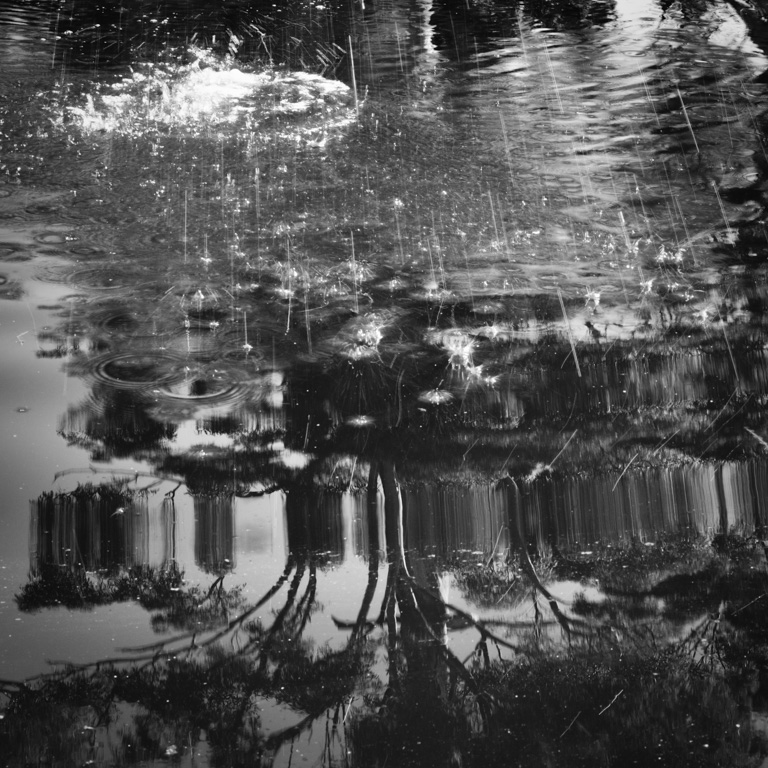
The sense of energy at Canary Wharf is palpable; it’s not a place that is often associated with quiet contemplation. Yet pausing for a moment reveals real beauty and softness alongside the corporate architecture; the patterns and colours can be mesmerising like a kaleidoscope as they change with the light and weather. With so much activity all around, capturing these colourful images requires a focus that isn’t immediately obvious to passers by; I can spend hours at a time examining one body of water, waiting for something out of the ordinary – I sometimes think I might be the only person who is still among the crowd.
Attending the first On Landscape conference was a bit of a revelation for me creatively - I had made many trips to locations like the Lakes and Scotland that are usually regarded as highly productive for photographers yet came away with nothing that I felt was remarkable. Jem Southam's talk about his concentrated and detailed studies of his local area helped me realise why my previous approach wasn't working for me.
If anyone asks about what my photography influences are, I think of what fascinated me as a child, playing for hours with a kaleidoscope, spirograph and etch-a-sketch and being captivated by the endless variation of colours and shapes you could create.
If anyone asks about what my photography influences are, I think of what fascinated me as a child, playing for hours with a kaleidoscope, spirograph and etch-a-sketch and being captivated by the endless variation of colours and shapes you could create. Later on, I connected with artists such as Rothko, Klimt and the photography of David Hockney; those themes still inspire me. I realised the sort of photographs I was producing before the On Landscape conference had no roots in what enthused me. So I decided to be more focused and, on being given a creative commission for the Canary Wharf Group plc, and a 24/7 access all areas pass for their site, some ideas began to germinate.
Having to return to the same location time and time again over several months, I began to notice shapes and patterns that motivated me to try to capture in photographic form the images that I was I visualising in my mind. It was precisely because I returned repeatedly that I began to realise the potential for them as a project, a project that would take the next four years to develop into something fruitful. It was probably no coincidence that connecting with something that really interested me meant I was more productive and happier with the results. Winning the 'Your View' section of LPOTY in 2015 with an image from the series made me feel I was on the right track somehow.
Having to return to the same location time and time again over several months, I began to notice shapes and patterns that motivated me to try to capture in photographic form the images that I was I visualising in my mind. It was precisely because I returned repeatedly that I began to realise the potential for them as a project....
It was very much a trial and error process getting the technique right to create what I was imagining I could record but when I did I barely noticed at the time taking them, it was pretty common to take over 600 images over 4 or 5 hours and get only one or two I was happy with. The type of weather I preferred and my availability to coincide with it slowed the process down greatly as only certain conditions seemed to create what I was looking for. But it's no bad thing to have to wait sometimes to make progress; it sort of makes it more exciting.
The whole process became like a form of meditation for me and felt very rewarding, which only fuelled more photography. I doubt that I will find an end to the project as I enjoy it too much but, then again, why would I want to end it if I am still enjoying it?
In the early nineties, Abelardo Morell’s decision to photograph the Camera Obscura effect led to an exploration of the interaction between the outside and the inside, initially in black and white and later in colour. He subsequently devised a portable room – effectively a tent fitted with a periscope – which enabled him to take his work outdoors, first into the desert and then into American National Parks. His images of the landscape have an impressionistic quality, but for me their magic lies in the harmonious juxtaposition of the view with the pattern, colour and texture of the ground below.
Although you’d been inspired by the images you’d seen as a child I believe you came to study photography by chance - you were an engineering student but took a photography course in your second year at college? What was its appeal to you and how did this change the course of your studies and subsequent career?
When I was young I wanted to study engineering so when I went to college that’s what I took courses in; it was a total disaster. I flunked Physics and Math - I went into a spiral of depression. I decided to take a Photography course in the Fall of 1969 and it was instant love and fire. I think that I had a visual intelligence that was much better than the scientific path I was on. Really, I felt that I had found a language and a structural way to look at the world that was intuitive and personal.
Fern 9, Cliché-Verre, 2009
You’ve commented on the significance of having a good teacher and mentor, and that when successful the relationship broadens and the knowledge imparted is not confined to photography?
John McKee was my photography teacher at Bowdoin College in 1969 and the way he taught it was not so much about f stops but rather about how discovery is tied up with linking music, art and poetry to photographic vision. His approach was perfect for the way I thought and understood things. I owe him a lot.
As a regular visitor to the northern Lake District I’ve become interested in photographic opportunities offered by the slate quarries in Borrowdale. Images of these quarries appear from time to time on Facebook and elsewhere, and during my recent visits I followed up on some of these leads. My own photography is mainly of the ‘classic landscape’ genre, but increasingly of late I’ve been interested in more abstract images to be found with closer study of details seen in natural landscapes.
One location that I have visited a number of times is Dalt Quarry, found not far from the footpath leading south from Grange in Borrowdale towards Castle Crag, OS grid 249165. (It is sometimes mentioned on Google as John Dalt Quarry, without references). A recent publication ‘Slate Mining in the Lake District: An Illustrated History By Alastair Cameron, 2016’refers to it by saying “In the woods below Castle Crag can be found the Dalt Quarry which was closed in 1973 by the National Trust on ‘amenity grounds’ causing 18 local men to be put out of work”. Wainwright’s Pictorial Guide to the North Western Fells doesn’t mention Dalt Quarry as such, although the chapter on nearby Castle Crag does include the location of Dalt Quarry as being within “one mile of country containing …. In the author’s humble submission …the loveliest square mile in Lakeland – the Jaws of Borrowdale”. Chris Jesty’s 2008 revision of Wainwright’s Central Fells shows a dotted footpath leading to and from Dalt Quarry, in the chapter ‘Ascent from Grange – Castle Crag 5’.
For reasons that must be due to the local geology, this quarry presents a high vertical face with, on one side, diagonal brightly coloured yellow/orange stripes running from top to bottom.
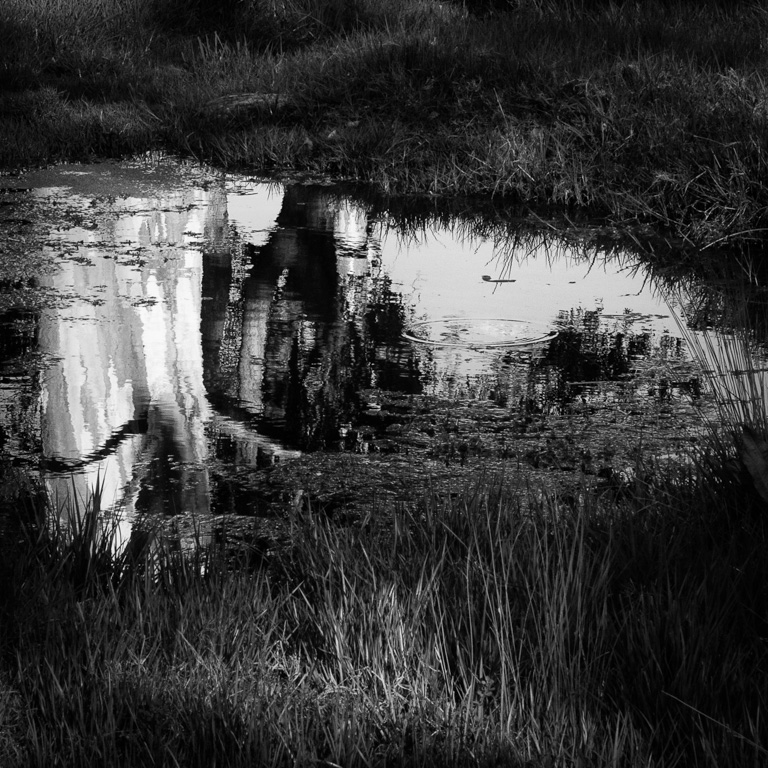
I’d visited Dalt Quarry a while ago but didn’t properly investigate the location. I did what most people seem to do, walking up to the fence at the edge of the quarry (in a very boggy area) and taking some photos from only that spot. By doing so, reflections of the vertical rock strata in the flooded quarry make a good subject.
On a second visit I was determined to explore it more thoroughly, and found there are easily obtained - and much better - views of the coloured rock strata to be had by a short scramble up to the right, where it’s possible to walk around the quarry edge – take care! - and look down from above onto the differently coloured rock faces below. This second visit was in January when there were no leaves on the trees to obstruct the views. For reasons that must be due to the local geology, this quarry presents a high vertical face with, on one side, diagonal brightly coloured yellow/orange stripes running from top to bottom. On the opposite side are rusty/reddish strata. Some images taken in January 2017 are shown here.
Quarries in Borrowdale are a subject for photography I plan to explore more thoroughly in future. I think they offer great potential for ‘landscapes within’.
Polaroid was a remarkable invention. In a world where you had to send film off to a lab before you could see your pictures, here was a technology that was akin to digital photography 30+ years before it existed; better you got a print out of it.
My experience with using Polaroid camera was minimal until a few years ago. I remember using a cream coloured Pack Film camera as a child but have no recollection of whose it was, or what photos were taken with it. But I do recall seeing the little plastic coated paper tab which you had to pull out to reveal the tab of the photo and its backing.
I once shot a book cover using my wife's Polaroid 600 camera, but apart from that, the era passed me by. I knew the name and the cultural significance of a Polaroid. I even knew not to 'shake it like a Polaroid picture' following the release of the song "Hey Ya" by Outkast (their use of the phrase eliciting the stuffy response from the Polaroid Corporation that shaking a Polaroid could damage the development process).
In a way, that was partly the subconscious genesis of this project. Something about that press release made me think a little bit more about Polaroids; that the development process could be damaged.
A bit later and I finally had an old Polaroid SX-70 camera and some Polaroid film. I shot some landscapes with them but due to either a fault in the camera or mucky rollers (a common problem!) what came out was a weird set of blobs and brown and beige colours. They were interesting but not as intended. I moved on but kept the prints. Every so often I'd come across them, puzzle a bit, then put them away in a box.
Leonard Murray Metcalf was born in Australia to parents with mixed heritage. Family folklore tell tales of ancestors such as a Scottish Sea Ferry Captain, an Indian Herbalist, a Reverend from Tatterford, a Chinese music teacher and possible Aboriginal lineage. His paternal grandparents hail from Newcastle on Tyne. It’s no surprise that Len’s work is sophisticated and worldly, attracting attention from an international audience.
Len began his obsession for landscape photography over 40 years ago when his father gifted him his first camera. Growing up in Australia’s spectacular Blue Mountains provided Len with an endless array of incredible scenes to capture. He particularly loves the light and mood of misty wet landscapes, abundant in that region.
Naturally, Len pursued a Bachelor of Visual Arts in Photography and graduated with straight distinctions, also receiving the coveted award for ‘Most Outstanding Advanced Colour Photographer’. However, education had also captured Len’s attention as he had been teaching Outdoor and Environmental Education to pay his way through University. This other passion coupled with a growing sense of disillusionment with the art world saw Len excel in education in the youth, government and corporate worlds for the next 20 years. He undertook a Graduate Diploma in Art Education and a Master’s Degree in Adult Education.
His reunion with photography occurred at the conclusion of a three-year lecturing tenure in the Middle East and he found that the love he had for photographing the natural world had flourished while he was otherwise engaged. Combining his flair for both education and photography made perfect sense and hence, Len’s School was created in 2000.
Len has become renowned as a leading photographic educator through teaching, mentoring and facilitating innovative workshops and tours around Australia. His exquisite photographs capture diverse Australian landscapes, from arid deserts and windswept coasts to his backyard in the Greater Blue Mountains World Heritage Area. He ran his own gallery, has exhibited widely and writes for photography journals around the world.
Meeting of Minds conference 2016
Len's talk looked into his approaches to simplicity and the use of visual punctuation as a tool to create absorbing images. At the end of the video we include a short 'behind the scenes' interview about Len's work.
Our 4x4 feature is a set of four mini landscape photography portfolios from our subscribers, each consisting of four images related in some way. You can view previous 4x4 portfolios here.
We're always on the lookout for new portfolios, so please do get in touch! If you would like to submit your 4x4 portfolio, please visit this page for submission information. We are looking for contributions for the next few issues, so please do get in touch if you're interested!
Please click the images to see the portfolios in full.
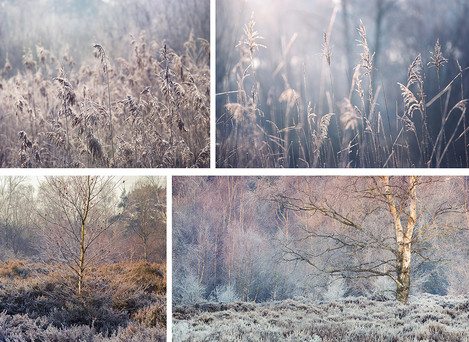
Images are from the Norfolk and Lincolnshire coast, around Boston, Cley-next-the-Sea, and Blakeney. Although 2 of them (unusually) show people, they still seem to me to be 'landscapes', as they both show the local natural environment and weather conditions perfectly? This coast is all about open skies, and the wind coming off the North Sea - called an 'idle wind' locally...it goes through you, not around you! The sunrise through the marsh mist was a rare moment of calm however. Falling Sky at Blakeney was in strong gusting winds, and shortly before a drenching in horizontal rain. (image edited 'colder' to emphasise the windchill!)
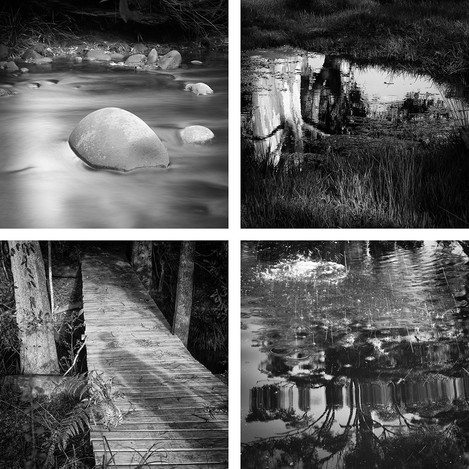
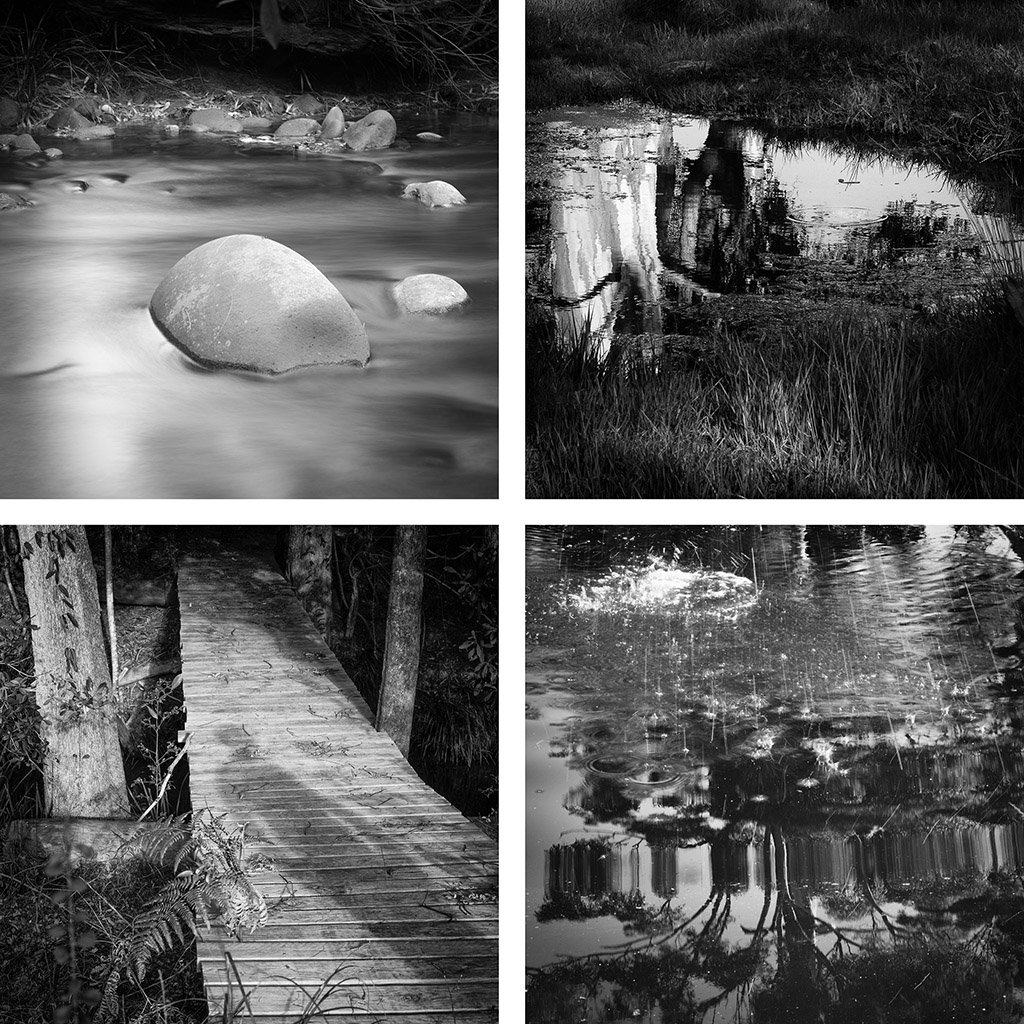
This mini folio of images entitled “Dark Woods” are from a recent visit to a wood in the Irish midlands. My preference, since my film days, has always been for black and white images. I am drawn more by texture and tone than by colour. In the early 90s I was lucky to do workshops with John Blakemore and Thomas Joshua Cooper. The dark tones of their images, and their subject matter, really resonated with me. I am not really interested in grand vistas. I find the dense woodland more challenging, attempting to capture some aspects amongst the snarling randomness.
I try to express the primaeval essence of the woodland with its ivy and moss covered trees surrounded by tangled undergrowth. This form of landscape, I feel, removes us from our everyday commuter life and transposes us into the ethereal life of trees.
Water and snow make for a great combination to view and enjoy in the winter season. Nature takes on a magical look with snow caps on rocks or ice forms by a water fall. For a photographer every direction the camera is pointed is another photo opportunity to enjoy and capture so that others can also enjoy the magic of winter season
I discovered these woods one spring while walking locally in search of bluebells and have been back many times since in all seasons. They’re a bit of a local secret and during the majority of the year are free of other people so a great place to get headspace. That said, once word gets out the bluebells are in flower they can get a bit overrun with photographers, apparently.
It’s a great wood for me as it’s less than 5 minutes drive from home and if I can’t see the hill it sits on from home due to mist or fog I can grab my kit and pop up. I’ll generally spend a good couple of hours wandering around taking in the atmosphere and trying to be quiet in case I get a glimpse of the herd of roe deer that live here. These shots were taken through the seasons as it’s a beautiful place to be all year. My partner, Philippa Starkey, and I did get a thorough soaking one day when it was pouring with rain which tested our kit somewhat. Even so, we had a great time trying to find compositions and watching out for the deer.
I chose these images as I think they show the diversity of images that can be made in a small space all year round.
Lying 100 miles off the tip of Scotland, the Shetland Isles often seem to get overlooked. Being confined to a small box stuck on the edge of most maps of Britain, you would be forgiven for thinking they were nothing but a minor inconvenience for map makers for refusing to sit a bit closer to the mainland. Mention the Isle of Skye and you can easily conjure up images of The Storr, but mention Shetland and most people would be stumped to think of anything other than ponies. This is why we had to go explore it for ourselves.
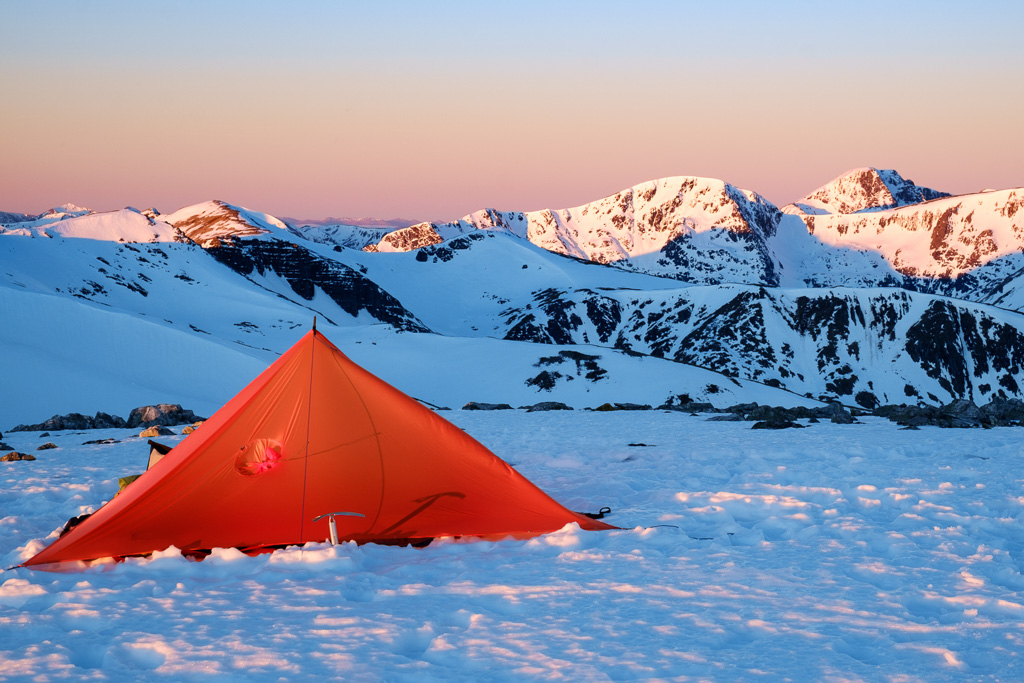
Taking the car over on the overnight ferry from Aberdeen, we had decided to wild camp for most of the trip. My wife Kerry (a travel blogger) and I had always found this a good way to really discover new landscapes and allow me to maximise my time shooting rather than travelling back and forth from accommodation (and being able to make up a coffee anytime, anywhere is a serious bonus).
Rolling off the ferry in Lerwick early in the morning, our initial plan was to start from the southernmost tip of the mainland and spend a week working our way up to the top. Then we would revisit the areas we thought were worth spending time in. I’ve often found this to be one of the main challenges of landscape photography, no matter how much research you do beforehand until you’ve been somewhere a few times to build up familiarity much of your time can be spent scouting out locations rather than taking any photographs.
The Shetland isles are much lower, with the highest peak being only 450m tall, the interior land lacks much of the drama seen in Skye or Lewis and Harris.
Our drive to the cliffs of Sumburgh at the south revealed a completely different type of landscape than the other islands of Scotland. The Shetland isles are much lower, with the highest peak being only 450m tall, the interior land lacks much of the drama seen in Skye or Lewis and Harris. Much of the landscape consists of large undulating hills covered in heather or farmland. Given the right weather and light, I’m sure there may have been some good opportunities for photography inland, but I felt my time would be better spent on the rugged coastline, which Shetland has in abundance. The cliffs at Sumburgh were shrouded in low level cloud, providing the type of light that appeals to me; low contrast with none of the hard shadows created by direct light and ideal for longer exposures.
From here we started our exploration of the main island, using 1:25 000 scale maps of the islands to locate beaches, access roads and any areas that looked particularly interesting. The maps we used were OS maps 466-470. It might seem a bit pricey to buy so many maps for each trip (about £40 for the set) but I find them essential, allowing you to plan routes and pick out points of interest; how can rock stacks and places with names such as The Drongs, Papa Stour and Muckle Roe not be worth checking out?
There’s been a noticeable shift in Rachael Talibart’s images over time. Not surprisingly for someone with a self-confessed love of the sea, this has become an increasingly significant part of her work. There’s also been a move towards simpler compositions, with fewer references to location and it is these rather than her earlier landscape views that you will now find most prominent on her website and in her posts on social media.
White Cliffs
Can you tell readers a little about yourself – your education, early interests and career – and how you first became interested in photography?
I’m a full-time photographer, specialising in coastal imagery. I live in Surrey now but I grew up on the South Coast, in a yachting family. For the first twelve years of my life, every weekend and all of the school holidays were spent at sea. Those years left me with a lifelong fascination for the ocean and, although I now live in a landlocked county, I go to the coast as often as I possibly can, at least once a week.
I first became interested in photography in my teens when I was given a little cartridge-film camera for Christmas, one of those where the case folded down to make a handle. The obsession really set in when I took my first 35mm camera on a 9-week, solo, backpacking trip around the world. I’d just qualified as a solicitor in a ‘magic circle’ City firm and was able to take unpaid leave before settling into the rigours of practice. When I got back, I spent my first pay cheque as a qualified solicitor on an SLR and that was it - completely hooked.
Solent Skies
You made a radical change in career and presumably not one driven by financial reward. What prompted this?
I left the legal profession in 2000, when my daughter was born. There were lots of reasons, but looking back I see that I had become bored. It wasn’t just that I wanted to spend more time with the kids; I needed a new challenge. So I went back to university, studying part-time while the children were little. I was still enjoying photography as a hobby but had no plans to make it a career; that just evolved naturally. I want to be clear that it has only been in the last year that my photography has started to pay enough that I need to bother the tax-man. It’s easy to make a few sales sound like a lot in conversation and, as it’s better for your profile to sound successful, photographers are not always upfront about this side of things. In reality, it’s not easy to make money in this game and much patience is needed. If you add up all the expenses (all those miles spent driving to the coast and back!), any income soon gets swallowed up and, if you view it as an hourly rate, well, you’d be better off doing something else. I think most people who choose this life are in it for the love of it, not to get rich. In this respect, I’m lucky that I am a little older and have something to fall back on. I don't have to spend time doing commercial work to pay the bills, which gives me more time for doing what I love.
I am a hydrologist (as well as a photographer for more than 50 years). Hydrology is the study of water. It is a fascinating area of research, in part because of the real importance to human lives of the availability of water for drinking, hygiene, agriculture and manufacturing processes, but also because it is also one of the most dynamic features of the landscape. It has therefore in the past been a subject that has long attracted artists. We have long looked at the water with interest – one of the most famous documented examples being the drawings of the nature of turbulence in the sketchbooks of Leonardo da Vinci. He was one of the first people to study the dynamics of flowing water in detail (he prepared, but never published a Treatise on Water1,2), though it has been suggested that his interest was driven as much by an interest in how to make practical use of the power of water, how to improve canal design, and how to protect people against devastating floods, than in the artistic potential2.
Leonardo da Vinci: sketch of turbulence in a pool below a fall
In fact, the history of art suggests that it has proven really rather difficult to represent the dynamics of flowing water in two-dimensional images. It appears to be one of the greatest challenges for an artist. This is perhaps for good scientific reasons. Water flows are dynamic, changing constantly in response to the changing hydrology and boundaries to the flow, including the effect of the wind. The water will have varying degrees of transparency depending on water quality and sediment loads. Flowing water produces complex and changing patterns of light due to reflection and refraction. The result is that the artistic representation of water often seems to be rather poorly done.
He suggests that one of the first and most influential treatments of water was by J W M Turner, in part because of his skill in using the medium of watercolour to represent effects of light and water in the outdoors, with a view to representing the sublime
Actually, the situation is not that much better for the scientist. We actually have a really beautiful representation of the dynamics of water in the 3 dimensional Navier-Stokes equations. The problem is that we cannot solve those equations in most applications of practical interest because of the uncertainties associated with the knowledge of the relevant boundary conditions (and also, still today, the sheer computer power needed to produce numerical solutions at useful scales). Another problem for the hydrologist is that a lot of the water flows that are of interest take place under the ground surface where it is very difficult to study exactly what is going on, except in small samples. We often resort to inferring what is going on from larger scale flow and tracer observations.
Some of the artistic difficulties of representing water are discussed in an interesting book by David Clarke3. He suggests that one of the first and most influential treatments of water was by J W M Turner, in part because of his skill in using the medium of watercolour to represent effects of light and water in the outdoors, with a view to representing the sublime (as originally defined by Edmund Burke in the 1750s)4. Water was an essential part of the sublime – the sound and fury of mountain torrents and the dramatic presence of glaciers adding to the atmosphere as the Grand Tourists passed through the Alps. Many of Turner’s most famous large-scale watercolours are of waterfalls in Switzerland he had encountered on his travels. David Clarke also suggests that it was the dissolution of the subject matter in his watercolours (which Turner also carried over into his later oil paintings), using water as a medium to represent water as the subject, that started the path towards a more abstract art, particularly in the water-related art of Monet, Mondrian, Kandinsky, Pollock, De Kooning and Frankenthaler. He suggests that these artists (and others of course) had been all influenced by living close to and interacting visually with, water on a daily basis.
J W M Turner: Water colour sketch of sea and sky
With the invention of photography, the representation of water has become somewhat easier. Water has been a subject for images made since the very earliest days of photography, even more so once exposure times became short enough to be able to capture waves (e.g.Gustav Le Gray’s images of the sea in the 1880s). Photography has been used extensively in experimental laboratory studies in hydraulics5. There are whole books devoted to photographic studies and surveys of water images6, and we have now become used to pictures of blurred waterfalls, autumn colours reflected in rivers and lakes and, since the work of Hiroshi Sugimoto and Michael Kenna, of minimalist water stilled by the use of long exposures to emphasise the nature of the light. Water is also involved in other forms of landscape photography, of course, from the refraction that produces rainbows8, to the cloud “equivalents” of Alfred Stieglitz, to backlit geyser eruptions, and, in the form of ice, the recent spate of pictures from inside glacial ice caves and in the lagoon and on the beach at Jökulsárlón. The challenge now, as with so many aspects of photography is trying to avoid cliché (but there are some striking examples of doing so, see, for example, the River Taw work of Susan Derges, the Atlantic and Scottish Rivers work of Thomas Joshua Cooper, the Thames Studies of Roni Horn, and the early Sea Horizon work of Garry Fabian Miller and On Landscape’s own Michéla Griffiths).
In the images that follow I have wanted to show the life and intrinsic beauty of water flows in a realistic way, while recognising the approximate way in which we can represent the dynamics.
As a hydrologist, I can claim to understand something about the nature of the way in which water moves through the landscape. But as already noted, in doing so the scientist has some severe constraints of how well that movement can be observed, measured and modelled. As a result, hydrology is one of the inexact sciences, subject to considerable uncertainties. The precision that scientists like is impossible to achieve (except in certain well-controlled laboratory experiments). Thus, in producing hydrological science we must allow for abstraction and uncertainty. It seems that this has carried over into my image making of water (though it is also interesting to speculate that it might have been the other way round?).
In the images that follow I have wanted to show the life and intrinsic beauty of water flows in a realistic way, while recognising the approximate way in which we can represent the dynamics. How has this been done? By trying to capture images that “feel right” – which is clearly a more artistic concept. Uncertainty also plays a role – I find some of the most satisfying images are those that require the viewer to make some effort to understand. I also find situations where there is no water to be seen, but the history of a place as affected by water is evident – the marks of past water. My hope is that the viewer will respond by valuing what is shown more highly (as hydrologists we often have to deal with the pollution and degradation of water bodies – and it is so difficult to clean up that pollution, especially under the ground, an issue addressed photographically by Edward Burtynski7,9).
Images
Surface Reflections: River Eden at Shoregill
Surface reflections: River Eden at Shoregill
Surface Reflections: River Eden at Shoregill
Surface Reflections: The Sarine at Hauterive, Canton de Fribourg, Switzerland
Internal reflections: Lookout Creek, Oregon
Internal Reflections: River Eden at Stenkrith
Internal Reflections: Val Versasca, Tessin, Switzerland
Frozen Water: River Eden at Hell Gill
Frozen water: glacier D’Aletsch, Canton de Valais, Switzerland
Uncertainty: River Eden at Shoregill
Uncertainty: River Eden at Hell Gill
Uncertainty: The Sarine at Hautrive, Canton de Fribourg, Switzerland
Uncertainty: La Jogne,, Canton de Fribourg, Switzerland
Footnotes
1 Asit K. Biswas, 1971, A History of Hydrology, North-Holland Publishing 2 Laurent Pfister et al., 2009, Leonardo da Vinci’s Theory of Water, Int. Assoc. Sci. Hydrol. Special Publication No. 9 3 David Clarke, 2010, Water and Art, Reaktion Books 4 Thomes Peck, 2015, Face to Face with the Sublime, On Landscape Issue 90. 5 M Van Dyke, 1982, A Gallery of Fluid Motion, Parabolic Press; M. Samimy et al., 2004, A Gallery of Fluid Motion, Cambridge University Press 6 Hans Sylvester, 1992, L’Eau, Editions de La Martinière; David Herrod, 1994; Waters of Cumbria, Creative Monochrome; Bernhard Edmaier, 2015, Water, Prestel; 7 Edward Burtynsky, 2013, Water, Steidl; 8 M G J Minnaert, 1993, Light and Color in the Outdoors, Springer. 9 Edward Burtynsky, 2003, Manufactured Landscapes, Yale University Press and 2013, Salt Pans, Steidl.
‘Black Dots’ is an exploration of mountain bothies and bothy culture throughout the United Kingdom. Far from civilisation and mostly accessible only by foot, these secluded mountain shelters are scattered across the British Isles, tirelessly maintained by volunteers from the Mountain Bothies Association. Unlocked and free to use, they provide a refuge from the vast terrain that surrounds them and have rapidly become an iconic feature of the British Landscape over the past fifty years. Bothies are synonymous with the outdoor experience in the UK, and from day trippers to seasoned mountaineers the growing community of bothy users is hugely diverse.
Born out of curiosity, ‘Black Dots’ is the result of two years spent exploring the British Isles in an attempt to better understand what these buildings are, where they’re located and the culture that surrounds them. In doing so, my hope is that the work will generate a wider dialogue celebrating the relationship between man and the wilderness in the 21st century.
In this piece for OnLandscape, I’ll be selecting a handful of my favourite photographs from the project and delving a little deeper into the stories behind them. [N.B. We caught up with Nick in July 2016 when Tim talked to Nick about his photography and the background to the project]
Warnscale Hut & Haystacks, The Lake District, England
Warnscale was the first bothy I ever stayed in. It ignited a fascination in bothies and was the catalyst that really kick started Black Dots for me. Tucked into the fellside between Fleetwith Pike & Haystacks, this converted miners hut overlooks Buttermere & Crummock water and is only a short hike from the Honister Slate Mine. Once you navigate the tiny doorway, the primitive interior is quickly converted into a truly magical home-away-from-home once the fire is lit, making this one of my favourite bothies in the network. Waking early and scrambling up the banks of slate and heather behind the bothy, I set the 5x4 up and waited for the sun to break over the ridgeline behind me. As it did so, it created a perfect line of light across the summit of Haystacks which timed perfectly with a small plume of smoke that billowed from the chimney.
Corrour & The Devil’s Point, The Cairngorms, Scotland
In the beginning of my photography career, I could not think of shooting landscapes formed by man. I was entirely focusing on the natural and untouched wilderness. I wanted to bring beautiful images from the wild out to the readers of magazines and books. I hiked up and down in the remotest of the Swedish mountains. This to find landscapes which had never had been photographed before. I travelled across the globe to look for the sublime creations of Mother Nature herself. Not until I started to travel to the high Arctic had I any interest in landscapes moderated by man. In and around the the Inuit settlements of Greenland and Nunavut, and the coal mines of Svalbard, I found traces of the presence of mankind and of a kind which changed the course of my photography. I now consider man as the greatest creator and destroyer on top of the crust of the earth.
Working with Adam and Jo, we wanted our second exhibition at the gallery to show what an influence Joe Cornish and the gallery have been on landscape photography in the UK. Going back through our featured photographers and other interviews (and talks at the conference), the common theme with a lot of photographers was who they drew inspiration from when they were defining their voice and style of photography.
On Saturday 4th March 2017 we launched our second exhibition 'First Light Inspiration' and held a panel discussion with Joe Cornish, Tim Parkin and the exhibiting photographers to discuss the influence and inspiration of First Light (click here for our review of First Light) on their photography and the wider conversation around influence and inspiration in their creativity.
The transcription starts just after we get past introductions
Exhibition Launch Discussion
Tim Parkin (Tim): <to Julian> A lot of your work, when you first started personal projects, was based in Scotland and you made almost pilgrimages to various parts. Was that inspired by some of the work in First Light?
Julian Calverley (Julian): It was indeed. Plus I used to go there as a kid, so I wanted to get back and try to capture this amazing place. Which I failed miserably to do! It took a long time for me to come back with something that felt like it was seeing and feeling. Feeling is the important word actually. Some of the locations I hadn’t even really heard of like Skye. The picture on the front of [Joe's] book obviously is a classic and I had never seen this alien landscape. In fact I couldn’t find that boulder, it took me a couple of trips. When I finally found it I was like ‘This is it, I’m here!’. There is something special about being in these particular sorts of places in general though
Tim: You didn’t have much luck with the weather when you went up to look for these pictures?
Julian: That’s right, but it’s when the penny dropped. I was trying to capture big vistas, and failing, and it wasn’t until the bad weather came in and I learnt how to deal with that and capture it that I got excited. It felt like I was doing something, not necessarily unique, but that felt personal. That was the point at which it felt like personal work.
Tim: That’s when the sense of the sublime came in that you talk about Joe?
Joe Cornish (Joe): Exactly, the feeling that you get in your pictures, if that’s the threshold that you cross when you realise that you could work with the weather rather than fighting against it. One more thing I wanted to say in response what Julian said was about crafting pictures. I worked as an assistant with car photographers quite a bit and I subsequently started to think about the landscape a giant still life. When you do that you can’t control the lighting but you can at least conceptualise about the colour relationships and the form and the way modelling works, because of that knowledge from the studio.
Julian: And it was high tide wasn't it? I saw someone commented once on that picture. They said “wow how did he do that because when I was there the water wasn’t there!” That did make me chuckle! Planning and patience. Patience is important.
Joe: Persistence too. I’m not a very patient person and I remember talking to Paul Wakefield about that once. He said “I’m very impatient person” but when you look at his pictures you think, how on earth did he do that! So it’s not so much about hanging around but being prepared to go back and back. Being able to use your time constructively when you are waiting for something to happen. As you need to be able to keep that energy in check and let it flow when you need it to.
Tim: I think it would be safe to say that you lead a bit of a renaissance in large format camera usage in the UK. I know a lot of people who took up large format camera after seeing your's and David Ward’s book. Was this the case for you Baxter? How long had you worked with large format?
Baxter Bradford (Baxter): I had been on a course with Joe in 2001 and I was making my first foray into large format then. I was having a conversation with Paul Saunders last summer and we both made this confession. I feel like a bit of a saddoe as when I went through the book I did a done a tally of the Lee filters Joe had used! The ones with the most ticks against them, I went to Lee Filters and bought! I couldn’t afford all of them but it gave me a pecking order, so when I got a bit more money, I got more. Paul said that was exactly what he’d done. This moment that we had this discussion for the first time. I was getting misses as well as the occasional fluke. The book was seminal in that it shows a nearly right photograph as well as the one that worked. They talk about and self-criticise, and there is the narrative about the background to the image as well. The fact, like you said Julian, the lighting is there, but it’s a case of how can you solve problems so you can identify the answers when you’re out in the landscape. You might have gone with the idea of doing this but the light is doing something different, so I should concentrate on doing that. The variety of landscapes in the book and the picture styles. It helped give me self-confidence to solve the problems such as this isn’t quite right because ……. And this is better because….In hindsight, I would have done this... I thought that was very open and gave me a lot of footholds on my own journey to improve.
Tim: Whose idea was that in the book Joe?
Joe: Very interesting in the way Bax has put that as it reminds me that although the idea for the book was principally Eddie Ephraum’s - the content was inspired largely by my reading of Galen Rowell’s Mountain Light. Anybody got that? Very important work in photography I think. Of all the books that I’d ever read up to that point, that was the first one that revealed the craft process.
Tim: Pulled the curtains back on the process….
Joe: Yes. Galen was extremely good and generous with his explanations for how he’d analyse the way lighting worked. He was very scientific in his approach to problem-solving and that was a revelation to me! That was a good way to go and a generosity of spirit that I liked too. When I was an assistant in London, I don’t know if this will resonate for Julian or not, nobody would tell you anything!
Julian: Absolutely!
Joe: Everything was secretive because every photographer was afraid.
Julian: Paranoid of the next guy?
Joe: Yes, of the next assistant pinching their clients basically! There were no workshops back then either so you had to go out and learn everything by taking pictures and making very expensive mistakes. They were expensive because of the cost of film and processing. It was a different way of learning for sure then. Mountain Light and Galen should have been referenced more strongly in that last chapter. I’m hoping to make up for that here. Thank you for that.
Tim: Matt, you’ve only just recently got into photography is that right?
Matt Lethbridge (Matt): Within the last ten years and pretty much as a direct result of stumbling across Joe’s book in a bookstore. I was the same as a lot of people, I had a little compact camera and took it on holiday and made some nice pictures. You come back from holiday and would be disappointed with the results. I was wandering around a bookshop in our local town, just trying to kill time and came around this remarkable picture on a book cover, the picture of Elgol, and I was just amazed and picked up the book, opened it up and had a flick through. I was even more amazed at the pictures at that time, bearing in mind I had no photographic experience.
We’re all used to National Geographic Magazine images with these wonderful pictures of exotic far off places. But this bloke called Joe Cornish, he photographed all of these photos in the UK more or less. To see Elgol in Scotland and see it lit, and the depth of beauty in the picture, it astounded me. It moved me to purchase the book and got it home. I read through it and again, and it sparked something inside me and made me want to go out and make pictures. I went out and bought a proper camera with interchangeable lens and failed miserably. I devoured magazine after magazine but kept going back and referencing the book.
Joe: You must have a very patient other half, I’m sure!
Matt: I have a very patient wife, she’s wonderful. This inspiration from First Light has just carried on and the book is there at home and is a constant reference to me. Whenever I feel I need some inspiration I pick up the book and look through it. I read a few passages and look at the ‘nearly photos’ and think perhaps one day I’ll make a photo as good as them!
Tim: Do you think that it’s the narrative as well as the pictures that are important for your appreciation?
Matt: Incredibly important because, although the picture speaks volumes itself, it is also the thought processes. I felt I needed to understand why Joe took that particular picture, how he produced it, how was he feeling. It’s been profound actually. Without the book, I wouldn’t be a photographer and I wouldn’t be sat here today.
Tim: Beata, you have a very different style of photography now. Tell me about how you went from discovering Joe’s book and your style.
Beata Moore (Beata): I went for a workshop with Joe a couple of years before the book was published. As a result of the workshop, the very first thing I did was to buy a wide angle lens. I thought that’s it, I’m done, I know what I’m doing! I didn’t and luckily a couple of years later your book came out. I read it a lot and I understood more but I still couldn’t quite grasp, as wonderful as the wide vistas are, I just didn’t feel them. I couldn’t portray what I felt and what I wanted to portray. It took me longer to understand that actually, my heart lies in smaller views, more intimate details. I think some of my images border with abstract and I still love colour on top of everything else.
I think abstracts and a little bit more nature details are more me. As much as I’d like to be Joe Cornish, I’m not! For the last few years, I work more and more towards his more intimate views. I learnt so much from Joe. It’s his approach, that slow approach, less of a galloping photographer like I tend to be sometimes as I get fascinated with what’s in front of me. Joe has a more meticulous approach which I have witnessed and I took that into consideration and I slowed down much more. Although I still get distracted a lot by light, changing moods and reflections and whatever else! I have learnt a lot and think I’m kind of semi-comfortable with what I’m doing with my little nature details.
Tim: Harvey, how did you discover the book?
Harvey Lloyd-Thomas (Harvey): Around the time when I was asked to take part in this exhibition, I was trying to think back to when I became aware of Joe’s work. It was so long ago I can’t remember! I first got into photography at university when I was hill walking in places like Scotland and the Lake District. I was just taking photographers of the walks and the outdoors. My love is being outdoors, that’s what I enjoy and have an interest in the arts and design from when I was a child as I did lots of painting and drawing.
The photography started as a means of recording my hill walking expeditions and around that time I came across Colin Prior books and became aware of Joe’s work. There was a big disconnect between the pictures I was taking and the pictures I saw in these books. That’s when reading Joe’s book and his explanations of how these pictures were taken made me realise that there’s a whole extra new level of craft, patience and attention to detail that I wasn’t taking myself. It started from there and I became more serious about the photography and although I think it’s still being outdoors is the number one thing for me, making the image is number two and I get enjoyment out of both and that’s why I take photographs outdoors rather than other styles of photography.
I still have a conflict in that I have a spontaneous approach to my photography quite often and most of the time I don’t use tripods or filters. I’m aware of deficiencies when I come back with images that I then realise they could have been improved if I’d paid attention to detail that people like Joe do. I’m still trying to slow down and perhaps take that extra care and not always succeeding with images I like as much as when I take the spontaneous approach.
Joe: That’s a very interesting point you identified there I think. That remains a big challenge for everyone that you’re ideas are truly your own voice and you often see those and make phone based snapshots. A few of us here will have that experience and the phone pictures look fantastic and you think I’ll set up my camera and you get your big camera out and you often when you get those pictures back they don’t have quite the same something. So that perhaps some of what was there in the original idea and perhaps it’s how the phone translates it. Perhaps the colour and the light have changed, but sometimes it’s because you’ve laboured over it and it’s hard to get that feeling of something that is crafted and stilled and retains the spontaneity of the idea. That’s no easy job.
Harvey: I think I perhaps just accept that’s my style, that spontaneous approach and it’s not going to be technically perfect as a result. I think also my approach took a while to work out this problem of exposing sky and landscape equally until I discovered graduated filters. Until that point, I was just not achieving results in my pictures that I was seeing in magazines and books. My approach was quite often to come up with compositions that ignored the sky and I think that partly lead me, like Beata. I'm not necessarily attached to representation like the pictures are on the wall in the gallery. A lot of my pictures are more abstracts and details of intimate landscapes. Extracts, I think people describe them as, and that partly started from the technical limitations of how I was taking pictures. I’m still drawn to that but I have this other conflict that I take a lot of my photography when I go away to Iceland, Scandinavia and places like that. I go to these places and come back with pictures of details which could have been taken anywhere. I do want to take vistas and I do occasionally succeed but I’m more successful in the smaller work.
Tim: This is an example of the difference between inspiration and influence isn’t it? Because I can look at many different styles of photography and be inspired by them but not want to produce the same style of work or look. It’s a difference between what you see as well.
Joe: Yes, if only it was possible to fully understand when that changes. We all want to develop our own voice as artists, I think that must be true, and in order to get to that point or place, you do have to go through something that appears to be plagiarism. I’m sure that most people will understand that and after all you go to any art gallery on any day of the week, anywhere in the world and you’ll find art students copying paintings. This is a well-established process, trying to study and understand the work of master painters or photographers in order to build. There’s a famous quote of Picasso’s which I never really understood until David Ward made it clear to me the reasoning. Picasso said that “all artists borrow, great artists steal!” Which I thought was an interesting distinction and I have always been baffled by that. What it means is that when you steal something you now own it. That’s the difference.
Tim: It becomes part of you?
Joe: Yes, in some ways it’s better I suppose to draw the lessons that you learn from the work of others and incorporate it into your own approach as far as you can. Rather than looking at the superficial impression of a picture and go back to try and copy that particular idea. That’s easy to say and not easy to do.
Tim: I remember Charlotte and I went on holiday to Elgol about eight years ago and I sat on the beach there, having a relax and had to guide five people to a particular boulder! I was like a guide or tour operator. It got to the point by the fifth person came and before they even said anything I said: “It’s over there!”.
I do think that there’s a certain problem, there are a lot of people who when they are doing art or photography, can develop a mental model of what a picture looks like. That internal model is related to your exposure to other photographers or artists work. If you have only ever had one influence, that mental model will always look like that influence. I think that this is part of what Picasso was referring to. If you’re going to take influences, take them from lots of different areas and, as you say Joe, don't just take the representation, take the whole work of the artist. Then you become the sum of everything you’ve seen and hopefully that includes your own work too. It’s that which becomes the essence of yourself - a composite of influence and self creation.
Joe: I think that successful artists, what they do is translate themselves very accurately or directly into their work. That has a curious way of becoming the universal. There’s a very famous quote by an artist and which Charles Cramer included in his talk at the On Landscape Meeting of Mind Conference. The summary of which is that "art is not a popularity contest" or a technique contest or any contest. The contest is actually with yourself; to connect with what you really are and feel.
You hear that in music particularly, and I don’t want to go too far off track but if we briefly look at the analogies between photography and the other arts, I think that music is often the most fascinating because it’s a two stage process. The composer or songwriter creates the work but it doesn’t exist until it’s performed. In many ways, that’s how photography is. Until you make that print then you haven’t revealed its life to the world. You can go out and have the experience and make the picture, which matters. Then there’s the performance and Ansel Adams himself said: “The negative is the score and the print is the performance”. Since we have got Charles Cramer's pictures behind us and Charlie was a good friend of Ansel, it’s appropriate. I think we see that it also enables you to think to have the idea on one hand but then have to translate it. At both stages, both at the seeing, thinking, feeling and the craft side making the picture you have to put yourself into it and then you have another opportunity to express more accurately or more decisively what you’ve seen at the print stage. That was certainly true for all those great darkroom printers and it was very difficult in colour up until quite recently. Now it’s opening up amazingly because of new technology.
Tim: I was going to ask you a question which is, a few of the pictures in the exhibition you’ve rescanned, reprocessed and printed for this exhibition. I’m interested in how you felt about that and did you find yourself wanting to process them differently than they were in the book?
Joe: Yes! Very much so. It’s was a pressured test, Tim, thanks for that! Of the ones we ended up choosing, I was fairly happy with them in their own way. They reflected back to me something about myself and how I’ve changed as well. I like to think I’m a better printer, I wasn’t a printer then. I was used to doing some repro but I was not a colour printer. I was shooting to get it right in camera. Because if any of you don't remember that far back or weren't a professional photographer, you took your transparency, in the so-called ‘good old days’ and send it off to your client or repro house and they often murdered it. They then covered it in oil and dust, that’s how it came back anyway.
Some of those repro guys were very good. But what they were trying to do was reproduce the transparency. What you were looking at was both the good and bad aspects of the transparency. So what we were essentially trying to do as colour photographers in the 80s and 90s was to make something that was perfect in camera.
With the best will in the world, that is a very difficult ask. Certainly, Ansel Adams and Edward Weston and the great masters black and white would never have thought that was their obligation to create the perfect negative. Which you could put down on paper and print it. They would have done lots of dodging and burning, multi-stage split toning and contrast control, all of those things.
In some respects what you see in the original book is an honest attempt more or less to reproduce the transparency and in many cases, I can tell you they aren’t very accurate. Not only are they limited by everything I’ve just said, but not that well reproduced. There’s a big difference between a transparency and four colour CMYK, especially with the blues. So the Contours in Blue, that print of the beach in Dunraven Bay is a mile off what the transparency.
Tim: We do have two copies of First Light, one is in Polish version and the other English, if you want to compare what’s in the book, with what’s on the page to see just how accurate it is.
Joe: It is interesting, the scans - Although they’d be even better if I’d got you to scan them Tim, I scanned them at home - I then used Photoshop to rebalance the colour where needed and maybe draw out a bit of shadow detail in one or two places and look at the overall balance. Now, for instance, I always analyse my pictures by inverting them on the screen to understand the flow better, the abstracted flow of the picture, and the life force within it. Then I’ll change areas in terms of light and dark, occasionally I’ll desaturate areas which are too demanding and occasionally bring in little a bit of saturation out to others. It’s usually a multi-stage process, so I very rarely make a scan, clean the dust and print it. I will do those first things, clean the dust, do my first basic curve adjustments and then leave it and come back to it a day later to do some more and come back to it a week later and do a bit more, then I’ll do the print. That way you get a more nuanced interpretation of the original, but the idea, for me is, the light remains at a primary life force of the picture.
Tim: Would it be safe to say that the book is a testament to a moment, that era of photography and to the equipment you used at the time?
Joe: You could say that and I continued to use that large format 5x4 camera up until Scotlands Mountains, so two books down the road as it were. Then I pretty much changed as I realised that at one point I was trying to shot 5x4 large format and medium format digital alongside, which apart from breaking your back, you get distracted. You need to concentrate so I did change but in a way it represents that and certainly First Light is a dedication to that type of workflow. I think in the back I write about how the dedication of film remains as I saw it as the benchmark of what you can do in real terms of quality out in the field. None of that has changed, but what has happened is that digital capture has improved beyond recognition in the meantime.
Tim: Were you using large format Julian presumably?
Julian: Only commercially.
Tim: Harvey, you were using 35mm?
Harvey: Never been anywhere near large format!
Tim: Matt you’ve just started large format?
Matt: Yes, just started!
Tim: Over a decade later you’ve influenced someone else to pick up large format as well Joe! So Matt tell me why you started large format?
Matt: I’m not quite sure Tim, to be quite honest. I like the idea of the whole process, to slow yourself down, to take more time over the finding of your composition. It’s a lot slower process and there is more thought involved. That’s the part I enjoy, going out finding the compositions, finding these pictures, and spending the time making these pictures correct. It really appealed and it doesn’t help when I come to your place and see things on light tables. It was inevitable really, just to learn the craft and it feeds back really towards the book, as it still has relevance personally for me today, because of the details in the back, of what film they were shot on, what filters may have used. I have now come to the conclusion I would like to go back to a lot of the locations I’ve shot digitally and over a period of time, reshoot them on 5x4 film, because I’m a bit daft and it’s hard! That’s the honest explanation!
Tim: You like a challenge Baxter?
Baxter: It was the challenge that got me into it. My father in law had read about the Gandolfi Brothers in the Sunday Times about their cameras and he said to them, I’d quite like one of your cameras and they said if you pay a deposit and wait two years we’ll let you know when it’s ready. So he bought this camera and went to pick it up from Peckham, as that’s where they are in a garage, and it sat upstairs. We were in York and he said I’ve got this 5x4 Bax. So we went down to Jessops and they had some HP5 and had a checklist of things to go through. End of the weekend he said, why don’t you borrow it, as he’d had some abject failures. I read a bit more and (this was preceding going on the course with Joe) and we went to the Lakes for New Year and there was pristine snow in Wastwater and about a three-mile walk in with a Bronica, which I’d only just started using, and this Gandolphi. I set it all up and it was like something I’d never seen before.
For one I discovered that Blutack doesn’t stick filters in place in those conditions! I hadn’t loaded the film into the dark slides properly and there’s a guillotine in the film which popped forward, so all the best light drifted off with me cursing an awful lot and trying to use this thing, it would have made a very funny video.
I took a couple of shots on the Bronica, which came out really quite nicely, and at that point, I thought, I need some tuition and so got on Joe’s course. It was the challenge initially that this bit of wood, leather and brass wasn’t going to beat me. It was a technical challenge, then all of a sudden I found that it was the slowness and contemplation, and occasionally a bit of swearing that got me succeeding.
There was something about the aesthetic of the images that you produce, even the ones which weren’t quite right, you knew you’d done something. That you can control the perspective, the tilt on and get things absolutely right and do things you couldn’t do with a more conventional camera, that’s what got me on that pathway. Something that came in earlier in the conversation, I think some of the best photos that you see them and are dead obvious, those moments are rare, but generally, those are the ones which really just happen for me. There are other ones, where I’ve done all the problem solving and you look at it and it ticks all the boxes but there’s something missing, and you’ve worked too hard to in order to make compromises or whatever it is, solve too many problems that it leaves it a bit sterile. There’s a lot to be said for spontaneity, which sometimes you do get on your phone or whatever else. The bottom line is using the camera like that and the craft that is seen in First Light, it’s amazing.
Tim: Thanks Bax. Any questions from the audience?
Audience Member: Let’s say you were doing a new book called Second Light. What would be different?
Joe: Very interesting question. It would be easier to say what would be the same initially, which would be the craft remains a fundamental of art, but what I mean by that is, that I’m lucky enough to have friends who are painters, musicians, and the odd poet and the thing which is surprising is that when you get chatting to other artists, they are not all head in the sky dreamers. They are actually hard working, analytical, rational thinkers who craft their work and they allow their more personal experience emerge through their work. They won’t necessarily talk about that but they can talk about and share is some of the process. Actually, the mysterious aspects are very difficult to describe, and may by they are beyond description, maybe that’s why we need to use a photograph. So the craft side would probably remain as an important part of it. What I would like to do more of, I think, having reread bits of First Light, is to put landscape photography into a slightly wider context philosophically, so that it ripples out a bit more, more outward looking than the original book. It is concerned with the pictures of all, and I think as time has gone by, I’ve tried to understand why do we do what we do, and I know many people in this room who have jobs that if I compare to what I do are more important than I do, because it’s about saving people’s lives and teaching young people, those really core jobs. What I do is wander about taking pictures, that’s an unimportant job in lots of ways, but I do know that from conversations that I have with many people about how landscape photography and photography and the experience of being in nature influences their life and enriches the quality of it, the kind of reconnecting with the natural world that this process is important and significant. I probably don’t mention that in First Light, probably because it wasn’t something that was on my agenda at the time, whereas it has so now. So I’d like to weave that story in more.
Audience Member: One thing that’s changed from your reprographic use of transparencies being translated to as you print each page which wasn’t available then was local adjustments. I’ve recently reread all the Ansel Adams books on technique and I was actually quite surprised that I knew he managed dynamic range both at the negative and print stage by choice of exposure and choice of developer, that sort of thing. But I hadn't realised quite just how much local adjustment he did. I’m thinking about his large format enlarger with different bulbs he could put in and take out. But that’s something we do routinely.
Joe: Just to check that everyone can hear at the back. The question was, in the dark room, Ansel Adams is a good example and probably the best-known example of how it’s possible to use local adjustments to fundamentally tune the image to a point of perfection. Now we have that process available, whether if that’s through Photoshop or a raw developer like Lightroom, which makes it very easy to do it. Doing it properly is the hard part. You’re right, and I see that very much that local adjustments are really where you identify or re-identify your voice. How you manage local adjustments speaks of how you see light and form and that’s fundamental. You cannot do refined work in global adjustments alone.
Audience Member: Did you use any local adjustments when you rescanned and printed?
Joe: I sure did. I can talk about them if you like? Some of them are very subtle if you look a the Elgol picture as an example. If you look at the foreground, and I think I might have done a little too much there, I’ve drawn out more modelling in the rock to create a more three-dimensional sense of the foreground, and I’ve pushed the background further back by tweaking the light in there. If we take the case of Contours in Blue, the background is actually very slightly softened and the foreground is sharpened and there’s a gradient between them. I’ve basically tried to increase it. It’s very subtle, it’s a small adjustment but these are two local adjustments intersecting. So that there’s an enhanced sense of depth to the image and also the yellows in it, I remember being incredibly vivid on the day. The yellow against the blue light, I’ve tuned them to how I believe they were, whether they were or not nobody can prove, but that’s how I remember it, and certainly, if you look at the original reproduction it’s not how it looks, unfortunately. Hope that makes the point.
Audience Member: You spoke about having to everything in the camera when you were working on film, with very little opportunity to do anything thereafter. Now, what proportion of the final image is the original shot and what proportion is the edit?
Joe: I’ll try to precis that, what proportion is what is captured I camera and what’s the final edit? That’s a how long is a piece of string question, so forgive me for saying that. The fact is the composition is established in camera. To me, that’s, I won’t say that’s sacrosanct like I’d never crop or anything but if you don’t the proportions and overall relationships in the picture are fundamental. If I were to make a print, that’s a straight print and then the print that’s the final version, you most certainly would see the difference. You could say that the original if should be, a good picture. If it’s not a good picture then I shouldn’t be working on it to a final print. Do you see what I mean? What you’ll see is refinements and tweaks of colour, and tonal relationships to essentially create more depth and better balance and usually a more active flow around the image.
Audience Member: One of the things which have changed since the book came out is that we’re bombarded with landscape images. Going back to the inspiration/influence discussion earlier, one of the challenges to me seems to be cliché these days, because we’ve seen everything before more or less. I wondered if you had any comment on that and how to avoid a cliché.
Joe: Avoiding a cliché, I think the most important thing is to try to speak with your own voice. It doesn’t matter if the subject matter is well known but I think that the difficulty is, that if you put “I must avoid a cliché” as a primary objective, then it feels like you’re putting the cart slightly before the horse. Although I totally understand what you’re saying and I think everyone here has a voice and they follow your own path. What’s everyone’s view on that?
Harvey: I find it an interesting challenge as I’ve been to a few of these iconic locations over the years now, Elgol for example, and I take it as a personal fun challenge, other people might not find it so fun to try and avoid all the obvious shots the cliché one. It’s a challenge to myself.
Tim: Like finding a novel take on an existing location that’s well recognised.
Harvey: Yes, the starting point is quite often that’s the view you’ve seen many times in magazines and on the web. Right, I’ll go that way instead…..as a deliberate attempt to avoid it.
Joe: I have a slightly different background in some respects as I still had to make a living as a photographer.
Harvey: Good point, I don’t!
Joe: When I went to do travel photography, to me this is quite interesting because I totally understand the fear of the cliché. When I was going guide books and travel books, my publishing client wanted me to photograph clichés. But I didn’t want to photograph clichés. For example, what happens when you get to somewhere like Mont Saint-Michel which is one of the biggest tourist destinations in Europe, I have been lucky enough to be there on a few occasions and I love it. I explored all the way round on the causeway in the low tide area trying to find different compositions but actually, the best picture I took of Mont Saint-Michel was an absolutely frame filling long lens picture of the mount with a reflection and a storm happening behind it. It was the light which transformed it on that day and it felt like my picture. I didn’t mind, it was what it was. It was quite clearly Mont Saint-Michel, you wouldn’t mistake it for anything else. At least it had been translated in a way that had a very transient lighting, and the lighting for me brought out the magic and the kind of drama of this great historical location.
I also strongly believe that every generation has to rediscover the landscape. So for example, whenever I do talks in Scotland and I show the images of Buachaille Etive Moor, there’s always some wag in the audience who says that old cliché! I was thinking it wasn’t a cliché to me when I first saw it! As when I first saw it I had never seen a picture of it. That’s literally true. I’d say there are two approaches and one is to tackle well-known locations and try to make them your own in whatever way you feel. The other is to keep looking for the new, after all, the truth is there is still millions of places, scenes and angles that have never been photographed.
Tim: It’s worth referring to music as a reference or metaphor for this, as in the world of music, as I’ve chatted with loads of musicians, when I’ve been in bands. They all sit-down at some point and ask themselves "what can do that’s not been done before" and reach the conclusion that it’s impossible. Yet a new genre comes out every year or a new style of music. They are mélanges of everything that’s gone before, with a new person doing it and a new take on lyrics or sounds, but they fundamentally are working on the foundations of every artist that has gone before.
Joe: It’s a performance as well, which is slightly different admittedly. I love this story, my mum many years ago asked her aunt if she liked to accompany her and my father to a concert. She said it’s going to be Beethoven’s 5th and her aunt said I’ve heard it before and declined. We shouldn’t become a victim of cynicism as it were.
Audience Member: How many of the panel might have been influenced or inspired if Joe’s book had been a digital book originally? If they hadn’t actually seen a physical photography of the book would that have affected their thinking? I put it down to my age that the fact that I don’t get the same inspiration or influence by looking at a digital image. If I was Ansel Adams I would call that a negative instead of a print. If I go to a gallery I can be inspired or see a book I can be inspired but I can’t be inspired by digital images.
Harvey: I’ve been inspired by individual images I’ve seen on the web.
Tim: I’ve got William Neill’s books that he’s done digitally which I’ve been inspired by. Do you look at On Landscape possibly?
Joe: It’s more of a kind of how much can you spend with a picture as part of it and I think if this is what you’re saying Rod, that to me pictures on paper do have a presence that a screen image doesn’t have. I know when we all print, I’m sure that everybody here has printed here and had success or had a print come back from a lab that they really loved. It’s often a surprise by how much presence a paper print has compared to a screen image, which is should have, but that goes without saying.
Audience Member: One for all the panel, if you doesn’t matter if you capture the image on film or digitally, when you get to post production. Do the members of the panel see that part as corrective or creative.
Harvey: At the moment I don’t do much post production because Iif I’ve got the free time to dedicate to photography, I prefer to go up a mountain than sit in front of a computer screen. So I guess I would see it as creative on top of instead of correcting. I try and take images out of the camera that I like and I believe most of them could be improved upon creatively post production but I’d consider it as an extra creative step on top of, rather than creatively correcting errors.
Beata: I think it’s a necessity nowadays to put a lot of work in post processing. Probably the creative part for me is cropping the image as a lot of my images are cropped into squares. That is very creative as I choose intentionally which part of the image I am going to get rid of and sometimes what I have in mind when I’m shooting isn’t necessarily the same when I start cropping, which is a bit bizarre but it happens quite often. All the other one is the technical and is basically trying to correct what the camera cannot cope with like dynamic range – sometimes I have to put the layers but I wouldn’t call that creative it’s more like a technical part.
Baxter: When I was shooting film the colour was largely corrective but the black and white film was more creative in that I was doing black and white dark room and darkening areas/sections to bring out different things. I would like to be more creative with my digital processing as sometimes I get blocks and just sit there and don’t do anything with them and leave them and come back to them. The other thing about digital is that your raw files, they improve over time, they do!, as they bring out new generations of software that you get more shadow detail so you can do things with your adjustments you couldn’t do before or in terms of changing your white balance or you can modify if it’s a straight or grad. It’s amazing if you go back with some of them you can actually things you didn’t do. You’ve done nothing, they’ve just sat there and it’s a good job you didn’t throw them away because sometimes you see ones that you wish you’d just done a little bit differently and it’s immediately obvious what you need to do, like the cropping can come in. I see some people who have had fantastic exponents, such as David Baker does some really creative things with seascapes and use of waves which has been successful. We both went to Mupe and shot a fantastic storm in 2014 and I just didn’t have that extra dimension to the way I saw things than David’s done and he’s had tremendous success with those images.
Tim: Julian, you’ve done a bit of post processing now and again!
Julian: Just a little bit! I see it as mostly creative. With commercial work, it can be corrective as you’ve getting rid of things or adding things compositing. But with the landscape work, I’m just playing with a single file, I see it totally as creatively. I see it as no different to darkroom work and I hate it when people go ‘it’s been photoshopped’ because it requires skill and control to do a good job. It’s a creative process apart from spotting dust and for me, it’s an enjoyable part of the process.
Matt: Definitely creative, certainly with digital. When you open up your raw files the picture’s there or not if you know what I mean. It’s either a good picture which means you’re going to try and enhance it and be creative with it or if it’s failed, it’s failed. I tried to get everything right in camera with the use of grads, shot off a tripod and get everything as correct as I possibly can at the point of capture as I’m not a fan of doing a lot of editing as I don’t like being in front of a computer. To open up the raw file as we all know, raw files are flat so they are going to need a bit of a boost or lift and I see that as creative to get the best image from that individual file.
Joe: I echo what Matt says to a large extent but with a twist which is that the camera itself is totally different to the eye and the brain, we all know that. The raw file is the ingredients that you layout when you’ve been shopping they still need to be turned into a dish. The better the ingredients you have the better the final results are going to be. But fundamentally if you want to think about it and corrective and creative. Level one, what did you see, you should restore what you believe you saw, and that should be done as it’s completely different to a pictorial scene where there’s a big dynamic range with a sky for example which is much brighter that land
Secondly, what do you remember seeing often not the same as you saw! Thirdly how do you interpret that memory and then how do you feed in your personal view and lifetime experience of being outdoors and view of colour, texture and form will result from that. Finally, the picture itself will have a life of its own and it will feed back to you the adjustments that need to be made. To me those last stages are creative but the corrective part is to say that the raw file needs to be tuned so it looks three dimensional as the scene that was in front of you because it won’t do when you initial open the file. Whereas a film or transparency image basically has built in curves, so you’re doing much, much less.
Julian: And how you were feeling when you were standing there as well is massively important.
Joe: Did you feel warm about it, or cold is an obvious way of thinking about it. Or is the impression in your memory or mind or emotion is it a dark one or is it a light one? Is it purely balanced or neutral? Have a look at Julian’s prints as you’ll get some dark imagery and some are lighter in mood, so that’s the artistic side.
Tim: I’d like to thank our panel and Joe for coming in and speaking some fantastic words on photography and influence. Big thank you for everybody.
The On Landscape II exhibition celebrates the inspirational elements that stimulate our chosen photographers creativity when making their images.
We hope that you too are inspired!
We would love you to get creative and share your images with us. Include images of your visit to the exhibition and of your own inspired landscape photographs, using the hashtag #firstlightinspired.
There are 3 annual subscriptions to On Landscape to be won for those we like best.
Tweet us on:
@jcornishgallery and @on_landscape using hashtag #firstlightinspired or email us at: charlotte@onlandscape.co.uk
In the fading light of a bleak winter’s evening I stare from the plane window as we begin our decent into Ürümqi. Bogda Peak rises nearly 18000 feet up to meet us in the cold air and layers of lesser hills dusted in snow add captivating textures. This is my first sight of Xinjiang Province in western China and my wife Juanli can see the excitement in my eyes. Our somewhat spontaneous plan to journey through the deserts of China’s Silk Road for three weeks was only 4 days old, having been born on a New Year’s Day walk near our home on the west coast of Scotland.
Juanli deals with all our company’s logistics, and she is meticulous in her role. Subsequently, as we left the city by high-speed train the next morning I had virtually no idea of where we were going. I sat back in the enveloping comfort of a first class seat and smiled as the train pulled away at exactly 10:02, the scheduled departure time. I enjoy surrendering myself to the plans of my partner, I can relax and let my mind drift, dwelling on small thoughts, with occasional grand sparks of inspiration hitting the neurones. I tend to manage my expectations rather well, obsessively avoiding looking at the work of other photographer’s, beyond getting a general feel for what terrain I may expect. However, I’d be lying if I said I wasn’t incredibly excited about the prospect of our journey through the desert. I’ve been fortunate to travel the world extensively, but massive sand dunes had somehow been avoided to date!
The train blasted across a flat, desolate plain; dry, dusty and desiccated by both extremes of heat and cold. With an 80C range of temperatures, the climate can be brutal. Outside it was a modest -17C, and that did cause a moment of anxiety as I knew we planned to camp in the desert. After a couple of hours, we arrived in ShanShan and met our driver for dinner that evening. He was a typical hard core adventurer; a heavy smoker, laconic smiles, yet friendly, quiet and thoughtful. He spoke no English, and after a few minutes of listening to them talking in Chinese, I let myself drift off into my watery beer to clear my head of jet lag and adrenaline. Rarely did Juanli bring me up to speed on their conversation, but she did startle me out of deep thought by telling me that as far as Hui knew, I was the first “foreigner” to make photographs in the area we would be travelling.
That got my attention!
Hui was in his mid 40’s and had spent his entire life in Xinjiang - this was his landscape, and his enthusiasm for it shone from his weathered face. He energetically told Juanli that it was the finest landscape in the world, a fierce pride in his voice. I find that degree of passion infectious and my sense of anticipation grew with each passing moment.
Ben Nevis is the UK's highest mountain, and arguably one of the most intriguing for the landscape photographer. It has everything: towering walls, sweeping ridges, deep corries, and a thousand secret places that would take a lifetime to explore. Ben Nevis offers limitless riches for the photographer willing to seek them out – but those riches are often hard won, for Nevis guards its treasures with hostile weather and inaccessible terrain.
My relationship with this mountain goes back many years. Since I first climbed it, I have sought the perfect Nevis adventure: a long winter's journey on foot to reach the summit, with at least one night spent under the stars on a remote, high ridge. In recent years this dream grew to include photography as well. Perhaps to create images of Ben Nevis that really mean something I'd need to experience that definitive journey, that trail to the stars.
Our 4x4 feature is a set of four mini landscape photography portfolios from our subscribers, each consisting of four images related in some way. You can view previous 4x4 portfolios here.
We're always on the lookout for new portfolios, so please do get in touch! If you would like to submit your 4x4 portfolio, please visit this page for submission information. We are looking for contributions for the next few issues, so please do get in touch if you're interested!
These images are from a late autumn visit to Kingley Vale National Nature Reserve (also known as Kingley Bottom) near Chichester in West Sussex. The reserve was established in 1952 and is renowned as one of the finest yew forests in western Europe. Some of the trees are considered amongst the most ancient living organisms in Britain, in fact the oldest specimens are thought to be over 1000 years old. The reserve covers an area of 160 Ha, and near the foot of the vale are found about twenty of these fascinating contorted trees. It is a landscape of twisted trunks and boughs that provide a very dense, dark cover to the woodland floor beneath them.
Finding pleasing compositions amongst the complex tangle of forms found within these trees is an interesting challenge, and I spent a long time just wandering amongst them. In the deep shade shutter speeds run to several seconds, and controlling the highlights of patches of sky through the trees and reflections off the deep red boughs can be a challenge.
In addition to the ancient yews, the reserve also comprises some important lowland chalk grassland and is an archaeological site, with 14 scheduled ancient monuments within its boundaries. Natural history photographers should therefore find plenty of interest. From the top of the vale the views open out over Chichester, West Sussex, and the Channel beyond.
All 4 images were taken at a local area of woodland that I frequently visit. This particular morning was extremely cold with a thick frost across the heather covered floor. The sun began to rise, bringing with it a warm glow that began to contrast beautifully with the cooler winter tones, creating a beautiful variety of blues, purples, oranges & reds. A stunning morning to be out!
During the second half of the 1960s I saw a few 30 minutes TV programs on Swedish television. As I watched them a dream was born – a dream of someday being able to visit this archipelago myself. The dream became a reality in November 2016 after 18 months of planning – it was time for an adventure to South America with the Galápagos’ Islands as the highlight for me.
When we think about the Galápagos Islands we envision encounters with birds, sea lion, iguanas, etc. Animals that aren’t shy or reserved which gives you the opportunity to get really close to them. But when I finally got there I realised that the scenery was an equally good experience. November means drought season - on the volcanic islands - during which the landscape is characterised by trees and bushes that are withered and therefore appear to be dead. The use of this bare landscape when I created my images was really interesting.
I made these four images on my son-in-law’s farm near the Hunter Valley, NSW, Australia. This land is in a climatically well endowed part of Australia, and as always, water forms and defines the landscape. The various types of waterways and the life they support is endlessly interesting.
Ducklings making their first little “quacks” amongst the grasses around a waterhole; a handmade footbridge over a tributary creek; rocks making interesting splash patterns after being hurled into the water; the river rushing to its eventual destination in the sea. At any time, cattle might arrive and, seeking water, change these scenes so they are never the same again.



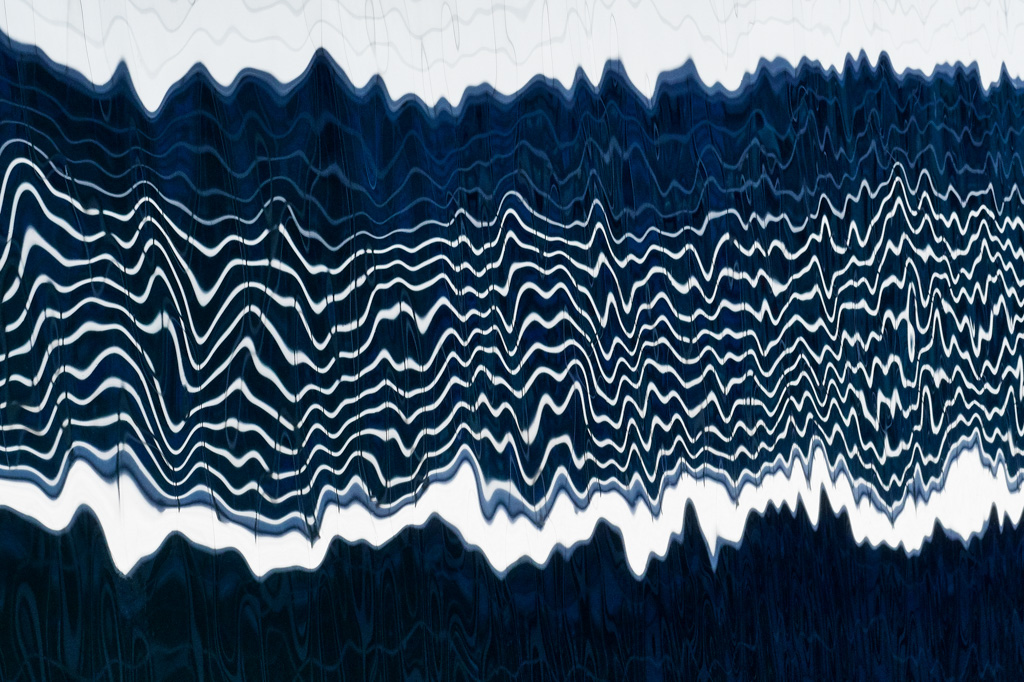 Attending the first On Landscape conference was a bit of a revelation for me creatively - I had made many trips to locations like the Lakes and Scotland that are usually regarded as highly productive for photographers yet came away with nothing that I felt was remarkable. Jem Southam's talk about his concentrated and detailed studies of his local area helped me realise why my previous approach wasn't working for me.
 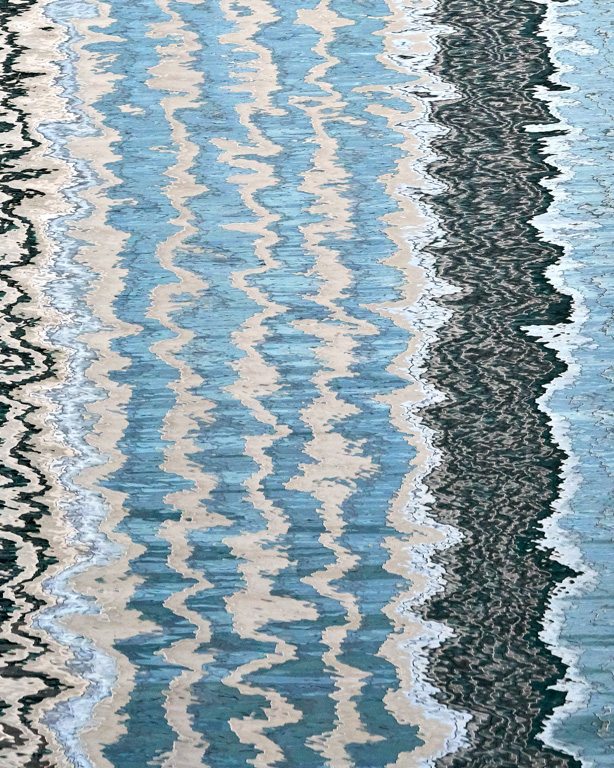 If anyone asks about what my photography influences are, I think of what fascinated me as a child, playing for hours with a kaleidoscope, spirograph and etch-a-sketch and being captivated by the endless variation of colours and shapes you could create. Later on, I connected with artists such as Rothko, Klimt and the photography of David Hockney; those themes still inspire me. I realised the sort of photographs I was producing before the On Landscape conference had no roots in what enthused me. So I decided to be more focused and, on being given a creative commission for the Canary Wharf Group plc, and a 24/7 access all areas pass for their site, some ideas began to germinate.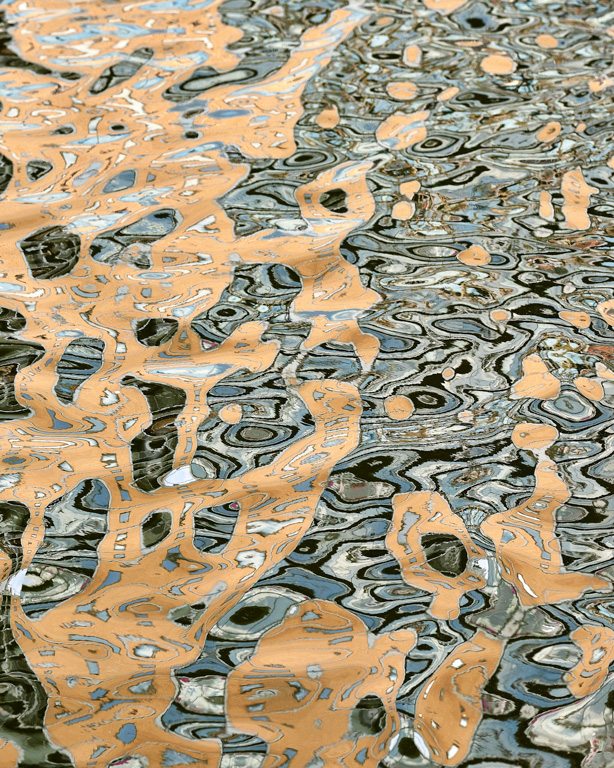
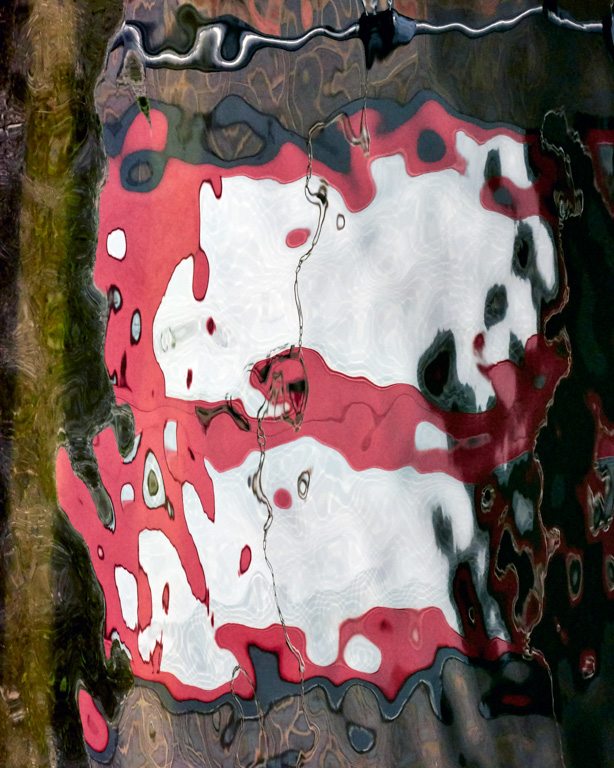
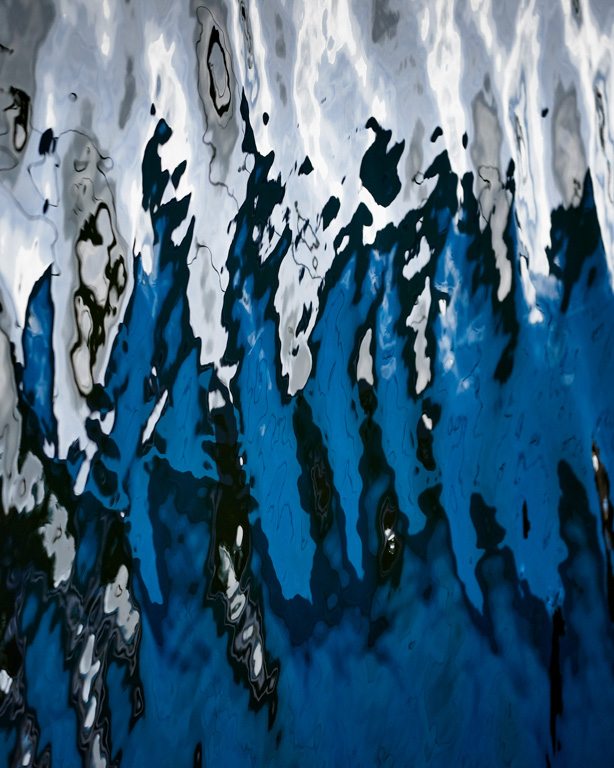
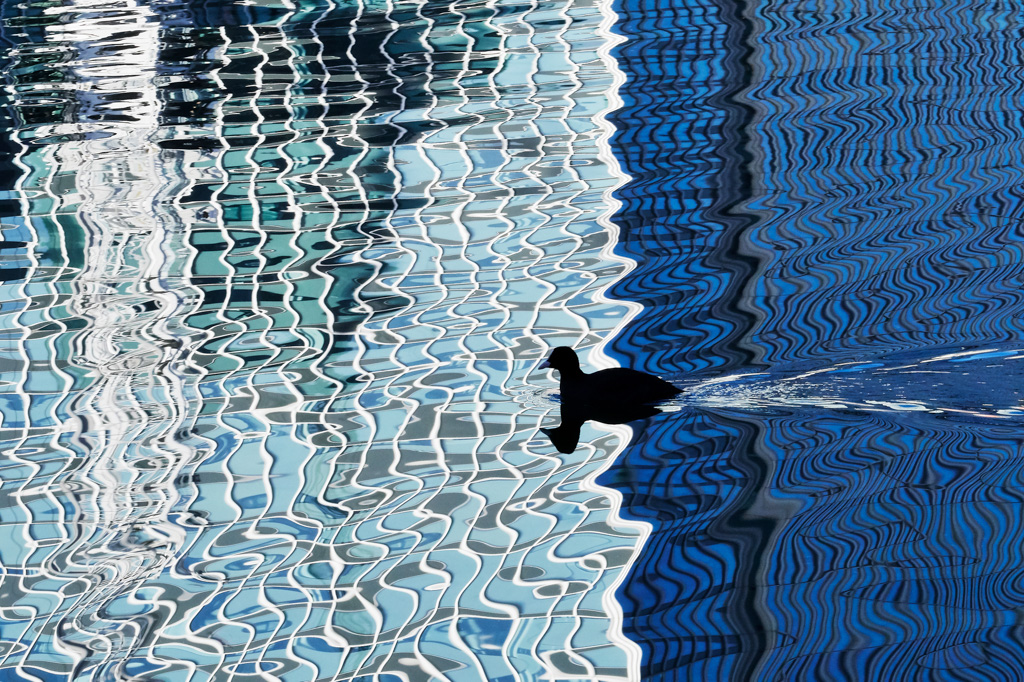
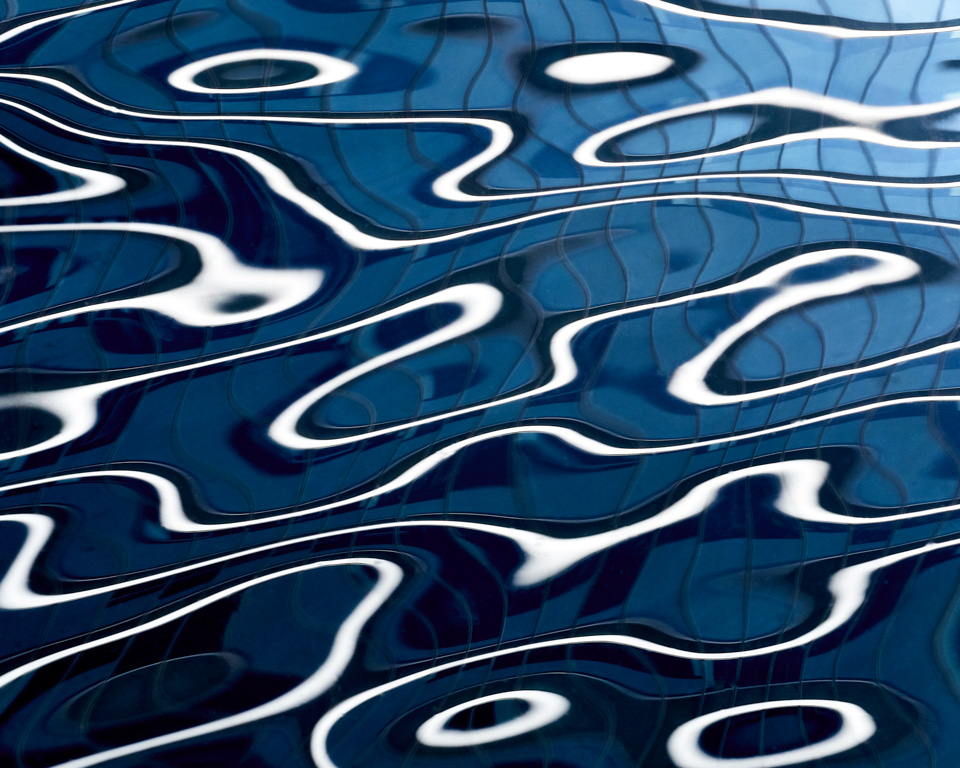
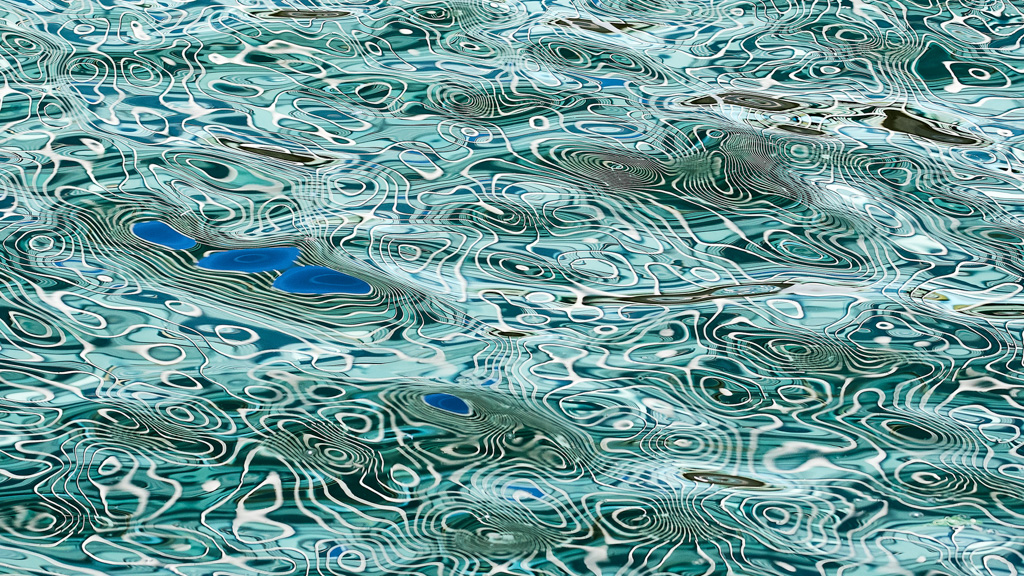
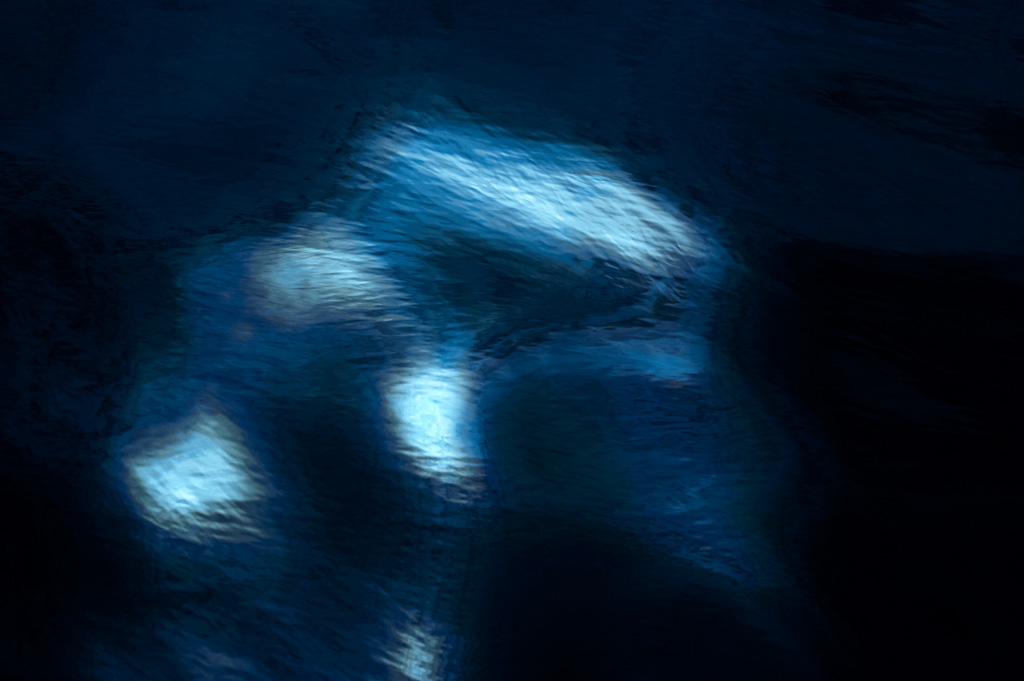
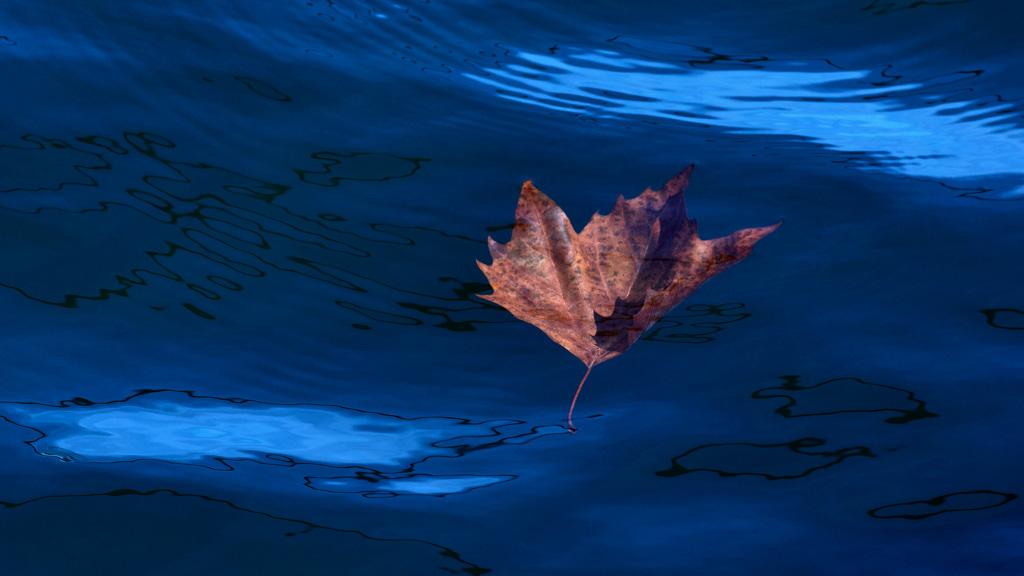
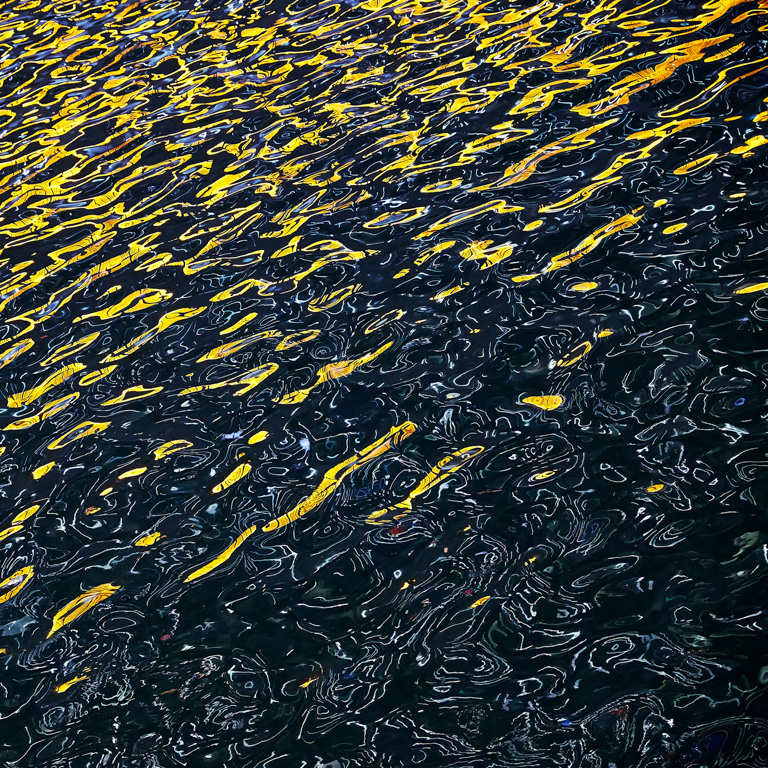
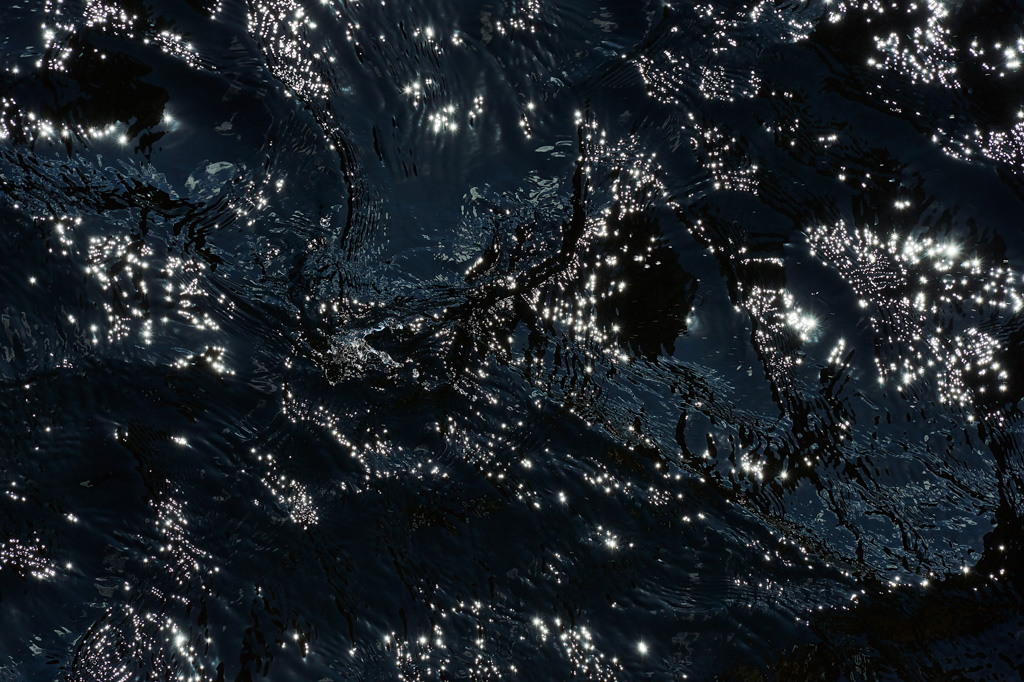
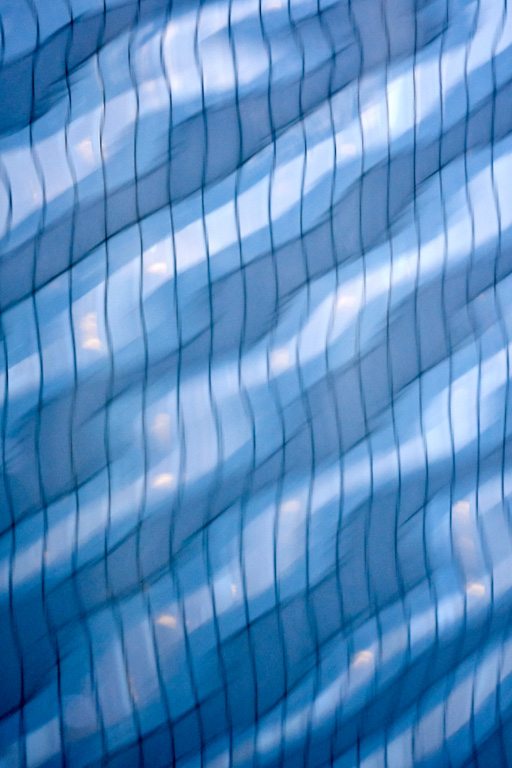

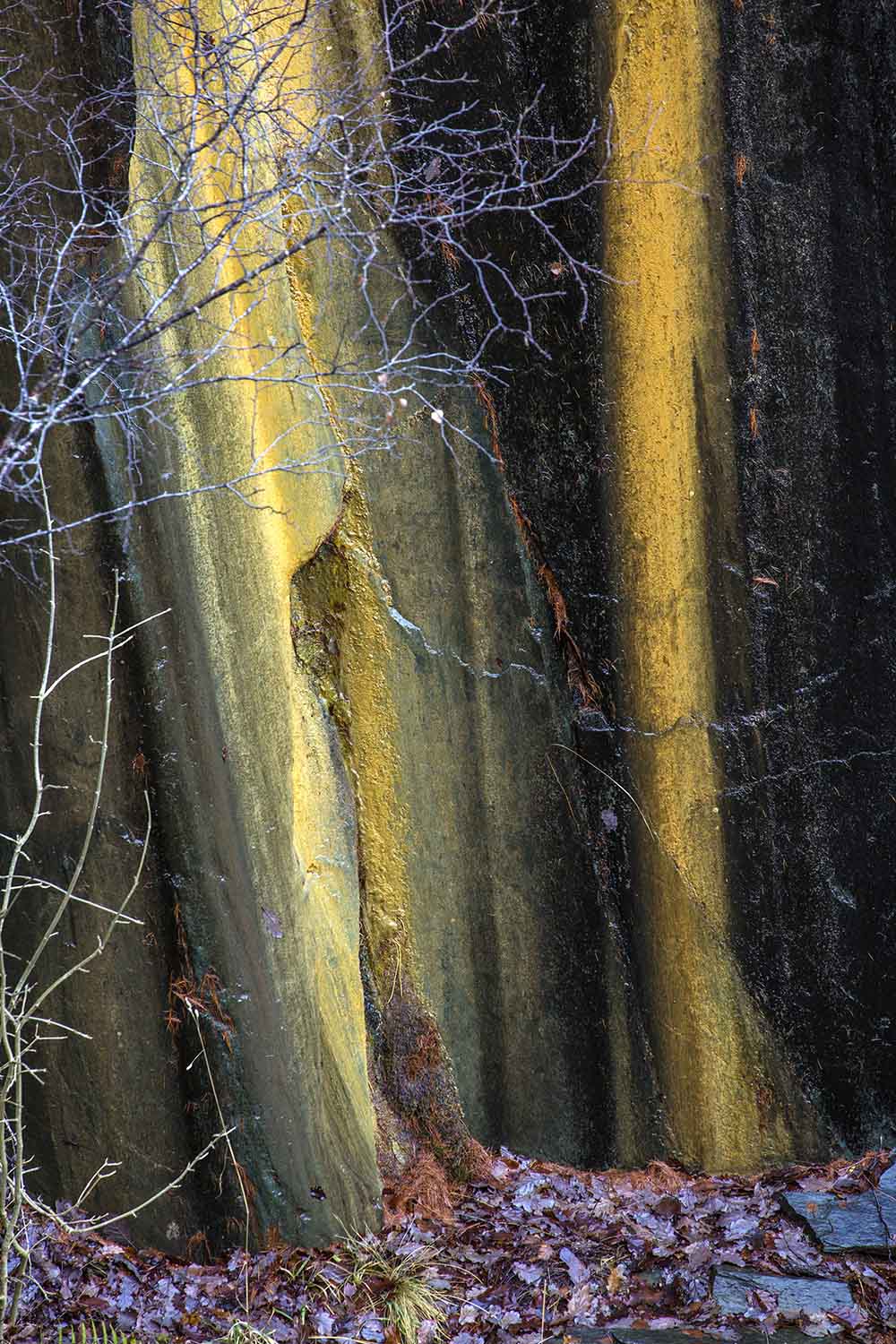
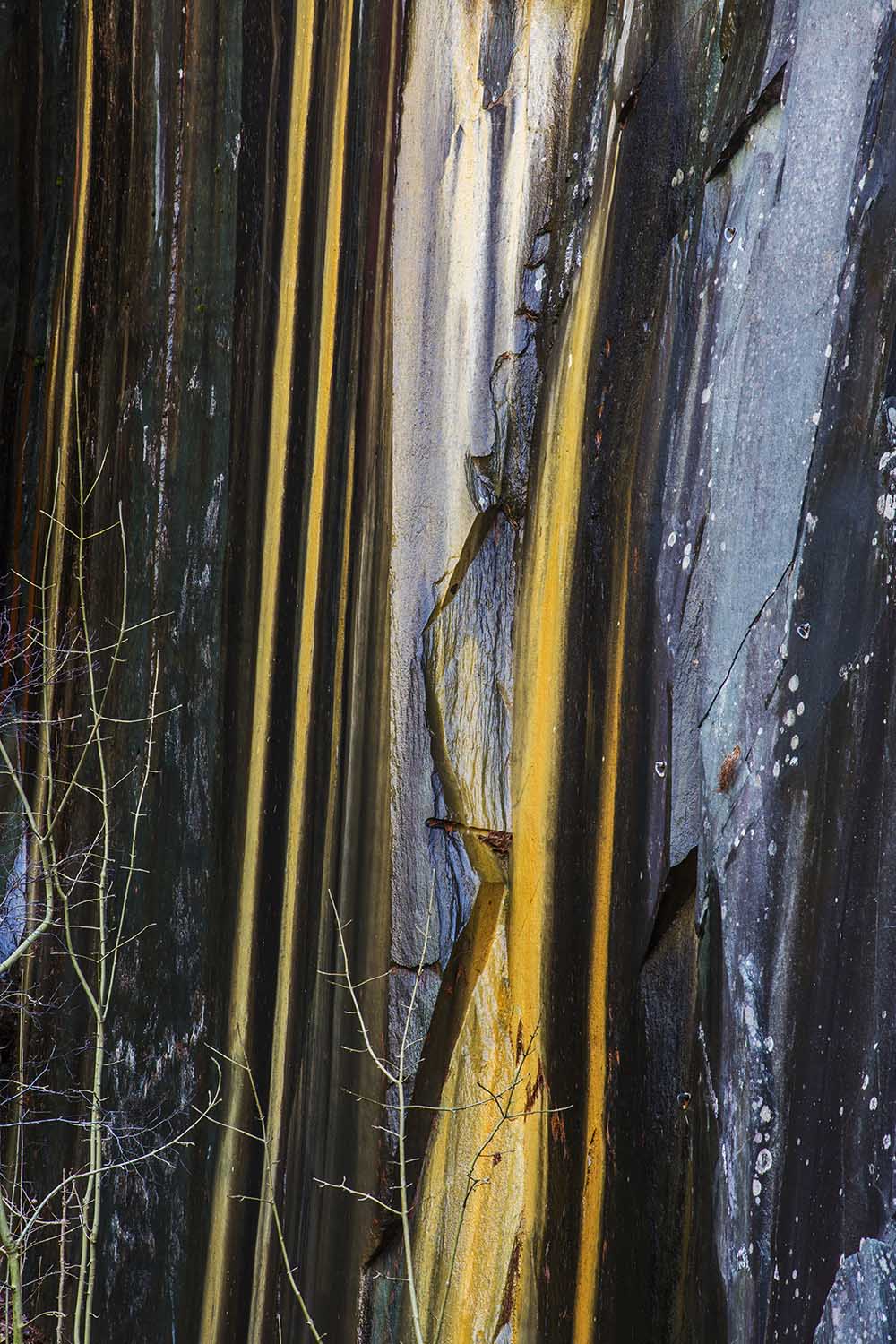
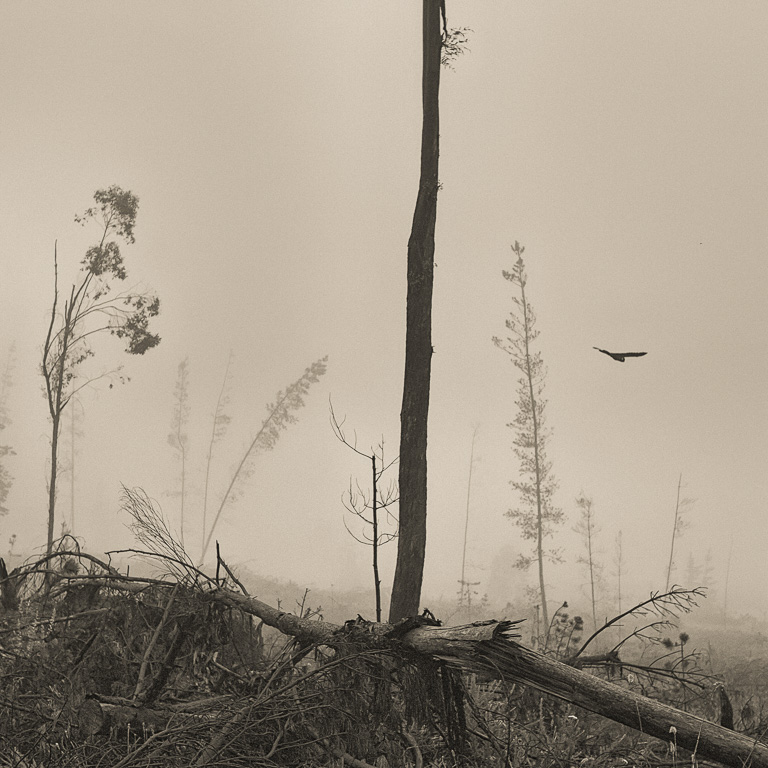
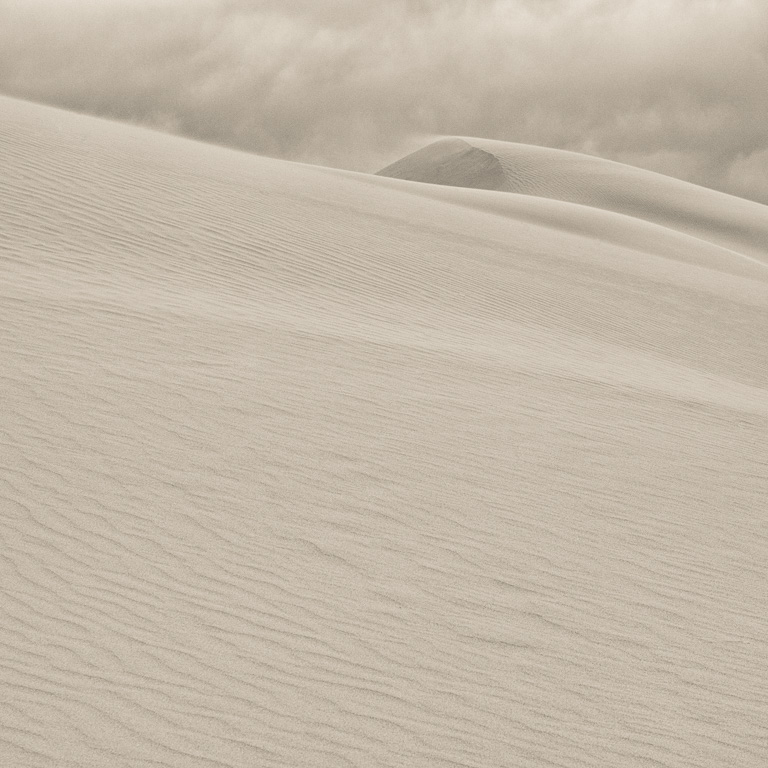
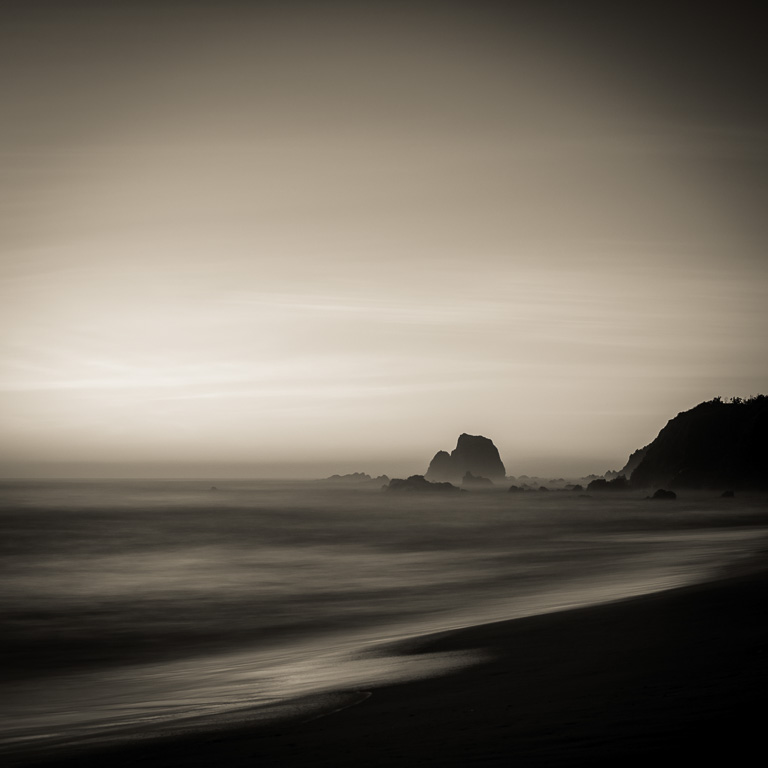
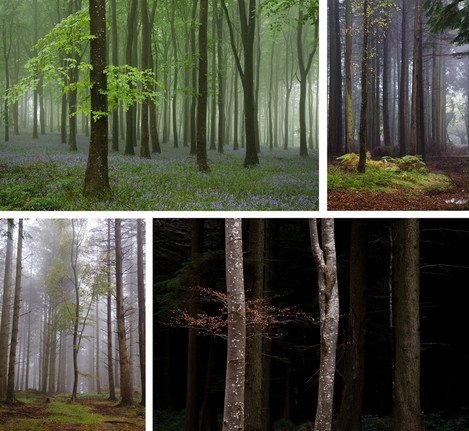
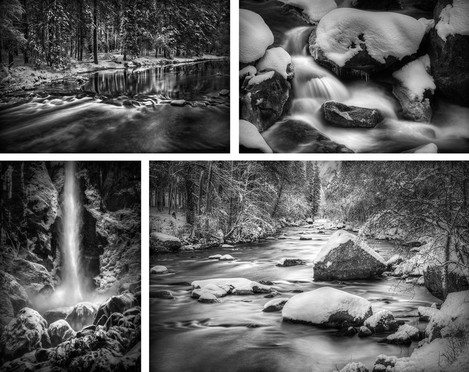
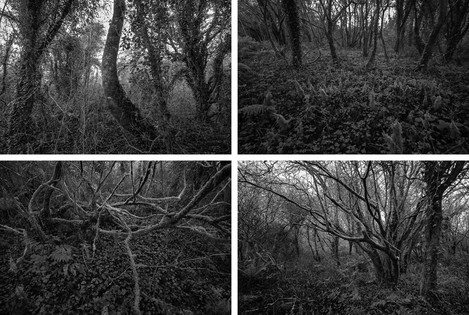
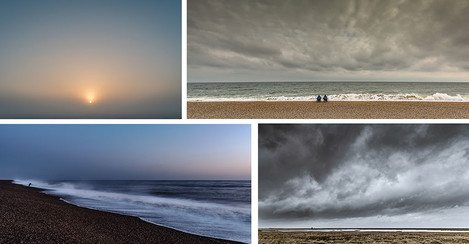
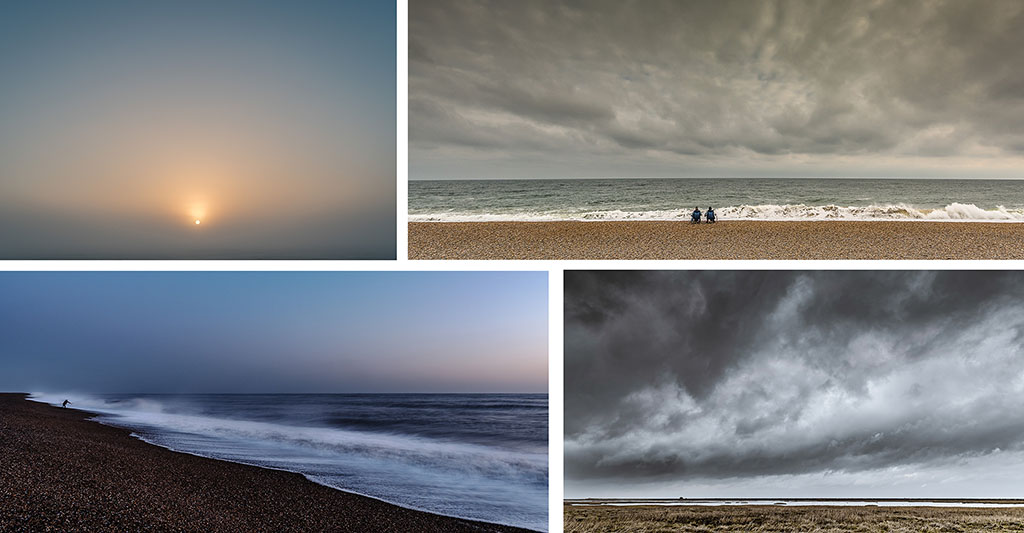
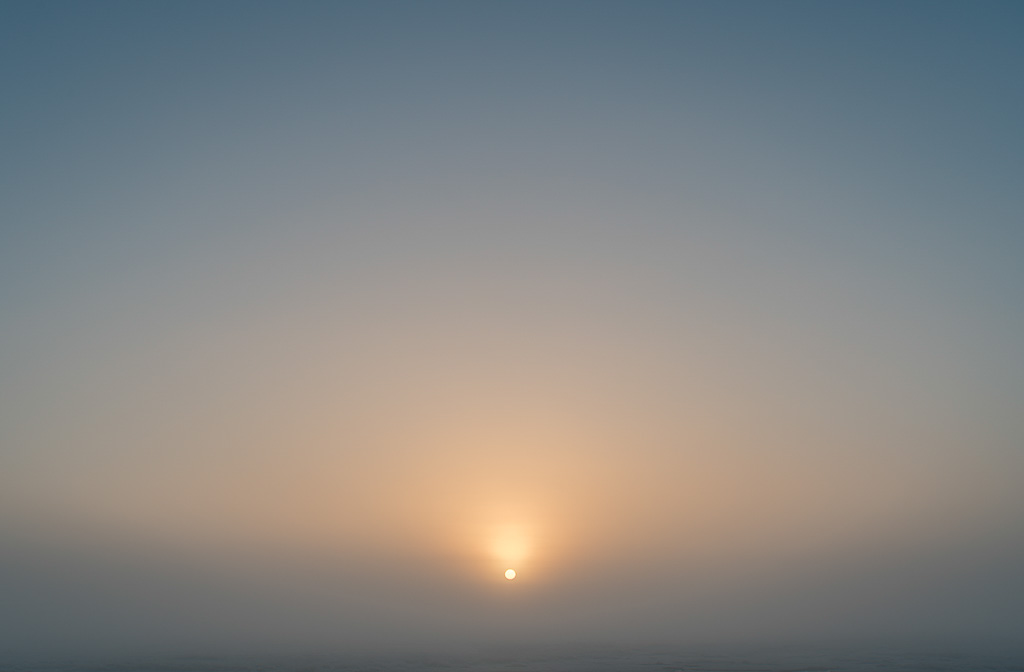
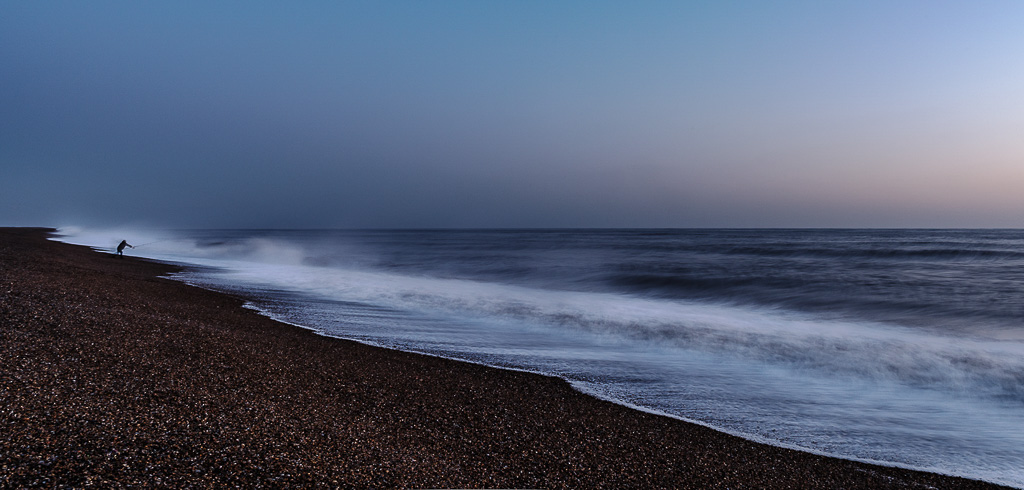
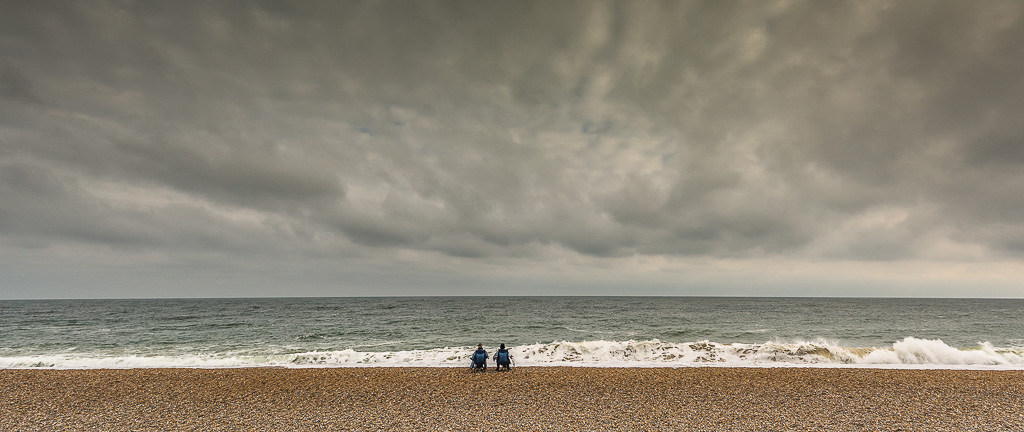
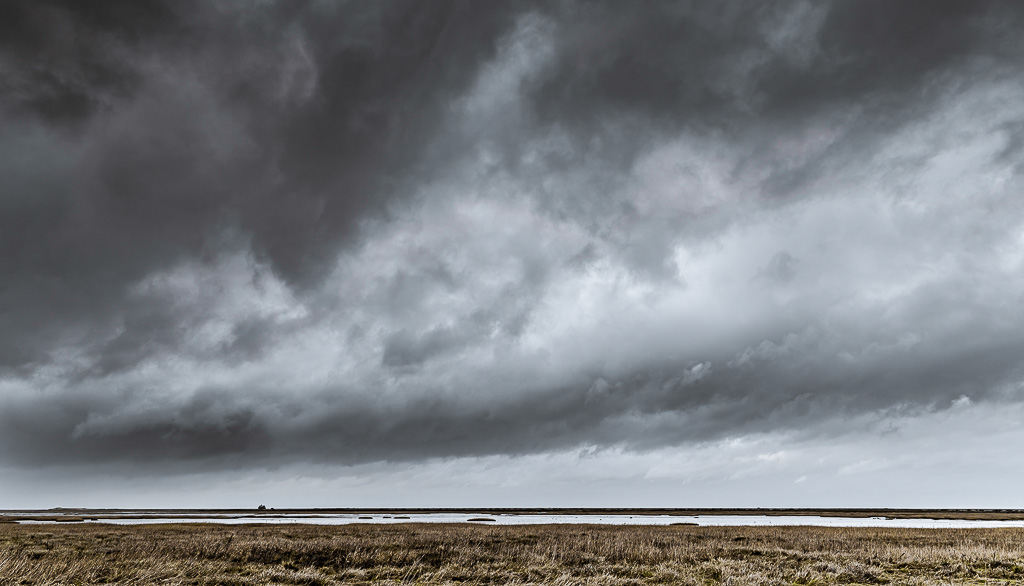
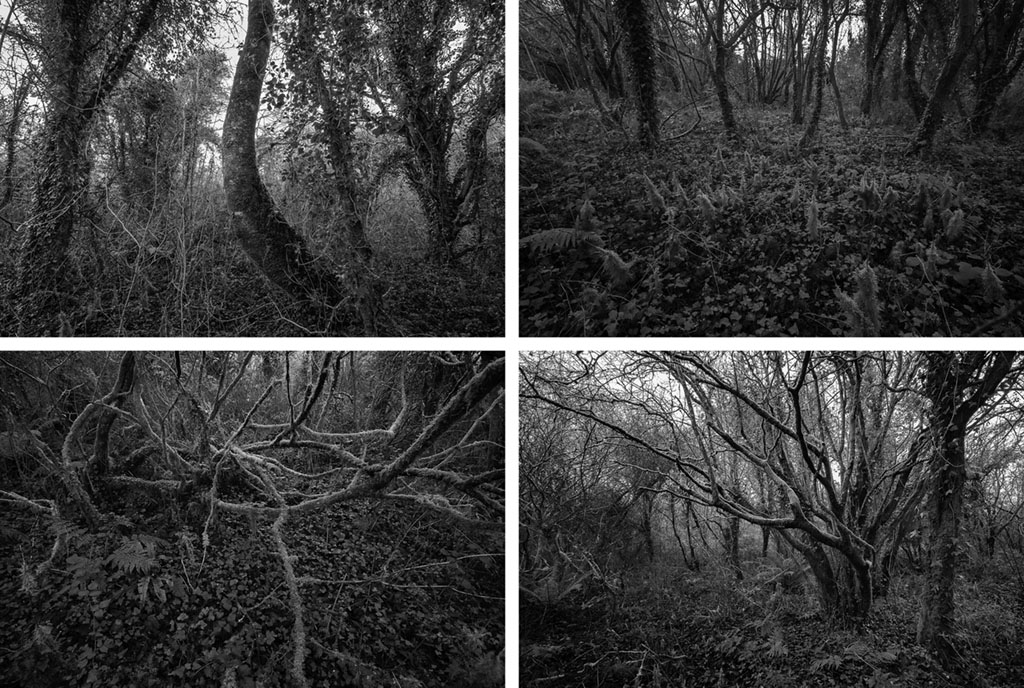
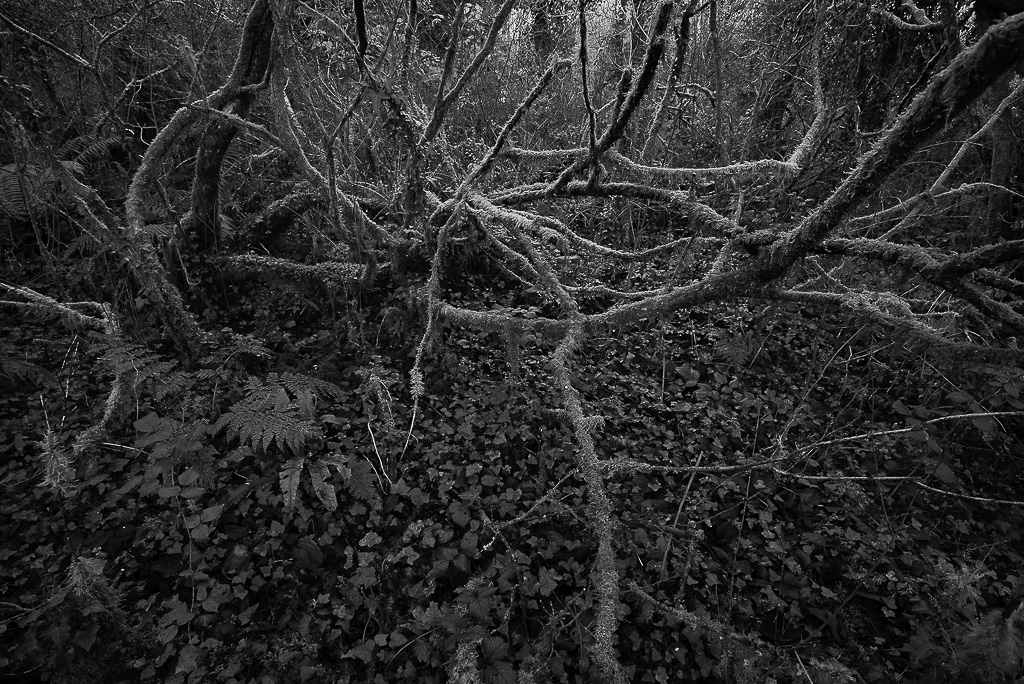
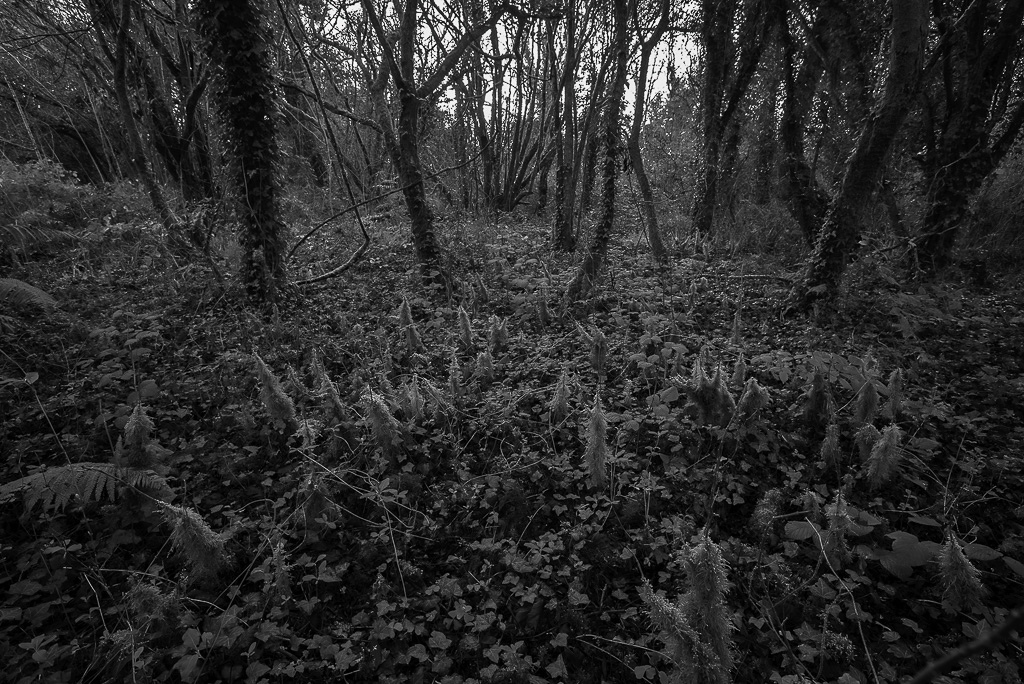
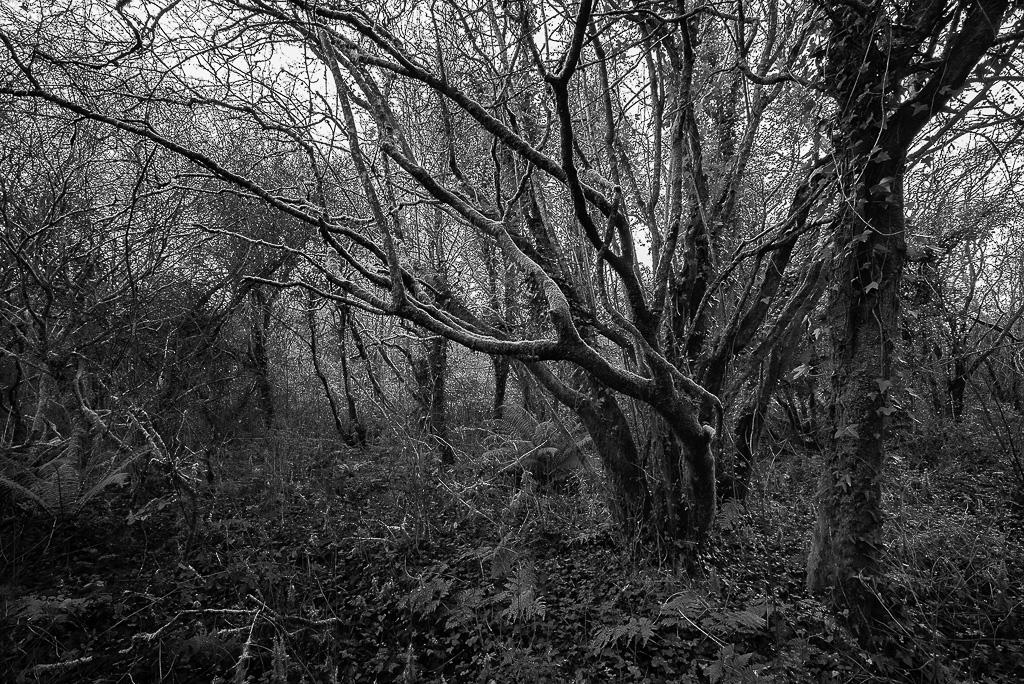
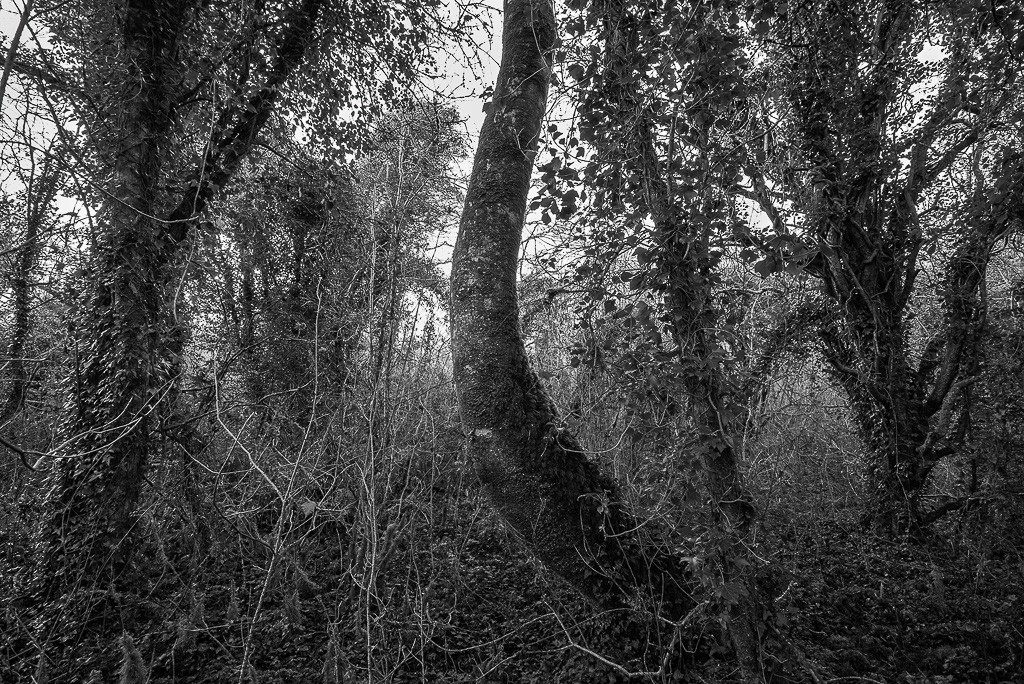
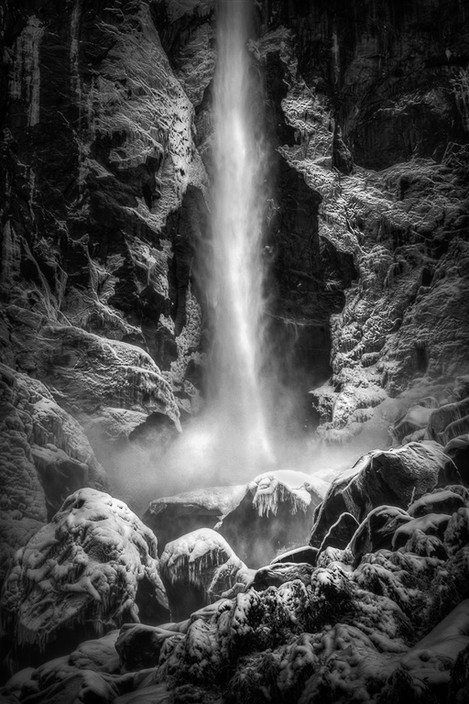
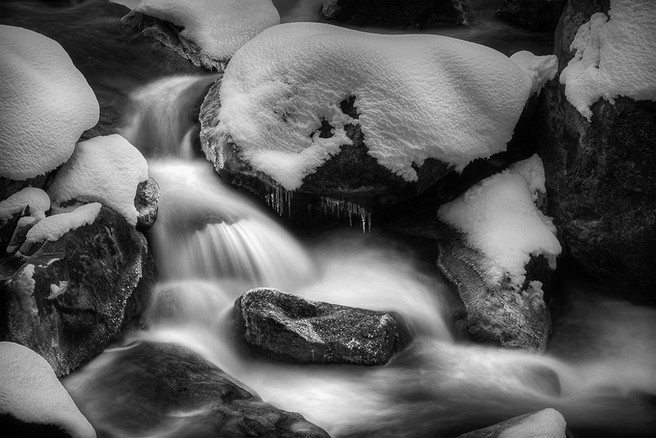
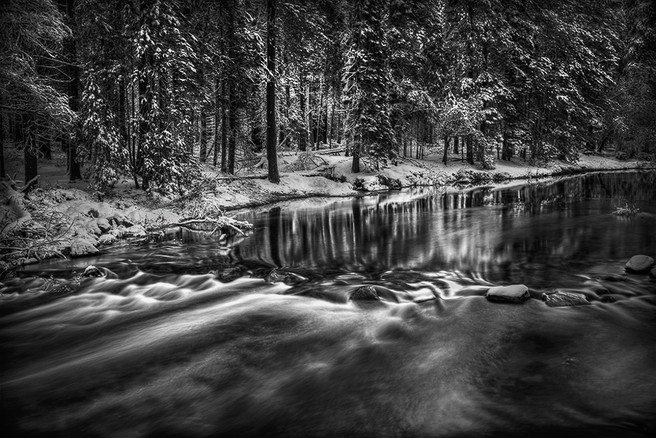
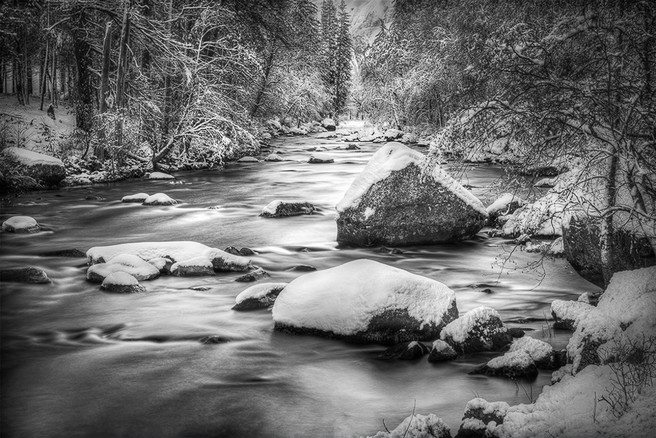
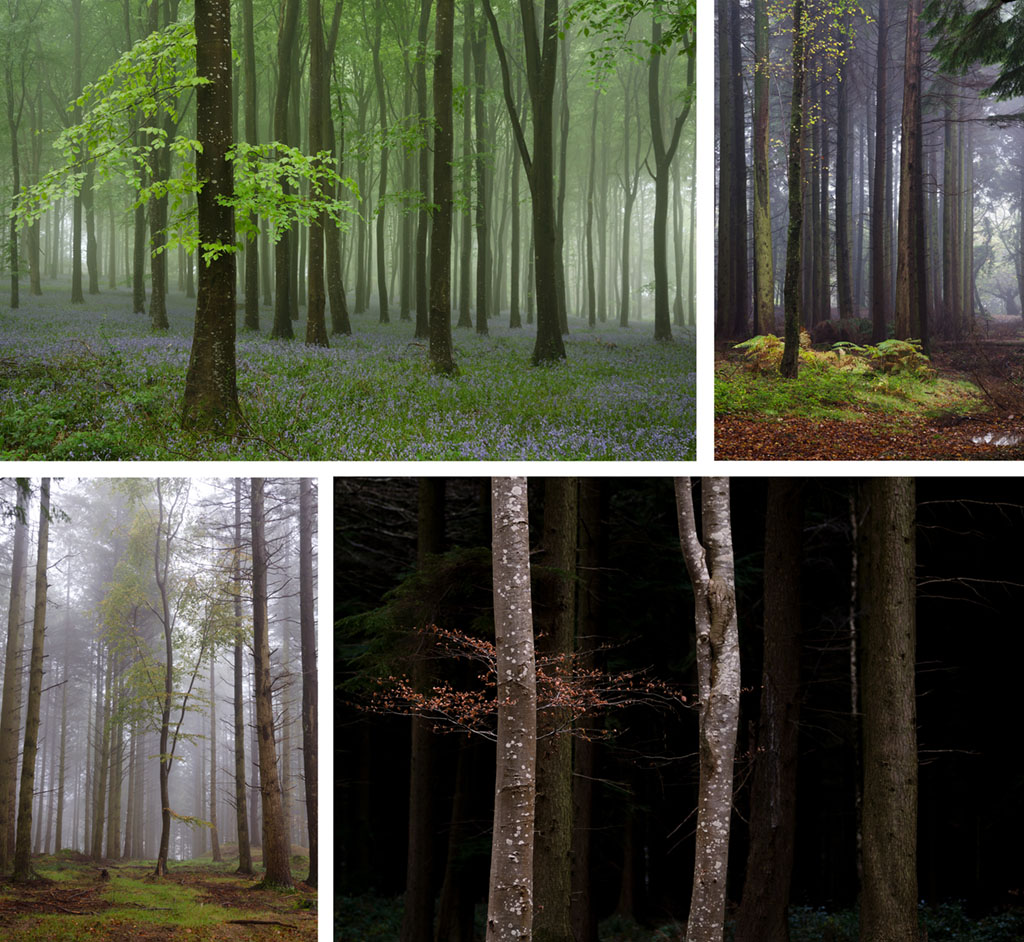
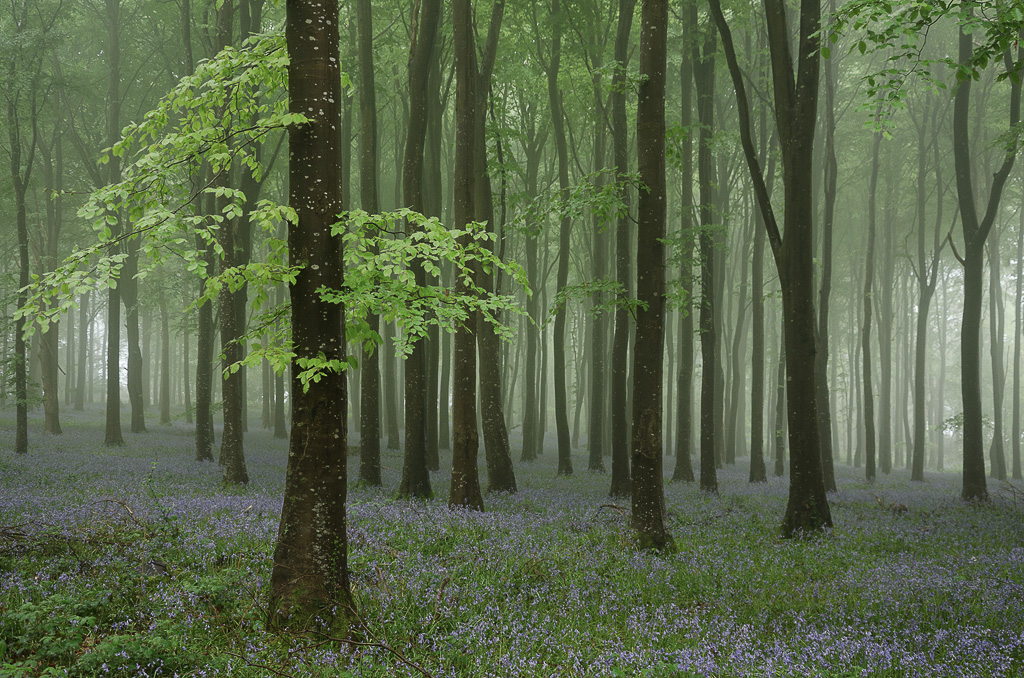
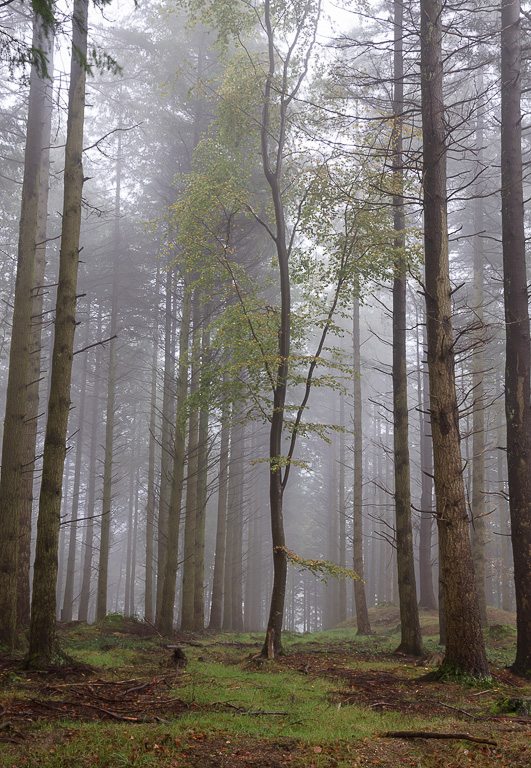
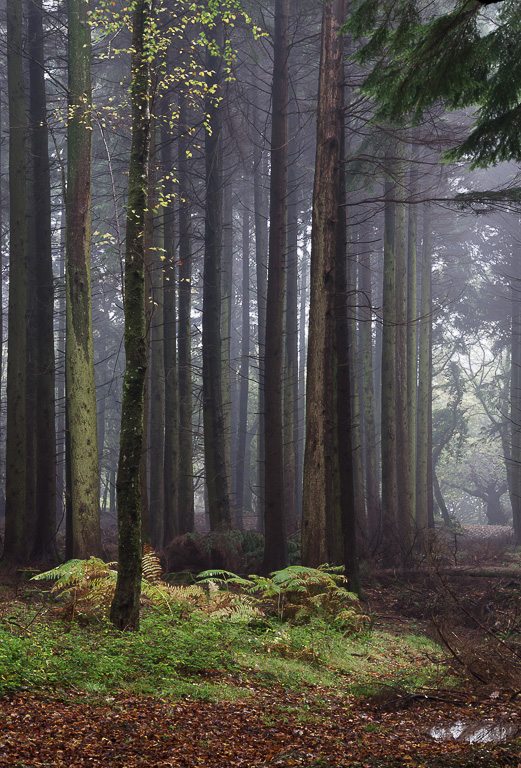
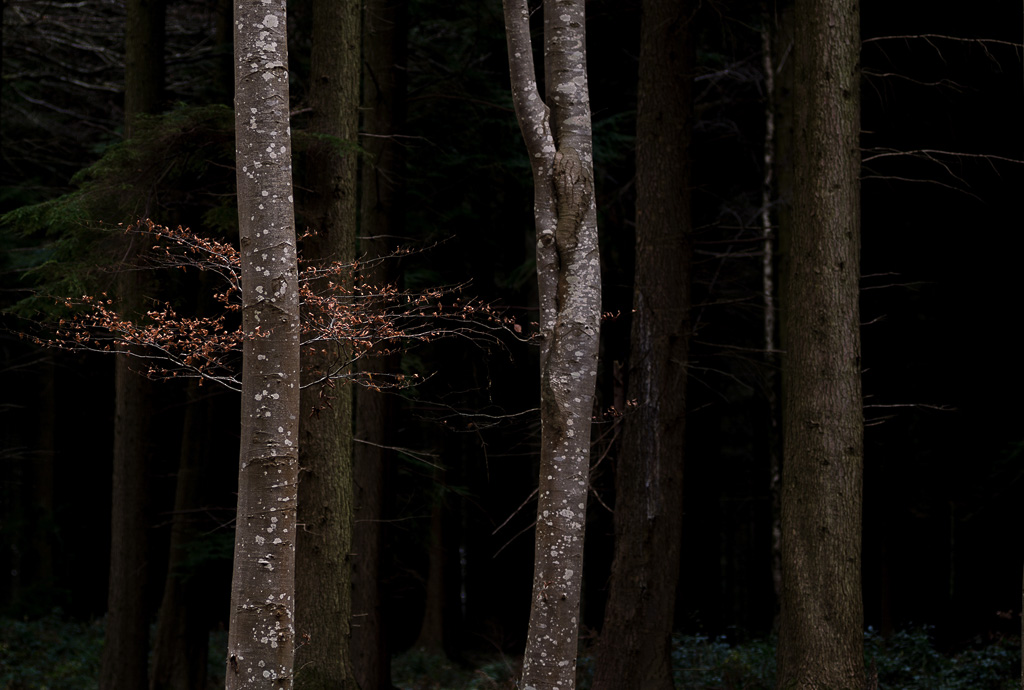
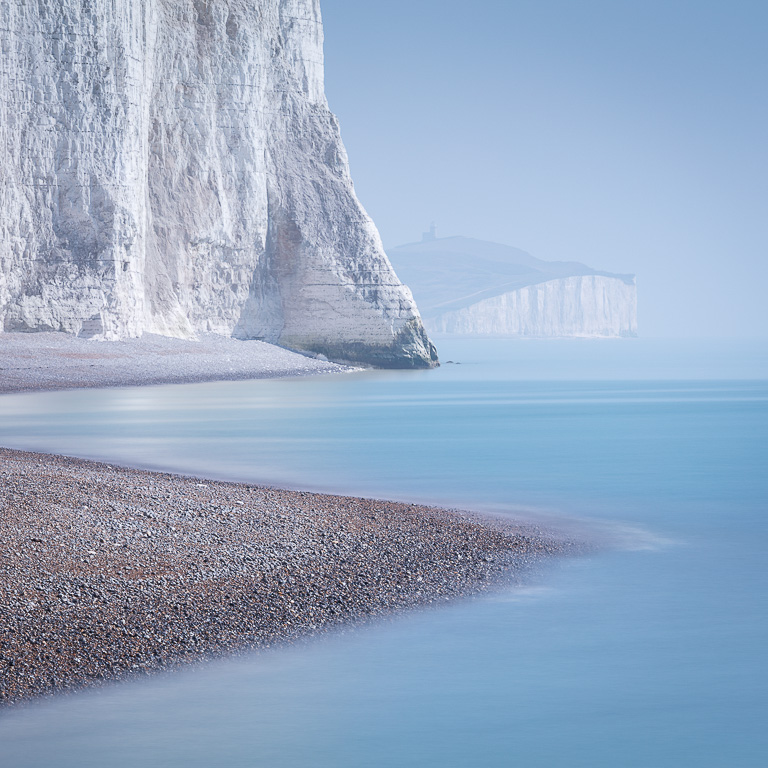
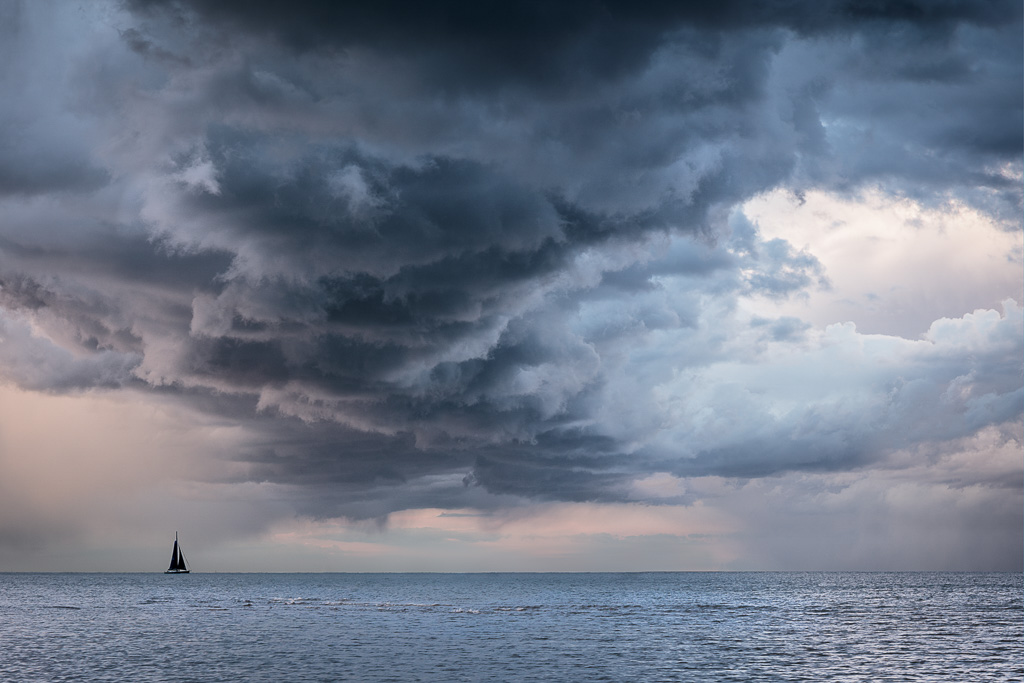
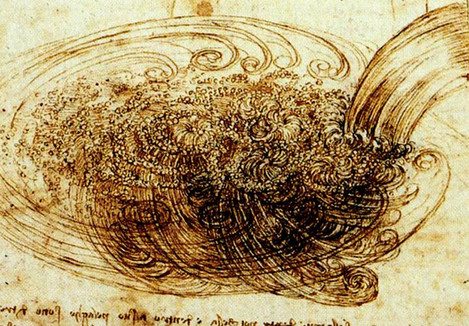
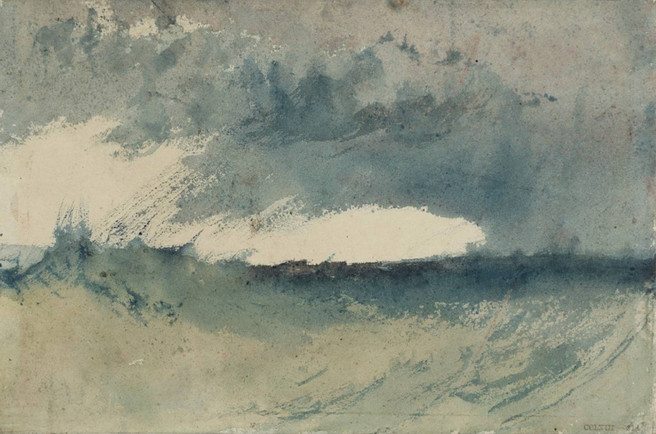
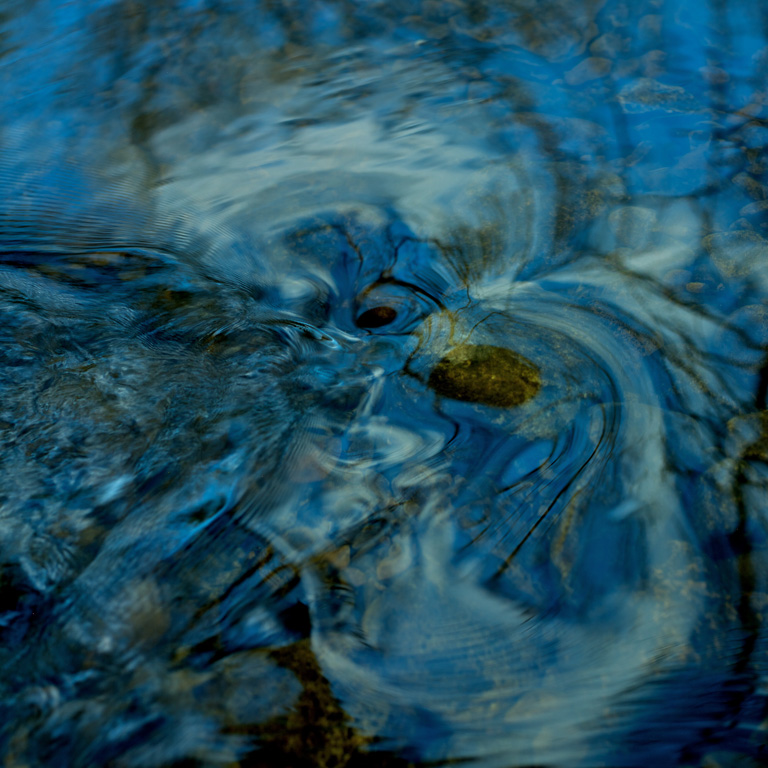
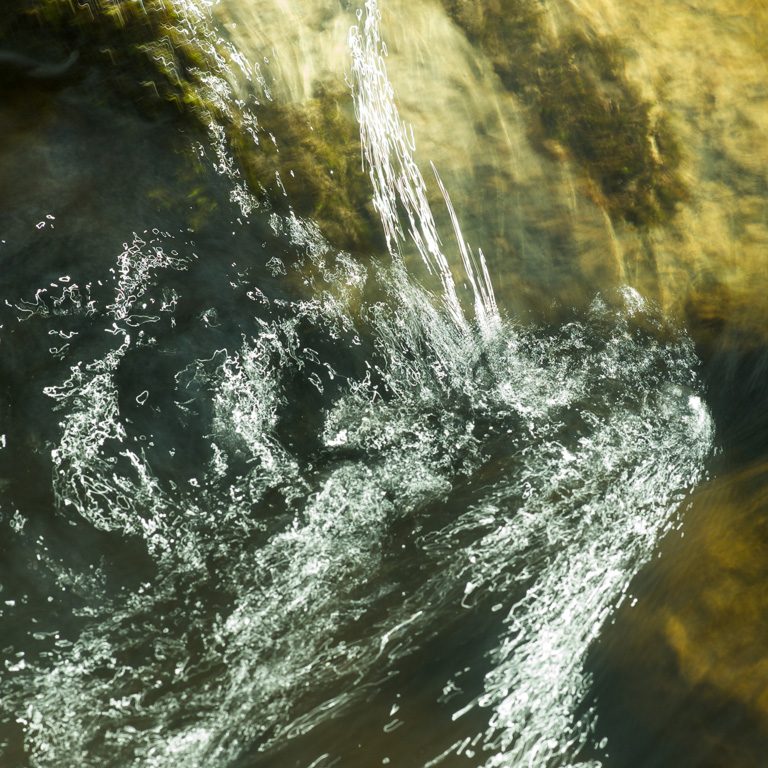
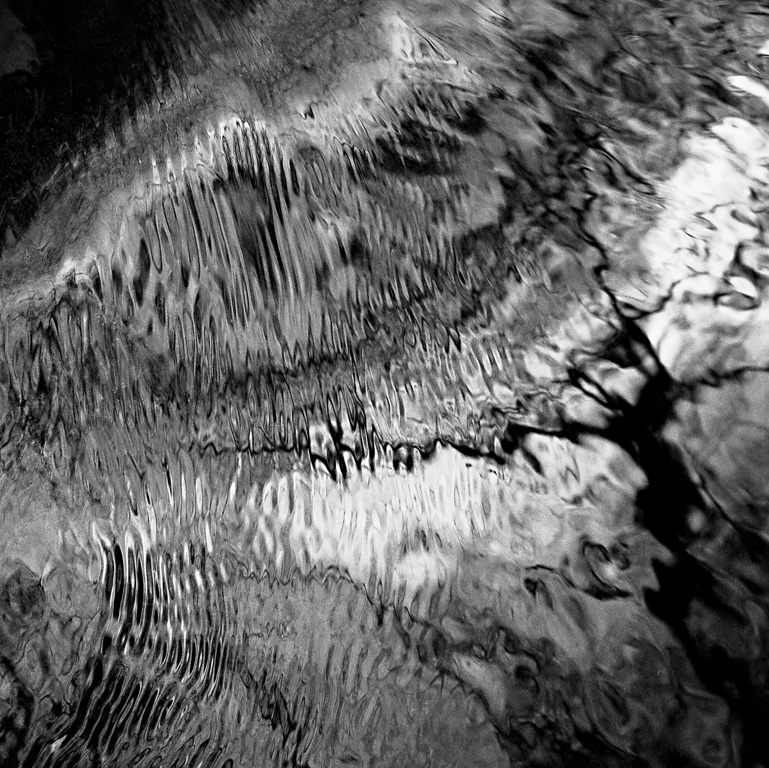
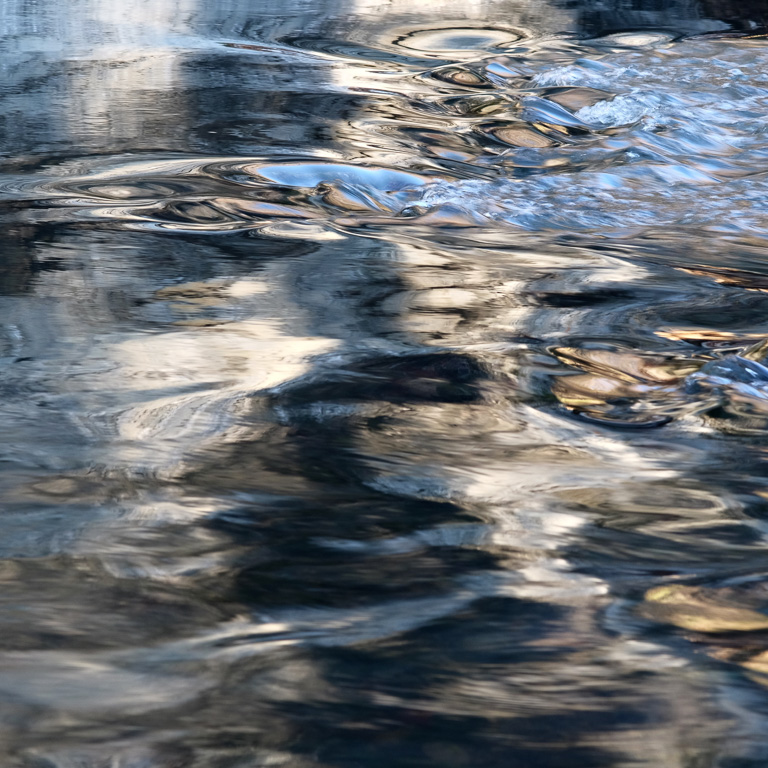
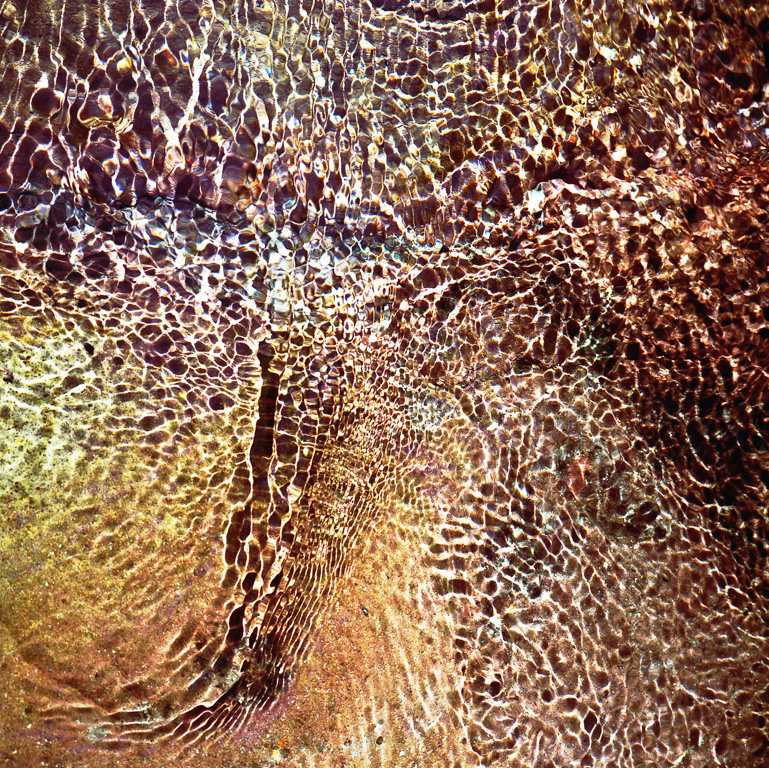
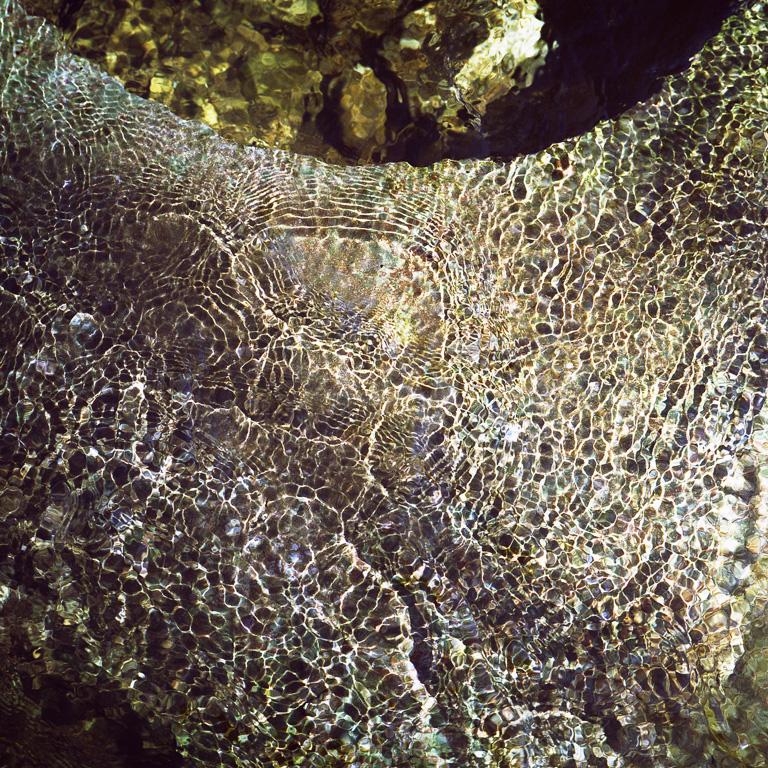
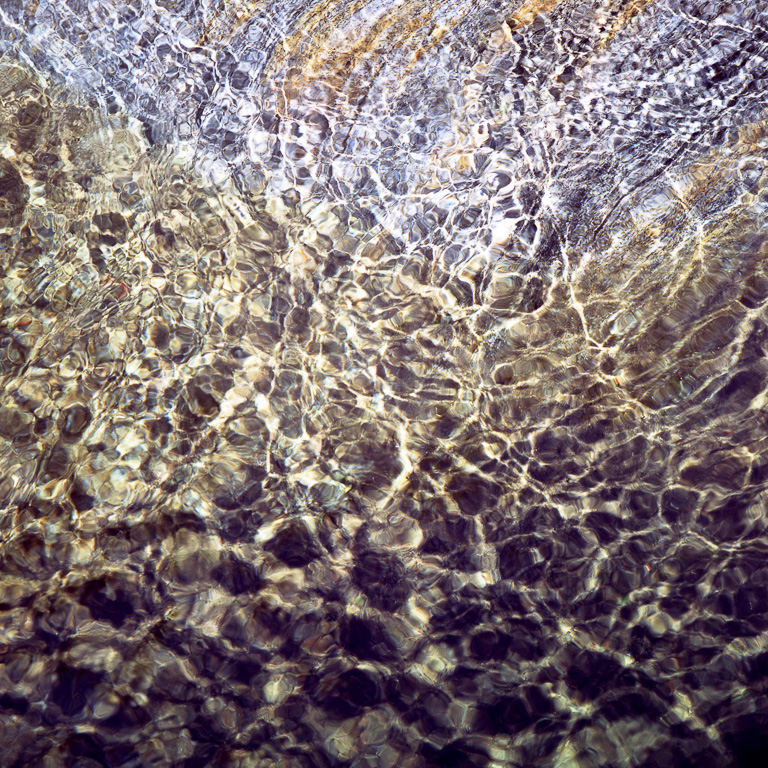
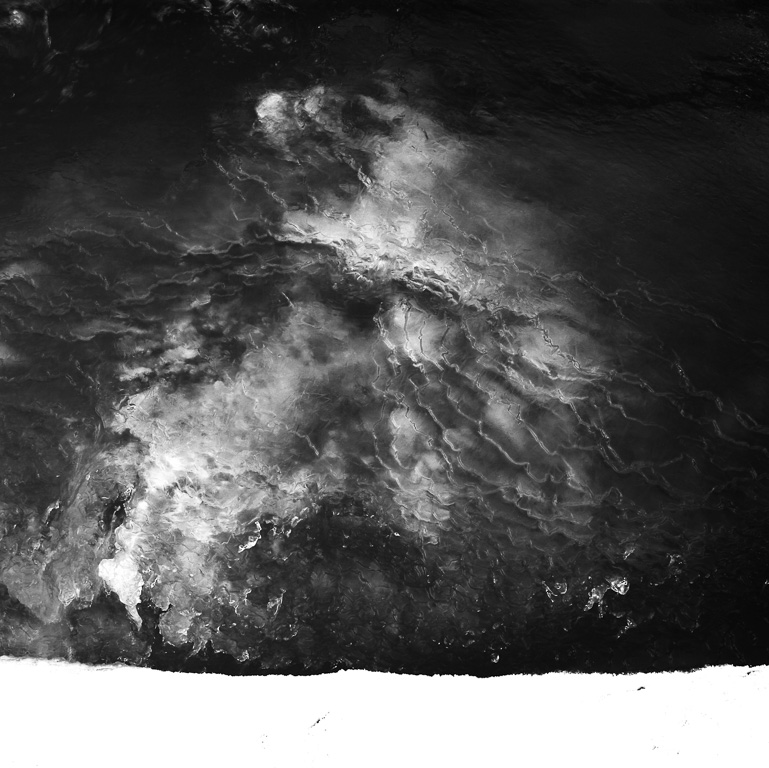
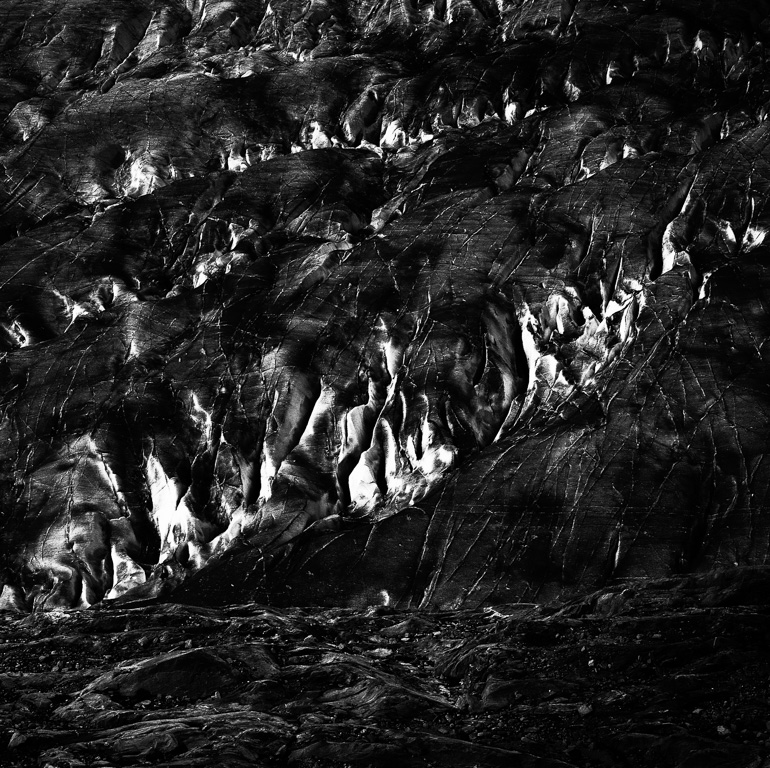
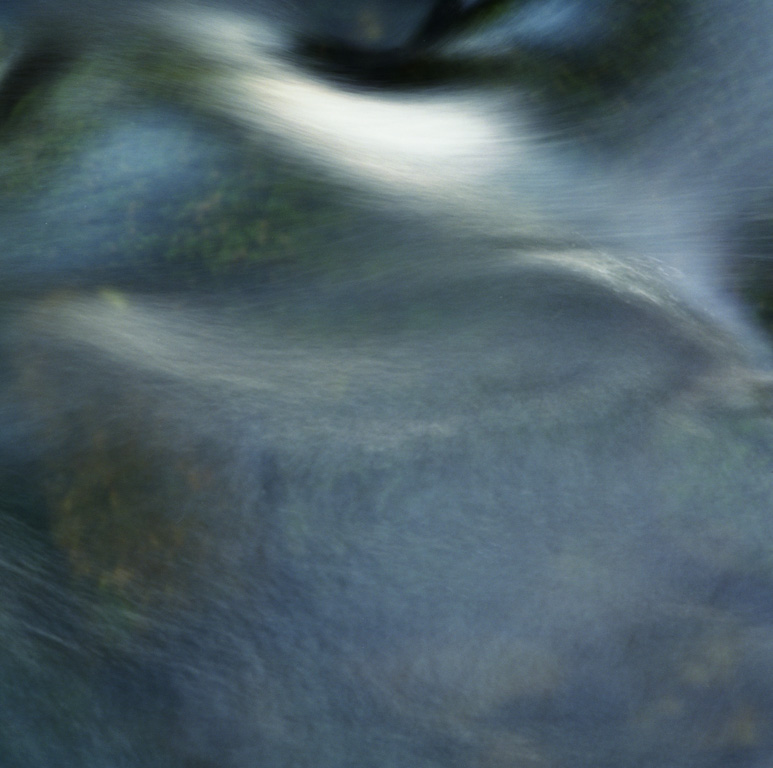
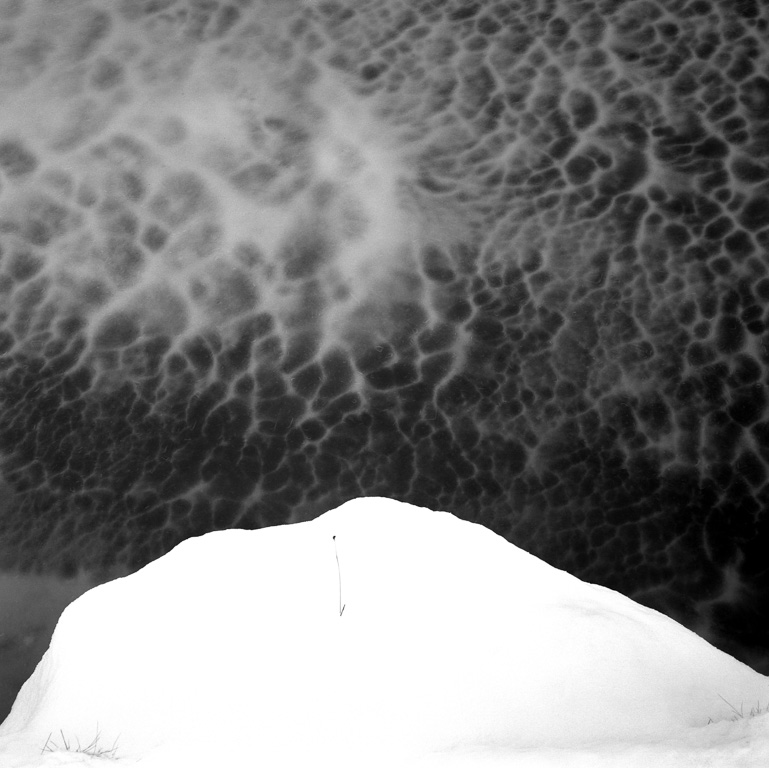
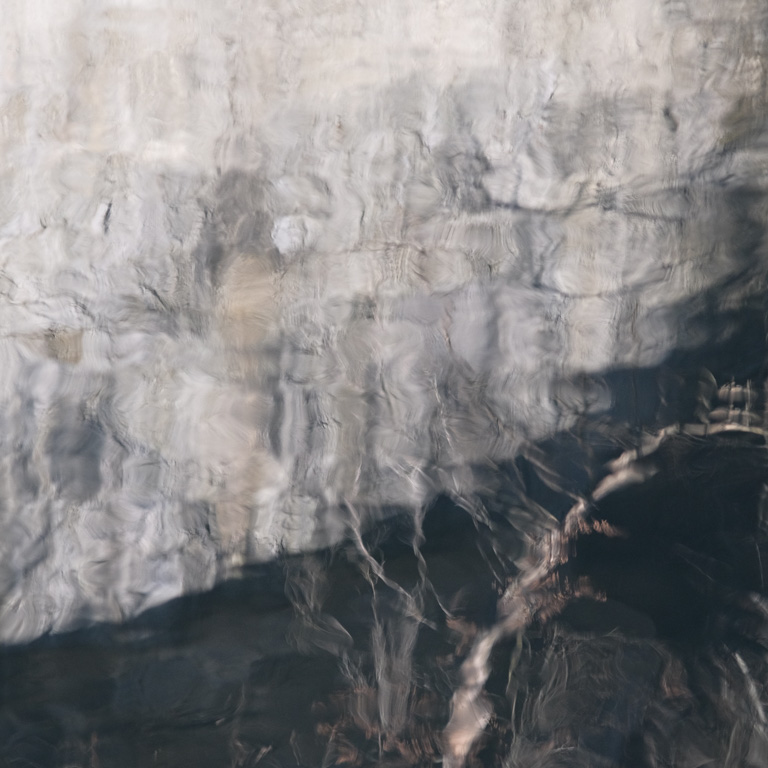
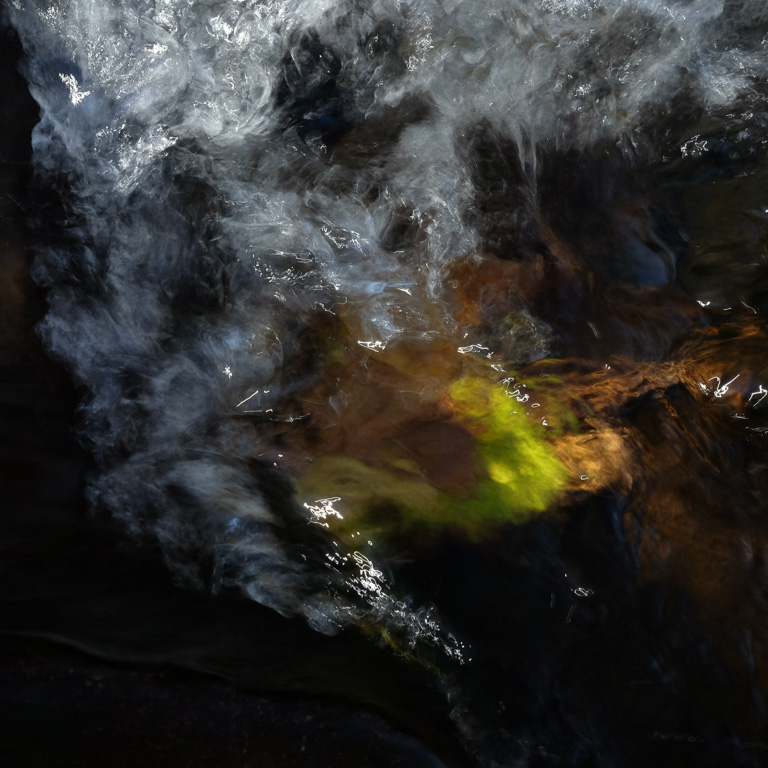
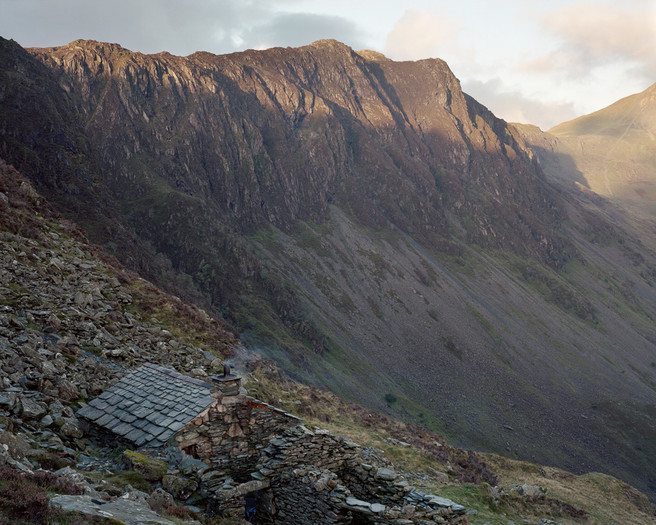
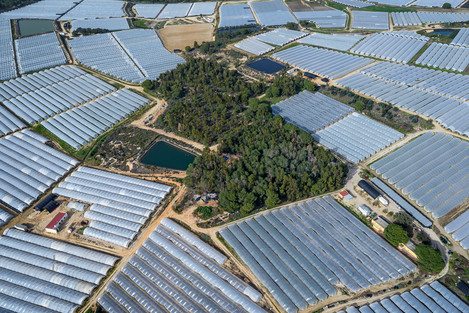
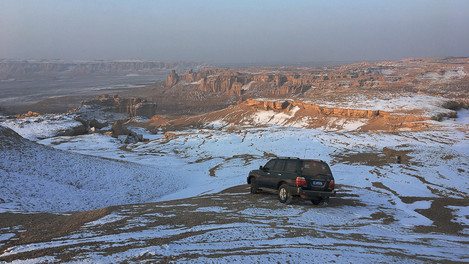
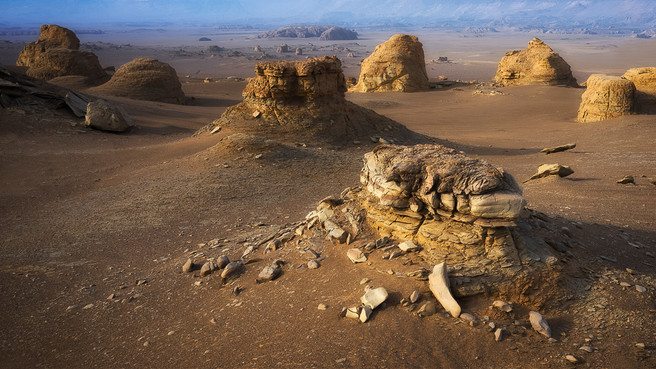 Hui was in his mid 40’s and had spent his entire life in Xinjiang - this was his landscape, and his enthusiasm for it shone from his weathered face. He energetically told Juanli that it was the finest landscape in the world, a fierce pride in his voice. I find that degree of passion infectious and my sense of anticipation grew with each passing moment.